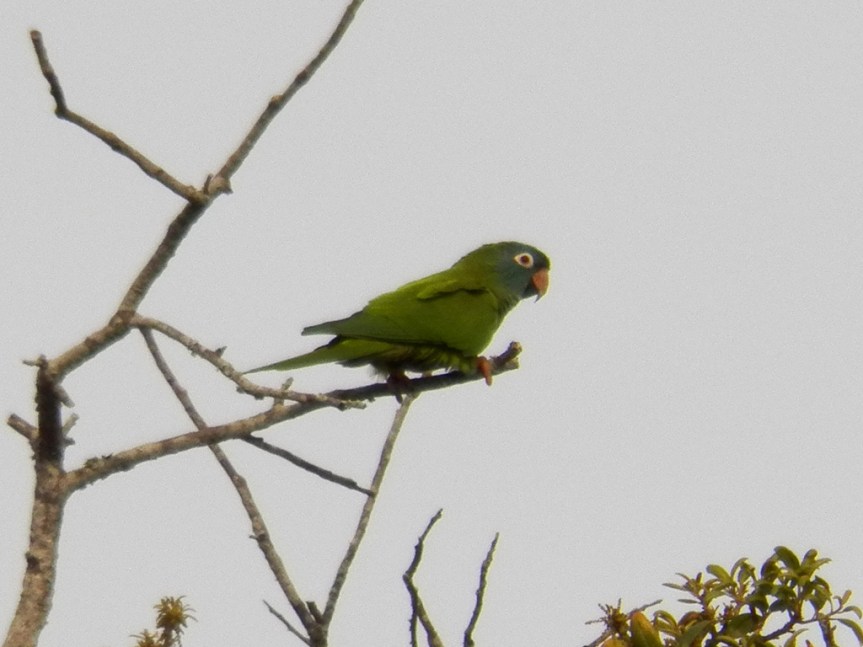
Blue-crowned Conures

My wife and I had two unexpected parrot encounters today. The first was a small flock of parrots that flew past the car while we were waiting in traffic. I didn’t get a good enough look at them for identification.

When we got to our destination, two parrots flew into a tree nearby (where I took this photograph). It took a bit of web and field guide research to determine these are Blue-crowned Conures (the small flock was likely the same species). I saw them last year near the Post Office (along US 1). The small flock was seen not far from the Post Office, and this photograph was taken just a mile or so north of there. I’ve heard there is a nesting colony beachside of the causeway, but I don’t know if these are the same birds or not.

Over My Head I Hear Music

Yesterday’s birding time was shortened again due to my knee issue, and I returned to the Turkey Creek Sanctuary. It was not a very active morning, though I did manage three FOY birds.

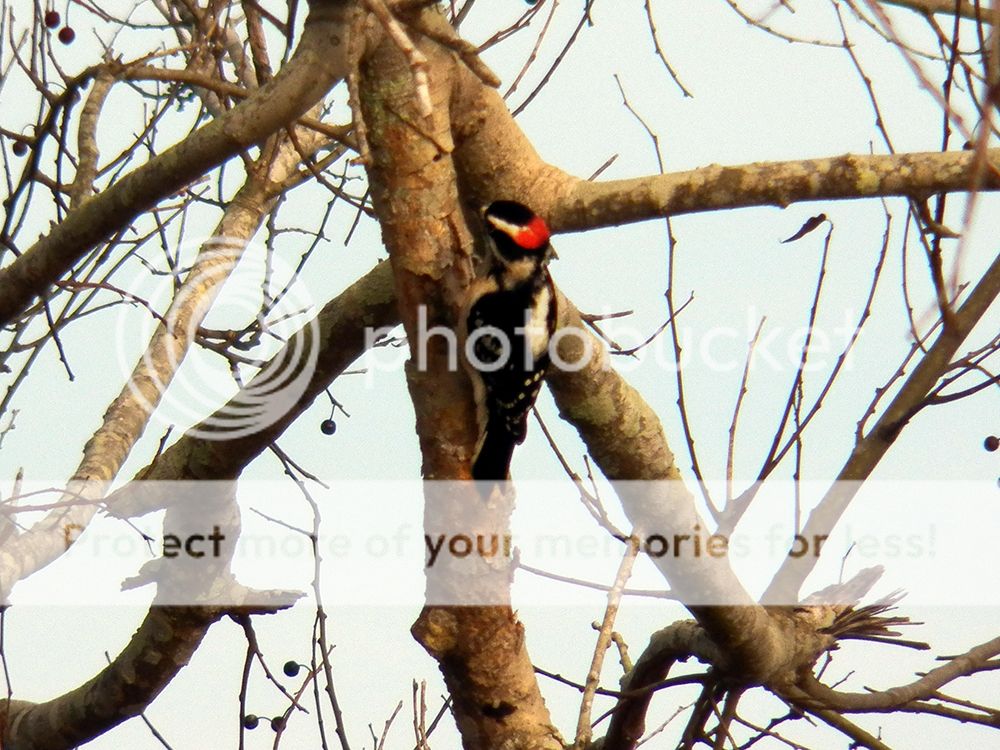
I started out on the north side of the creek (on the mountain bike trails) and did one of the loop trails. I could hear several species of warbler, but was frustrated in my attempts to identify anything by my lack of warbler song knowledge and the birds hiding too well in the foliage overhead. I recognized Northern Parulas and Yellow Warblers, but the other 2 or 3 songs I have not yet figured out. Just before returning to the car, I followed some woodpecker drumming to a Hairy Woodpecker (FOY) hammering on a dead tree.

I drove to the main part of the sanctuary and walked the boardwalk loop. Again, I heard a couple of warbler songs high in the canopy, but was unable to see anything long enough for an identification. I suspected one song was a Black-throated Blue Warbler (FOY), and it took a good deal of stalking to catch a solitary male.

I heard more Blue-gray Gnatcatchers than I had for a couple of weeks, and there was one Gray Catbird that crossed my path. The Northern Cardinals are growing more vocal every time I come out, but they have not yet reached the distracting cacophony they will later in the spring.

High above, I also heard what was probably a vireo of some species, but it flew away too quickly for me to definitively identify.

The only other bird species of note that I’ll mention here was a White-winged Dove (FOY) that flew over the car as I drove home.

Here’s the species list for the day (including drive to and from the sanctuary):

  • Northern Mockingbird
  • Common Grackle
  • White Ibis
  • Cattle Egret
  • Mourning Dove
  • Eurasian Collared Dove
  • Common Ground Dove ♫
  • Blue-gray Gnatcatcher
  • Northern Cardinal
  • Blue Jay
  • Fish Crow
  • Black Vulture
  • Turkey Vulture
  • Gray Catbird
  • Northern Parula ♫
  • Black-throated Blue Warbler (FOY)
  • Hairy Woodpecker (FOY)
  • Red-bellied Woodpecker
  • White-winged Dove (FOY)
  • Carolina Wren ♫
  • Osprey
  • Sandhill Crane
  • European Starling

Some pseudo-random sampling of photographs taken during the Space Coast Birding & Wildlife Festival this year. 

  • Painted Bunting at Merritt Island National Wildlife Sanctuary Visitor’s Center
  • Black-bellied Whistling Ducks at Blue Heron Wetlands, Titusville
  • Palm Warbler at Marl Bed Flats, Lake Jesup
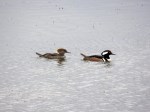
  • Hooded Mergansers at Ritch Grissom Memorial Wetlands at Viera
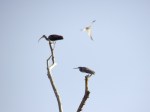
  • Immature White Ibis and Tri-colored Heron, photobombed by a Killdeer at Charles H. Bronson State Forest.
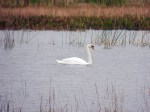
  • Mute Swan, Ritch Grissom Memorial Wetlands at Viera.

One week to go!

In just one week I’ll be attending various sessions and field trips at the Space Coast Birding & Wildlife Festival.

If anyone reading this is attending (or planning, though a lot of slots might be taken by now), here’s where I’ll be.

My schedule of events, beginning on next Thursday:

Thursday, January 23rd:

08:00 am – 11:30 am:  Birding with Laura Erickson
03:00 pm – 04:00 pm:  Annual Journey of the Swallow-tailed Kite*
06:30 pm – 08:30 pm:  Evening Owl Prowl at Sam’s House

Friday, January 24th:

06:45 am – 11:30 am:  Turkey Creek Tract – C. H. Bronson State Forest
                                    (This is not Turkey Creek Sanctuary)
04:00 pm – 07:00 pm:  Black Rails at the St. Johns NWR

Saturday, January 25th:

05:15 am – 11:00 am:  Red-cockaded Woodpeckers & More
12:30 pm – 02:30 pm:  Laura’s Conservation Big Year (Laura Erickson)*

Sunday, January 26th:

06:00 am – 12:00 pm:  Marl Bed Flats – Lake Jesup Conservation Area

Monday, January 27th:

06:30 am – 06:00 pm:  Pelagic Birding Boat Trip
[make-up/weather day is Tuesday, January 28th.]

* denotes classroom presentation

I’m getting excited! But dang, I am going to be getting up EARLY….

Pine Island Jackpot

What a difference a few months make! After the disappointing fall migration in the area, I am turning my focus to the winter residents that have arrived (with more to come). I went to the Pine Island Conservation area thinking I’d mostly be seeing the winter resident ducks and other waterfowl. Instead, I had one of the biggest single-day (well, half day for me) species haul that I can remember, outside of the SCBWF. The list I posted yesterday will follow this entry.

It took a bit of work to see 30+ species of bird yesterday. Unlike Turkey Creek Sanctuary (on a good day) or Erna Nixon Park in its hey-day, Pine Island had a fairly low bird density, apart from a few gatherings of Killdeer and Black Vultures. I walked A LOT. The morning started out promising right out of the gate.

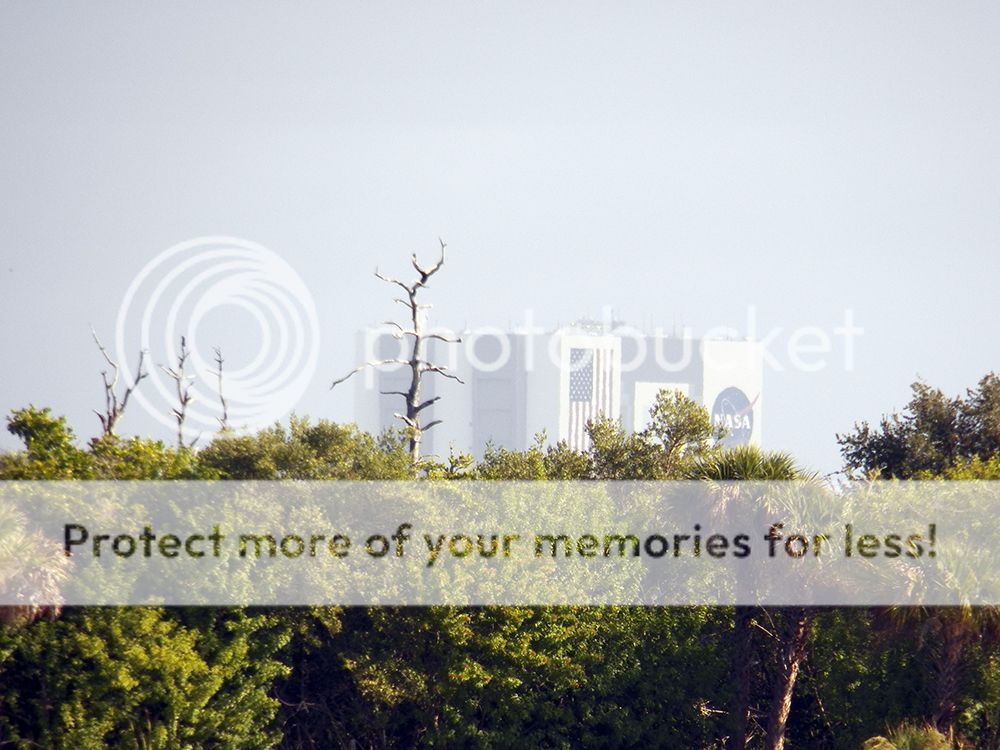
First, I had not noticed this on my first visit here. Through the morning haze the top part of NASA’s huge Vehicle Assembly Building (VAB) was visible over the tree-tops. This means I was closer to the Kennedy Space Center than I realized! I am seriously mulling over this place as a launch-viewing opportunity, especially when human flights resume.

photo vab1.jpg
NASA’s VAB looms in the distance.

After scaring off a noisy contingent of Killdeers, I saw some Yellow-rumped Warblers, some sparrows (later IDed as Song Sparrows), and a Downy Woodpecker.

photo downy.jpg
Just like a Hairy Woodpecker, only more portable!

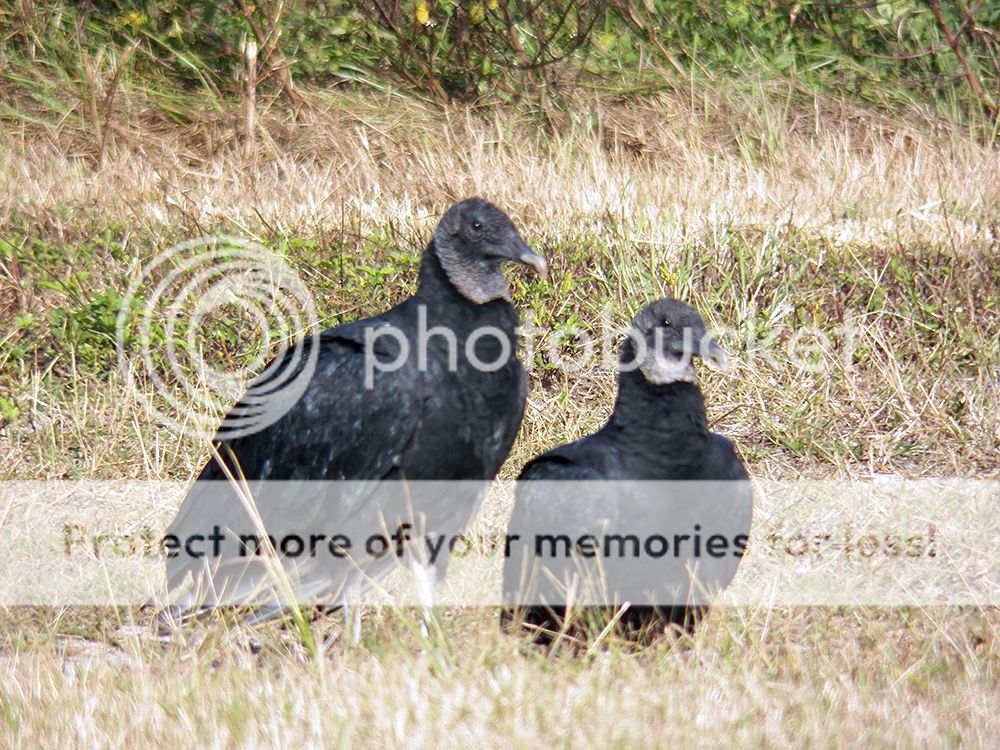
The day’s first great photo-op went to these photogenic Black Vultures. The one on the right was a bit shy, and snuggled up and behind its companion as I went by. I don’t know if they are a mated pair, or an adult and immature.

photo 2-black-vultures.jpg
The family that scavenges together, stays together.

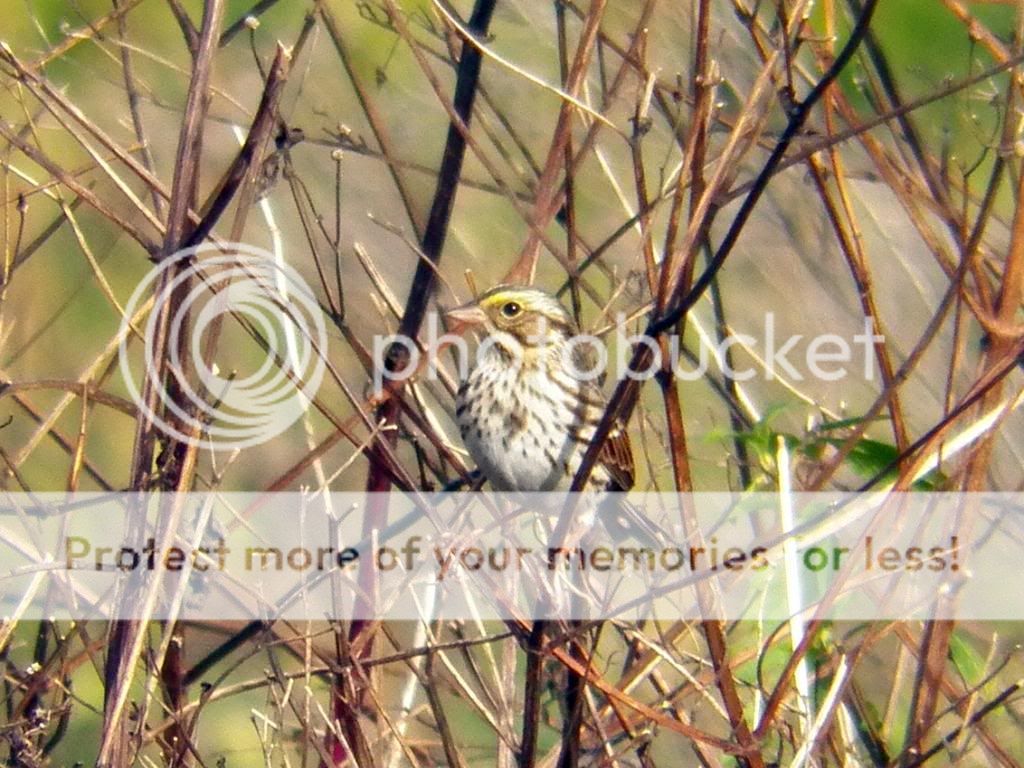
Farther along the path around the pond, there was activity on the ground, with more Song Sparrows and Savannah Sparrows foraging and then flitting off the path and diving over the embankment to my left as I got too close. This Savannah Sparrow stayed behind as some sort of picket.

photo savannah-sparow.jpg
“I’ve got my eye on you!”

There was also an Eastern Phoebe catching insects from a sallying perch in a palm tree. There were a few phoebes around the park, as well as an Eastern Wood-pewee.
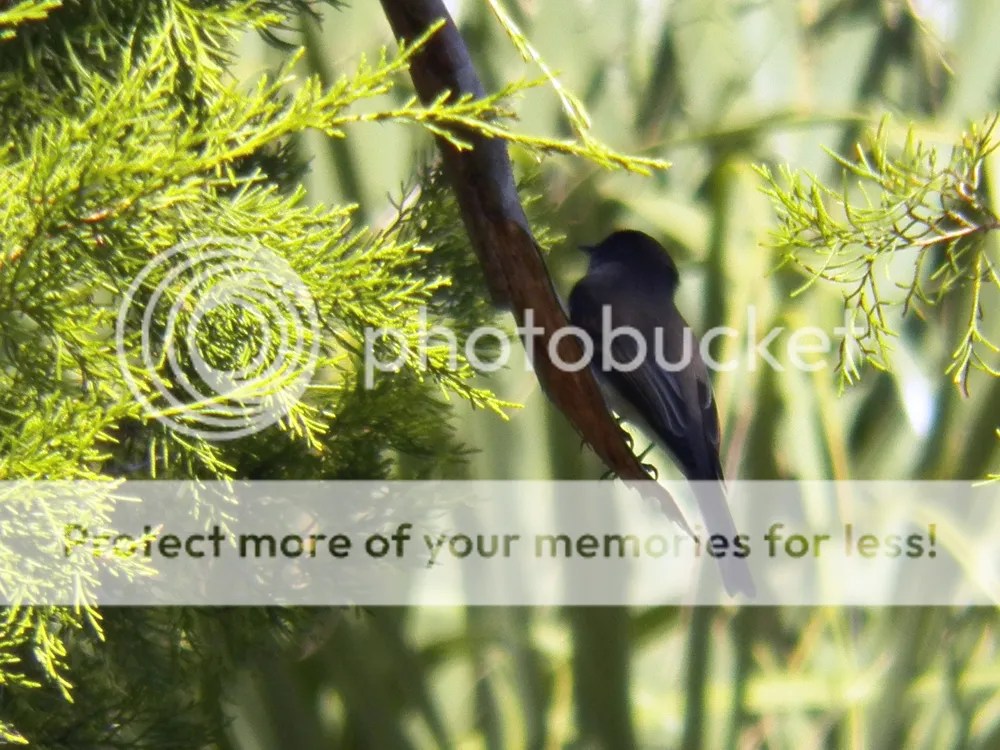
photo eastern-phoebe.jpg
This phoebe was very shaded, but the relative lack of field-marks is evident (is that any oxymoron?).

photo eastern-phoebe2.jpg
For comparison, here’s a better lit individual!

Out on the pond, quite a distance away, was a scaup, but I could not tell if it was a Lesser Scaup or a Greater Scaup. It was very wary, staying well away from me no matter where along the pond shore I was.

A few Double-crested Cormorants flew overhead, and I noticed some White Ibises along the shoreline.

A bit further down, I noticed another bird mixed in with the sparrows, showing more yellow than anything I’d seen to that point. There was a pair of Common Yellowthroats in the brush. The male took a moment to pose for me.

photo common-yellowthroat.jpg
Common Yellowthroat, ready for action!

There were a handful of Anhingas, drying their wings from a morning fishing expedition along the pond, and several egrets. I also flushed out an aggravated Great Blue Heron.

When I arrived at the north end of the pond, I turned left down a path. The north side of Pine Island borders the Merritt Island National Wildlife Refuge (marked by a low wire fence). As I walked along this section, I distinctly heard the call of a Yellow-billed Cuckoo. I paused but was unable to see it, nor did it call again. The last time I’d seen or heard this bird was in the early 1990s in Massachusetts, so even just one call was thrilling to hear!

After another left, the path led south, parallel to the pond, but on the other side of some mangroves and other swampy vegetation. I noticed some rather large animal droppings, most of which had berries in them. There was also areas of the ground tore up and the soil turned over. It took a while for my brain to figure out what I was seeing, but my thoughts were interrupted by some large splishing in the wooded swamp to my right. I saw some brown animal legs, and though, “Oh, a deer!” and stopped and tried to peer into the underbrush to get a look as it passed by. I could hear walking, but nothing came into view. I stepped back onto the path and caught my breath.

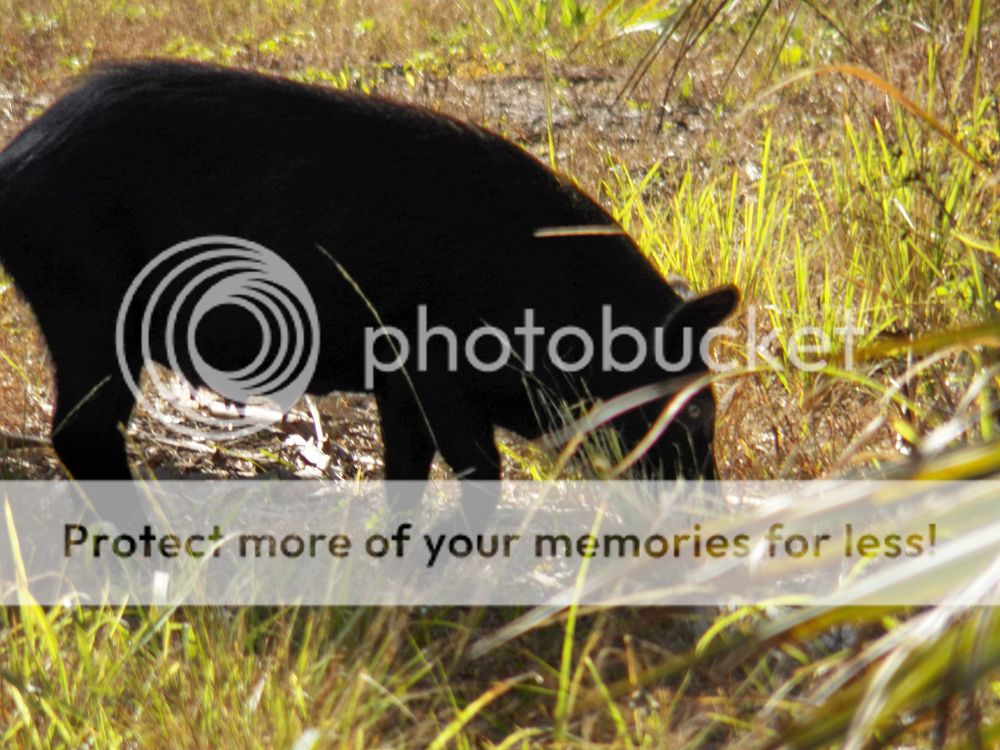
photo dark-wild-pig.jpg
Wild pig, hogging the path. I kid. Sort of.

Wild pigs can be aggressive, so I was unsure what to do. I only managed this photo, because my presence was not welcome. She grunted at me a couple of times, then splashed back into the swamp. I took a few breaths and continued on the path, looking back into the swampy area to catch another look. I did this a few times, and each time, I heard a low grunting growl that sounded “big”. I realized that while the legs I saw were a light brown or tan, the female I saw was decidedly dark. There was a good chance I was being threatened by a male, so I stopped looking back and headed briskly down the trail.

Along this section, there were some Grey Catbirds and Northern Cardinals, but not much else visible. I assumed the path would eventually join up at the south end of the pond and I could get back to where i started. Unfortunately, the path ultimately broke right, away from where I needed to go, so I had to hike the whole length back.

Just before getting to the end of the path again, I saw another flycatcher. I have not yet been able to identify it. The main field mark I noted was a distinctly yellowish throat and breast. I did not see any strong head markings, and I was unable to tell if it had wing-bars or not. It was about the size of a phoebe (perhaps a bit larger). If any of my blog readers would like to suggest candidate birds, they are most welcome to offer them. There were some Palm Warblers along this path, too.

When I got back out to the pond, I decided to circle around to the east side and around. As I looked across the pond, I saw something a bit peculiar.

photo gator-tail.jpg
Mokele-mbembe, is that you?

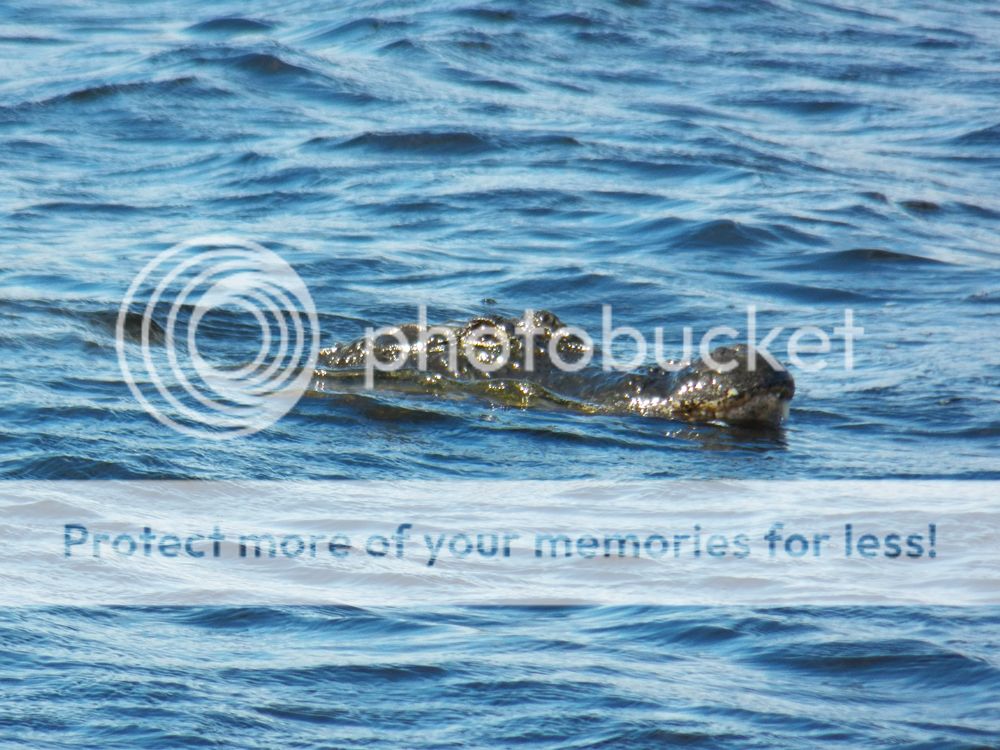
What manner of monster was this? Seconds later the beast’s head appeared.

photo gator-head.jpg
Oh, what great teeth you have!

This was the largest of 5 adult alligators I saw. This one was at least about 8 feet long. Some of them were basking along the pond’s shore and were not very pleased with my disruption of their morning. Luckily, they all chose to break for the water, making a tremendous splash each time.

photo gator.jpg
It was careful to keep facing toward me as I walked past.

As I approached the southern end of the pond, there were more Killdeers, some Cattle Egrets, a Great Blue Heron and, on the water, some Pied-billed Grebes. I love grebes. In Massachusetts, where I started birding as a teenager, a old traditional name for Pied-billed Grebes was “Water Witch” because of the ability of these birds to slowly submerge while swimming upright, then “disappearing” without a ripple only to reappear some distance away in the same manner. Early and, unfortunately, superstitious settlers thought it was by dark magic, and that these birds might in fact be witches disguising themselves as birds.

photo grebes.jpg
Which is witch and who is who?

As nuts as this sounds, recall that the Great Auk was thought to be a witch as well (though its demise was a much due to exploitation as a food source).

There were more herons at the southern most end of the pond. This pair of cousins paused in their foraging to pose for this lovely shot.

photo 2-herons.jpg
Tri-colored Heron and Snowy Egret, sychronized staring.

At this point it became clear that the path along this side of the pond did NOT connect around to the other side, so I had to hike my way all the way back around to get to my car. At first I was fairly aggravated, as my feet and ankles were very sore (and ant-bit from earlier). But there wasn’t much I could do about it, so I held my head up and started back. I saw a Red-shouldered Hawk and more Anhingas, among other birds. Back on the western side of the pond were more Savannah Sparrows and Palm Warblers.

I took one more look across the pond to the VAB, this time in full sun (with heat ripples). My feet were tired, and it was about an hour beyond when I expected to be finished, but it was a banner day with 33 definitive species identifications! Just think of how it will be when the waterfowl and other winter residents arrive.

photo vab2.jpg
VABulous parting shot.

Here’s the complete list of birds (taken from yesterday’s quick post):

Winter residents FTW! (not in order seen)

  1. Black Vulture
  2. Boat-tailed Grackle
  3. Palm Warbler
  4. Song Sparrow
  5. Savannah Sparrow
  6. Yellow-rumped Warbler
  7. Killdeer
  8. Osprey
  9. Downy Woodpecker
  10. Great Blue Heron
  11. Common Gallinule
  12. Belted Kingfisher
  13. Common Yellowthroat
  14. Anhinga
  15. Double-crested Cormorant
  16. White Ibis
  17. Great Egret
  18. American Kestrel
  19. Turkey Vulture
  20. Eastern Phoebe
  21. Northern Cardinal
  22. Grey Catbird
  23. Common Ground Dove
  24. Red-bellied Woodpecker
  25. Yellow-bellied Sapsucker
  26. American Coot
  27. Pied-billed Grebe
  28. Snowy Egret
  29. Tri-colored Heron
  30. Cattle Egret
  31. Red-shouldered Hawk
  32. Tree Swallow
  33. Eastern Wood-pewee

Birds in the Hood

Migration season is heating up for sure at Turkey Creek Sanctuary. It wasn’t the best day for photographs, but I did get a few here and there. Right off the bat (it IS baseball playoff seaon after all), I saw 2 Cooper’s Hawks in the parking area. I don’t have any definitive proof, but I believe these are the same hawks I saw as juveniles a couple of months ago (the size and behaviors seem very similar). They now have their adult plumage. This one was persistently calling out to it’s companion.

photo coopers-back.jpg
Surveying the domain.

photo coopers-calling.jpg
“Hey, sib! Look at this crazy human with the camera!”

Most of the way down the Sand Pine Trail I heard some commotion amongst the backdrop of Blue Jays and Northern Cardinals that were making the usual racket. In some of the thick brush I could hear some Blue-gray Gnatcatchers (which seem to have taken over as the Sanctuary mascot from the White-eyed Vireos), some blackbirds (not sure what species) and some more generic call notes. I caught partial glimpses of a warbler that I have not been able to ID. It was definitely yellow with black streaking on the breast and throat. However, it also had no clear wing bars, a mostly plain face and head, and maybe white outer tail edges. The two closest birds, based on my Peterson’s guide are either a Canada Warbler or a Yellow-rumped Warbler. But neither seems particularly satifying to me as an ID.

As I rounded the end of the trail towards the boardwalk, an Ovenbird (year’s first) popped out into the open for a few seconds, then dashed off.

The creek overlooks were fairly quiet, but as I neared the far end toward the Hammock Loop, I saw a couple of armadillos. Here’s a short video of one foraging by the boardwalk. Armadillos have very sharp claws and have no problem shoving their heads down into the soil to snap up various insects. My apologies for the loud camera zoom motor.


Armadillo.. nom nom nom

Along the Hammock Loop I again noticed some gnatcatchers in the understory. Experience has taught me (and my friend Laura Erickson reminded me this past winter) that where there is one species present, there is often another. Sure enough, I saw some larger movement and caught a male Hooded Warbler square in my binocs! I tried to snap a photograph, but he was too fidgety and flew off.

Somewhere along this stretch I did hear the morning’s single White-eyed Vireo, so I know they haven’t completely left the Sanctuary. I also heard quite a few Downy Woodpeckers today, and managed to sight a few (I’ve embedded a video of one further down).

I went by the canoe deck and out to McKinnon’s Way backwards from the way I normally go, and went out toward the weir and canal. As was the case 2 weeks ago, there were a lot of butterflies throughtout the Sanctuary today. Here’s a White Peacock that stopped long enough for a nice shot.

photo white-peacock-butterfly.jpg
Proud as a Peacock

Down at the weir were the usual suspects: a Little Blue Heron, an American Coot and a Spotted Sandpiper (in unspotted plumage). I did notice a Solitary Sandpiper there as well today. [Edit: I originally misidentified the Solitary Sandpiper as a Lesser Yellowlegs. Further research in my field and desk guides, as well as the Internet has clarified it for me.]

In the area near the Harris radio tower, I saw another Ovenbird near more Northern Cardinals, but most of the rest of the morning was quiet as the sun rode higher and the temperature climbed. On the way out of the Scrub Trail toward the Sanctuary exit I saw this Downy Woodpecker on the stem of a palm frond.


Downy Woodpecker leaving tiny holes in a palm frond.

I did another loop from the boardwalk to the Sand Pine Trail, but there wasn’t much to see, so I headed out and for home.

Despite the ambiguous warbler ID at that start, I was pleased with this outing. October is shaping up to be quite nice, I think.

Scrubbing it Up in Malabar

I spent the morning in the central part of the Malabar Scrub Sanctuary. My post from April 14th discusses how much of the sanctuary was overgrown too much for the Florida Scrub Jay. The central part, however, is being managed to keep the habitat more amenable to the jays and other scrub-adapted wildlife.

The Malabar Scrub Santuary was set up in the early to mid 1990s, using a failed housing development from the 1980s.

photo sign.jpg
Malabar Woods Blvd. You can’t have a more exclusive address

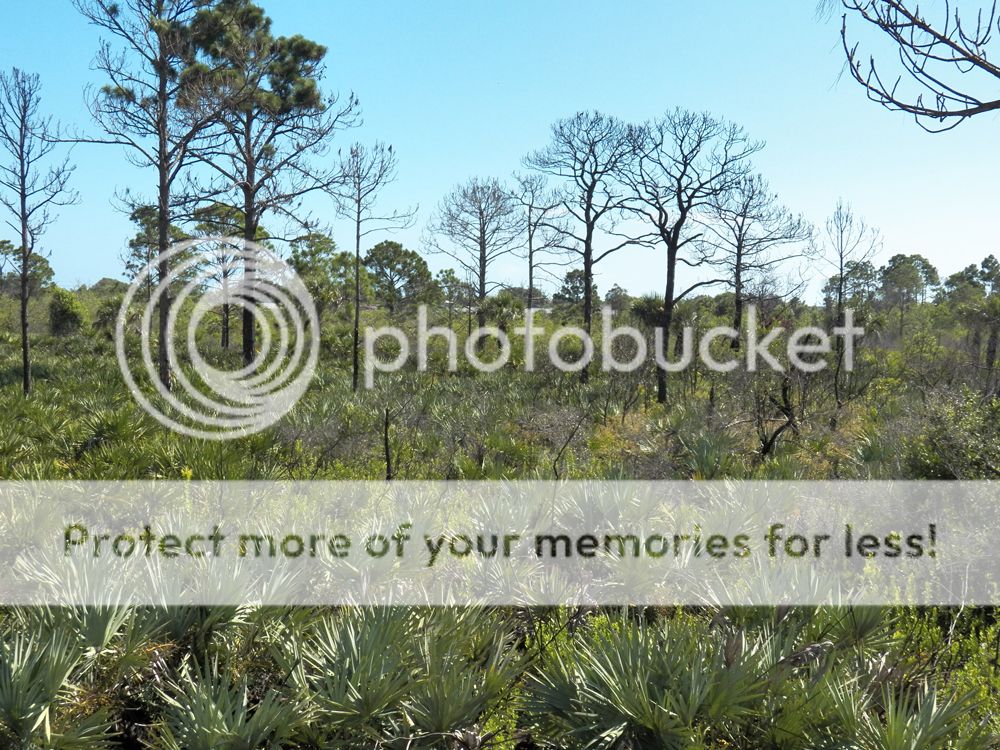
Here are a few photographs of what post-burn scrub habitat looks like from ground level. I am not sure exactly when this was burned, but probably some time this year. Vegetation grows back very quickly; these plants are adapted to fire. photo scrub2.jpg
Burn-managed scrub.

You’ll notice the lower part of the tree trunks are charred, but there’s no evidence of buring in the upper part. Management fires, like the natural fire they mimic, are fast moving and low to the ground. The taller trees here are relics of pre-management days. Left to its own devices, a scrub habitat would tend to be devoid of any taller trees. You can see that the burns have caused many of these taller tress to die, though. photo scrub1.jpg
Lack of shade is par for the course in scrub country.

There were some Blue-grey Gnatcatchers calling in their wheezy-complaining way along the paths off the paved boulevard, but as I walked down the defunct street, I noticed something ahead that excited me a bit. I couldn’t be sure until I got closer, but yes! Florida Scrub Jays! One was acting as a look-out on top of a dead sapling while another foraged on the ground. The foraging jay actually came within 2 feet of me and was very curious. I know that many people tend to feed them (which is illegal), so I don’t know if this jay is habituated to hand-outs or if this was just a normal level of curiousity seen in the species.

photo jay-lookout1.jpg
Sentinel.

photo jay-good-color.jpg
The blue coloration was very varible, depending on the sun angle. This shot shows it to best effect.

photo jay-close.jpg Hello neighbor!

I walked along some of the paths that led into the more forested parts of the sanctuary. I saw a White-eyed Vireo, but wasn’t able to get a photo (again!!), but was hearing what sounded like an Eastern Towhee. I know that the White-eyed Vireos in this area love to mimic towhees, so I was skeptical. It took some careful and lonely stalking, but sure enough, there was male Eastern Towhee singing in the shade of a tree. The race of Eastern Towhee here in Florida has white eyes (rather than the red eyes of northern bretheren) and a slightly less musical and slurring voice.

photo towhee-singing.jpg
Eastern Towhee singing his heart out.

photo towhee-sitting.jpg
Pause for breath.

At this point the sun was really beating down and I started to head back out. I saw a few more jays and another towhee. I noticed on my way back out to the scrub habitat a six-lined racerunner and creepy flies (like I’ve seen at Turkey Creek Sanctuary).

The only other resident I saw before exiting the sanctuary was this small Gopher Tortoise. It was about the size of a small bagel, but I don’t know how old that would make it, but I expect pretty young in turtle-years.

photo young-gopher-tortoise.jpg
Looks like the kids play outside in this neighborhood.

Both the Florida Scrub Jays and the Eastern Towhees are firsts for this year, bringing my 2013 total to 132 species.

I had other obligations this weekend, so no birding excursions to report; however, while waiting for my ride to work this morning, I saw and/or heard the following:

  • Great-crested Flycatcher ♫
  • Mourning Doves ♫
  • Eurasian Collared Dove ♫
  • Common Grackles
  • Chimney Swifts
  • Cedar Waxwings
  • Northern Mockingbird ♫
  • Red-bellied Woodpecker ♫

♫ = voice only

A nice 5 minute wait, I say.

Warbler Jackpot

I had a strange outing today at Turkey Creek Sanctuary. I was really in an escapist mood, and I hoped a combination of the weather (gloomy, showers  had just passed) and it being Sunday morning (a lot of folks at church in the morning) would mean I was unlikely to bump into too many people on the trails. Ultimately this wasn’t meant to be, but I rolled with it.

To start off, on the Sand Pine Ridge Trail, I saw this osprey tending to its catch.

image
Catch of the day!

I got a couple more shots before I basically scared it away, fish in tow. While this was happening, I heard a White-eyed Vireo in the nearby brush and got a few good glimpses.

At the base of the tree the osprey was in, I saw a Black-and-white Warbler scaling up and down the trunk. He let me get fairly close and I was struck by how its movements a mix of those of a chickadee and a woodpecker.

image
This made me think of the 1960s Batman show when Batman and Robin scale the buildings in an obviously tilted camera shot. No celebrity cameos here, though.

image
Black-and-white Warbler striking an epic pose.

Further down the trail, I caught a glimpse of a female American Redstart and what ultimately turned out to be a female Blackpoll Warbler (a first!). I also got great binocular views of a Prairie Warbler and a Northern Parula before more redstarts and Blackpolls flew in. I took a few throw-away shots of what I realized were female Black-throated Blue Warblers (first this year).

At this point, as I neared the boardwalk, I ran into my first group of birders, all equipped with the equivalent of the Hubble Telescope for camera lenses. A couple even had lighting rigs that would make night-time shrimpers envious. I have to admit (and I am slightly embarrassed to) that I felt pretty inadequate in the camera department, so I missed what would have been a couple of great shots of a male Black-throated Blue. I was annoyed, though I had no right to be, that my lonely birding had been interrupted. I continued down the trail and along the creek overlooks. I calmed myself down and had a look down.

image
Hello, gorgeous!

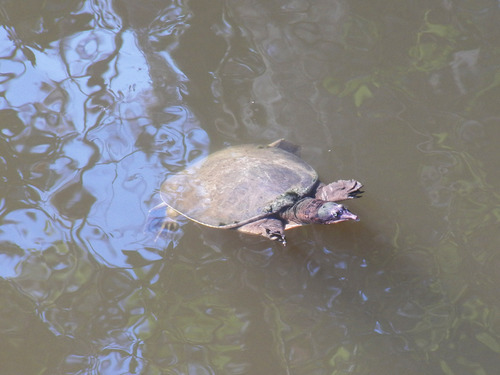
This Florida softshell turtle was fairly large. Maybe about 15” across (there was an even bigger one just barely visible through the murk). Further down the creek I caught this pair of Florida red-bellied turtles sunning themselves as the first rays broke through the overcast.

image
Sunbathers in a half-shell!

I was feeling better, until I ran up upon another pair of birders with Overcompensatingly Large equipment setups (ok, I am being a bit mean there, forgive me – it was just my state of mind at the time).

I saw this Carolina anole (a.k.a. green anole) displaying below the overlook I was standing on, and used him to center my mind again. He’s a beaut!

image“Can I help you?”

This time, I stuck it out and took a few shots of my own as we were in the midst of a mixed flock of Blackpolls, redstarts and Black-and-Whites.

image
Blackpoll Warbler, peeking out to say hey.


imageAmerican Redstart fanning his tail at me. Yes. He did.

image
I manged to mostly shoot between the thick brush along the boardwalk.

I went my separate way again, managning to get some more binocular and unaided-eye views of more Black-throated Blues (this was THE bird of the day) and some Black-and-Whites. There was a quick glimpse of a magnificent Pileated Woodpecker, too.

I then bumped into the first group of birders I had encountered earlier (plus more) and finally determined that I wasn’t going to miss any shots I might take of my own. My equipment is fine, thank you very much! Plus, I realized these birders had every right to be there, as I did. So together we watched the antics of more American Redstarts, Blackpolls, Black-and-Whites and yes, I finally got my Black-throated Blue Warbler shot!

image
Parting shot.

Then it was up and out, and another great day, in the end. Sometimes it’s easy being a lonely birder. Sometimes it isn’t. But in the end, it’s all about the birds.