
I ran through my ABA checklist today to verify my 2013 species count. As of this morning, with the addition of some Wood Ducks, it stands at 114 definite IDs. I am hoping to make it out to Merriitt Island before too long to get some of the waders and perhaps more ducks.
Category: Birding
Crane Family Miracle
A potent thunderstorm moved through our area last night, dumping several inches of rain and with wind gusts over 30mph. I was worried about the Sandhill Cranes where I work and their single chick and unhatched egg.
This morning, I noticed the pond was filled up and the nest site was inundated with water. I scanned around and saw the two adult cranes foraging in the grass. At first I didn’t see the chick and feared the worst. But then I saw the little one between its parents and thought, “Well, at least the chick made it.” I felt pretty bad about the egg.
When my wife came to pick me up, we saw the crane family was foraging near the parking lot and what did we spy?

What’s this?
A close inspection found not just one chick, but two! Yes, apparently the other egg must have hatched some time yesterday. My wife was driving so she pulled off so I could get some closer pictures.

“Say hello to my little sister (or brother)!”
I got some adorable close-ups before Poppa Crane VERY LOUDLY announced his displeasure at us paparazzi invading family time.
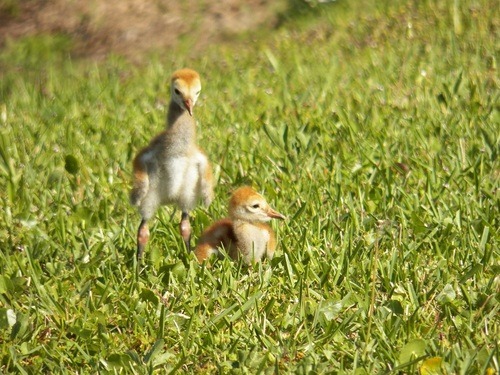
Adorable crane chicks.

Can you believe it?
Here’s to a great summer for the crane family as they rear 2 beautiful babies!
Red and Redstart
This morning I went to the Malabar Scrub Sanctuary, which is a property adjacent to the Turkey Creek Sanctuary. In fact, the first place I stopped was technically in Turkey Creek, but on the opposite side of the creek than I normally visit.

Far side of the creek than I am usually on.
Apart from a lot of leaping fish in the creek (I think that happens more on overcast mornings, like today), there wasn’t too much going on. The trails are for mountain bikes, and I did see a few riders on the trail. I did get a good glimpse of a warbler, but positive ID was tough. A lot of these birds are in the midst of getting their breeding plumage, so there’s generally a wild mix of colors and patterns that most field guides just have to skip over. My best guess would be a Magnolia Warbler, based on the wing pattern and the emerging black about the throat.
I did hear a few White-eyed Vireos, but did not get any visuals (and of course, the hordes of Northern Cardinals were in evidence). White-eyed Vireos seem to be very plentiful this year.

Bike trail at Turkey Creek in the morning gloom.
With not much going on, I drove the short distance to one of the trailheads for the Malabar Scrub Sanctuary. The Sanctuary and surrounding property are great to have as conservation land, but it comes with a little bitterness. Originally, the Sanctuary was to help with the local Florida Scrub Jay populations; however, with the rise of the adjacent residential developments and population increase in and around Palm Bay, the necessary operations (i.e., FIRE) to keep the scrub in a state that the Jays would thrive in were halted. Much of the property has grown over and isn’t suitable for Florida Scrub Jay habitat. There is a good variety of habitat, though, including some gorgeous open grassland areas.

Some of the diverse landscape types in the Malabar Scrub Sanctuary.
One persistent Northern Cardinal did present himself well enough for some decent photographs.

I give cardinals a bit of rough time in this blog, but they are pretty.

Here he was listening to his mate, who was gathering nesting materials nearby. In all honesty, the red of male Northern Cardinals is stunning.
While setting up the shots of this guy, I was pleasantly surprised by a non-stop flutter of black and orange. An American Redstart! He was actively foraging with his mate. These birds do NOT sit still very often. Here’s the only decent shot I got of him. You can see a bit of the characteristic wing and tail drooping of the species. They flutter down and around like falling leaves, which is pretty neat.

He stood still just long enough to get this.
Other than a few more ear-only catches (White-eyed Vireos) I got some good binocular views of a dark grey-ish bird with a faint black necklace of streaks that I can’t identify. I’ve seen them before, and cannot figure out what they are. The day was heating up, the sun came out and I headed out. I did get a quick glimpse (finally!) of a Carolina Wren in some thick palm scrub.
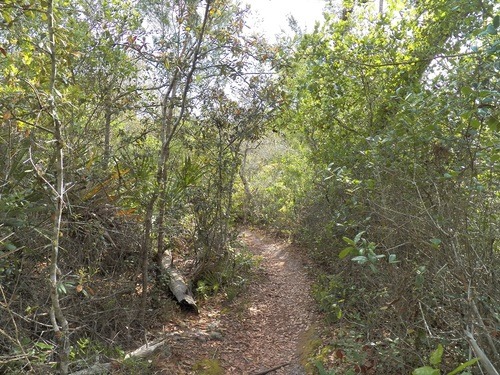
The trails at the Malabar Scrub Sanctuary are very well kept
Not the most prolific outing, but it was nice and I had fun – which is what birding is all about!
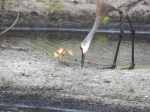
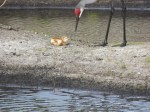
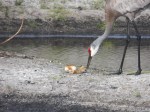
Baby crane must have hatched in the past couple of days! We drove up by the pond a snuck a few snapshots. The family portrait above is actually the final shot. you can see Poppa was getting a bit wary, and we were over 50 feet away. Good, protective parents! We’re pretty sure she’s still on the second egg, which should be ready to hatch soon! 🙂 Click pics to enlarge.
20 Minutes
I had a few minutes to walk around some conservation land abutting a housing subdivision in Viera this evening. The paved walk/bike ways encircle a large irregular pond. It was a nice 20 minutes.
- Downy Woodpeckers
- Lesser Scaups (first this year)
- Blue-winged Teals
- Mottled Ducks
- Common Grackles
- Mourning Doves
I didn’t have my camera handy, so you’ll have to go with your imaginations or a Google image search. Your choice!
True Story
The exciting life of a birder and his wife.
She: Hey, there’s a bird on the wire outside.
Me: (Mildly interested) Oh, yeah? Cool.
She: Well, it’s probably just a pigeon or a dove (not convinced).
Me: (Looks.) Hey! That’s not a dove. It’s a flycatcher of some kind!
She: Cool!
Me: Can you hand me my binoculars?
She: Yeah, hang on. (Rummaging.) I’m trying to get it, I promise
Me: No problem. Hey, I think it’s singing. I could open the window
She: (Handing me the binoculars.) That window will probably scare it away.
Me: Well, maybe. (Opens window.)
Window: ScccrreeEEEEE!
Bird: (Silent.)
Me: Well, it hasn’t left.
Bird: (Darts out and catches a bug. Lands on a tree.)
Me: Cool! Well, at first I thought it was an Eastern Kingbird, but it’s too gray and I don’t think it’s big enough.
She: Hm.
Me: (Gets a better look) Hm. (Watches bird a bit more through binoculars.)
Cat: (Watches intently.)
Me: (Walks to sofa and grabs field guide, sits down.) Hm.. let see. Smallish flycatcher, weak wing-bars, no eye-ring. No tail bobbing. It’s an Eastern Wood-pewee!
She: Cool! Is that a new bird?
Me: Not a lifer, but first this year, and in a while! Thanks babe!
She: o/ Yay!
True story. Hey, it’s exciting to ME! 😉

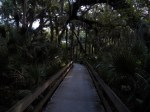
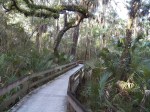
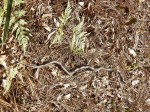
I went to Erna Nixon Park this morning to see what was happening there. At the first “Vista” stop along the boardwalk, there’s an overlook of some reedy vegetation and some grasses, adjacent to a pond that there is no path to get at. In that area I had the most success today. There were several Ruby-throated Hummingbirds (males and females, a lot of bickering), what sounded like House Wrens, and at least one Common Yellowthroat (which came quite close, but I was unable to capture on camera). Further along the boardwalk I did see a single male Northern Parula, and along the fire-path along the northern edge of the property was a nice little gathering of Blue-gray Gnatcatchers. The usual Northern Cardinals, Mourning Doves and Fish Crows were also in evidence. I did get a nice shot of a snake (not sure what species). Also heard some Carolina Wrens, but they stayed well out of sight.
Viera Wetlands/Moccasin Island, Part II: Moo for Meadowlarks!
The Moccasin Island Tract is part of the River Lakes Conservation Area and is adjacent to the Viera Wetlands. Where the Viera Wetlands are, well WET, the Tract is an upland area. In fact, much of the land around the Tract is a cattle ranch.

Cows ahead

Florida looking very Western (except for the palms). Click to enlarge
Of course, Stitch was with us.

Cedric took this photograph of me on a concrete bridge just near the entrance to the path we took into the Tract. Based on the trail map, there are quite a few miles of trails, but we stuck to one straight road and hiked in about a mile or so.

Look at me! Binocs AND camera! Starting to look profesh!
We came here to have a look at cows (and birds). We must have been on the right track.

Hey, man. Look at that hay.
The most obvious indication of any birds in the area was the beautiful flute-like song of the Eastern Meadowlark. In fact, this seemed to be THE bird of the day here. Every few fence posts and there was a meadowlark, singing away.

One of the many Eastern Meadowlarks that stake out the Tract
There wasn’t much else obvious in the way of birds, but with some careful listening, I caught a glimpse of some Red-bellied Woodpeckers and at least one Northern Mockingbird. As we walked up to a bit of remnant water off the side of the trail, we saw these two cute baby alligators!

Little Monsters
Cedric wondered aloud if Momma Gator was around, but these seemed a bit big to have Momma still watching them, but we scanned around just in case. Here’s a closer look at one of them.

What a beauty!
I had expected to see some caracaras over the upland areas, and I did see one. It must have been from the same camera-dodging clan as the ones in the Wetlands, so I didn’t manage to catch a photo of it. As I said, this is ranch land, and there were cows!

Cows of a feather flock together?
The cows were very interested in what we were doing, but kept their distance.

Curious Cows

Far away.

You lose something over here, Hondo?
The sky was gorgeous, and we had a tremendous time of it, but we had to head on out.

Big Sky Country, Florida style.
Thanks for the fabulous time, Cedric.
Viera Wetlands/Moccasin Island, Part I: Crazy About Caracaras!
Today I went to the Viera Wetlands and the neighboring Moccasin Island Tract (part of the River Lakes Conservation Area) with my friend Cedric. This picture of him was taken at our second stop, which you can see in Part 2. Here’s the handsome guy
Cedric is not a ‘birder’; per se, but he’s a smart guy and loves to learn new things. He actually invited me to go birding today, which was a pleasant surprise.
Our first stop was the Viera Wetlands. A conservation area born out of the area’s wastewater management, for years now the Wetlands have been a haven for birds throughout the year, but in particular for birds that tend to favor marshlands and their surroundings. I’ll spare you the details, just visit this page to learn more.
Here are some highlights of the Wetlands portion of our outing.
Right off we saw some Red-winged Blackbirds chasing each other around in territorial displays and in hope of mating. Here’s one resting on a sign near the area in which we parked.

Pay attention to this Red-winged Blackbird

Pied-billed Grebe
There were several Pied-billed Grebes throughout the various ponds (“cells”), some alone, some in pairs.
At this point, a Crested Caracara surprised me and went past, too fast to get a shot. I love these guys, and it’s always a pleasure to see them in numbers. And in numbers they are! There were at least 1/2 a dozen individuals by my best estimate. But I couldn’t manage any photographs (but got great binoc views!).

American Coot (foreground) and Common Gallinule
As is typical through the Winter and early Spring, coots and gallinules were quite plentiful in most cells. I did not see any Purple Gallinules today. I don’t know why they were not there, but I’ll try to find that out.

White Ibis in flight
I’m proud of the above photograph. White Ibises are common enough, even in residential neighborhoods, but it’s really neat to see them in a more “natural” type habitat. This was my first attempt at a motion shot with my new camera.
More Crested Caracaras went by at this point, doing their level best to dodge my camera.
We came across some Glossy Ibises and a couple of unidentified shorebirds (perhaps a snipe?) and sparrows (what some birders affectionately called “LBJs” for “”Little Brown Jobs.” Savannah Sparrows seemed plentiful along most of the path edges throughout the morning.

Savannah Sparrow
This Tricolored Heron was one of several heron and egret species present throughout the Wetlands. We saw Green, Little Blue and Great Blue Herons. There were Great and Cattle egrets too. Many of these were in full breeding regalia, which was quite impressive. Also, below is a shot of a more immature Great Blue Heron that was stalking about the place.

Tricolored Heron with breeding plumes 
Immature Great Blue Heron
This next picture is of one of a number of warblers seen along the path edges. Based on behavior and plumage indications, I want to say this is a Palm Warbler beginning to get it’s breeding plumage, but I am not sure. If anyone reading this blog can positively identify this bird, would you please let me know?

Perhaps a Palm Warbler?
As we rounded the paths to head back to the car, Cedric pointed out some Sandhill Cranes rather close to us. To my surprise was the cutest thing EVER! LOOK!

Sandhill Crane parent and baby!

Sandhill Crane family
So awesome!
This handsome fellow swam by, too

OMG, alligator!
On the final walk out to the car, I finally got a shot of a Crested Caracara. These guys had been swooping around all morning. This one has a rather nasty bit of fish remains in his beak. But hey, scavenging is essential to any healthy ecosystem (even a human created one like this).

With that, we headed out to the Moccasin Island Tract and some upland habitat adventures. Oh. And cows.
Part II to come.
Viera Wetlands/Moccasin Island, Part I
Today I went to the Viera Wetlands and the neighboring Moccasin Island Tract (part of the River Lakes Conservation Area) with my friend Cedric. This picture of him was taken at our second stop, which you can see in Part 2.Here’s the handsome guy
Cedric is not a ‘birder’; per se, but he’s a smart guy and loves to learn new things. He actually invited me to go birding today, which was a pleasant surprise.
Our first stop was the Viera Wetlands. A conservation area born out of the area’s wastewater management, for years now the Wetlands have been a haven for birds throughout the year, but in particular for birds that tend to favor marshlands and their surroundings. I’ll spare you the details, just visit this page to learn more.
Here are some highlights of the Wetlands portion of our outing.
Right off we saw some Red-winged Blackbirds chasing each other around in territorial displays and in hope of mating. Here’s one resting on a sign near the area in which we parked.

Pay attention to this Red-winged Blackbird

Pied-billed Grebe
There were several Pied-billed Grebes throughout the various ponds (“cells”), some alone, some in pairs.
At this point, a Crested Caracara surprised me and went past, too fast to get a shot. I love these guys, and it’s always a pleasure to see them in numbers. And in numbers they are! There were at least 1/2 a dozen individuals by my best estimate. But I couldn’t manage any photographs (but got great binoc views!).

American Coot (foreground) and Common Gallinule
As is typical through the Winter and early Spring, coots and gallinules were quite plentiful in most cells. I did not see any Purple Gallinules today. I don’t know why they were not there, but I’ll try to find that out.

White Ibis in flight
I’m proud of the above photograph. White Ibises are common enough, even in residential neighborhoods, but it’s really neat to see them in a more “natural” type habitat. This was my first attempt at a motion shot with my new camera.
More Crested Caracaras went by at this point, doing their level best to dodge my camera.
We came across some Glossy Ibises and a couple of unidentified shorebirds (perhaps a snipe?) and sparrows (what some birders affectionately called “LBJs” for “”Little Brown Jobs.” Savannah Sparrows seemed plentiful along most of the path edges throughout the morning.

Savannah Sparrow
This Tricolored Heron was one of several heron and egret species present throughout the Wetlands. We saw Green, Little Blue and Great Blue Herons. There were Great and Cattle egrets too. Many of these were in full breeding regalia, which was quite impressive. Also, below is a shot of a more immature Great Blue Heron that was stalking about the place.

Tricolored Heron with breeding plumes
Immature Great Blue Heron
This next picture is of one of a number of warblers seen along the path edges. Based on behavior and plumage indications, I want to say this is a Palm Warbler beginning to get it’s breeding plumage, but I am not sure. If anyone reading this blog can positively identify this bird, would you please let me know?

Perhaps a Palm Warbler?
As we rounded the paths to head back to the car, Cedric pointed out some Sandhill Cranes rather close to us. To my surprise was the cutest thing EVER! LOOK!

Sandhill Crane parent and baby!

Sandhill Crane family
So awesome!
This handsome fellow swam by, too
OMG, alligator!
On the final walk out to the car, I finally got a shot of a Crested Caracara. These guys had been swooping around all morning. This one has a rather nasty bit of fish remains in his beak. But hey, scavenging is essential to any healthy ecosystem (even a human created one like this).

With that, we headed out to the Moccasin Island Tract and some upland habitat adventures. Oh. And cows.
Part II to come.
 Lonely Birder