Frozen Chicken

This was me on Sunday. It was, as my father might say, “bleaky cold” out Sunday morning, so I chickened out and stayed in bed. I’ll try to make a foray before the week gets too far along. It might be a brief stop at my other favorite birding area, Erna Nixon Park. It’s been a good place for American Redstarts, Black and White Warlbers and others in the past.

Your blog author this past weekend.

Dancing cranes

Just a quick update on the Sandhill Cranes mentioned in my last post. On the way home from work today, the cranes were doing some pair-bonding dance moves. First, the male would bow and leap, flapping his wings and kicking his legs out. Then, the female would do the same. They did some synchronized bows and leaps, too. It was neat to watch. When I passed by their pond on the way to get dinner, they had settled in for the night; I saw them quietly standing side by side in the pond, silhouetted and shadowed by the headlights along the road.

Workplace birding

With work being as it has been, I’ve not had much opportunity to check out the bird life around me. Luckily, with the landscaping and proximity to some nicely forested (if, at times ATV infested) woods, I can catch a few neat-o sightings on my way into the building I work in, or by glancing out at the retention ponds.

Today, there was a very manic looking Snowy Egret along the western edge of the large courtyard pond. I am not sure what he hoped to find, as facilities ruthlessly “manages” the pond with herbicides and other chemicals. I think if he didn’t hang around long, he’ll escape any lasting damage.

The bird celebrities on the work campus here are the mated Sandhill Cranes that call the front landscaping/retention pond home. The female had a single egg a couple of weeks ago, and it was cool to see her sitting on it, sometimes napping with her head tucked under her wing. The male was always foraging nearby. But something has happened to the egg. The nest is bare and both male and female are again foraging together. A co-worker did see some.. ‘hem.. “amorous” activity the other day, so perhaps another egg is due soon.

image

Sandhill Crane pair at a nearby location

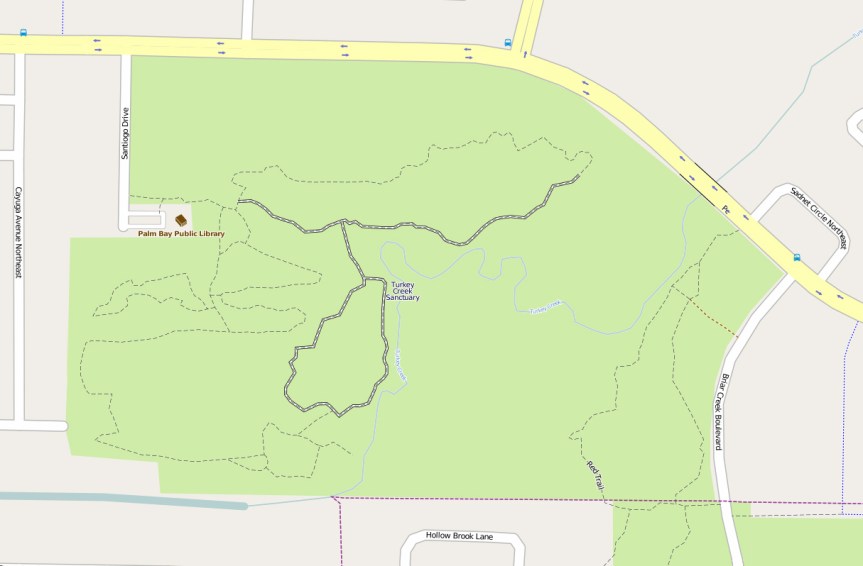
I notice that there is no truly decent map online for Turkey Creek Sanctuary. I did find a reasonable depiction of the trails and boardwalk on OpenStreetMap, though some of the ancillary structures (gazebo, radio tower, pump station, etc.) are not displayed. In this map, trails are dotted lines (The Sand Ridge Pine Trail is the northernmost) and the boardwalk is shown in the thick white lines with the black dashes along the center-lines. (The creek overlooks are also not shown.)  [UPDATE: I added some map updates to the trails, including a few of the overlooks, the canoe deck and the radio tower. It may take some time for all the updates to show up on the map.]

Click through the map above and it will take you to the full OSM map where you’re free to zoom, pan and play around to your heart’s content.

Turkey Creek Sanctuary: Parulas and Vireos

I had my first Turkey Creek outing of the year today. I got to the sanctuary just as some of the morning fog was lifting. I decided to start on the upland sand pine trail before doing the boardwalk loop, and ended by doing the scrub trail and the jogging trail before heading home.

[Note: The photographs in this entry are royalty free images I found to illustrate the blog. I did not take them myself]

This is my first official outing with my new Carson 8X42s as well. Solid performance from my optics!

The first bird I got a visual ID on was a Brown Thrasher. I don’t normally see them around; the last one I saw was at my parents’ house several years ago. There was a Grey Catbird nearby, but the main backdrop to all this was the persistent call of the Northern Parula and the occasional “Per-chick-wee-chip” of the White-eyed Vireo.

While trying to stalk those birds, I ran up on the inevitable hordes of Northern Cardinals that roam the sanctuary. At one point while close to homing in on the Parulas, I was surrounded by an entire family of angry Cardinals. I must have been too close to some nests or something. So I quickly moved along.

I finally caught my first White-eyed Vireo – most likely an immature, given it’s black eyes, but he seemed happy enough, singing and flitting about.

image

White-eyed Vireo

A good number of trees are stating to leaf out, which made finding the Northern Parula a bit more difficult. But I probably would not have seen them (or as soon) if I hadn’t bumped into another birder on the boardwalk. Frank is an older gentleman who seems quite familiar with the sanctuary and has been birding there a long time. He had a lot of tips about when and where to see various birds. I wrote those tips down, of course. 

image

Blue-headed Vireo

When I first met him, I was getting a good look at some vireos, but was only able to see the shape and the bottom halves of them. He asked what I was tracking and so I told him. He was watching the same birds, but from his vantage point, he could see their heads, so he told me they were Blue-headed Vireos. We watched them together for a few more minutes, and I did get several good full views. 

We moved along and could hear some Northern Parulas singing in a live oak. Eventually, I caught a good look at several in the tree. Mostly males. 

image

Northern Parula

We parted ways a bit after that, and I continued on to the scrub trail and jogging trail.

Here’s a list of birds for today, mostly in order of sighting:

Black Vulture
Turkey Vulture
Brown Thrasher
Grey Catbird
Carolina Wren
White-eyed Vireo
Blue-grey Gnatcatcher
Green Heron
Blue-headed Vireo
Northern Parula
Red-bellied Woodpecker
Yellow-bellied Sapsucker

Heard but not seen:

Downy Woodpecker
Hairy Woodpecker
Fish Crow
Northern Mockingbird
Undifferentiated warbler spp.

All in all, an nice and tidy morning of birding!

Front yard chorus and fly-bys

This morning while waiting for my ride to work (yay, carpool!), I took a few minutes to concentrate on the bird songs and calls in the neighborhood.

Apart from the usual cacophony of grackles, I could hear 2 species of dove singing simultaneously (Eurasian Collared and Mourning), at least one American Robin (alarm calls), a Red-bellied Woodpecker (call), what was most likely a Northern Mockingbird (might have been masking a Carolina Wren, but I am not certain of that).

In flight, I saw some terns flying overhead. I usually see them heading inland, toward the west in the morning. I don’t know why that is. I wonder if they are heading toward Lake Washington? A pair of cormorants were heading east, and a pair of White Ibises flew over the house to the south.

Not bad for a few minutes just looking and listening.

Lonely Defined

What does it mean to be a lonely birder? The answer is a bit different than you might expect.

I started birding as an escape from certain aspects of my senior year of high school. I’m an introvert by nature, and birding offered me a pleasant and quiet way to enjoy nature and process my life at the time. Once I started college and then grad school, and then work life, I was with people all the time. Family, professors, class mates, students, work mates…

For me being alone while birding is the default. I don’t mind outing with others. I had a fabulous time at the Space Coast Birding and Wildlife Festival. But my “birding core” is birding alone. It’s part spiritual retreat, part personal quest.

The side effect of this is that there are things you can see and behaviors you observe that you just might miss in a comparatively noisy group. I have some stories along those lines for future posts.

I’m a lonely birder. Sometimes that does make me a bit sad, but if I might take Gotye’s lyrics a bit out of context, “you can get addicted to a certain kind of sadness.” Sweet melancholy, I think the romantics called it.

How official is official?

I’ve done some further looking into the raptor I saw over the courtyard pond at work today. Based on the field marks I saw and the shape of the bird, the closest match I can find is the White-tailed Kite. I didn’t notice the eye-color, but the white body and wings with some black near the leading-edge underwing matches little else. My perception of the size was a bit larger that what a White-tailed kite is described as, but size is sometimes hard to guage in the field.

I am not certain if I should count this as a positive ID or not. If so, it’s a lifer for me and the 98th bird species this year. I am not sure what to think.

Edging near 100

(4th time trying to post this)


I saw 6-8 Hooded Mergansers on a retention pond yesterday. The were all males, which was unusual. I think they are so comical, with their out-sized crests. First sighting of this species this  year.

image

On the way to an appointment I saw a Great Horned Owl being harassed by a mockingbird. Judging by its size, I believe it was a female. I love seeing day-flying owls; it’s such a treat.

image

(The above images are not mine, but from public domain sources…I need a camera!)

I also saw an unidentified raptor over a pond at work. It’s strange, though, because although I got a very good look at it, I could not place the field marks. Time for some research later, I think.

That brings the official species count to 97 this year!

What do you mean, the one without the Gannet? They’ve all got the Gannet!

My new birding friend, Laura Erickson took some fabulous photographs while on the pelagic birding field trip at the Space Coast Birding and Wildlife Festival last week. Here’s her blog page for her Northern Gannet photographs. Here’s a teaser… follow the link above for the blog post (and the rest of her blog is fabulous).

image

Photograph is © 2013 Laura Erickson.

What do you mean, the one without the Gannet? They’ve all got the Gannet!