Quick Secret

I found a “secret” place this afternoon while taking a bicycle ride around the neighborhood. A pseudo-abandoned piece of land that has potential for future birding. A quick scout through some of it yielded FOY Chimney Swift, Brown Thrasher. 

Short list for the secret area and the neighborhood

  • Chimney Swift (FOY)
  • Brown Thrasher (FOY)
  • Carolina Wren
  • Black Vulture
  • Eurasian Collared Dove
  • Mourning Dove
  • Fish Crow
  • Common Grackle
  • Blue-gray Gnatcatcher
  • Northern Cardinal
  • Wood Stork
  • Red-shouldered Hawk

Additionally, there were at last two warbler species I could not identify. I’ll be checking this area out again. We’ll see how it pans out.

P.S.
Yesterday the Great Crested Flycatchers returned to the neighborhood as well, having arrived either that morning or overnight. 

Better Luck at Fay Lake

Today I tried heading off to somewhere other than Turkey Creek. Since I normally only go on a birding trip once a week, it can be difficult to balance repeat observations at one location (like Turkey Creek Sanctuary) and trying out different places for variety and seeing how other places are faring.

I decided to head to Fay Lake Wilderness Park. It’s a bit of a misnomer, as the entire park was created around an artificial pond, but it does border the St. Johns National Wildlife Refuge, and they manage most of the land by burning, rather than by tilling under the vegetation.

photo lake.jpg
Gorgeous day!

photo burned.jpg
Ooooh.. park got burned! (sorry).

The park has a variety of trails. There are paved walkways and boardwalk overlooks for the more pedestrian visitors. There are also wide dirt paths (frequented by ATVs and dirt-bikes on one side of the park) and some more “primitive” paths through the mostly naturalized vegetation.

photo paved.jpgphoto dirt.jpg
Choose your path.

There were still a good number of “winter” and resident birds in the park, but I did have a few FOY birds, including some Blue Grosbeaks and a Northern Flicker (red-shafted variety, based on my brief glance at its red “moustache” mark).

The first birds I encountered were some rambunctious Carolina Wrens, singing out in the open and chasing each other either for territorial or mating reasons (or both!). I don’t think I’ve seen as high a concentration of these birds anywhere before. There were at times 6 within close earshot (and several more in the background).

The Eastern Towhees were quite active and vocal, preferring to sing on exposed perches even as I drew near.

photo towhee.jpg
Eastern towhee.

The stretch of paths along the St. Johns Wildlife Refuge had a nice mix of Gray Catbirds, Common Yellowthroats, White-eyed Vireos, and as I mentioned, Blue Grosbeaks. The arrangement of habitat was quite good for all these species, ordered, from my right to my left, pond, reeds, brush, field, and “park land” (almost savannah like, with herbaceous cover interspersed with groves of trees).

At first I thought there were House Wrens singing, but something about their voices didn’t sound “right.” It turns out that Blue Grosbeak songs are similar to the House Finches’, and it was the grosbeaks I had been hearing.

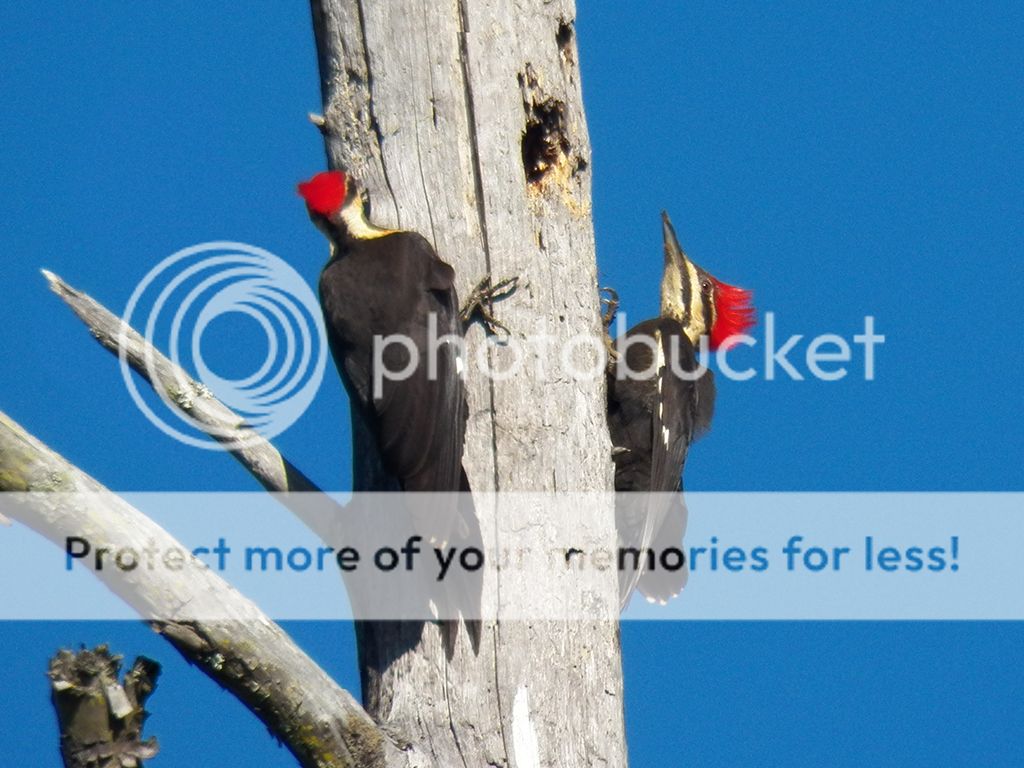
I spent about 15 minutes watching a Pileated Woodpecker chiselling out bugs along a tree limb. He also let me get close before reluctantly flying away when I lingered a bit too long.

photo pileated.jpg
Pileated Woodpecker.

In some ways this park is similar to Pine Island, but on a slightly smaller scale. That helped with the walking, as I am still on hold regarding this persistent issue with my knee.

The complete species list for the morning:

  • Mourning Dove
  • Eurasian Collared Dove
  • Common Ground Dove
  • Black Vulture
  • Turkey Vulture
  • Blue Jay
  • Fish Crow
  • Northern Cardinal
  • Blue Grosbeak (FOY)
  • Eastern Towhee
  • Gray Catbird
  • Northern Mockingbird
  • Carolina Wren
  • White-eyed Vireo
  • White Ibis
  • Snowy Egret
  • Reddish Egret (FOY – white morph)
  • Great Egret
  • Green Heron
  • Double-crested Cormorant
  • Anhinga
  • Pileated Woodpecker
  • Red-bellied Woodpecker
  • Northern Flicker (FOY)
  • Common Grackle
  • Boat-tailed Grackle
  • Common Yellowthroat
  • Osprey
  • Killdeer

I count today as particularly successful because I saw every bird I heard today, which is pretty rare. I wish I had seen more migrants, but all in all I had a good time.


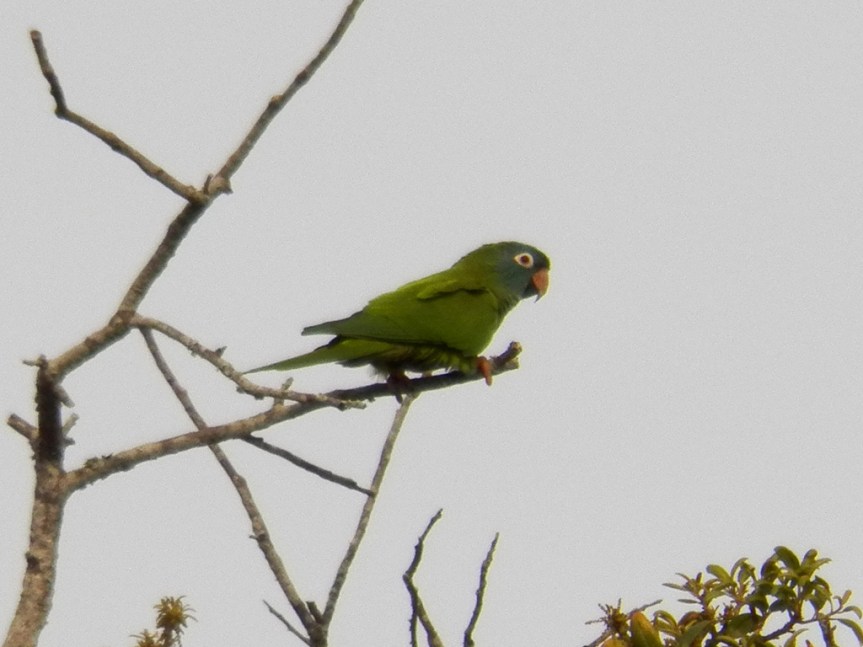
Blue-crowned Conures

My wife and I had two unexpected parrot encounters today. The first was a small flock of parrots that flew past the car while we were waiting in traffic. I didn’t get a good enough look at them for identification.

When we got to our destination, two parrots flew into a tree nearby (where I took this photograph). It took a bit of web and field guide research to determine these are Blue-crowned Conures (the small flock was likely the same species). I saw them last year near the Post Office (along US 1). The small flock was seen not far from the Post Office, and this photograph was taken just a mile or so north of there. I’ve heard there is a nesting colony beachside of the causeway, but I don’t know if these are the same birds or not.

Over My Head I Hear Music

Yesterday’s birding time was shortened again due to my knee issue, and I returned to the Turkey Creek Sanctuary. It was not a very active morning, though I did manage three FOY birds.

I started out on the north side of the creek (on the mountain bike trails) and did one of the loop trails. I could hear several species of warbler, but was frustrated in my attempts to identify anything by my lack of warbler song knowledge and the birds hiding too well in the foliage overhead. I recognized Northern Parulas and Yellow Warblers, but the other 2 or 3 songs I have not yet figured out. Just before returning to the car, I followed some woodpecker drumming to a Hairy Woodpecker (FOY) hammering on a dead tree.

I drove to the main part of the sanctuary and walked the boardwalk loop. Again, I heard a couple of warbler songs high in the canopy, but was unable to see anything long enough for an identification. I suspected one song was a Black-throated Blue Warbler (FOY), and it took a good deal of stalking to catch a solitary male.

I heard more Blue-gray Gnatcatchers than I had for a couple of weeks, and there was one Gray Catbird that crossed my path. The Northern Cardinals are growing more vocal every time I come out, but they have not yet reached the distracting cacophony they will later in the spring.

High above, I also heard what was probably a vireo of some species, but it flew away too quickly for me to definitively identify.

The only other bird species of note that I’ll mention here was a White-winged Dove (FOY) that flew over the car as I drove home.

Here’s the species list for the day (including drive to and from the sanctuary):

  • Northern Mockingbird
  • Common Grackle
  • White Ibis
  • Cattle Egret
  • Mourning Dove
  • Eurasian Collared Dove
  • Common Ground Dove ♫
  • Blue-gray Gnatcatcher
  • Northern Cardinal
  • Blue Jay
  • Fish Crow
  • Black Vulture
  • Turkey Vulture
  • Gray Catbird
  • Northern Parula ♫
  • Black-throated Blue Warbler (FOY)
  • Hairy Woodpecker (FOY)
  • Red-bellied Woodpecker
  • White-winged Dove (FOY)
  • Carolina Wren ♫
  • Osprey
  • Sandhill Crane
  • European Starling

Odd Birds

Not odd as is in weird, but odd as in ones I wouldn’t have expected to see.

While waiting for a ride from work yesterday, I glanced up, as I often do, to see if any soaring birds were overhead. I saw 4 or 5 birds flying to my east, heading east, high enough that I could only make out general shape and patterns. The birds’ overall shape and under-wing patterns showed them to be White-tailed Kites! I have no photographic or other evidence to show you, but I know this species is very uncommon in Florida, especially near the coast. There was a documented nesting pair in the Kissimmee Preserve a couple of years ago.


Wite-tailed Kite photo taken by Andrew Baksh.

A Short Walk In The Woods: Turkey Creek Sanctuary

We had some strong weather move through the area late on Saturday, so I was hoping for a small “fallout” of migrants Sunday morning. For my non-birding or novice birding followers, a “fallout” is when an event, such as a strong weather front or a storm forces birds to land, either to take shelter or to rest from the extra exertion. Often these birds will spend some time after the fallout foraging to get their reserves back up to continue their journey. Unfortunately, there didn’t seem to be much of any fallout activity in the Sanctuary (though there were lots of windblown twigs, leaves and branches in places).

photo backlit-rbwp.jpg
Red-bellied Woodpecker enjoying the sunrise.

I’ve been having some issues with one of my knees, and by doctor’s orders I am limiting my walking distance and time until we figure out what to do; therefore, my outing on Sunday was abbreviated and I mainly stuck to the boardwalk.

I heard more Yellow Warblers high in the canopy (and may have glimpsed one), but otherwise it was still mostly the locals and winter residents. I heard just one Blue-gray Gnatcatcher and there was no evidence Gray Catbirds, so there are changes happening as daylight increases and temperatures rise.

photo n-parula.jpg
Northern Parula playing peek-a-boo with a leaf.

The best watching opportunity happened near the Pileated Woodpeckers’ nest tree, where I saw a total of three at once. One was on the nest tree while the other two (which I think are fledgling juveniles) chased each other around a nearby tree (which has a Red-bellied Woodpecker nest hole in it) and flew awkwardly in circles before heading north and out of sight. The other bird (one of the parents, I assume), stayed a bit longer before flying off in the same direction.

photo pileateds.jpg
Pileated Woodpeckers playing around a Red-bellied Woodpecker nest hole.

The new Floodplain Trail boardwalk I reported on last time is now 100% complete (though there is still a small cache of boards that need to be removed).

photo boardwalk-name.jpg
Future civil engineer?

Since I didn’t walk the southern part of the jogging trail, nor go out by the weir and canal, this weekend’s list is shorter than might otherwise be expected.

  • Yellow Warbler ♫
  • Northern Parula
  • Black-and-white Warbler
  • Blue-gray Gnatcatcher ♫
  • Northern Cardinal
  • Pileated Woodpecker
  • Red-bellied Woodpecker
  • Turkey Vulture
  • Black Vulture
  • Osprey
  • Red-shouldered Hawk
  • Bald Eagle
  • Carolina Wren ♫
  • Black-bellied Whistling Duck
  • Mallard

I am looking forward to getting this knee issue resolved so I can resume “normal birding operations.”

The Warbler Guide

I received my copy of “The Warbler Guide” this week. I’ve only had a chance to skim through a few pages and species, but it appears to be a fairly comprehensive guide (note: not field guide) to warbler identification. It has several diagnostic photographs of each bird from different angles, including from below (which is a common enough view those of us with “warbler neck”). There are groups of photographs showing male and female plumages for adults and juveniles. It also has a series of sonogram-based song pictograms to help describe and differentiate songs within and among species.

I look forward to getting into the nuts and bolts on how this works, especially as we move through spring migration. I hope to have more comments on it then.

Here’s the website for the book:

http://www.thewarblerguide.com/

Pause

There is no weekend blog update for this past Sunday. I slept in and gave myself some needed rest. There are a few things I would like to note.

First, if you haven’t checked out Laura Erickson’s blog lately, have a look. She’s a very passionate conservationist, and her take on the bunker oil spill in Galveston Bay can be found here:

http://lauraerickson.blogspot.com/2014/03/oil-spill-in-galveston-bay.html

You can also read her review of the movie “A Birder’s Guide to Everything”, which I have not seen yet. Sounds good though:

http://lauraerickson.blogspot.com/2014/03/movie-review-birders-guide-to-everything.html

Over at the 10,000 Birds Blog, Corey Finger has a short post about a not-bird he recently encountered:

http://10000birds.com/not-a-green-winged-teal.htm

I had to laugh at this one, because (as I am sure many of my fellow birders can relate) I am often talking about the “stump bird” or “trash bird” or “leaf bird” that tricked me into thinking I’d seen a Whip-poor-will or a Snowy Owl or a Marsh Wren (respectively). I have to say, Corey’s not-bird is among the “best” I’ve seen.

In “local” birding news, the Sandhill Crane family is doing well as of this morning. The chicks are growing like the proverbial weeds. I may try to get some new photos later on. I also saw a “FOY” Swallow-tailed Kite on Friday.

That’s about all I have for fillers this morning. I hope you can have a fine day.