Longer term readers of this blog know that Turkey Creek Sanctuary [map] had long been a mainstay of my weekly birding adventures. Of late, this beautiful part of the EEL family has been less than stellar, when it comes to watching birds. Migrations for the past two years have been exceedingly quiet and episodic. While visiting new places and teaching a newbie the “birding ropes”, it’s not been a priority location. This changed late last week after seeing the uptick in action and Lori Wilson Park (another quiet-of-late Space Coast migrant spot). I saw on the Brdbrain e-mail list that Bill Haddad had some decent species numbers at Turkey Creek, and was leading a Space Coast Audubon Society walk there on Saturday morning. We’d had a “good” shift in weather, and Bill was banking on seeing more migrant warbler (and other species). I decided to drop in on his walk and see what my birding fortunes would be.
I am glad I made the trip. While we didn’t have a “blockbuster” morning by any measure, it was nice to see some bonafide migrant species and enjoy a day that, while starting off a bit drizzly, wound up blue and beautiful. The only metaphorical “fly in the ointment” was the wind, which likely kept the numbers and species count down. But for Turkey Creek it was a nice change, and I got to walk the comfortable and familiar paths of my old stomping grounds.
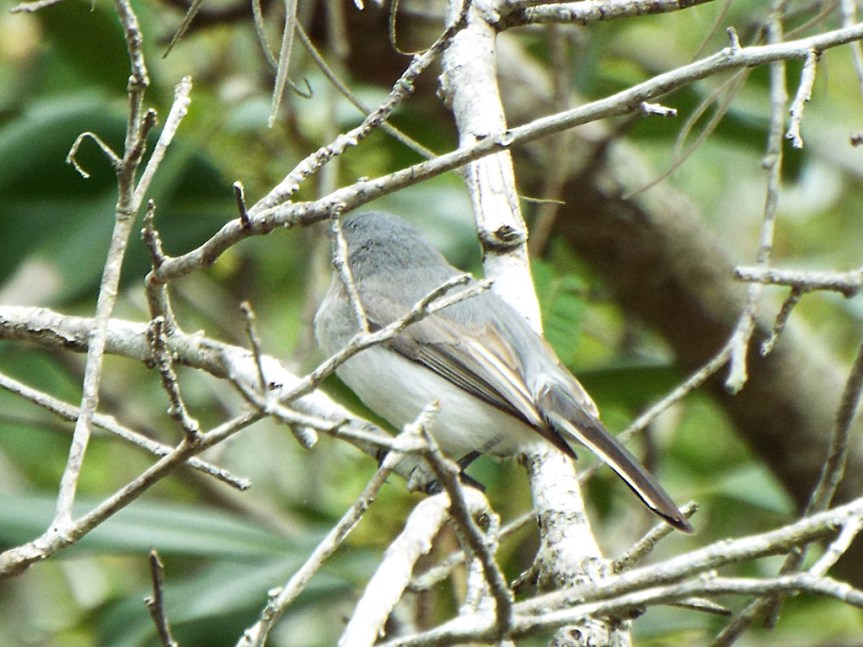
We used the tried-and-true method of locating common and vocal resident species, such as Northern Cardinals and Blue-gray Gnatcatchers to find associated migrants.
The tail-end of a Blue-gray Gnatcatcher. All the birds we saw were so active, photography was not often a fruitful endeavor.
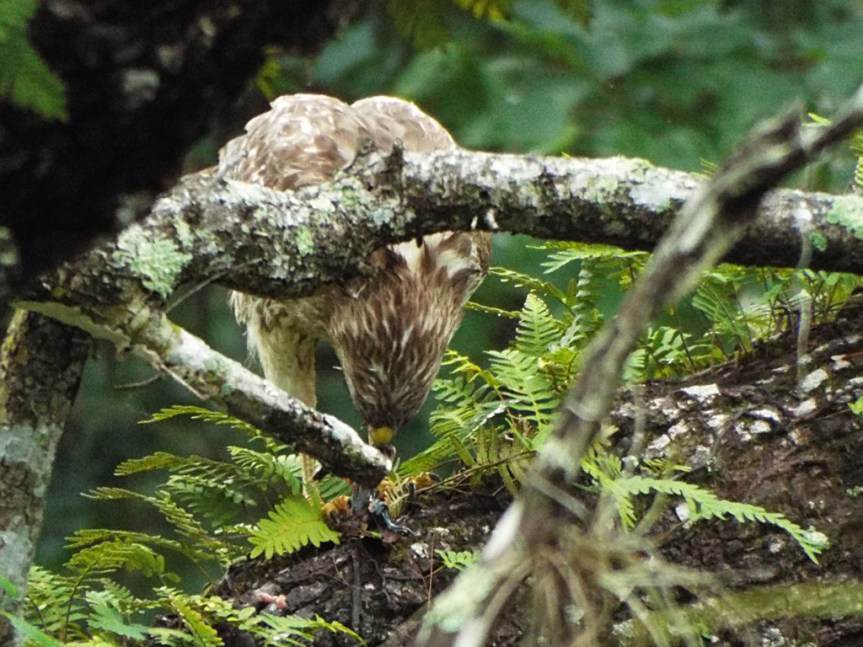
At the end of one overlook (I can’t remember if it was the “Tree House” overlook or not), a juvenile Red-shouldered Hawk landed in some nearby (but obscuring) oak limbs to devour it’s lunch (a frog).
Best-focused and least graphic photo I have of the hawk having a fresh meal.
Of course, spring time is in full swing, and much of our canopy is closed in, which made locating the many Northern Parulas we heard a frustrating exercise. Even later on, with other warblers and vireos singing quite close by, we had to rely on the group’s combined birding-by-ear expertise to positively identify the birds.
Among the FOY birds for me this trip were Black-throated Blue, Worm-eating, and Cape May warblers.
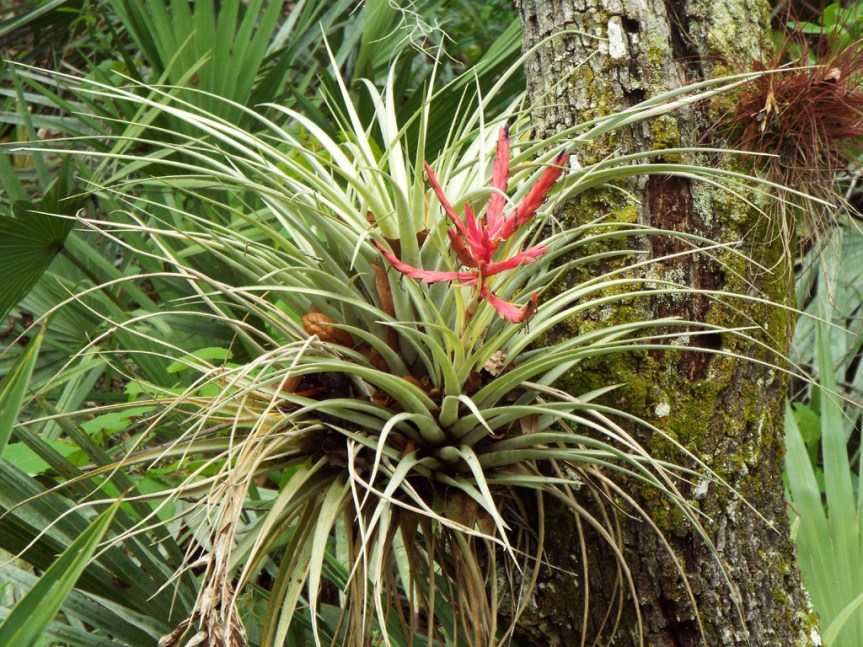
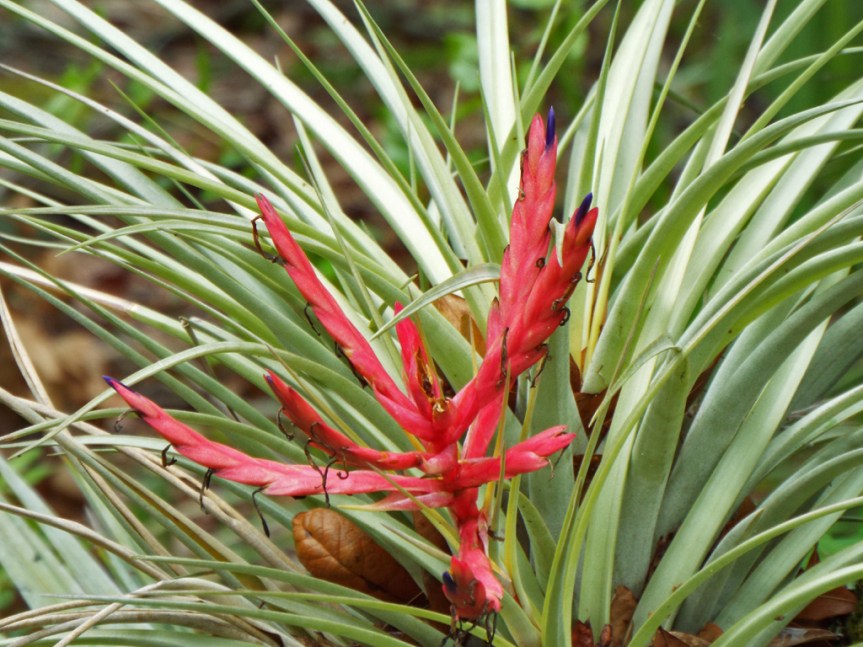
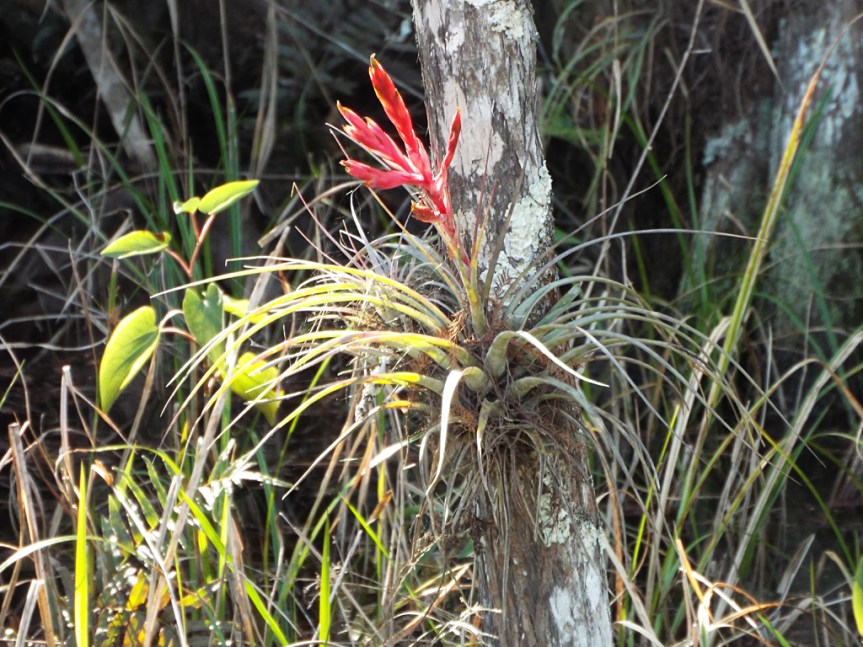
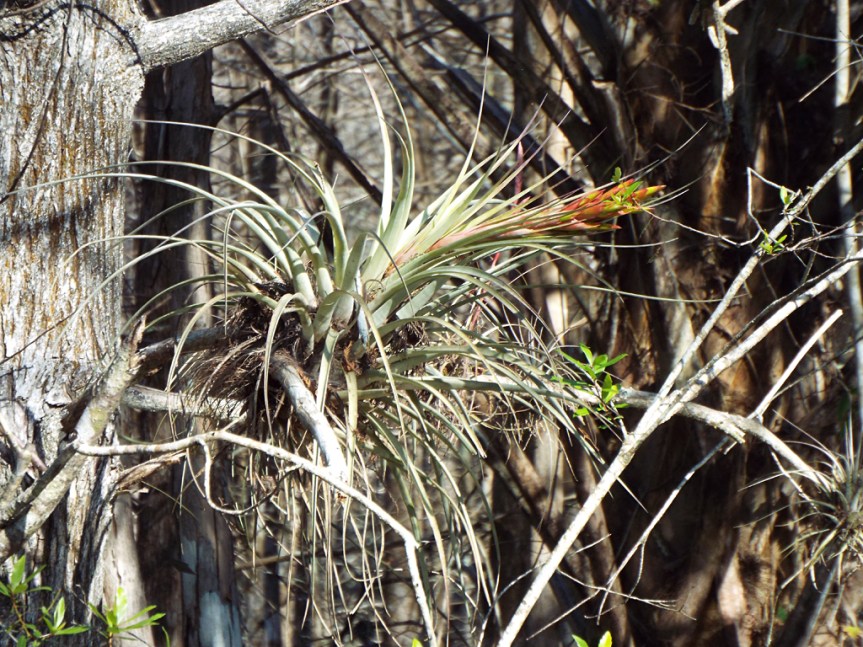
Various airplants and bromeliads are still blooming, like this +2-foot diameters plant with the bright red inflorescence. I was tempted to ID it as a Cardinal Airplant, but the inflorescence looked different to me. If anyone knows the specific species, I’d be glad to know – just leave a comment.
This may be the largest airplant I’ve seen, outside of the Everglades.Brilliant red inflorescence.
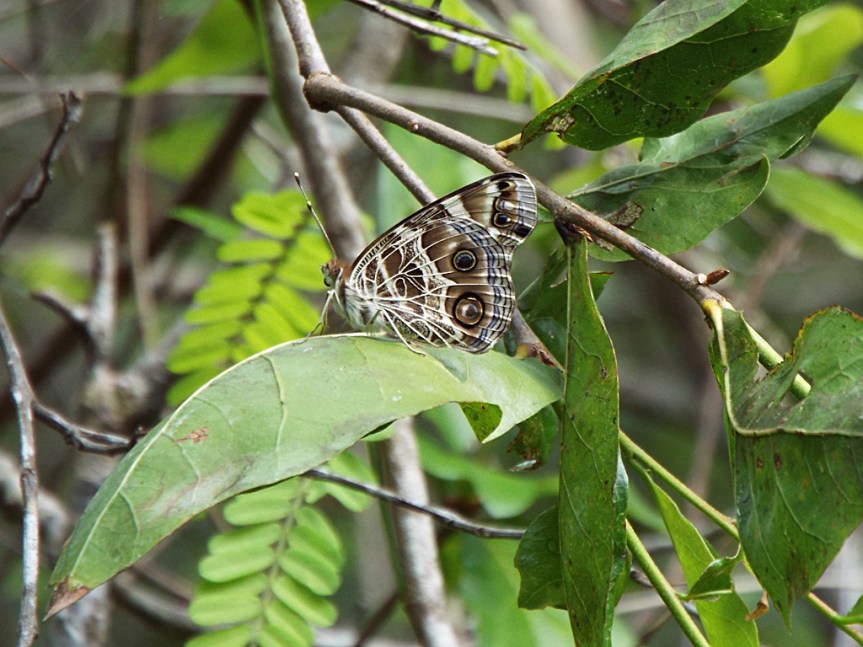
We had some non-avian friends as well. A pretty orange butterfly landed on the path from McKinnon’s way to the jogging path. When it finally landed, it refused to open it’s wings (at least until after I left the vicinity – other’s ID’d it for us).
American Painted Lady butterfly, resting.
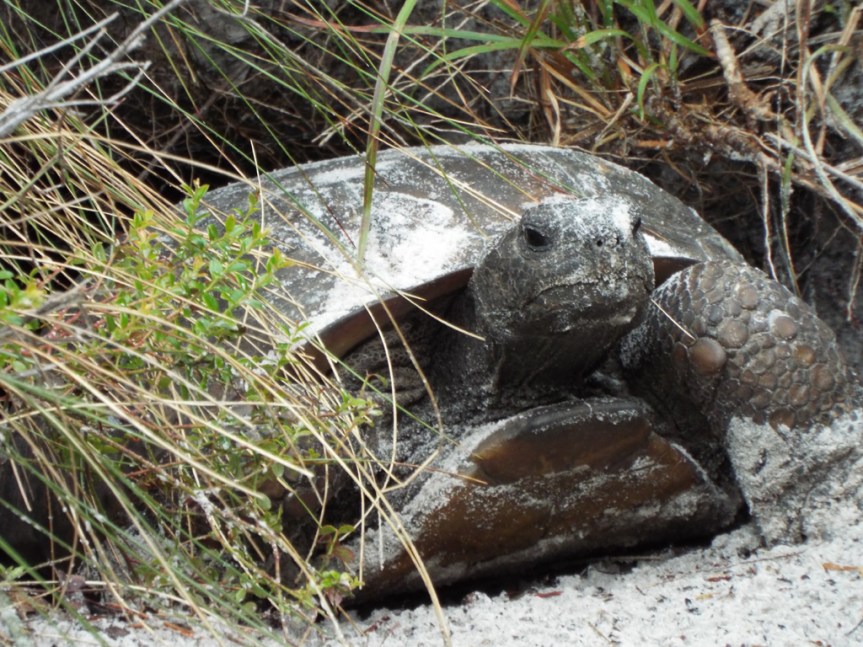
No trip to Turkey Creek Sanctuary is complete without a Gopher Tortoise sighting, of course. This one was just off the boardwalk on the way toward the park entrance.
Gopher Tortoise hanging out on the equivalent of its front porch.
By the end of the walk, only a few of the 10 of us remained (it was a taxing walk, with little reward at first), and we were treated to a couple of male Indigo Buntings in the sanctuary and public library parking lot. At the very end just Bill and I were left as two Swallow-tailed Kites flew quickly past over us in the lot before the breeze quickly carried them away.
This may bode for some good migrant activity through the week until the weather changes again, and I hope some birders have a chance to get out there and appreciate these birds as they make their way north, in some cases thousands of miles, to their breeding grounds.
This past weekend I attended the Florida Ornithological Society’s spring meeting, near Brooksville, FL. Along with a paper session, keynote speech, and membership meetings, we also had a series of field trips throughout the weekend. I’ve never birded Hernando or Citrus counties, so this was a great opportunity to see some different habitats and maybe get some First of Year (FOY) or life birds.
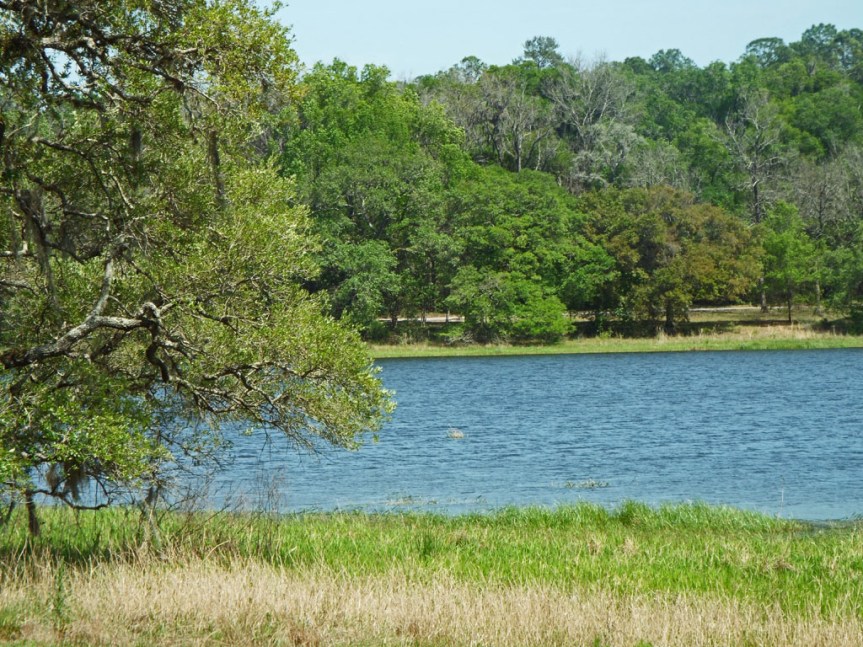
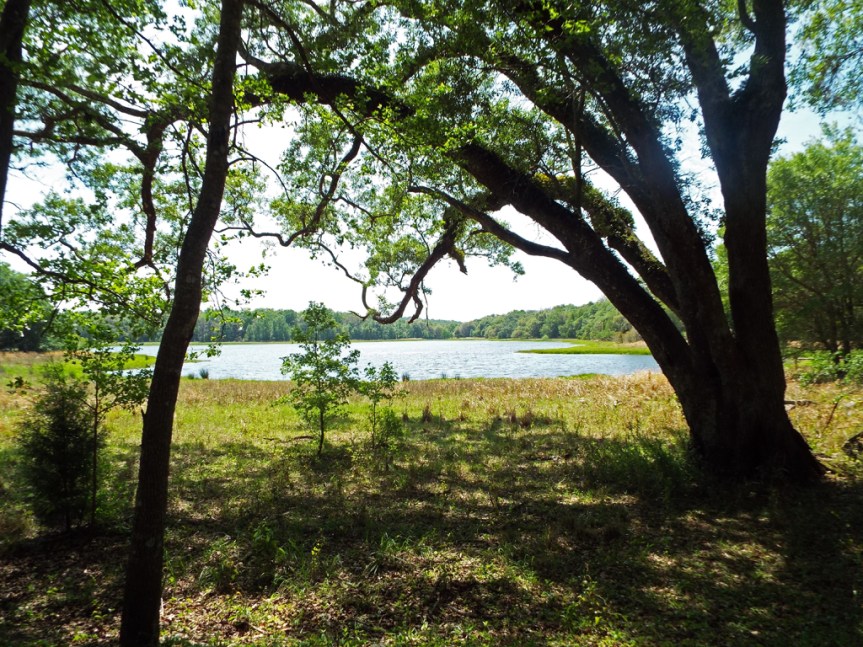
The first field trip was to nearby McKethan Lake [map]. Despite a strong breeze, the day was lovely, and the lake was gorgeous. A group of about a dozen of us, including keynote speaker Dr. Bob Askins, make the 3-mile hike around the lake.
A gorgeous day at McKethan Lake.
The lake is circled by mature Live Oaks and a lovely hardwood-palm hammock habitat. We heard Red-eyed and White-eyed Vireos singing, despite the wind noise. Our trip leader and some others also heard Yellow-throated Vireos (I did not). We were also visited briefly by a small flock of Tufted Titmouses that were clearly agitated and vocal about it!
McKethan Lake is ringed by many large Live Oaks.
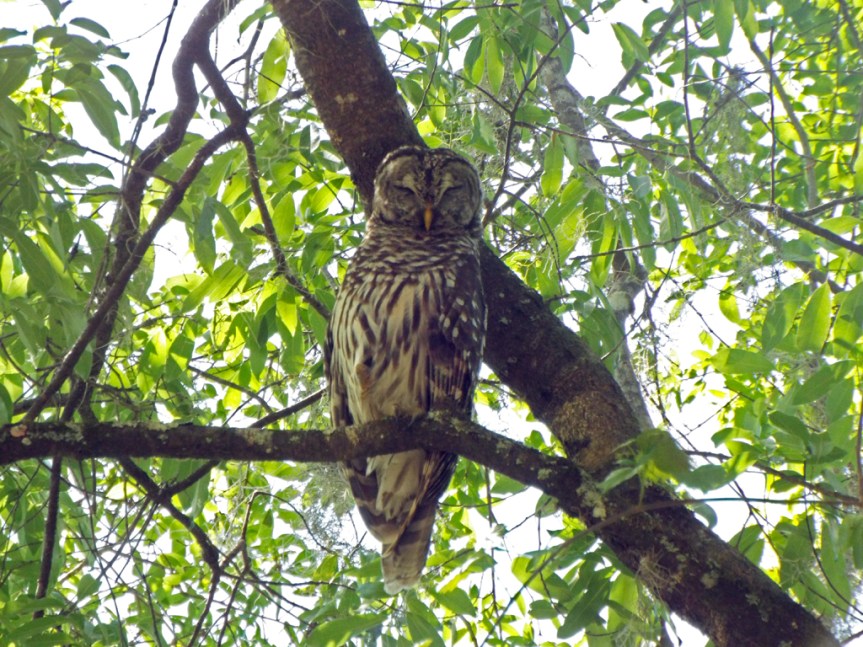
A Barred Owl pair and two chicks had been reported the day before, and we searched the trees for them with no luck. But then someone looked up and saw one of the parents, quite out in the open. It was probably looking out for the other owls, although as you can see, it might have been asleep on the job.
Adult Barred Owl keeping a bleary-eyed watch.
The lake was fairly devoid of water or wading birds. We’re well into spring now, so anything besides Mottled Ducks and maybe some Mallards would be rare. Aside from an egret or two, and a few coots and gallinules, the lake was empty.
One species of note was my FOY Hermit Thrush, which flushed onto a low branch in the woods for a few seconds before disappearing before anyone else had a good look at it.
Back at the Chinsegut Retreat Center [map], where the meeting was based, I decided to talk a walk around the grounds. The usual resident birds were singing, including Northern Cardinals, Northern Parulas, American Crows, and Mourning Doves. A Yellow-throated Warbler was singing in one of the large oak trees, but I never got a look at it.
I met with the vice-president of the Friends of Chinsegut Hill, who was out and about on an ATV with a tool trailer. He told me a bit about the property and directed me down a path that led to an abandoned dining lodge.
The building was creepy. So creepy (the photos do not do it justice) that I was unwilling to go inside on my own. I might have just been convinced to try if I had been with someone else.
The property and surroundings are gorgeous, with a large manor house at the top of the hill, with several air-conditioned cabins, with bathrooms for each room. There is a nearby conservation area, and we were just down the road from the Withlacoochee Training Center [map] (for the Florida Forestry Service), where we had our keynote session and banquet.
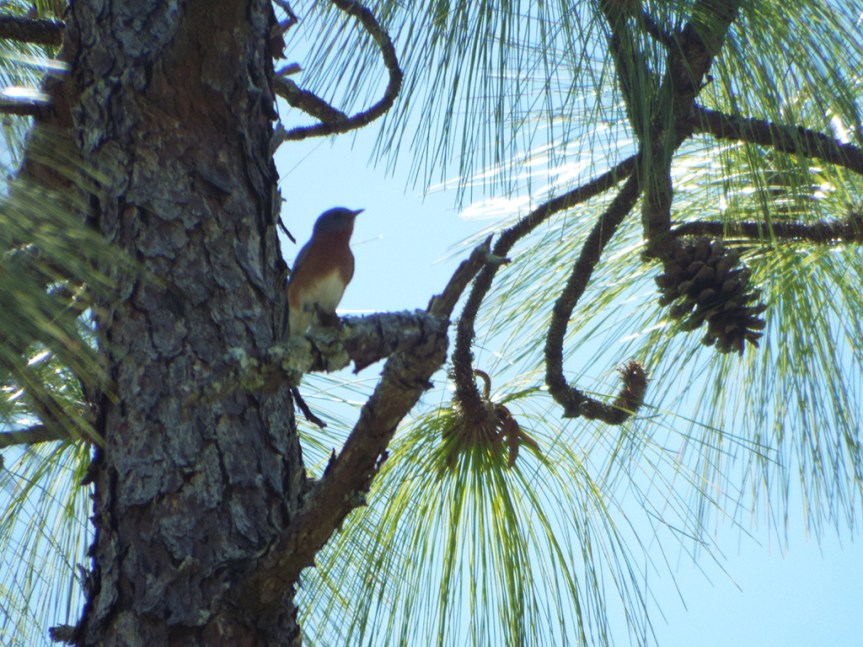
The birds at the training center were present, but tended to be a bit shy, like this male Eastern Bluebird.
Saturday morning was a fair bit cooler, and the breeze was really starting to pick up. One group of us went to the Weekiwachee Preserve [map]. The preserve is a reclaimed sand mining operation with several large and deep ponds (the abandoned sand pits) and some large grassy areas, fringed with woods. There is some limited marsh vegetation along the edges of some ponds, but nothing to support large numbers of waders. Likewise, due to the deep water and low plant production, the biological activity of these lakes are limited, so they also do not see large numbers of ducks or other dabblers and divers.
The abandoned sand pit ponds are beautiful, if empty.
The open grassy areas are potentially good for sparrows and upland wrens, but with the wind, we didn’t see anything like that. A few optimistic Forster’s Terns, Bald Eagles, and some overflying gulls were all that we saw over the ponds. We had a little more luck in the trees, including Eastern Bluebirds, a Pileated Woodpecker, and a few others.
On our final day, some of us went to Fort Island Beach Park [map] to look at shorebirds and take our chances to find some Seaside Sparrows. While the sparrows were a no-show (probably due to the wind), we did get a nice group of shorebirds before the beaches had too many people arrive.
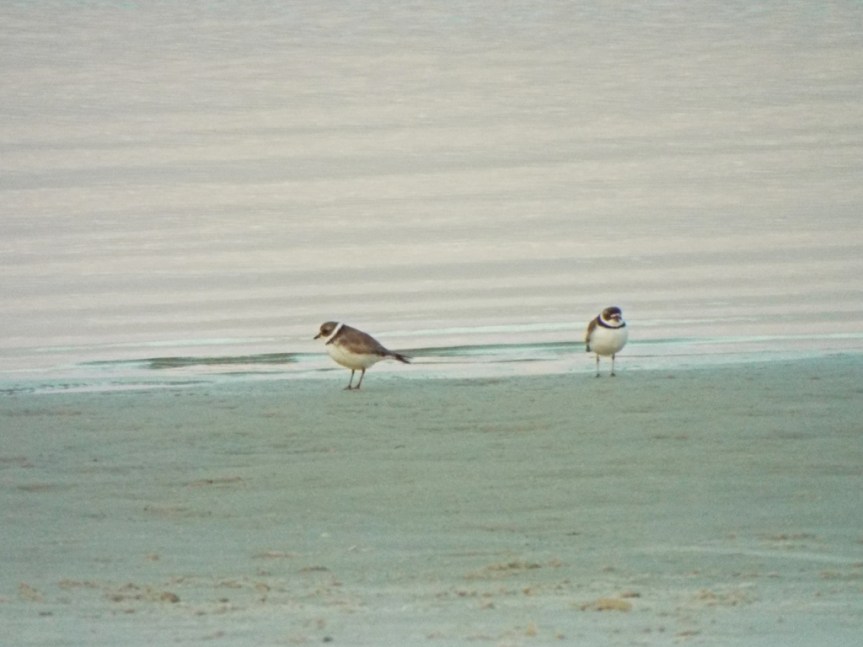
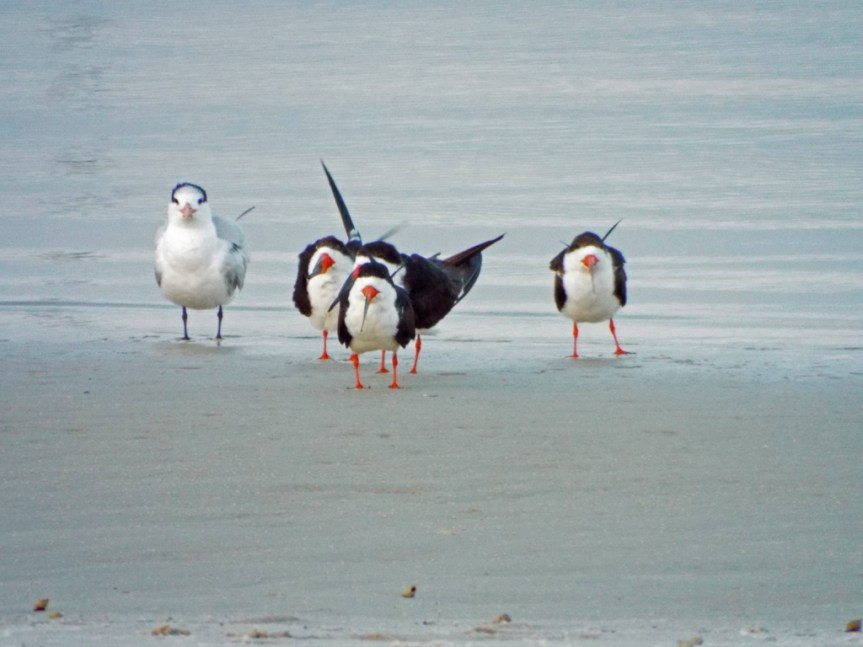
Two Semipalmated Plovers on the beach. Black Skimmers and a Royal tern resting between foraging runs.A Least Sandpiper on an oyster bar remnant.
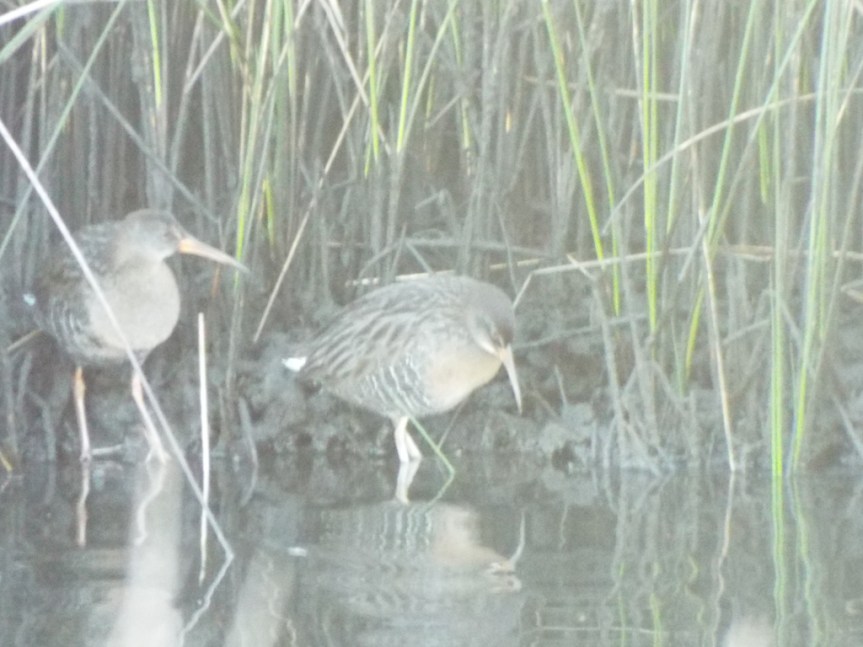
Across the parking area was some salt marsh habitat where some Clapper Rails were calling back and forth. On a hunch, I left the group and walked over. The sun was still low on the horizon, making the entire marsh back-lit and hazy looking. Despite that, I could see two Clapper Rails out in the open and got some low-contrast photos before rejoining the group.
Clapper Rails.
After checking out the shoreline, the group walked onto the boardwalk path into the adjacent hammock [map]. Almost immediately upon walking in, I saw a female Prothonotary Warbler on the side of a palm tree. She quickly took stock of about 20 people walking toward her and made a bee-line out of sight. A few of us tried to coax her back out (mainly by pishing), to no avail.
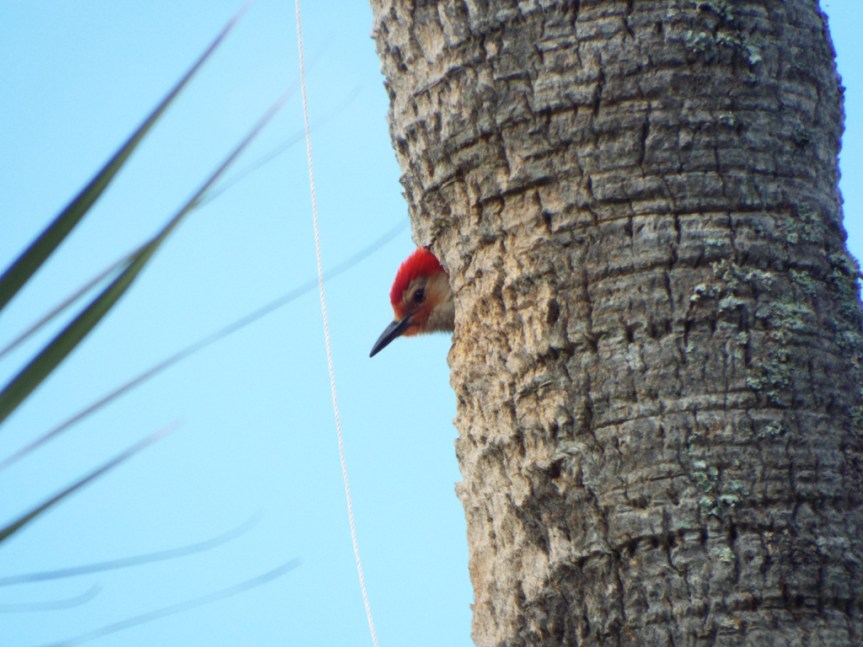
I walked down one part of the boardwalk in pursuit of a chip note I kept hearing. To the right was a dead palm tree with a woodpecker hole in it. Then out popped a little bird head, and a Red-bellied Woodpecker called out. He seemed content to call from the safety of his home for a few minutes, but he did eventually venture out. I didn’t hear any calls back from either a mate or other males. That white line through the center of the image is some string that was partially wrapped around the tree. It didn’t seem t be blocking the nest hole, but there was no way to reach it to remove it, in any case.
A Red-bellied Woodpecker checks out his neighborhood.
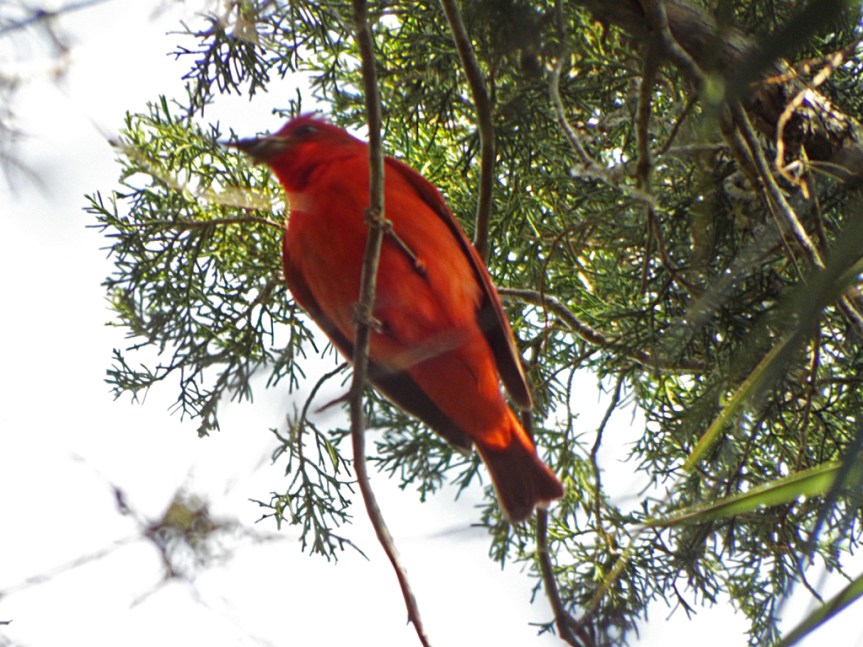
A few meters more along the boardwalk, I saw a flash of red, which I immediately thought didn’t quite look right for a Northern Cardinal. The bird didn’t fly too far, and I saw it was a male Summer Tanager. I’ve previously only seen females or non-breeding males, so this was a good bird to find. He was active and reluctant to stand still for long.
What’s up?
Another birder and I watched him for as long as we could, before he finally worked his way deep into the hammock. He did come out later and some other members got some good looks and photos.
I walked back to join up with the rest of the group and found them congregated under an oak tree, intently looking with binoculars. There were two Red-eyed Vireos and a Tennessee Warbler foraging in the canopy. It took some patience and iBird Pro referencing before I could discern the Tennessee Warbler – a life bird for me! There were also two Yellow-throated Vireos in the dense vegetation.
The boardwalk exited the hammock by the beach. I walked to the right and found a path behind some mangroves and over some small dunes. There was a small wetland there with cardinals and some House Wrens singing.
I decided to see if anyone wanted to check the area out, as I heard some softer chip notes, and I went back to see who might be interested. On the dune crossover I had to step over this gorgeous Gulf Salt Marsh Snake.
Ultimately I got Jim Eager and Karen Askins to come over with me. We flushed a male Prothonotary Warbler, who tried to hide in the mangrove trees. Jim didn’t manage to get a look at him, but the yellow on his head and throat was the brightest I’ve ever seen on a bird. It was shockingly yellow. He would not come out of the mangroves for a photo, however.
We walked back out to the beach and joined the main group to try our luck along the shoreline for wrens or sparrows. We did get a couple of Sedge Wrens to sing out, but nothing else showed itself. It was still breezy, which likely kept the smaller birds hunkered down.
We went out to a couple of other locations to find Seaside Sparrows, but didn’t have any luck. At Red Fish Hole [map] a Marsh Wren was singing within a couple of feet of us in thick tangles of rushes, but we could not see him. He kept singing and didn’t fly out or away. Otherwise there was not much activity.
It was a busy and enriching weekend. I was glad to see both new and familiar faces, the paper sessions were informative, and Dr. Askins’ keynote speech was well received. In six months, we’ll meet up again at Archibold Research Station, in Lake Placid.
I recently traveled from Homestead to Flamingo, through Everglades National Park. Despite some drizzly weather, it was fabulous! I even saw my first American Crocodile and white form of the Great Blue Heron (sorry, no photos 😦 ).
Double-crested Cormorants
Male Double-crested Cormorant.
Female Double-crested Cormorant.
Male Double-crested Cormorant.
Double-crested Cormorant plumage up close.
Various plants
Coral Bean Flower
Cardinal Airplant inflorescence
Swamp-lily (also called Seven-sisters and String-lily).
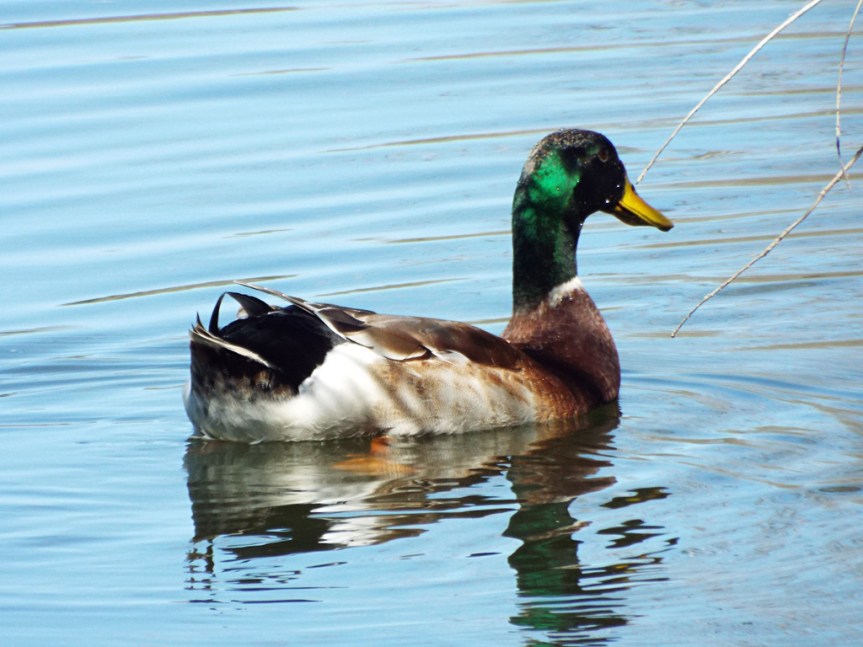
Here are some recent photos taken of the local domestic and feral domestic waterfowl at Veteran’s Memorial Park, in The Villages, FL.
All the Mallards there have been “officially” classified as domestic or hybrids, according to the ABA and eBird.
Another telltale trait of domestic-type Mallards is size. Mallards with domestic genes are usually noticeably larger than wild Mallards. This duck was quite large.
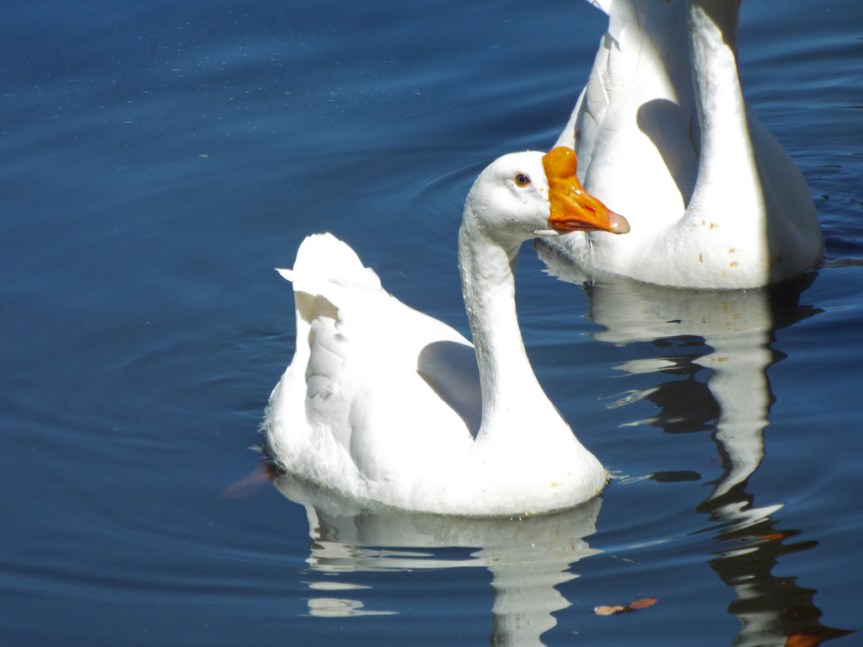
Of course, there usually are the typical white ducks and geese, too.
Typical domestic goose. I love all birds, but to be honest, that mean look isn’t just coincidence. Geese can be mean (but probably not as mean as swans)!
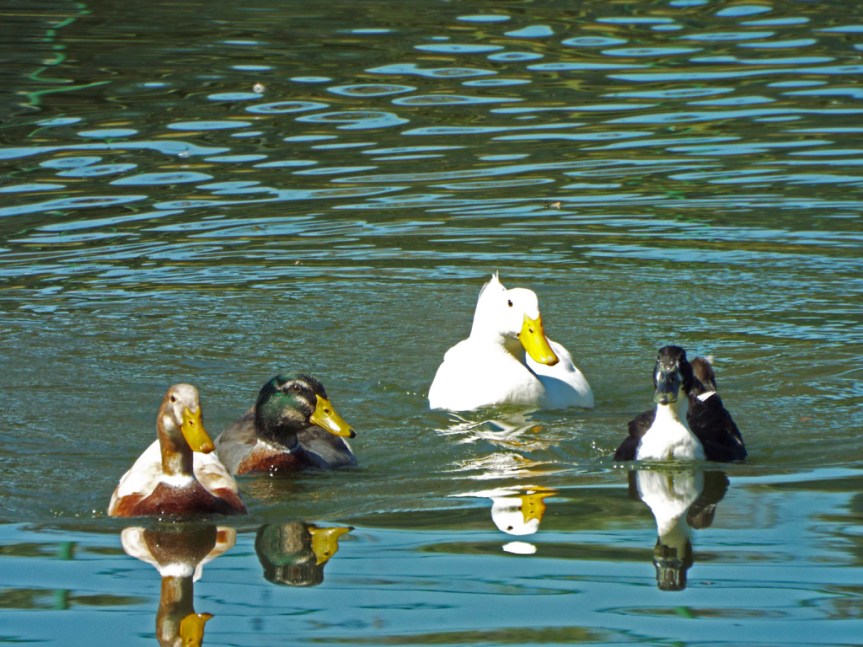
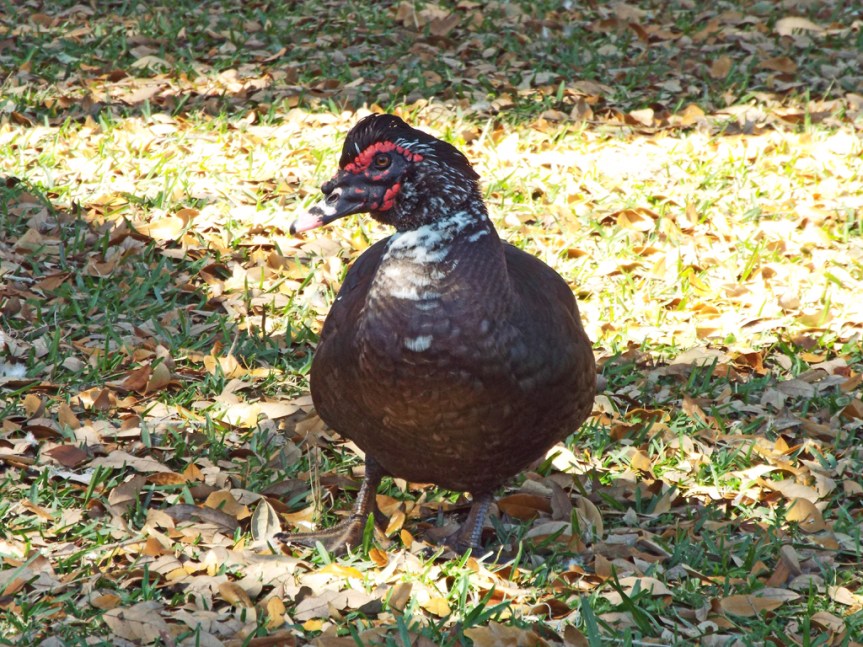
The local “established feral” Muscovy Ducks have also bred with the Mallards, resulting in some interestingly patterned ducks.
Note the subtle head patterning on the second duck from the left. That cinnamon shaded duck was stunning! A “typical” white domestic duck and a hybrid round out the crew.
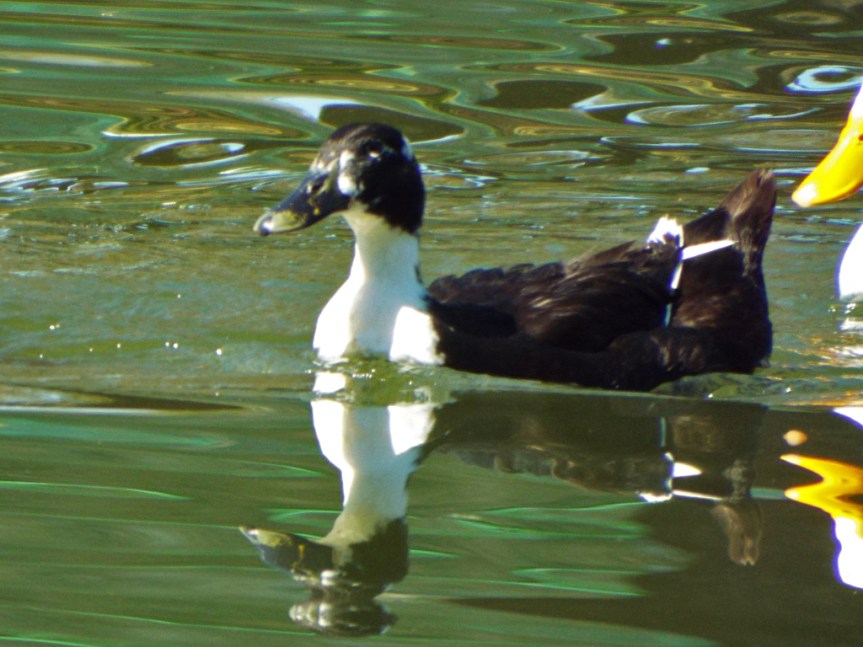
I am pretty sure this one is a Mallard-Muscovy-Domestic Duck!
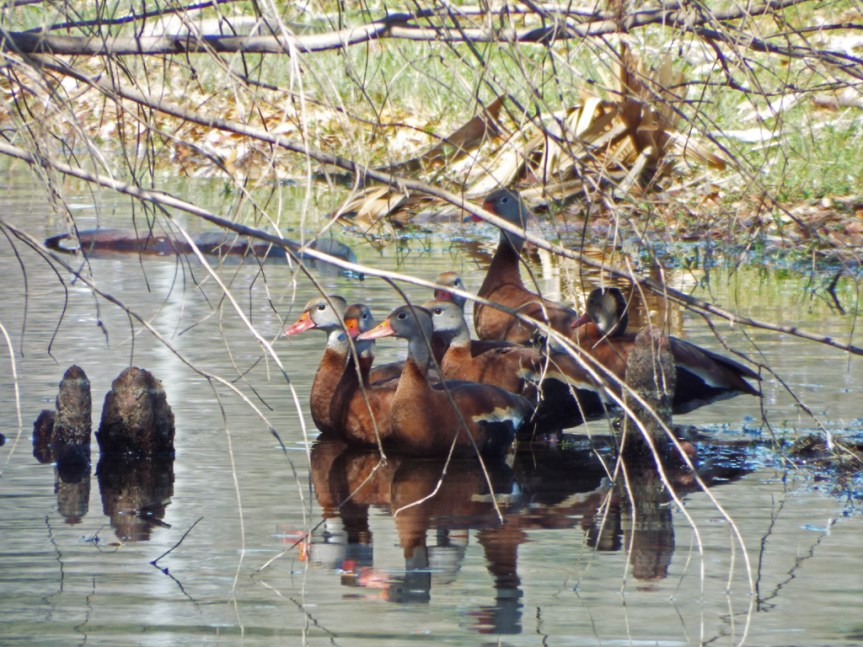
While this parade of semi-domestic ducks swam by, several groups of Black-bellied Whistling Ducks (totaling over 50 birds), newly arrived and taking a rest, watched from a safe distance.
These Black-bellied Whistling Ducks were looking on at the locals like disapproving parents at a KISS show (ask your parents. Or grandparents).
The domestic/feral waterfowl may not be “officially” countable, but I love ducks and geese, so even these guys have a warm place in my heart.
I had a very nice outing at Orlando Wetlands Park [map] yesterday. The park has normally been closed from November to February, which meant missing the bulk of the ducks that arrive there in the fall. I’ve been anticipating getting back to the park before the real heat of summer sets in.
There is some good news, though. This past year, the City of Orlando bought the hunting rights from the former land-owners and from now on, the park will be open all year! This will be good news for the Space Coast Birding and Wildlife Festival in the years ahead, as the park normally opened the week immediately after the festival ended.
It had been several weeks since I’ve not birded by myself (some adventures not recounted here), and Camille has been wanting to check out the park now that it reopened, so we once again paired up for the day.
The morning was surprisingly cool, with some light fog. Some birds were still catching the first rays of sun to help warm up for the day.
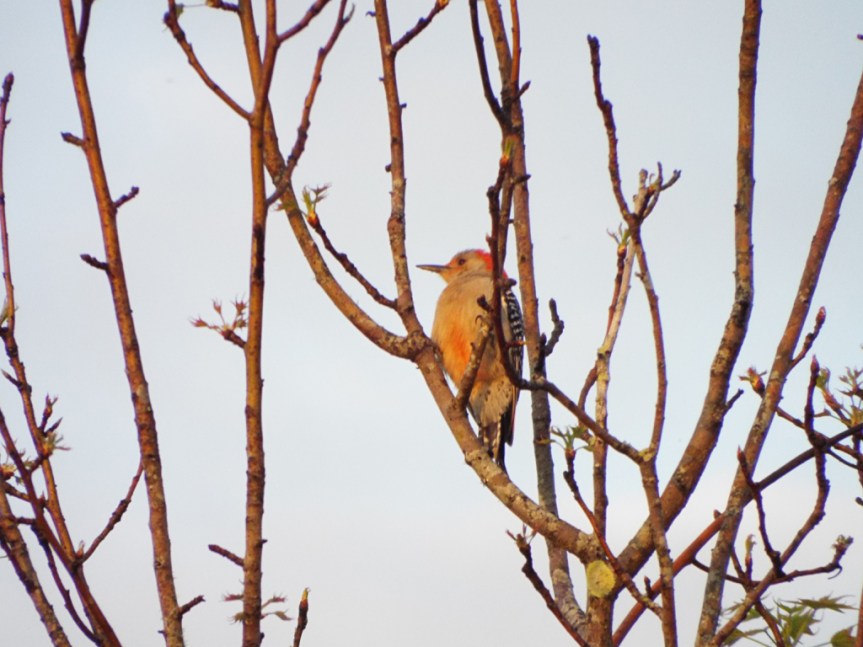
Early morning look at a Red-bellied Woodpecker, with its rarely seen red belly!
We were hoping to catch the Vermilion Flycatcher that had been reported all winter. If you recall from last year, an adult male Vermilion has been visiting the park for several years. This past fall, however, an immature male came in and has been regularly, but intermittently, spotted. We had no luck relocating either bird, but it’s possible one or both have left the area now that spring has arrived.
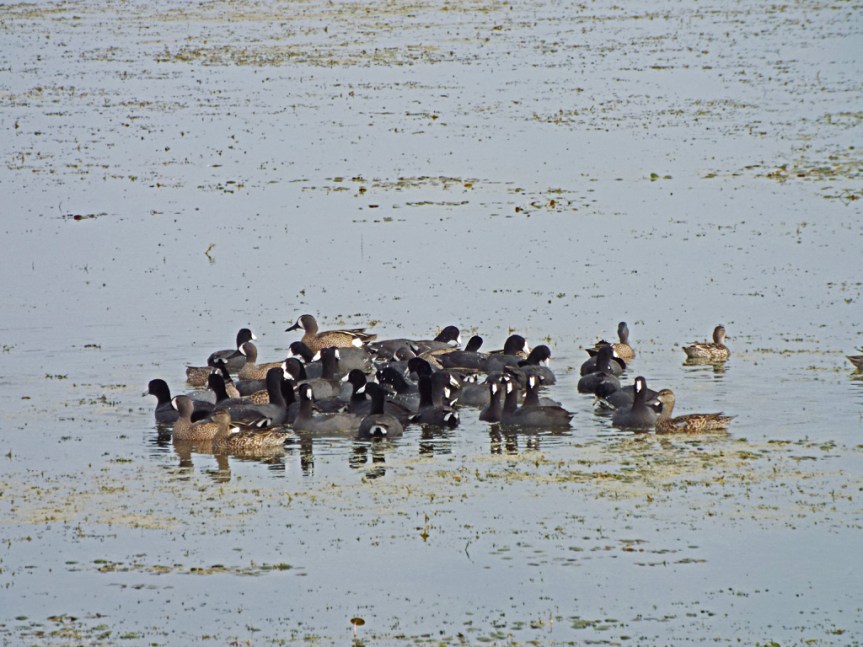
There was also not much in the way of duck diversity. By far the species of duck with the highest numbers was the Blue-winged Teal. They were mingling with American Coots, the males calling with high-pitched squeaks while the females quacked.
Many of the Blue-winged Teals were associating with American Coots in small rafts.
The first group of ducks we saw had a single male Green-winged Teal swimming with them. Although both species are called “teals,” I learned from the Waterfowl 101 field trip at the festival that they are actually not closely related. Genetically and structurally, Blue-winged Teals are more closely related to shovelers, while Green-winged Teals are related to Mallards. In truth, the genetic relationships of teals (like most ducks) is complicated and not well understood.
As we continued our search for the Vermilion Flycatcher, we met Richard Hattaway, who was taking photos. We walked together for a while, sharing some advice, experiences, and tips.
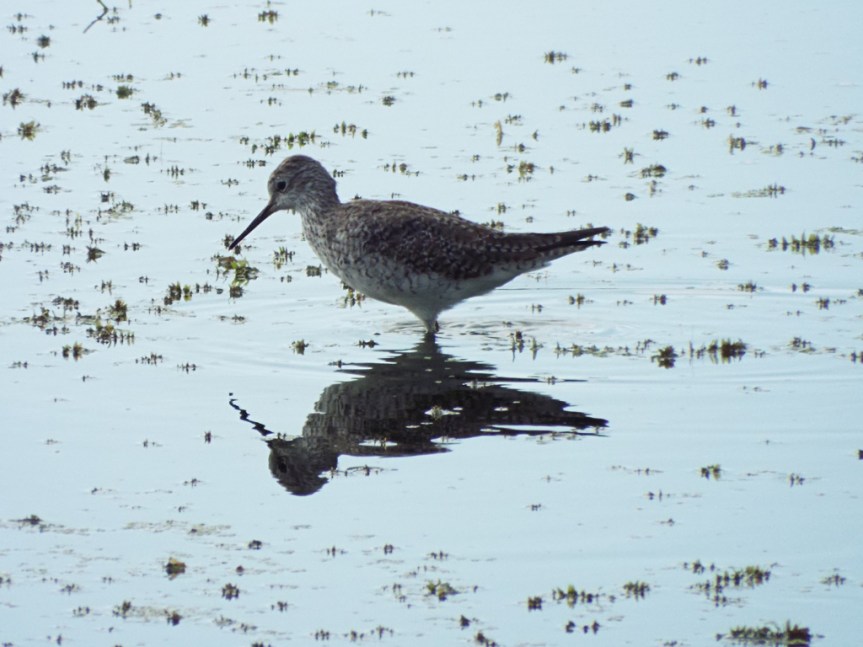
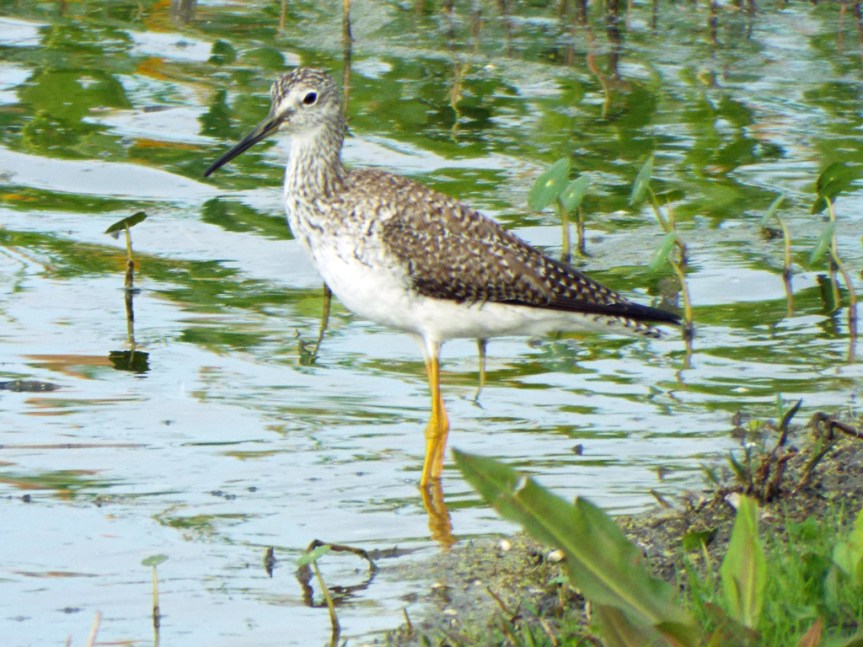
Both Greater and Lesser Yellowlegs were present, and at times in close proximity, which allowed for some good direct comparisons (they did not get quite close enough for a mutual photo-op). Although similar in appearance, size and slight morphological (fancy term for “shape”) differences allow each species to exploit slightly different habitats and prey.
Both yellowlegs species were present (see below). This Lesser Yellowlegs was wading relatively close to shore.
The Greater Yellowlegs larger size, longer legs, and longer bill let it take advantage of deeper water. But here, the bird was content at the shoreline, watching us take its photo.
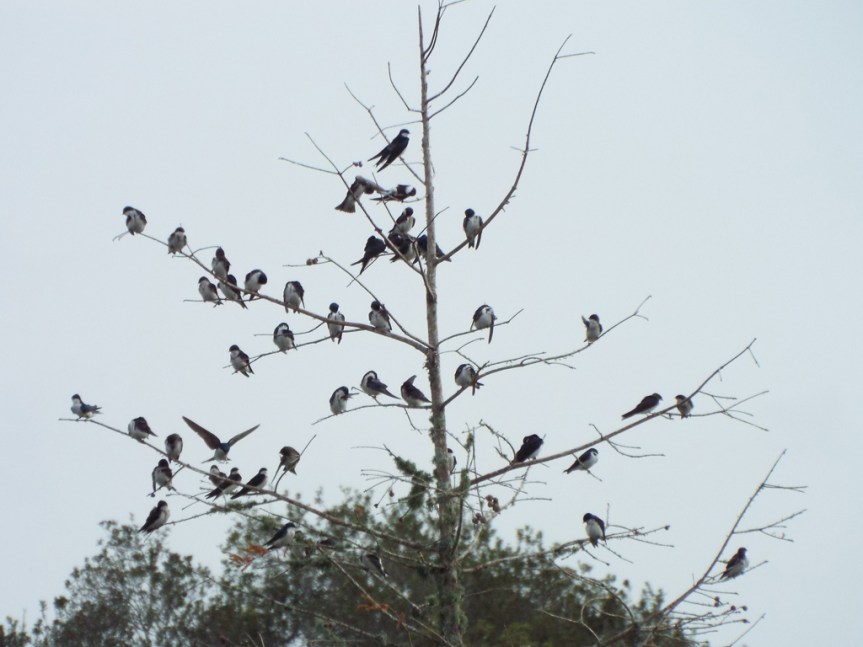
Tree Swallows were widespread throughout the park, though not in any large vortexes. At any given time, smaller groups would rest on cypress trees before heading off at once, while other groups landed to take their turn to rest.
Some Tree Swallows resting in a cypress tree.
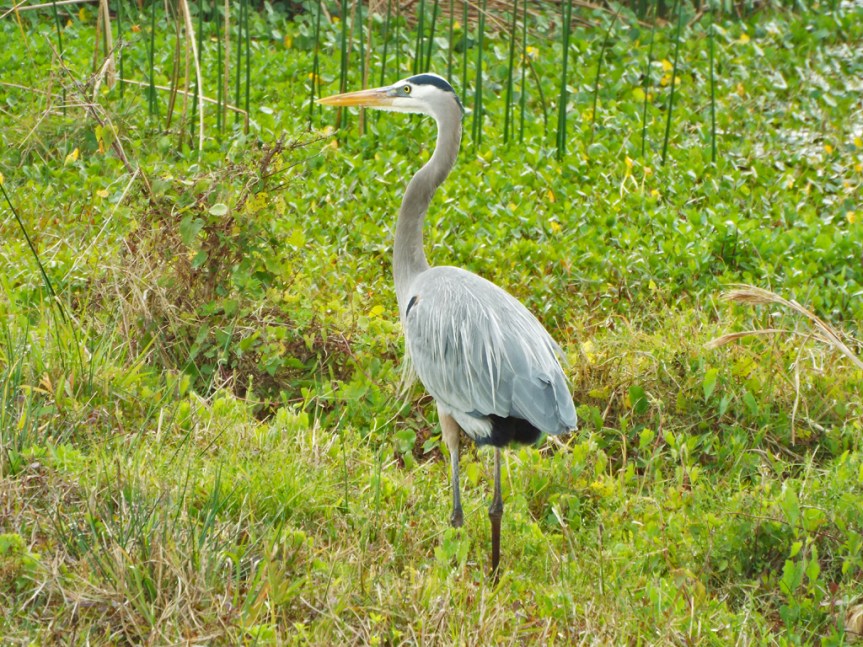
Breeding season in well under way for heron species. Some of the chicks are large enough now that both parents are out getting food for them. This bird was carefully walking the berm road, too busy keeping an eye on us to be hunting for food.
A Great Blue Heron, warily watching.
We said good-bye to Richard at this point, having no luck with the Vermilion Flycatcher (we checked two locations the birds were known to perch and hunt from).
At long intervals along the berm roads, just at the water’s edge, were large purple flowers. I noticed them the last two times I visited the park. Camille says they are an iris of some sort. I’m still not that familiar with plants (thought I am learning), so I leave it up to my readers to identify. If you know what this flower is, please feel free to leave a comment.
I don’t know what this beautiful flower is, but they seem to grow at the water’s edge. The petals span about six inches across.
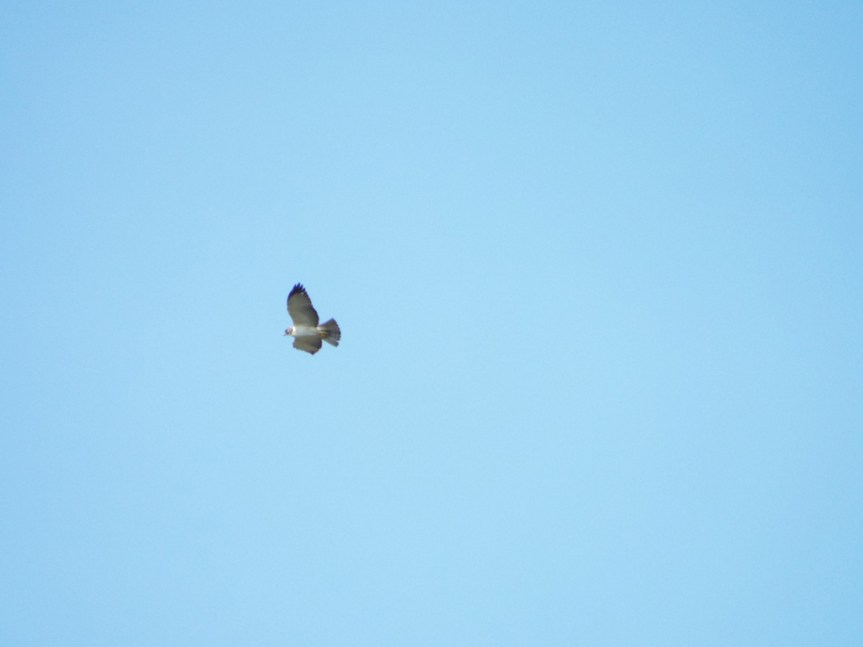
Just prior to leaving the open acres of berm roads and wetland cells for the wooded “hiking trail,” we caught sight of another rare bird visitor to the area. People had been reporting a Short-tailed Hawk associating with Black Vultures. We kept an eye to the sky for the entire morning, in case we caught glimpse of it as well. The bird was “kiting” with a group of circling vultures, occasionally dipping down out of sight. Birds kite or are kiting when they use airflow over their wings to stay aloft while not moving in relation to the ground or water beneath them. This typically requires a steady and stiff breeze. Kiting differs from hovering, which is when a bird uses rapid wingbeats to stay aloft (like a kingfisher ready to dive for fish, or a hummingbird at a flower).
The only “reasonable” photo of the light morph Short-tailed Hawk that I took. A rare bird that has been reported at the park for the past week or so.
This wooded section of the park [trail map] is a palm-dominated hardwood hammock with a fairly open understory. We heard Northern Parulas singing all around, and encountered Blue-headed Vireos, Tufted Titmouses, Black-and-white Warblers, and Ruby-crowned Kinglets. This section of the park is comparatively primitive, but the trails are flat, open, and well-marked, with a few wooden foot bridges to cross the wetter areas.
As we got deeper into the woods, more hardwoods (like oaks and maples) mixed with the palms, with Resurrection Ferns, vigorous airplant growth, Spanish Moss, and other epiphytes.
The end of the trail we emerged from connected back to the berm road about a mile from the parking area (via another wooded trail). After a full morning of walking, this last stretch became formidable, and by the end my feet and hips were really feeling the strain. In total we walked about 4 miles, but it felt like more! I think I must have gotten considerably out of shape over the winter.
By the end of the walk, we identified 67 species with one rarity (the Short-tailed Hawk).
April is fast approaching, and with it the FOS meeting and that much-hoped-for trip to Fort De Soto. Next up, though, is a south Florida day-trip. Stay tuned for that next week!
It’s been time to take a breath and a pause, here at Lonely Birder Central. I just completed the Freshwater Systems core module for the Florida Master Naturalist Program. Part of that course were group projects that we presented on our last day of class (“graduation day”). There were some really spectacular presentations; we have everything from Freshwater Systems Jeopardy to video productions.
The group I was a member of did a signage proposal for the Moccasin Island Tract/Lake Winder. Readers of this blog will remember that the Moccasin Island Tract is part of the River Lakes Conservation Area in Brevard County, and site of several Lonely Birder adventures!
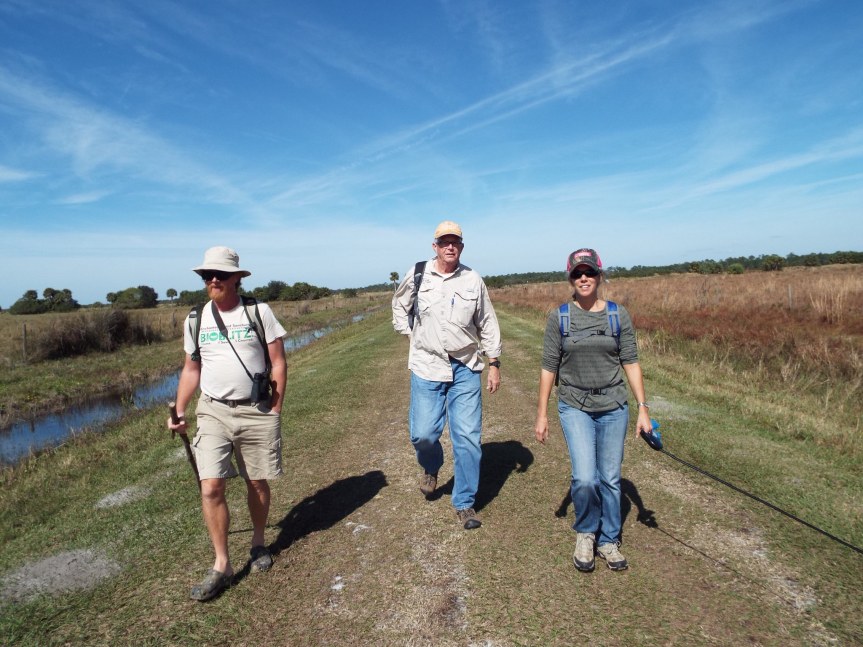
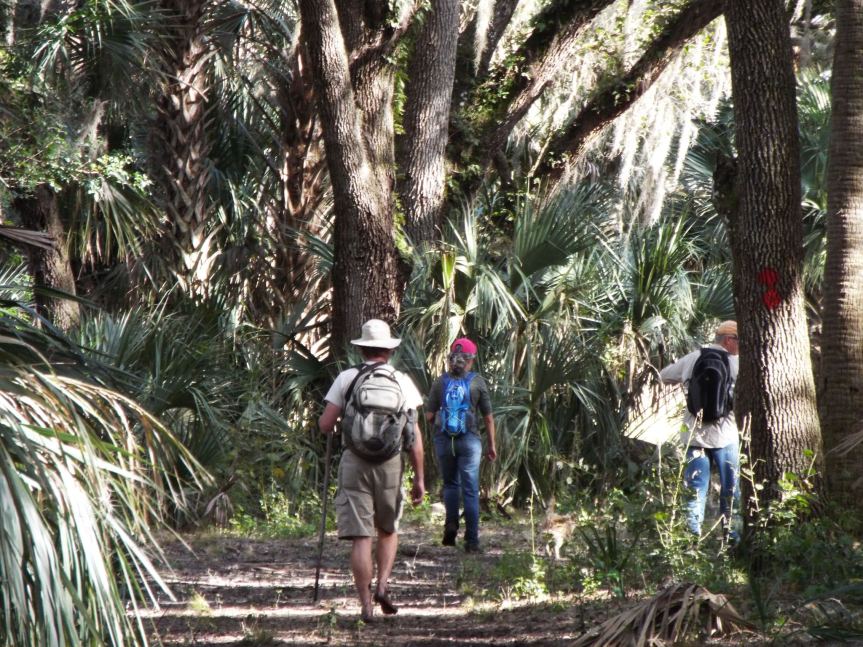
Our project group: Brian Bowers, Jim Higham, Jolyn Rozzo, Lucy (not pictured), and me (also not pictured).Working our way through the Oak Hammock Trail (this is one of the drier sections).
Our group’s presentation is embedded below. It’s a little rough around the edges, and it remains to be seen if the St. Johns River Water Management District wants to use anything we’d produce. The point of the project, of course, was not to necessarily have anything accepted or officially approved, but to get out and experience Florida’s freshwater systems (lakes, rivers, springs, swamps, and marshes) and work together.
I can’t link to everyone’s presentation, but the videos produced by Curtis Whitwam and Peggy McGrath were well done. They are meant to be used at nature or environmental education centers. They are concise and informative. It’s amazing what a little GoPro will do.
Allison Arteaga made a watercoloring book that anyone can download and put together of various freshwater wetland animals and plants. Allison is (among other things) the Lagoon Restoration Specialist at the Brevard Zoo. I’ll try to link to the files when she gets them uploaded and ready.
Now that the module is over, it’s time to both consider my next move in the FMNP, and of course, to get back to some regular birding! Migrants and spring/summer residents are already starting to move through the state. In fact, Swallow-tailed Kites and Great Crested Flycatchers have been reported as far north as Daytona Beach and Lake County.
I’m ready and excited for the Spring. I have trips to south Florida planned for this month, and we have the Florida Ornithological Society’s Spring Meeting in April. I also hope to make it out to Ft. De Soto in April and there’s the Global Big Day in May.
It’s Springtime in Florida! Yes, February is the month in which trees begin to bud, flowers are blooming and the pollen is starting to fill the air! By the end of this month, many of the resident birds will be nesting, mating will have started, and a few species will even have eggs on the nest (in fact, some Bald Eagles and a few herons already have chicks).
Last week, for our Florida Master Naturalist Program class, we had classroom and field work at Saint Sebastian River Preserve State Park [map]. The focus was on “wooded wetlands”, a.k.a. swamps.
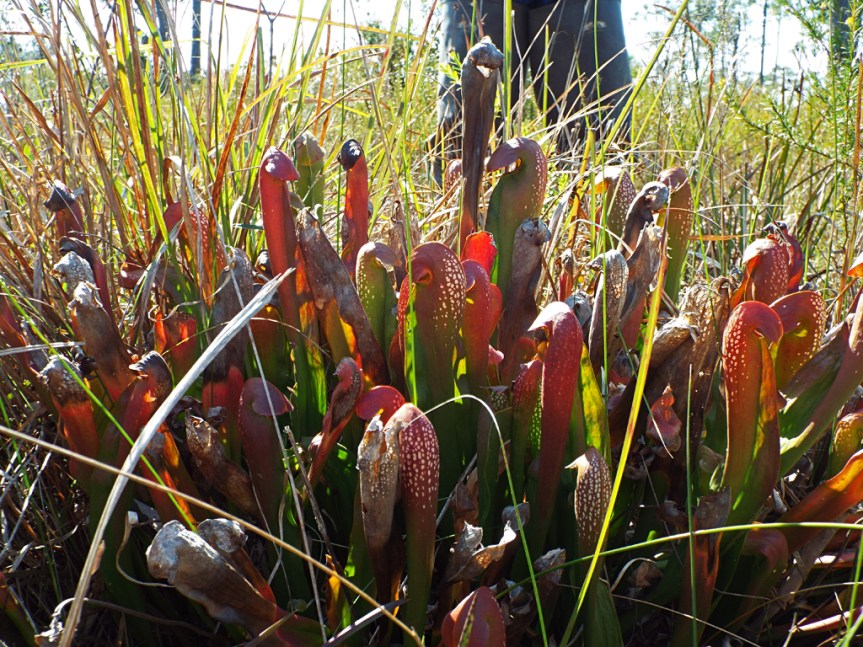
But, before heading into a cypress dome, we detoured to an area in the park with groups of the endangered Hooded Pitcher Plant. Pitcher plants are usually associated with seepage wetlands with very specific soil conditions. In this case, disruption of the normal hydrology by the placement of large power lines through the area have created optimal conditions for these plants. Pitcher plants are carnivorous. They lure prey (usually insects) into the pitcher with sweet tasting and smelling liquid. Once inside, however, the prey cannot climb or fly out. Once trapped in the liquid, they are digested. Amazing!
A mature group of Hooded Pitcher Plants. The small translucent windows just below the top of the hood marks it as this species. These windows are possibly used to confuse trapped insects, which bounce off the windows (thinking they can escape) and fall into the plant to be digested.
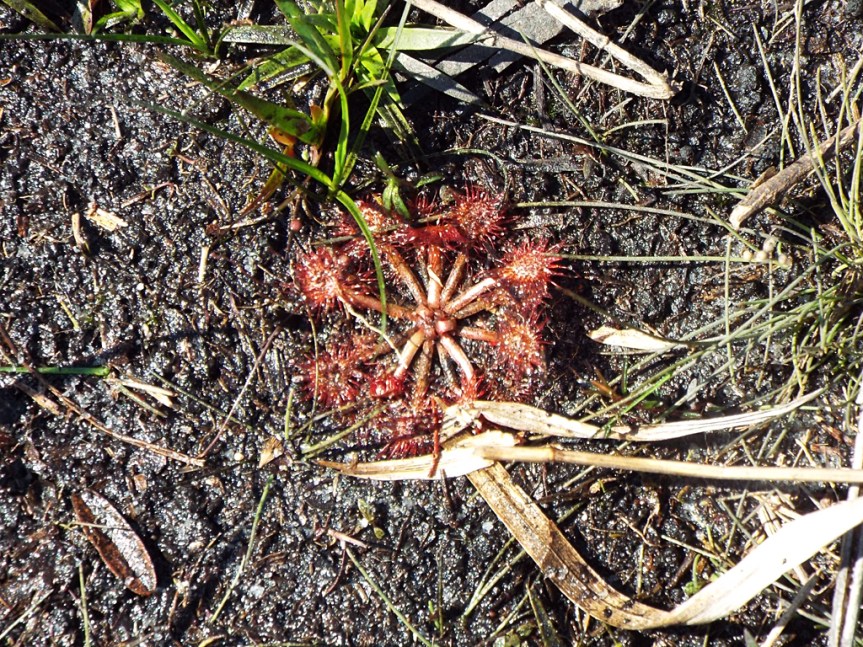
Along with the pitcher plants there were areas of Sphagnum Moss, which ensures a supply of water for the pitcher plants and other organisms during normally dry times. Another carnivorous plant was found nearby – the Dwarf Sundew.
The Dwarf Sundew is the smallest species of sundew. This specimen was just a bit larger than a U.S. Quarter in diameter.
Sundews attract small insects to their sticky, paddle or spoon-like extremities, where the tendrils slowly wrap around them, trapping the insect and digesting them. Such fun!
We went in to see these fragile plant communities in groups of about 5 at a time. While waiting for other groups to take their turn, I noticed a few birds in the vicinity, including Eastern Bluebirds, Brown-headed Nuthatches, and Pine Warblers.
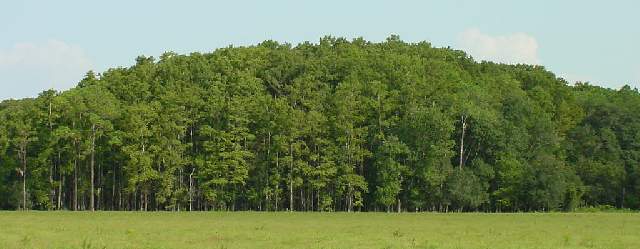
In any case, we then continued on to the swamp. Technically, the State of Florida, a swamp is a wetland with over 1/3 woody plant species. Cypress domes are a particular type of swamp, dominated by cypress trees, as you might expect (Pond Cypress). Cypress domes are so named because the optimal conditions (and deepest) water at the center of the wetland helps the tallest trees grow there, with slightly less optimal conditions with increasing distance from the center. The trees get progressively shorter, creating a dome-like shape. The difference in water depth may only be a matter of inches, but that can have a profound effect on the productivity (measure of plant matter and growth) in the swamp.
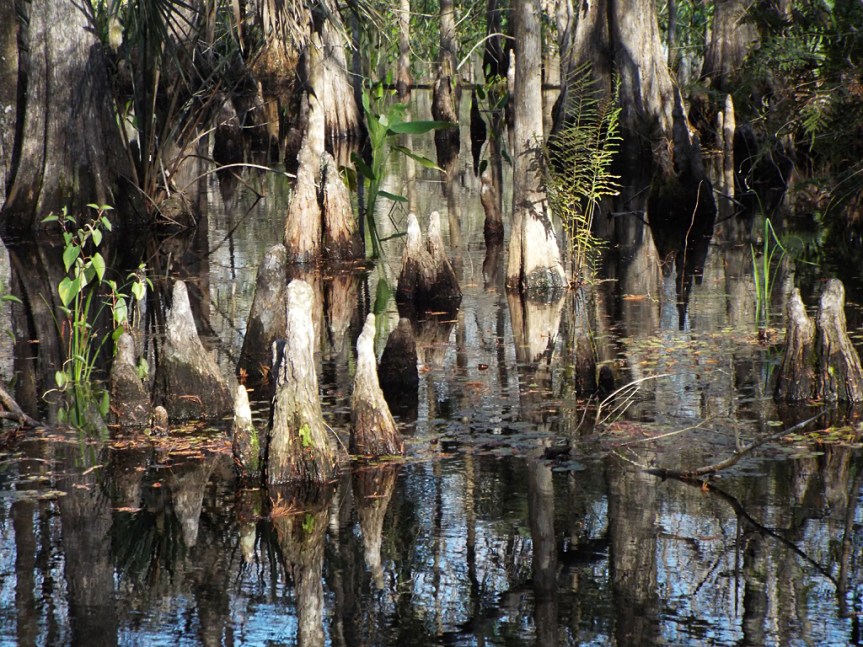
Another peculiar feature of cypress domes are cypress knees. Cypress knees are knobby projections of the trees’ roots that rise above the water. It has been speculated that this is to allow for gas exchange with the roots that are otherwise underwater, but there is not 100% agreement in scientific circles if this is true. Another hypothesis is that they are stabilization structures, working in concert with buttressed roots, to keep the trees upright in the soft soils.
Some cypress knees and buttressed roots. Buttressed roots flare out like bell-bottom pants. This shape helps make a wider base for the trees to stand on, keeping them stable in mucky or soft soils in wetlands.
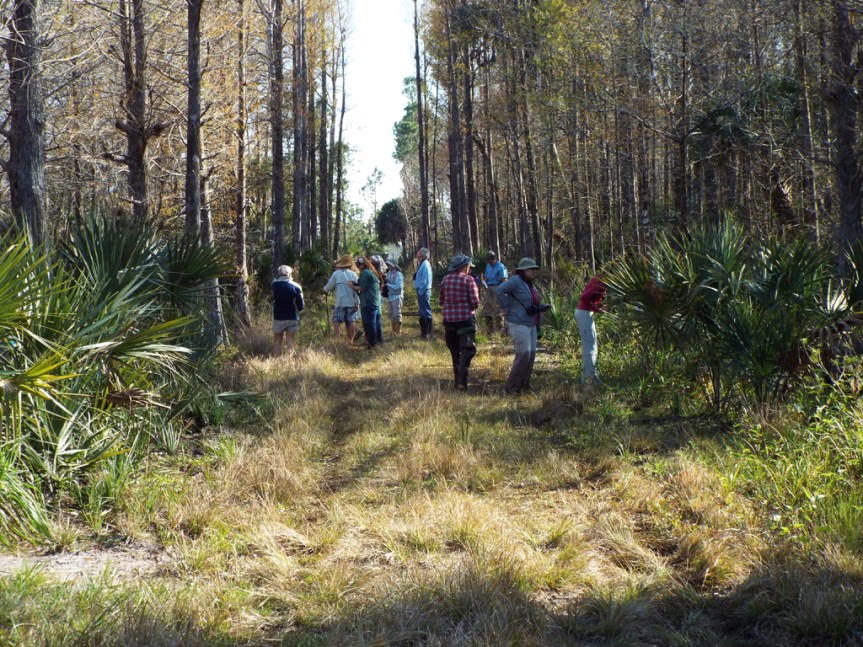
Some students were given dip nets and waded into the water to see what they could find in the swamp, while other (including me) walked along a gas line right-of-way that cut through the dome.
Some beautiful buttressed roots on the tree, just left of center.This gas line right-of-way has split the hydrology of the cypress dome, but the two halves seem to be doing OK, all things considered.
As I’ve said, February is Florida’s spring, and many plants are starting to bud and flower. Among these are various epiphytes. Florida is home to a couple of dozen epiphyte species, which include Spanish Moss, Wild Pine, Cardinal Airplant, and other bromeliads.
This Cardinal Airplant (so-named for its bright red inflorescence) was about the size of a soccer ball (football).
–
This Wild Pine was about the size of a basketball. This, and other bromeliads, are related to pineapples. Can you see the resemblance?
Near the edges of the water, some herbaceous plants were growing, providing some cover for various invertebrate species, including crayfish, fishing spiders, and insect larvae.
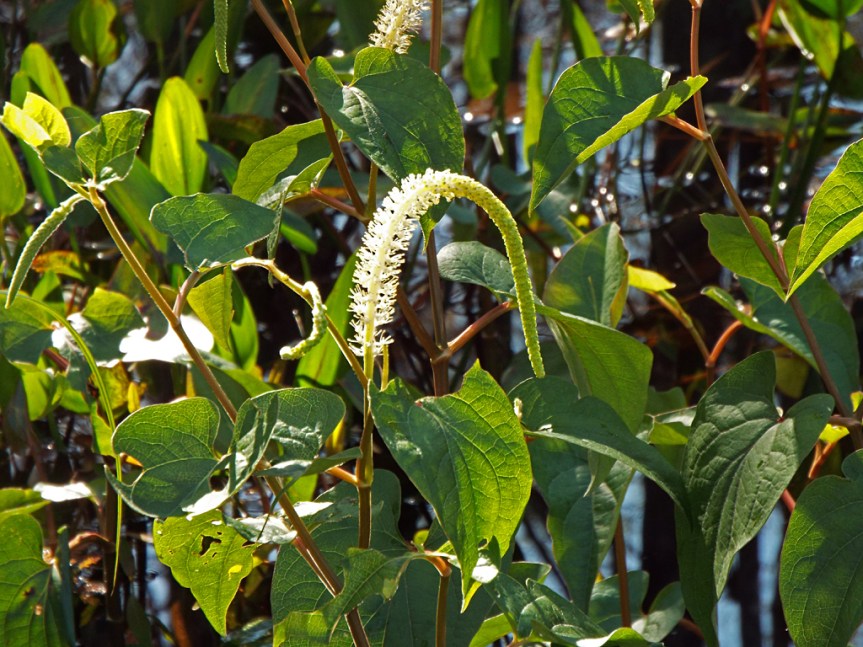
Another aptly-named plant, Lizard’s Tail was growing in small groups along the water’s edge.
There were a few birds flying among the cypress trees, and in the adjacent pine flatwoods community, including Yellow-bellied Sapsuckers, Yellow-rumped Warblers, American Robins, and Blue Jays.
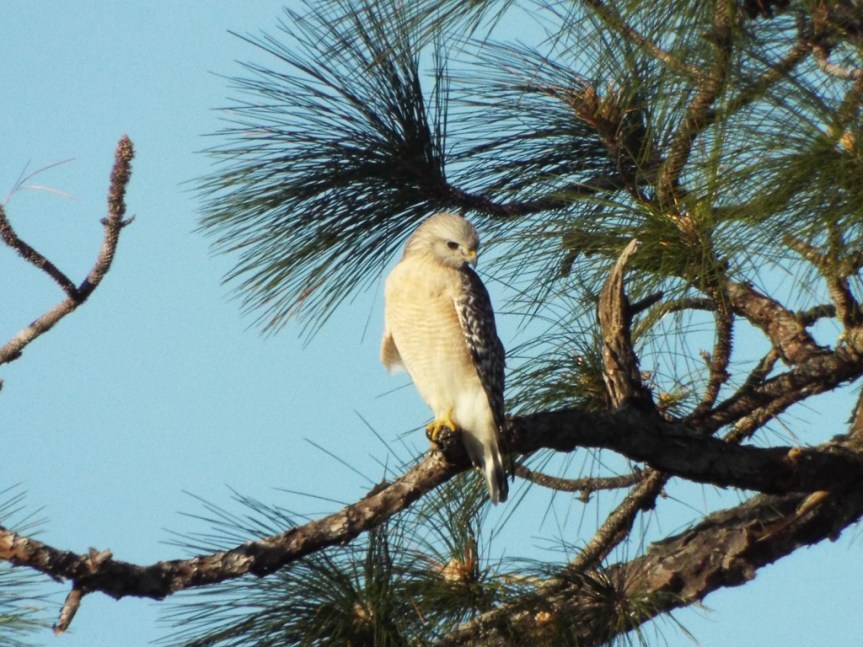
As we finished our day, this lovely “Florida form” Red-shouldered Hawk was patiently grooming itself in a pine tree.
We capped off the day with dinner at Marsh Landing Restaurant, in Fellsmere. So far the FMNP is really living up to my hopes for educating and enlightening me with regards to Florida’s wildlife and habitats. The course wraps up in another week (as of this post) where we’ll be presenting our group projects and “graduating” from this module. Then it’s on to the next!
Picking up from days 1-3, here are the remaining SCBWF 2016 field trips I had this year. The weather continued to be cold and windy, though the rain moved out for the second half of the festival. Now that I’ve gotten over my cold and sorted through the past couple of weeks, here are the rest of my field trip experiences.
DAY 4:
Zellwood/Lake Apopka
This is the second year in a row that I’ve done the Lake Apopka trip for the festival [map]. This year was similar to last year in several respects. Firstly, we had Gian Basili leading us, again. He’s been working on the North Shore Restoration Project for the St. Johns River Water Management District for years, and he has an intimate knowledge of the lake and its history. Secondly, the weather was terrible again, for birding, this year. Although we didn’t have the apocalyptic morning conditions from last year (rain squalls and thunder), we did have a cold and quite windy day, which kept many of the birds hunkered down or otherwise out of sight.
Much of the birding was done from inside the bus, along the Wildlife Drive. We did get out occasionally, but not nearly as much as last year. I was at the rear of the bus, in the middle of the final, bench seat, which made some observations challenging. Camille was at the front of the bus, and I am glad to say she had a good experience, since she was able to get tips and converse with Gian and with Nancy McAllister, the co-leader.
Nancy is doing a “Mom’s Big Year,” and will be blogging her travels. Please have a look in from time to time to see her adventures!
While the same trip for the previous two days garnered over 90 different bird species, the wind kept our trip total to a lower (but still respectable, to me) total of 71 species.
Highlights included a couple of Fulvous Whistling-Duck flocks, some nice looks at Northern Harriers, and a single Yellow Warbler – a rarity – responding to some recorded calls played by David Hartgrove.
After the Wildlife Drive, we drove over into Lake County (The Wildlife Drive is in Orange County) to some other properties managed by the SJRWMD, including the abandoned pole barn to look for Barn Owls, and areas near the Apopka-Beauclair Lock and Dam. We ended the trip on a wonderful note. A young birder named Noah had been fighting sleep all afternoon, and had apparently nodded off by the window on the bus. As we were driving out way out past a small pond, he woke up and immediately announced, “Wilson’s Snipe!” We all scrambled for a look and there were no less than a dozen Wilson’s Snipes (I personally only saw seven of them) around the edges of the pond. If he had opened his eyes just a couple of seconds later, we would never have seen them. Great job, Noah!
The fourth and final night-hike of the festival was the much anticipated Sams House Owl Prowl [map]. For some reason this trip was not offered last year, but two years ago was a highlight of my festival experience. I knew there would undoubtedly be changes, but I was hopeful for another good hike. This year, they had an owl rehabilitator, Susan Boorse, show us a couple of her “owl ambassadors” and talk about her experiences as wildlife rehabilitator and share her knowledge of owls. It was an educational and enlightening experience, and a good addition to this particular trip. A group of students doing some sort of special “semester” for a month were also present, and the trip leaders had an insect expert on hand, too. Unfortunately, the weather was cold and windy (a theme for a good chunk of this festival). We did hear the resident Barred Owl pair call, in the distance, a couple of times before we started hiking, but after that, I believe it was just too windy.
Once the hike started, the trip seemed to unravel. Instead of stopping to do any interpretation or talk about the owls and the night-time ecology of the area, we silently walked a short loop trail. The line of us stopped a few times, but I never knew why. I heard nothing from the trip leaders, and as we emerged from the woods, half the group walked in one direction, toward a fire-pit and the other back through some darkened outdoor exhibits. I went with this second group, and we stopped and milled around for a few minutes before one of the trip leaders emerged and had us walk to the fire-pit for s’mores. The insect expert had some UV traps set up but, due to the weather, had nothing to show us. Instead of talking to us about insects in general, or pointing out what they do on cold, windy nights, he packed up to leave without a word. If I hadn’t stopped him to mention regrets about the weather, he would have disappeared from the proceedings without a trace!
Camille and I stayed and spoke with a couple of the students for a few minutes, and I did toast a marshmallow. The students were excited for their Florida adventure and were keen on science and nature – which was really good to hear and see. Unfortunately, the “owl prowl” proved to be a bust. Not because we saw no owls, but because there was virtually no leadership or structure to the hike, and almost non-existent communication. I hope, if they offer this trip again next year, they manage to run it more like it was two years ago. It was the only real disappointment of the festival, for me.
DAY 5:
Waterfowl 101
We braved another frigid (for Florida) and windy morning for the Waterfowl 101 field trip and workshop. The initial intent was to have about an hour or so of waterfowl description and identification tips, followed by a drive along Blackpoint Wildlife Drive [map] at Merritt Island to put some of that new knowledge into practice. While certain waterfowl, like Wood Ducks, Northern Shovelers, and Pintails, are easy to identify in the field (especially the males), other species can be trickier, and many of the females look very similar. I was hoping to get a little more help in duck identification. The weather had other plans. Since it was so cold and windy, it was decided we’d drive Blackpoint first, getting some of the tips and advice en route, then have the proper lecture at the end.
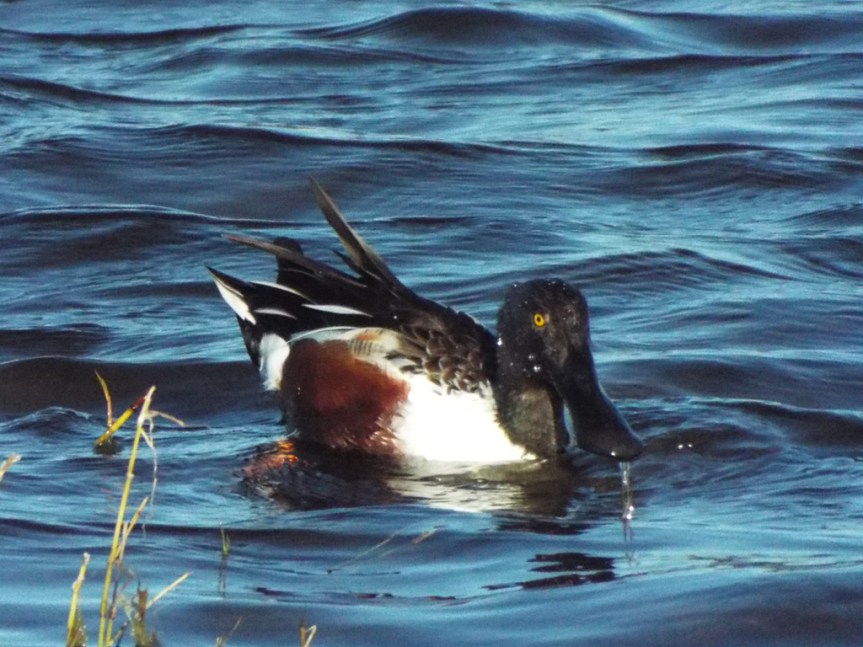
Northern Shovelers are among the more distinctive looking ducks.
As well as various duck species, including many dozens of Northern Pintails and the most Redheads I’ve seen in one place, we also had some good looks at American Avocets and some resting Long-billed Dowitchers. In fact, Murray Gardler had quite few good pointers for dowitcher identification that I’ll be sure to use from now on!
Further on, after exiting Blackpoint, we went on to an area along the main road to look at a large assemblage of American Wigeons. In past years, wigeons tended to congregate near the exit-end of Blackpoint, staying far away from the vista points, just within my binoculars’ range. This time they were much closer, though the screening vegetation made it hard to get long looks.
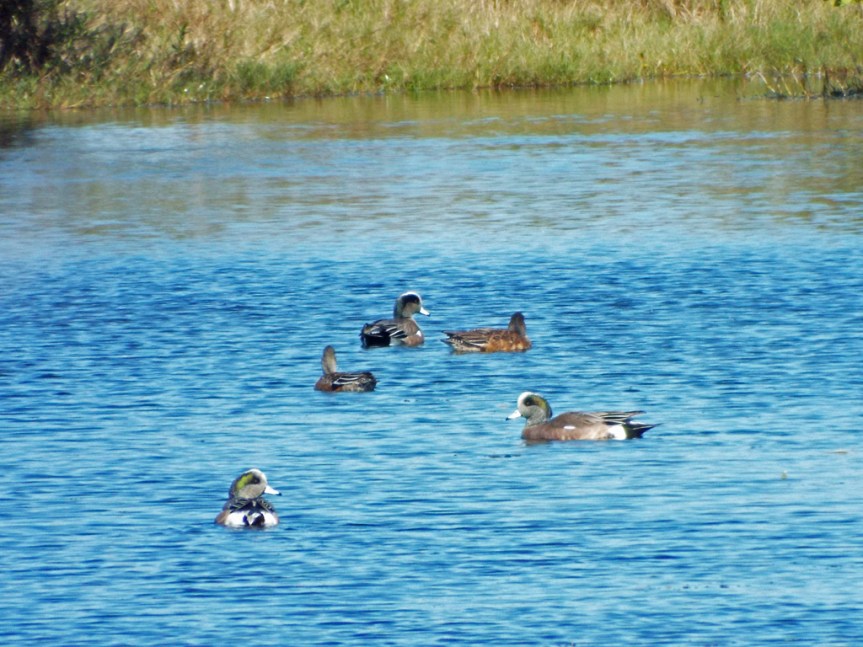
A group of American Wigeons. These birds constantly call to each other with cute “peeps,” making for a noisy chatter as hundreds talk at once.
We scanned as many areas along the road with openings in the vegetation to see if any Eurasian Wigeons were present. Murray said that it’s not unusual for some small percentage of Eurasian varieties to be present, so with so many wigeons, it was statistically likely some were there. Unfortunately, we didn’t see any.
At that point we were given the option to stay for the lecture session originally planned for the morning, or to go on. It was still very wind and a bit cool, so Camille and I decided to end the trip.
After lunch, it was time for an unofficial side trip to Shiloh Marsh Road [map]. I was hopeful of catching either Nelson’s Sparrows or Saltmarsh Sparrows, both of which are often recorded along the road.
There was a good variety of what are sometimes referred to as “the usual suspects,” egrets, herons, ibises, coots, etc., but no sparrows. A nice group of herons and Roseate Spoonbills were along Coot Creek, and near the end of the marsh, where Turnbull Creek empties into the Indian River Lagoon, there were some Forster’s Terns, American White Pelicans, and some Belted Kingfishers.
Lastly, before the end of the day, Camille and I did a quick run through Chain of Lakes Park [map], just behind the Festival headquarters. There, I saw my first Canada Geese in Florida, as well as a nice variety of other birds (see the eBird list).
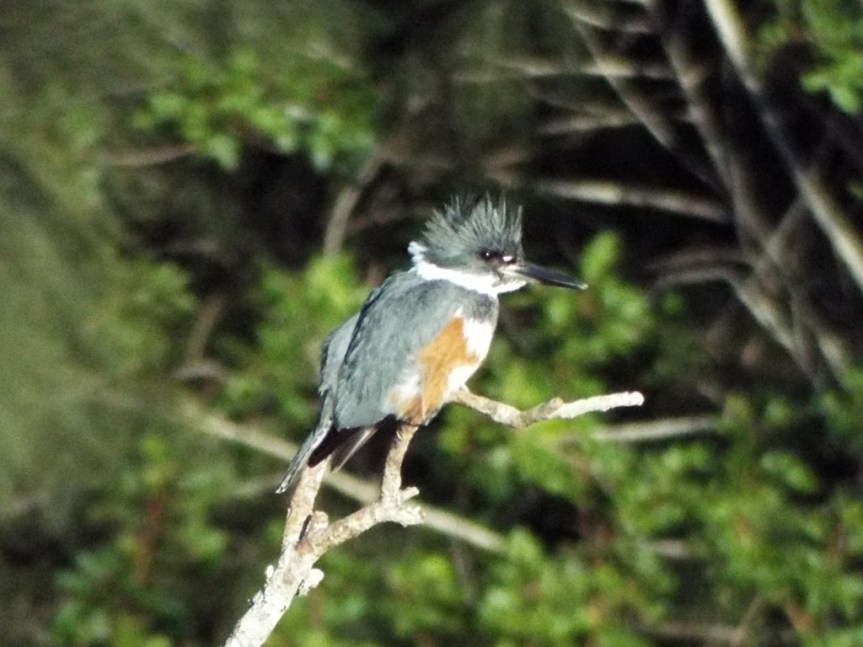
A female Belted Kingfisher, seen from an observation tower at Chain of Lakes Park.
It was a decent end to the final official day of the festival. At this point most of the vendors and presenters had packed up and many people were headed home. The off-shore boat trip (formerly known as the Pelagic Birding Trip) is always the day after the official festival, and with no night-hike scheduled, it was good to get some good rest before what is usually my favorite trip of the festival.
DAY 6:
Offshore Birding Boat Trip
This trip was highly anticipated by me and many others. Last year, due to gale-force winds off-shore, the boat trip stayed close to shore, and we had thousands of birds (mostly Northern Gannets) and several whales! This, combined with past complaints of “hours of boredom punctuated by a flurry of blurry binocular views” prompted a change in the program. Instead of a twelve-hour trip out to the Gulf Stream and back, we had a half-day tour up and down the Volusia County coast [map].
I wasn’t sure what to make of it. I look forward to those twelve-hours each year, and I have had fun every time – no matter what we actually did. But I understand the change and saw it as an experiment to see what works and what doesn’t.
The results were satisfactory, if not lackluster. The morning was cold but beautiful. Here are some shots as we headed toward Ponce Inlet.
Nice, just past full, Moon over the inlet.
Tranquil sailboat at dawn.
The seas were very calm and there was a bit wind. The temperatures remained cool, so it did get a little chilly when exposed to the combined breeze and boat movement.
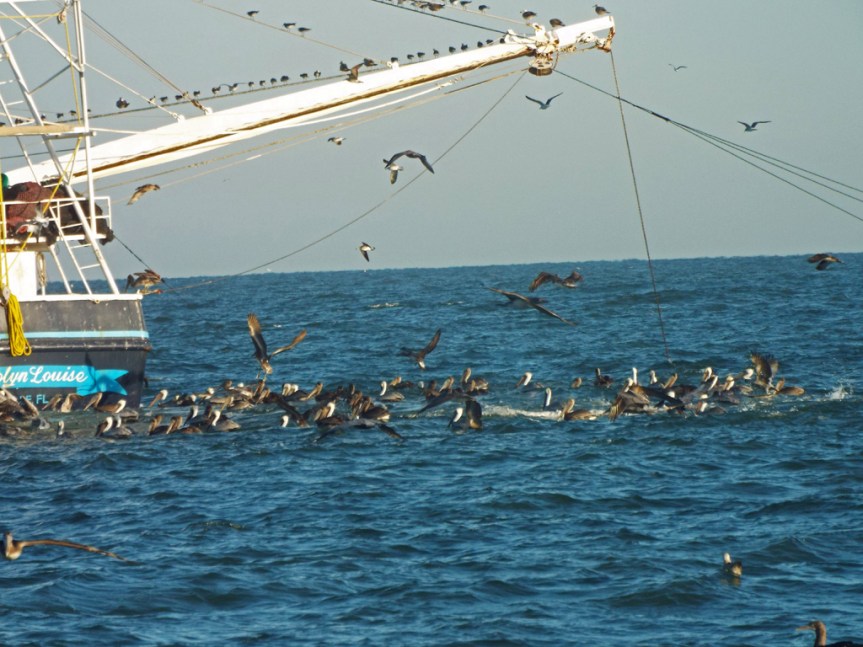
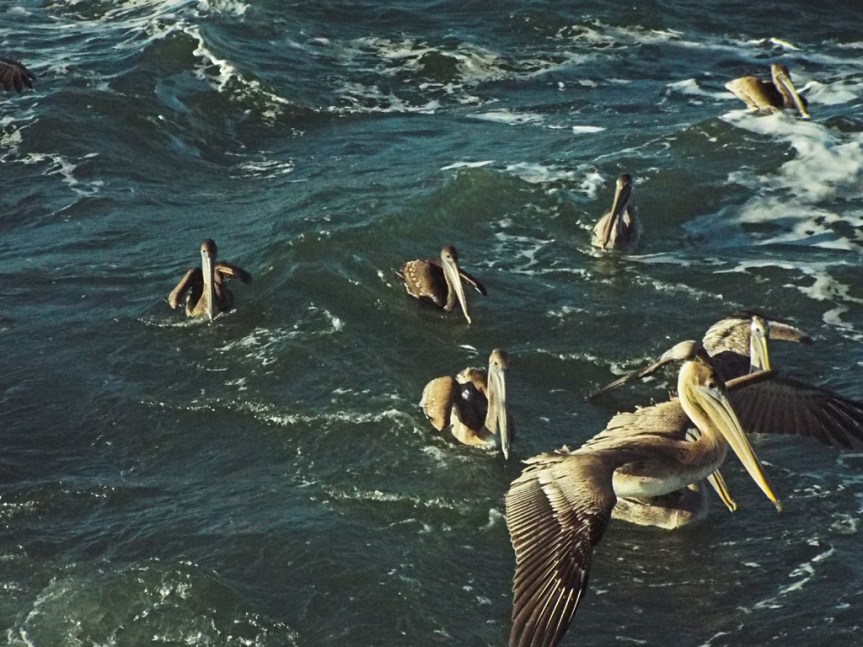
This year we seemed to come upon a very large number of Brown Pelicans, many of them immature. They were following shrimp boats along with flocks of gulls. Although we looked for some rarities, like Iceland or Glaucous Gulls, we saw mainly Laughing and Herring Gulls, with a few Ring-billed Gulls.
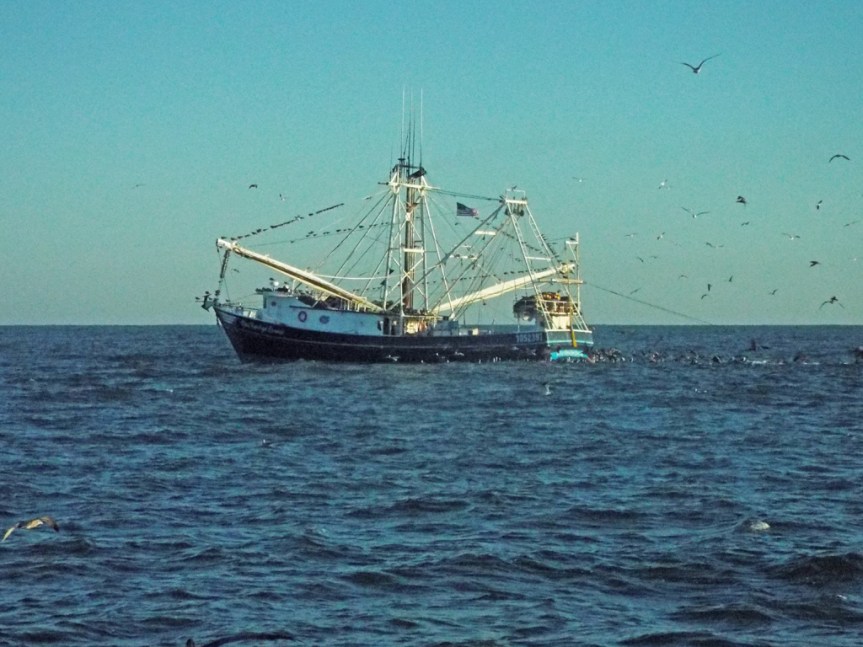
One of several shrimp boats we encountered. Most of the birds behind the boat are pelicans, while gulls line the rigging.
We had Laurilee Thompson, owner of Dixie Crossroads restaurant and founder of the Festival on board with us, which was fascinating. She knows all the ins-and-outs of shrimp boat operation, and gave us an in-depth explanation, in real-time, of how the boats pull in a a catch and what the birds look for.
The birds have learned the shrimpers’ routine and methods of catching shrimp, so are always near the right place, anticipating their meal.
As is usual for the boat trips, the crew chums the water behind the boat with a mixture of fish parts, fish oil, and popcorn. This is to attract as many birds as possible, who follow the boat, making identification and photographs easier. It also increases the odds of seeing something rare, and also luring is predators, like jaegers, in to steal food from the gulls, pelicans, and gannets.
Birds fill the sky!Brown Pelican youngsters, settling along the chum line.
I finally did get some good looks at both Pomarine and Parasitic Jaegers on this trip. The birds obliged by resting on the water a few times, which made for good binocular views. We saw a few larger pod of dolphins, but no whales this time. On the way back into the inlet, I finally got a glimpse of one of the rare, but usual, Purple Sandpipers than visit the jetty during the winter.
Too soon (for my tastes) we came back to the dock, but I had a lot of fun. I love these trips, and now my appetite is whet for some of the truly pelagic trips the Marine Science Center runs through summer and fall. They go out to the eastern edge of the Gulf Stream and historically have seen a good variety of birds.
Since it was still afternoon, and it was close by on the way home, Camille and I stopped off at Spruce Creek Park [map] for a quick look for some Clapper Rails and whatever else might be enjoying the day.
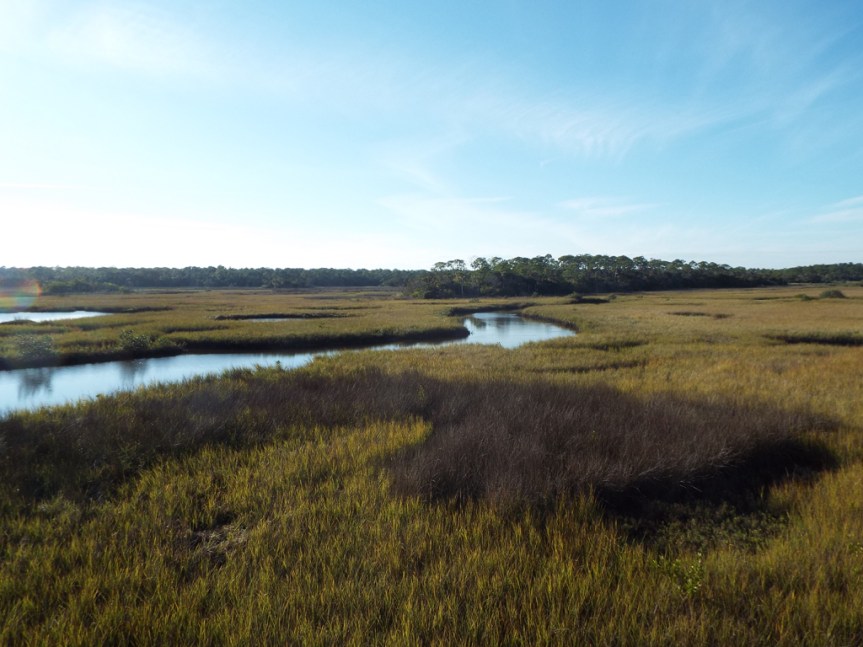
The marshes and waters of Spruce Creek Park.
We did hear quite a few rails, though they stayed well concealed. Otherwise, we had a mix of egrets, a good showing of Hooded Mergansers, and a pair of Bald Eagles. A Sharp-shinned Hawk surprised us near the parking area as it chased some American Robins through the woods.
It was then time to get home, with another SCBWF gone. Adjusting to a normal schedule has taken a bit of time, and getting sick didn’t help matters there (although I am truly grateful I didn’t get sick during the festival itself). It’s a bit amusing to me that getting back to work and all that entails has meant better sleep. I am going to think twice (at least!) before scheduling so many night hikes in a row.
In the end, though, it was a success and good fun. I renewed old birding partnerships and friendships and made some new ones. I learn new things each year, even on trips I’ve take before. I am already looking forward to next year’s festival!
The 2016 Space Coast Birding and Wildlife Festival is over, and it’s time to face the post festival let-down and adjust back to “real life.” I also came down with a severe cold (luckily after the festival!). My apologies for the delay in getting this blog post up.
I had a packed schedule this year. Since I’d had so much fun on the night hikes last year and the year before, I signed up for one each night of the festival. This was great, in theory, but in practice it meant being sleep-deprived for much of the festival. This was Camille’s first festival, so she basically mirrored my schedule.
The weather was quite variable and temperamental all week, and due to a much wetter than average fall and winter, many of the sites had standing water or deep mud that would have otherwise been dry. That made for some fun challenges in getting around the trip sites, but we managed.
I’ll summarize each day/trip here with a few photographs. I had my camera with me most of the time, but with my focus on FOY and life birds, and with some days being rainy and windy, photography was not a great priority for me.
DAY 1:
Lake Monroe
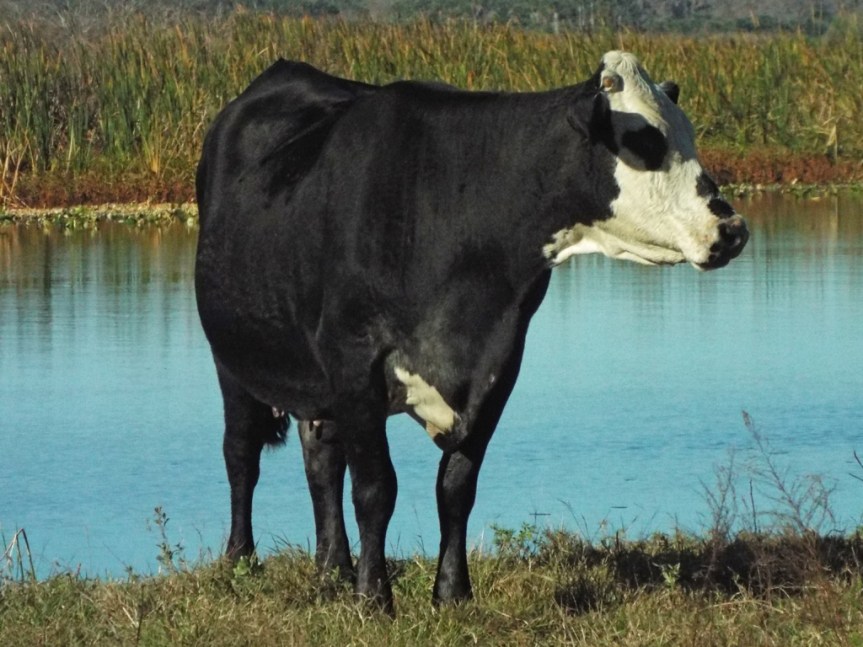
Lake Monroe is one of the many lakes that makes up the St. Johns River system. As such, it is similar in many ways to Lake Jesup and its surroundings. There are hardwood hammocks adjacent to some wet meadows and mudflats, leading to wetlands along the lake’s edge. The wet grassy meadow is grazed by cattle (much like the Marl Bed Flats) which can make for some hazardous going. [MAP]
Could you steer us to the birds?
Most of our trip was along the Brickyard Slough Tract – a sort of side extension of the St. Johns River – and the ranchlands adjacent to some wetlands and some wooded tracts. In the comparatively drier “upland” grassy areas we saw and heard my FOY Sedge Wrens and had some great fly-bys of Pileated Woodpeckers.
Much of the typical habitat we slogged through.
Unfortunately, recent rains (and a wet fall and winter) made much of our going very muddy and difficult to walk through. Our ultimate goal was to make it to Bench Ranch Park, but the going was so difficult that we had to turn back the way we came (no easy feat in itself), and get driven out via park service trucks. Camille almost lost a rubber boot, and one of our trip leaders lost both his shoes twice to the muck.
Other notable bird sightings included a dark morph Red-tailed Hawk, something I’ve never seen before, a pair of Northern Harriers, and a couple of American Kestrels. Chip Clouse, another trip leader, provided the base eBird list for us, linked below.
The evening trip for Day 1 was a bus ride/walk along Hatbill Road [map] with Mitchell Harris. The night was a little cool, and we had a cold day previously, but Mitchell was hopeful the owls would be active and responsive to us. He birds the area frequently and has an intimate knowledge of the owl (and other crepuscular/nocturnal birds) species.
At the start of the trip, just after sundown, we played some rail calls near a marsh along the St. Johns River at Hatbill Park. We got some clear replies to both King Rail and Virginia Rail calls! The Virginia Rail calls were a lifer ID for me, but this would be put in a different context later in the week.
We had some good call-backs from the Eastern Screech Owl calls he played, but no response at all from the Barred or Great Horned Owls he knows to be there. We were about to finish the trip, at our last stop, when we finally got a Eastern Screech Owl to come out and let us spotlight it. This is the first time I’ve actually seen a screech owl in the wild. All my previous IDs are voice only! Camille, a fellow owl-phile, was excited as well, and we did a celebratory fist-bump. That one sighting made the whole trip worth it!
The second day of field trips started off cool again, and off-an-on rain showers made the birding a challenge. I’d been urged by my friend Sean Reynolds for years to visit the Tosohatchee Wildlife Management Area [map], so I made it a priority to do both Tosohatchee trips this year. The park is spectacularly beautiful!
Lake Charlie reflections.
We followed a powerline cut at sunrise, and we got out a few times to see the birds waking up. We were treated to an extended look at a King Rail at the edge of some brushy wetlands, and a great look at a Barred Owl perched in the open after sunrise. We stopped at a bend in the St. Johns River where a small flock of wintering warblers were feeding. We then made our way into the WMA and the various habitats it maintains.
Birding in the rain is difficult and limiting. I didn’t dare have my camera out for most of the time, and keeping my binoculars clear was distracting. Fortunately, many of the birds obliged by being very visible, even to the unaided eyes. We had great looks at Bald Eagles, Purple Gallinules, various woodpecker species, and Blue-Gray Gnatcatchers near Lake Charlie (see photo, above).
A male (note the red cap) Yellow-bellied Sapsucker having breakfast at Tosohatchee WMA.
We generated momentum throughout the day and managed a decent list, despite the weather, and got some good looks at a few of the birds not afraid to brave the intermittent downpours and wind gusts. But there weren’t many large flocks of winter residents hanging around.
The second night-hike of the festival was at Fox Lake Park [map]. I had done this trip last year, and it had been so much fun, I was very keen to try again. On the whole, the trip was quite fun, and we managed to call in a Barred Owl pair and get some good looks at them. My main complaints would be that some of the trip leaders got to talking and gossiping to the point that they were not interpreting the trail or paying close attention to the group behind them. Xavier (whom was a trip leader last year, as well) did manage to give us some good information on the park and its management practices, though.
DAY 3:
Tosohatchee II
The start of the second Tosohatchee trip followed along the powerlines again and down to the St. Johns River. We stopped along the same stretch as the previous day’s trip, listening again for rails and watching as the birds woke up. We heard some King Rails again, and even had some quick views of Marsh Wrens. The biggest excitement for me was my very first look at a Virginia Rail. Although hearing one on the Hatbill Road trip was great, seeing one was a highlight of my entire birding experiences. It’s strikingly orange bill and gray head were beautiful!
We also stopped at the St. Johns river, again. This time, however, we walked along the river to get some better looks at some shorebirds and other activity not visible from the end of the road. One of the park employees who was assisting us got really carried away and excited over hearing some Eastern Meadowlarks (which had been heard the previous morning as well), leading her to keep walking further and further along the river edge, trying to get a look. That sort of energy and happiness is part of what makes birding for some of us so rewarding.
A Great Egret braving the chilly rain at the river’s edge.
The weather was windier and the threat of heavy rain shadowed us throughout the day, but we managed to miss most of the bad weather as the day wore on. We hiked through some pine flatwoods, catching some warblers and even American Goldfinches, here and there.
Drizzly hike through pine flatwoods.
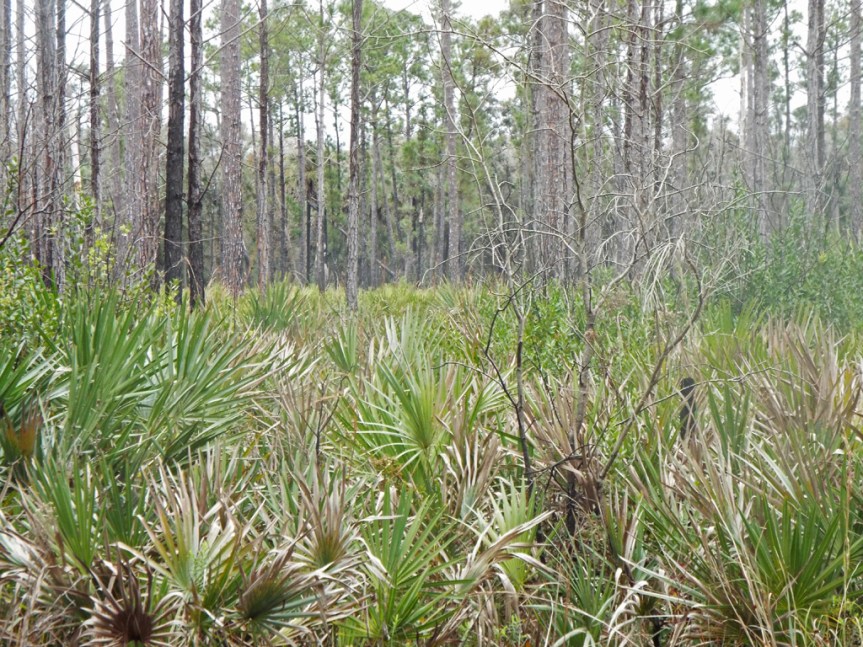
Angel, one of our trip leaders (and his wife, Mariel), tried several times to call out a Bachman’s Sparrow after we heard some tell-tale high pitched call notes. Unfortunately, the flatwoods in this part of the WMA were probably too overgrown to attract these birds. Although managed fire does a lot to keep these habitats better suited for most wildlife in central Florida, it’s hard to keep the Saw Palmettos and other brushy plants from quickly out-competing the wire grasses and other cover Bachman’s Sparrows prefer.
Slightly overgrown pine flatwoods.
While birds are, of course, the highlight of these trips for most of us, the festival is meant to highlight wildlife, in general. When we encounter our non-avian friends it is always fun and often educational. Mariel managed to find this little toad on our way along the path.
An Oak Toad. This guy is nearly full-grown! I had no idea such a small toad existed in Florida.
We emerged at the edge of the woods, back near the powerline cut, and got our first look at some Eastern Bluebirds and a nice flock of Pine Warblers. From there we slogged through some very wet conditions in a cedar dome swamp. The water overtopped my hiking boots, making for a very squishy hike, thereafter.
The rains also started to move in, but we still managed to get some reasonable looks at some more birds, ending the day happy, if a little wet.
After arriving back at the Eastern Florida State College campus, Camille and I decided to drop by Parrish Park and see if the Long-tailed Duck was there. It had been seen now and again in the weeks leading up to the festival, and some eBird lists had it showing up recently.
Two large groups of resting Black Skimmers and a large number of Ring-billed Gulls made up the majority of birds at the park.
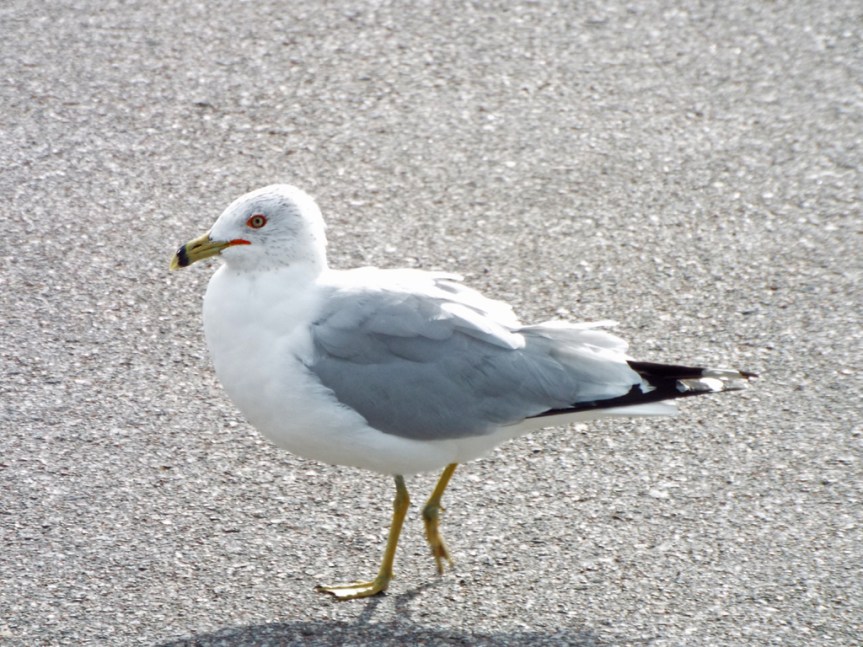
One of the two flocks of Black Skimmers, having a rest out of the wind.A Ring-billed Gull, walking in the parking area. Note the bright red eye-ring and gape area behind the bill.
One ubiquitous bird in our area that is found near beaches and parking-lots is the Boat-tailed Grackle. I’ve featured them a few times in this blog, but I tend to gloss over them because they are so pervasive. Here are a couple of shots as they braved the high winds. Unlike Common Grackles, where the males and females are quite similar in appearance, Boat-tailed Grackles show much more sexual dimorphism. This is a fancy term meaning the two nominal sexes look different from each other. In this species, the females tend to be a rich brown with darker wings and tails, while the males are larger and an iridescent black.
The third night-hike this year was at the Enchanted Forest Sanctuary. It wasn’t as cold this night as previous ones, making for a more comfortable walk in the woods. Like previous years, this trip was educational and fun. We saw various animal tracks, spotlighted hundreds of spider eyes with our individual flashlilghts, and even got both night-vision and spotlighted views of a Southern Flying Squirrel.
We called in owls, and managed to get really close to an Eastern Screech Owl that even called as we watched. The trip leaders used red lights to spotlight the wildlife here, which differed from both the Hatbill Road and Fox Lake trips, which both used standard, white flashlights. There is a differeing of philosophy when dealing with nocturnal wildlife, and owls in particular. Some people, including experts such as Mitchell Harris, contend that the bright white lights do little to disturb the owls and as long as we keep a reasonable distance (not specified), there should be no ill effects. At EFS, they use red lights. For many animals (most notably, people), red lights result in little loss of low-light vision because it affects the light-sensitive rods in the retina the least. Whether or not this is true for owls, I don’t know. As I’ll mention again later, some people don’t spotlight wildlife at all.
In any case, the night went well and seeing another owl up close was a real treat.
That wraps up the first half of my field trips for SCBWF 2016. I’ll summarize the rest, including the much anticipated off-shore (formerly know as pelagic) trip in my next post!


















 Lonely Birder