
I ran through my ABA checklist today to verify my 2013 species count. As of this morning, with the addition of some Wood Ducks, it stands at 114 definite IDs. I am hoping to make it out to Merriitt Island before too long to get some of the waders and perhaps more ducks.
Tag: Birding
Crane Family Miracle
A potent thunderstorm moved through our area last night, dumping several inches of rain and with wind gusts over 30mph. I was worried about the Sandhill Cranes where I work and their single chick and unhatched egg.
This morning, I noticed the pond was filled up and the nest site was inundated with water. I scanned around and saw the two adult cranes foraging in the grass. At first I didn’t see the chick and feared the worst. But then I saw the little one between its parents and thought, “Well, at least the chick made it.” I felt pretty bad about the egg.
When my wife came to pick me up, we saw the crane family was foraging near the parking lot and what did we spy?

What’s this?
A close inspection found not just one chick, but two! Yes, apparently the other egg must have hatched some time yesterday. My wife was driving so she pulled off so I could get some closer pictures.

“Say hello to my little sister (or brother)!”
I got some adorable close-ups before Poppa Crane VERY LOUDLY announced his displeasure at us paparazzi invading family time.
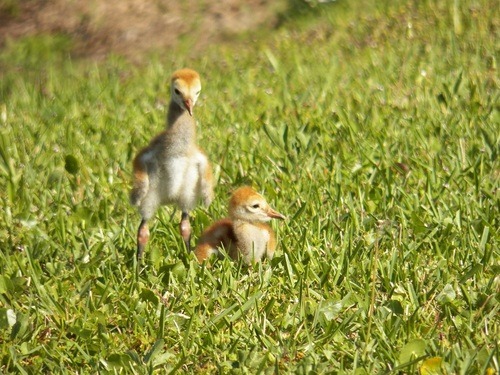
Adorable crane chicks.

Can you believe it?
Here’s to a great summer for the crane family as they rear 2 beautiful babies!
Red and Redstart
This morning I went to the Malabar Scrub Sanctuary, which is a property adjacent to the Turkey Creek Sanctuary. In fact, the first place I stopped was technically in Turkey Creek, but on the opposite side of the creek than I normally visit.

Far side of the creek than I am usually on.
Apart from a lot of leaping fish in the creek (I think that happens more on overcast mornings, like today), there wasn’t too much going on. The trails are for mountain bikes, and I did see a few riders on the trail. I did get a good glimpse of a warbler, but positive ID was tough. A lot of these birds are in the midst of getting their breeding plumage, so there’s generally a wild mix of colors and patterns that most field guides just have to skip over. My best guess would be a Magnolia Warbler, based on the wing pattern and the emerging black about the throat.
I did hear a few White-eyed Vireos, but did not get any visuals (and of course, the hordes of Northern Cardinals were in evidence). White-eyed Vireos seem to be very plentiful this year.

Bike trail at Turkey Creek in the morning gloom.
With not much going on, I drove the short distance to one of the trailheads for the Malabar Scrub Sanctuary. The Sanctuary and surrounding property are great to have as conservation land, but it comes with a little bitterness. Originally, the Sanctuary was to help with the local Florida Scrub Jay populations; however, with the rise of the adjacent residential developments and population increase in and around Palm Bay, the necessary operations (i.e., FIRE) to keep the scrub in a state that the Jays would thrive in were halted. Much of the property has grown over and isn’t suitable for Florida Scrub Jay habitat. There is a good variety of habitat, though, including some gorgeous open grassland areas.

Some of the diverse landscape types in the Malabar Scrub Sanctuary.
One persistent Northern Cardinal did present himself well enough for some decent photographs.

I give cardinals a bit of rough time in this blog, but they are pretty.

Here he was listening to his mate, who was gathering nesting materials nearby. In all honesty, the red of male Northern Cardinals is stunning.
While setting up the shots of this guy, I was pleasantly surprised by a non-stop flutter of black and orange. An American Redstart! He was actively foraging with his mate. These birds do NOT sit still very often. Here’s the only decent shot I got of him. You can see a bit of the characteristic wing and tail drooping of the species. They flutter down and around like falling leaves, which is pretty neat.

He stood still just long enough to get this.
Other than a few more ear-only catches (White-eyed Vireos) I got some good binocular views of a dark grey-ish bird with a faint black necklace of streaks that I can’t identify. I’ve seen them before, and cannot figure out what they are. The day was heating up, the sun came out and I headed out. I did get a quick glimpse (finally!) of a Carolina Wren in some thick palm scrub.
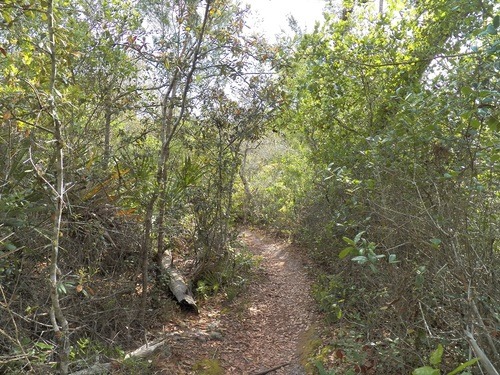
The trails at the Malabar Scrub Sanctuary are very well kept
Not the most prolific outing, but it was nice and I had fun – which is what birding is all about!
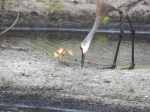
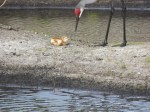
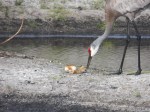
Baby crane must have hatched in the past couple of days! We drove up by the pond a snuck a few snapshots. The family portrait above is actually the final shot. you can see Poppa was getting a bit wary, and we were over 50 feet away. Good, protective parents! We’re pretty sure she’s still on the second egg, which should be ready to hatch soon! 🙂 Click pics to enlarge.
20 Minutes
I had a few minutes to walk around some conservation land abutting a housing subdivision in Viera this evening. The paved walk/bike ways encircle a large irregular pond. It was a nice 20 minutes.
- Downy Woodpeckers
- Lesser Scaups (first this year)
- Blue-winged Teals
- Mottled Ducks
- Common Grackles
- Mourning Doves
I didn’t have my camera handy, so you’ll have to go with your imaginations or a Google image search. Your choice!
Turkey Creek Sanctuary: Parulas and Vireos
I had my first Turkey Creek outing of the year today. I got to the sanctuary just as some of the morning fog was lifting. I decided to start on the upland sand pine trail before doing the boardwalk loop, and ended by doing the scrub trail and the jogging trail before heading home.
[Note: The photographs in this entry are royalty free images I found to illustrate the blog. I did not take them myself]
This is my first official outing with my new Carson 8X42s as well. Solid performance from my optics!
The first bird I got a visual ID on was a Brown Thrasher. I don’t normally see them around; the last one I saw was at my parents’ house several years ago. There was a Grey Catbird nearby, but the main backdrop to all this was the persistent call of the Northern Parula and the occasional “Per-chick-wee-chip” of the White-eyed Vireo.
While trying to stalk those birds, I ran up on the inevitable hordes of Northern Cardinals that roam the sanctuary. At one point while close to homing in on the Parulas, I was surrounded by an entire family of angry Cardinals. I must have been too close to some nests or something. So I quickly moved along.
I finally caught my first White-eyed Vireo – most likely an immature, given it’s black eyes, but he seemed happy enough, singing and flitting about.

White-eyed Vireo
A good number of trees are stating to leaf out, which made finding the Northern Parula a bit more difficult. But I probably would not have seen them (or as soon) if I hadn’t bumped into another birder on the boardwalk. Frank is an older gentleman who seems quite familiar with the sanctuary and has been birding there a long time. He had a lot of tips about when and where to see various birds. I wrote those tips down, of course.

Blue-headed Vireo
When I first met him, I was getting a good look at some vireos, but was only able to see the shape and the bottom halves of them. He asked what I was tracking and so I told him. He was watching the same birds, but from his vantage point, he could see their heads, so he told me they were Blue-headed Vireos. We watched them together for a few more minutes, and I did get several good full views.
We moved along and could hear some Northern Parulas singing in a live oak. Eventually, I caught a good look at several in the tree. Mostly males.

Northern Parula
We parted ways a bit after that, and I continued on to the scrub trail and jogging trail.
Here’s a list of birds for today, mostly in order of sighting:
Black Vulture
Turkey Vulture
Brown Thrasher
Grey Catbird
Carolina Wren
White-eyed Vireo
Blue-grey Gnatcatcher
Green Heron
Blue-headed Vireo
Northern Parula
Red-bellied Woodpecker
Yellow-bellied Sapsucker
Heard but not seen:
Downy Woodpecker
Hairy Woodpecker
Fish Crow
Northern Mockingbird
Undifferentiated warbler spp.
All in all, an nice and tidy morning of birding!
Front yard chorus and fly-bys
This morning while waiting for my ride to work (yay, carpool!), I took a few minutes to concentrate on the bird songs and calls in the neighborhood.
Apart from the usual cacophony of grackles, I could hear 2 species of dove singing simultaneously (Eurasian Collared and Mourning), at least one American Robin (alarm calls), a Red-bellied Woodpecker (call), what was most likely a Northern Mockingbird (might have been masking a Carolina Wren, but I am not certain of that).
In flight, I saw some terns flying overhead. I usually see them heading inland, toward the west in the morning. I don’t know why that is. I wonder if they are heading toward Lake Washington? A pair of cormorants were heading east, and a pair of White Ibises flew over the house to the south.
Not bad for a few minutes just looking and listening.
Lonely Defined
What does it mean to be a lonely birder? The answer is a bit different than you might expect.
I started birding as an escape from certain aspects of my senior year of high school. I’m an introvert by nature, and birding offered me a pleasant and quiet way to enjoy nature and process my life at the time. Once I started college and then grad school, and then work life, I was with people all the time. Family, professors, class mates, students, work mates…
For me being alone while birding is the default. I don’t mind outing with others. I had a fabulous time at the Space Coast Birding and Wildlife Festival. But my “birding core” is birding alone. It’s part spiritual retreat, part personal quest.
The side effect of this is that there are things you can see and behaviors you observe that you just might miss in a comparatively noisy group. I have some stories along those lines for future posts.
I’m a lonely birder. Sometimes that does make me a bit sad, but if I might take Gotye’s lyrics a bit out of context, “you can get addicted to a certain kind of sadness.” Sweet melancholy, I think the romantics called it.
How official is official?
I’ve done some further looking into the raptor I saw over the courtyard pond at work today. Based on the field marks I saw and the shape of the bird, the closest match I can find is the White-tailed Kite. I didn’t notice the eye-color, but the white body and wings with some black near the leading-edge underwing matches little else. My perception of the size was a bit larger that what a White-tailed kite is described as, but size is sometimes hard to guage in the field.
I am not certain if I should count this as a positive ID or not. If so, it’s a lifer for me and the 98th bird species this year. I am not sure what to think.
Edging near 100
(4th time trying to post this)
I saw 6-8 Hooded Mergansers on a retention pond yesterday. The were all males, which was unusual. I think they are so comical, with their out-sized crests. First sighting of this species this year.

On the way to an appointment I saw a Great Horned Owl being harassed by a mockingbird. Judging by its size, I believe it was a female. I love seeing day-flying owls; it’s such a treat.

(The above images are not mine, but from public domain sources…I need a camera!)
I also saw an unidentified raptor over a pond at work. It’s strange, though, because although I got a very good look at it, I could not place the field marks. Time for some research later, I think.
That brings the official species count to 97 this year!
 Lonely Birder