As central Florida begins to settle into a summer pattern, I thought it would be a good weekend to stay more local and see what was happening both at the Helen and Alan Cruickshank and Turkey Creek Sanctuaries this past Sunday.
As expected, it was a quiet morning at both places, but it is breeding season for most of the resident birds. That means fledglings!
There were at least a couple of Purple Martin families flying high above the Cruickshank Sanctuary, with many of the fledged birds taking food from adults while on the wing. Purple Martin calls can sometimes sound almost like a Star Wars blaster effect or a metallic twang, and these sounds filled the air for the whole time I was there.
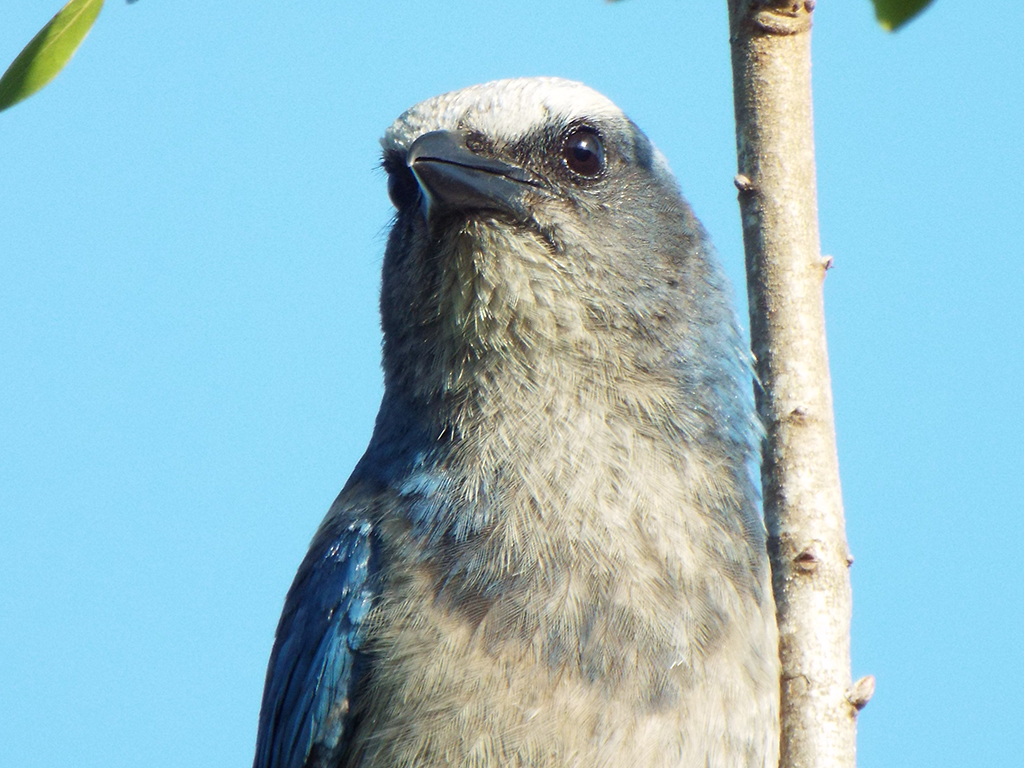
Also fledging are the Florida Scrub Jay chicks. Almost immediately upon stepping into the sanctuary, I had inquisitive youngsters fly up to take a close look at me.
This immature Florida Scrub Jay is a little older than a fledgling, but is yet to molt into his adult plumage.
Some of the younger fledglings were having trouble flying long distances, so stuck close to the lower scrub, while the older and more bold youngsters tried to keep up with the adults (who were feeling quite feisty!)
An adult Florida Scrub Jay acting as a lookout.
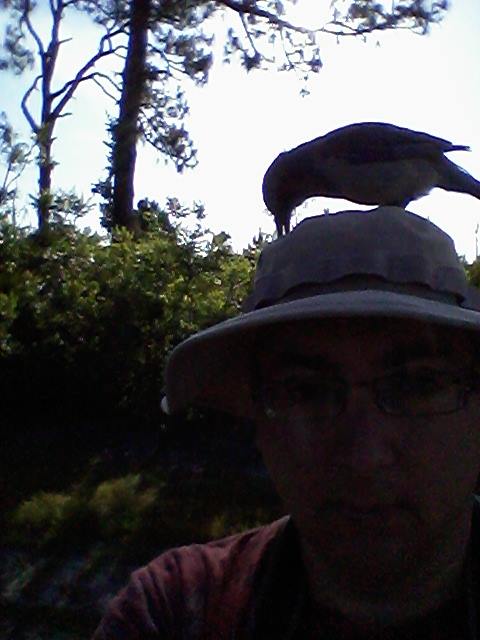
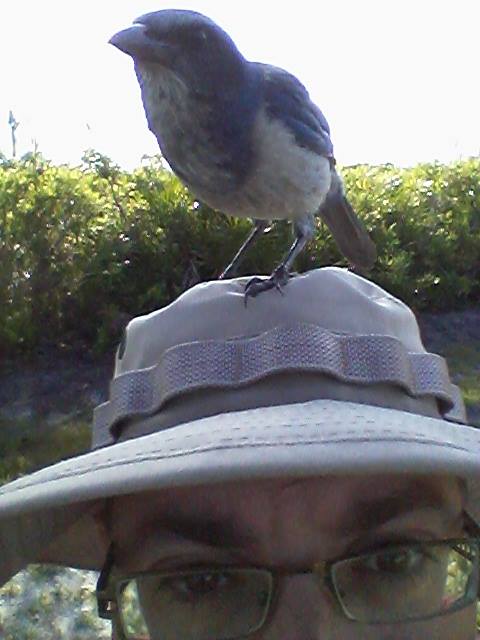
At one point an adult landed on my head. This isn’t unusual at this sanctuary. In the past, scientists and hikers alike fed these birds peanuts, which took advantage of this species bold and gregarious tendencies. It was found that in the long run this was not helpful for the long-term rehabilitation of the species (especially if the birds were ever relocated to colonize new habitats in the future), so the practice was officially discontinued. Unfortunately, many visitors continue to feed these birds, and some of them have come to expect the hand-out. In the case of this particular bird, it began pecking me on the head!
OW!This bird pecked at the phone right after this shot.
After I pulled my hat back far enough to get the bird off of me, it landed on the ground and then looked up at me, confused, as if it had done nothing wrong.
“What the heck is YOUR problem?”
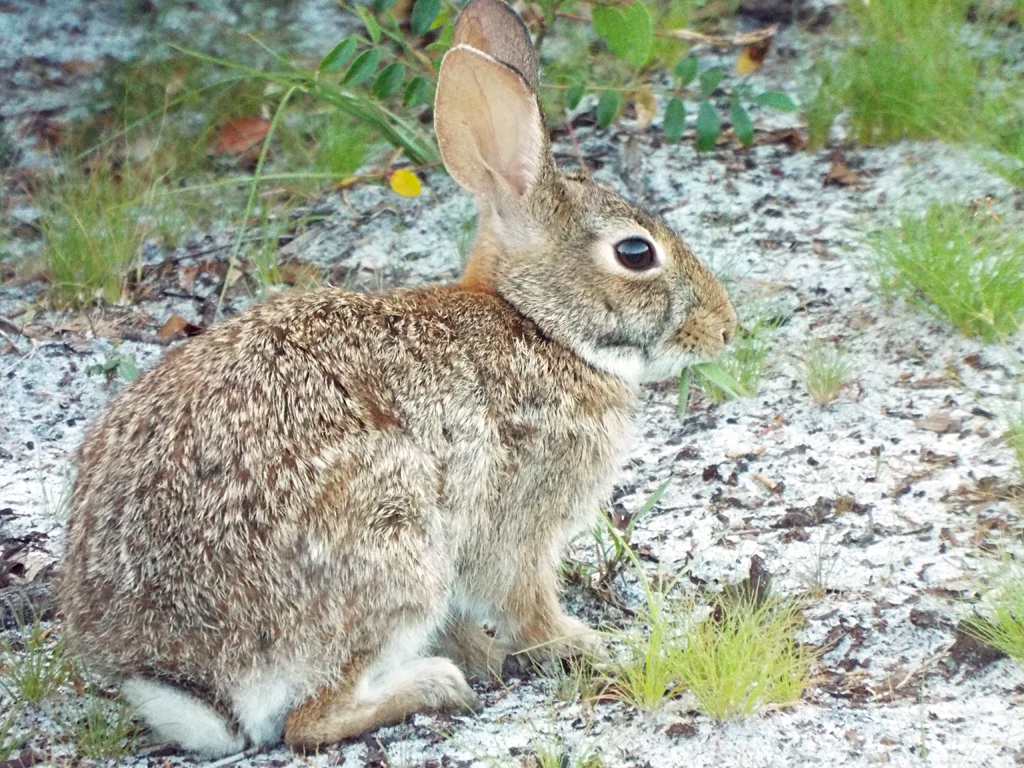
There were some non-avian friends about the place, too, including a nice collection of Eastern Cottontails, some Green Anoles and other lizards, and frogs, singing in the trees.
BUNNY!
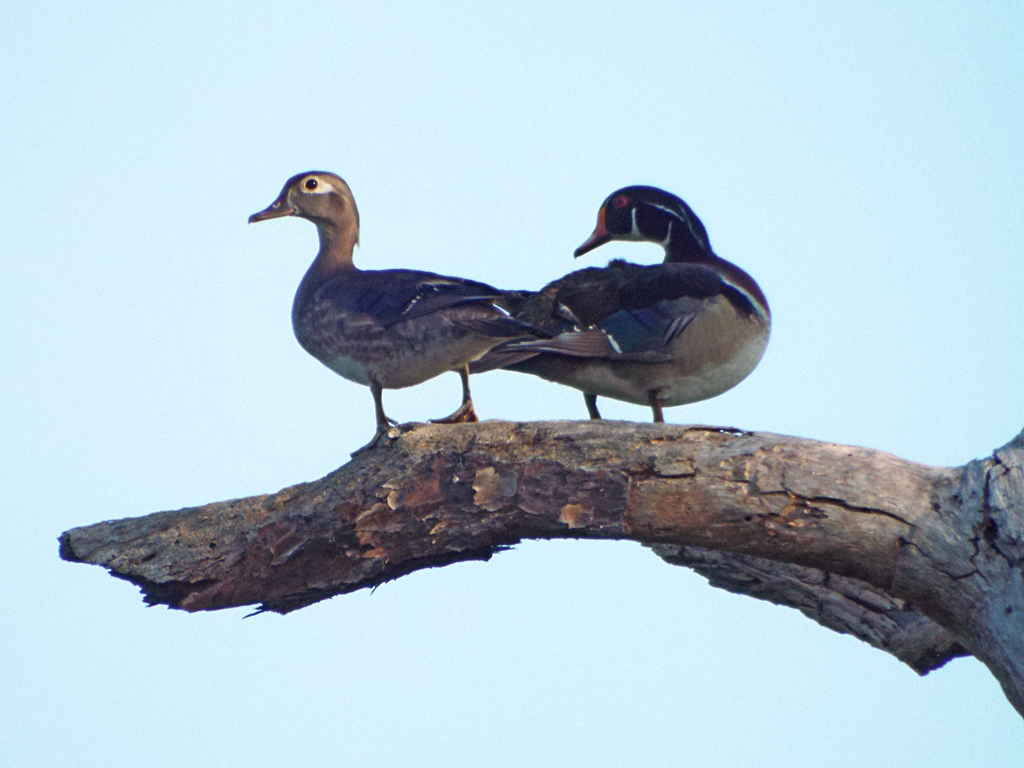
A pair of Wood Ducks were sitting up in some of the dead trees. I suspect they may have a nest nearby, though they either already had a brood of chicks or the female has yet to lay eggs (or it may be both; Wood Ducks may have 2 broods per season). Wood Ducks nest in cavities that may be over 50 feet off the ground! When the young hatch, they jump to the ground just a day or so later, surviving a harrowing fall and running off to join their mother, usually to the relative safety of a pond or stream.
A Wood Duck pair, high above. The nest up and to their right is an Osprey aerie.
Overall, it was a pleasant morning and I left this sanctuary before the heat of the day. You can see the complete list of birds I identified below.
I then drove south to the Turkey Creek Sanctuary to get a look at how it was faring, post-migration. It was relatively quiet, though the woods were full of Carolina Wrens and Northern Cardinals singing and calling. It started to get a little warm as the day progressed, but there was a reasonable amount of bird activity spread throughout the portions of the sanctuary I visited (I did not walk most of the boardwalk).
Many Northern Parula chicks have fledged, and were begging for food high in the canopy as their parents gleaned food for them, and at the weir there were some first year Common Gallinules and one transitioning Little Blue Heron.
This immature Little Blue Heron has gotten most of its adult primary feathers.
The biggest surprise was a Gray Catbird out by the turn-around by the boat ramp and end of the jogging trail. It’s not the first time I’ve seen one in the area in the summer, but it is unusual. I may have heard a second one, but I can’t be certain. That’s one of many reasons to love birding: you never know what to expect and surprises are always possible.
This morning, I took a drive to the Blackpoint Wildlife Drive at Merritt Island National Wildlife Refuge [map]. It ended up being a pretty good birding day, all things considered. It was hot early, and the Spring migration is all but over. I saw or heard about 50 different species, but the three most interesting all have something in common. In their life-cycle, each one sports black and white plumage.
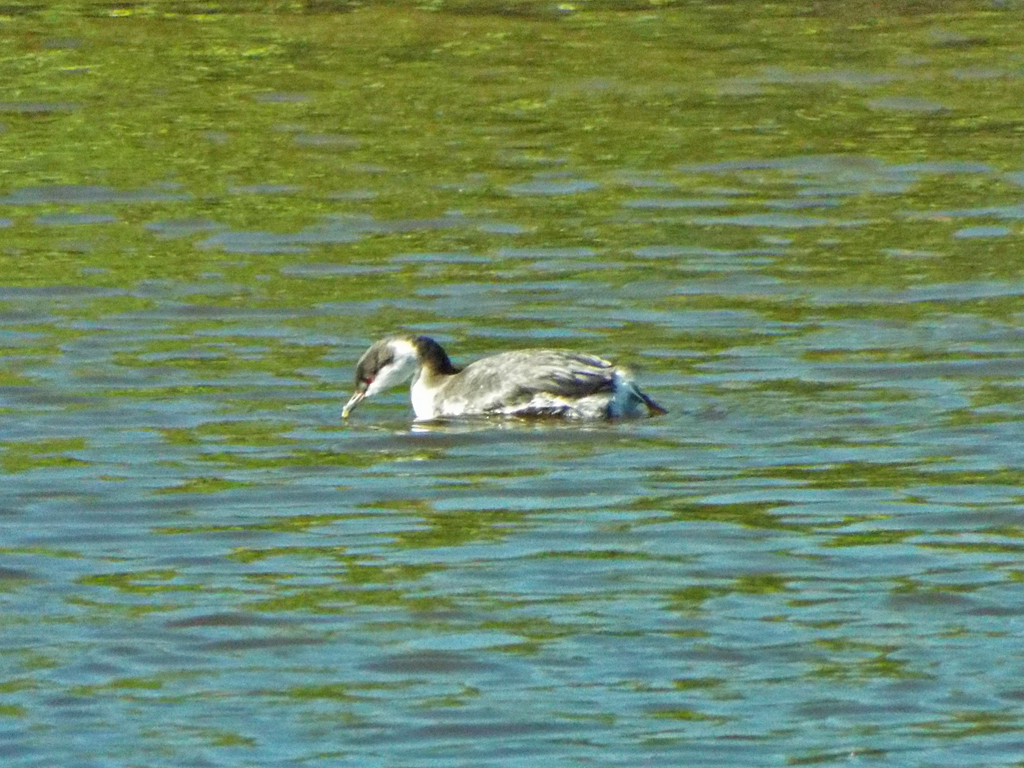
First, there had been reports of a Horned Grebe along the drive, which is unusual this time of year. Normally these birds might winter over (and many did this past Winter), but for one to be hanging around in May is a bit odd. Additionally, the bird was reported to be transitioning into breeding plumage. The normal breeding range for a Horned Grebe is the western half of Canada into southeastern Alaska. Here’s my photo of an apparently injured Horned Grebe from this past winter:
Injured Horned Grebe taking refuge in the Refuge. Note the primarily black and white plumage.
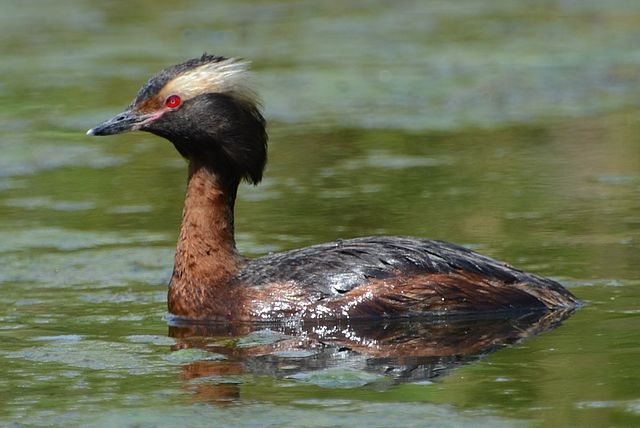
These grebes, and the very similar Eared Grebe, look very different during the breeding season, losing their black and white feathers in exchange for warm browns and some wild, buffy-colored head tufts!
I did not get very good photographs of the bird today, so here’s one taken from the Wikipedia entry on the Horned Grebe:
By Connon Mah (Own work) [CC BY-SA 3.0 (http://creativecommons.org/liceses.by-sa/3.0) or GFDL (http://www.gnu.org/copyleft/fdl.html)%5D, via Wikimedia Commons.I speculate (with nothing more than circumstantial evidence) that this is the same, injured bird. It might not be, but it would be a bit improbable, in my opinion.
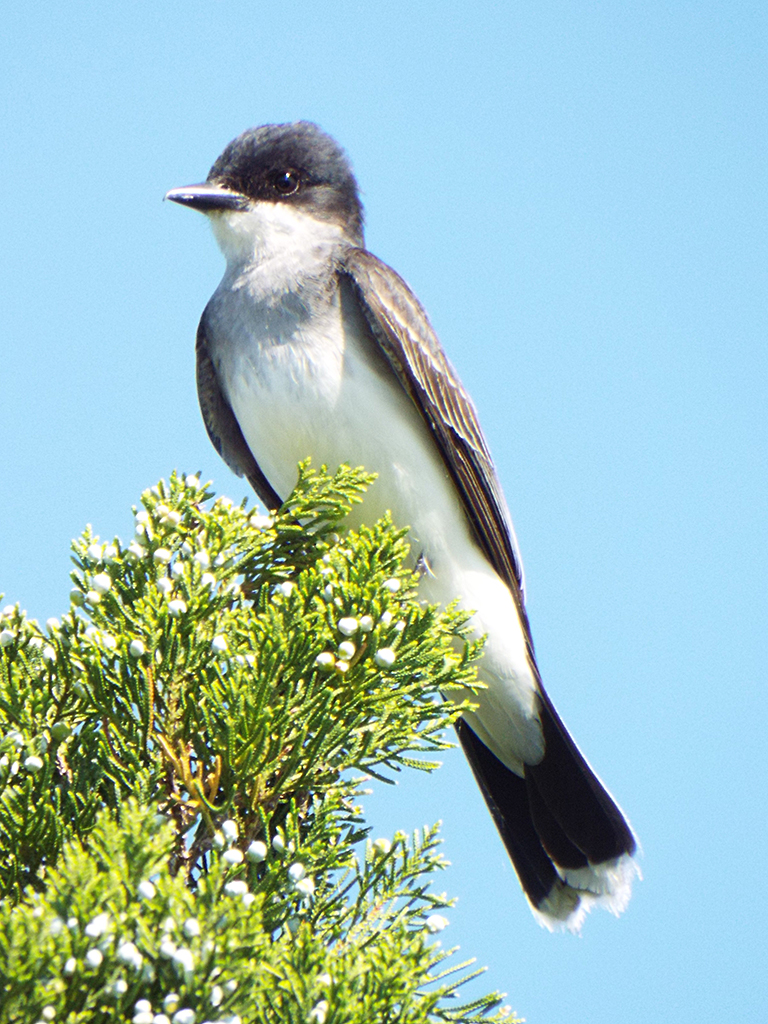
The next “black and white” bird I’d like to highlight from my adventure today, was a fairly accommodating Eastern Kingbird. This species has been a little harder to come by of late, at least when I’ve been out. We used to have one or two that would hang around the back yard some years ago, and I’d seem them in passing from time to time around town. The past few years it seems they’ve been more dispersed. In any case, this bird sat for a while in a nearby tree along the road and let me take a few photos before casually flying off.
This Eastern Kingbird would have likely arrived recently from central or northern South America, where it was staying for the winter.
In addition to the striking black and white color scheme, male Eastern Kingbirds have a small patch of red (or sometimes yellow or orange) feathers on the crown of their heads, which are almost never seen in the field, expect at close range when the bird is agitated or upset.
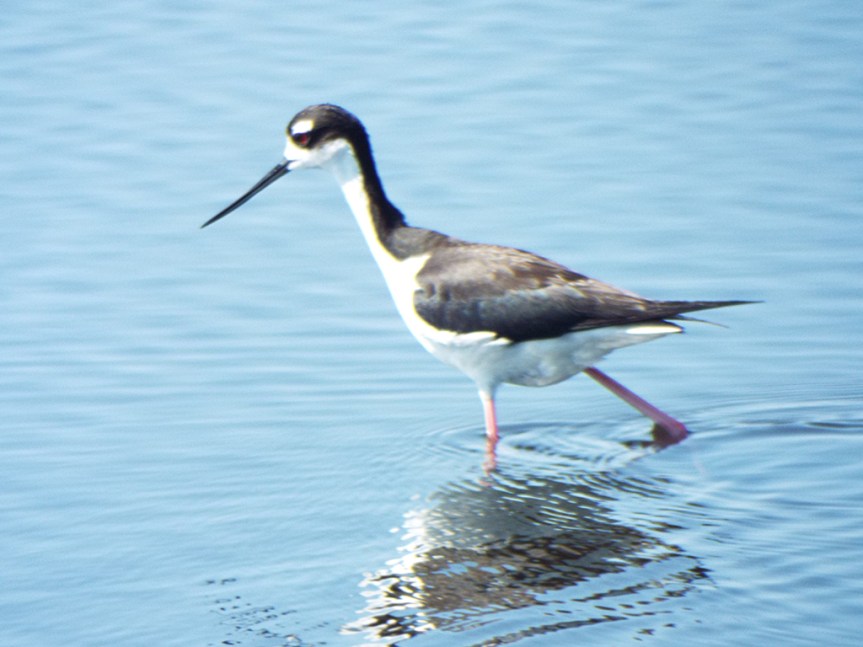
The final bird I’d like to focus on with black and white plumage, from today, is the Black-necked Stilt.
Although a bit out of focus, you can see the striking black and white pattern on this Black-necked Stilt. Less than 1/2 of the bird’s right leg is showing.
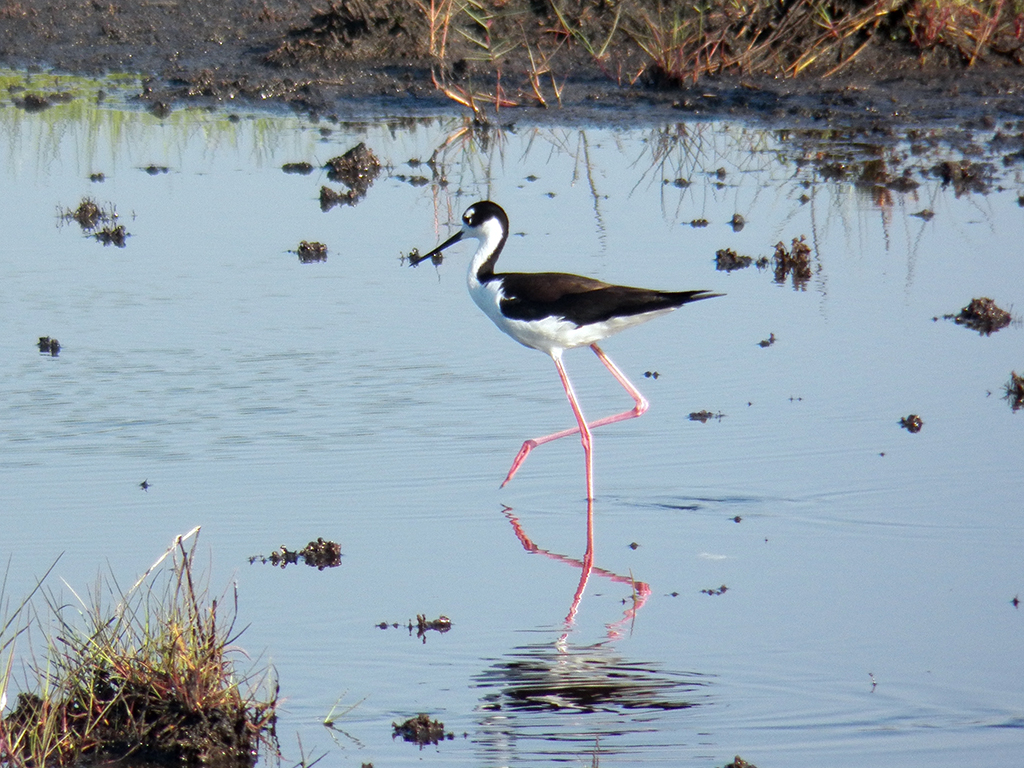
Black-necked Stilts are beautiful birds, and their conspicuous, long, red legs are second only to flamingos in their relative length to their bodies. Here’s another photo I took last year, showing how long their legs are.
A Black-necked Stilt showing off those amazing legs!
Those legs are likely an adaptation to allow stilts to wade in deeper water than other wading and shorebirds of it’s size, so it is not directly competing with them. This is sometimes referred to as “resource partitioning.”
Of course, I saw and heard other birds. If you’re interested, I’ve linked to my eBird checklist below:
May is rapidly drawing to a close and the relative quiet of Florida’s Summer is almost here, but I expect I’ll have plenty more adventures throughout the next few months, including a trip or two to more temperate climes. Stay tuned!
Saturday was the second annual “Global Big Day“, promoted by the Cornell University Lab of Ornithology. Just as a birder’s “Big Year” would be an attempt to rack up as many bird species in a year as possible (usually over a large area, like a country or continent), a “Big Day” is an attempt to identify as many birds as possible, in a smaller area, in 24 hours. It isn’t unusual to see goals of 100 or more species for the day. I’d even seen one statewide (not Florida) goal of 200 species.
My Big Day was a bit more modest. There have been a couple of rare species reported since the winter in Palm Beach County, but I haven’t been able to take advantage of any opportunities to head there all year. Using the Global Big Day as a catalyst, Camille and I decided it would be a good time to go. We’d try for the rare species and tally up as many birds as we would see throughout the day.
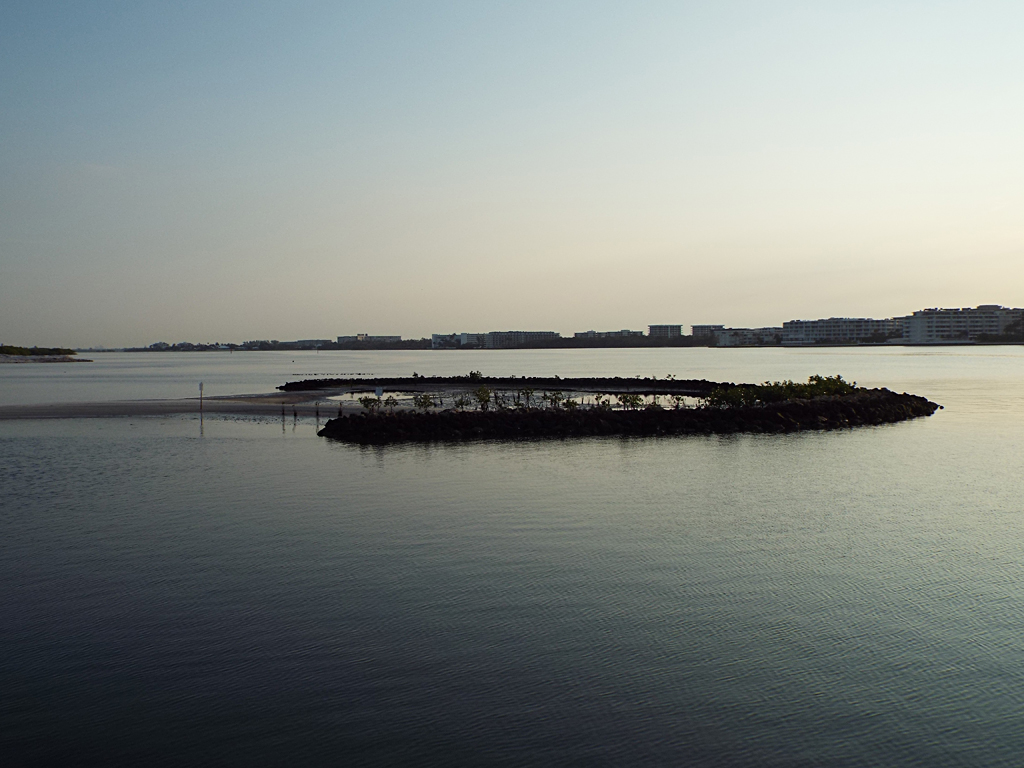
In the hopes of catching some shorebirds, we started at the relatively new (and still under construction) Snook Islands Natural Area [map]. I’ll leave it up to the reader to decide the level of irony involved in having a natural area under construction.
One of the created islands of the Snook Islands Natural Area. This one was mainly pigeon free.
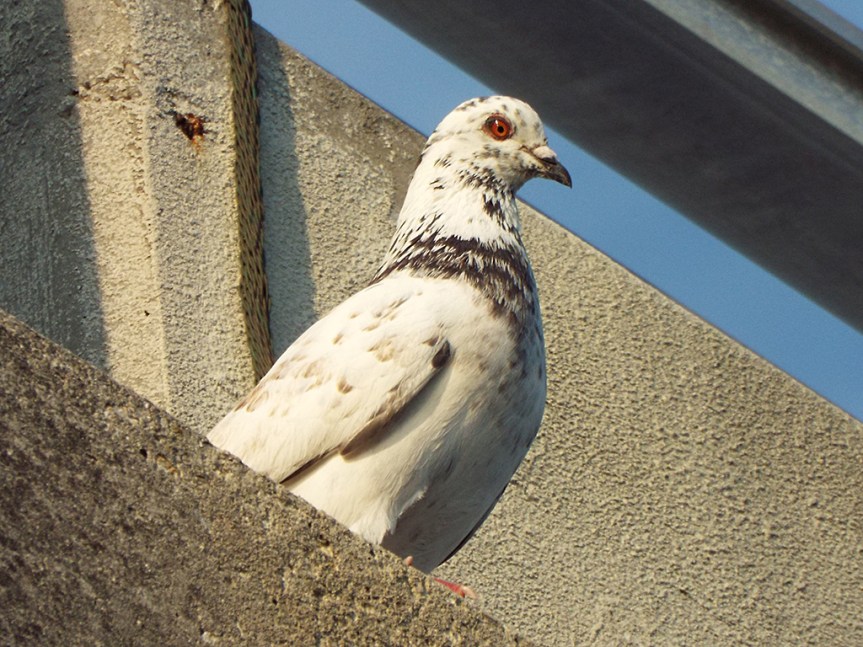
There were many Rock Pigeons in the area, including the islands. Rock Pigeons are considered an established feral species and are known for their plumage variations, probably due to mixture with domestic stock. At least 40 were flocking by the boardwalk’s start, with more walking on or flying over the artificial islands.
A strikingly pale-feathered Rock Pigeon. Plumage variations like this are common in feral pigeons.
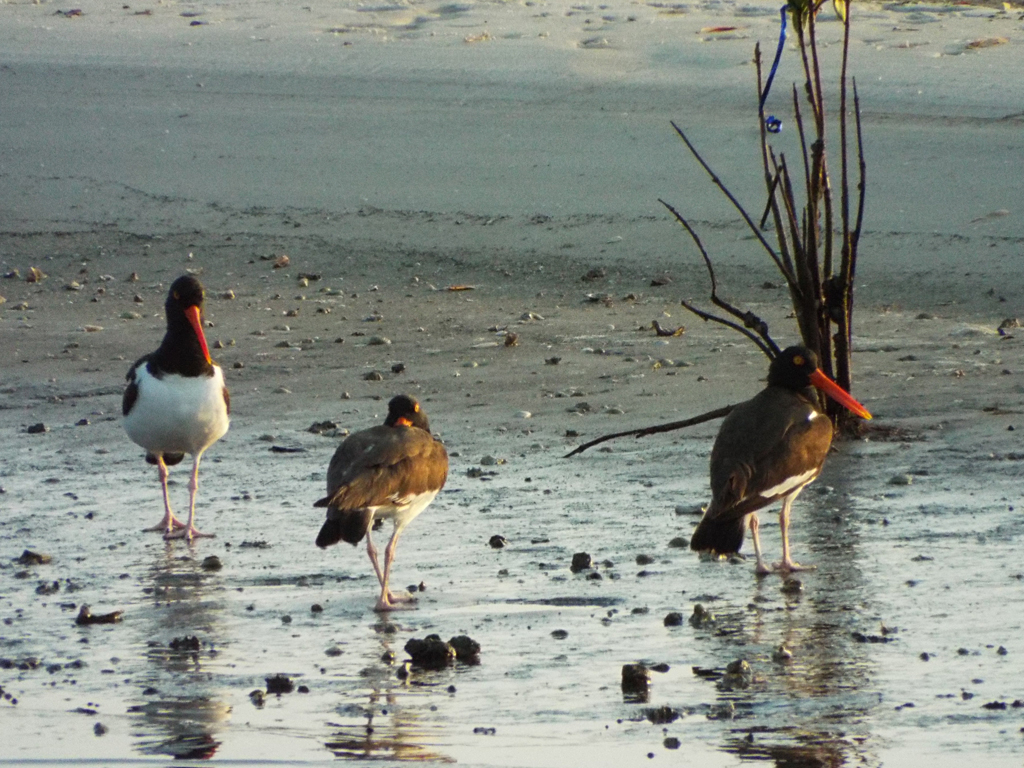
There were a few shorebirds, too. While watching a small group of Ruddy Turnstones, a trio of American Oystercatchers flew onto one of the islets closest to the boardwalk we were on. These birds are loud, by the way.
Some of the American Oystercatchers at Snook Islands Natural Area.
We heard a Black-throated Blue Warbler and saw some other smaller birds we couldn’t identify. There was a surprising lack of larger terns or gulls, and no Ospreys were nearby.
Our next stop was Loxahatchee National Wildlife Refuge [map].
The boardwalk at the visitors’ center makes its way through a cypress swamp, with a variety of birds singing and calling. A Swallow-tailed Kite soared overhead, and there were Pileated Woodpeckers, Wood Ducks, Northern Cardinals, Carolina Wrens, and over a dozen Common Grackles. Several Northern Parulas could be heard singing, too.
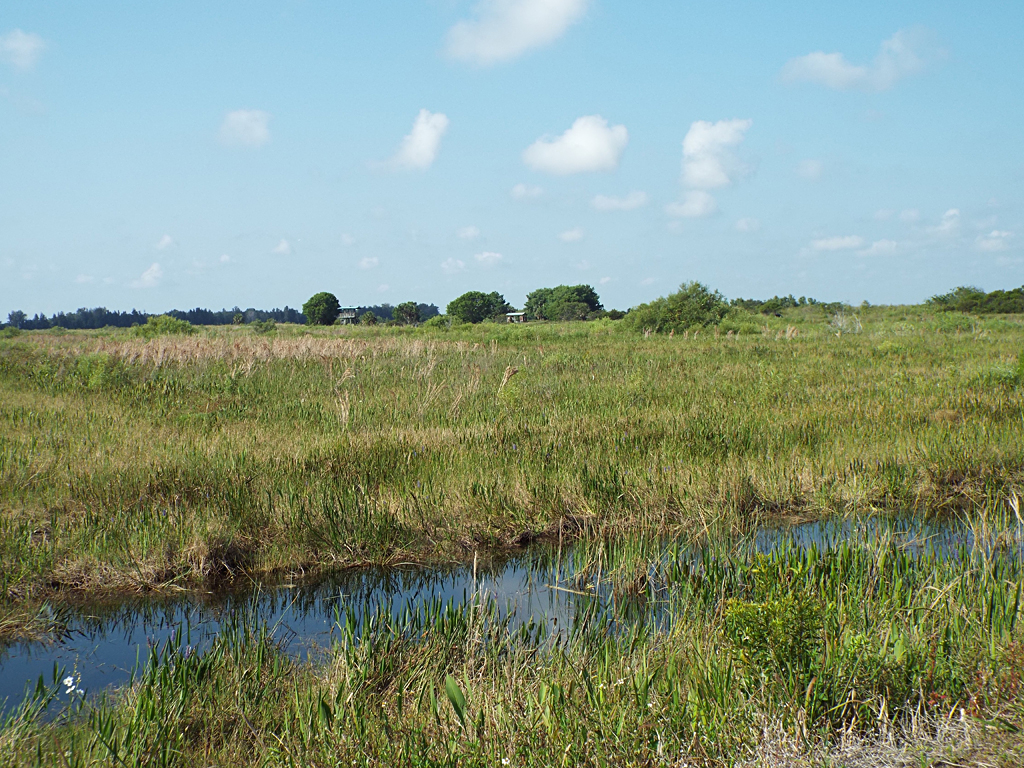
Loxahatchee is part of the Everglades ecosystem, with some sawgrass, wet prairie, and hammock habitat, interrupted by sloughs and sluices. The areas accessible to the public are primarily former agricultural tracts, and are less expansive than the bulk of the refuge, or of Everglades National Park, but contain ample examples of plant and animal communities native to South Florida. Loxahatchee is separated from the rest of the Everglades by dikes and canals.
A typical Loxahatchee landscape, on the Marsh Trail.
Near the Lee Way levee is a large rookery of wading birds. White Ibises were the most numerous, but there were many heron and egret species, with individuals shuttling back and forth with food and nesting material.
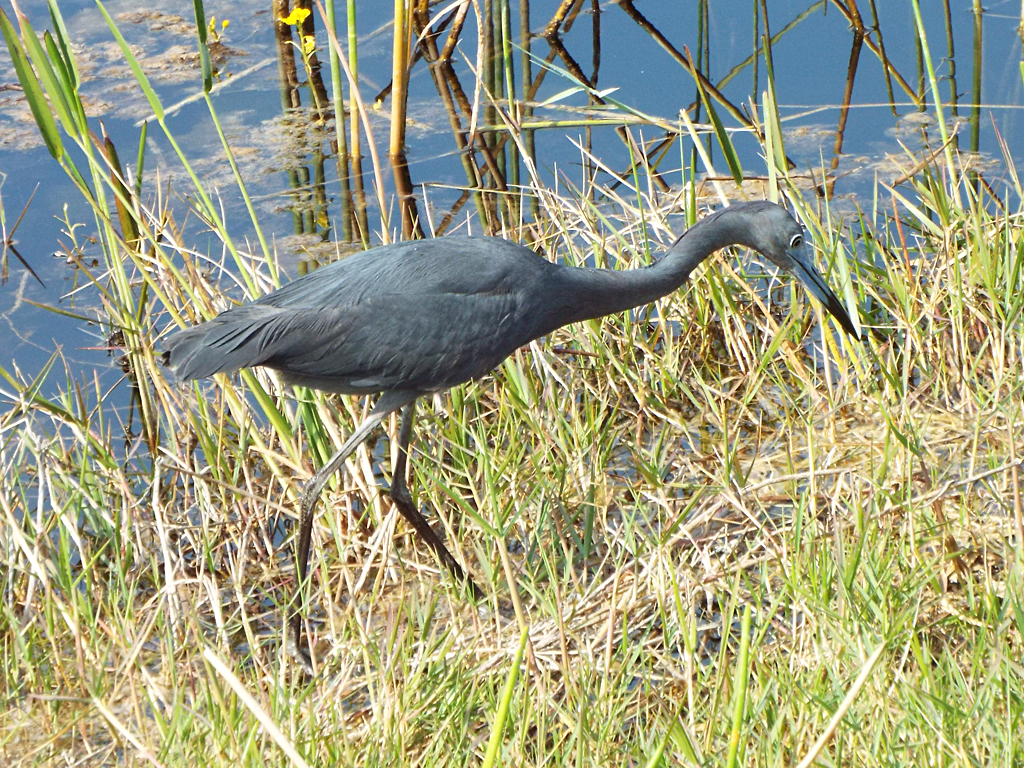
An adult Little Blue Heron stalking frogs and insects.
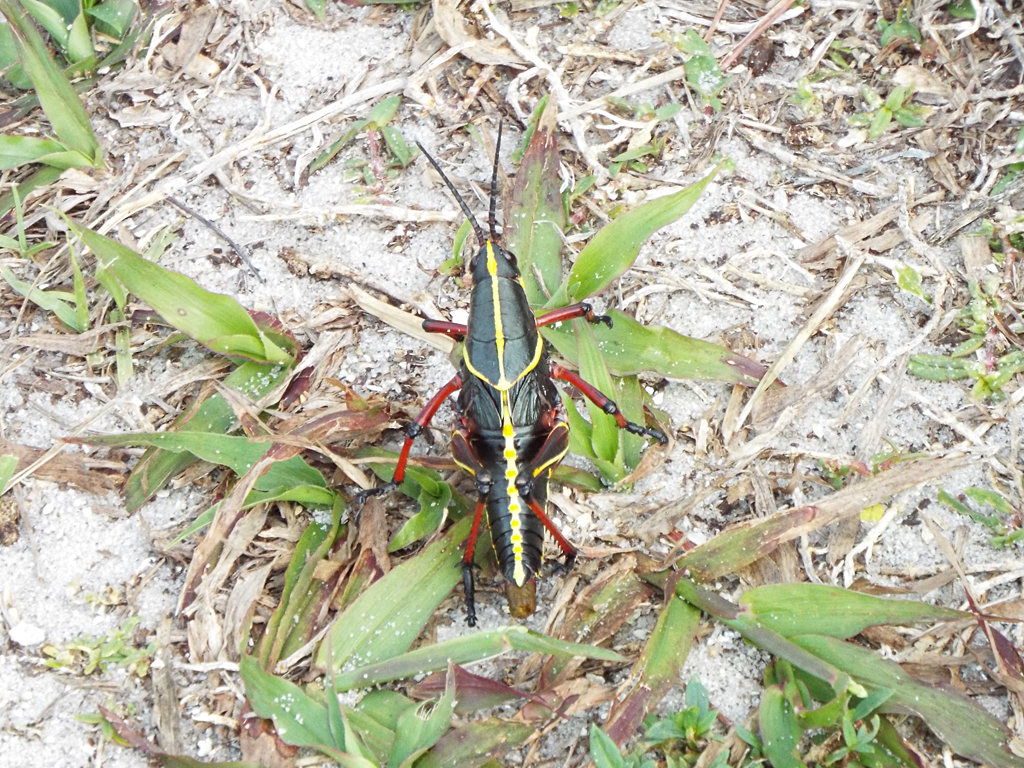
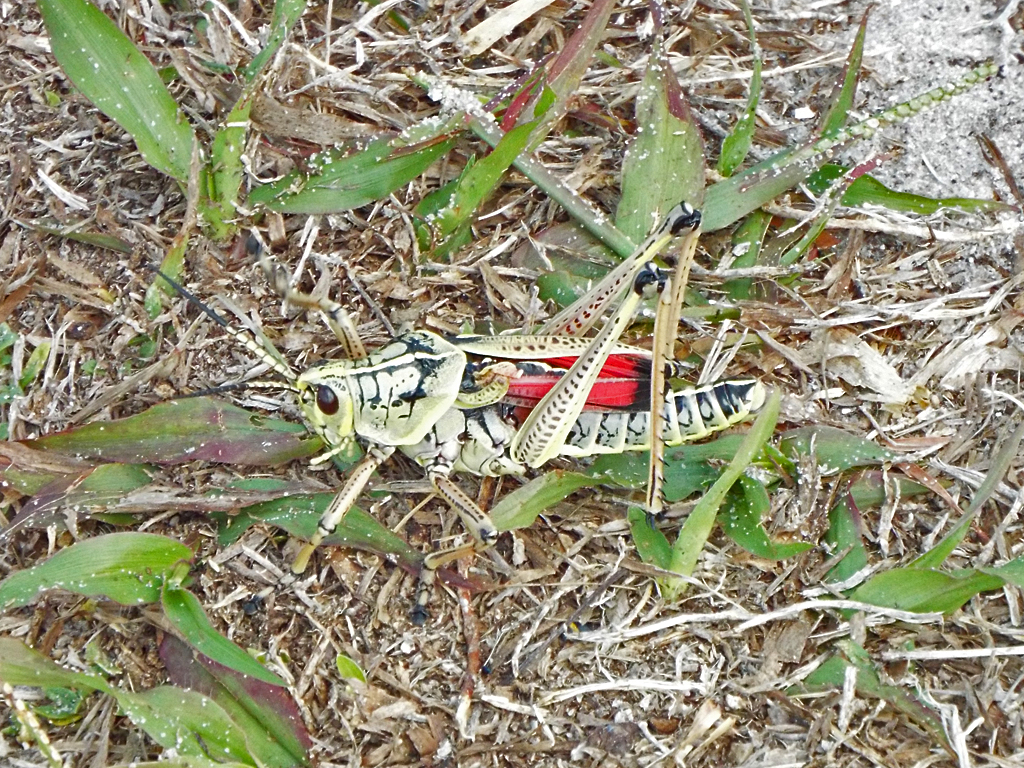
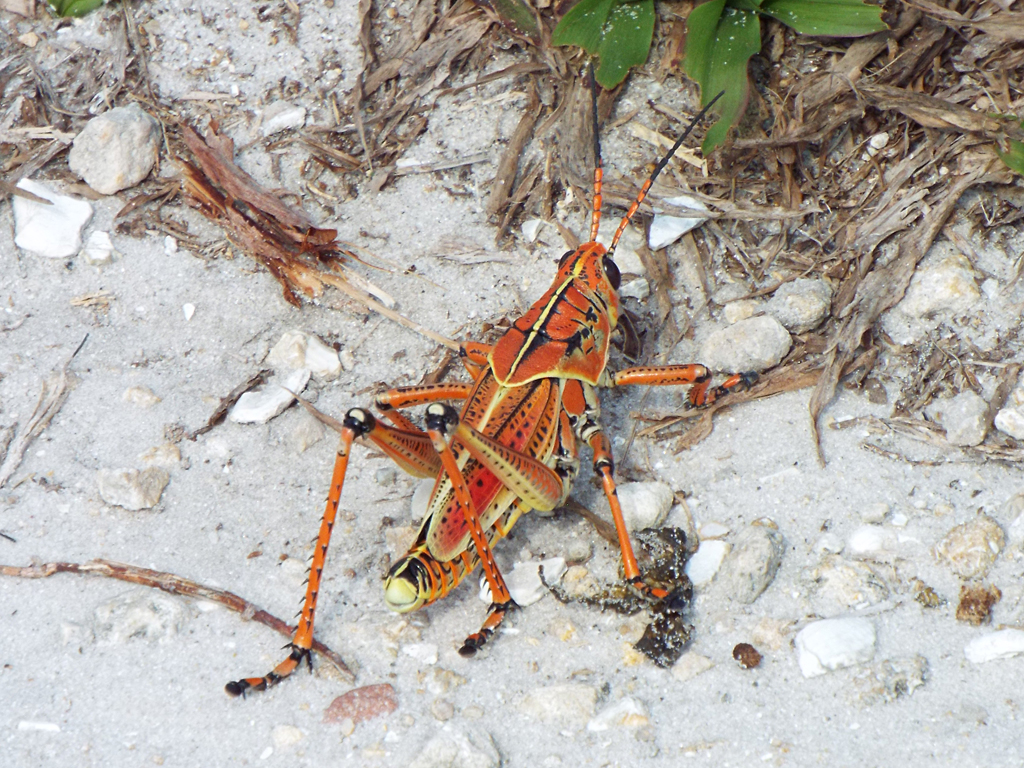
Along most of the Marsh Trail there were hundreds of large grasshoppers. There were at least three distinct looking varieties (shown below). They covered the trail and were sometimes slow to get out of the way. I spent a lot of time looking ahead on the ground to try and step around or over them. I did not see many birds eating them, though, so I wonder how palatable they are. The larger individuals of each type were easily about 5 cm (2 inches) long.
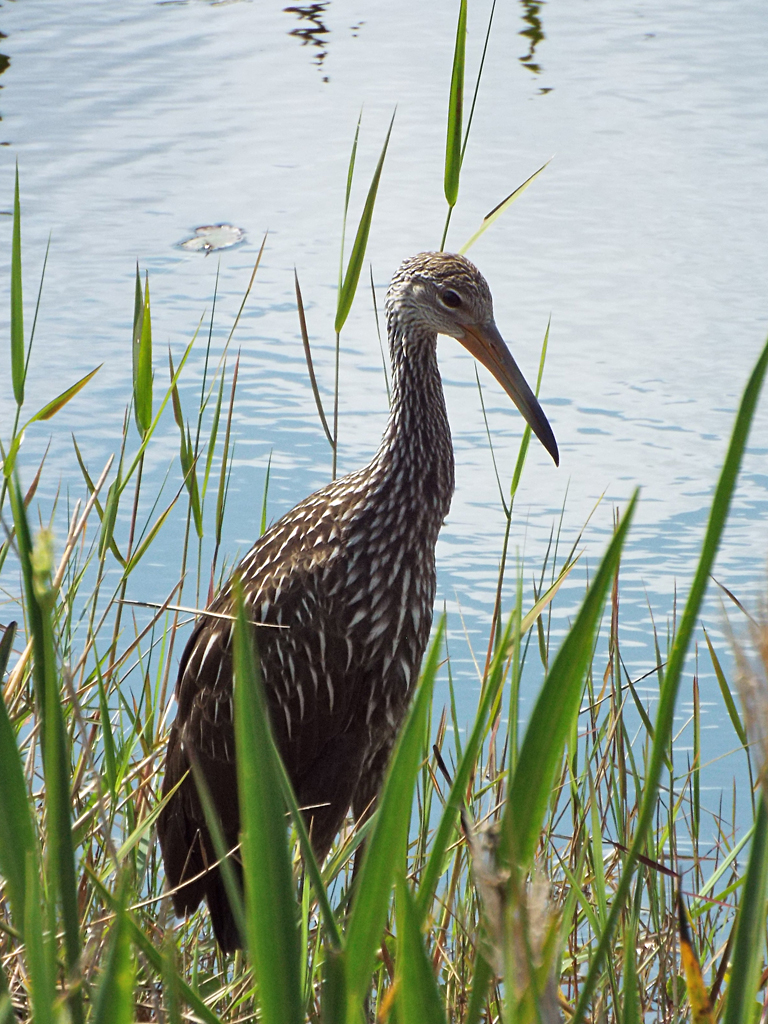
There were Limpkins there, too, eating Apple Snails. Snail Kites have been regularly reported, but we didn’t see any. In fact, to this point in the day, we’d only seen one other raptor (besides the Swallow-tailed Kite over the Loxahatchee NWR visitors’ center).
A Limpkin, seemingly lost in thought.
Even after consulting some notes on where to find the Smooth-billed Anis that are regularly reported there, we came up empty.
There are two smaller parks not far from Loxahatchee, Wakodahatchee Wetlands (a converted water treatment area) and Green Cay Wetlands. Both are run by Palm Beach County.
Wakodahatchee [map] has several rookeries on it, very close to the boardwalk. Here, there were dozens of Wood Storks, including nests with several chicks each, as well as Double Crested Cormorants, Great Egrets, Cattle Egrets, and Anhingas – all nesting and rearing young.
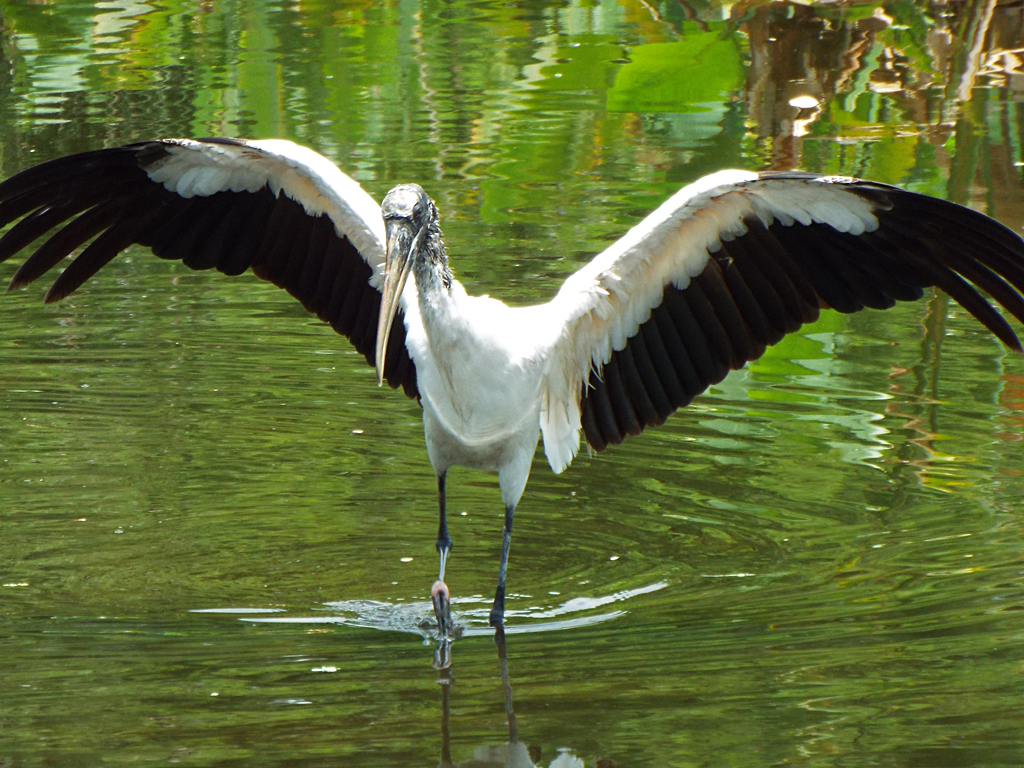
A Wood Stork, scaring up prey, at Green Cay Wetlands.
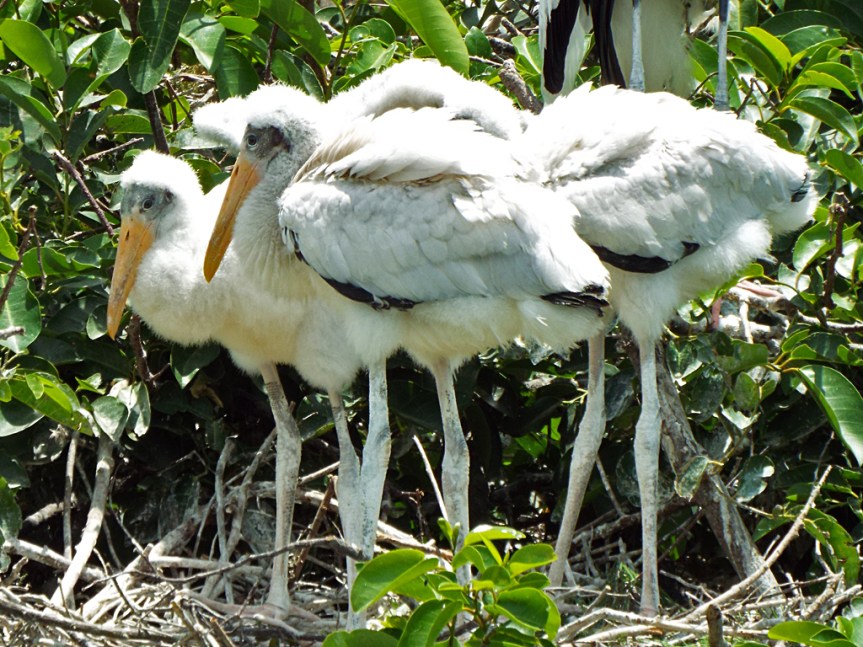
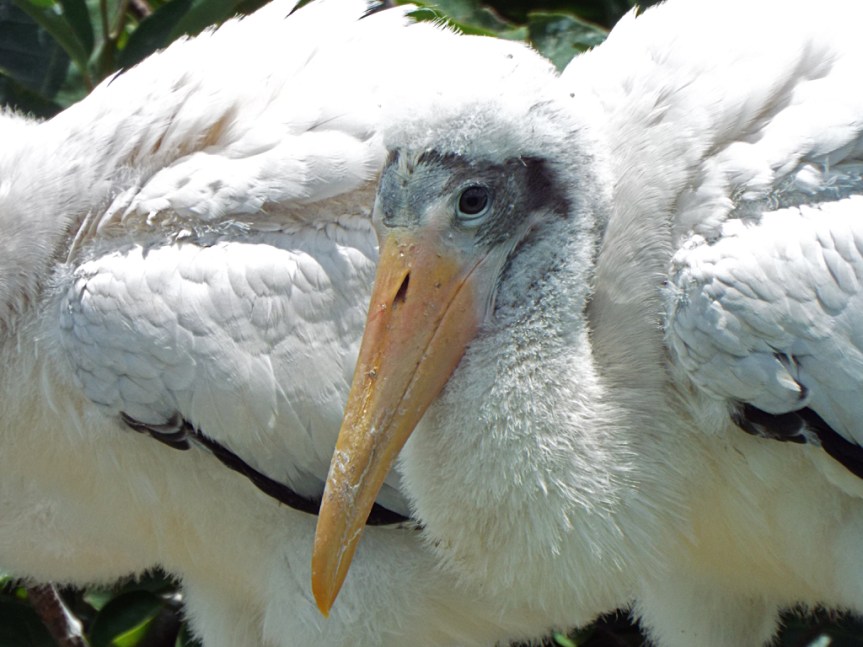
I’ve never seen Wood Stork Chicks before, so it was exciting to see some youngsters so close and accessible. Whenever the chicks in one nest would start to call out (presumably for food), chicks in the other nests would start begging, too.
Three Wood Stork siblings.
This chick, and its siblings, are already starting to lose some head feathers.
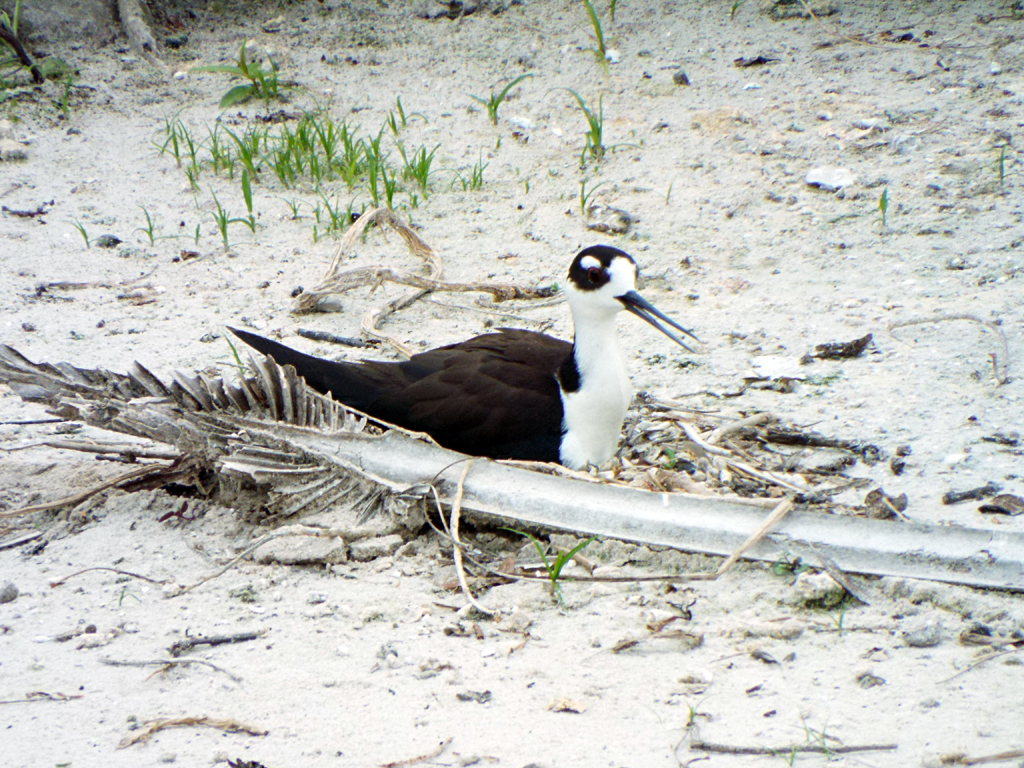
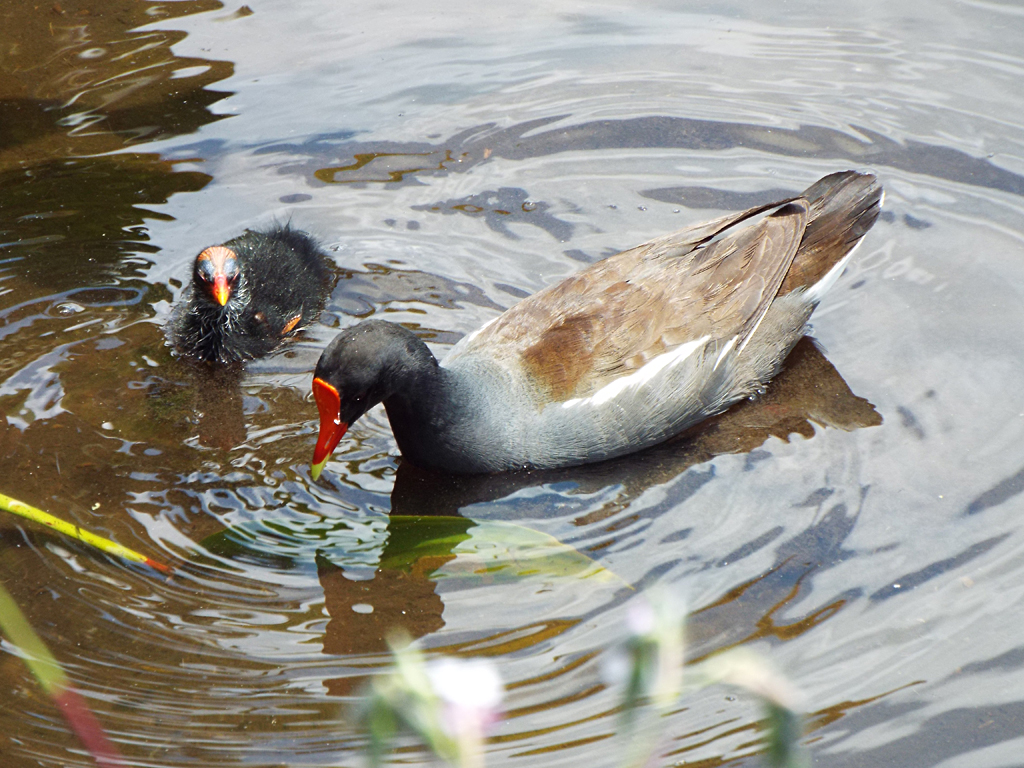
There were also many fledgling Tricolored Herons as well as nesting and incubating Black-necked Stilts, as well as several Common Gallinule pairs with tiny chicks.
Black-necked Stilt sitting on eggs.
Common Gallinule parent with one of its chicks.
Warblers were scarce, and had been all day, so it as a pleasant surprise to see a Northern Waterthrush timidly hop out among some grackles and gallinules.
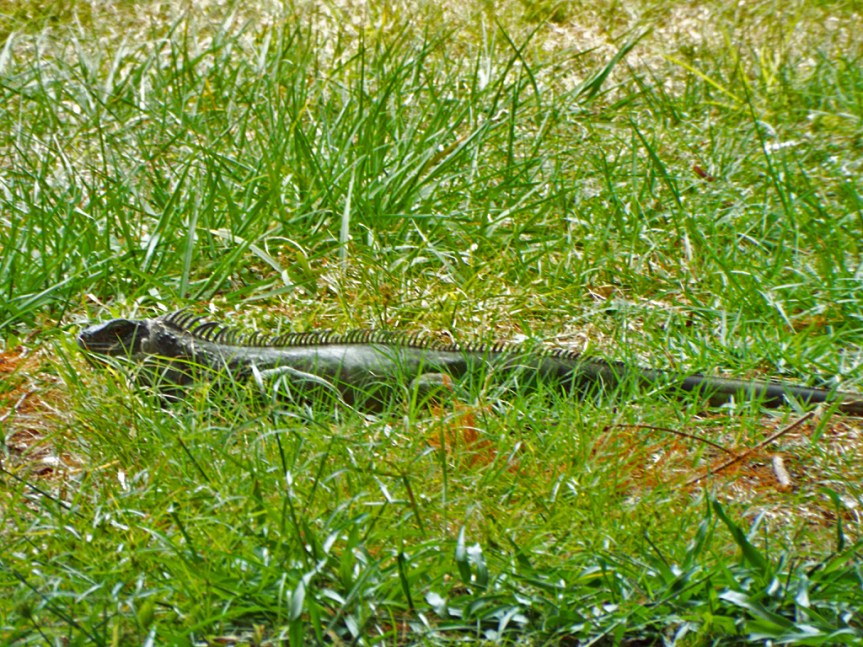
The park is also known for a population of feral iguanas. I only saw a few, including this larger one. It was a hot day, and they seemed to be resting in the in the shaded areas.
This iguana had just walked out from some shady trees toward the water.
Just down the road from Wakodahatchee is Green Cay Wetlands [map], which has a more extensive boardwalk and a nature center (which was closed soon after we arrived).
Nature Center at Green Cay Wetlands.
Many of the same species seen at Wakodatchee were present, but none of them were nesting. There were also several White-winged Doves, and one unhappy Red-shouldered Hawk (only our third raptor of the day) getting dive-bombed by families of Purple Martins and harassed by Red-winged Blackbirds.
I got some decent looks at Grey-headed Swamphens (I only got a few glimpses at Wakodatchee in the thick rushes). Grey-headed Swamphens are relatively new arrivals in Florida, competing with Purple Gallinules for food and nesting territories.
As their populations rise and move northward, there is concern that the larger and more robust Grey-headed Swamphens may outcompete the native gallinules.
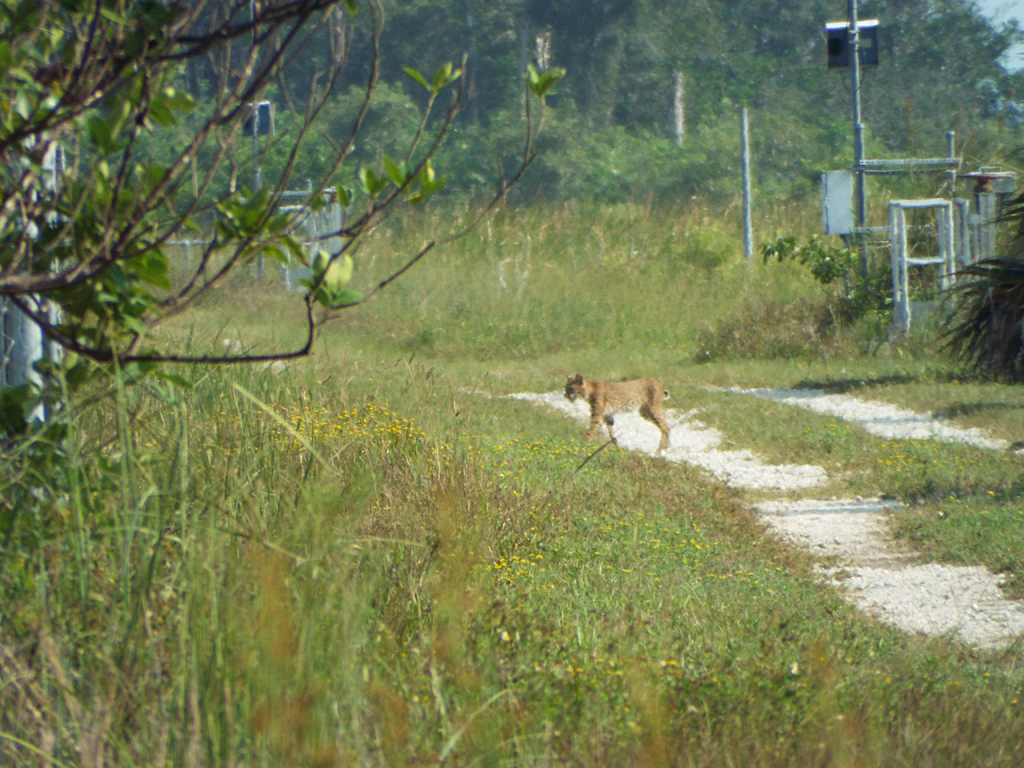
We decided to give the Smooth-billed Anis one last try at Loxahatchee, late in the afternoon. We cut across the Marsh Trail area up to the levee road. As we got to the western sluice gates a bobcat came out of the brush onto the path, quite a distance away. I watched it in my binoculars and I could see the instant it either saw us or caught our scent, because it jerked its head up and immediately changed direction onto another path and then off into a slough area. About half a dozen egrets and ibises immediately flew up, and a Little Blue Heron seemed to dive-bomb the bobcat (which was out of view) a couple of times before clearing off. That’s the last we saw of the bobcat. You can see from the photo below that it was fairly large.
A bobcat out for a late-afternoon stroll.
We worked our way up to the levee road (Lee Way) again and had a look around before crossing back to the parking area. I have to admit it was a little disappointing to miss seeing a Smooth-billed Ani, but it wasn’t for lack of trying.
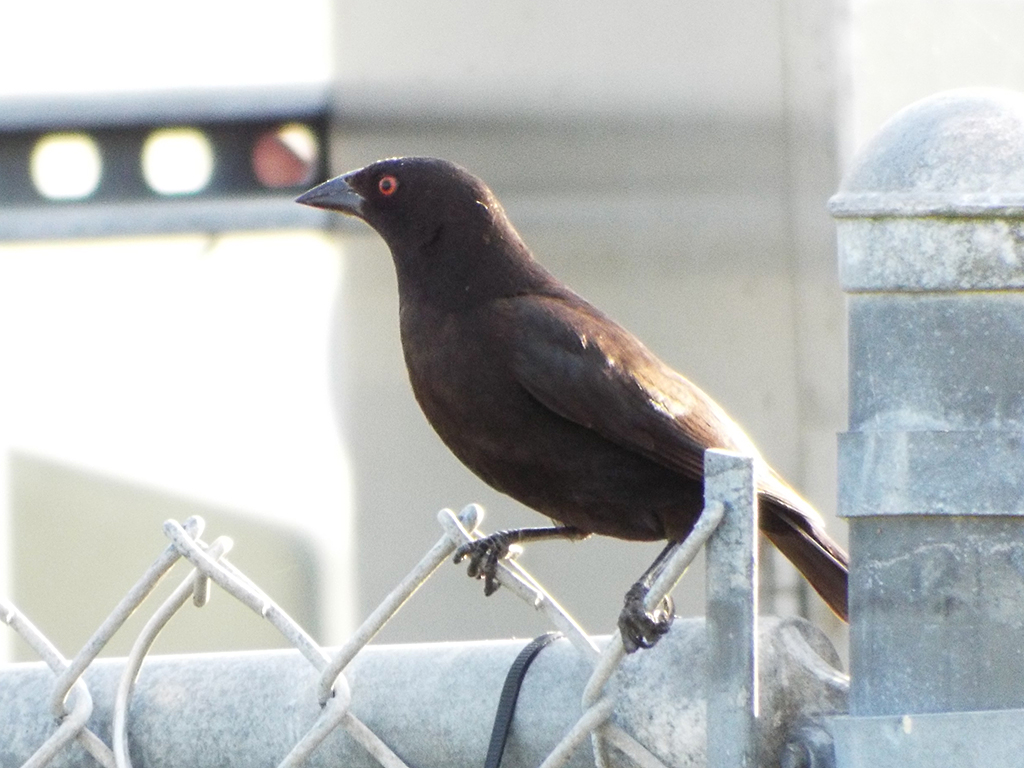
The last stop was at the Peaceful Waters Sanctuary [map] where a Bronzed Cowbird has been reported since earlier this Spring. The sanctuary is a beautiful, created wetland park with a boardwalk and some nature trails, tucked into a city park. The cowbird, however, had been seen working a chain-link fence around a retention pond adjacent to the sanctuary. Sure enough, that’s where we found it.
Bronzed Cowbird. Note the red-orange eye and relatively large bill.
In the sanctuary there were numerous Boat-tailed Grackles, some Red-winged Blackbirds, and several large rafts of Mottled Ducks with ducklings of varying ages. There was even a pair of Wood Ducks with a couple of ducklings of their own.
I’ve read that the winter-time birding here is even better, and some nearby parks, including the Wellington Environmental Preserve and the Royal Pine Beach Pines Natural Area, are good spots to check out when the weather is cooler.
That concluded our Global Big Day around Palm Beach County. The big numbers might not be there, but over 60 species for southern Florida after peak migration season isn’t terrible. Besides, I got to see 2 lifers and explore a part of the state I’d only driven through until that day.
April is peak Spring migration in Florida, and Ft. De Soto is usually the center of the action. On Friday, some weather came through behind strong southerly winds, and on Saturday there were reports of many migrants in the park. Camille and I couldn’t get there until Sunday, but the birding activity was still high.
The five islands (keys) that comprise the park jut across the entrance of Tampa Bay, south of St. Petersburg [map]. Its location along the Gulf migration route (and not terribly far from the Atlantic coastal route, depending on prevailing winds and weather), make it a migrant trap. Its relatively undeveloped beaches and sandbars are a haven for shorebirds and gulls and terns (at least where public access is limited).
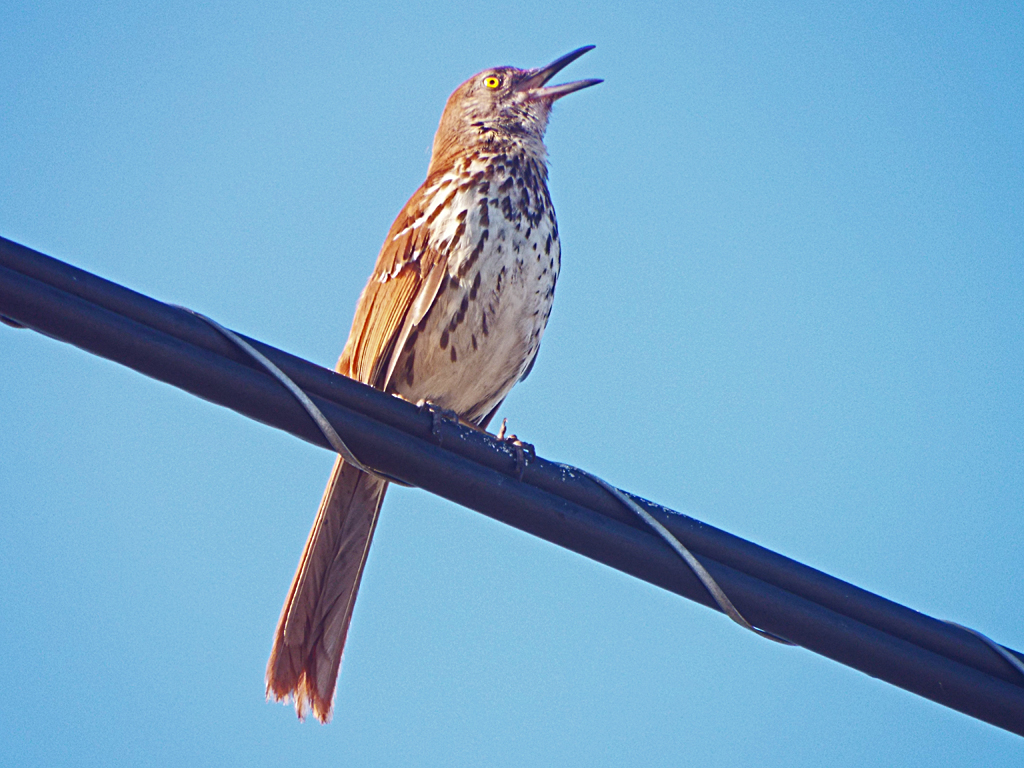
A Brown Thrasher greeted us in the parking lot.
It was nice to see a Brown Thrasher (above) out singing. This normally more reclusive relative of the mockingbird also mimics other birds, though a little less forcefully.
Of course, the main draws to Ft. De Soto this time of year are migrants, including warblers, orioles and finches (among others).
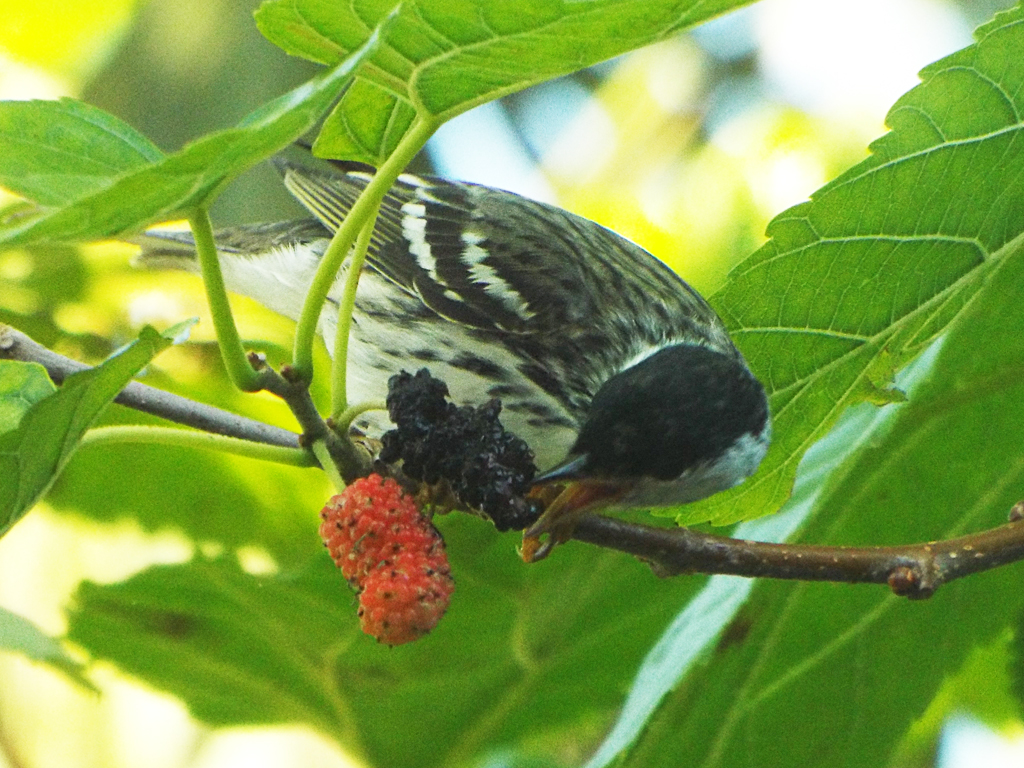
A male Blackpoll Warbler eating mulberries.
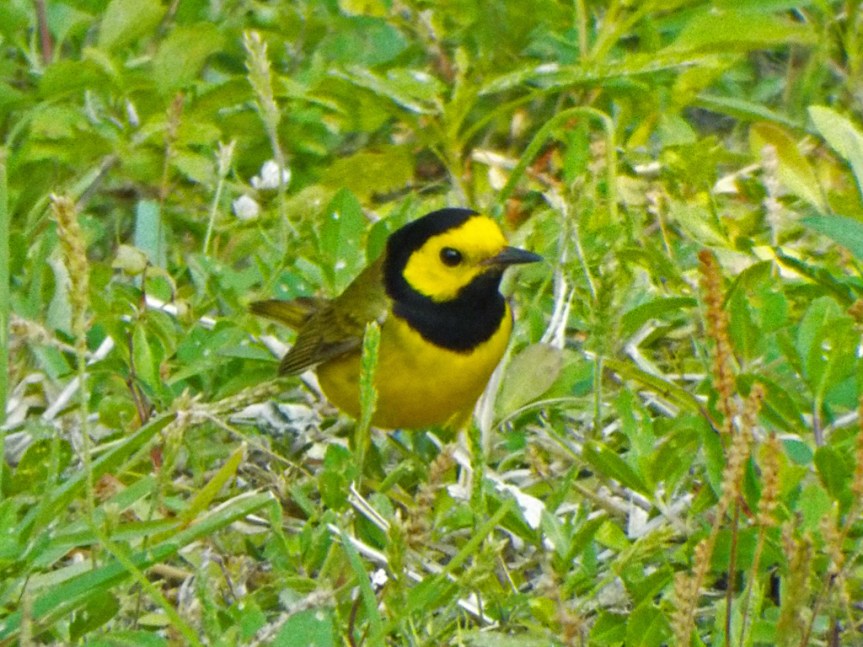
We had a nice number of warblers through the day, including resident birds like Black-and-White Warblers and Northern Parulas. Migrants included Blackpoll, Yellow, Magnolia, and Hooded warblers.
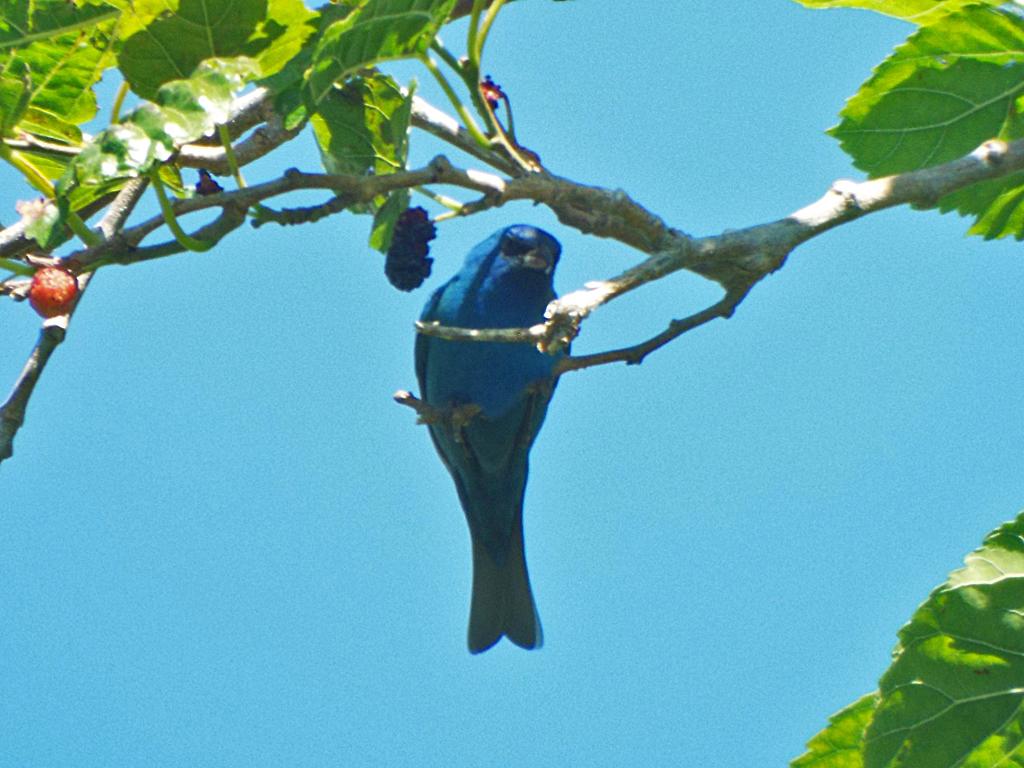
Most of the activity centered around the Mulberry Trees by the rangers’ residence, with birds flying in and out of the trees, occasionally singing. The Indigo Buntings had a long feeding session before some Fish Crows broke up the party.
An Indigo Bunting.
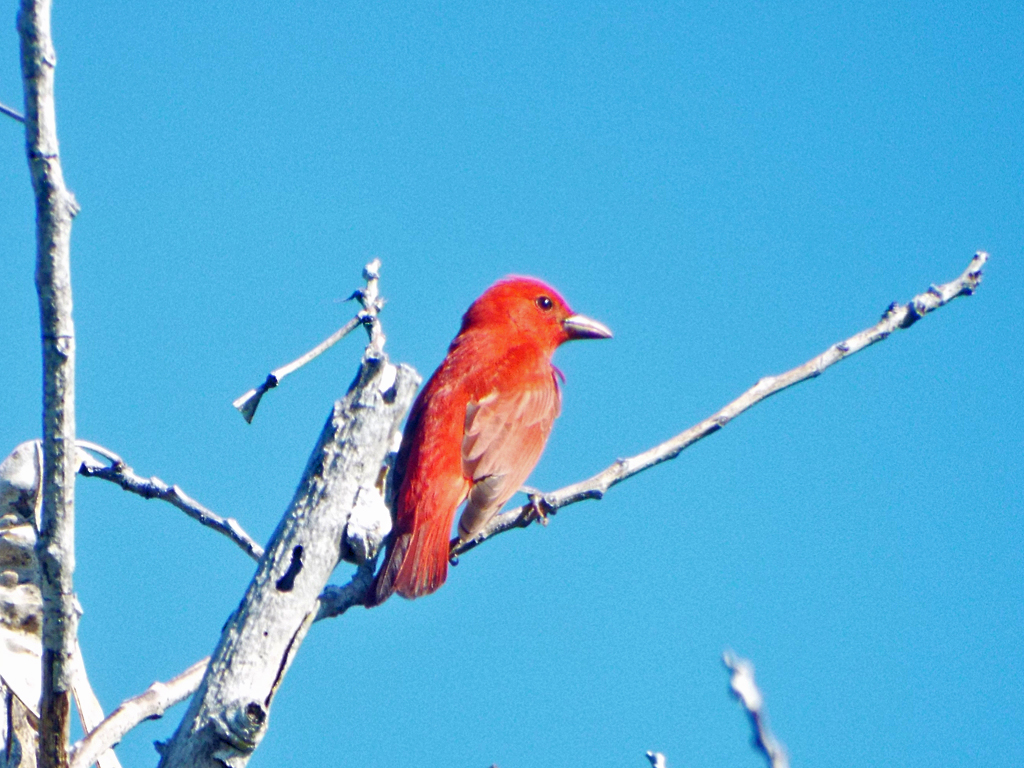
Some male Summer tanagers obliged us by perching out in the open. Having not seen this bird for so long, I was happy to see them just a few weeks apart.
Longer term readers of this blog know that Turkey Creek Sanctuary [map] had long been a mainstay of my weekly birding adventures. Of late, this beautiful part of the EEL family has been less than stellar, when it comes to watching birds. Migrations for the past two years have been exceedingly quiet and episodic. While visiting new places and teaching a newbie the “birding ropes”, it’s not been a priority location. This changed late last week after seeing the uptick in action and Lori Wilson Park (another quiet-of-late Space Coast migrant spot). I saw on the Brdbrain e-mail list that Bill Haddad had some decent species numbers at Turkey Creek, and was leading a Space Coast Audubon Society walk there on Saturday morning. We’d had a “good” shift in weather, and Bill was banking on seeing more migrant warbler (and other species). I decided to drop in on his walk and see what my birding fortunes would be.
I am glad I made the trip. While we didn’t have a “blockbuster” morning by any measure, it was nice to see some bonafide migrant species and enjoy a day that, while starting off a bit drizzly, wound up blue and beautiful. The only metaphorical “fly in the ointment” was the wind, which likely kept the numbers and species count down. But for Turkey Creek it was a nice change, and I got to walk the comfortable and familiar paths of my old stomping grounds.
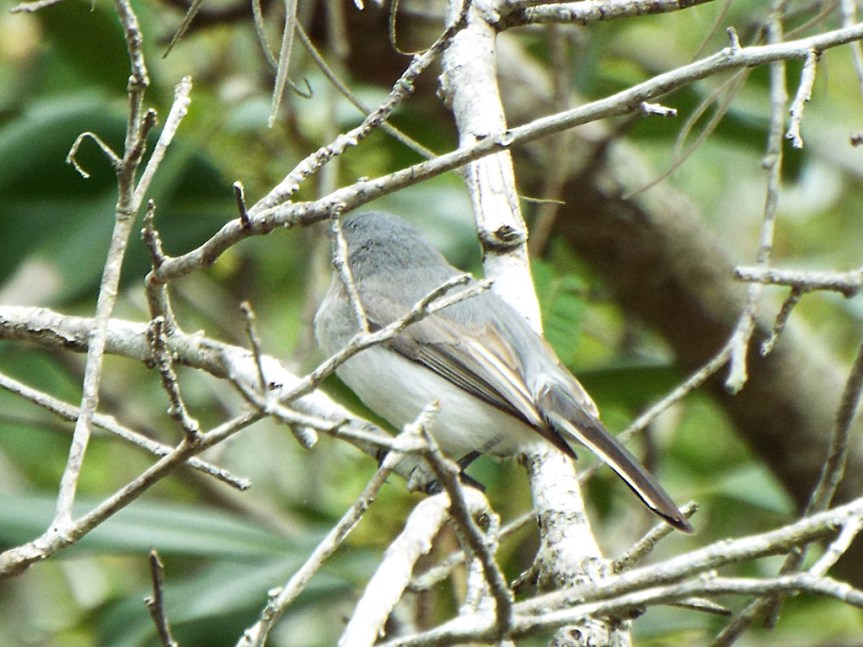
We used the tried-and-true method of locating common and vocal resident species, such as Northern Cardinals and Blue-gray Gnatcatchers to find associated migrants.
The tail-end of a Blue-gray Gnatcatcher. All the birds we saw were so active, photography was not often a fruitful endeavor.
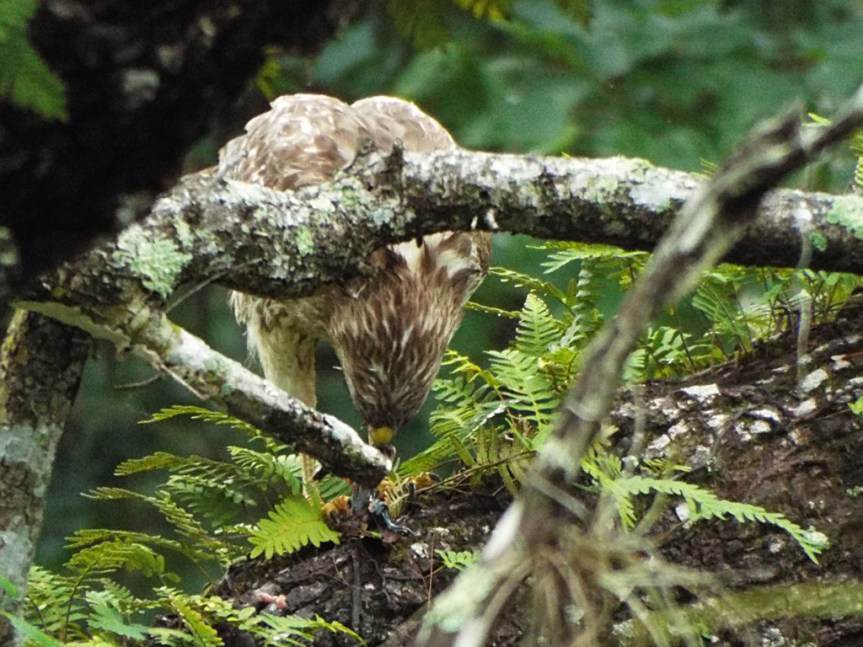
At the end of one overlook (I can’t remember if it was the “Tree House” overlook or not), a juvenile Red-shouldered Hawk landed in some nearby (but obscuring) oak limbs to devour it’s lunch (a frog).
Best-focused and least graphic photo I have of the hawk having a fresh meal.
Of course, spring time is in full swing, and much of our canopy is closed in, which made locating the many Northern Parulas we heard a frustrating exercise. Even later on, with other warblers and vireos singing quite close by, we had to rely on the group’s combined birding-by-ear expertise to positively identify the birds.
Among the FOY birds for me this trip were Black-throated Blue, Worm-eating, and Cape May warblers.
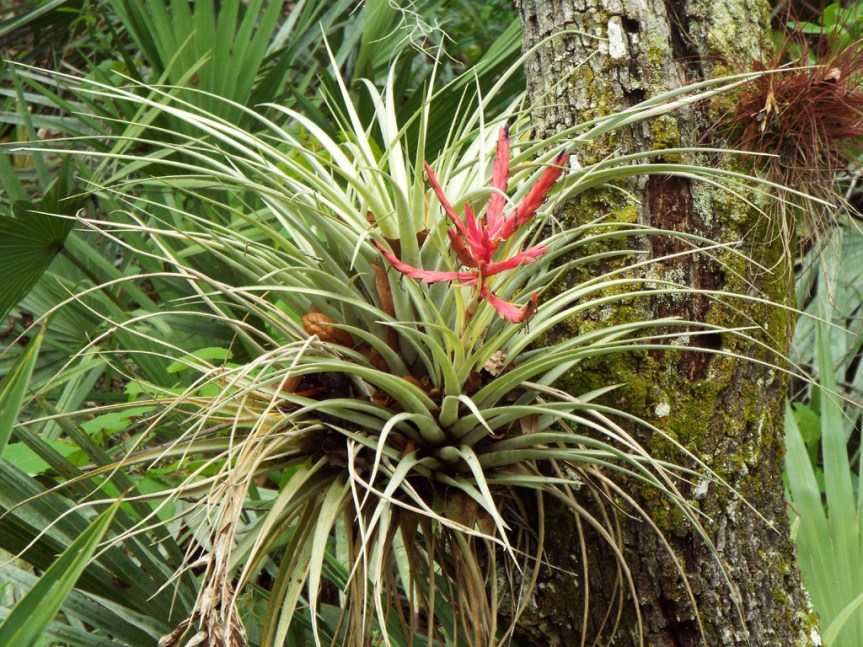
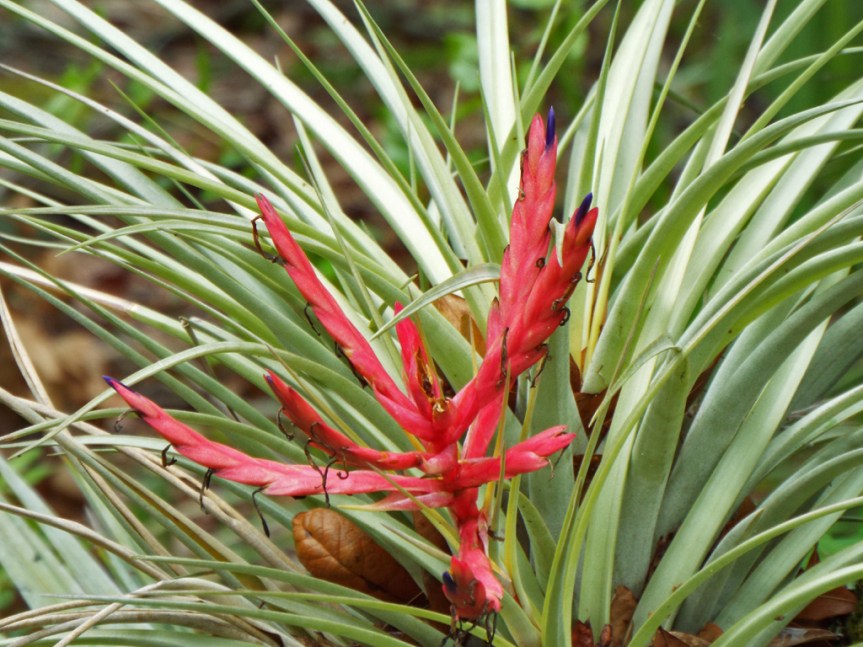
Various airplants and bromeliads are still blooming, like this +2-foot diameters plant with the bright red inflorescence. I was tempted to ID it as a Cardinal Airplant, but the inflorescence looked different to me. If anyone knows the specific species, I’d be glad to know – just leave a comment.
This may be the largest airplant I’ve seen, outside of the Everglades.Brilliant red inflorescence.
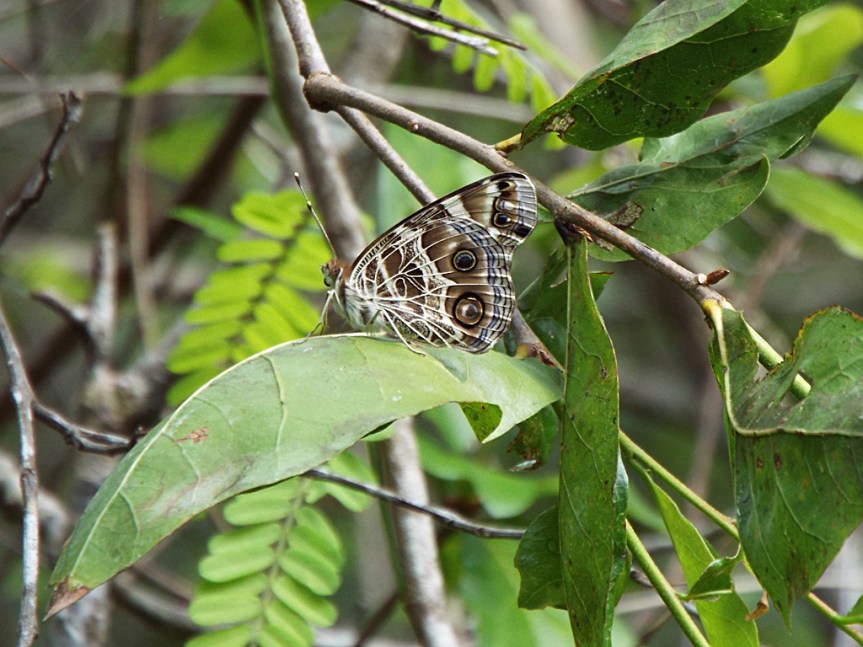
We had some non-avian friends as well. A pretty orange butterfly landed on the path from McKinnon’s way to the jogging path. When it finally landed, it refused to open it’s wings (at least until after I left the vicinity – other’s ID’d it for us).
American Painted Lady butterfly, resting.
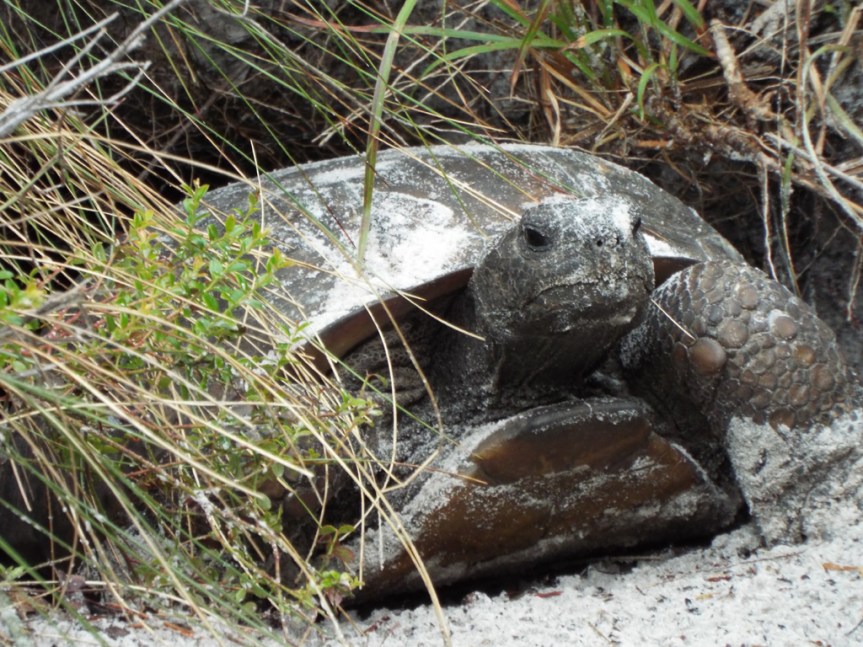
No trip to Turkey Creek Sanctuary is complete without a Gopher Tortoise sighting, of course. This one was just off the boardwalk on the way toward the park entrance.
Gopher Tortoise hanging out on the equivalent of its front porch.
By the end of the walk, only a few of the 10 of us remained (it was a taxing walk, with little reward at first), and we were treated to a couple of male Indigo Buntings in the sanctuary and public library parking lot. At the very end just Bill and I were left as two Swallow-tailed Kites flew quickly past over us in the lot before the breeze quickly carried them away.
This may bode for some good migrant activity through the week until the weather changes again, and I hope some birders have a chance to get out there and appreciate these birds as they make their way north, in some cases thousands of miles, to their breeding grounds.
This past weekend I attended the Florida Ornithological Society’s spring meeting, near Brooksville, FL. Along with a paper session, keynote speech, and membership meetings, we also had a series of field trips throughout the weekend. I’ve never birded Hernando or Citrus counties, so this was a great opportunity to see some different habitats and maybe get some First of Year (FOY) or life birds.
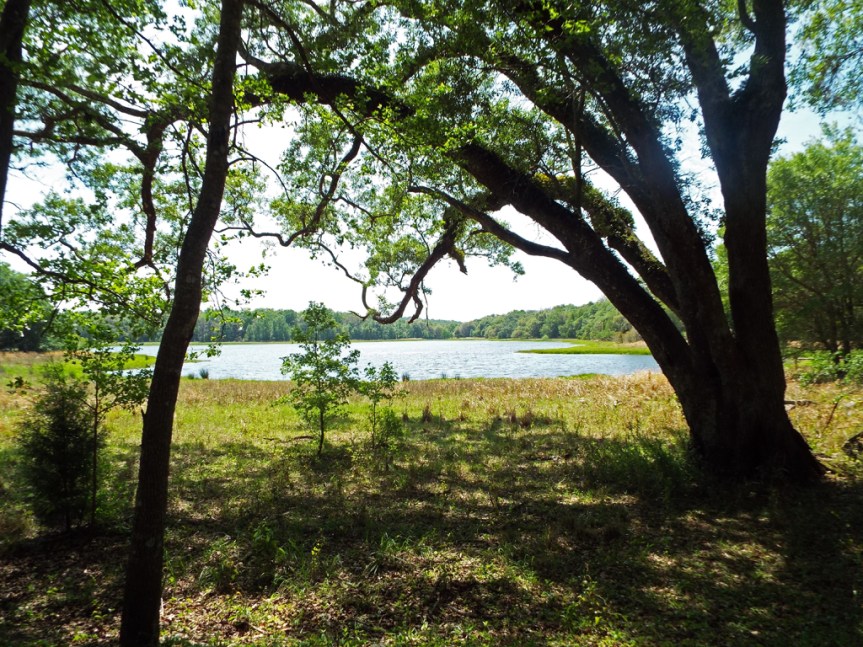
The first field trip was to nearby McKethan Lake [map]. Despite a strong breeze, the day was lovely, and the lake was gorgeous. A group of about a dozen of us, including keynote speaker Dr. Bob Askins, make the 3-mile hike around the lake.
A gorgeous day at McKethan Lake.
The lake is circled by mature Live Oaks and a lovely hardwood-palm hammock habitat. We heard Red-eyed and White-eyed Vireos singing, despite the wind noise. Our trip leader and some others also heard Yellow-throated Vireos (I did not). We were also visited briefly by a small flock of Tufted Titmouses that were clearly agitated and vocal about it!
McKethan Lake is ringed by many large Live Oaks.
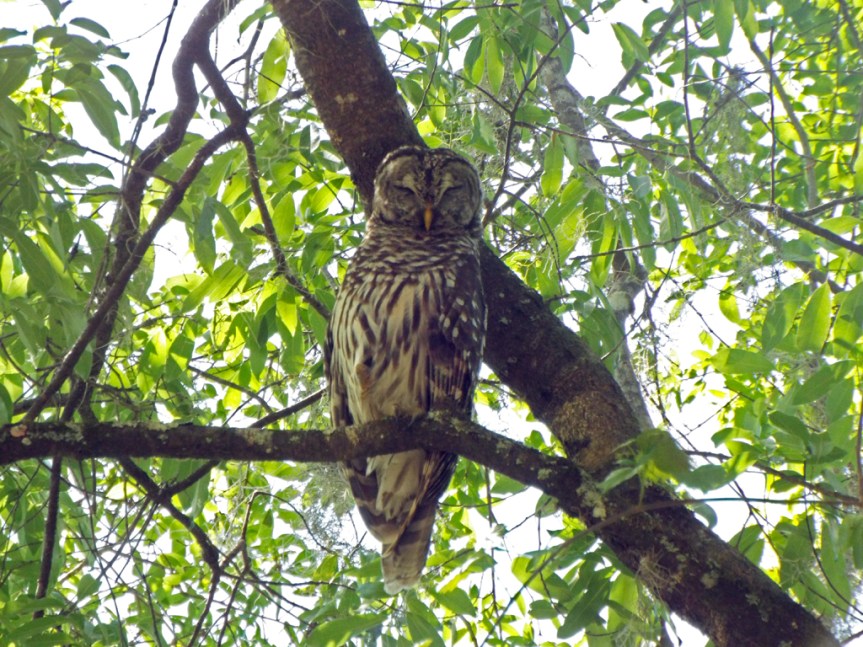
A Barred Owl pair and two chicks had been reported the day before, and we searched the trees for them with no luck. But then someone looked up and saw one of the parents, quite out in the open. It was probably looking out for the other owls, although as you can see, it might have been asleep on the job.
Adult Barred Owl keeping a bleary-eyed watch.
The lake was fairly devoid of water or wading birds. We’re well into spring now, so anything besides Mottled Ducks and maybe some Mallards would be rare. Aside from an egret or two, and a few coots and gallinules, the lake was empty.
One species of note was my FOY Hermit Thrush, which flushed onto a low branch in the woods for a few seconds before disappearing before anyone else had a good look at it.
Back at the Chinsegut Retreat Center [map], where the meeting was based, I decided to talk a walk around the grounds. The usual resident birds were singing, including Northern Cardinals, Northern Parulas, American Crows, and Mourning Doves. A Yellow-throated Warbler was singing in one of the large oak trees, but I never got a look at it.
I met with the vice-president of the Friends of Chinsegut Hill, who was out and about on an ATV with a tool trailer. He told me a bit about the property and directed me down a path that led to an abandoned dining lodge.
The building was creepy. So creepy (the photos do not do it justice) that I was unwilling to go inside on my own. I might have just been convinced to try if I had been with someone else.
The property and surroundings are gorgeous, with a large manor house at the top of the hill, with several air-conditioned cabins, with bathrooms for each room. There is a nearby conservation area, and we were just down the road from the Withlacoochee Training Center [map] (for the Florida Forestry Service), where we had our keynote session and banquet.
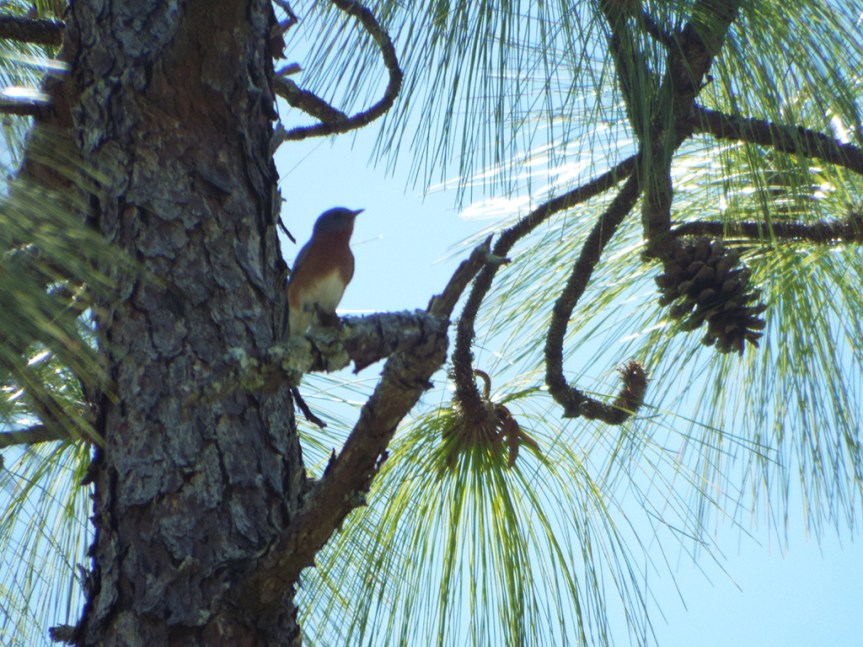
The birds at the training center were present, but tended to be a bit shy, like this male Eastern Bluebird.
Saturday morning was a fair bit cooler, and the breeze was really starting to pick up. One group of us went to the Weekiwachee Preserve [map]. The preserve is a reclaimed sand mining operation with several large and deep ponds (the abandoned sand pits) and some large grassy areas, fringed with woods. There is some limited marsh vegetation along the edges of some ponds, but nothing to support large numbers of waders. Likewise, due to the deep water and low plant production, the biological activity of these lakes are limited, so they also do not see large numbers of ducks or other dabblers and divers.
The abandoned sand pit ponds are beautiful, if empty.
The open grassy areas are potentially good for sparrows and upland wrens, but with the wind, we didn’t see anything like that. A few optimistic Forster’s Terns, Bald Eagles, and some overflying gulls were all that we saw over the ponds. We had a little more luck in the trees, including Eastern Bluebirds, a Pileated Woodpecker, and a few others.
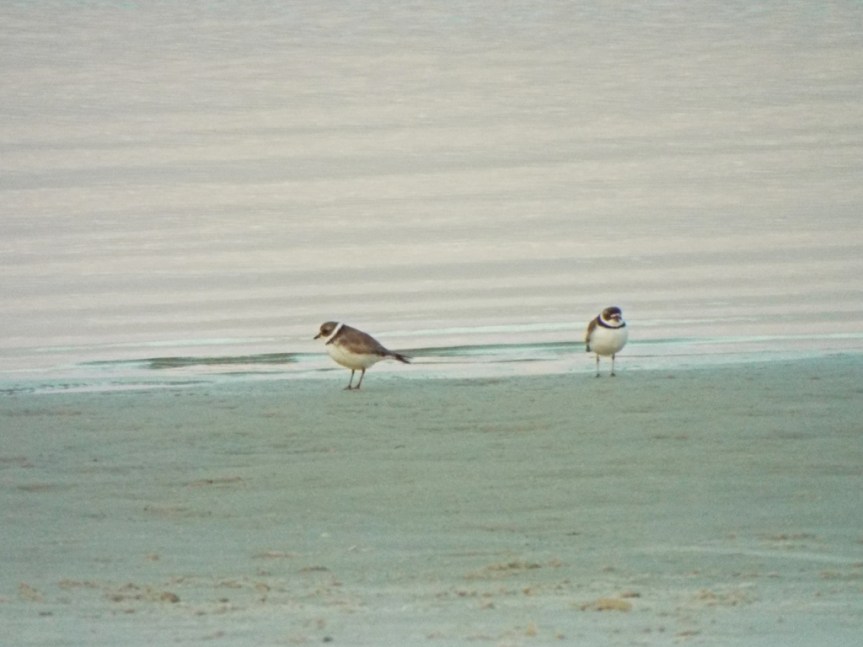
On our final day, some of us went to Fort Island Beach Park [map] to look at shorebirds and take our chances to find some Seaside Sparrows. While the sparrows were a no-show (probably due to the wind), we did get a nice group of shorebirds before the beaches had too many people arrive.
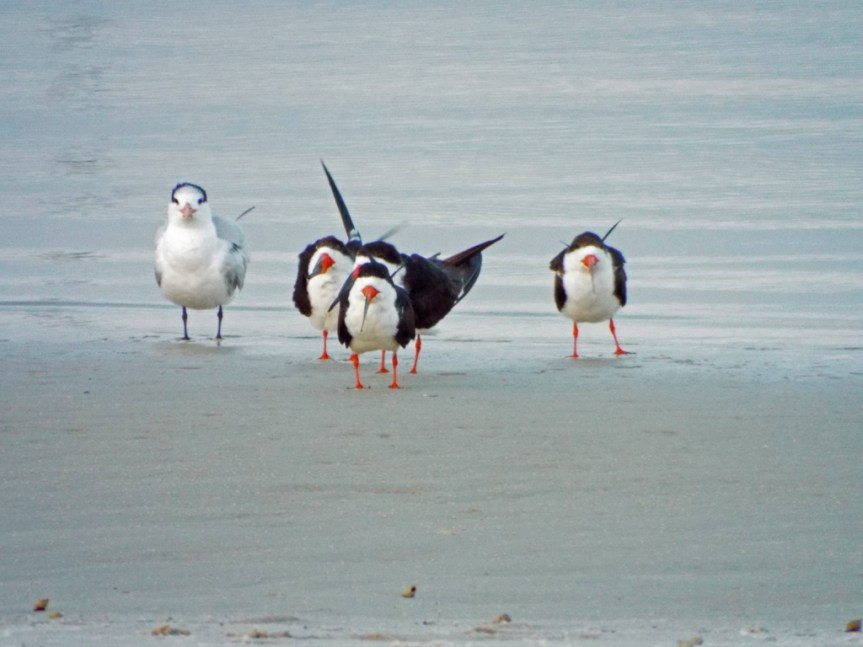
Two Semipalmated Plovers on the beach. Black Skimmers and a Royal tern resting between foraging runs.A Least Sandpiper on an oyster bar remnant.
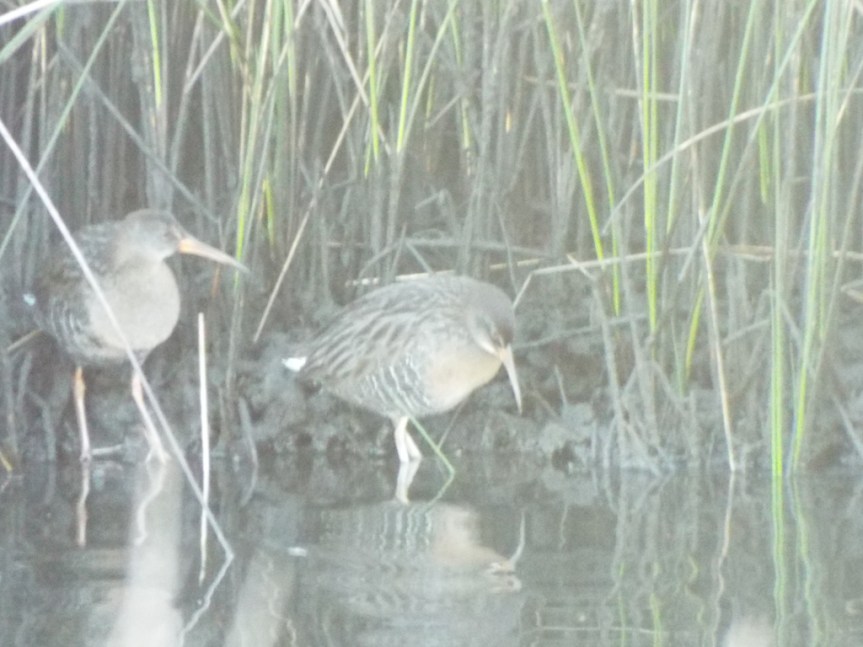
Across the parking area was some salt marsh habitat where some Clapper Rails were calling back and forth. On a hunch, I left the group and walked over. The sun was still low on the horizon, making the entire marsh back-lit and hazy looking. Despite that, I could see two Clapper Rails out in the open and got some low-contrast photos before rejoining the group.
Clapper Rails.
After checking out the shoreline, the group walked onto the boardwalk path into the adjacent hammock [map]. Almost immediately upon walking in, I saw a female Prothonotary Warbler on the side of a palm tree. She quickly took stock of about 20 people walking toward her and made a bee-line out of sight. A few of us tried to coax her back out (mainly by pishing), to no avail.
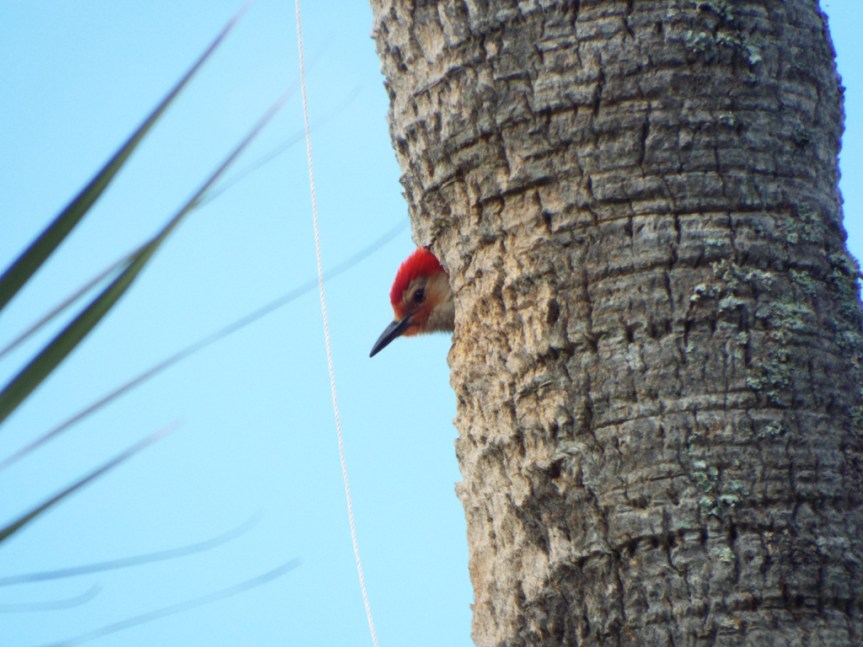
I walked down one part of the boardwalk in pursuit of a chip note I kept hearing. To the right was a dead palm tree with a woodpecker hole in it. Then out popped a little bird head, and a Red-bellied Woodpecker called out. He seemed content to call from the safety of his home for a few minutes, but he did eventually venture out. I didn’t hear any calls back from either a mate or other males. That white line through the center of the image is some string that was partially wrapped around the tree. It didn’t seem t be blocking the nest hole, but there was no way to reach it to remove it, in any case.
A Red-bellied Woodpecker checks out his neighborhood.
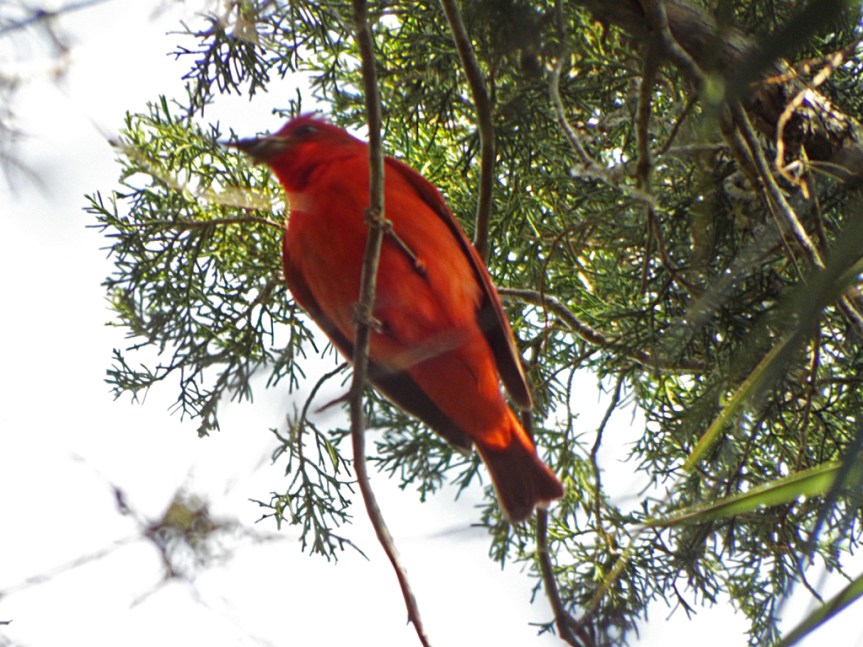
A few meters more along the boardwalk, I saw a flash of red, which I immediately thought didn’t quite look right for a Northern Cardinal. The bird didn’t fly too far, and I saw it was a male Summer Tanager. I’ve previously only seen females or non-breeding males, so this was a good bird to find. He was active and reluctant to stand still for long.
What’s up?
Another birder and I watched him for as long as we could, before he finally worked his way deep into the hammock. He did come out later and some other members got some good looks and photos.
I walked back to join up with the rest of the group and found them congregated under an oak tree, intently looking with binoculars. There were two Red-eyed Vireos and a Tennessee Warbler foraging in the canopy. It took some patience and iBird Pro referencing before I could discern the Tennessee Warbler – a life bird for me! There were also two Yellow-throated Vireos in the dense vegetation.
The boardwalk exited the hammock by the beach. I walked to the right and found a path behind some mangroves and over some small dunes. There was a small wetland there with cardinals and some House Wrens singing.
I decided to see if anyone wanted to check the area out, as I heard some softer chip notes, and I went back to see who might be interested. On the dune crossover I had to step over this gorgeous Gulf Salt Marsh Snake.
Ultimately I got Jim Eager and Karen Askins to come over with me. We flushed a male Prothonotary Warbler, who tried to hide in the mangrove trees. Jim didn’t manage to get a look at him, but the yellow on his head and throat was the brightest I’ve ever seen on a bird. It was shockingly yellow. He would not come out of the mangroves for a photo, however.
We walked back out to the beach and joined the main group to try our luck along the shoreline for wrens or sparrows. We did get a couple of Sedge Wrens to sing out, but nothing else showed itself. It was still breezy, which likely kept the smaller birds hunkered down.
We went out to a couple of other locations to find Seaside Sparrows, but didn’t have any luck. At Red Fish Hole [map] a Marsh Wren was singing within a couple of feet of us in thick tangles of rushes, but we could not see him. He kept singing and didn’t fly out or away. Otherwise there was not much activity.
It was a busy and enriching weekend. I was glad to see both new and familiar faces, the paper sessions were informative, and Dr. Askins’ keynote speech was well received. In six months, we’ll meet up again at Archibold Research Station, in Lake Placid.
I recently traveled from Homestead to Flamingo, through Everglades National Park. Despite some drizzly weather, it was fabulous! I even saw my first American Crocodile and white form of the Great Blue Heron (sorry, no photos 😦 ).
Double-crested Cormorants
Male Double-crested Cormorant.
Female Double-crested Cormorant.
Male Double-crested Cormorant.
Double-crested Cormorant plumage up close.
Various plants
Coral Bean Flower
Cardinal Airplant inflorescence
Swamp-lily (also called Seven-sisters and String-lily).
















 Lonely Birder