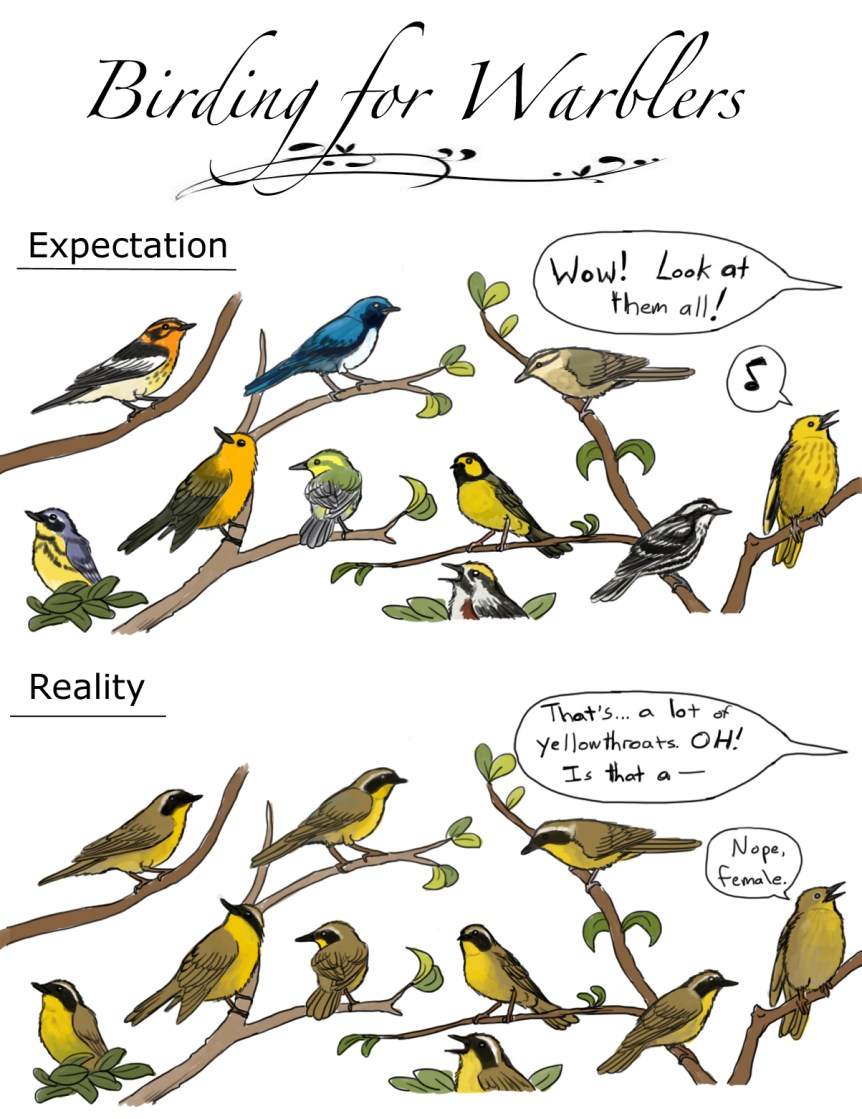
You’d almost think they were common or something.
Oh lord help me, I’m drawing birding cartoons now.
I don’t always reblog posts on Lonely Birder, but when I do, I prefer Dendroica. HA.
No, seriously, this is me. To a tee.

You’d almost think they were common or something.
Oh lord help me, I’m drawing birding cartoons now.
I don’t always reblog posts on Lonely Birder, but when I do, I prefer Dendroica. HA.
No, seriously, this is me. To a tee.
My wife and I had a guest the past few days, named Stanley. Flat Stanley. He was mailed to us (on account of a bulletin board flattening him in class one day), which seems a darn great way to travel. I took Stanley out to Turkey Creek and Malabar Scrub Sanctuaries so he could experience some of central Florida’s natural world.

Flat Stanley chilling out by Turkey Creek.
We started the day at Turkey Creek, but I had us do most of the park in reverse order from my usual walks. I started by heading out to the weir, but recent heavy rains washed most of the mucky debris behind the orange flotation barrier. This is where most of the wading birds would hang out, but there was just one Green Heron skulking along the shore. There were plenty of bird songs along the rest of the walk. Stanley and I identified quite a few birds by voice and by sight.

Red-bellied Woodpecker feasting on ants.
After exiting via the Sand Pine Trail, we drove to the Malabar Scrub Sanctuary. Stanley wanted to do the “Red Loop Trail” and I thought that was fine. We identified more birds and even saw a large snake! About midway around the trail we came across a loud group of Florida Scrub Jays. Stanely was excited to see them, as I had shown him my photos from last week in the sanctuary.

Florida Scrub Jay. Unlike last week, this was just one of about a dozen we saw in 2 separate family groups.
One of the area middle schools built an educational platform in the heart of the sanctuary. Stanley and I learned a bit more about Florida’s scrub habitat and had a nice view of the surrounding landscape.
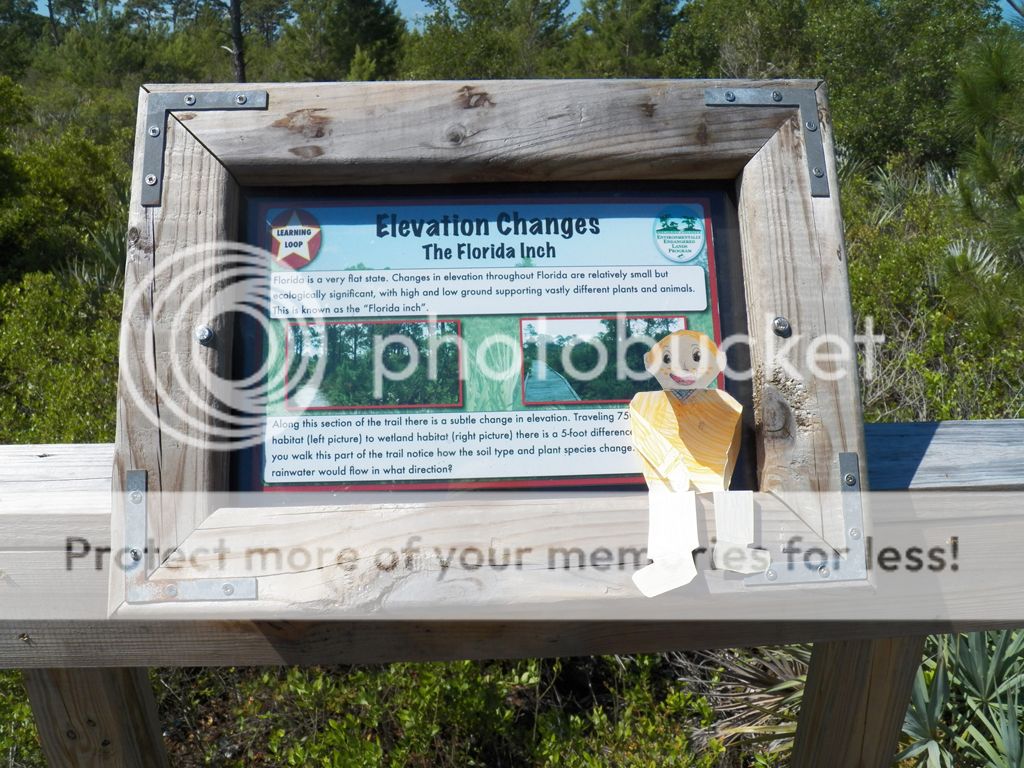
Educational board showing how “flat” Florida is.
The second half of the trail was through some habitats I hadn’t seen there before, with lots of scrub oaks making archways over the path, and pockets of Blue-gray Gnatcatchers here and there.
Here is our list of bird species for both parks (loosely grouped by family rather than order seen).
It was great having Stanley around, but he has to leave early tomorrow. We’re having him head home in style, though, in a USPS Priority envelope, along with photos and descriptions of his time with us here in Florida.

Me (actual photo!) and Flat Stanley at Turkey Creek Sanctuary.
Happy Mothers’ Day! Today’s birding adventure had me ranging farther that I’ve done recently, now that my knee has been feeling better. I spent the first couple of hours at Turkey Creek Sanctuary, mainly south of the creek itself. For most of this first portion of the hike, I could hear quite a few bird species, but it was difficult to see any. I had voice hits on Mourning Doves, Northern Cardinals, White-eyed Vireos and various woodpeckers, among others.

If you look closely, you can see the red feathers on the belly that give this woodpecker its name.
There was one sweet spot along the trail in an upland section, adjacent to some homes, that had quite a few American Redstarts. Unlike last week, when there was a good mix of adult males and adult females, this week I think most of the birds were first year males. They had some black feathers coming in, but for the most part were yellowish, but displaying like males. I’ll have to check if this is usual for how this species migrates.
Near the end of the path along the creek I did hear one, solitary Black-throated Blue Warbler among the Northern Parulas and general background noise of the cardinals (yes, they’re getting up to that point where they’re drowning out other species again).
I neither saw nor heard any evidence of Blackpoll Warblers today.
The full species list for the Turkey Creek side of my hike follows:
I backtracked to where I parked and then crossed the road and entered the Malabar Scrub Sanctuary for the second part of my hike. For the first while, I had more voice hits and very little visual identification. This started to change as I crossed from the western part of the Sanctuary, through the Cameron Preserve and into the eastern section of the Malabar Scrub Sanctuary. Many of the same species were present as in Turkey Creek, plus some Fish Crows, Eastern Towhees, and a pale morph of a Red-shouldered Hawk.
I made another loop back to the car and decided to drive down to the southern portion of the sanctuary to try to see Florida Scrub Jays. On the way there, I saw some Ospreys, An American Brown Pelican and a Wood Stork.
Once back in the sanctuary I saw a Swallow-tailed Kite flying low. It actually passed within 20ft above me! I managed to get off a couple of camera shots (neither great, but hey, my first!). I was so excited.

Florida’s Bird of Awesomeness.
Then I made my way to the area I had last seen some jays and taken some photos. Sure enough, a single adult scrub jay was there. It let me get very close and even hopped down on the ground right at my feet for a while!

As awesome as Swallow-tailed Kites are, many people believe this should be Florida’s official bird.

Despite the overcast sky, it was very warm and humid, and I was sweating through my clothes. At this point I also ran out of water, so I made my way back to the car. In the park near the parking area there was a Sandhill Crane family (2 parents and 2 chicks) walking nearby.
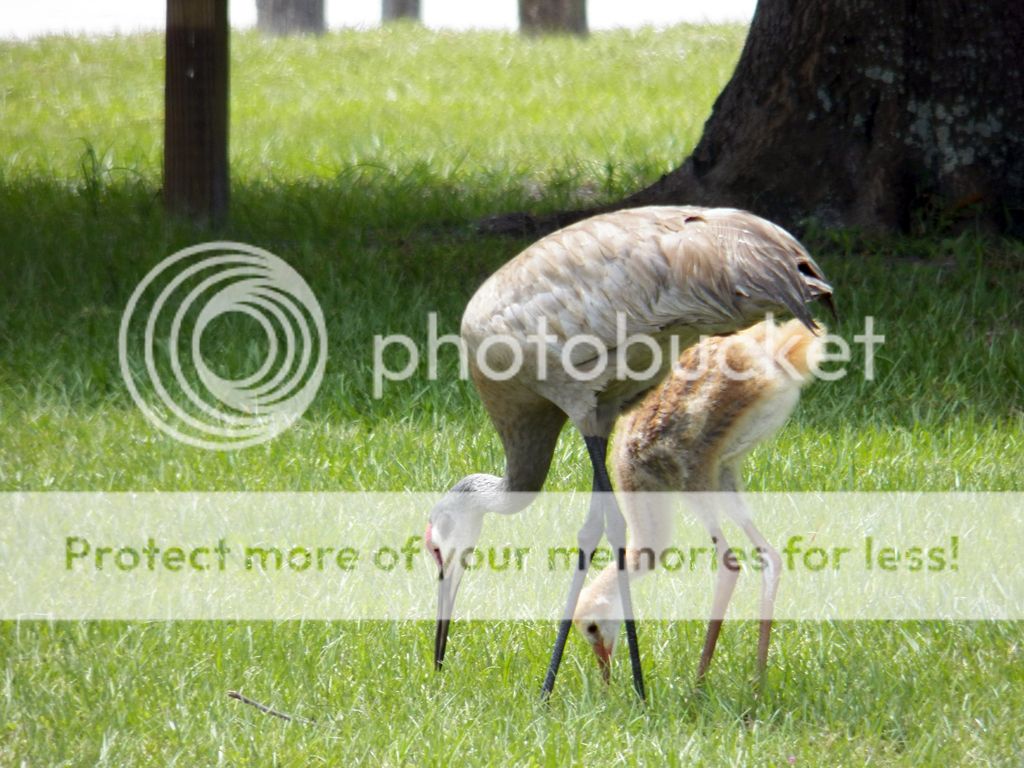
A mother Sandhill Crane and one of her chicks. Happy Mothers’ Day.

A not very happy Dad. Time to move along.
The final identification I got was a pair of Northern Rough-winged Swallows over the car as I was getting in. All in all, my Malabar Scrub Sanctuary list was:
Combined list of the two sanctuaries.
Historically and statistically, the spring migration ends around mid-May, but there may be stragglers. The summer residents will be setting up house and raising families, and there’s always room for surprises.
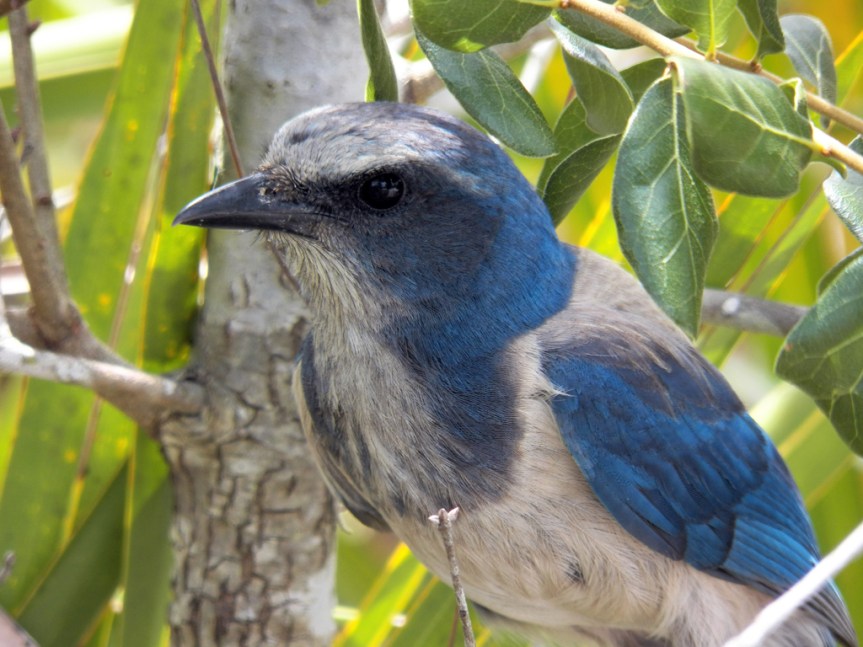
Teaser photo from today at the Malabar Scrub Sanctuary.
I had a much more exciting morning at Turkey Creek Sanctuary than I anticipated yesterday (Sunday). Having bemoaned the lack of bird activity in my last post, it seems the birds had to prove me wrong. Which is fine by me!
After a nice “good morning!” song from this Carolina Wren near the main trail-head, I headed off through the relatively new Turkey Oak Trail.

Nothing could be finer than a Thryothorus ludovicianus in the morning…
I was immediately surrounded by warbler call notes and fluttering activity. Blackpoll Warblers were everywhere. Some were quite curious about me and would momentarily perch just feet away and cock their little heads at me before zooming off.
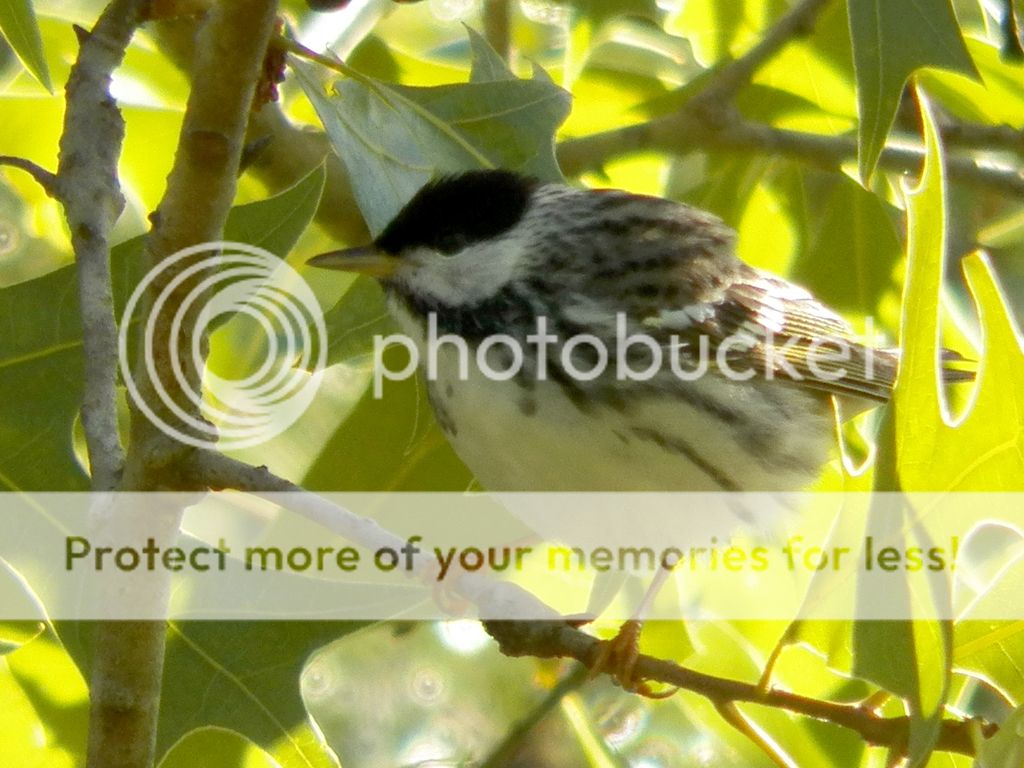
Puffball – er, I mean Blackpoll Warbler.
One female was a little more defensive and wary, following me along the path and looking at me as if to say, “I’ve got my eye on you.”

Several ounces of latent hostility.
I know from experience that some warbler species come in pairs. Usually when there are Blackpoll Warblers there are American Redstarts. Sure enough, there were many of those as well, in all stages of plumage. Pretty much anywhere in the sanctuary I went, there were American Redstarts nearby Blackpoll Warblers. The only exception was one spot near the end of the Turkey Oak Trail where instead of redstarts, the Blackpolls were mingling with Black-throated Blue Warblers. I find American Redstarts somewhat difficult to photograph with my current equpiment. They seen to almost never sit still, and the leap out of frame just as i get my finger on the shutter button.

This little guy stopped long enough for me to get this shot.
The Black-throated Blues were almost as numerous as the redstarts, but tended to stay lower in the canopy and among the Sabal palms.
Further along the way, I got a good look at a yellow warbler but was having an issue getting a good ID. I manged some photos that showed the facial markings pretty well, and decided to check at home with my Warbler’s Guide to pin down what it was. As it turns out, the Warbler’s Guide led me to conclude it was perhaps a Hooded Warbler – either a female or a male that had yet to molt into its bold head pattern. In the end, I posted the photo to Facebook and asked some of my friends what they thought. Corey Finger immediately IDed it as a Prairie Warbler. Upon another look I can see the distinctive “mustache” facial pattern. So not a FOY bird, but cool none-the-less.

Prairie Warbler.
The Turkey Oak Trail was uncharacteristically productive for me, as I also cataloged my first of the year (FOY) Scarlet Tanager, heard a Blue-headed Vireo, and a very secretive Ovenbird.
There were also several noisy Great-crested Flycatchers that were more-or-less moving in the same direction as me. They stayed pretty high up in the canopy, but came close enough to harrass me a few times, but never got in a good position for a photo-op.
By the time I got to the boardwalk, I was feeling pretty good. The boardwalk itself was a little quieter, but I did get a quick look at an Indigo Bunting male as well as more Black-throated Blues and American Redstarts.
I scared up a couple of Solitary Sandpipers as I got off the boardwalk on the path toward the jogging trail (I guess they weren’t so “solitary” if they were a pair?).
The biggest question, though, is what kind of thrush did I see as I made my way to the emergency boat ramp? I got a very clear look and I can say it was either a Gray-cheeked Thrush or a Bicknell’s Thrush. These two species are almost impossible to distinguish in the field. There is an accepted but challenged difference in their songs, but neither this bird, nor the one I saw further down the jogging path later, did any singing.

The only shot of the thrush I was able to get. Anyone see anything diagnostic?
At the weir and canal there were some Spotted Sandpipers, a few Green Herons, Cattle Egrets and a Common Gallinule.
That was about it as I walked back toward the picnic area and saw a few more Black-throated Blue Warblers and heard a few bickering Blue-gray Gnatcatchers.
Here’s the total species list for the outing yesterday morning:
It was good to see the old place looking more “birdy” this spring. I am wondering if the migration was a bit delayed, given the brutal winter most of eastern North America had this year, but we’ll see.
Well, it’s May and the promise of a migrant filled April has come and gone. I’ve heard some tricklings from the panhandle and Gulf coast areas that they’ve had some good days, but here on the Space Coast it’s been a bust migration again (at least from my point of view). I realize some of this is my own limitations. I only get out once a week for any focused birding. However, even with that restriction I’ve had much more success in years past than this spring. Coming after such a quiet and disappointing fall migration, it’s a bit disheartening.
If I can manage some trips north this year, I look forward to seeing some of the birds that passed over my area this spring, and it’s usually a good thing to travel. We’ll see what the summer brings.
I found a “secret” place this afternoon while taking a bicycle ride around the neighborhood. A pseudo-abandoned piece of land that has potential for future birding. A quick scout through some of it yielded FOY Chimney Swift, Brown Thrasher.
Short list for the secret area and the neighborhood
Additionally, there were at last two warbler species I could not identify. I’ll be checking this area out again. We’ll see how it pans out.
P.S.
Yesterday the Great Crested Flycatchers returned to the neighborhood as well, having arrived either that morning or overnight.
Today I tried heading off to somewhere other than Turkey Creek. Since I normally only go on a birding trip once a week, it can be difficult to balance repeat observations at one location (like Turkey Creek Sanctuary) and trying out different places for variety and seeing how other places are faring.
I decided to head to Fay Lake Wilderness Park. It’s a bit of a misnomer, as the entire park was created around an artificial pond, but it does border the St. Johns National Wildlife Refuge, and they manage most of the land by burning, rather than by tilling under the vegetation.

Gorgeous day!

Ooooh.. park got burned! (sorry).
The park has a variety of trails. There are paved walkways and boardwalk overlooks for the more pedestrian visitors. There are also wide dirt paths (frequented by ATVs and dirt-bikes on one side of the park) and some more “primitive” paths through the mostly naturalized vegetation.


Choose your path.
There were still a good number of “winter” and resident birds in the park, but I did have a few FOY birds, including some Blue Grosbeaks and a Northern Flicker (red-shafted variety, based on my brief glance at its red “moustache” mark).
The first birds I encountered were some rambunctious Carolina Wrens, singing out in the open and chasing each other either for territorial or mating reasons (or both!). I don’t think I’ve seen as high a concentration of these birds anywhere before. There were at times 6 within close earshot (and several more in the background).
The Eastern Towhees were quite active and vocal, preferring to sing on exposed perches even as I drew near.

Eastern towhee.
The stretch of paths along the St. Johns Wildlife Refuge had a nice mix of Gray Catbirds, Common Yellowthroats, White-eyed Vireos, and as I mentioned, Blue Grosbeaks. The arrangement of habitat was quite good for all these species, ordered, from my right to my left, pond, reeds, brush, field, and “park land” (almost savannah like, with herbaceous cover interspersed with groves of trees).
At first I thought there were House Wrens singing, but something about their voices didn’t sound “right.” It turns out that Blue Grosbeak songs are similar to the House Finches’, and it was the grosbeaks I had been hearing.
I spent about 15 minutes watching a Pileated Woodpecker chiselling out bugs along a tree limb. He also let me get close before reluctantly flying away when I lingered a bit too long.

Pileated Woodpecker.
In some ways this park is similar to Pine Island, but on a slightly smaller scale. That helped with the walking, as I am still on hold regarding this persistent issue with my knee.
The complete species list for the morning:
I count today as particularly successful because I saw every bird I heard today, which is pretty rare. I wish I had seen more migrants, but all in all I had a good time.
The year-to-date species count is 139 (138 ABA countable).
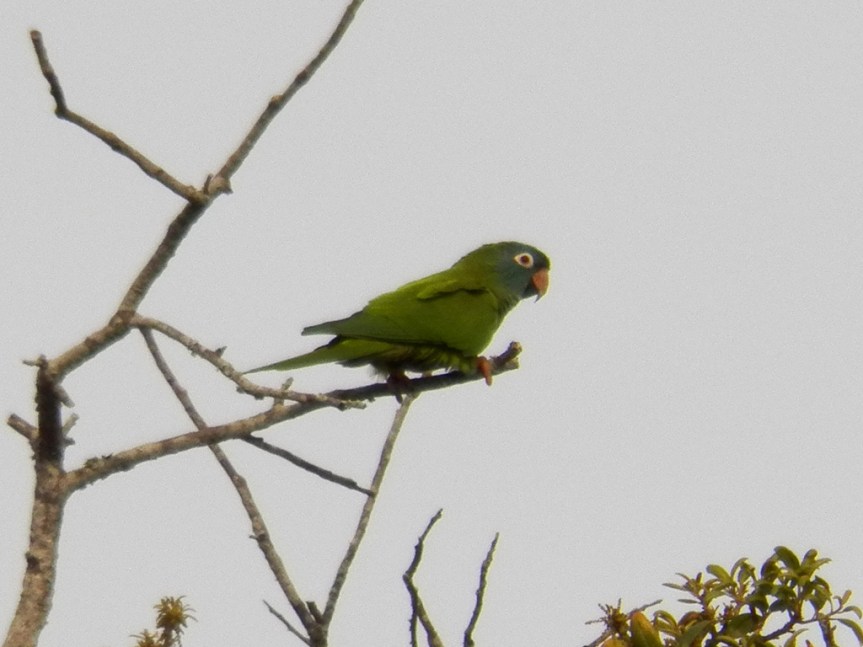
Blue-crowned Conures
My wife and I had two unexpected parrot encounters today. The first was a small flock of parrots that flew past the car while we were waiting in traffic. I didn’t get a good enough look at them for identification.
When we got to our destination, two parrots flew into a tree nearby (where I took this photograph). It took a bit of web and field guide research to determine these are Blue-crowned Conures (the small flock was likely the same species). I saw them last year near the Post Office (along US 1). The small flock was seen not far from the Post Office, and this photograph was taken just a mile or so north of there. I’ve heard there is a nesting colony beachside of the causeway, but I don’t know if these are the same birds or not.
 Lonely Birder