Will It Fly High Like A Bird Up In The Sky?

This past Sunday was my first birding-specific outing of the year, and I decided to check in on my old favorite haunt, Turkey Creek Sanctuary. The weather has been pretty mild, so I was hopeful for some good bird activity.

The past couple of years have really been a let-down for the Sanctuary. Birds seem to be utilizing the park less and less, and good activity is much more sporadic. I’ve seen a couple of reports via the BRDBRAIN and FLORIDABIRDS-L e-mail lists of some decent sightings there, but my morning was more typical of my other outings there.

One major change in the Sanctuary from two or three years ago is the relative dearth of Northern Cardinals. Regular and long-time readers will note my somewhat antagonistic love-hate relationship with these birds. They are beautiful to see and hear, but they had nearly overrun the Sanctuary. It had gotten to the point that their calls and songs were drowning out those of other birds I was trying to find and observe. Oh, how I wish for the good ol’ days! I saw a total of 2 and heard perhaps half a dozen cardinals for the entire morning.

What were plentiful were the American Robins and Blue-gray Gnatcatchers. Right upon entering the park and nearing the boardwalk, the first of what would be at least half a dozen overflights of a 10 or 15 American Robins flew overhead. American Robins are migratory; birds from the southern USA make their way to Florida and Mexico for the winter, while birds from further north move into the southern USA. The end result is a north-south shift of the the robins’ range, out of Canada, with a large section of the country having robins all year, though probably not the same robins. I never saw any robins in the park, just flying high over my head, en route to whatever winter roost they will use until they leave in the Spring.

Image ©2007 WhatBird.com

I caught up to a small flock of gnatcatchers on the boardwalk and enjoyed watching them hop and flit about the tree-tops, singing out their wheezy little calls. I was also watching the group closely because often other small birds will associate with the gnatcatchers. Sure enough, a small group of Blue-headed Vireos was there in the same tree. Both the gnatcatchers and the vireos are quite active, but I managed to snap some photographs, clearly showing the Blue-headed Vireos’ diagnostic fieldmarks: white spectacles on a gray head, with yellow flanks and an olive-greenish tail.
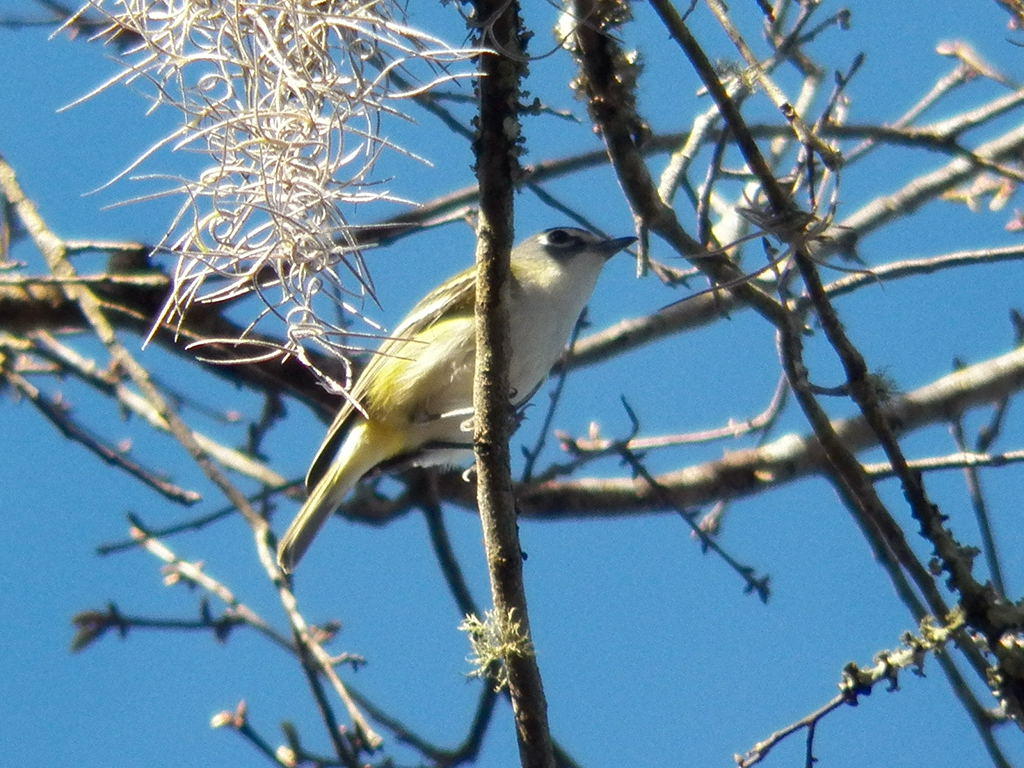
bh-vireo
This Blue-headed Vireo was palling around with some Blue-gray Gnatcatchers.

A breeze picked up by mid-morning, sending leaves and other debris swirling around the more open areas. By this time of year at the Turkey Creek Sanctuary the deciduous trees have dropped most of their leaves and the canopy is much more open, which makes observing any overflying birds (like the American Robins) easier. On this day I noted White Ibises, Black and Turkey vultures, a Double-crested Cormorant, and even a high-soaring Anhinga. A pair of Ospreys also went by, calling to each other as the wind swiftly carried them out of sight.

Some typical winter residents were also present, though in very low densities. I saw a single Yellow-throated Warbler, one Downy Woodpecker and two Ruby Crowned Kinglets. My very first visit to this park in 2002 coincided with a mass visitation of kinglets. There were literally hundreds of them throughout the park, hopping on the boardwalk railings and filling the adjacent trees with chittering notes.

I took the opportunity this trip to walk the Scrub Trail. I tend to neglect this trail, mainly due to low bird activity, but it’s a nice loop off the trail leading to the jogging and exercise paths.
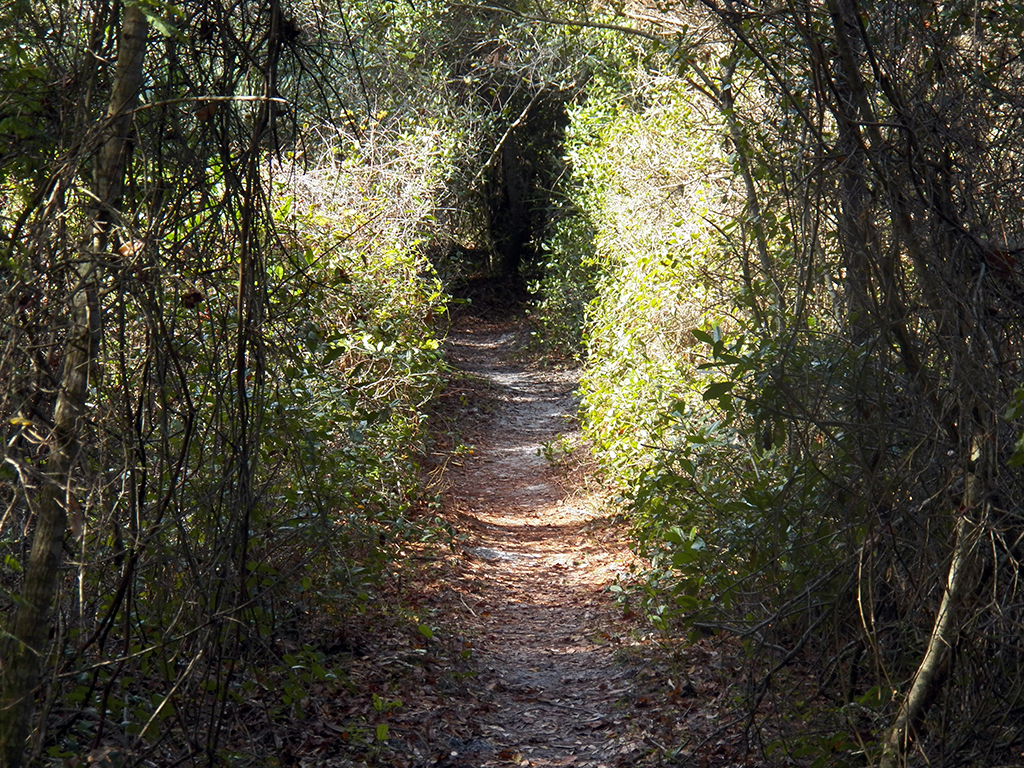
path
“A path! A path!”

As I returned back along the western and northern edge of the park toward to exit, I caught the song of a Yellow-throated Vireo over the fence-line. It sound like it came closer a few times, but I never did catch sight of it. I hung around for a while (getting a fire-ant bite on my finger for my troubles) before moving along and out.

Species seen by approximate order of identification:

  • Black Vulture
  • Ring-billed Gull
  • Rock Pigeon
  • White Ibis
  • American Robin
  • Northern Cardinal
  • Blue-gray Gnatcatcher
  • Blue-headed Vireo
  • Carolina Wren (♫)
  • Fish Crow
  • Turkey Vulture
  • Yellow-throated Warbler
  • Downy Woodpecker
  • Gray Catbird
  • Anhinga
  • Ruby-crowned Kinglet
  • Ovenbird
  • Palm Warbler
  • Blue Jay (♫)
  • Double-crested Cormorant
  • Yellow-throated Vireo
  • Osprey
  • Red-bellied Woodpecker (♫)

Happy New Year everyone, and here’s to another great year of birding!
Will It Go ‘Round In Circles?

Another year and we’ve about circled around again. It’s fitting that I end the year at the same place I ended last year: at the Merritt Island National Wildlife Refuge’s (MINWR) Blackpoint Drive. This year I saw some of the same cast of players as last year, but hopefully with a keener eye and with some surprises on the way.

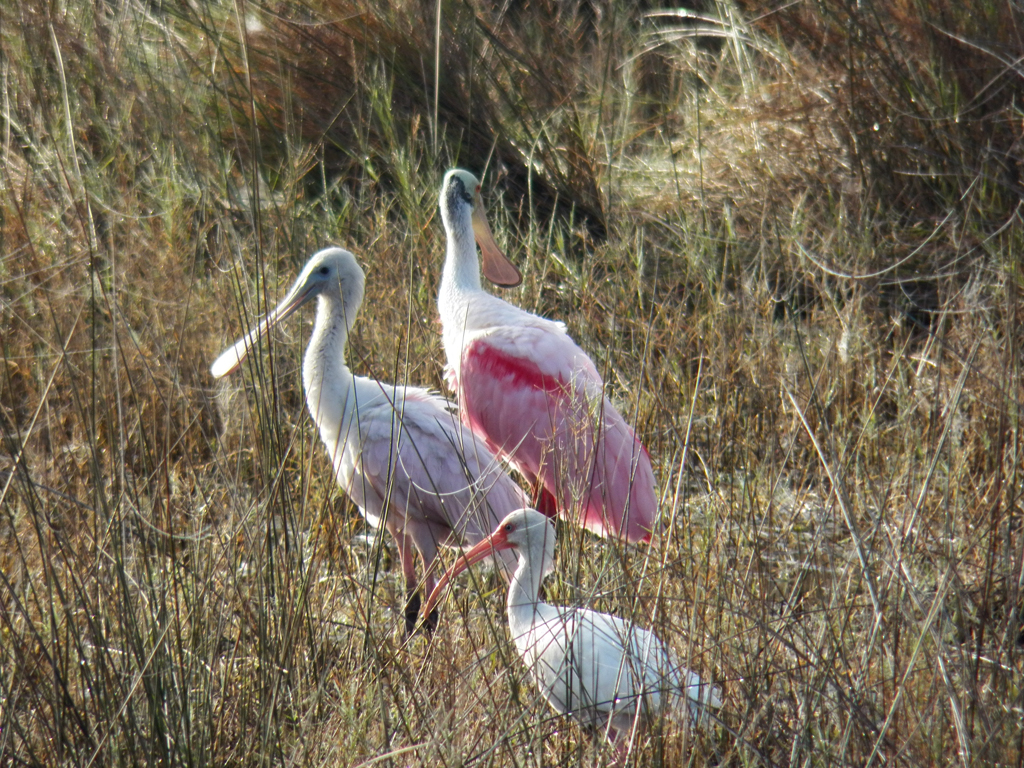
The main stars this time were the Roseate Spoonbills. At several points along the drive, several cars were pulled over and everyone was out taking pictures of relatively large flocks of spoonbills. I was fortunate to catch a good look at this pair, pictured below. I’ve not seen an immature Roseate Spoonbill until now.

spoonbills-young-old
An immature Roseate Spoonbill (left) and an adult (right) with a White Ibis in the foreground.

The spoonbills were aggressively feeding with a group of mixed herons and ibises, along with smaller interlopers like Hooded Mergansers and Boat-tailed Grackles.

As I made my way around Blackpoint Drive, the most obvious birds just about everywhere were the American Coots. It must not take much to make a coot happy. They are generally present in large numbers, especially during the winter. Unlike Common Gallinules, American Coots seem to thrive equally in brackish or fresh water. Overwintering ducks often raft with them, I imagine for protection (safety in numbers).

coots-n-things
Going incognito: Look closely and you’ll see Lesser Scaups and Pied-billed Grebes in with the American Coots. I think there’s even a RIng-necked Duck back there somewhere.

I was surprised to learn this past year that Reddish Egrets are actually fairly rare and of conservation concern in Florida. I’ve only seen them at MINWR and at Fay Lake Wilderness Park. I was able to make a short video clip of one feeding, using it’s characteristic “drunken” dance strategy.

“What will we do with a drunken egret? What will we do with a drunken egret? What will we do with a drunken egret? Early in the morning!”

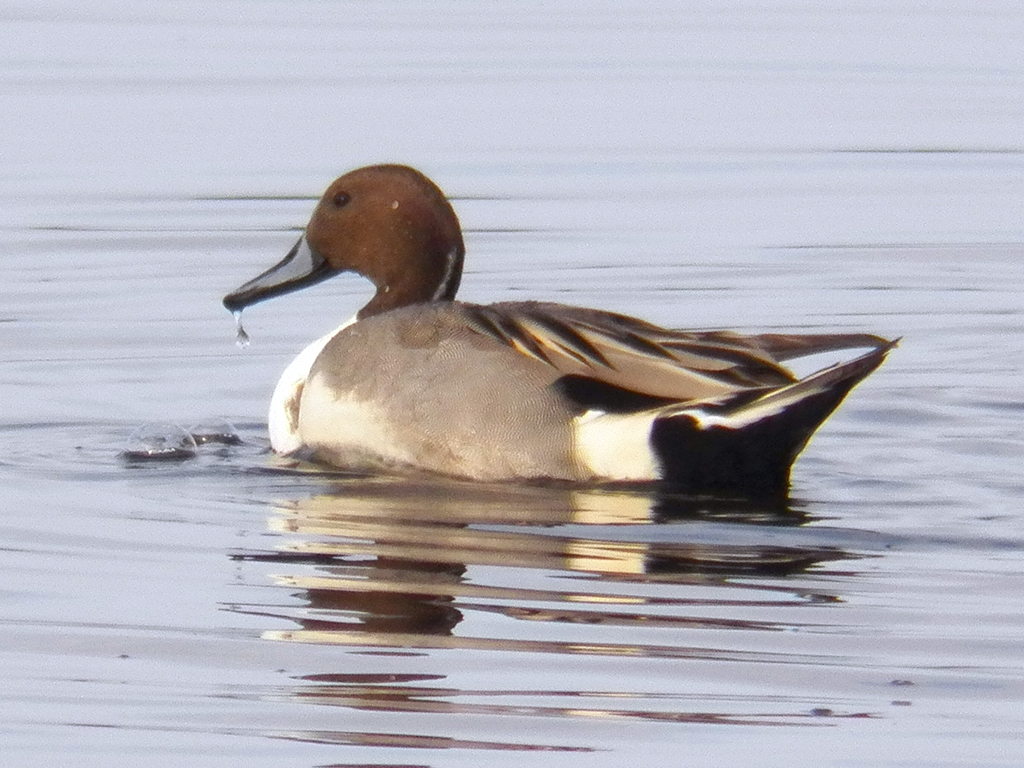
MINWR is a good place to find Northern Pintails, too. Pintails are dabblers; they tip back-end up to reach their food and then briefly upright themselves before tipping back down again. Dabblers will often synchronize their tip-ups, looking like some mad duck Esther Williams wannabes.. This would seem to be counter to an effective predator look-out system, since there is significant time where their heads are all underwater, but it seems to work.

pintail-male
Male Northern Pintail after coming upright. This one has either recently lost or has not yet grown in his long “pintail” for which the species gets its common name.

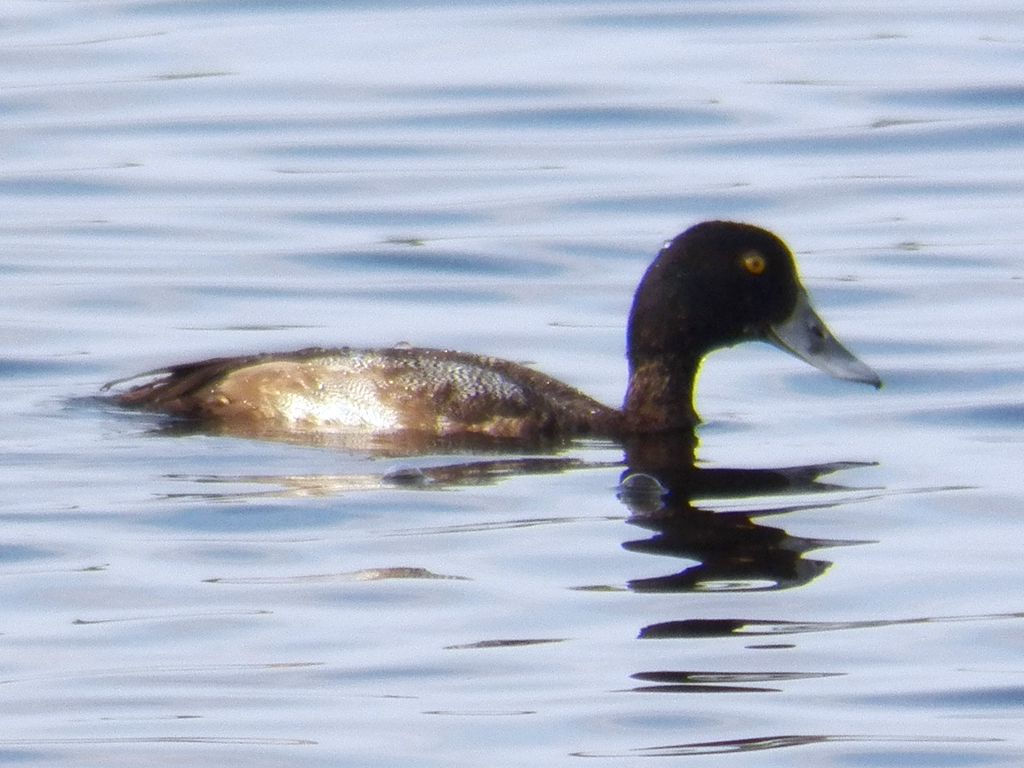
Both species of scaups were present, though as usual the Lesser Scaups far outnumbered the Greater Scaups. There are a couple of good pointers for telling the two apart, especially if they are both present near each other. I’ll have that as an upcoming post, after the New Year holiday.

g-scaup
Oh, great, a scaup! He is Greater than any other scaup I’ve seen!
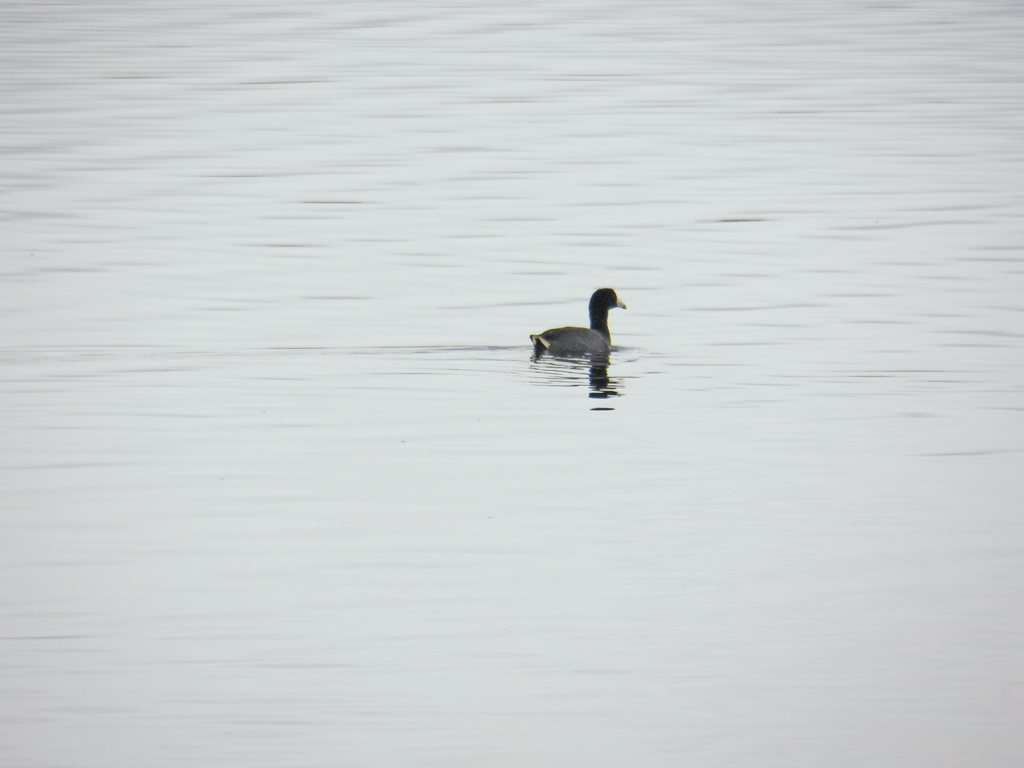
Scaups are diving ducks. Like grebes, they will often quickly submerge when they feel threatened and resurface quite a distance from where they first went under water. This can cause some consternation when trying to focus on them in a viewfinder and suddenly they have vanished and you have to remember to put the camera down and wait for it to resurface.

invisible-scaup
This is not a photo of an American Coot. OK, well, it IS a photo of an American Coot, but it’s SUPPOSED to show a Greater Scaup.

Blackpoint Drive is definitely a “waders and rafters” sort of experience for many visitors. There might be the occasional hawk or eagle, and in the shallower sections there can be sandpipers and other shorebirds. But even with my 8x40s the shorebirds can be hard to distinguish. I did bump into a couple that had a nice digiscope out and that was useful in identifying some gulls, terns and sandpipers. There were hundreds of Dunlins, but also a few yellowlegs (both Greater and Lesser species) and some Black-bellied Plovers. Black-bellied Plovers seem so gentle and almost fragile in their winter plumage. They walk very delicately, compared to the frantic running and dashing of the yellowlegs, and the purposeful striding of the Willets.

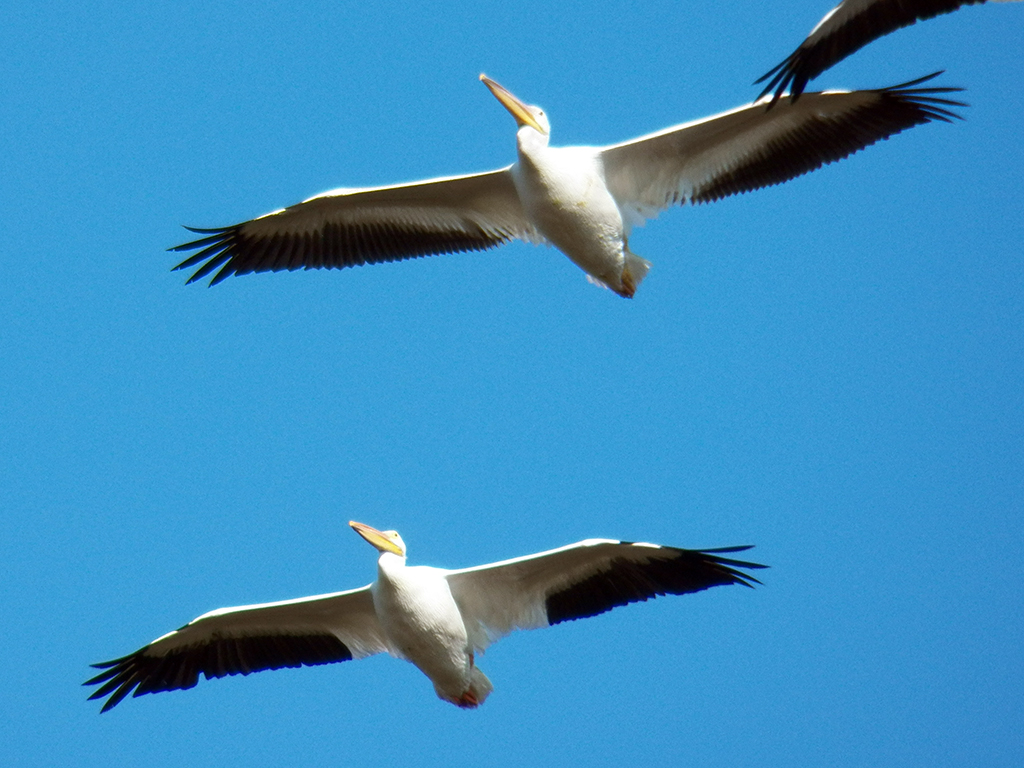
Just as last year, flights of American White Pelicans soared overhead. I am always awed and impressed with these huge birds. They are ponderous, yet graceful and majestic, yet slightly goofy.

pelican

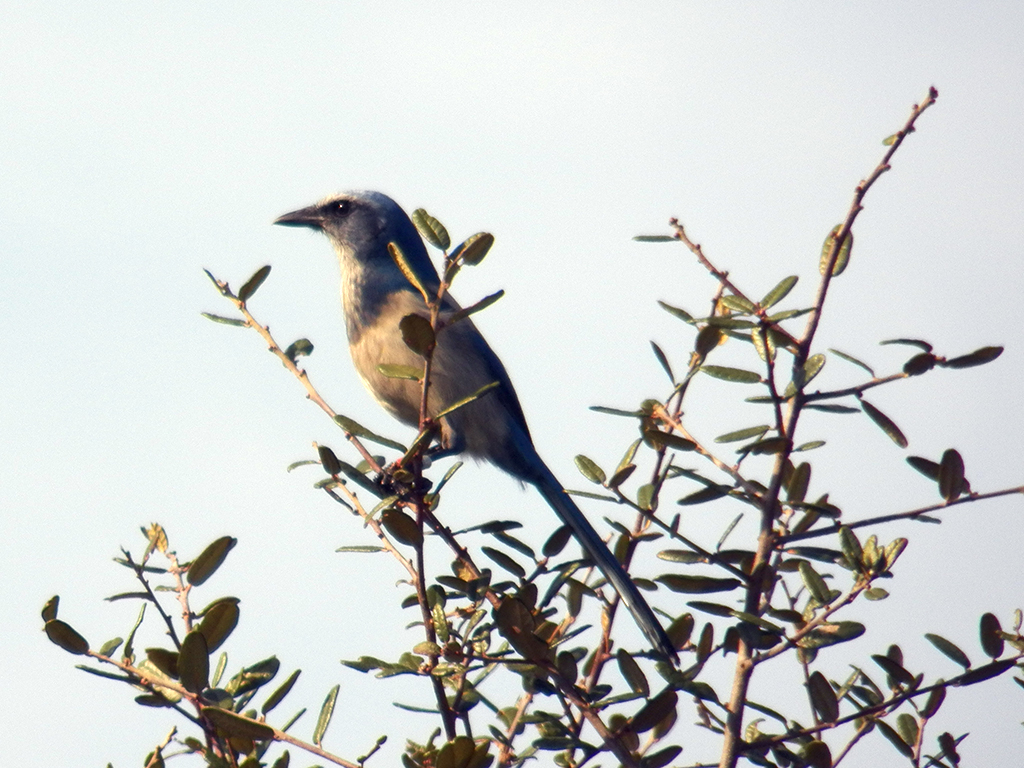
On the other side of MINWR from Blackpoint Drive’s entrance, just a short drive away,  is the short Scrub Ridge Trail. This trail loops through a small section of upland scrub vegetation adjacent to the marshes and ponds and provides some habitat for Florida Scrub Jays. There had been an e-mail alert the previous day about a Groove-billed Ani sighting near the parking area, so I was hopeful, especially after missing the ani pair that had been seen at Lake Apopka. Unfortunately, I did not see the ani, but I did encounter a family of Florida Scrub Jays. These jays were much more skittish and more prone to hide than the ones I’ve seen at the Malabar Scrub Sanctuary.

scrubjay
This jay acted as a sentinel for the others who would dash out into the grass or shrubs for a few seconds before launching up and over the tops of the bushes and out of sight.

Along the Scrub Ridge Trail the most numerous birds were the Tree Swallows, Yellow-rumped Warblers and Palm Warblers. I heard a few Eastern Towhees, and one female Northern Harrier raced past, scattering coots in a nearby pond. After completing the trail loop, it was time to head home.

Here’s the complete species list, roughly in order of confirmed identification:

  • Great Egret
  • White Ibis
  • Roseate Spoonbill
  • Snowy Egret
  • Glossy Ibis
  • American Coot
  • Boat-tailed Grackle
  • Red-winged Blackbird
  • Reddish Egret
  • Little Blue Heron
  • Great Blue Heron
  • Wood Stork
  • Double-crested Cormorant
  • Fish Crow
  • Pied-billed Grebe
  • Northern Pintail
  • Blue-winged Teal
  • Tri-colored Heron
  • Hooded Merganser
  • Lesser Scaup
  • Northern Shoveler
  • Ring-necked Duck
  • Caspian Tern
  • Ring-billed Gull
  • Herring Gull
  • Dunlin
  • Belted Kingfisher
  • American White Pelican
  • Willet
  • Greater Yellowlegs
  • Lesser Yellowlegs
  • Black-belled Plover
  • Anhinga
  • Turkey Vulture
  • Black Vulture
  • Osprey
  • Merlin
  • American Wigeon
  • Eastern Towhee (♫)
  • Red-bellied Woodpecker
  • Florida Scrub Jay
  • Palm Warbler
  • Yellow-rumped Warbler
  • Tree Swallow
  • Northern Mockingbird
  • Downy Woodpecker

That likely ends by birding excursions for the year. It was fun to come full-circle to MINWR,  and the adventures will continue, with the Space Coast Birding and Wildlife Festival in January, and a short trip to see my friend Laura for Superb Owl Sunday!

Long Walk on the Shortest Day

Sunday morning, I decided to check out Pine Island Conservation Area to see how it’s settling in for the winter. The restoration efforts continue for the southern half, but little has changed for the rest of the park.

I always underestimate Pine Island, and it always ends up taking longer to do whatever I’m trying to accomplish there compared to other birding spots. The main pond is over 1.35 km (.84 mi) long, and I walked a total of 6.5 km (4 miles). Bird densities are usually low, except for the vultures, so you have to work a bit for it.

My day was significant for a couple of reasons. One, was sighting a yellow variant of a House Finch. I’ve seen orange variants described, but never a yellow one. I first noticed a normal reddish individual and then the yellow one nearby. At first I thought it was a warbler with a deformed beak, but after a prolonged look in the binoculars, all the patterns and shapes of a House Finch were there. The call notes from the individual were also in keeping with the rest of the House Finches in the branches close by. The bird came into the light, during a 2nd sighting, enough for two photos, only one of which it wasn’t facing completely away from the camera.

photo yellow-house-finch.jpg
Unusual or “aberrant” plumages, while rare, are normal. There are even occasional reports of yellow cardinals!

Another great find was a flock of American Wigeons sitting at the far end of a secluded pond. I could only see them through some dense understory and they were back-lit, but I’ve included this photo. The glare was so bad in the binoculars that I had to rely on this photo to identify them.

photo wigeons.jpg
I don’t often see American Wigeons, but when I do, I prefer they aren’t back-lit and far away.

Pine Island usually has large groups of both Black and Turkey vultures, but this time as they took to the sky on the first thermal of the day, they had a diverse mix of soaring birds with them. In a single large kettle (that’s a group of birds circling in a thermal together) I saw Anhingas, Ospreys, Wood Storks, Red-shouldered Hawks and even some gulls and terns, in addition to both vulture species.


Nothing says “Good morning!” like a swarm of vultures!

I scared up a number of egrets and herons through the morning, with the Tri-colored Herons being the most vocal and skittish, as usual. There were fewer waders in the main pond than I expected, but there were a few larger alligators around the area, so perhaps they sought out a safer place to be.

photo gator-pan.jpg
“Not if I see you first!” said the 10-foot gator.

There was this nice group of waders, though. A nearby Red-shouldered Hawk had them a little on edge, but they had obviously found a great foraging area, so they stood their ground. Eventually the commotion generated by the Common Gallinules annoyed it enough to fly away, and everyone calmed down enough for me to get this group shot.

photo waders.jpg
A motley crüe…er, crew, of waders!

My morning ended with a nice mixed flock of finches and warblers, including a Prairie Warbler, a very yellow Palm Warbler with some grayer friends, and a few Yellow-rumped Warblers and House Finches for good measure.

Identified birds, in approximate order of confirmation:

  • Black Vulture
  • Bald Eagle
  • Tri-colored Heron
  • Double-crested Cormorant
  • Turkey Vulture
  • Palm Warbler
  • Northern Cardinal
  • Common Gallinule
  • Little Blue Heron
  • Royal Tern
  • Savannah Sparrow
  • Eastern Phoebe
  • Great Blue Heron
  • Cattle Egret
  • White Ibis
  • Roseate Spoonbill
  • Wood Stork
  • Osprey
  • Anhinga
  • Ring-billed Gull
  • Yellow-rumped Warbler
  • Common Ground Dove
  • Pied-billed Grebe
  • American Wigeon (FOY)
  • Boat-tailed Grackle
  • Red-shouldered Hawk
  • Killdeer
  • Carolina Wren (♫)
  • Common Yellowthroat
  • House Finch
  • Red-bellied Woodpecker
  • American White Pelican
  • Great Egret
  • Snowy Egret
  • Glossy Ibis
  • Prairie Warbler
  • Green Heron
  • Pileated Woodpecker

Merry Christmas, Happy Chanukkah, and Happy whatever holiday you choose to celebrate!

Quick Run to Turkey Creek

I made a quick jaunt to Turkey Creek this morning, and it was fairly quiet, except for near the trail/boardwalk entrance and exit. On my way in the pines near the picnic area were full of a mixed flock of Northern Parulas and Pine Warblers. At the end of my walk just before the end of the Sand Pine Trail by the nature center was a mixed flock of Pine Warblers and several Blue-headed Vireos. Otherwise, there were REALLY worn Zebra Longtail Butterflies throughout the park.

image
Tattered survivor.

And there was this mystery whistle.

Any help with identifying this sound would be welcome. How about it?

Otherwise, here’s the list of birds seen today.

  • Rock Pigeon
  • Pine Warbler
  • Northern Parula
  • Gray Catbird
  • Anhinga
  • Great Blue Heron
  • Green Heron
  • Cattle Egret
  • Double-crested Cormorant
  • Turkey Vulture
  • Osprey
  • Black Vulture
  • Blue-gray Gnatcatcher
  • Blue-headed Vireo

It’s been chilly (for Florida) the past several days, but the sun’s been warm, and by mid-morning I’ll take mid 60s Fahrenheit over freezing any day.

Striking it Ritch in Viera

The bird population at the Ritch Grissom Memorial Wetlands continues to change and grow as winter sets in. I identified almost 50 different bird species on Sunday, plus a handful of ambiguous sightings. More duck populations are arriving, with Lesser Scaups, Ring-necked Ducks, Blue-winged Teals, Canvasbacks, Redheads, and a Hooded Merganser all present.

It was cloudy most of the morning with a few breaks of sunshine which transformed the Wetlands from looking like this:

photo not-as-sunny.jpg

To this:

photo sunny.jpg

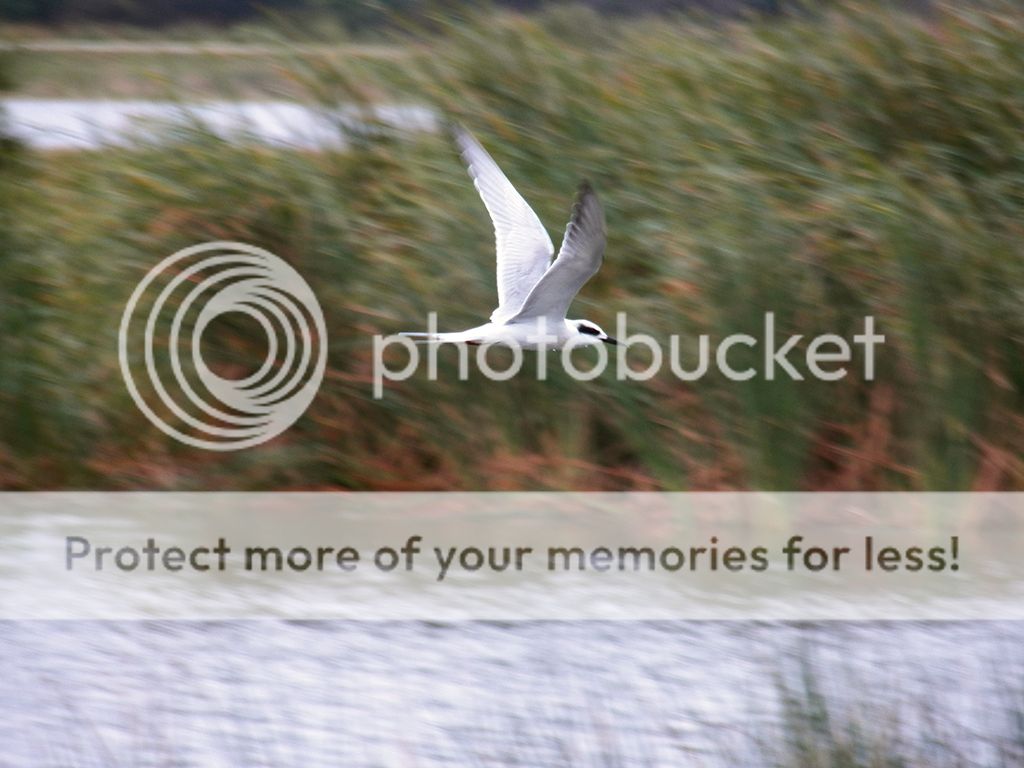
There were several species of terns flying and diving for fish. I didn’t see any Least Terns, but in addition to the larger Caspian and Royal Terns there were several Forster’s Terns making circuits over the water. The terns were using the stiff northerly breeze to help them hover over a promising spot before diving in. Then they turned and used the tail-wind to speed around for another pass. Forster’s terns come to the Wetlands every winter and are among the most active feeders.

photo forsters-tern-214-dec-07.jpg
In the summer Forster’s Terns have entirely black caps, but here you can see the extended black “ear patch” of its winter plumage.

There have been Northern Harriers patrolling the Wetlands for the past two visits. This harrier was resting after cruising the marshes and stirring up trouble, scattering coots and ducks everywhere.

photo northern-harrier.jpg
Male Northern Harriers are gray and the females brown. Have a look at those talons.

Most visits to the Wetlands include a Crested Caracara sighting. Longer-time followers of the blog know that I don’t manage to get many photographs of them, for some reason. This time there were two in flight a bit of distance away.

photo caracara.jpg
Even from this distance, the Crested Caracaras’ distinctive field marks are obvious.

Living in Florida, it is easy to overlook the White Ibis. Here they often descend on lawns and golf courses in small flocks. Ibises use their long curved bills to probe deep in the mud and soil for insects, crustaceans and small invertebrates.

photo ibis-head.jpg

Ibises look kind of like Gonzo, from The Muppets. Also, I never realized they had blue eyes!

There were plenty of Palm Warblers and some Yellow-rumped Warblers along the edge of the outer driving loop. I saw a few Eastern Phoebes and a pair of Red-bellied Woodpeckers. Woodpeckers will often hide behind tree trunks, alternating between sidling up the tree, out of view, and popping out to have a look at where the potential predator is (that would be me, from a woodpecker’s perspective).

photo red-bellied-woodpecker.jpg
“Hey, are you still here?”

Roseate Spoonbills don’t often come down to feed at the Wetlands, but this one obliged and let observers come within 10 feet or so before briskly walking away until it felt a bit safer. Spoonbills use their unusually shaped bills to sense for small prey items in the mud and water.

photo spoonbill.jpg
The head makings make it look like this bird has headphones on.


Spoonbills are pink because they often eat prey that are high in pigments called carotenoids. This is the same reason why flamingos are pink.

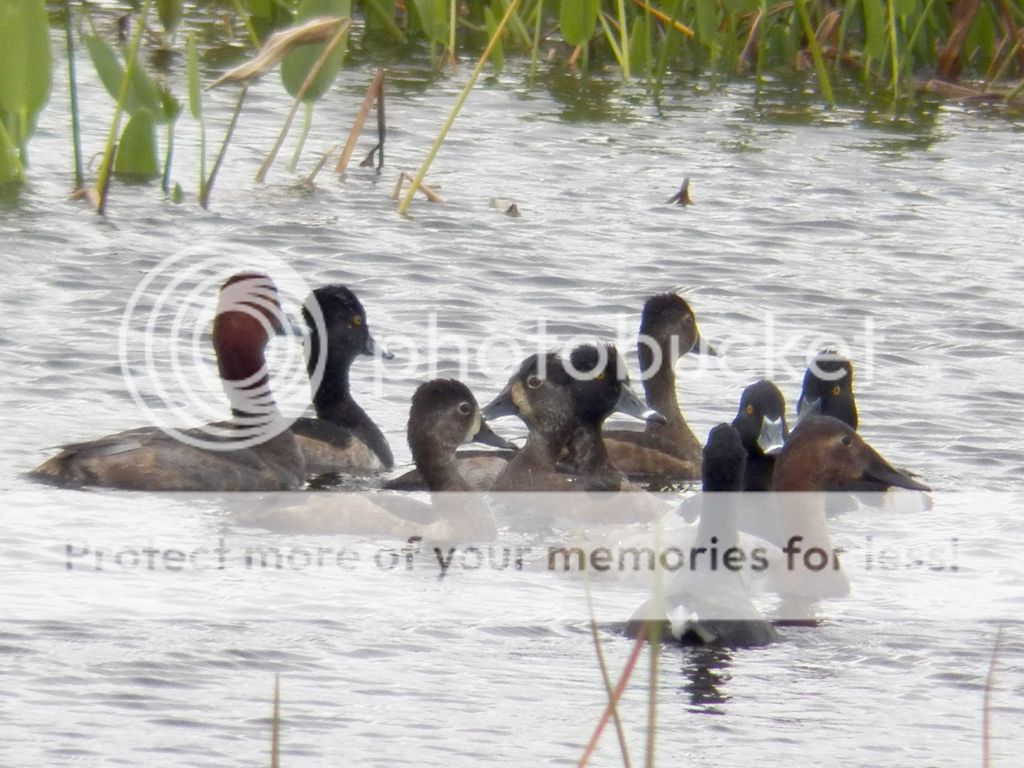
I was pleasantly surprised by a grouping of mixed ducks. There were Ring-necked Ducks (male and female) and a male Redhead with a couple of females. Also present were two female Canvasbacks. I had to double check that the male Redhead was not a Canvasback, as the species do look similar.

photo mixed-ducks.jpg
A duck social mixer.

photo canvasback-v-redhead-hens.jpg
Female Canvasback on the left, female Redhead on the right. It’s a little hard to see because of the viewing angles, but the Canvasback has a longer, straighter bill that starts at her forehead.

The American Coots continue to gather in larger groups, or “rafts.” When a harrier or other bird of prey flew by (not always making a hunting run), the entire raft scrambles. Coots are poor flyers and generally make a loud, splashing ruckus as they skitter along.


Panic At The Disco. You can see a Blue-winged Teal on the left about 15 seconds in.

Here is a list of the identified species from the day, roughly in the order I saw them:

  • Cattle Egret
  • Double-crested Cormorant
  • Boat-tailed Grackle
  • Northern Mockingbird
  • Sandhill Crane
  • Forster’s Tern
  • Great Egret
  • Little Blue Heron
  • Northern Harrier
  • Blue-winged Teal
  • American Coot
  • Common Gallinule
  • Palm Warbler
  • Wilson’s Snipe
  • White Ibis
  • Yellow-rumped Warbler
  • Limpkin
  • Pied-billed Grebe
  • Ring-necked Duck
  • Eastern Meadowlark (♫)
  • Black-crowned Night Heron
  • Anhinga
  • Turkey Vulture
  • American Kestrel
  • Fish Crow
  • Eurasian Collared Dove
  • Savannah Sparrow
  • Common Yellowthroat
  • Snowy Egret
  • Crested Caracara
  • Tri-colored Heron
  • Glossy Ibis
  • Black Vulture
  • Red-shouldered Hawk
  • Royal Tern
  • Caspian Tern
  • Roseate Spoonbill
  • Northern Shoveler
  • Green Heron
  • Belted Kingfisher
  • Red-bellied Woodpecker
  • Red-winged Blackbird
  • Osprey
  • Lesser Scaup
  • Redhead
  • Canvasback
  • Hooded Merganser
  • Ring-billed Gull
  • Loggerhead Shrike

I believe this was the single “biggest” day in terms of species count since the Space Coast Birding and Wildlife Festival for me. I don’t normally focus on that, but given the level of activity I felt it was noteworthy. The 2015 SCBWF registration should open soon, and I am really looking forward to that.

Successful Failure

Yesterday’s birding adventure seemed particularly apt, given that my wife and I spent Friday at the Kennedy Space Center with our friends. Among the exhibits at the Saturn V Center are those honoring Apollo 13 as a “successful failure” in that the mission suffered a catastrophic failure, but the 3 astronauts were able to make it home safely, and much was learned.

I don’t know how much was learned today, except maybe a hard-earned “the early bird gets the worm,” or in this case, the Groove-billed Ani. There have been sightings of a pair of anis on the north end of Lake Apopka since last week (along with a male Vermilion Flycatcher!). I was not able to venture out there until Sunday. But as it takes over an hour and forty-five minutes to get there from here, I ended up 20-30 minutes too late for the anis.  Apparently, they went to their daytime roost, out of view of anyone. I should have just got up and out there early, but since some of the previous sighting times were after 11:00am, I didn’t exactly rush out the door. My loss.

But the outing was still a success. Firstly, I was out observing birds and other wildlife on a beautiful sunny day. Also, among the birds I also saw a rather large River Otter cross the path and had a brief but close encounter with a Bobcat.

The area I visited, the “Lake Apopka North Shore Restoration Area” looks much like this most of the way (with varying degrees of shrubbery buffering some swampy, marshy areas from the road).

photo road-to-nowhere.jpg
“We’re on a road to nowhere…”

The road to where the anis had been seen was well populated with Eastern Phoebes and Palm Warblers. Many of the phoebes were young birds, as I understand a slight yellow wash on their bellies means they are immatures.

photo young-phoebe.jpg
Young Eastern Phoebe.

I was surprised to see several Blue Grosbeaks soon after heading down the trail. I believe late November is a bit late for them to be hanging around, but if they’ve found a good wintering spot, who am I to judge? [edit: according to eBird, it looks like a handful stay the winter in FL and other parts of the southeast]

A rather dark Red-tailed hawk soared a distance away. It also had a good bit of white on the base of the tail – so much, that at first I thought it was a Bald eagle, until I had a good look in the binoculars and saw its underside. Red-tailed Hawks can have a wide variety of plumages. In fact, many subspecies were once considered as separate species.

I had a FOY Swamp Sparrow (actually several) and, thanks to a Bobcat stalking the tall grasses along the berm beside the road, a FOY Marsh Wren, who was too busy scolding the cat to notice me poking my binoculars into the brush. The House Wrens and Common Yellowthroats were also highly agitated, as you can imagine. The Bobcat only poked its head out at me for a second or two, before going back to stalking in the grass. I’m not sure how skilled a hunter it is, given the loud rustling and waving grass, but the birds weren’t taking any chances.

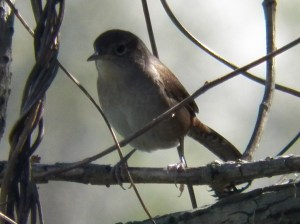
photo house-wren.jpg
This House Wren was warily watching a Bobcat while some Marsh Wrens and Common Yellowthroats scolded the cat from nearby.

After my encounter with the Bobcat, I heard and felt a distinct growling sound. At first I thought it was a distant motor being started, but then it almost had a lion’s roar quality. As I passed an area of more open water, I could tell it was nearby. The roar came in one to two-second bursts, with a brief pause in between. It turns out it was an alligator call! I’d never heard one before. I don’t know exactly where it was calling from, but I moved along just to be safe.

I spoke a little with some other birders who had come specifically to see the Groove-billed Anis, but they had missed them as well. There were reports of Yellow-breasted Chats in the area, too, but I didn’t see or hear any evidence of them.

Here is the complete species list, roughly in order of first confirmed identification.

  • Blue Jay
  • European Starling
  • Common Grackle
  • Northern Mockingbird
  • Sandhill Crane
  • Black Vulture
  • Turkey Vulture
  • Bald Eagle
  • Eastern Phoebe
  • Gray Catbird (♫)
  • Blue Grosbeak
  • Blue-gray Gnatcatcher
  • Northern Cardinal
  • Common Gallinule
  • Swamp Sparrow (FOY)
  • Palm Warbler
  • Little Blue Heron
  • Blue-winged Teal
  • American Coot
  • Great Egret
  • Red-tailed Hawk
  • Boat-tailed Grackle
  • Osprey
  • Marsh Wren (FOY)
  • Anhinga
  • Common Yellowthroat
  • House Wren
  • Red-shouldered Hawk (dark)
  • Great Blue Heron
  • Common Ground Dove
  • American Kestrel
  • White Ibis
  • Double-crested Cormorant
  • Tri-colored Heron
  • Downy Woodpecker (♫)
  • Red-bellied Woodpecker (♫)

No anis or chats (or Vermillion Flycatchers!) were seen by me on Sunday, but I had a successful outing nonetheless.