
Common Gallinule with baby

Osprey

Turkey Vulture

Red-winged Blackbird

Purple Martins (mostly fledglings)

Fledgling Purple Martin

Common Gallinule Chicks

I must apologize for the lateness of this blog post. I’ve been suffering from some sort of writer’s block and it’s caused me no end of headaches. Luckily, I had uploaded most of the photographs already, so I’ll use them as a scaffold to tell you about my and Camille’s birding adventures this past Saturday.
Our primary goals were to try to see the Fulvous Whistling Ducks reported at Brinson Park in Kissimmee and then to find Snail Kites around the lakes near St. Cloud.
Brinson Park is just at the north of Lake Tohopekaliga (or Toho, for the more tongue-tied of us) and overlooks the lake and some mudflats with a sidewalk that follows along most of its length. This is part of “The Florida Trail”, which runs from Big Cyprus Preserve and eventually to Pensacola.

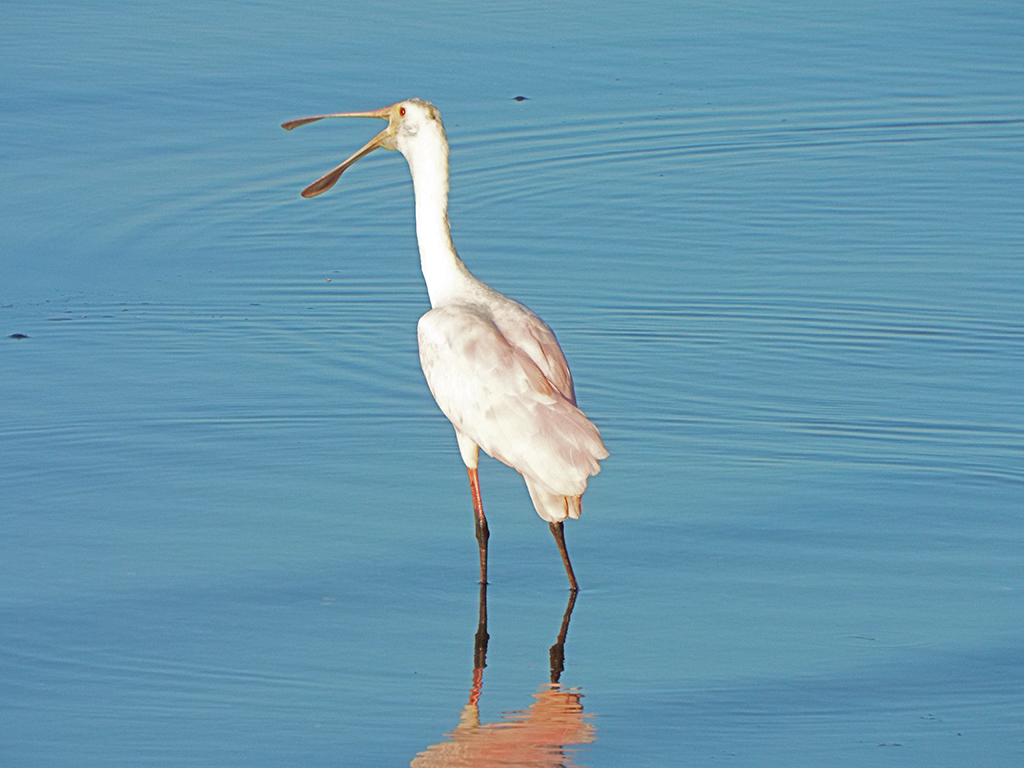
Brinson Park is a great place for wading birds. We saw White and Glossy Ibises, various herons and egrets, and even a Black-necked Stilt. But the dominant wading birds were the Roseate Spoonbills and the Limpkins. It seemed that a majority of the spoonbills were juveniles. In fact, it was hard not to see the place as a sort of cool hang-out spot for teen spoonbills away from adults.
As for the Limpkins, I have never seen so many together in my life. Most of them were flying and squabbling out over the water, but a few were closer in. Limpkins are adapted to feed on snails – particularly the large snails found in central Florida lakes. Their bills are actually slightly curved at the tip to allow for easier access into the snails’ shells. This gallery shows one of the limpkins going about it’s breakfast.
I scanned the horizon for raptors and other soaring birds and was quickly rewarded with the first Snail Kite of the day! We weren’t expecting it at this location, but I got a good look at it in the binoculars as it circled overhead and then landed on a post out in the water.
Nearer the shore were several ducks that I could not initially identify. It took a bit of watching and field guide checking, but they were immature Muscovy ducks. Muscovys are a feral species, and most birds in central Florida have a varied plumage, belying their domestic heritage; however, the juveniles are surprisingly uniform in appearance.

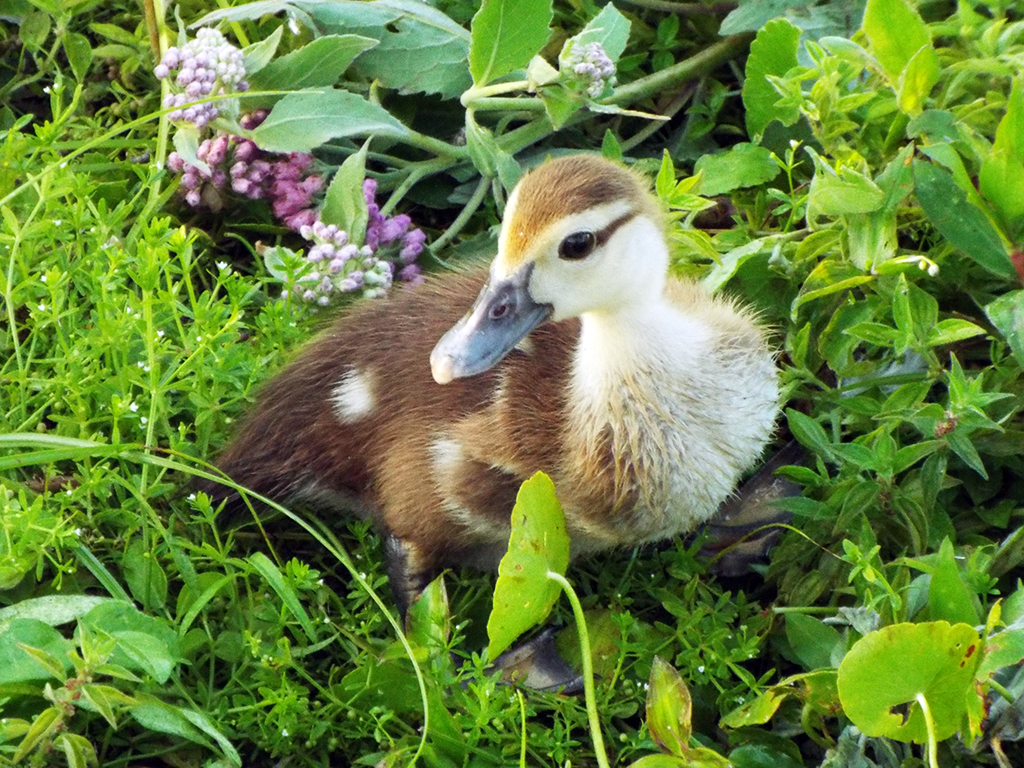
Along the vegetation below the sidewalk level there was a large brood of Muscovy chicks with their mother. It was clear that these ducklings are used to being fed, because they ran as fast as they could to where we were standing and watched us expectantly. I verbally apologized, telling them that people food (and bread in particular) was not good for them, and they needed to stay closer to Momma.
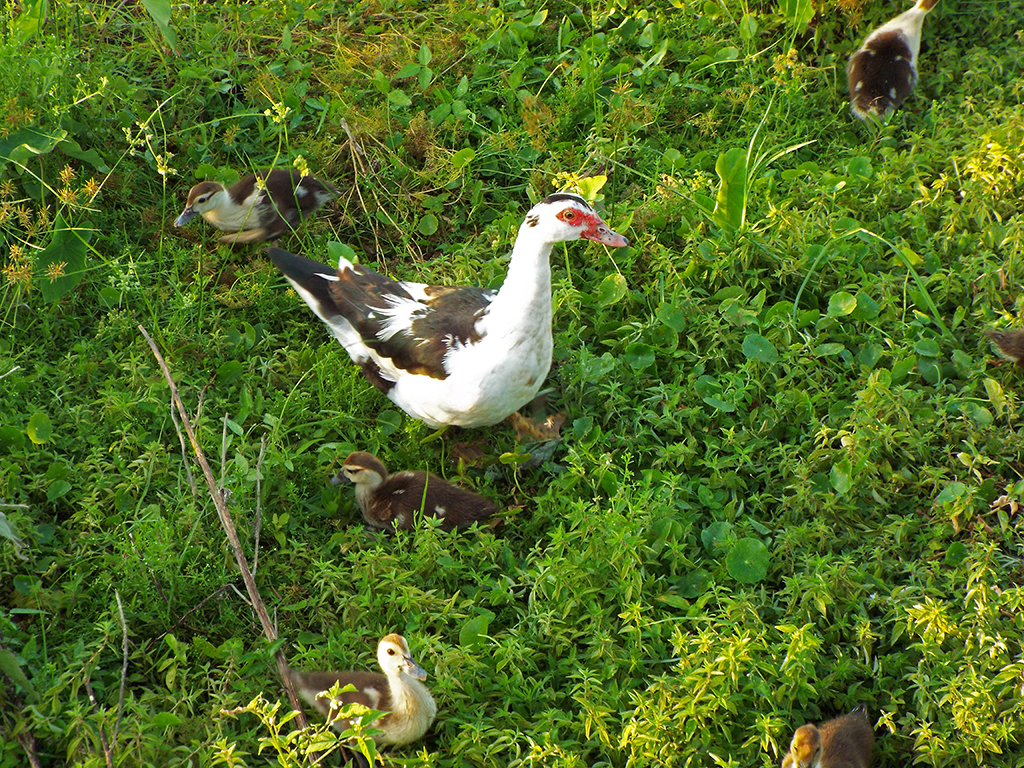
When their mother arrived just after them, they eventually settled down, but would occasionally glance up at us in case we changed our minds.
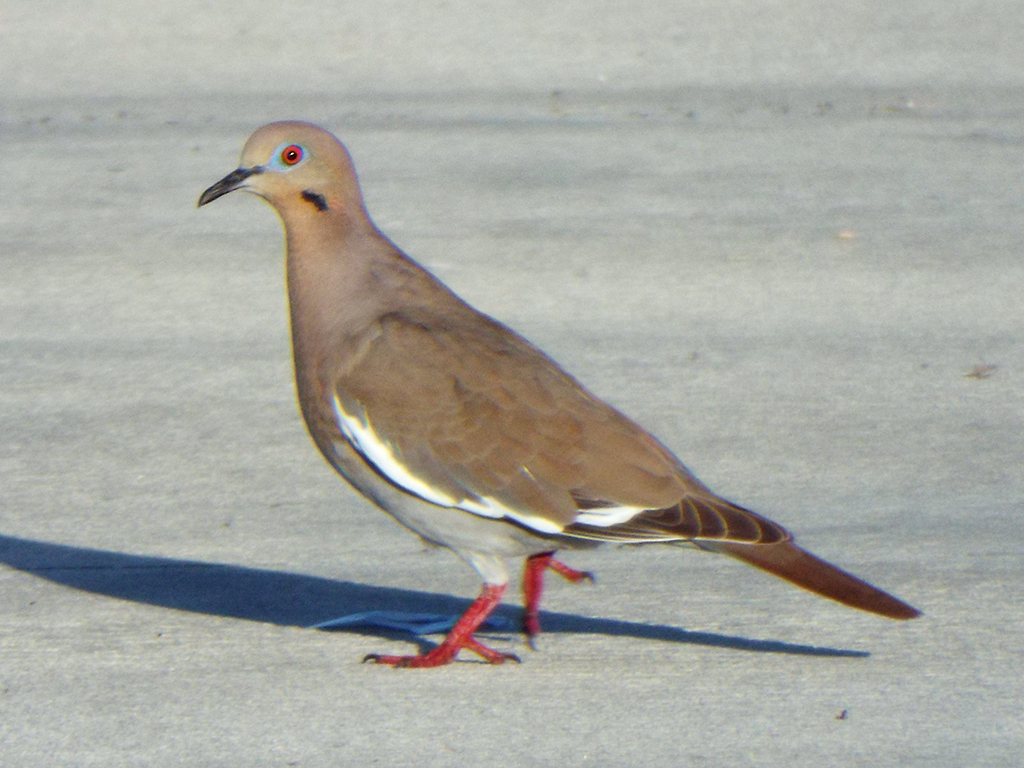
Meanwhile, along the road and sidewalk areas, both in the landscaping trees and the brushy vegetation at the edge of the lake, there were many fledgling and immature Boat-tailed Grackles creating a huge amount of noise. Alongside the adults feeding in the grass were three species of dove: Mourning, Eurasian Collared, and White-winged. One particularly handsome White-winged Dove let us get fairly close. The striking “eyeshadow” marking and red eye, along with that white racing stripe make for a gorgeous bird.
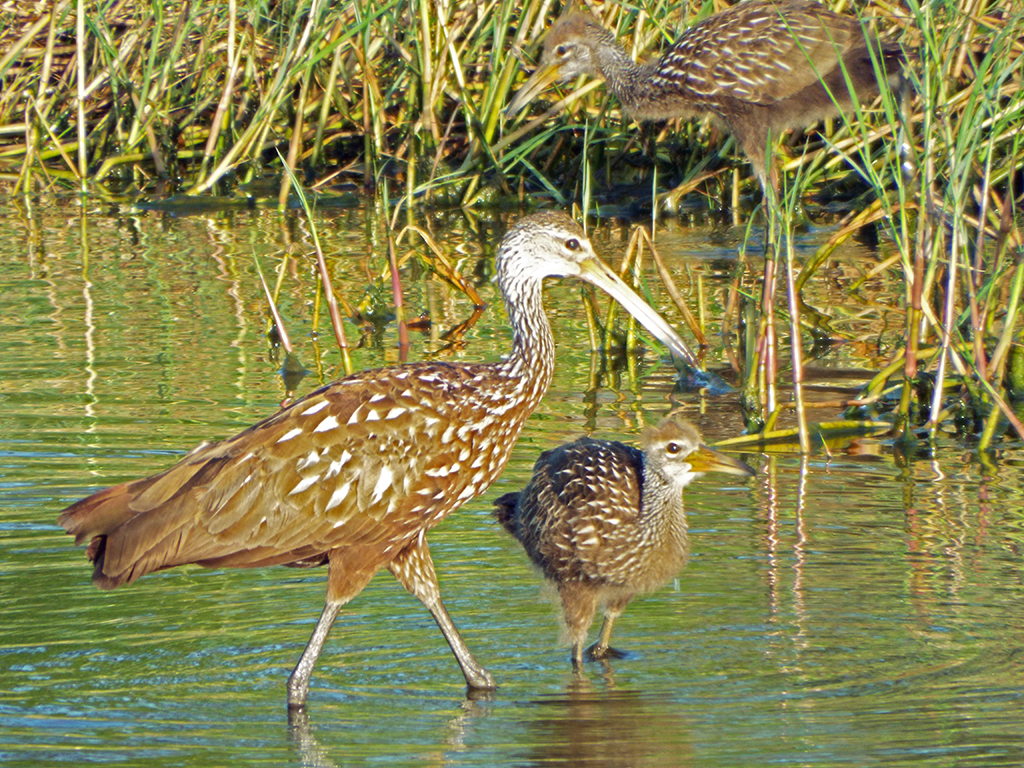
Back at the water’s edge, a family of Limpkins was also enjoying some breakfast. Some of the slightly older chicks were following an adult around and getting fed with the others hunkered uneasily in the reeds, but not out of sight.
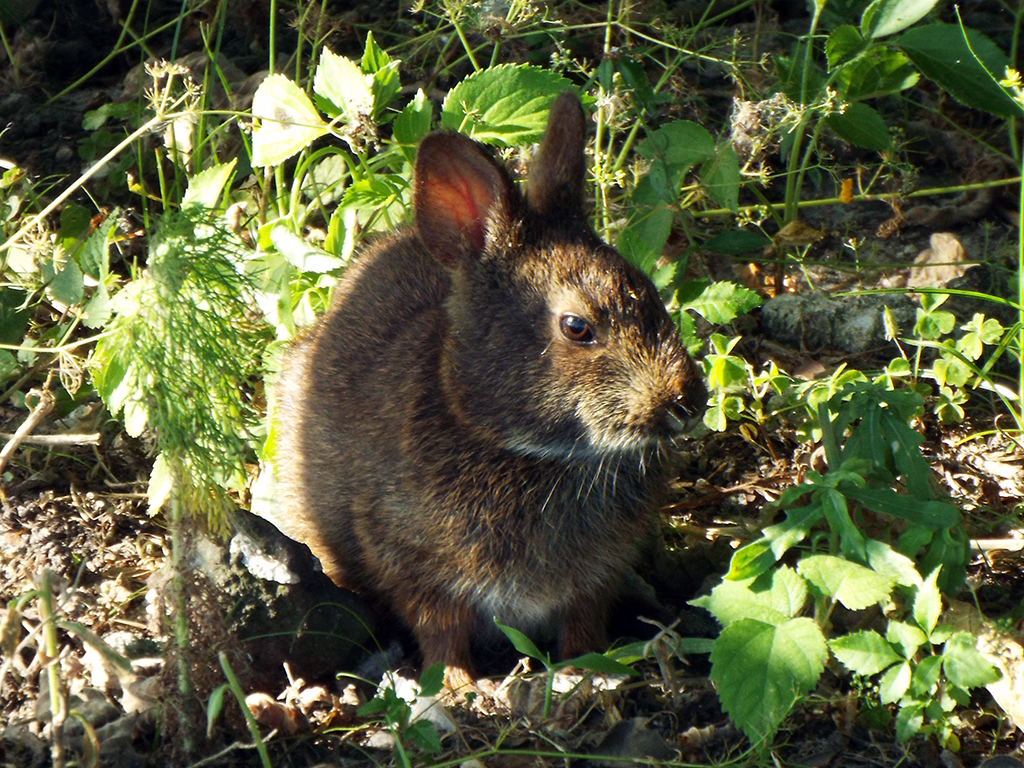
We walked around the lake shore and even crossed the road to see if the Fulvous Whistling Ducks were there, but we only got good looks at some groups of Black-bellied Whistling Ducks, a few Mottled Ducks, and more Limpkins and herons. There were some Purple Martins on the electrical wires, and several Marsh Rabbits eating and playing by the lake shore.
We really hung around a while hoping for those ducks, and we had a couple of very indeterminate and distant sighting of ducks that might have been what we were looking for, but the combination of distance and lighting made it impossible to tell. We headed over to St. Cloud and East Lake Tohopekaliga to get more Snail Kite views and see what else was afoot (or a-wing, I suppose?).
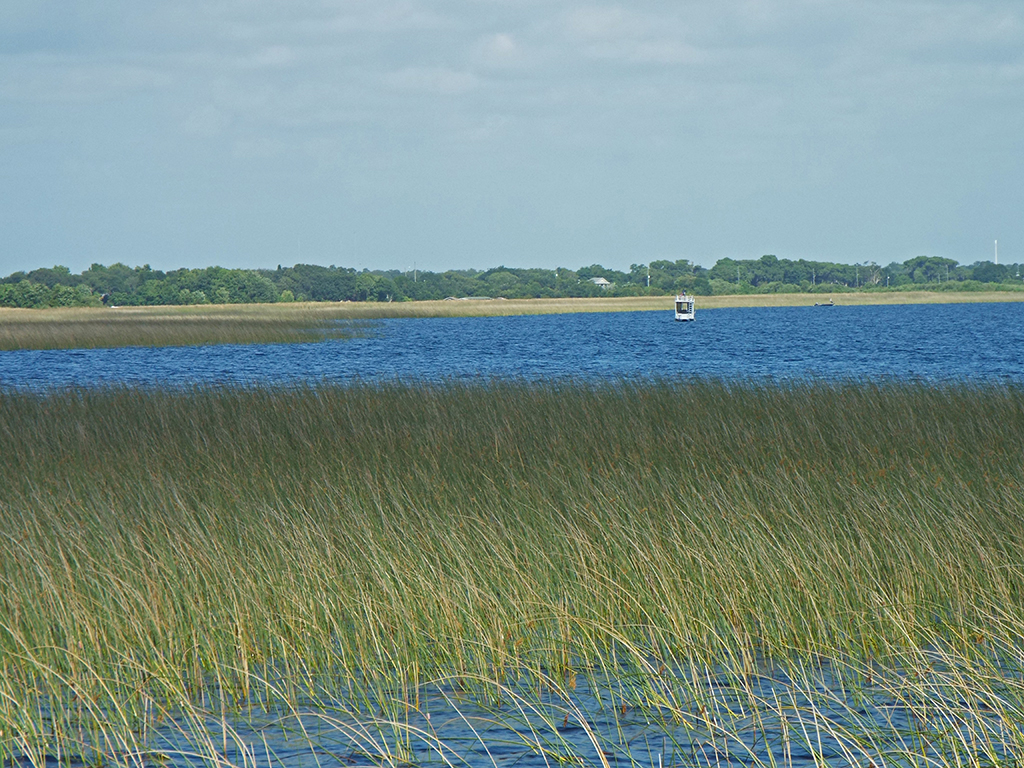
Lakefront Park is north of St. Cloud on the southern shore of East Lake Tohopekaliga. It was a beautiful morning, but surprisingly uncrowded for a Saturday. There were more Limpkins in the marsh grasses, and other wading and wetland birds scattered throughout. Camille even saw an American Bittern scoot across the park into some vegetation.
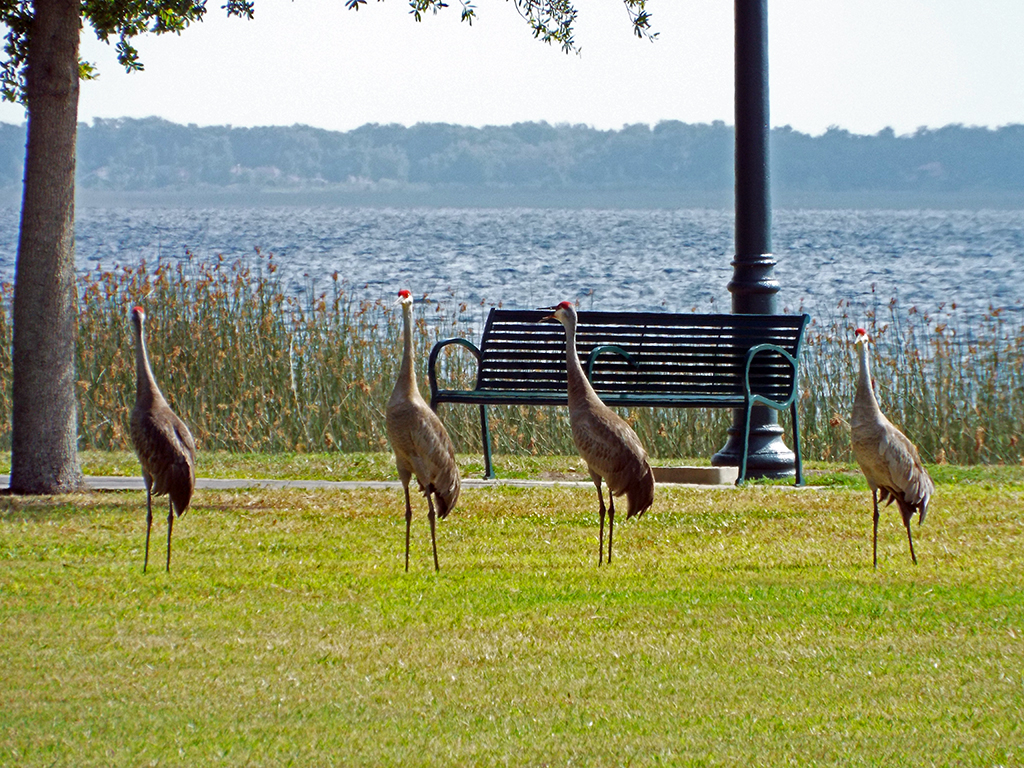
Right across from the parking area were about 8 or 9 Sandhill Cranes. Four of them were vocal and conspicuous, their shrill bugle-like calls all but drowning out any other sounds.
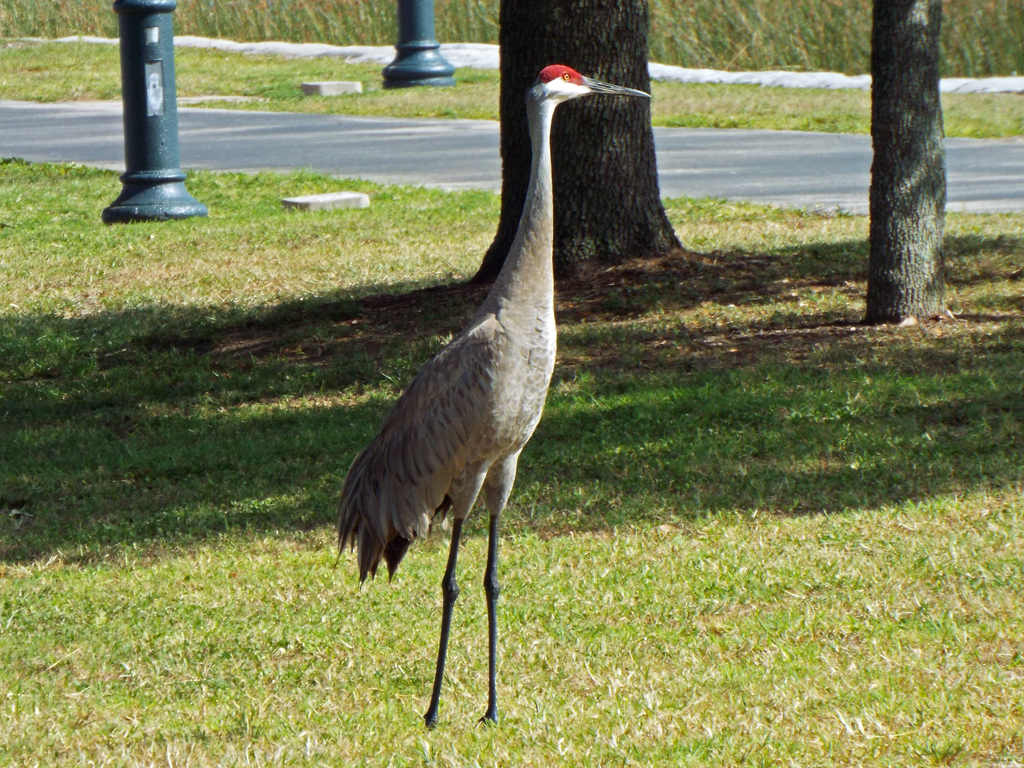
Meanwhile, a larger, even more imposing crane watched those four from a distance away. I don’t know if the others were juveniles or unattached males vying for a mate, but this crane was having none of their nonsense and eventually after a very loud call, sent them flying away.
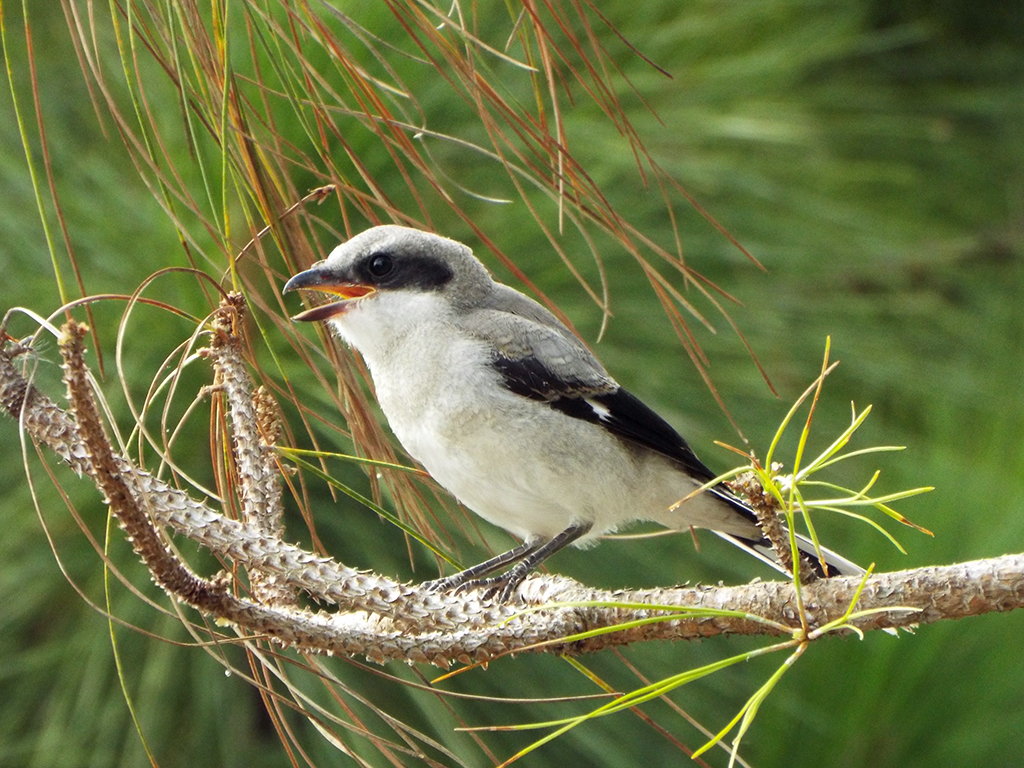
While this was going on a family of Loggerhead Shrikes was feeding on insects on the ground, and then flying up in to the trees right by our heads. One young bird was keen on showing off its skills and got an earful from his parents as it strutted its stuff.
As we got toward the overlook pavilion, a Snail Kite flew past, close to shore, its unmistakable white rump and orange bill visible even without optics.

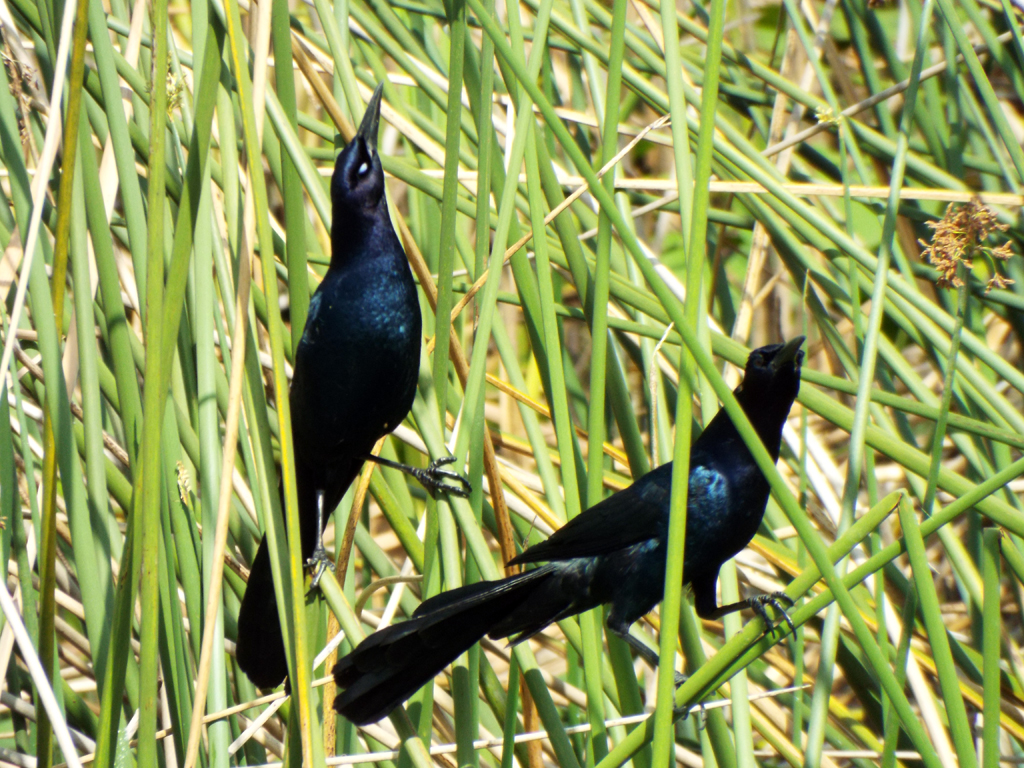
Nearby, Boat-tailed Grackles were making territorial displays and perhaps still vying for mates. One particular male seemed to get challenged multiple times, but each time the competition skulked away after a particularly loud round of chirps, bill rattles and squawks.
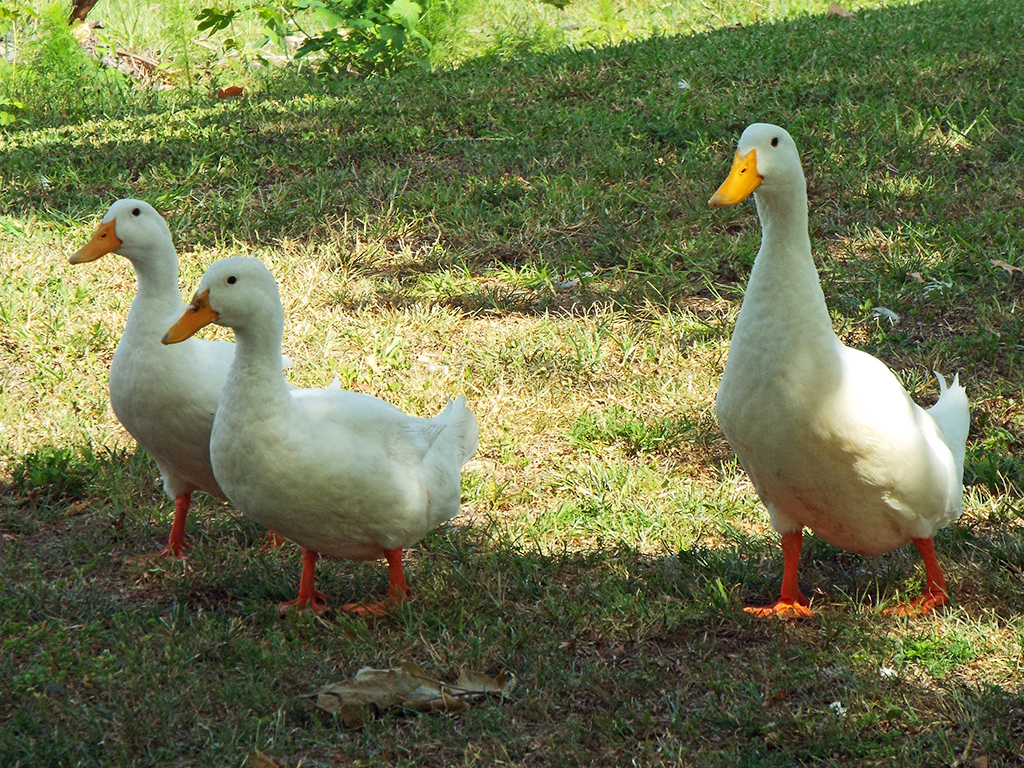
We waited for more Snail Kites and even searched around for some Fulvous Whistling Ducks, but to no avail. A trio of white feral Domestic Ducks approached us hoping for a handout, and there were more Limpkins nearby. We went back to Camille’s vehicle to decide on our next destination. While we discussed our plans, two more Snail Kites circled in from the west, along the shoreline before flying back out over the lake. We decided to visit Runnymeade Conservation area, just to the southeast.
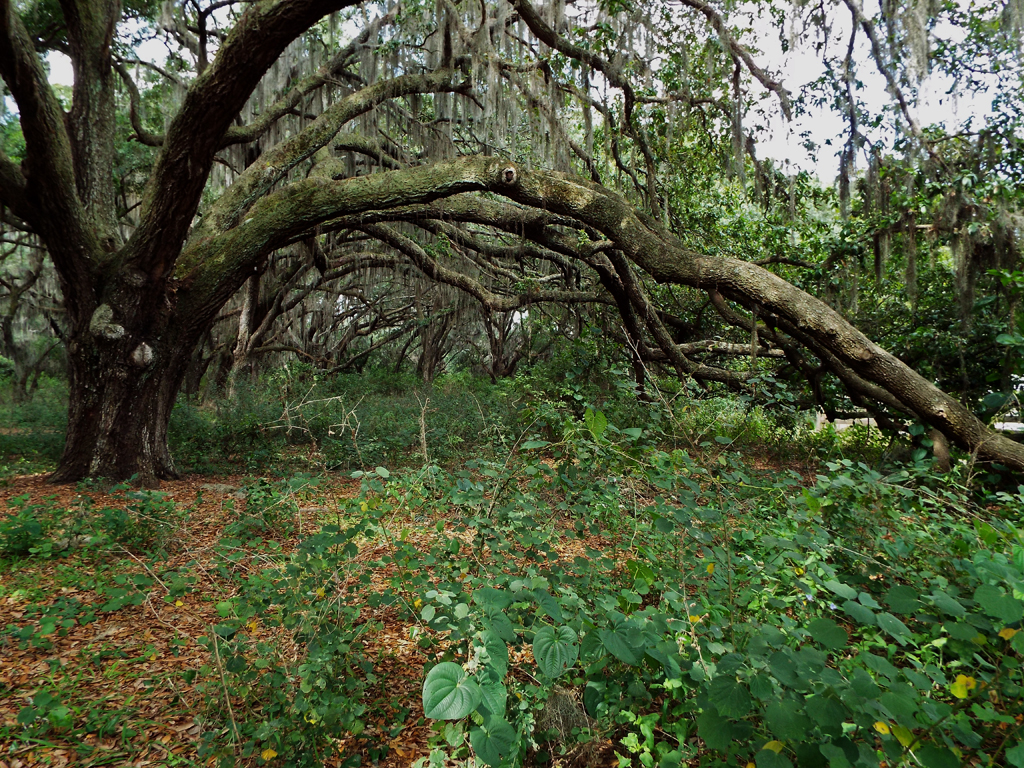
Runnymeade is primarily a Live Oak wood with a bit of scrub along its edges. This sort of arrangement is sometimes called a monotypic community. Most of the trees were reasonably mature, but the woods are isolated from a larger community by residential development and Runnymeade Lake.
I could hear (and saw a few) Northern Cardinals as well as Tufted Titmouses. We were visited, briefly, by a band of Downy Woodpeckers, too. Otherwise, it was quiet through most of the woods. In the scrub area we tracked a White-eyed Vireo that stayed very well hidden, despite it being only twenty or so feet away (based on the sound). We only ever caught the briefest glimpse of it between trees.
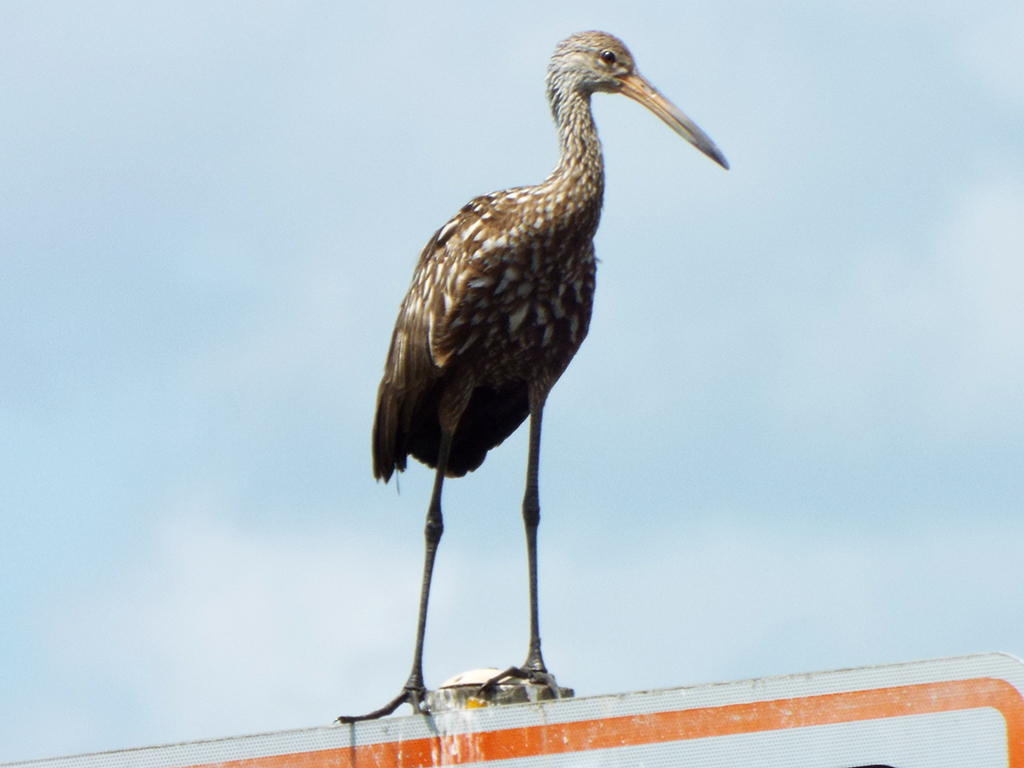
We decided to end the morning (by now early afternoon) back at East Lake Tohopekaliga, at Chisholm Park. This area is east of Lakefront Park and consists mainly of some picnic pavilions and a boat ramp. Just as the other lake area, Limpkins were conspicuous and active. Each sign by the boat ramp had a Limpkin atop it, calling loudly and refusing to fly away even when noisy boats came up tie up, or talkative birders sidled in for better photographs.
We hung around for a bit, when we glanced up at some soaring birds. At first I thought they were all vultures, but one bird was being harassed by a Red-winged Blackbird.

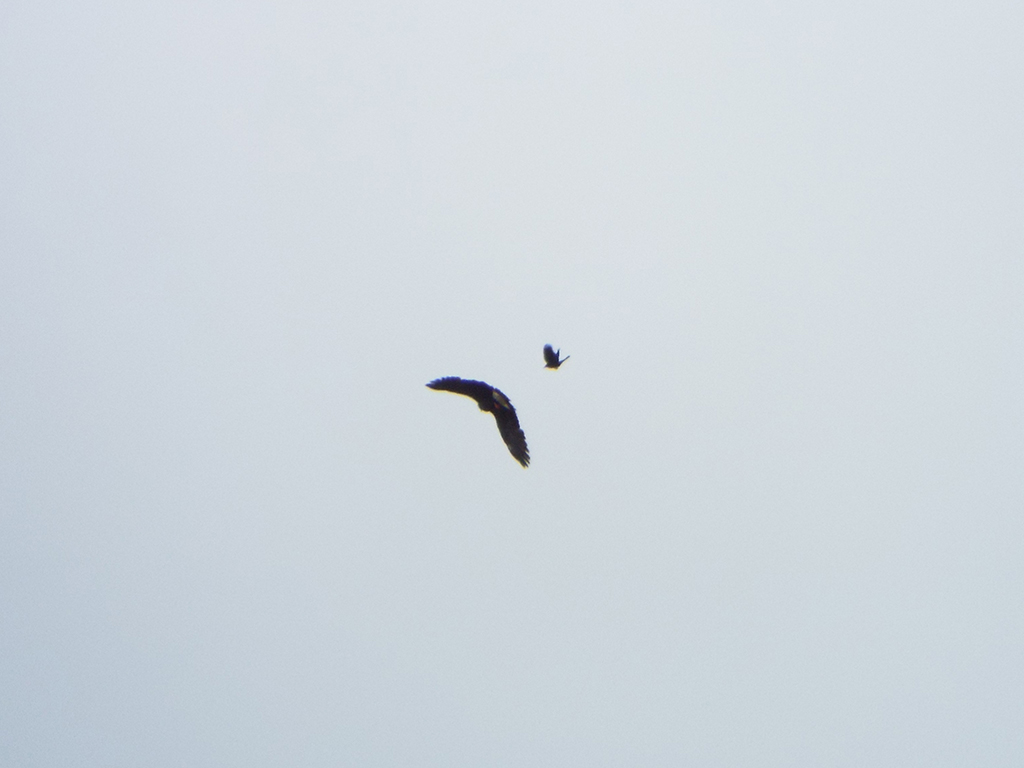
It was another Snail Kite. There were two, actually. One made its way down to a post beyond the reeds, while this one flew higher and higher in an attempt to shake off the blackbird. There’s a good chance these were the same ones we saw earlier at Lakefront Park, but there’s no way to be certain.
We watched the kites for a bit and then decided it was time for lunch and to head back to Brevard County. We may not have got our Fulvous Whistling Duck this trip, but the Snail Kites were a nice treat (and a first of year for me, a lifer for Camille).
My complete list (including the parking lot before we left in the morning), and part of the ride back, through Osceola Conty, roughly in order of first identification:
This was the first real outing with my new camera. My poor Kodak Z990 was having increased motor problems and would often not write images to the SD card, and would sometimes refuse to respond to any commands or button pushes. It’s been on a steady decline since my trip to Minnesota, and I had to replace it.
My new camera is a FujiFilm FinePix S9900W. It’s got a slightly longer reach in the max zoom, and I’ve increased from 12 megapixels to 16. I still have to get used to the settings and menus, but already I am really loving this new camera.
With the uneven migration season nearing its end, I had an additional impetus to get myself back to the Merritt Island National Wildlife Refuge (MINWR) when it was reported that a Curlew Sandpiper was seen there last week. I was hoping it would hang around another day or so, and on Sunday I made my way over the causeway and into MINWR. On the way in I saw some small birds mobbing a Red-tailed Hawk on a utility pole, and some Northern Mockingbirds chasing a Fish Crow. Exciting times!
Since many of the reports stated early morning viewing was very difficult, I decided to try both the Peacocks Pocket drive (which I had not done before) and then Blackpoint before circling back to Pumphouse Road.
Peacocks Pocket is a small bay-like feature of the Indian River Lagoon, near where it joins with Banana Creek (not the Banana River Lagoon). It has some popularity as a fishing spot, and there were several groups out fishing there. Here’s a map:
Due to the sun angle, I started down the eastern end of Peacocks Pocket and looped to the west. The sections of road in and out of Peacocks Pocket are relatively wide. If you needed to pull a bit to the side to let another vehicle pass, it’s pretty easy. The rest of the road is actually pretty narrow with very few turnouts, especially compared to Blackpoint, as an example. Luckily, I was early enough that I encountered few vehicles, and those I did see, I had plenty of time to find either a turnout or ride a slightly wider berm to get by.
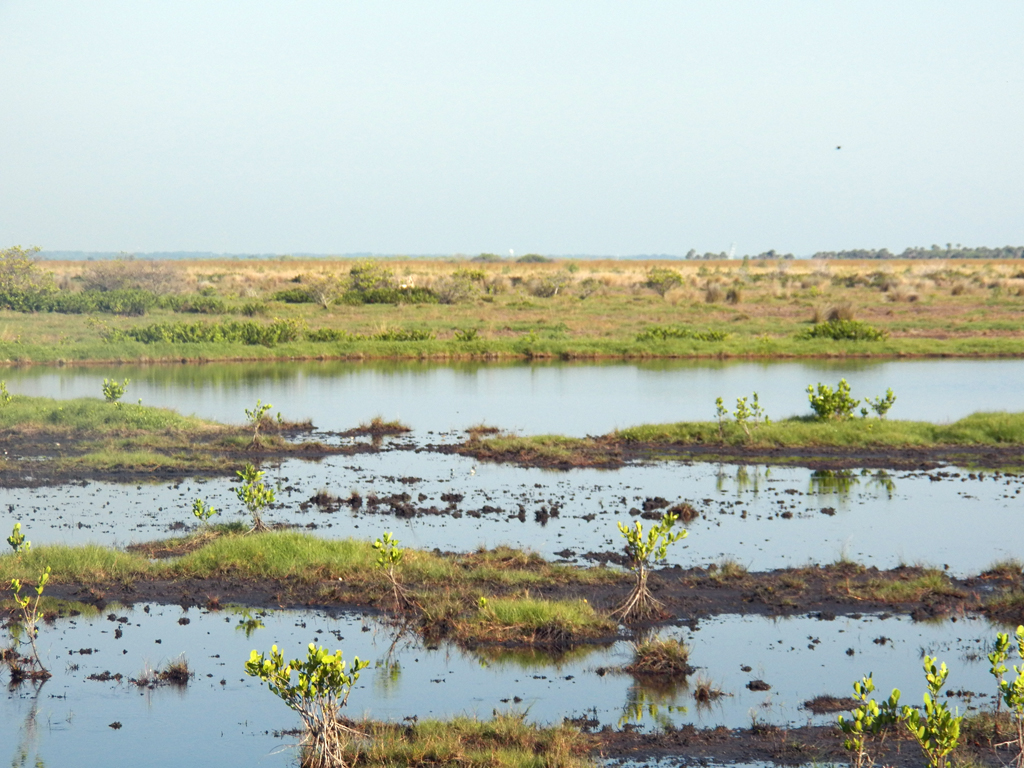
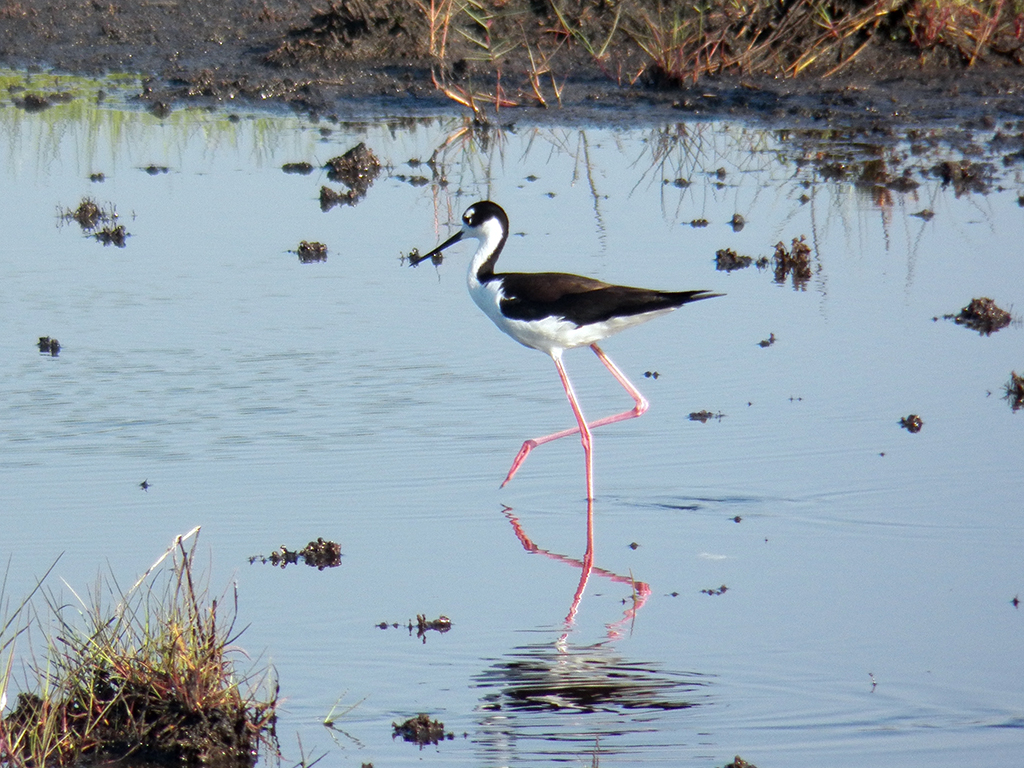
I had heard from Camille that there were nesting Black-necked Stilts along this drive, and I did see stiilts along most of its length, but they did not appear to be nesting. I don’t know the incubation period for stilts, but it was wholly possible they had finished nesting and were dispersed. If that was the case, I expected to see chicks, but at first I just saw adults.
There was the usual assemblage of herons and egrets, many of them just getting into their morning routines. One Great Blue Heron was standing, facing the sun, in an odd pose I have only seen one other time (and never quite this extreme). I know I haven’t seen photos of it before in my general searches and browsing.

I noticed quite a few small sandpipers in the mud and shallow water. I had heard a Killdeer or two nearby, so when I first focused on some of the browner birds, I thought I was looking at a few more; however, a closer look showed only a single breast-band and much smaller bill. These were Semipalmated Plovers, and I was quite happy to see these. I have limited shorebird identification prowess, and this is the first certain identification I have of this species (that’s a long-winded way of saying it was a lifer!). Curiously, upon closer inspection of the other small birds, I saw the yellow legs of Least Sandpipers, but then the black legs and stoutish bills of Semipalmated Sandpipers! Lifer number two (I never did resolve if the slightly larger “peep” from the Orlando Wetlands earlier in the year was a Semipalmated or a Western Sandpiper). I watched the birds running about for food and chasing each other around. They let out a collective series of avian epithets when an adult Bald Eagle flew by and landed in some taller vegetation.
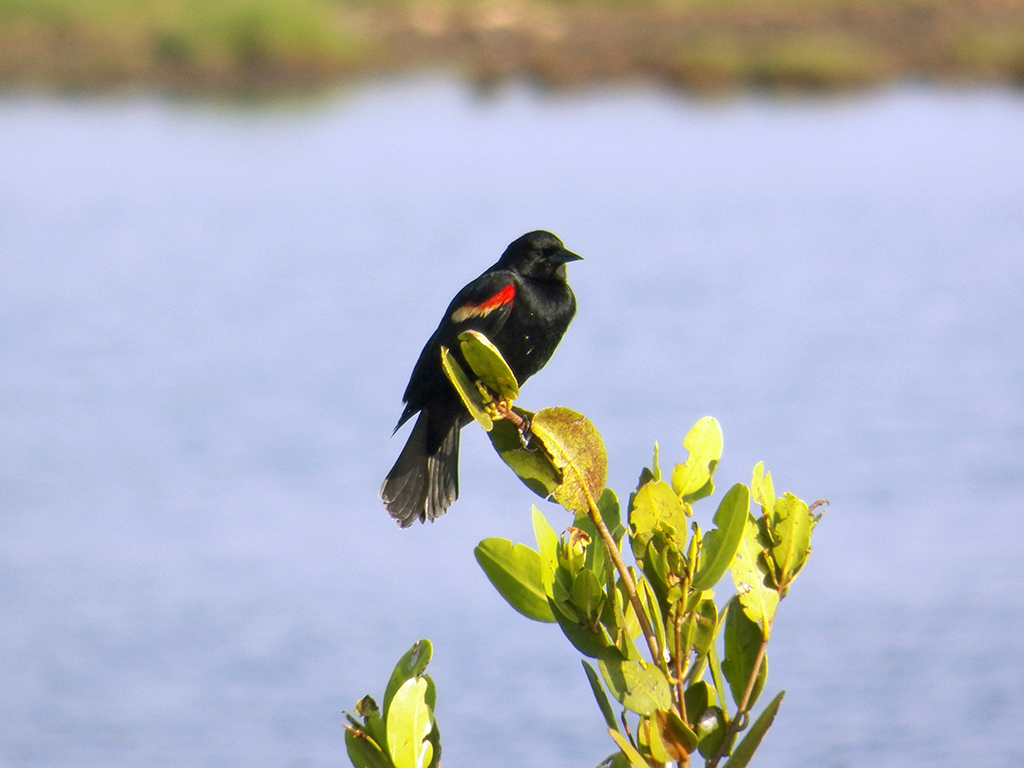
Aside from more egrets and stilts, the blackbirds were vigorously defending their terrtories and nests for each other and the occasional large bird (I saw both Ospreys and vultures being harrased out of the area). Both the Boat-tailed Grackles and the Red-winged Blackbirds were busy keeping threats away and singing, some quite close to the car.
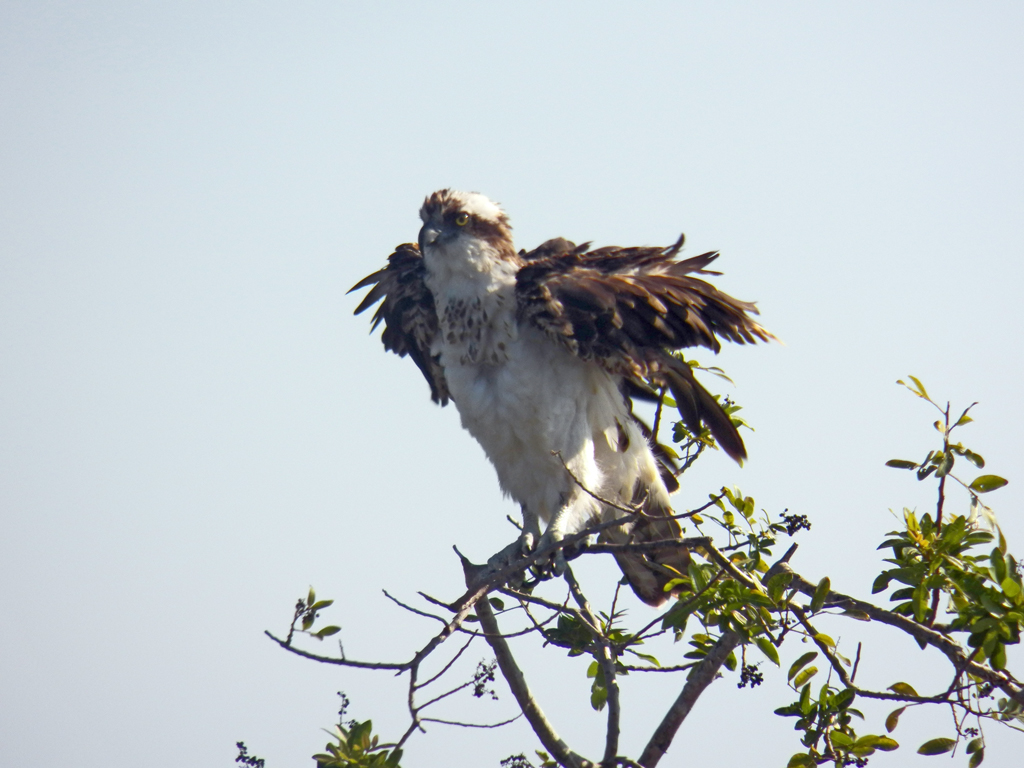
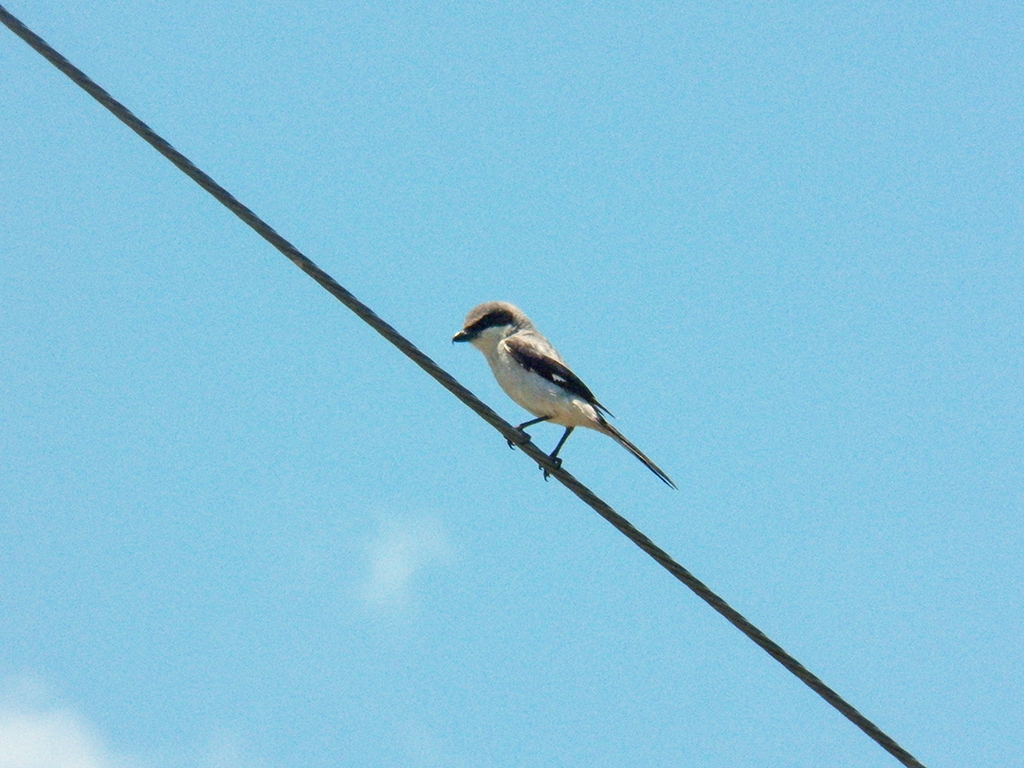
A pair of Loggerhead Shrikes really ruffled the feathers of an Osprey as they chased it so hard it almost dropped into the water! I saw it land on a small tree farther up the trail, where is stayed until I passed it several minutes later.
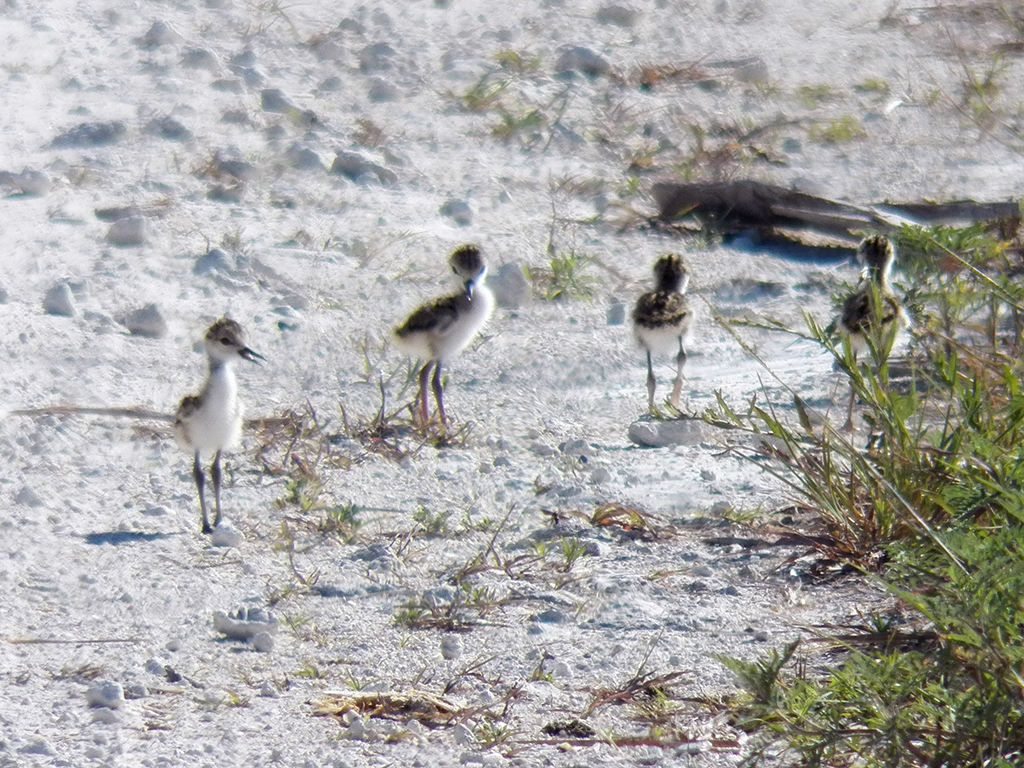
Farther up the road I heard some very loud Black-necked Stilt calls, and seeing 2 adults on the road in front of me stopped and slowly got out to take a photo. Right as I closed the car door, the birds went crazy, calling loudly and one of them doing a sort of wounded-flutter just above the road, legs dangling. I realized that there must be either a nest of chicks nearby, given the faux display (similar to what a Killdeer might do on the ground, feigning injury to draw away a predator).

There were four stilt chicks, walking the road. The parents got really worked up and after taking a few photos, I backed off and returned to car, apologizing and letting them be on their way. It’s very possible that many of the “dispersed” stilts I saw earlier had chicks nearby, but due to their coloring, size, and distance, I didn’t notice them.
Bird activity further long the road was sparse, and as I made my way toward the other end of the road, I started to encounter more vehicles coming the other way, most of them with fishing gear visible. At this point the road widened and I came back out of the main road, just west of Blackpoint.
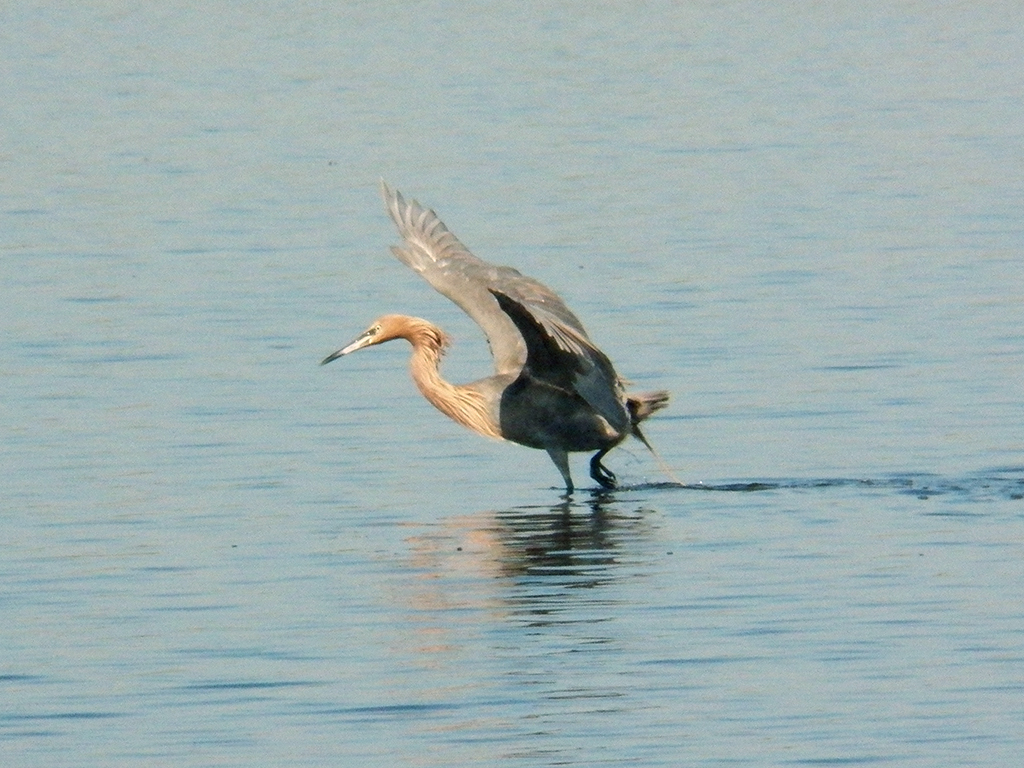
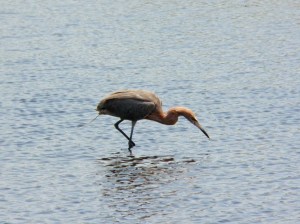
Blackpoint Wildlife Drive was quite devoid of birds, as it typical for this time of year. Except for the odd, small groupings of American Coots and Common Gallinules, there was nothing until I happened upon this Reddish Egret, dancing around to get its meal. This is the same spot I’ve seen a Reddish Egret during the winter, but I have no way of knowing if this is the same bird or not.
A bit further along the drive were a scattering of sandpipers and plovers, mainly Willets and Killdeer, with perhaps some other peeps mixed in, but nothing really close by to get a good look at, until this Glossy Ibis.

By this point it had reached late enough in the morning for the lighting to improve along Pumphouse Road and the potential for the Curlew Sandpiper, and whatever else might be close enough to grab with my binoculars.
The comments from the Brdbrain e-mail list indicated that views of the bird in question were just over a quarter of a mile down the road. As I stepped over the chain barrier onto the road I noticed a couple of birders ahead of me, both with scopes. I was clinging to a tenuous hope that maybe one of them would let me have a glance in their scope if they came across anything interesting.
The first two men were decidedly cool and almost clinical, so I didn’t feel very comfortable asking for a look in their optics. They scanned a flock of mostly Semipalmated Sandpipers, looking for the Curlew Sandpiper to no avail. Another man walked in and began setting up his scope. I think I recognized him from the Space Coast Birding and Wildlife Festival; he ran the Diceandra Scrub Sanctuary trip, I believe. He was quite friendly, and I thought he might be more friendly regarding the use of his optics.
Let me pause here for a short paragraph. It’s not that I feel entitled to others’ optics, it’s just that even a somewhat decent spotting scope is seriously out of my budget, and is likely to be for some time. Unfortunately, for any good looks at shorebirds or if something interesting is happening across a lake, it’s really tough with 8 power binoculars. It’s even tough with 10 power, to be honest. So the best hope that we scopeless folks have is to depend on the kindness of strangers (or any friends that are lucky enough to have procured a scope!).
All three men generally agreed that the mudflats and shallow water we were looking over had dried considerably since they’d last been there a couple of days before, and that the birds were therefore farther out and harder to discern.
I walked further up the road, scanning the two main groups of shorebirds just in case I caught a hint of reddish head and breast that might indicate the Curlew Sandpiper’s presence. Meanwhile, I got some good binocular looks at some of the smaller plovers and sandpipers that were venturing closer to the road.
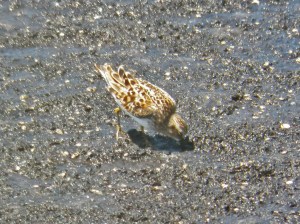
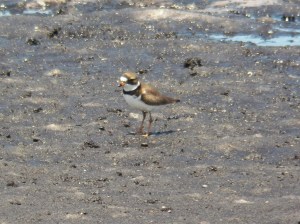
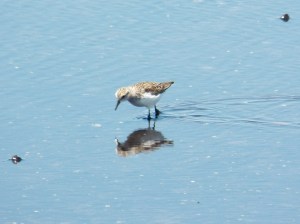
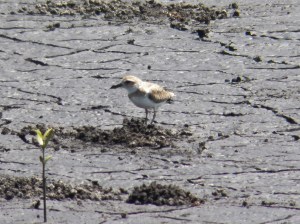
There were also some Willets, Greater Yellowlegs, quite a few Dunlins, Killdeers and even a single Piping Plover in the area. I walked back to where the men had been scanning with their scopes, but they had all departed while a few more people with scopes were coming in. I milled around and talked a bit with them about the Curlew Sandpiper and what other birds were present. I asked one couple if they saw anything of interest, would it be ok to have a look in their scopes. They said yes, they’d be happy to share, so I watched the nearer birds for a while. They finally had the scopes on some birds of interest (no Curlew Sandpiper, though) and I had a look at some American Avocets, more Reddish Egrets, a Black-bellied Plover and, a first for me, a Stilt Sandpiper.
By then it was getting hot and it was past lunchtime, so I headed out. On the way, I passed some more egrets.
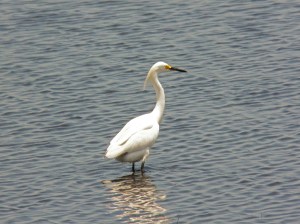

I took brief look overhead on my way the car and saw a mix of vultures, Wood Storks, and American White Pelicans soaring on an early afternoon thermal. The pelicans had brown primary feathers, so I believe they were juveniles. With that, it was time to head home.
Here is a list of the 53 species I identified, roughly in the order in which I saw them:
It turned out to be a pretty good day, even without a Curlew Sandpiper. It turns out that no one saw it at all that day or since. Such is the way with migrants. I can’t complain, though. I saw a good mix of beautiful birds, talked with some nice people, and enjoyed a great morning out.
I’m working on a blog update, but it’s been slower going than I expected. In the meantime, enjoy this teaser photo of some really cute Black-necked Stilt chicks! Like ducks, geese and cranes (among others), stilt chicks are precocial. They hatched with down, open eyes, and could leave the nest within a couple of days to forage with their parents (who they will rely on for protection and learning through the summer). In fact, stilt chicks have been observed swimming within hours of hatching!
Here’s a (slightly wavery) video of the Pileated Woodpecker chicks getting their breakfast from their dad. These chicks’ punk-rock mohawks will grow into the handsome crests as they get out of the nest and mature this spring.
It’s always an interesting balancing-act for me to decide where to go birding. I like to vary my experiences, but the (very) amateur scientist in me likes to see the changes in the same location over time and under varied circumstances. In the end, I wind up visiting the same places many times each year, sprinkled with the odd foray into somewhere new (or at least less visited by me). As this weekend approached, the decision seemed to come down to either Lori Wilson Park or Turkey Creek Sanctuary. Camille and I actually talked about it a bit, wondering if either one might prove more fruitful than the other. It remained up in the air until late Saturday when I decided that Lori Wilson Park would be a good place to start. If things were too quiet there, there would still be time enough try something else. At that time I was thinking Turkey Creek again.
I met up with Camille and it turns out that, yes, Lori Wilson Park was very quiet. Phyllis Mansfield was there, talking with 2 men who were staking out the small water feature (optimistically referred to as “the pond”) with it’s dripping hose. This is actually a good bird attractant, but this time there were only some Mourning Doves and House Sparrows in the vicinity.
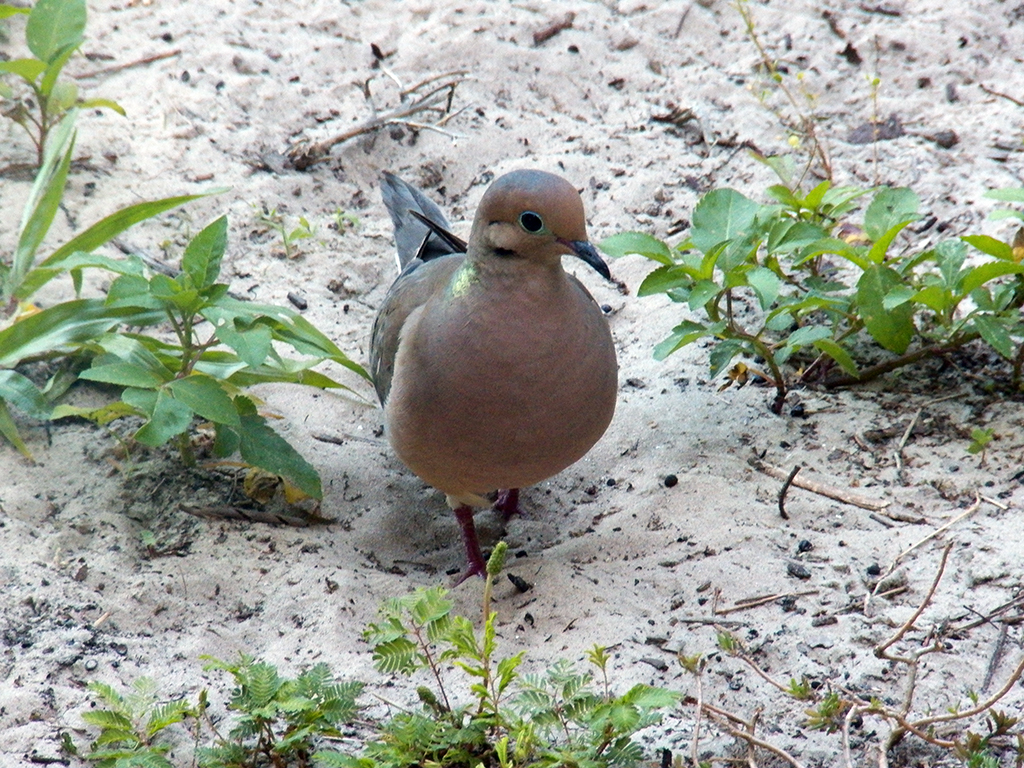
On the boardwalk loop, the park was dominated by white butterflies. There were dozens of them all over. I caught a couple of very brief glimpses of two Ovenbirds, and we heard and saw several Common Yellowthroats. Of course the Northern Cardinals were ever-present, and as we got back to the entrance/exit a bit later, we did see some Common Grackles, a single American Redstart, and a Gray Catbird near the pond.
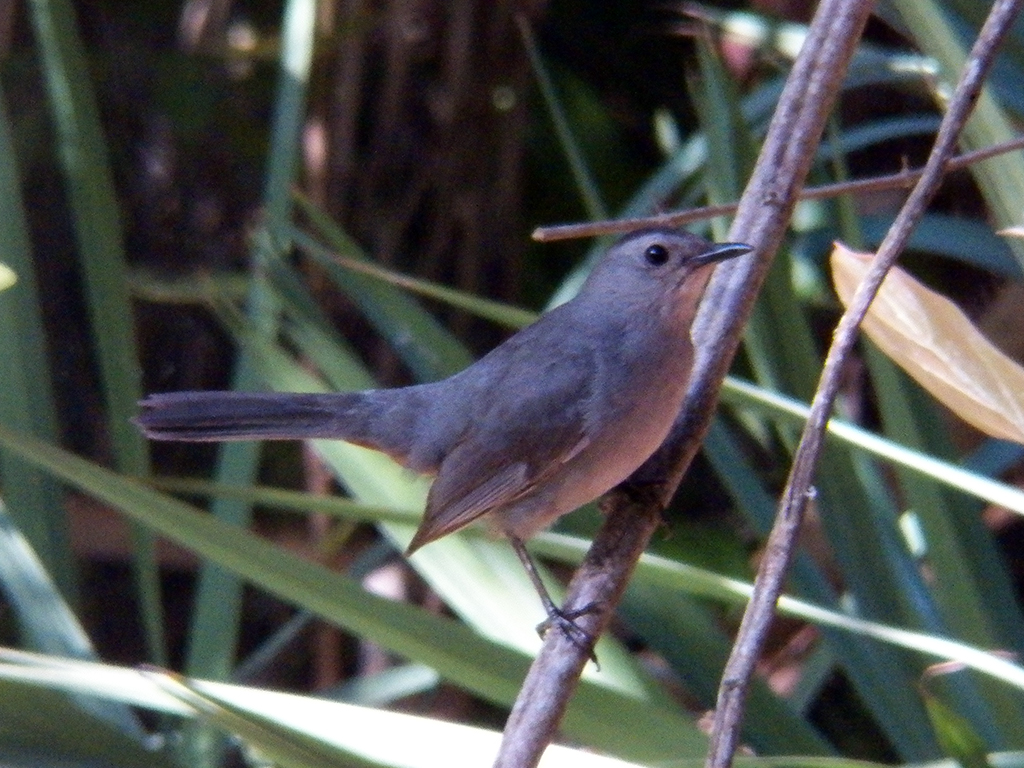
On the way out we flushed a couple of Palm Warblers and watched some Northern Mockingbirds go about their day. There were some Brown Pelicans flying overhead as we decided what to do next. With Lori Wilson Park so quiet, the prospects for Turkey Creek Sanctuary seemed bleak. I thought maybe trying something new might spruce the morning up a bit and we could head to the Helen and Allan Cruickshank Sanctuary. As a scrub preserve there was bound to be some Eastern Towhees (which for Camille would be a life bird) and who knows what else. At least the Florida Scrub Jays would be a pretty sure bet.
Here’s the list of birds seen and heard at Lori Wilson Park, including the parking area:
We arrived at Cruickshank about 20 minutes later and walked to the trailhead. The southern part of the sanctuary had been burned fairly recently, but it was growing in nicely. We quickly had our first birds of the day: some very inquisitive Florida Scrub Jays! I know in the past that visitors often would (sometimes at the encouragement of the sanctuary’s caretakers) feed the jays peanuts. They would land on people and even eat out of their hands. This is strongly discouraged now, but as these birds still seem want to land on people, I have to wonder if people aren’t still feeding them on the sly. I know that as recently as a couple of years ago the caretakers were still feeding them by hand. While it makes for great public relations (and fun photos!), the long term impact of this on the jays’ behavior isn’t clear.
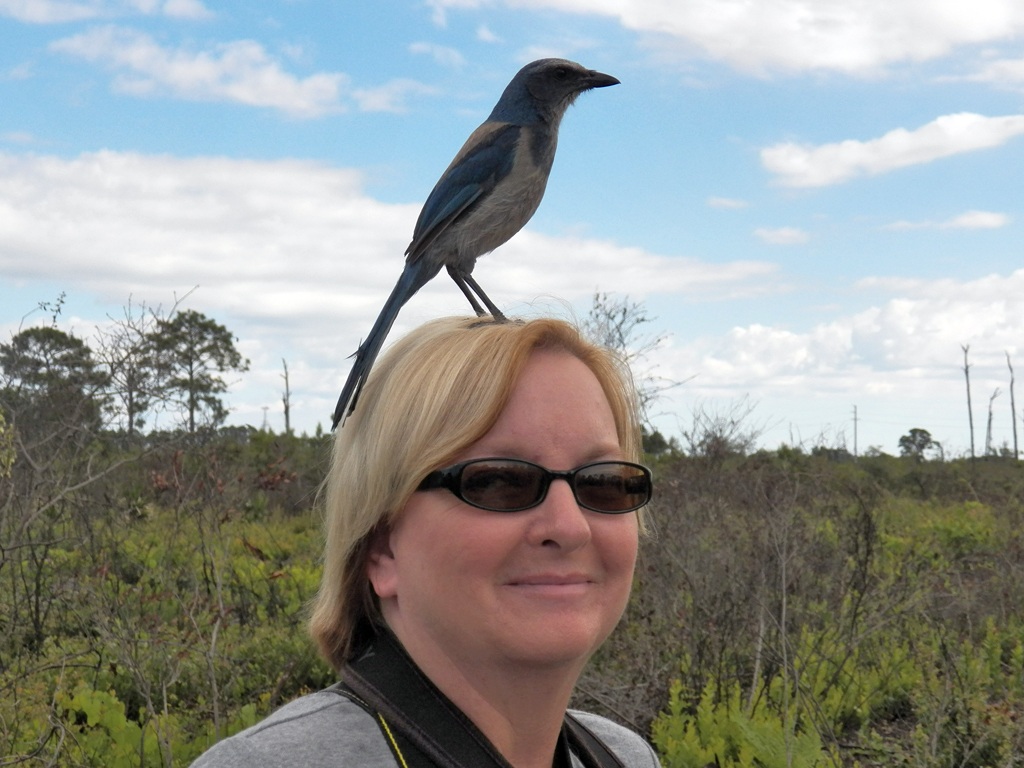
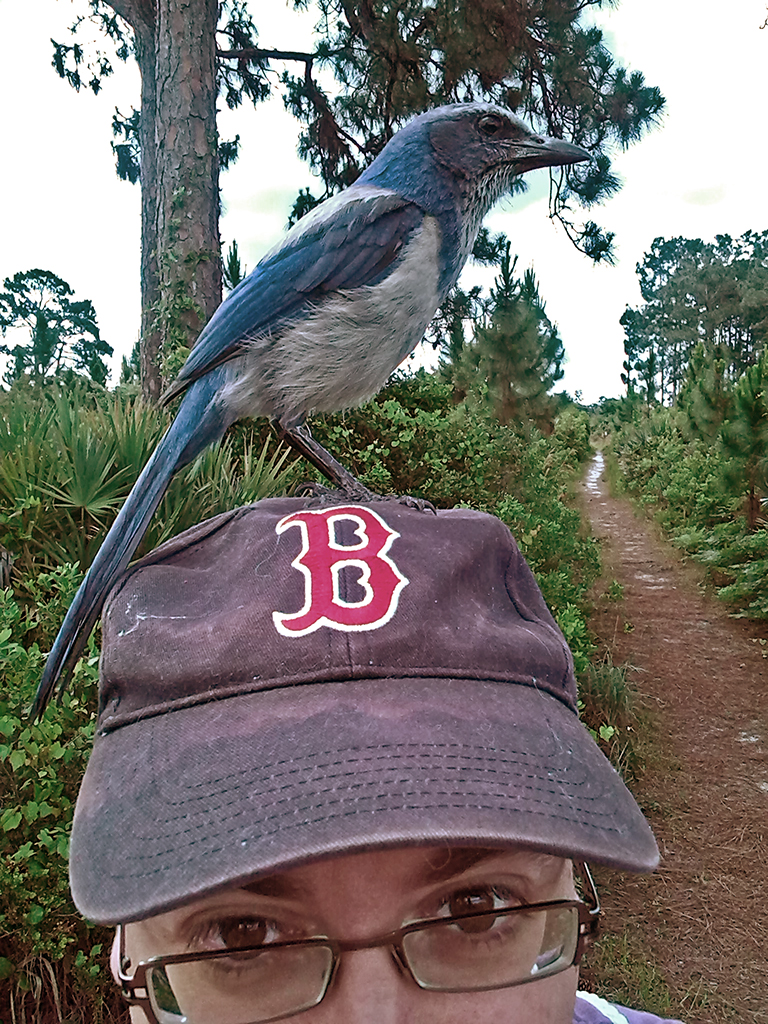
When not being fed peanuts (or stealing snacks from visitors’ pockets), these jays are omnivorous, feeding on berries, nuts (like acorns) and insects. I’ve seen them run down ants and catch bees in mid-air. After it became apparent we had nothing to offer them, the jays took to the ground, grabbing bugs and seeds in the dirt.
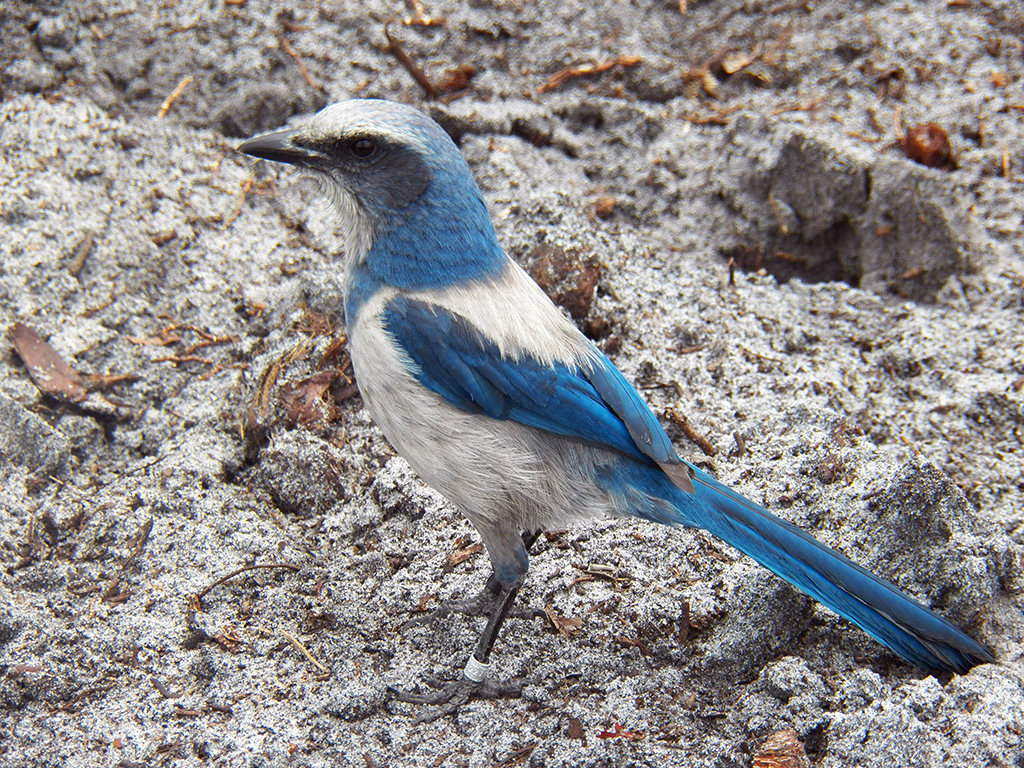
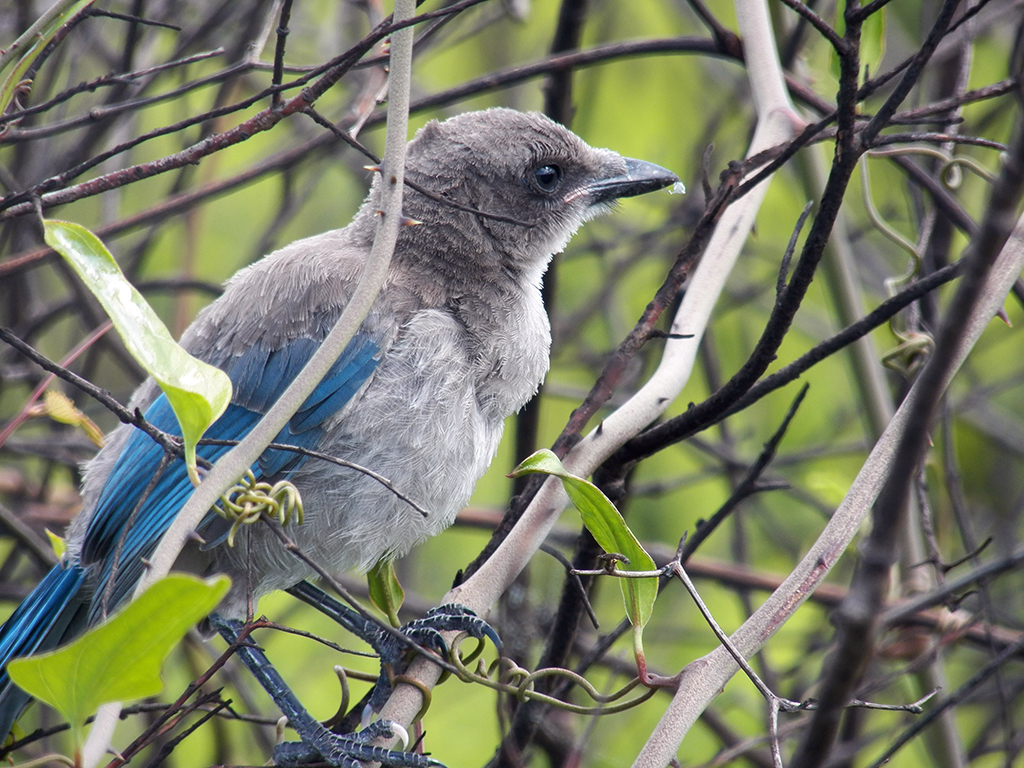
There were several fledglings calling and making short flights through the scrub. I’ve not seen scrub jay fledglings before and it was fun watching them try to navigate their world while family members looked on. These youngsters stayed very low in the vegetation and made only tentative attempts at crossing larger, open spaces.
As we progressed further in the sanctuary, we could hear Eastern Towhees calling to each other in the dense scrub. As we walked the 1-mile hiking trail I was hopeful we’d see some and add the bird to Camille’s steadily growing life list. This is when we had our first surprise of the morning. A Northern Bobwhite was out in the sunshine by the edge of the wider dirt path, singing while in his best breeding plumage. We heard a few of them throughout the sanctuary, but only this one stayed out long enough to get a good look at. This was a life bird for Camille, and one that I had not anticipated.
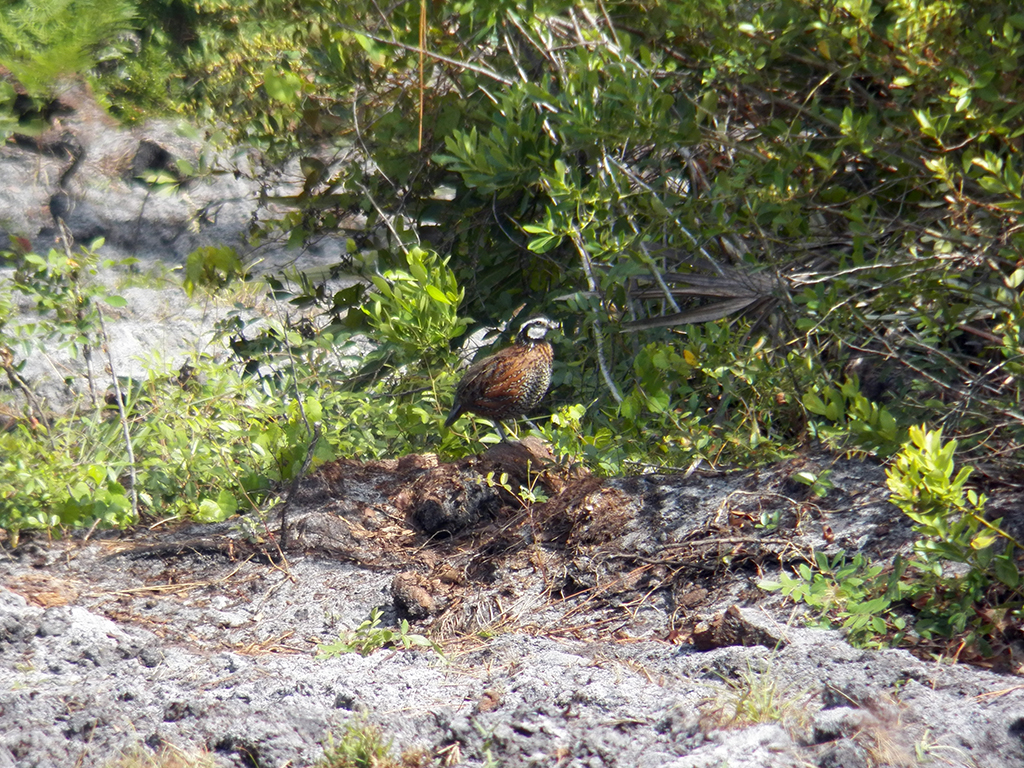
As we made our way along the trail, we finally did track down a singing male Eastern Towhee, while many others called nearby. Some swallows overfly us, too and I was confused because at first I thought they late-lingering Tree Swallows. In the end, I think they were Bank Swallows but I never quite got a good enough look at their throats to be sure. There were a few Barn Swallows as well (another Camille life bird), and at least one Purple Martin. One lone Sandhill Crane also flew overhead at one point, and there were several Anhingas soaring nearby.
As we approached some large, dead, oak trees, some very raucous calls started coming from one. A Pileated Woodpecker had landed next to a large, oval hole. Then, we had our second surprise of the day!
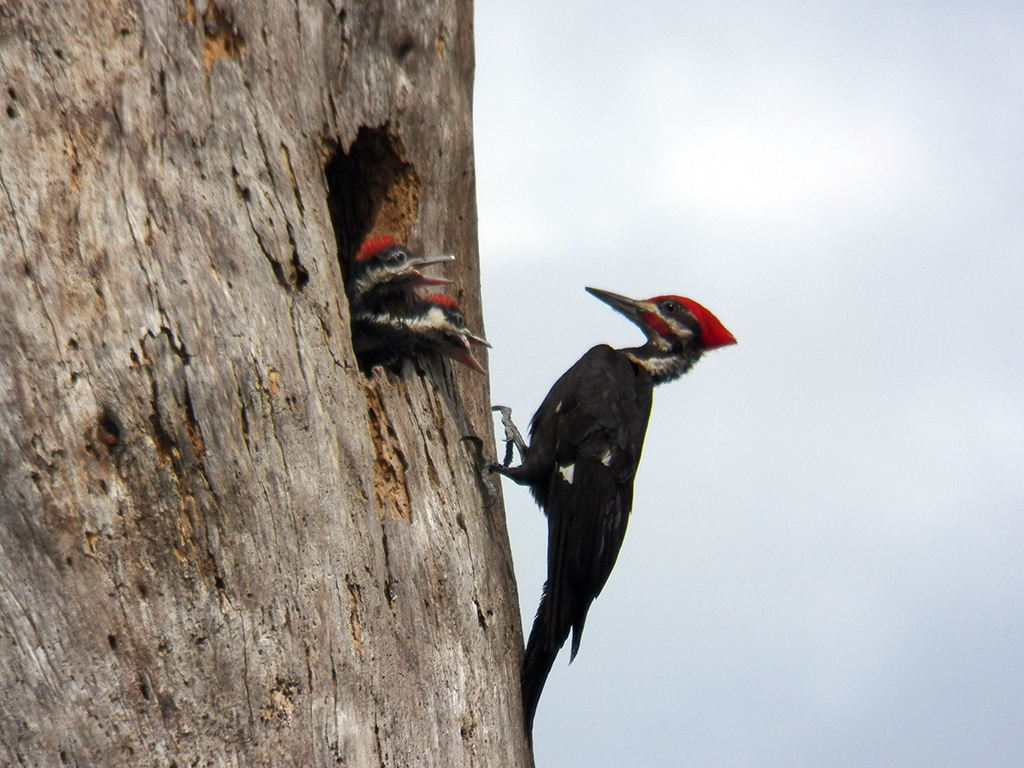
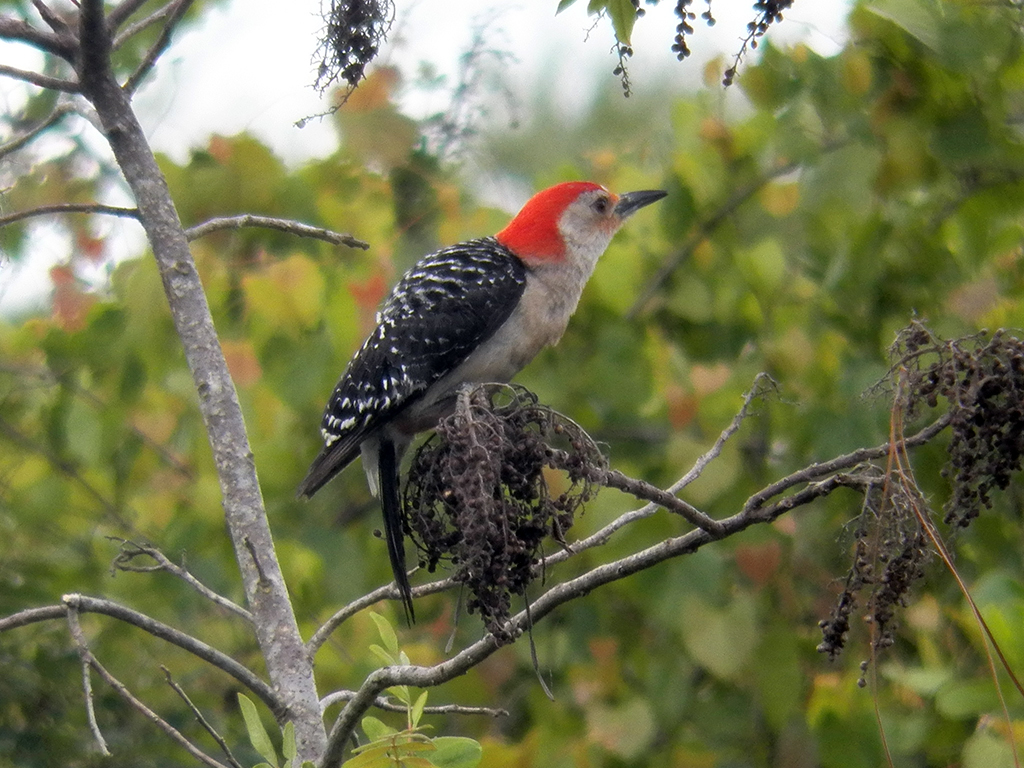
In addition to the Pileated Woodpeckers, two other species of woodpecker were present. Red-bellied Woodpeckers are fairly ubiquitous, but this one was foraging more like a chickadee. Just before the next photo was taken, it was swinging upside down under that tangle of seed pods.
We also had one of an apparent pair of Northern Flickers stop in a nearby tree. We could hear them clear across the sanctuary for a while before one finally came close enough to get a decent binocular view of. Flickers were always very common in my back (and front) yard as a child, and were a staple find in my early biding years. They are less common around my usual birding spots now, so it’s always a pleasure to hear or see them.
After that, we headed toward the parking area, stopping to watch the Scrub Jay fledglings again and have some more birds land on our heads. Florida Scrub Jays are scrappy little birds, and I am glad we’ve set aside some sanctuaries for them. My hope is that we come up with a better development and land-use strategy in central Florida to manage our scrub habitats and let the population roam and expand.
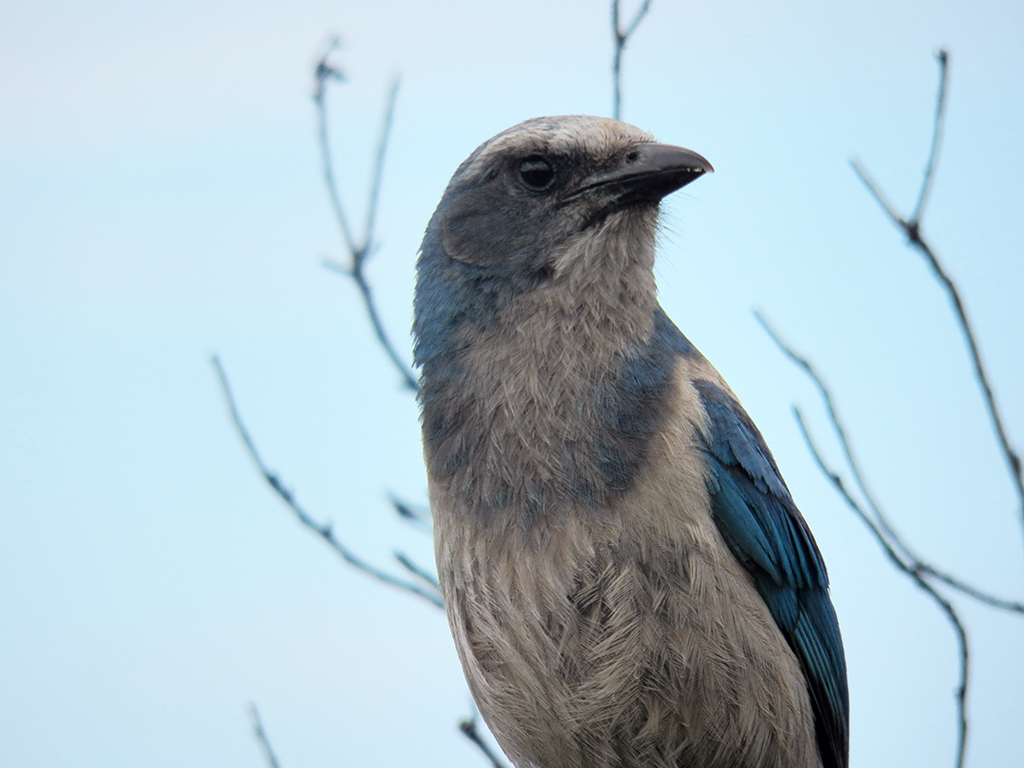
The total species list for the Cruickshank Sanctuary:
It turned out to be a pretty good choice, going to the Cruickshank Sanctuary. There are other less explored parks in the area I’m keen to visit. The normal migration season is beginning to wind down now. There will still be some birds moving through the rest of the month, but then the Space Coast and nearby areas will get into its usual summer regime. I’ve got some hopeful adventures planned for the summer. Let’s see how they pan out.

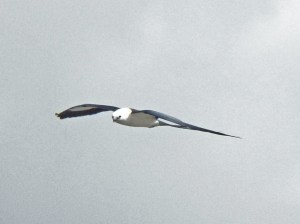
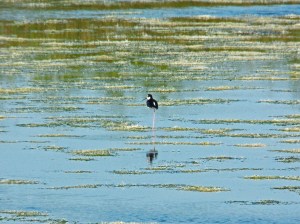
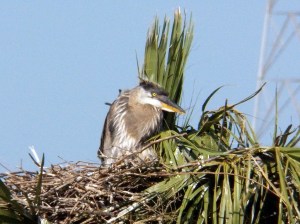
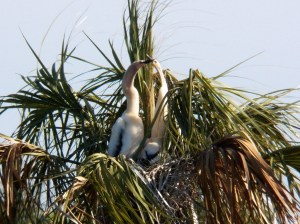
Here are a few outtakes from some recent outings near my work and at the Ritch Grissom Memorial Wetlands in Viera, FL.
With some better reports coming in from along some parts of the Space Coast, I thought it might be a good time to return to Turkey Creek Sanctuary. The better forecast for migrants is for later in the week, but the winds have been out of the south for the past few days, making for at least some marginally good conditions. I met up with Camille again and we set out along the Sand Pine Trail on our way to the boardwalk where there are generally reliable sightings.
Aside from the usual Northern Cardinals and Carolina Wrens singing up a storm, we did encounter a decent sized, mixed flock of Black-and-white Warblers and Blackpoll Warblers, mostly high in the pine trees. Since different warbler species often associate with each other, we gave this group a really good look to make sure we weren’t missing any other species before moving on down the trail. The flock more-or-less followed us along the trail, but we didn’t see much else. I could hear Chimney Swifts above us, but never got a good look, and there were Blue-gray Gnatcatchers nearby as well.
We got to the boardwalk to an area where Camille (who had run into Bill Haddad last week) had seen some warblers, and is known to be a pretty good hot-spot. At first we didn’t see to much, but then we heard some gnatcatchers (often a preamble to warbler or vireo activity). Sure enough, we wound up with a nice group of Blackpolls, Black-and-Whites, American Redstarts, and even a Black-throated Blue Warbler!
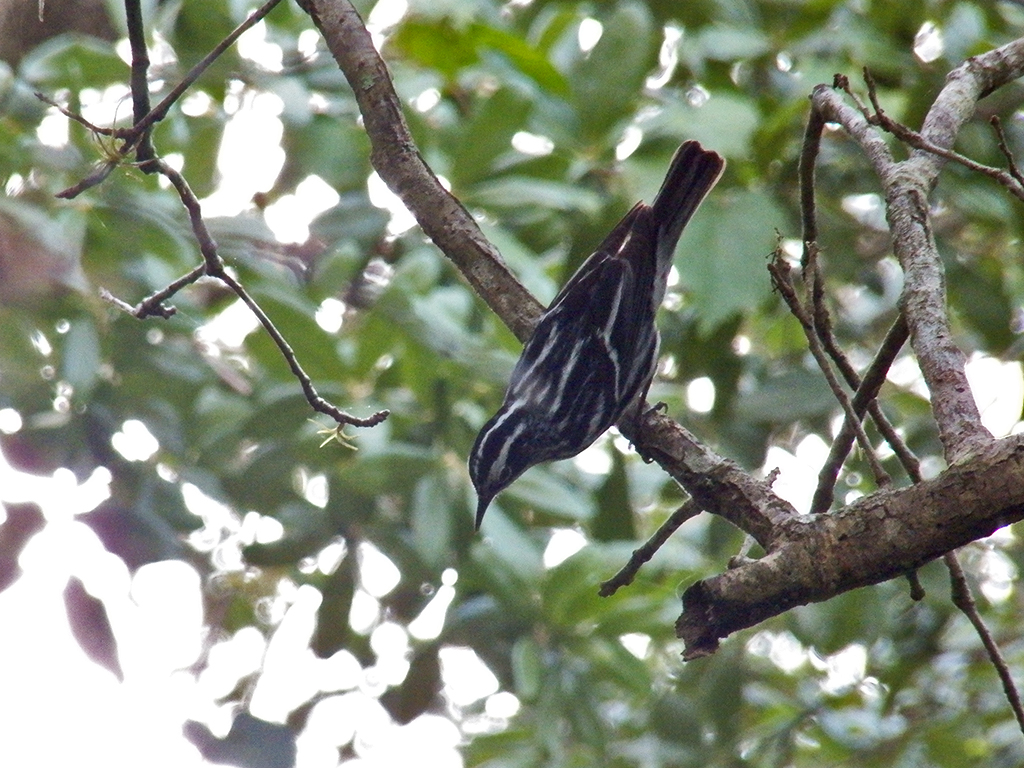
Sometimes it can be hard to distinguish the Blackpolls (especially the females) from some other species when the birds are in the canopy or in poor light (most of the birds we saw were very backlit). A key identifier for Blackpoll Warblers is their orange feet.
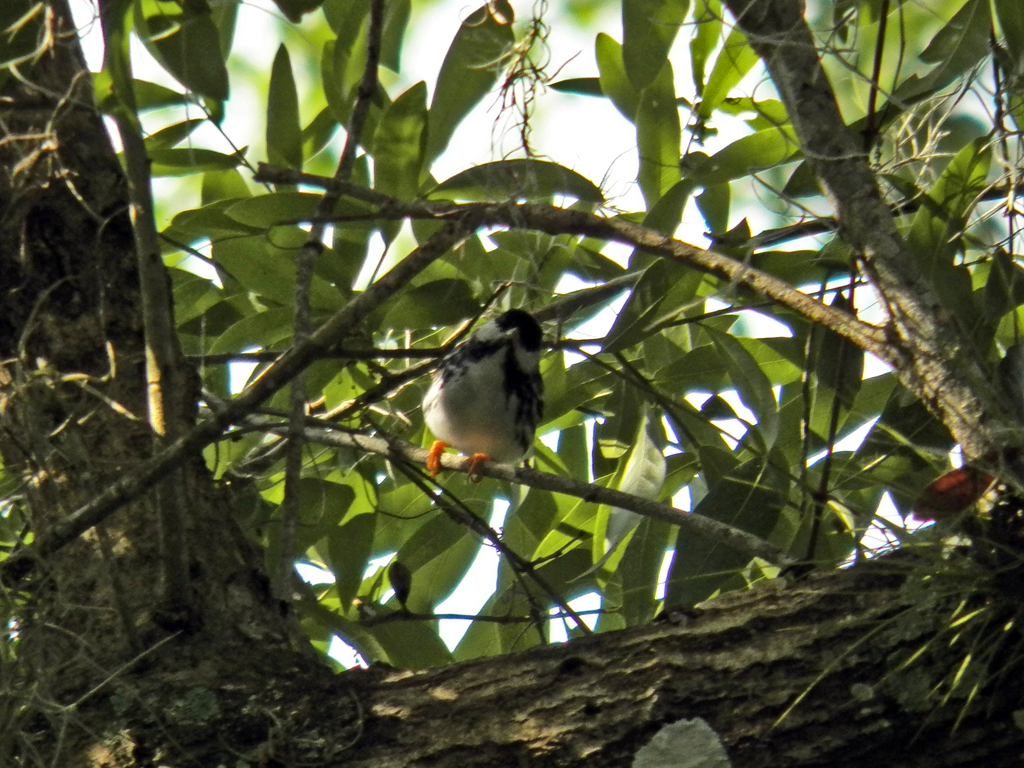
Female Blackpoll Warblers lack the dashing black cap (or “blackpoll”) of the male, but they have a pretty olive-yellow tint and subtle streaking. Again, those orange feet are a good field mark to differentiate the females from other, similarly colored birds.
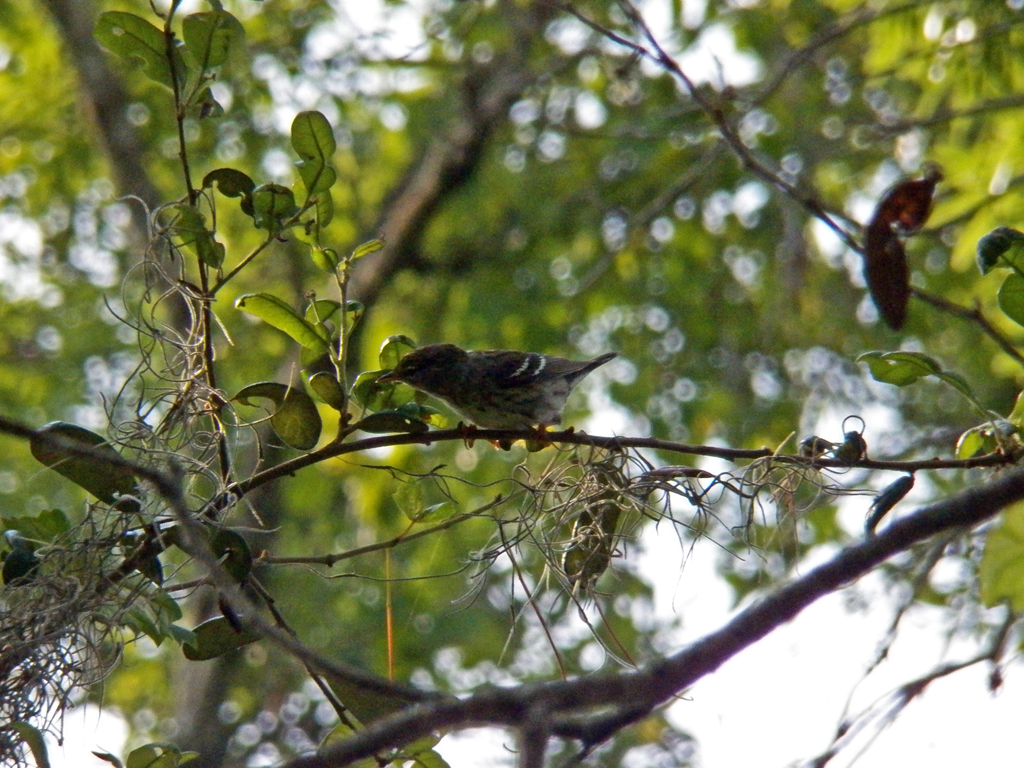
Most of these birds were engaged in three types of foraging: creeping, gleaning, and flycatching. Creeping is when birds walk along the bark of a tree trunk or limb, grabbing small invertebrates as they move along. When birds hop or walk from branch to branch or on twing, reaching up or across to grab food, that is gleaning. Flycatching, of course, is what just what it says: the bird will dash out from a perch to grab a flying insect from mid-air, often performing stunning aerial acrobatics to do so.
Along with our “monochromatic” friends (being mostly black and white), this flock of birds had a fair amount of American Redstarts among them. Redstarts are fun birds. The males are strikingly black and orange colored and they constantly flutter about, drooping their wings and fanning their tails. They will often drop off a branch and flit down, like a falling leaf, only to swoop back up and start again. The females are just as active as the males, though their colors are a little more muted (olive-brown and yellow).
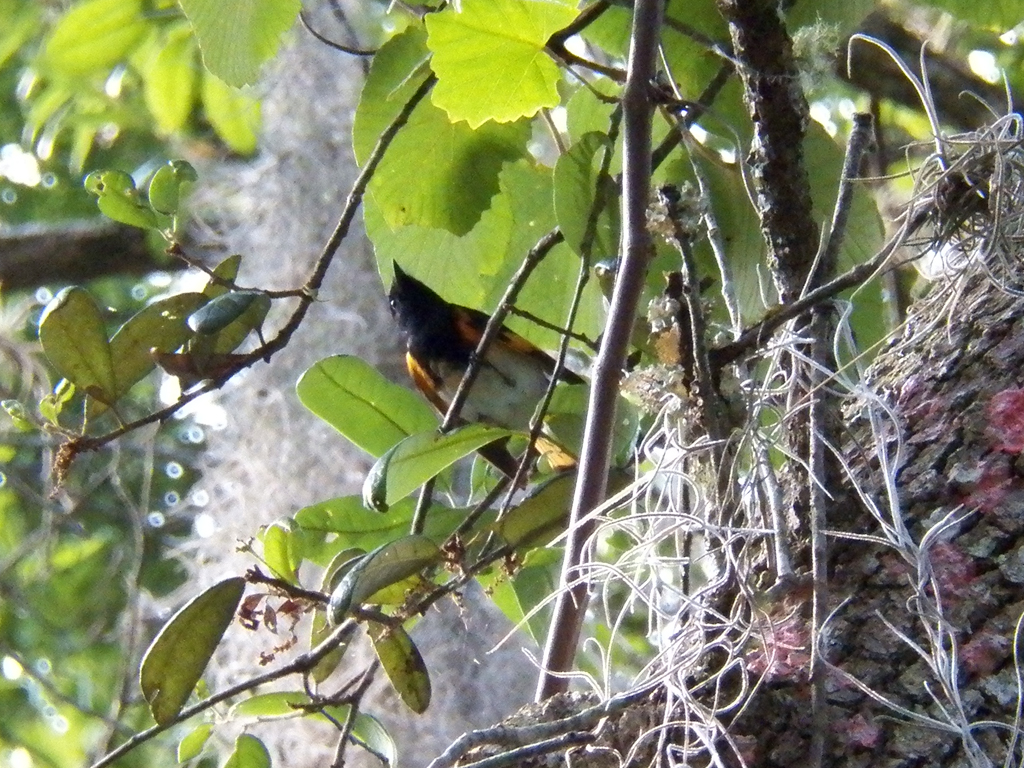
The overall effect of these three species moving through the canopy was one of almost dizzying chaos. It was hard to know where to center the eyes, binoculars, or camera. There was at least one Black-throated Blue Warbler among them, but it was hard to know if any more were in the melee of feathers.
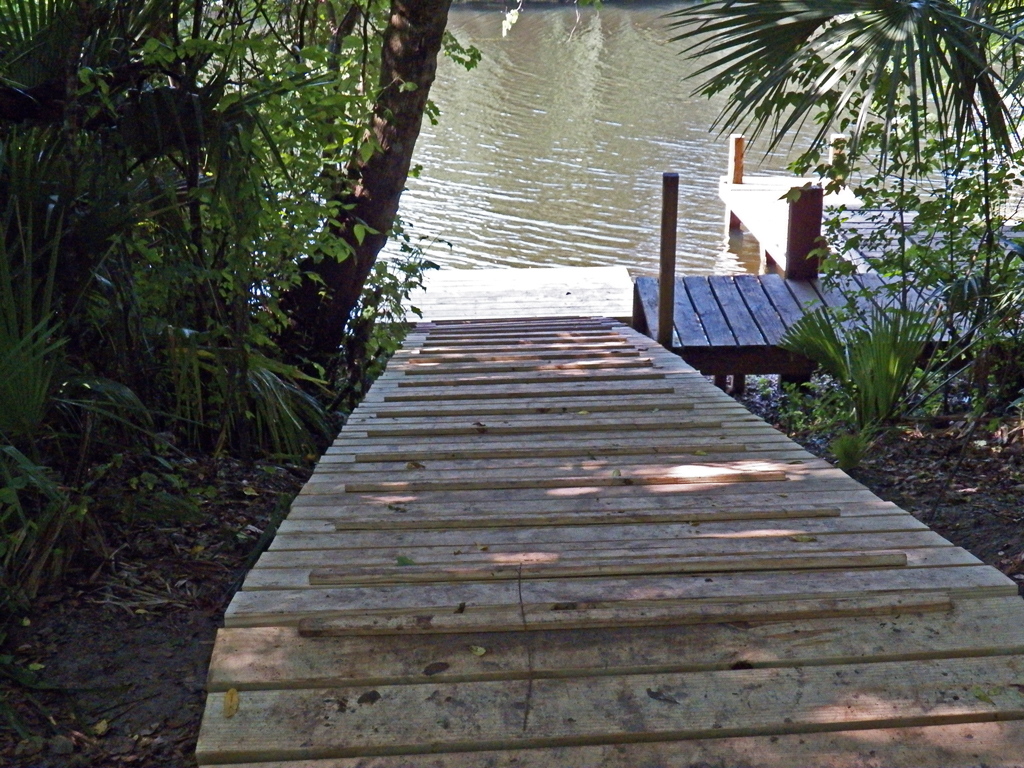
It was fairly quiet further along the boardwalk and onto McKinnon’s Way. We would hear some high-pitched calls here and there, but it was difficult to see much in the canopy. I got a glimpse of a Blue-gray Gnatcatcher, and we picked out a few more Blackpolls, but that was mostly it, until we got to the weir. First, I had a look at the “emergency” boat ramp. If you remember from last time at Turkey Creek, the high waters had likely removed the ramp’s deck (which was a bit rotted anyway). Repairs have been made, and there’s even a new platform at the base of the ramp.
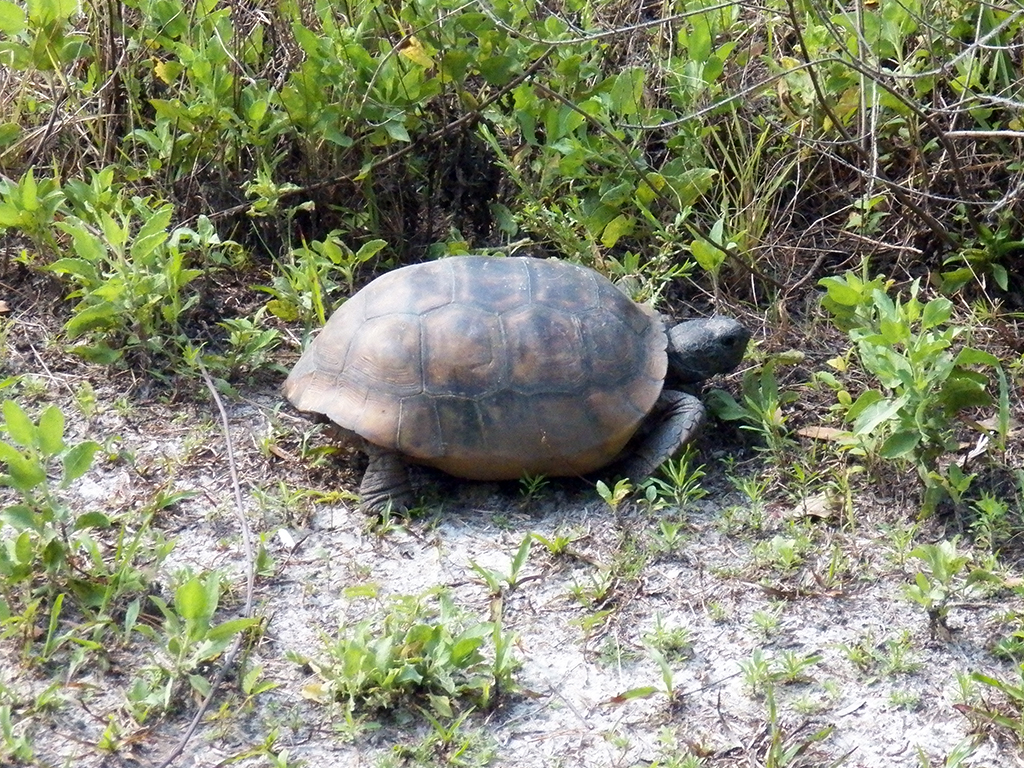
As we came out of the woods, we saw some movement along the trail up ahead. There was an overturned Gopher Tortoise! I quickly walked up and turned it upright. It didn’t hiss all that much and walked on its way.
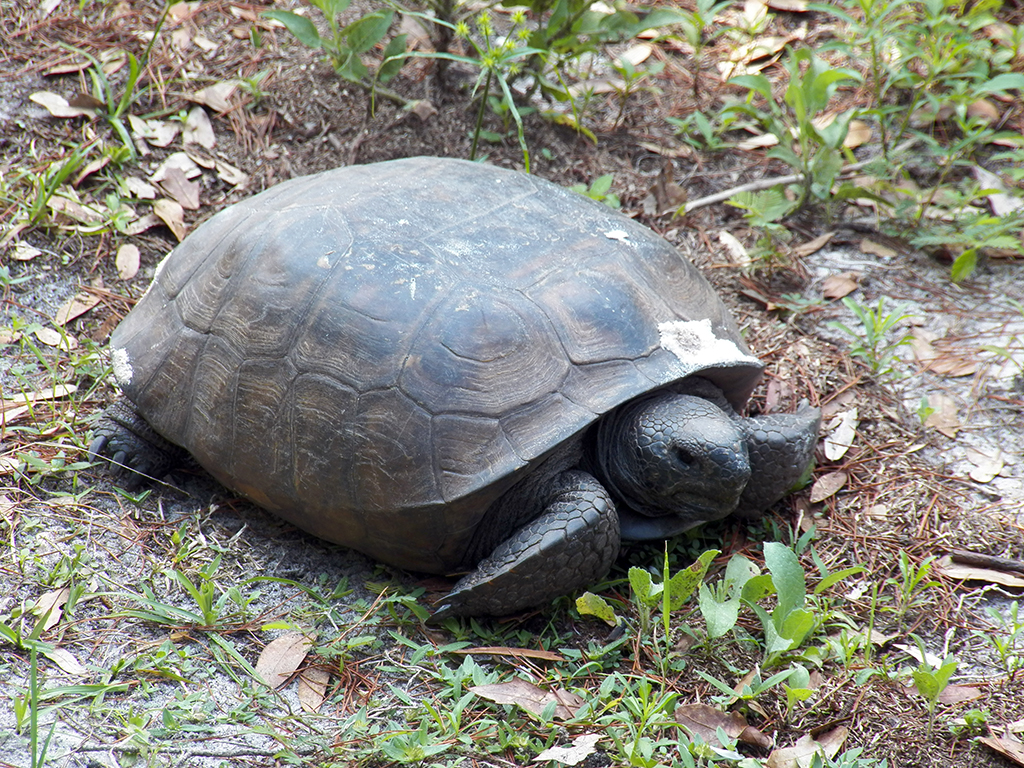
There was a larger tortoise further down the path, and Camille wondered if maybe they had a tussle or mating encounter that went awry (at least for the first turtle). I actually recognized the second tortoise from it’s shell markings and size, which was kind of cool.
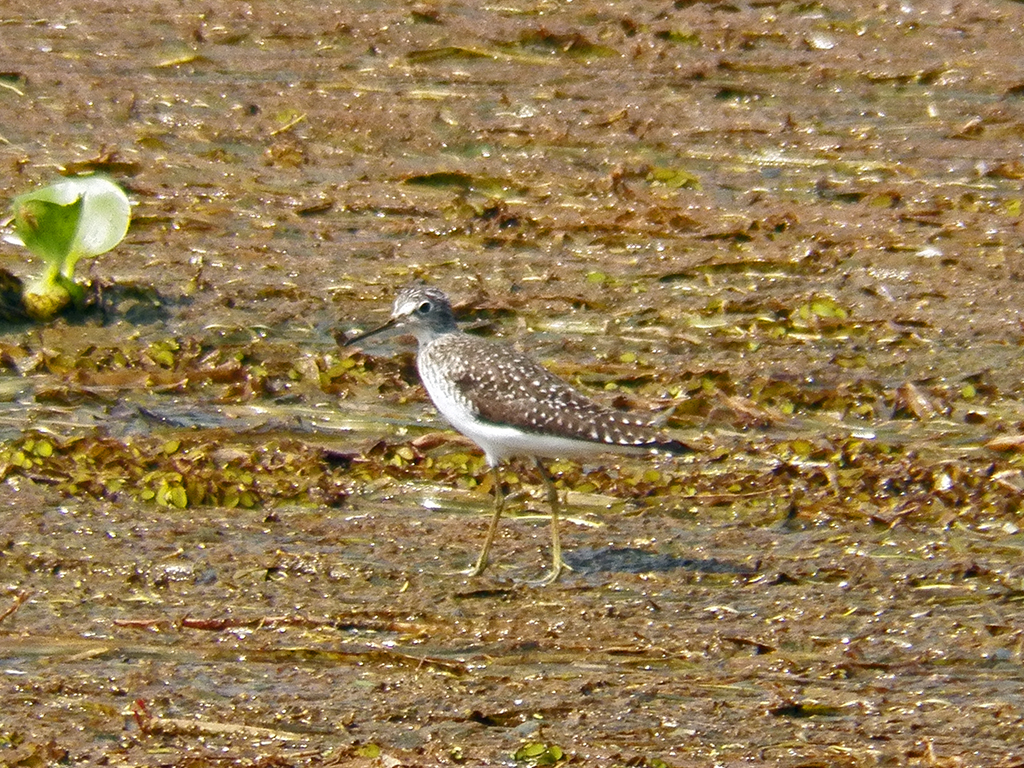
At the weir there were 2 spillways open, since the water was still somewhat low on the canal side. At first the area behind the orange float barrier seemed completely bird-free, but upon closer inspection there was a single Killdeer, one Green Heron, and then a lovely surprise. A pair of Solitary Sandpipers! This was another life bird for Camille, and a first of the year for me. I’ve actually encountered this species before, along the trail leading to McKinnon’s Way from the boardwalk. It was odd that they were so far into the wooded trail area, and i don’t know if this is the same pair or not.
With the day wearing on and the heat climbing, it was about time to wrap things up. We walked back up the western side of the Sanctuary, past the Scrub Trail, to where there are sometimes Indigo Buntings or vireos, but it was really quiet. We had one more look at some Blackpoll Warblers before heading on toward the Picnic Pavilion and then out.
Overall, it wasn’t a bad day for birding, especially given there wasn’t any special fall-out event or anything. Clearly Blackpolls and redstarts dominated the Sanctuary this weekend. What we didn’t see in species variety was more than made up for in the numbers of warblers. Here’s the species list in no particular order:
The weather forecast calls for potential fall-out inducing conditions early this week, but not so much for the coming weekend, so we’ll see how that pans out.
[My apologies – this post is late and delayed due to a really bad head cold I am just now getting over]
In contrast to the morning at Meade Botanical Gardens, the second part of our day was a lot quieter. After some lunch at Einstein Bros. Bagels, we drove over to the Lake Berry Overlook. The boardwalk out to the overlook is in a very posh neighborhood, and just gawking at some of the homes could be a daily hobby. Our hope was to see a Red-headed Woodpecker that has been reported on eBird. The boardwalk traverses some nice transitional vegetation, and we could hear Northern Parulas and cardinals along its length. Toward the end there were several pairs of Red-bellied Woodpeckers, and we manged to glimpse three male Wood Ducks through the swampy trees and brush. At least one Red-shouldered Hawk flew nearby, as well as a raptor we didn’t quite get a good enough look at. It seemed to lack most of the obvious field marks for a Red-shouldered Hawk, but nothing definitive. Unfortunately, the Red-headed Woodpecker did not appear, though we heard some encouraging call notes. On the way back out near the boardwalk entrance some Chimney Swifts flew overhead, the first I’ve seen this year.
We continued on to the Harry P. Leu Gardens to try our luck there. Leu Gardens, as I’ve said, is more formal and organized that Meade. It has a membership structure and entrance fees to help pay for its upkeep and events. People often hold weddings and other formal affairs there. There are more exotic plants, with many paved paths. This was all very beautiful, but either a combination of the non-native vegetation and the heat, or just luck of the draw, we didn’t see much in the way of birds (and certainly warblers).
We did see some activity along the chain-link fence by the parking lot. At first I thought they were Worm-eating Warblers, but a closer look was cuter!
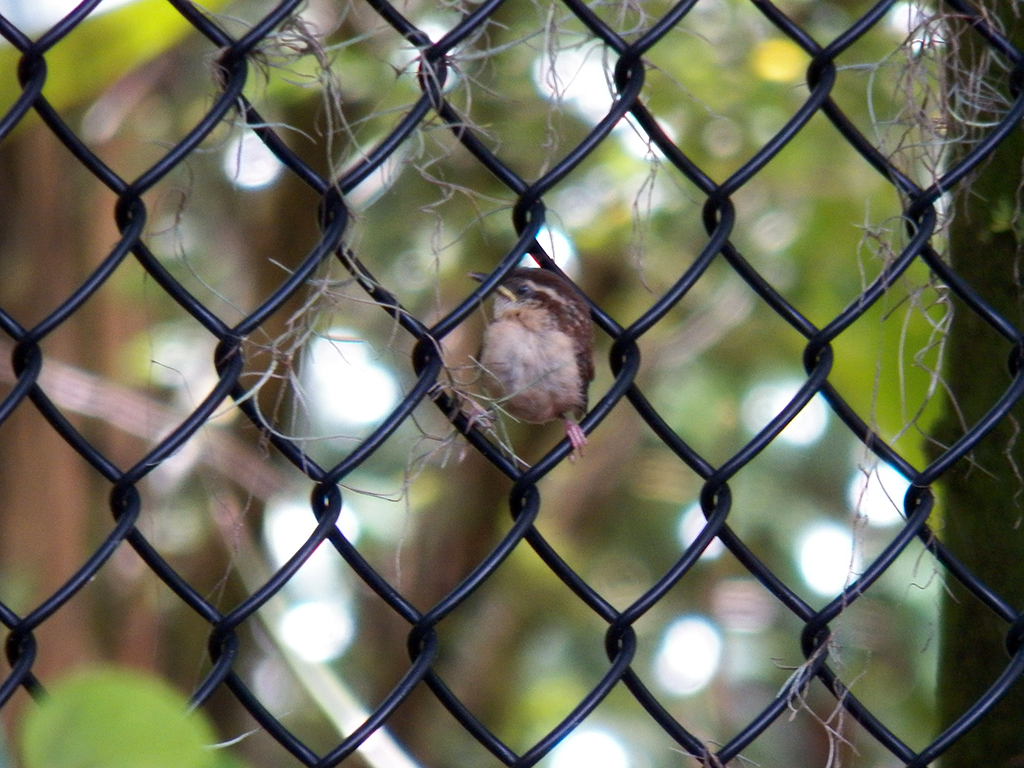
Apart from that, we did see a few larger birds, like crows, Anhingas and even an Osprey. We tracked a Northern Parula through the canopy for a while before getting any sort of decent look. Otherwise, despite the beautiful surroundings, we were getting tired.
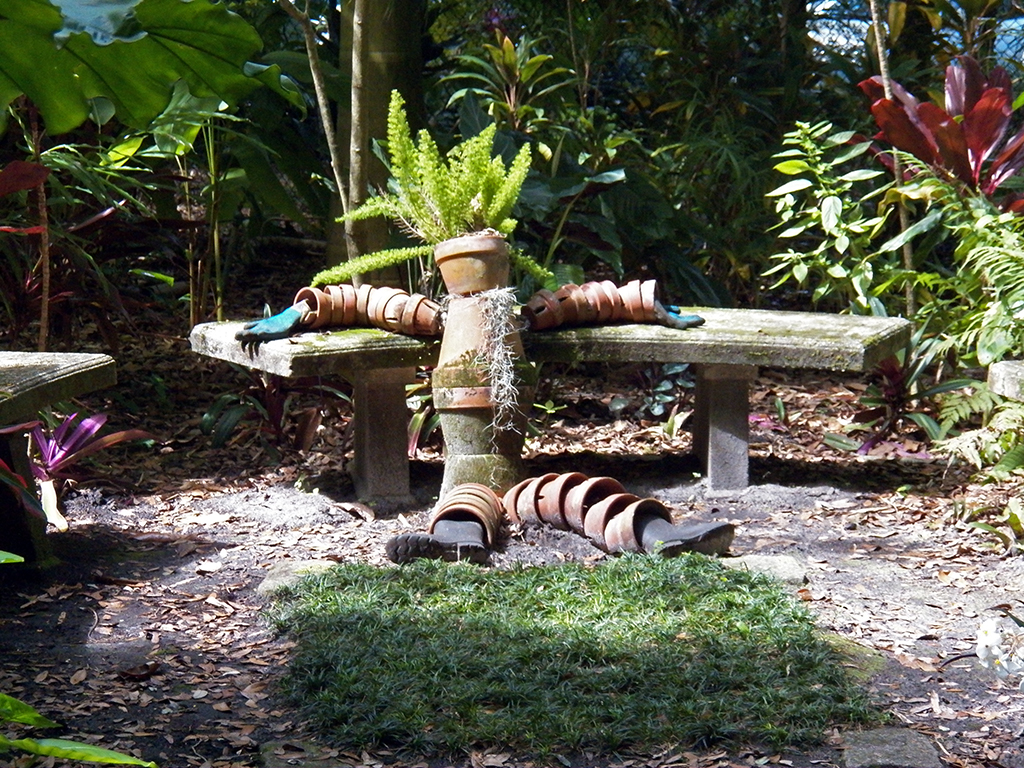
There were a few more whimsical garden areas, too. This “pot head” was definitely a work of art, with some butterflies nearby and Blue-gray Gnatcatchers singing in the trees above.
And that was our day out at Winter Park. For any “score keepers” out there, we can round out our afternoon species list:
My apologies for the delay in getting this out. Spring head colds are the worst!
Hello, Lonely Birder Blog Fans! My apologies for the lack of updates (especially after Part 1 of my Winter Park adventures with Camille), but I’ve been sick since Thursday. I hope to get caught up this week.
 Lonely Birder