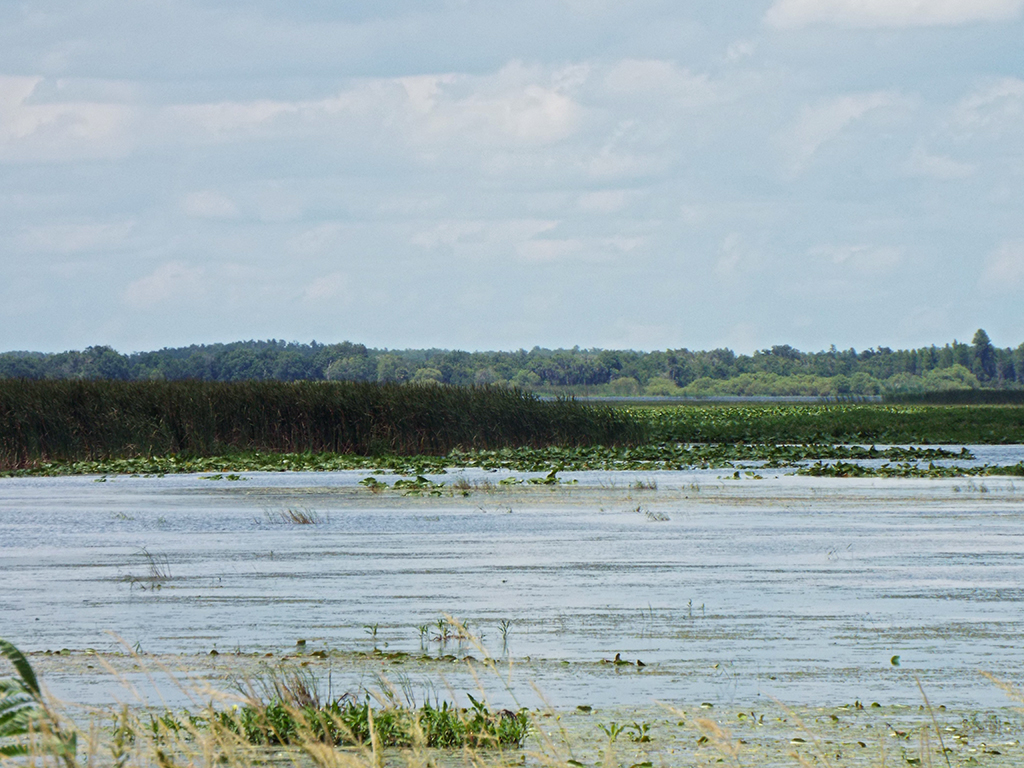
Some photos from this past weekend’s adventure to MINWR (Both Bio Lab Road and Black Point Drive). I had never been on Bio Lab Road before, but it looks to be a good place for shorebirds and waders, much like a lot of Black Point Drive.
While both locations didn’t offer the best photographic opportunities, the birding was good, and I did finally to manage to get my first Spotted Sandpipers of the year.
There was a duck on Bio Lab Road that was hard to ID at first, but was also maimed, with his right wing partially missing. I had to do some digging and questioning (thank you Brdbrains!) to positively identify him, but it seems this is a Ring-necked Duck drake that had been injured in the early spring and has been cruising around all summer. I was glad he seemed healthy and I am sure he’ll be happy to see his kin in the fall.
Black-necked Stilt. The vignetting was a happy accident!
As the summer is moving on, some of the early shorebird migration is getting started, and even some larger numbers of gulls and terns are starting to gather. Some of the lists at Fort DeSoto over on the Gulf coast are already getting impressive (at least from these meager Atlantic birding grounds!).
After taking the previous week off from birding, I went back out to Lake Apopka with Camille, but instead of starting at the Wildlife Drive, we first attempted to drive up to the small ponds and marshes to the west of the lake. Last time here, we drove to the Apopka-Beauclair Canal Lock and Dam and saw there might be access along the canal to the ponds, but we did not stop there. This time we attempted to go in, but were stopped by a facility employee who told us the area was actually off limits. I found this to be odd, as the location is listed as an eBird hotspot. Before leaving we did see a few dozen Barn Swallows, along with some other birds.
Since access to the ponds proved to be fruitless that way, we parked at the Loop Trail entrance and walked part of the trail, eventually getting out near the canal, south of the locks. As we approached a bridge over the canals, a bright yellow bird caught my eye in some brushy vegetation. At first I thought it might be a Yellow-breasted Chat, but on closer inspection I saw that it was a tanager! In fact there were three tanagers – all female Summer Tanagers, to be specific. Their appearance caught me off guard, and at first there was some confusion as to what they were. But after checking the field guides and some online photographs, I was satisfied that these were Summer Tanagers. This species was a life bird for the both of us, so that was something to cheer about.
Instead of crossing the bridge to continue on the trail, I realized the only way back to the parking area was to walk up the east side of the canal. This meant not being right adjacent to the ponds, but there were good views of it nonetheless. Apart from more of the usual suspects (egrets, herons, blackbirds, Osprey), nothing much was happening. Eventually getting back to the car, we decided go to the Wildlife Drive.
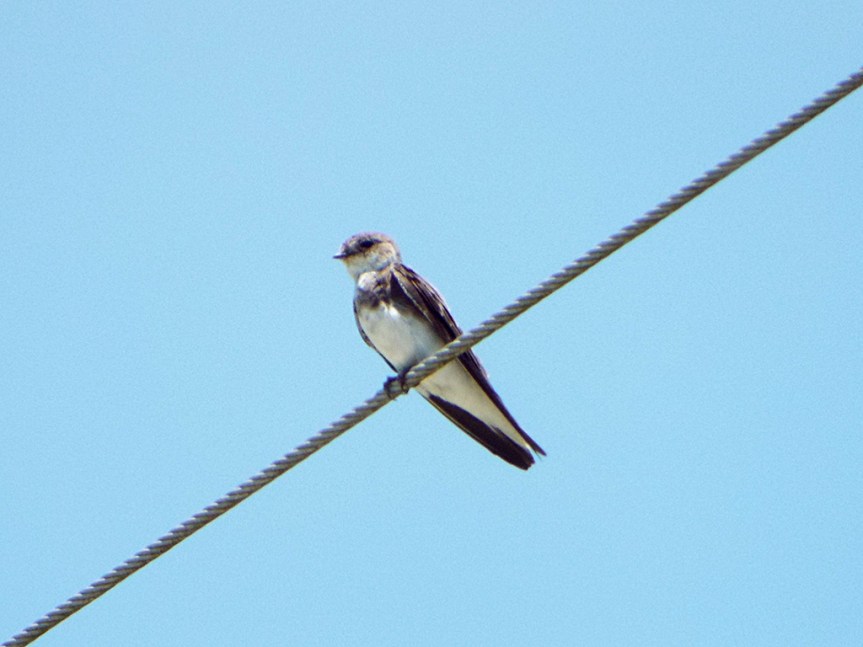
There had been reports of a Bank Swallow hanging out with the Barn Swallows (much like the lone Tree Swallow from a few weeks ago). As we approached the area the swallows seem to favor, I scanned the wires. To my delight, there was the Bank Swallow!
A Bank Swallow staying in FL for the summer.
Otherwise, as we drove the most notable species were the Anhingas (dozens), Cattle Egrets (several dozen) and Common Gallinules. Many of the gallinules had immatures with them – only a few had very small chicks, as the summer is wearing on.
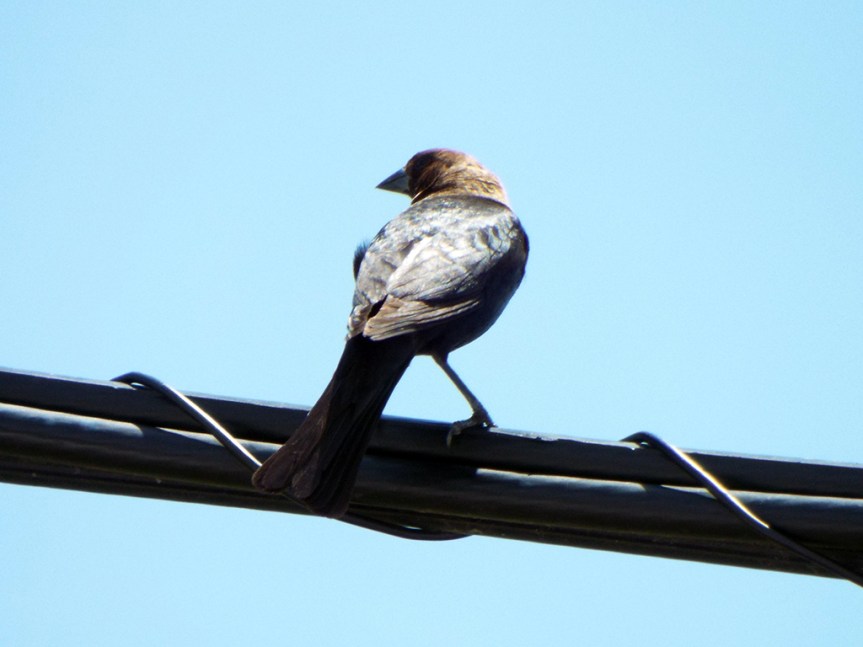
At the area we saw the Swallow-tailed and Mississippi Kites last time, there were several Swallow-tailed Kites very high up and this Brown-headed Cowbird, but that was all.
Brown-headed Cowbird
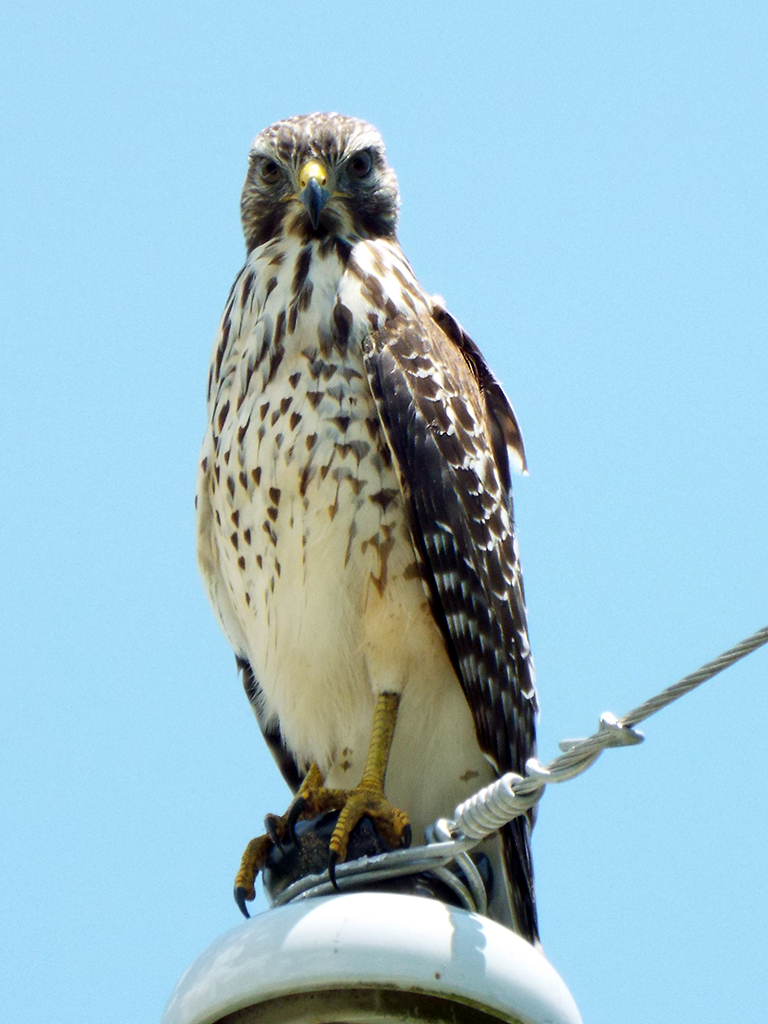
There were a few Red-shouldered Hawks, including one young bird that posed on a utility pole for a while. Further along the drive as we approached the exit, a Cooper’s Hawk and an adult Red-shouldered Hawk had a disagreement over airspace, with the Cooper’s actually driving the Red-shouldered Hawk away.
Another satisfying trip to Lake Apopka. It’s going to be really great birding there in the fall when the shorebirds and waterfowl come in, and again in the spring. During the normally quiet summer this has been one of the few productive birding spots in Central Florida.
This collection of images is from this week, taken at the Viera Wetlands and the Cruickshank Scrub Sanctuary. Click on an image to enlarge it. eBird lists are at the end of the post. Enjoy!
Two weeks ago, I headed to the recently opened Lake Apopka Wildlife Drive with Camille in an attempt to see a few select species that have been reported there on eBird and in the e-mail lists. I was most hopeful to see both an Orchard Oriole (last seen by me in Marlinton, WV over a decade ago) and a Yellow-breasted Chat (which I last saw at Bear Rocks Lake in West Virginia in the same time-frame). There had also been reports of a Shiny Cowbird, which is quite rare.
The oriole and chat were no-shows, but for summer-time birding, you can’t go wrong with Lake Apopka. We hooked up with some other birding folks and convoyed our morning away.
At one point, while trying to observe a distant Yellow-crowned Night Heron, I flushed a Bobcat out of the grass and right past Camille! By the time I turned around, it was gone! Below are some photographs from the trip.
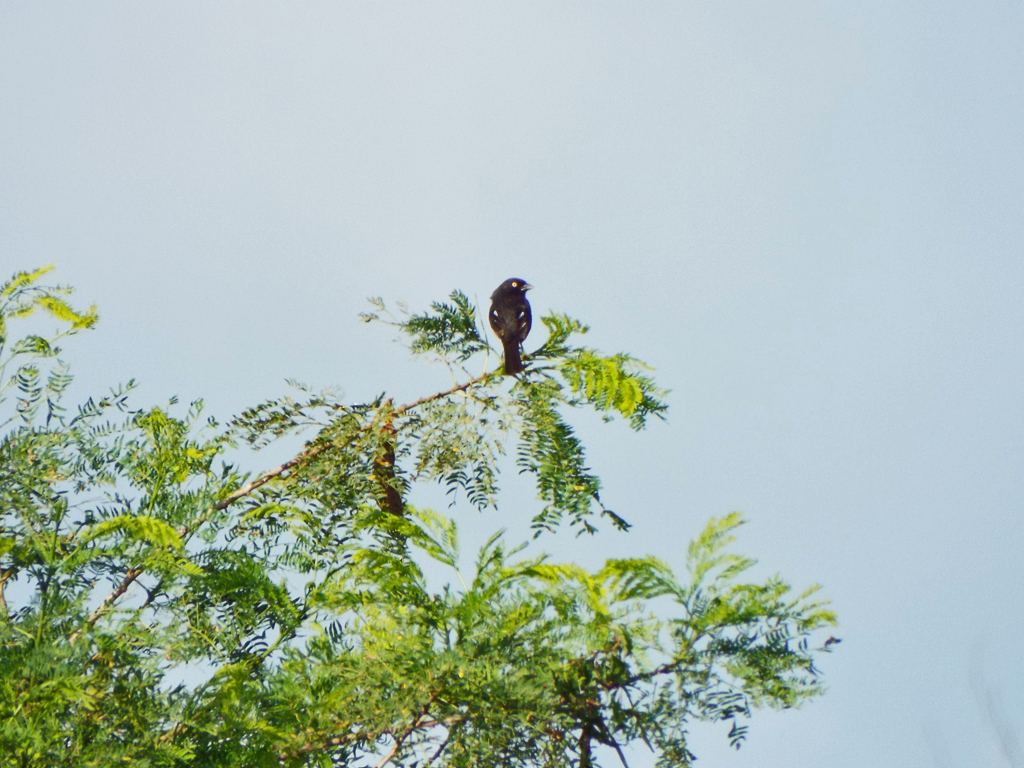
Even from this distance, the white eye of a Florida Eastern Towhee is startlingly evident.
Possible King Rail voice. Where are you?
Historic Pumphouse
Old pumphouse intakes.
Line of mostly Barn Swallows. What’s that 2nd from the right?
Female Tree Swallow
Canal near swallows.
Shiny Cowbird! A first!
I would have thought this bird was a grackle if I hadn’t known beforehand to expect it.
This Purple Gallinule had several fledglings.
Young birds make good meals.
Chick nearly adult-sized.
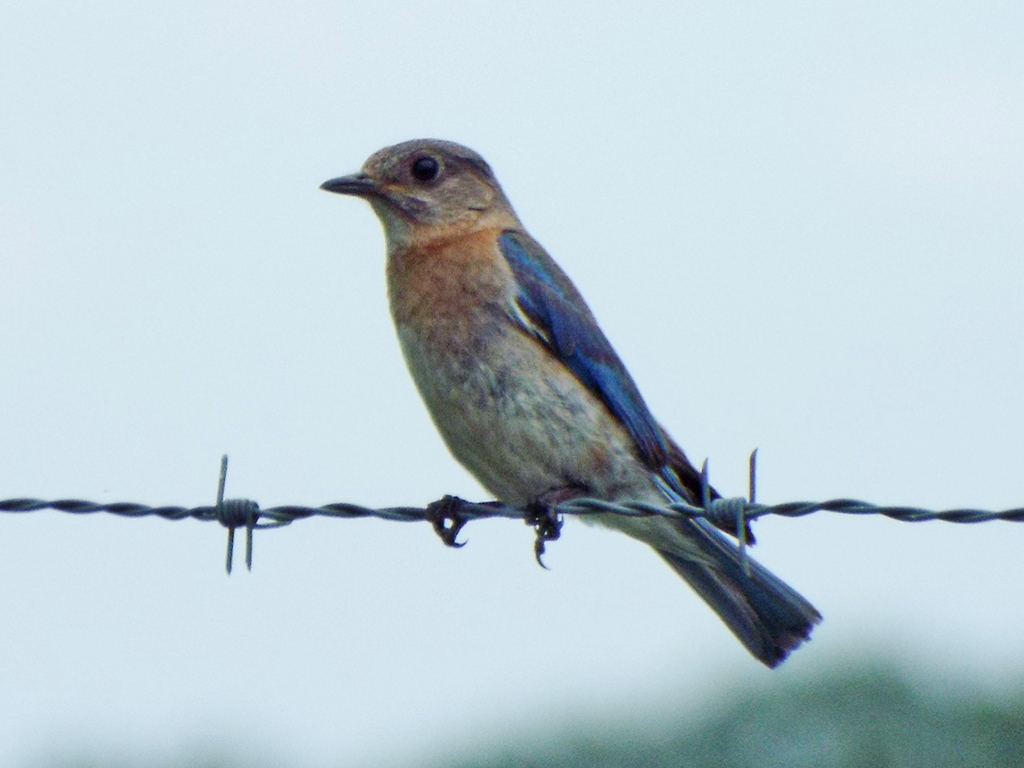
After the Wildlife Drive, we drove around to the North Shore Restoration Area loop trails for a few minutes to look for Blue Grosbeaks (we did find one!), then drove around the general area north of the lake before heading back home. Near the canal by the northwest side of the lake an adult female Eastern Bluebird was perched while an adult male flew around nearby.
Bluebirds are in the thrush family, and are close relatives of the American Robin. Can you see the resemblance in the shape of the face and bill?
The final highlight for me was the quick glimpse of a Gray Kingbird on West Jones Ave. This species is usually found along the coast, but a few have been regularly reported near the lake this summer.
Here are the links to the eBird lists for the follow species:
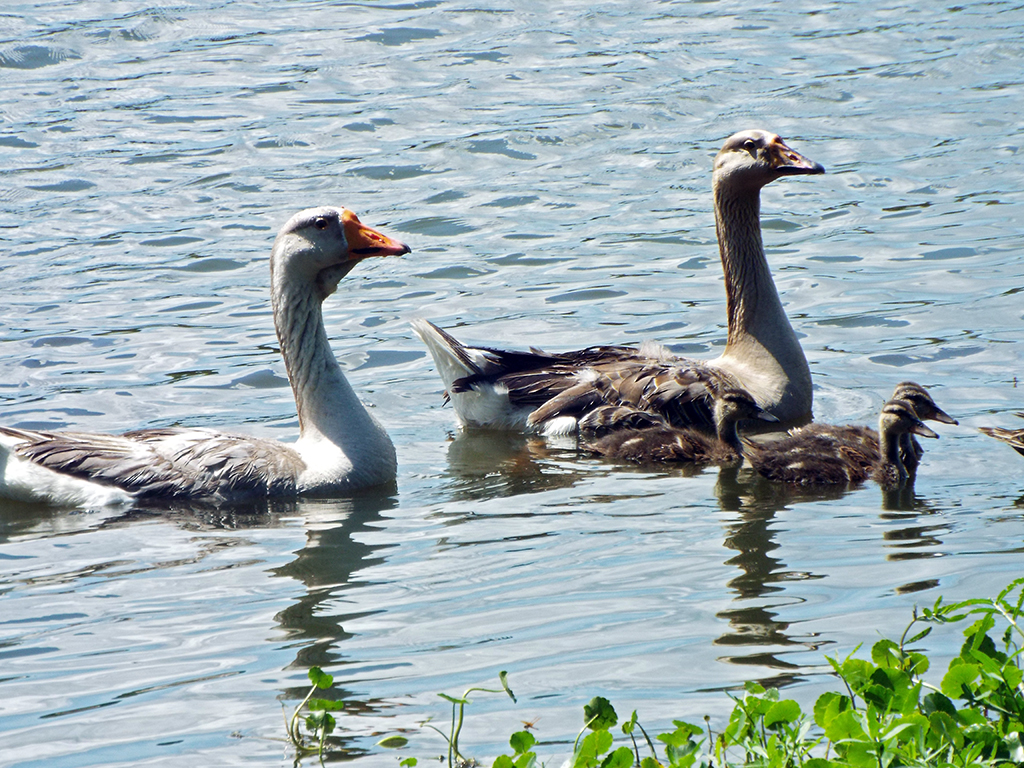
So the ABA doesn’t “allow” Greylag Geese to count in any official capacity, and if you list it on eBird, it doesn’t increment your bird counts.
A mated pair of Greylag Geese, somewhere in Kissimmee. This particular pair seems to have sort of adopted a Mottled Duck family and follows them around a lot. Pretty wild, eh?
The reason for this, apparently, is that this species isn’t “wild” enough.
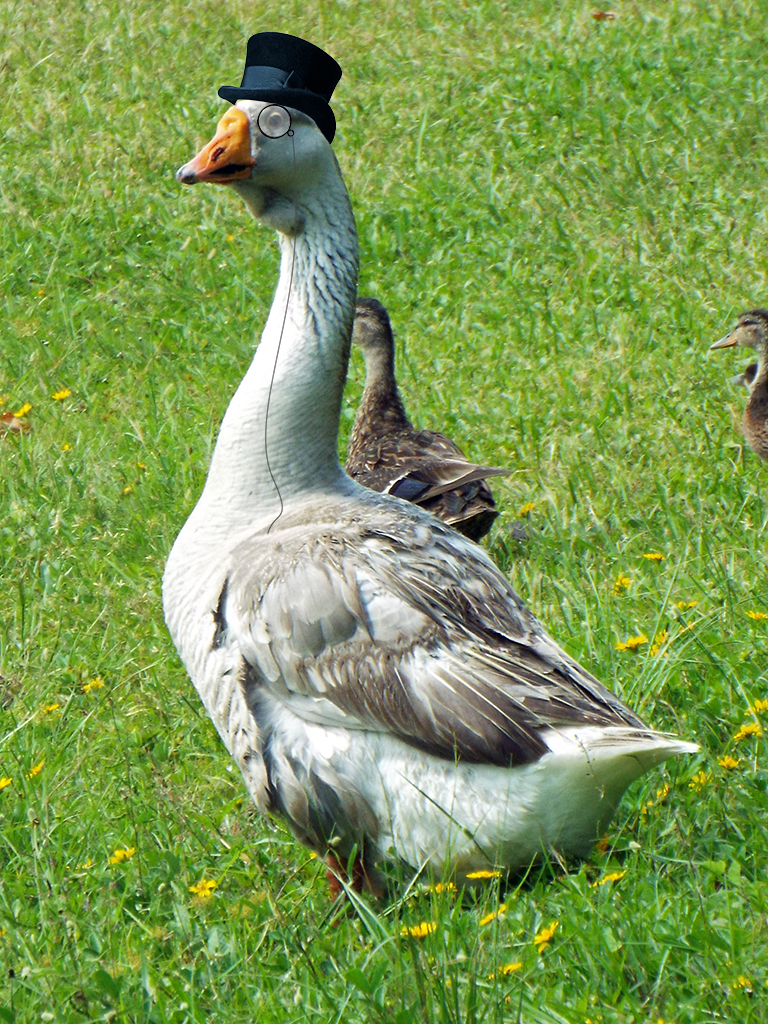
I can’t imagine what they’re talking about!
Ah, ok, once they got out of the water, it all became clear!
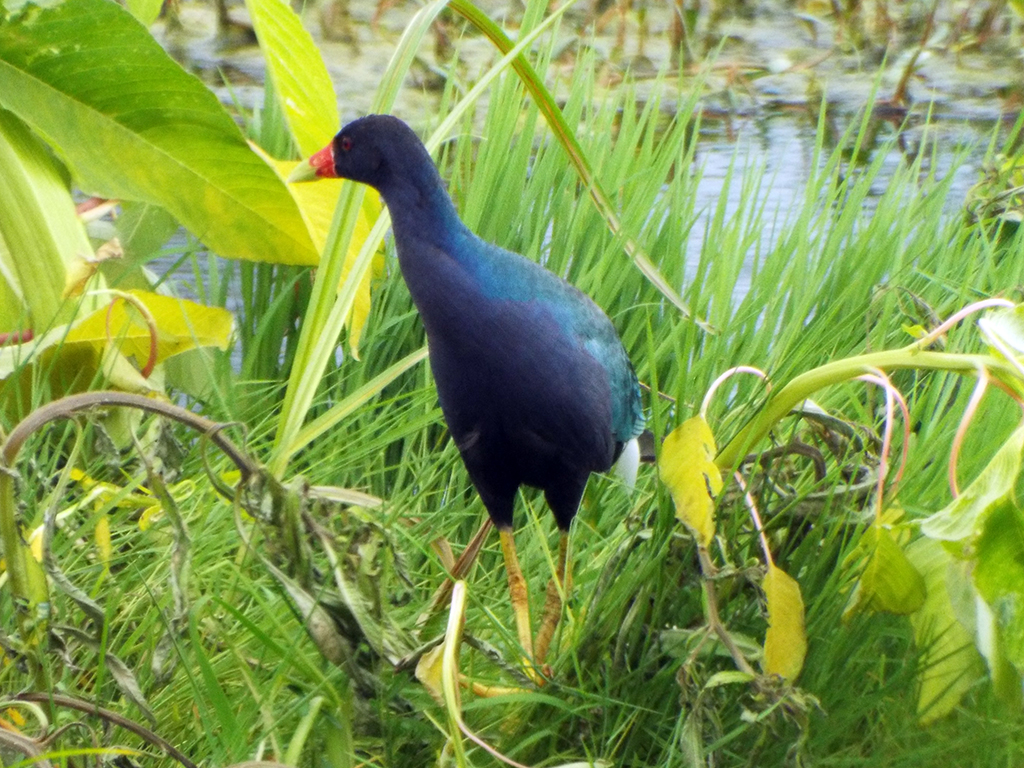
I’m running a little behind on my blog this week, but I do have some material coming up. Hang in there and I’ll be with you shortly! Meanwhile, enjoy this Purple Gallinule!
This past weekend’s adventure was all about the rails! After some good tips from both eBird and some local birders, Camille and I headed north to Spruce Creek Park for Clapper Rails. A few leads said that they were easily observed and calling loudly throughout the park.
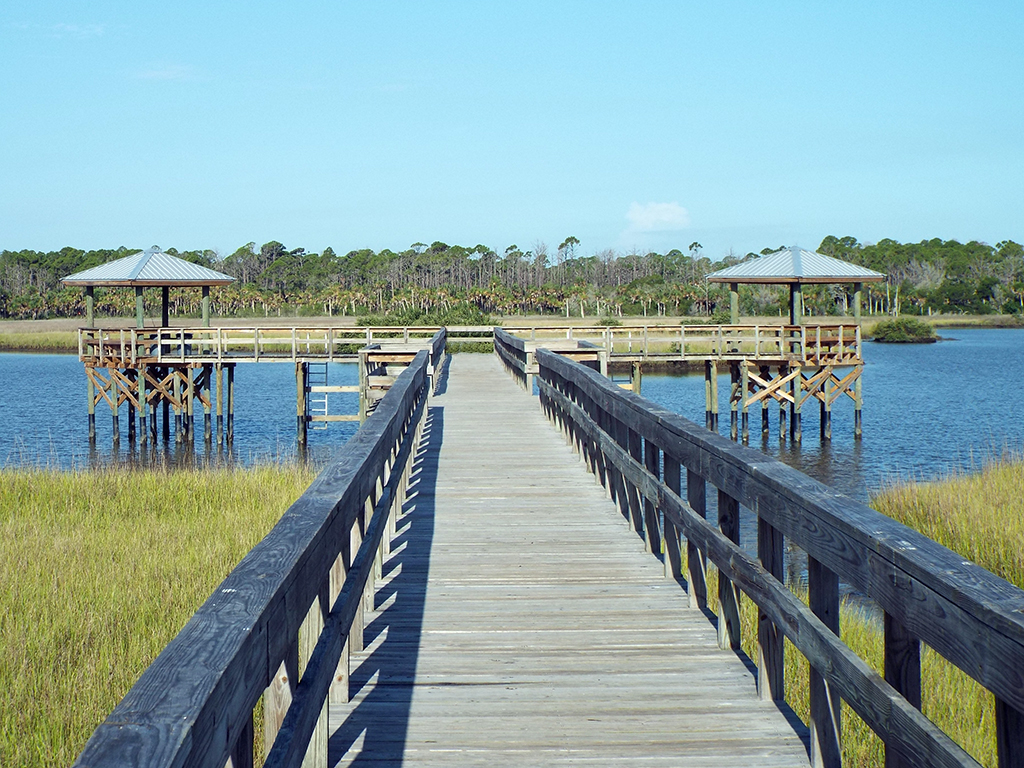
The park is over 1,600 acres in size and has a boardwalk overlooking the marshes and mudflats of Spruce Creek. There are also a few miles of hiking trails, but since the focus of the trip was rails, we didn’t really hike them.
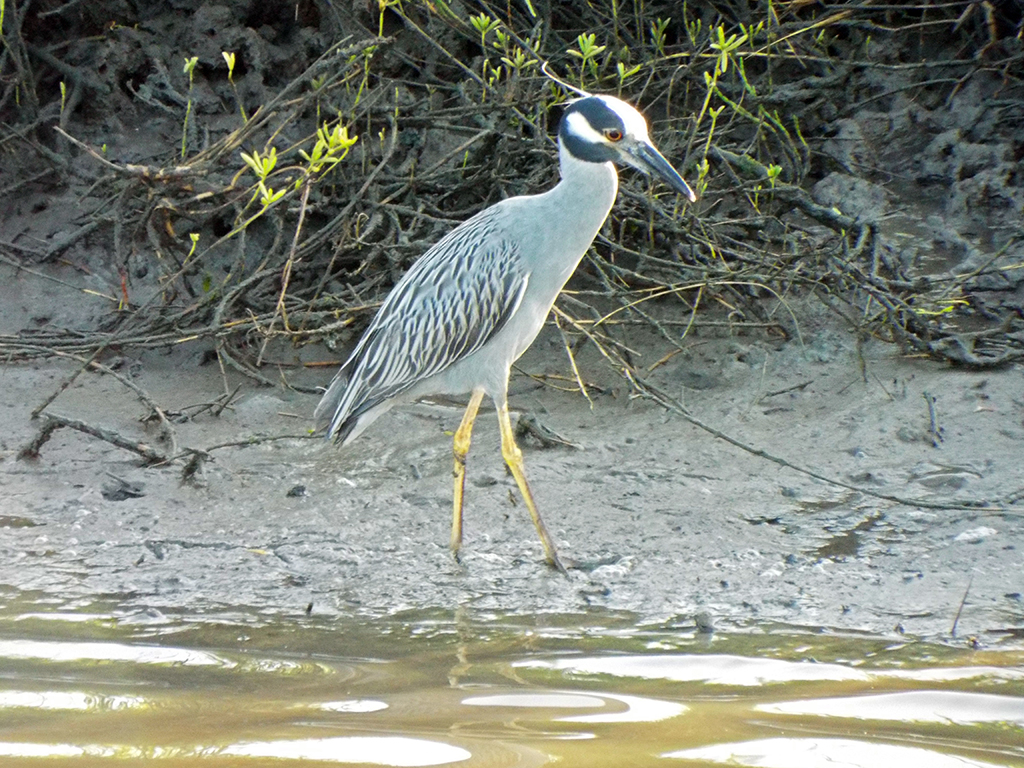
As soon as we stepped on the boardwalk we could hear Clapper Rails calling from all around the marsh, but we couldn’t see them. Other wading birds were working the perimeter of the mudflats (which were mostly underwater), including a Yellow-crowned Night Heron (my first of the year, finally).
Several Ospreys were soaring overhead, occasionally making a dive for fish, but more often chasing each other around the sky. I assumed they were young birds still associating with their parents.
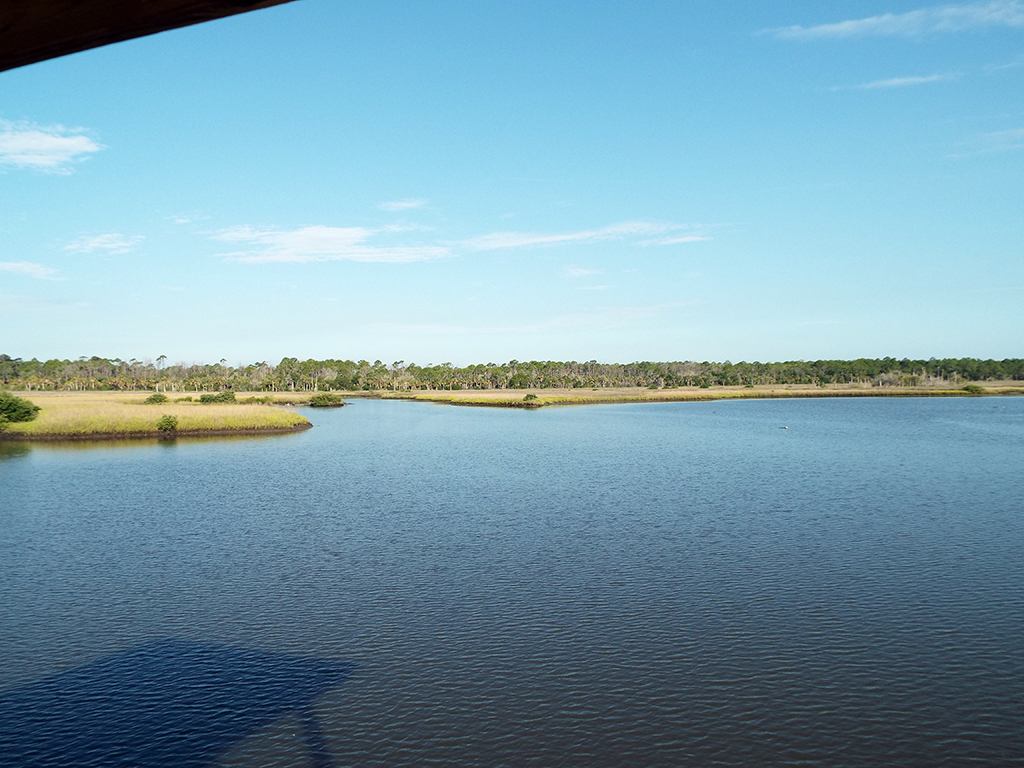
The marsh is beautiful and the stretch of water the boardwalk and pavilions overlook is expansive.
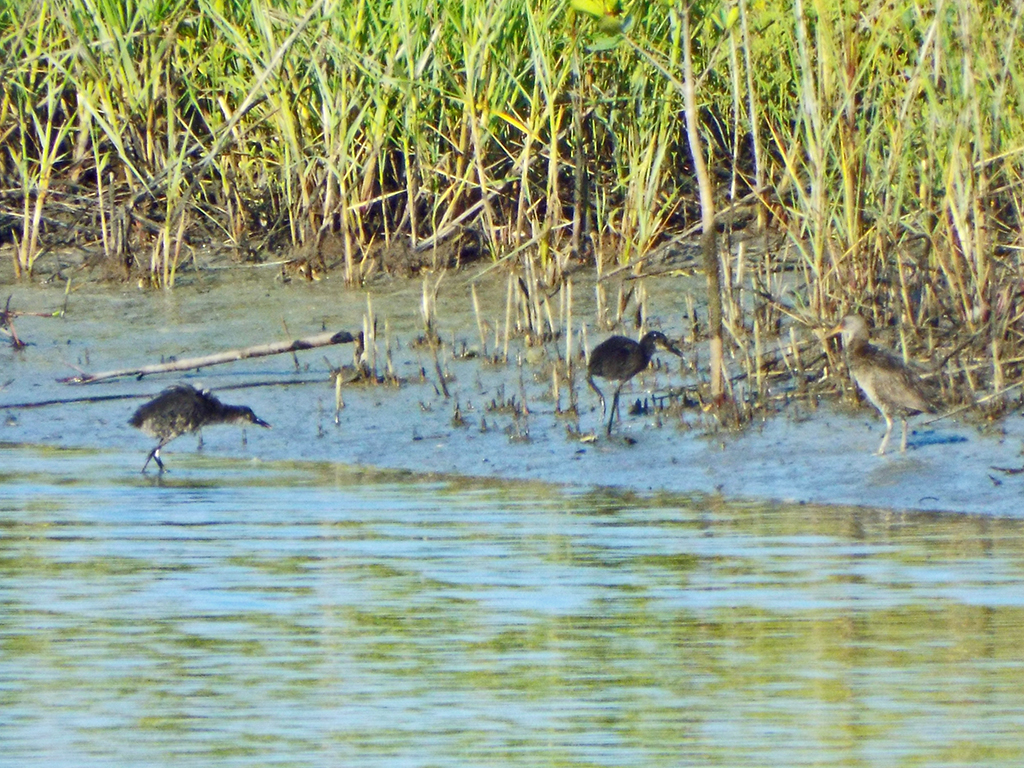
After waiting about 20 minutes or more, and continuing to hear the “kek-kek-kek-kek!” of Clapper Rails around, its was discouraging. But finally, I caught a glimpse of several gray bird shapes across the water cautiously emerge from the vegetation to the water’s edge. Just at the edge of my binoculars and camera range, I made out the characteristic rail shape.
Part of the rail family before heading back to the safety of the vegetation. These chicks look nearly adult sized.
There seemed to be two adults and several chicks. The adults’ gray plumage matched the mud almost perfectly, while the chicks were still sporting many black and dark gray feathers. The birds stayed in a group and wandered a bit along the vegetation before one by one, slipping back into the marsh.
After scanning the marsh another time, I saw a single rail even further away, but well into the open and in full sunlight. It ducked back out of sight after just a few minutes.
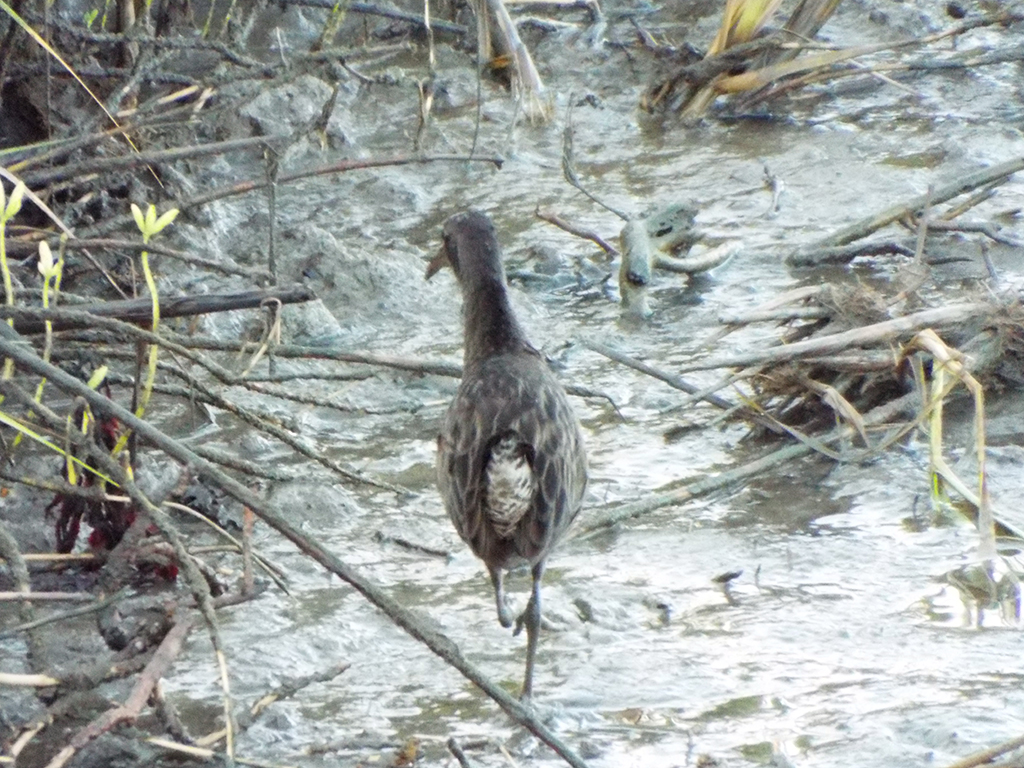
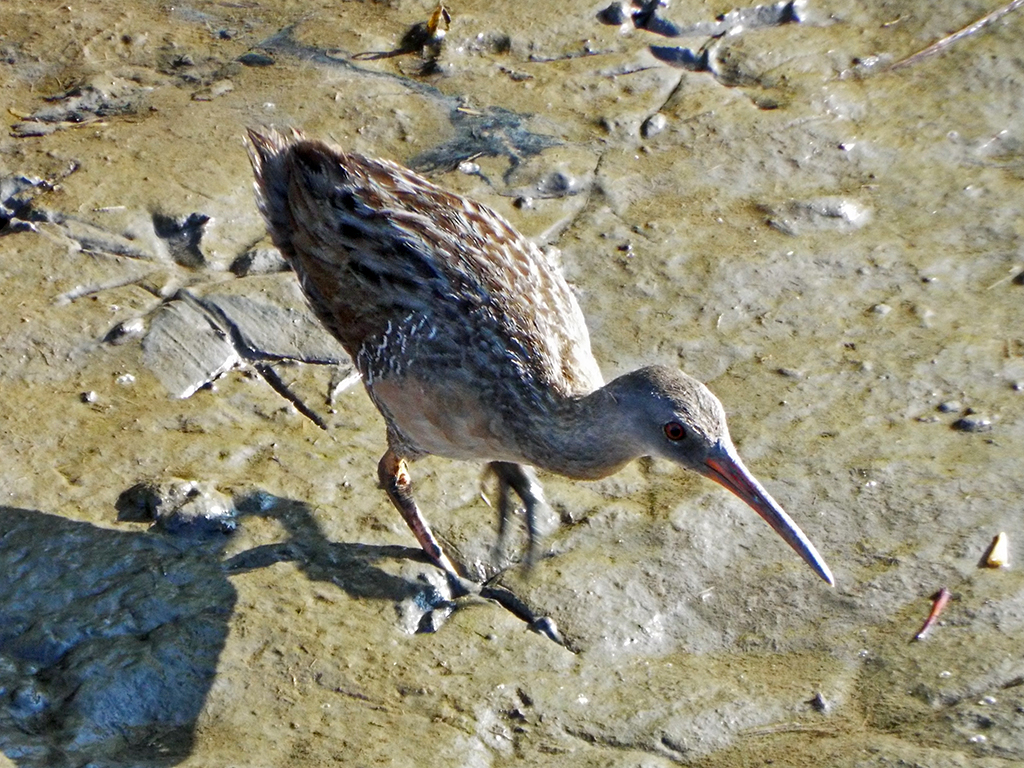
I figured that would be it, but Camille and I were excited to have finally seen rails! We began to slowly work our way back from the boardwalk to the parking area, but a bit of movement caught Camille’s eye as she saw something rail-like briefly fly above the vegetation before dropping down. We watched the spot where it disappeared for a minute before continuing on our way. Then a Clapper Rail walked right out in the open just below the boardwalk! It walked briskly away from me before running back under cover.
This was quite an unexpected treat. You can see from the laterally flattened body where the term “thin as a rail” comes from. Like bitterns, rails are exquisitely adapted to walking and running through reeds and other marsh vegetation, only very rarely flying in the open.
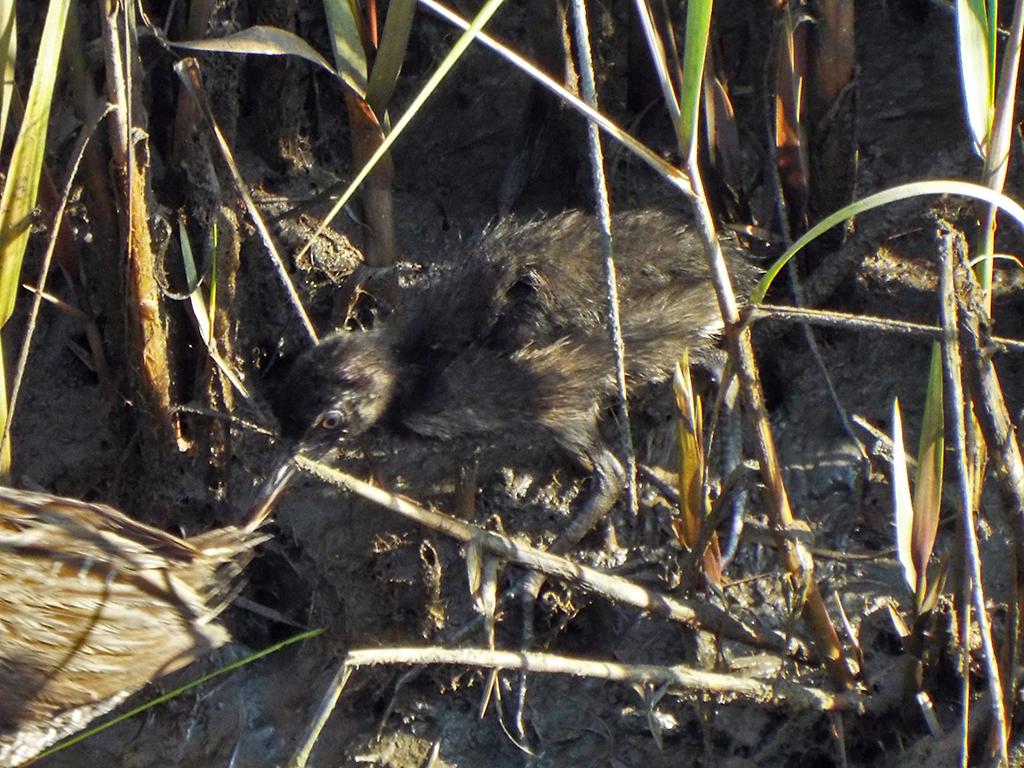
After a few more steps, I glanced over the other side of the boardwalk and another rail came out into the open, this one with a single chick following it! It paid us very little mind before making its way back into the marsh, followed by its chick.
The adult rail had only one chick following it. I don’t know if that means only one survived or hatched, or if more chicks were with the other parent.
Another bird I have not seen (at least not this year so far) is the American Oystercatcher. Recent sightings in Volusia county, not far from Spruce Creek Preserve, gave me some hope to see them. But after stops at the Port Orange Causeway Park and Seabird Island, no oystercatchers were in sight.
We did see a large number of Brown Pelicans (approximately 200 adults and nearly fledged chicks) as well as Double-crested Cormorants and a few egrets on a small island and sandbar near Seabird Island.
The last place we searched for American Oystercatchers was the Ponce Preserve. The eastern portion of the park is mostly vegetated sand dunes while the western portion (closest to the Halifax River) is a tidal marsh and mudflat habitat similar to Spruce Creek. Indeed, we heard more Clapper Rails (including one right below my feet under the boardwalk).
“Under the boardwalk, we’ll be hearing rails…”
Clapper Rails’ homeland.
That about wrapped up the morning, except one mystery. While we were exiting the dune portion of the Preserve and again later while on the boardwalk on the marsh, I heard a distinct, high-pitched, two-toned whistle that sounded exactly like a Mississippi Kite. I sort of joked about it to Camille, but then as we approached the end of the boardwalk, there was a very raptor-like silhouette on a small snag to our left. Perhaps it was that call plus the odd way the bird was perched, but we both really thought it was a small gray raptor. Each of us took a long series of photographs, but the bird was just far enough away to make it hard to know what we were looking at, even in binoculars. Upon closer review on my camera, it became embarrassingly apparent that it was merely a Mourning Dove, but that left the mystery call unresolved. As we were walking back along the boardwalk a small raptor did appear, this time soaring in quick circles, just after another two-tone whilstling call. I got a pretty decent look at the bird, and Camille got two slightly blurred photographs, but I can not make heads or tails out of what I saw. The most likely candidate would seem to be an immature Cooper’s Hawk; however, the mystery kite-like call and some aspects of this birds plumage have me wondering (Cooper’s Hawk calls sound much different than a kite). I’m going to take a closer look at the photographs and compare some other resources to see if anything definite can be determined.
But this is part of the fun and challenge of birding. You can’t always identify every bird you see or hear, and often the birds either refuse to cooperate in terms of posture or lighting, or they can look like a totally different bird. Since they have wings, species can be found far from where you’d expect (as Laura Erickson says, birds are functionally illiterate. They can’t read the field guides to know where they are supposed to be).
Here are the links to my eBird lists and identified species:
It’s been quite a few weeks since I checked in at the Turkey Creek Sanctuary. Although I wasn’t expecting too much, it was nice to take in the familiar sights and sounds of the place.
I arrived just after sunrise and managed to do the majority of the jogging trail, the boardwalk and the Sand Pine Trail in about three hours.
The Sanctuary doing its best to look primeval.
I also used this as an opportunity to count birds for my first “official” eBird checklist. I’ve been reluctant to make any checklists on eBird for a variety of reasons. For one, when there are larger numbers of individuals of a species, especially if they are encountered at various points though a hike, I don’t trust my count. I used to carry a notebook around and that might certainly help, but I find that I sometimes get too caught up in following a bird or watching what it’s doing, then I would forget to count the numbers. I realize that seems a bit lame, but I did make it a goal this year to start making an effort to use eBird.
I counted quite a number of Northern Cardinals, which is not surprising – this park is usually overrun with them. I tracked a few Northern Parulas both on the boardwalk and on McKinnon’s Way, and finally managed to get sight of one high in the canopy. I wasn’t sure what I was seeing, at first, until I realized the bird had no tail feathers! Whether this was from parasites, molting, or an attack by a predator, I have no way of knowing, but he was singing and foraging like all was well, otherwise.
Tail-less Northern Parula.
There was little else to document, apart from some woodpeckers and Carolina Wrens scattered here and there. The highest concentration of birdlife was near the canal and weir. There were Blue Jays (one of which was imitating a Red-shouldered Hawk so well that it got a hawk to answer its calls from across the canal), Fish Crows, Mourning Doves, and White-eyed Vireos along the jogging path before the weir. At the canal itself there was an assemblage of birds just behind the floating barrier.
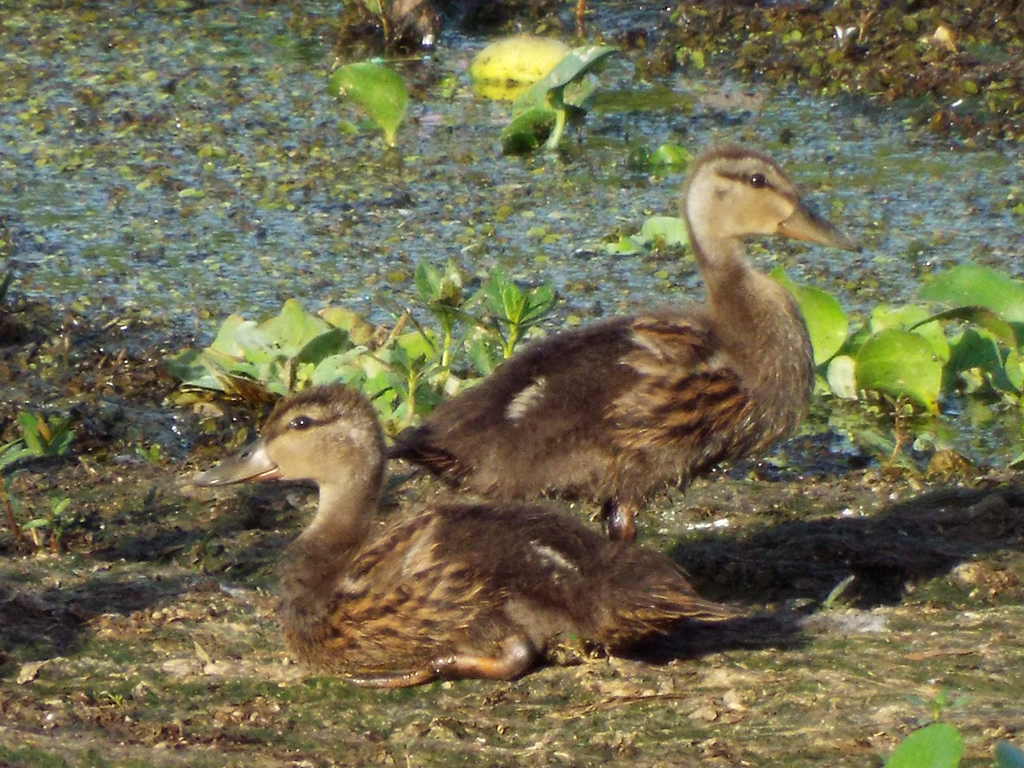
Two of four Mottled Duck juveniles (I think they are past the “chick” stage here) that were resting with 2 adults.
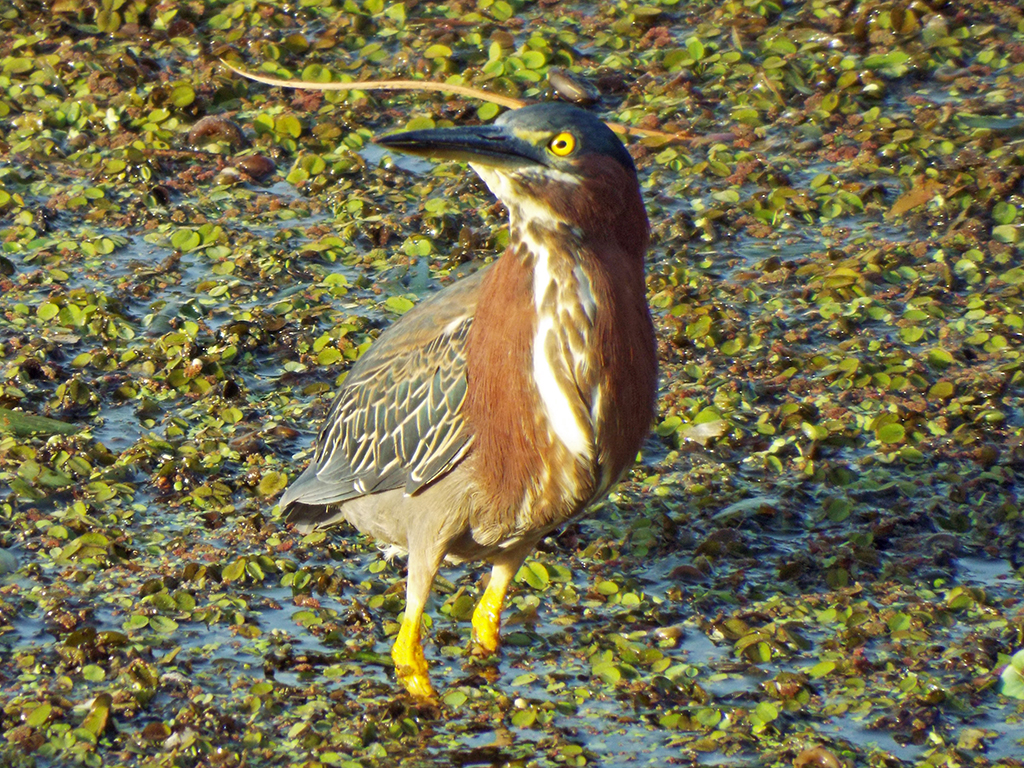
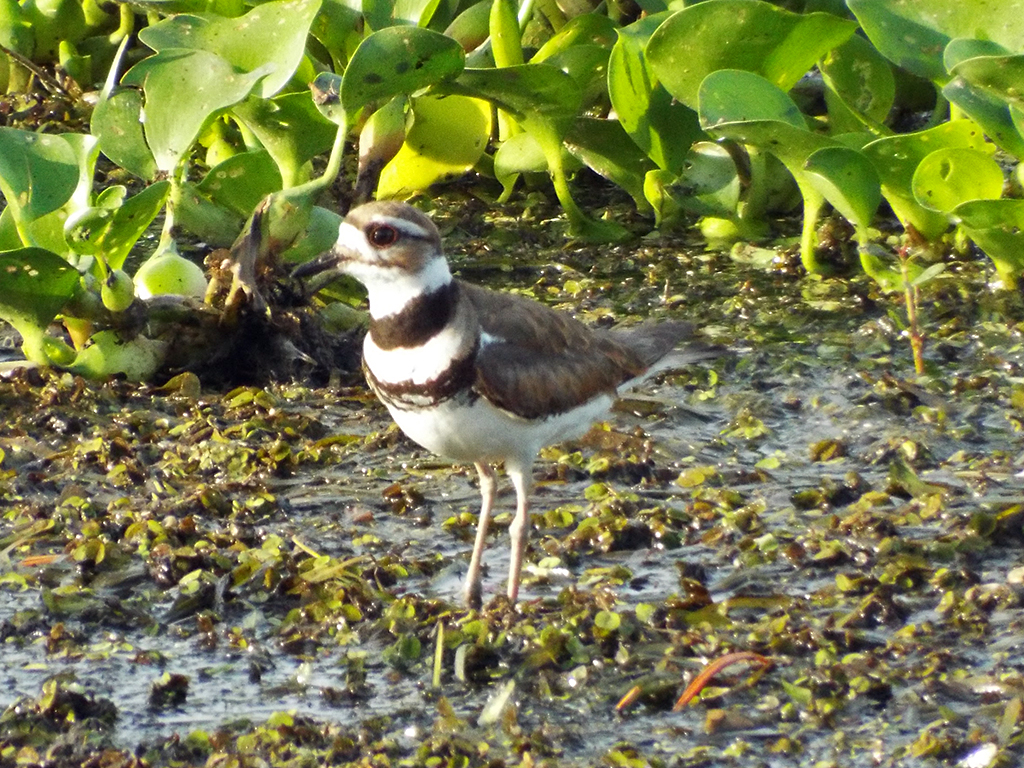
Along with Mottled Ducks and a few American Coots and Common Gallinules, there were two Green Herons and Two Killdeer probing the mud and vegetation. I was a little surprised not to see any other herons or egrets near the canal.
And the species list in the same order as the eBird checklist:
6 Mottled Ducks
2 Green Herons
2 Black Vultures
1 Turkey Vulture
2 Red-shouldered Hawks
3 Common Gallinules
2 American Coots
2 Killdeers
1 Common Ground Dove
3 Mourning Doves
5 Chimney Swifts
2 Red-bellied Woodpeckers
2 Downy Woodpeckers
3 Great Crested Flycatchers
3 White-eyed Vireos
4 Blue Jays
3 Fish Crows
5 Carolina Wrens
6 Blue-gray Gnatcatchers
5 Northern Parulas
A LOT of Northern Cardinals
I expect the situation at Turkey Creek will be fairly stable for the next month or so, with some of the breeding birds raising their young and some fledglings venturing out. Some of the early migration vanguard will start to arrive later in August, but until then things should remain quiet.
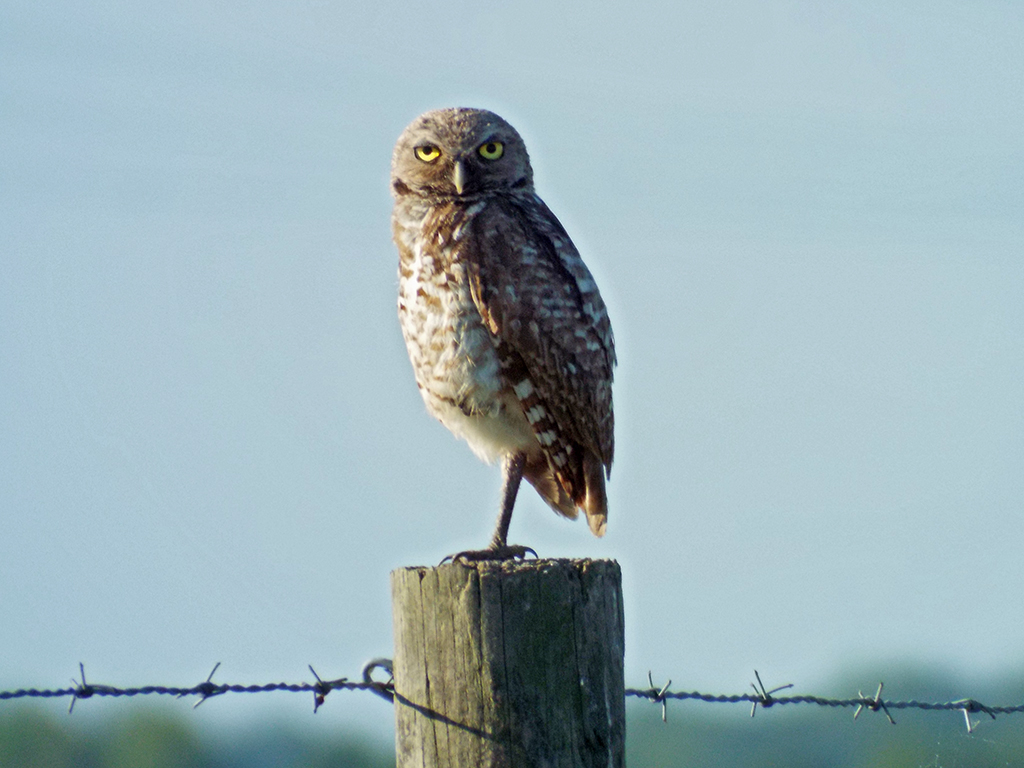
This past Sunday was an epic day-trip around Osceola County, with hopes to find Burrowing Owls, Red-headed and Red-cockaded Woodpeckers, maybe some Whooping Cranes, and anything else that might cross our paths.
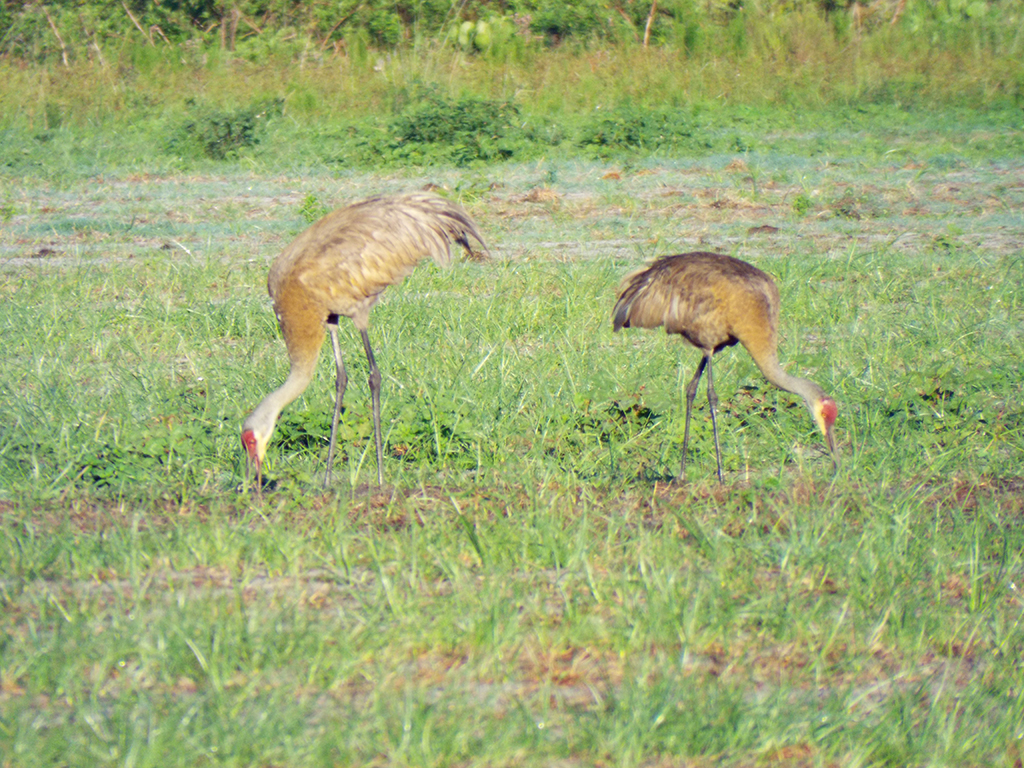
Our first stop was to find some Burrowing Owls along Deer Park Road, west of the St. Johns River. While there are clear hotspots with some very personable owls out toward the Gulf Coast, the possibility of this species within about 30 minutes of home was too good to ignore. Most of the area near Nova Road and Deer Park road is a cattle ranch, and on the left or northbound side of the road there were indeed many head of cattle with tall grassy vegetation. On the right side, though, the fields were cropped very short and there were no cows. There were, however, quite a few Sandhill Cranes. I counted just about 40 adult sized birds, in pairs and larger groups, spread throughout one field.
The cranes feeding at this location had a rusty wash in their feathers, something the cranes closer to home in Brevard County seem to lack.
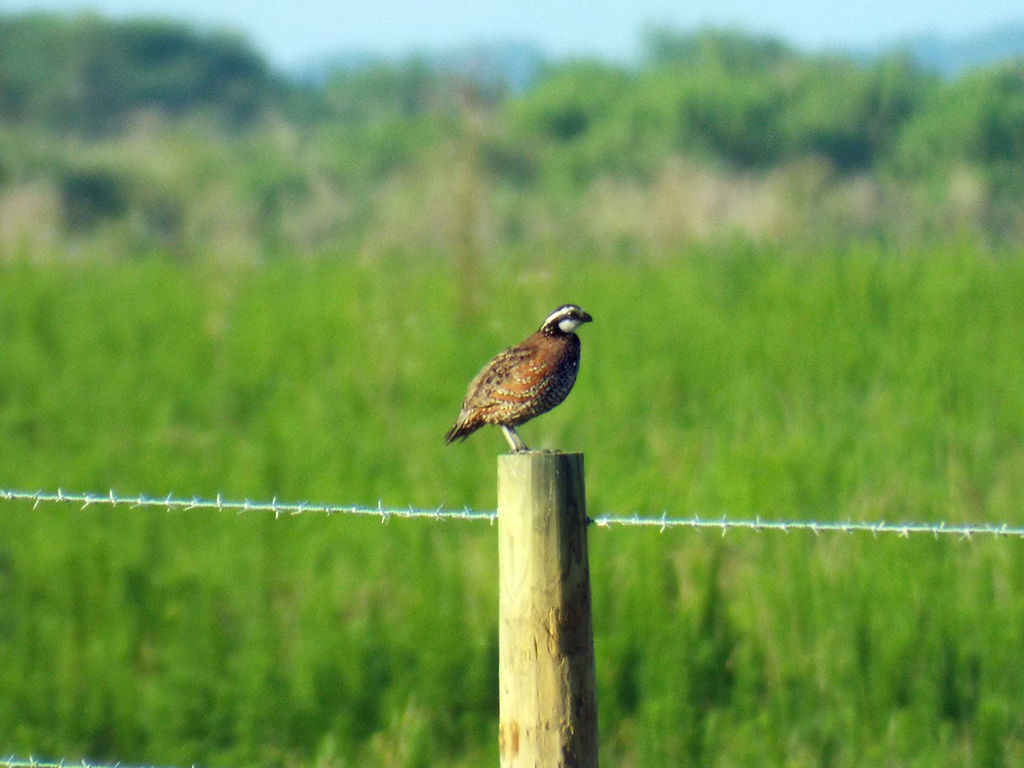
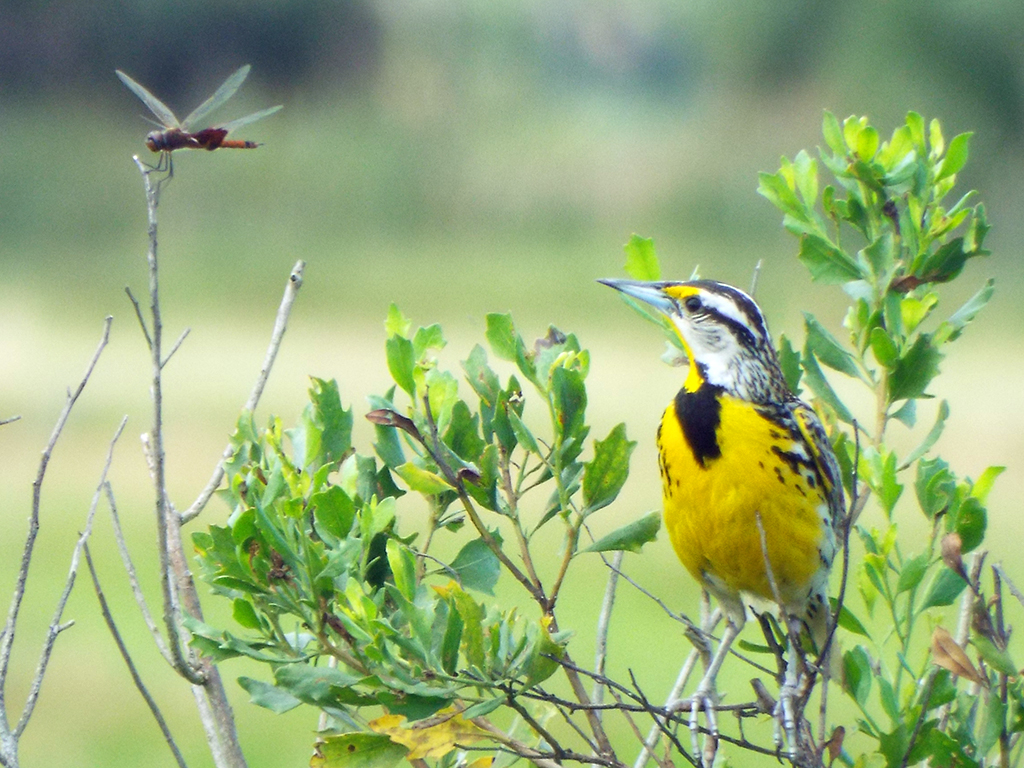
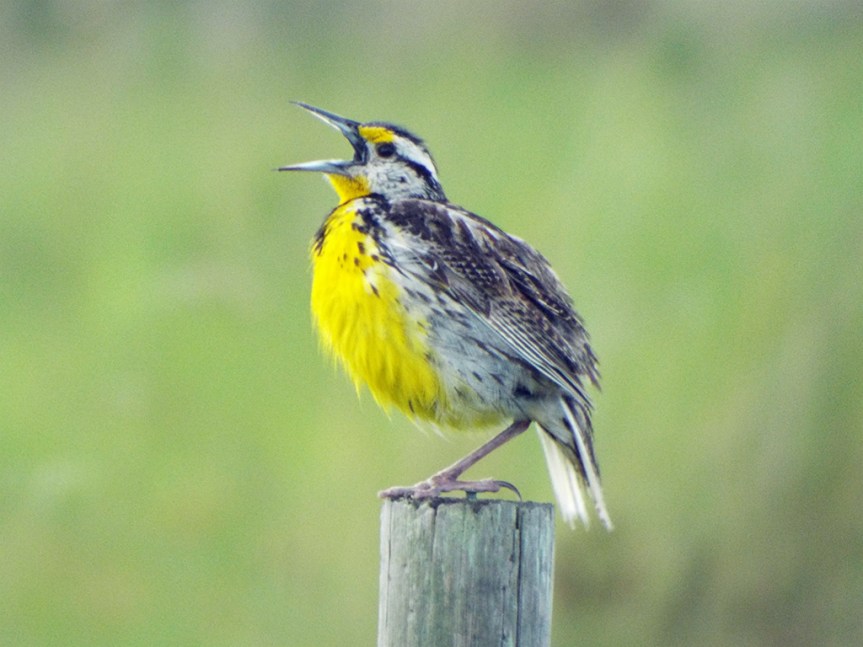
There were also Eastern Meadowlarks, some Northern Mockingbirds, and even a Northern Bobwhite. Unlike the bobwhites I’ve encountered at both the Cruickshank Sanctuary and Joe Overstreet Road, this bird was not very shy and was flying and running around in the open.
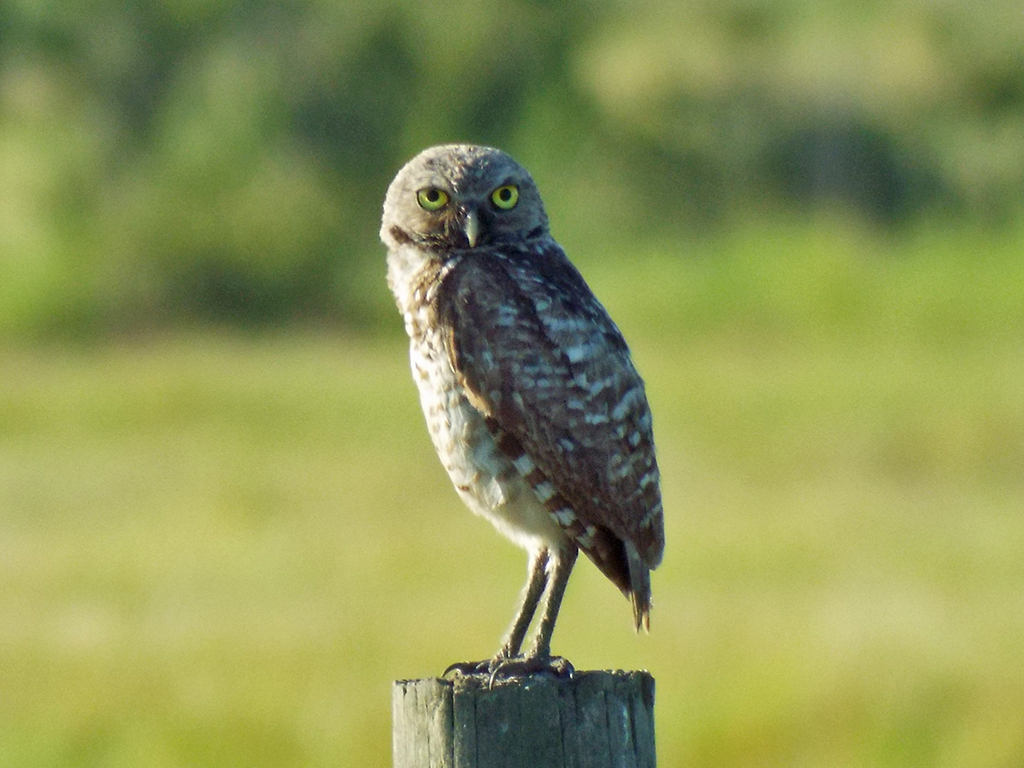
We parked not far from the Nova Road intersection and walked south, keeping an eye on the fence line. After about a thousand feet there was a small, bullet shaped bird on a fence post. We cautiously moved closer until we got a decent look in binoculars and saw it was a Burrowing Owl (and just about where we saw the first marker on eBird). After going back to bring the vehicle closer, we moved in to get some better photographs. We noticed another owl on a post nearby, and then another further down the road. One eventually flew into the grass near the first owl, but the others stayed on the posts and watched us closely, not the least perturbed.
The lighting was really tough, I took as many photos as I could, hoping at least a handful would be useful to me. After a while we didn’t want to overstay our welcome to their roadside perches and moved on. This was a life bird for both me and Camille, so we were really pumped and hoped it would set the tone for the rest of the day.
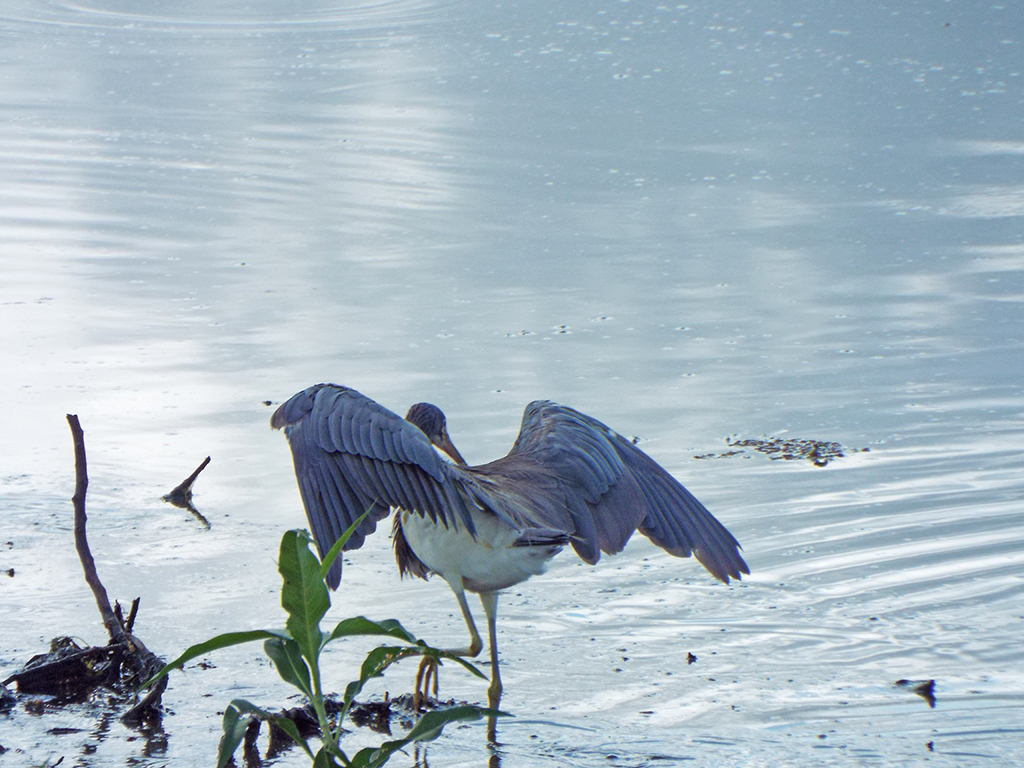
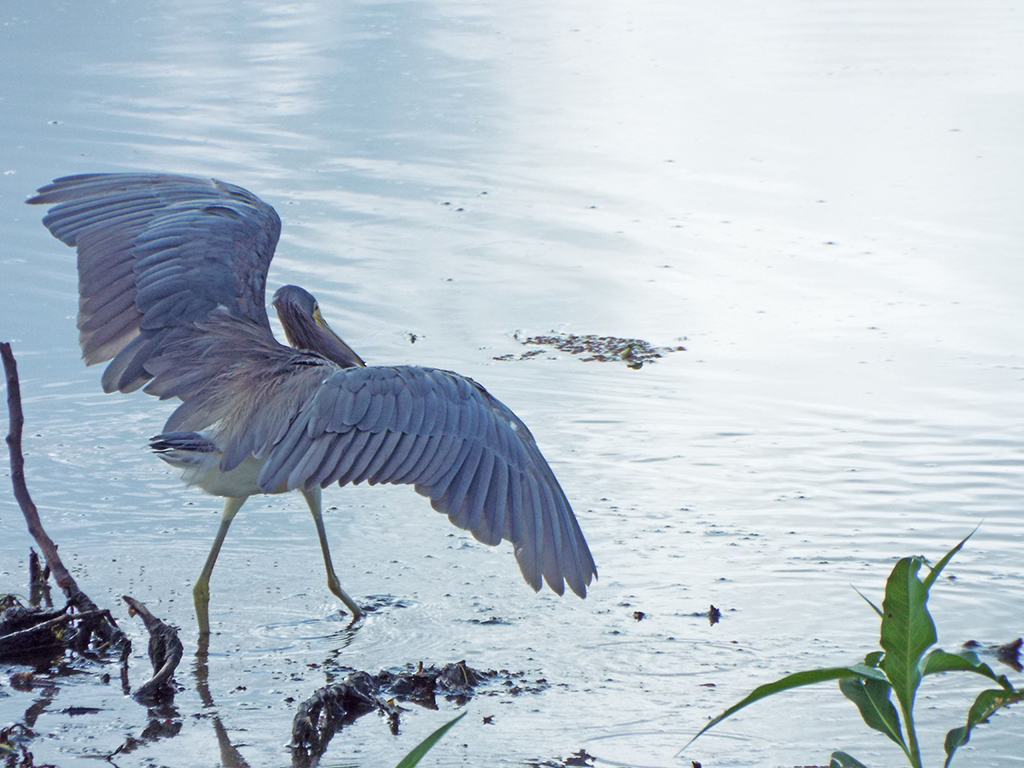
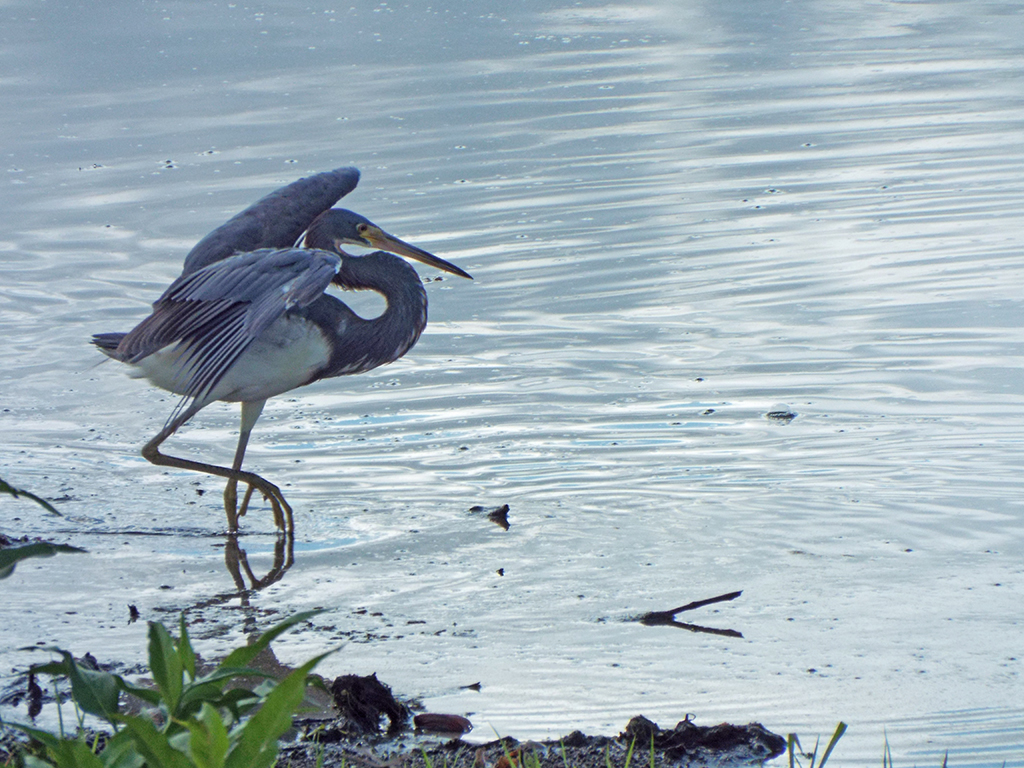
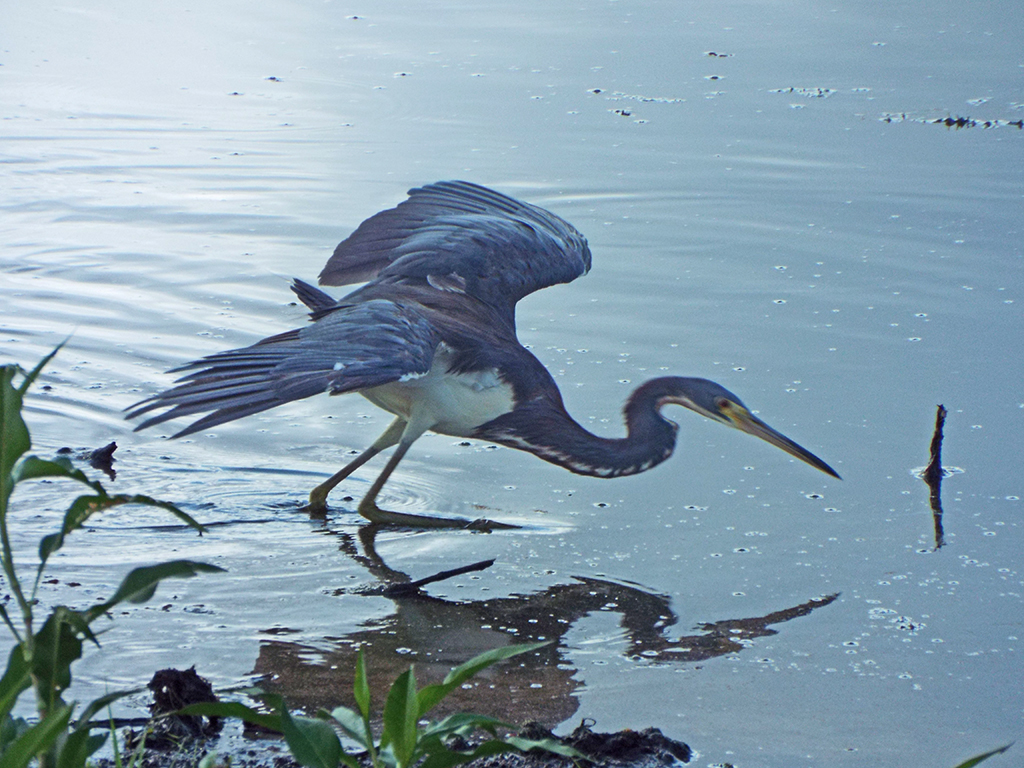
Our next stop was to revisit Brinson Park in Kissimmee, hopeful to see the Fulvous Whistling Ducks that are continuing to be reported on eBird. The same mix of birds from the last time was present: Roseate Spoonbills, Limpkins, White and Glossy Ibises, lots of Boat-tailed Grackles and Red-winged Blackbirds, a Black-necked Stilt and an assemblage of herons and egrets. One of the Tricolored Herons was doing a Reddish Egret impression, lurching and spinning around near the shoreline. I’ve never observed any other heron hunt this way (Snowy Egrets will sometimes lunge or shuffle at prey, but never in the “drunken” manner of a Reddish Egret).
We walked along the shoreline, scanning the vegetation for Fulvous Whistling Ducks, but there were none to be seen. A couple from Scotland were photographing birds, so I asked if they had any idea where the ducks might be, but they didn’t know. After a lovely conversation with them, we crossed the road over to the marshy area north of the lake.
There were more Black-necked Stilts, spoonbills, and herons. Some ducks just past the edge of my binocular’s reach looked promising, but the distance and lighting made it impossible to know for certain that they were not Black-bellied instead of Fulvous.
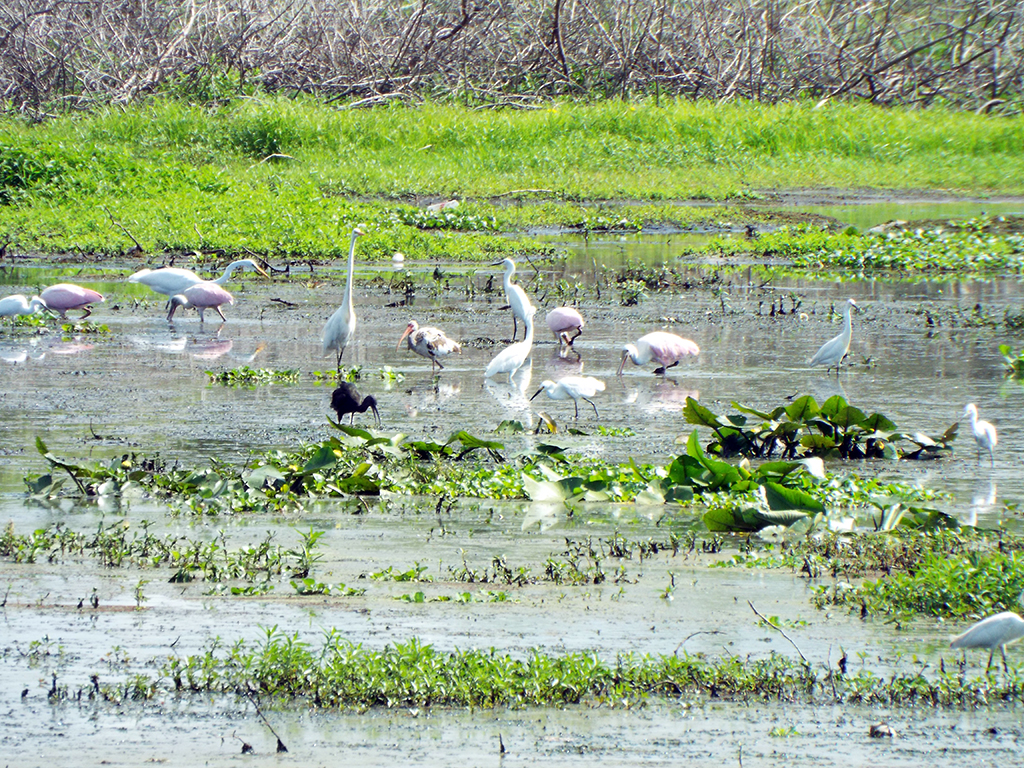
A motley crew of egrets, spoonbills and ibises across from Brinson Park and Lake Tohopekaliga.
Continuing the tour of central Florida, we headed to Joe Overstreet Road, hopeful for possible Burrowing Owls, Red-headed Woodpeckers, and perhaps even Whooping Cranes (at the nearby Double C Bar Ranch). We struck out on all accounts there, but we did see more Eastern Meadowlarks and some American and Fish crows.
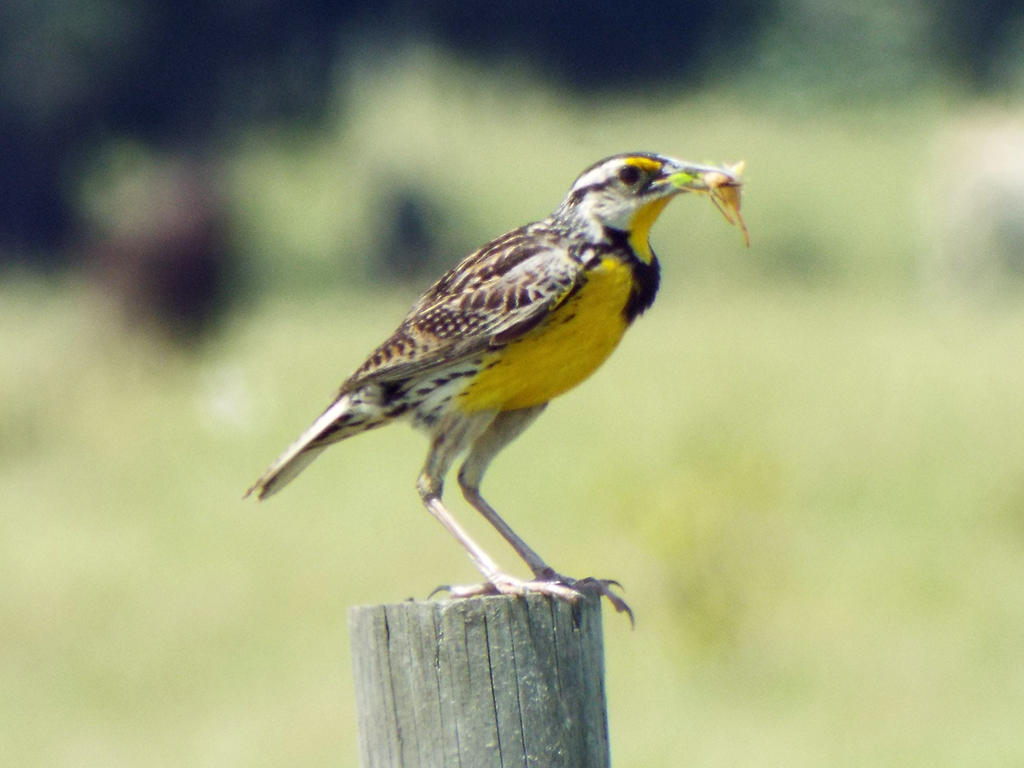
With two insects stuffed into its beak, it’s possible this meadowlark was just extremely hungry. It’s more likely that there are young mouths to feed.
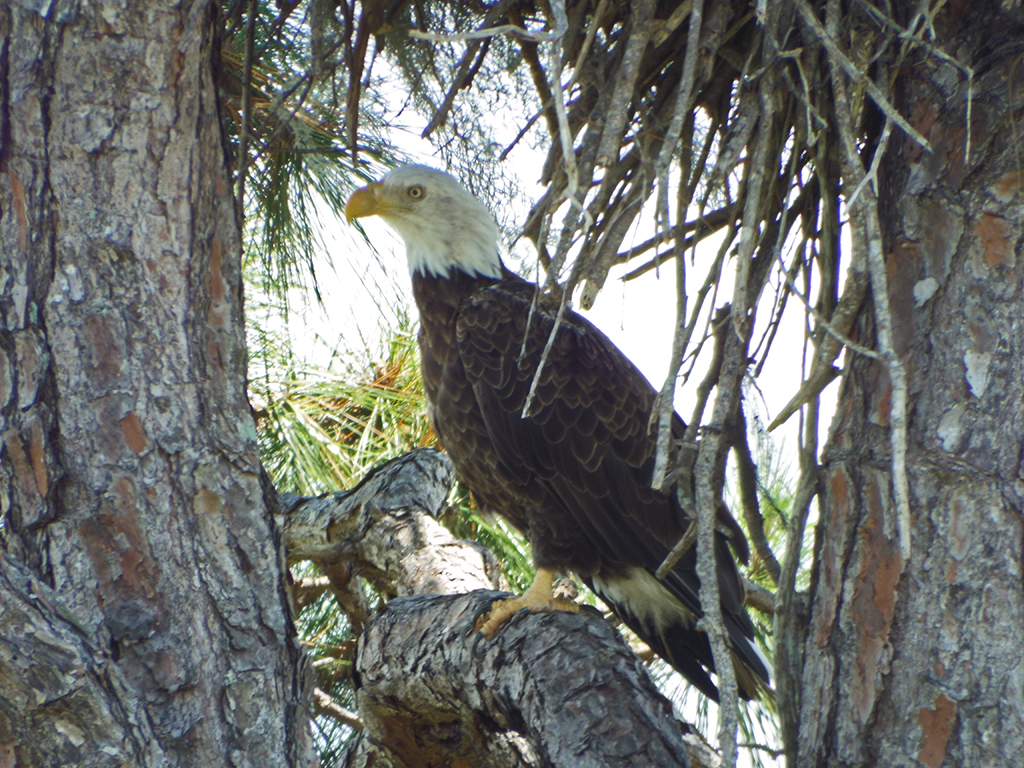
At Joe Overstreet Landing it was fairly quiet, though we did see two Bald Eagles and a few herons and egrets, widely scattered around the lake’s edge. The heat of the day was already building, but we were still hopeful to catch some Red-headed Woodpeckers or even an outside chance for Red-cockaded Woodpeckers at the Three Lakes Wildlife Management Area.
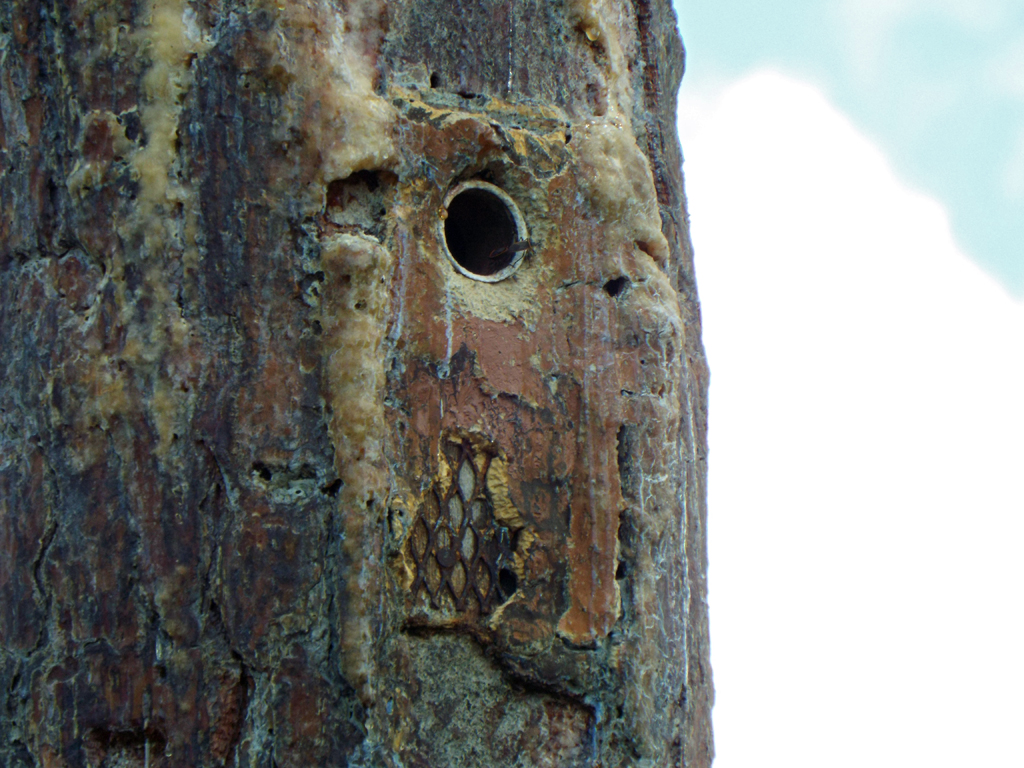
Three Lakes is one of a few areas in Florida with Red-cockaded Woodpeckers. Just a couple of decades ago, this species’ future was bleak. The birds require a very specific pine flatwoods habitat with large, older trees they can nest in. Unfortunately, naturally occurring nest trees had been cut down for lumber and development, so the birds had no where to breed. When we discussed Red-cockaded Woodpeckers in an Environmental Geography class in college, some predictions had the birds extinct by the end of the 1990s. Then something extraordinary happened. Someone got the idea of cutting into younger pines and embedding a nest box, then sealing it up. And that crazy idea has worked! There are now Red-cockaded Woodpeckers breeding at Three Lakes WMA as well as the Hal Scott Preserve and their numbers have been increasing. They still have a long way to go, and the birds are extensively monitored.
Unlike many woodpeckers that use dead trees for nests, Red-cockaded Woodpeckers prefer mature (as in hundreds of years old), living trees with heart rot. The relatively young trees of the pine flatwoods here don’t have heart rot, so this nest box solution was devised.
We started at the Prairie Lakes Unit, but the temperature was getting really high and most birds were inactive and sheltering from the Sun. There was a Bald Eagle nest with an adult using it as a large sun shade.
This nest has a nice built in rain and sun shelter.
We were making our way to an observation tower at the edge of Lake Jackson, and the habitat looked lovely. It might have been a miscalculation not to split up the goals of this trip into two separate trips. The woodpeckers are best found when they first leave their nests for the day at dawn. Finding them in the vast pine flatwoods during the afternoon would have been by “lucking into” them, as Laura Erickson says. At the gate at the end of the road a solitary Swallow-tailed Kite soared low over the tree tops and was gone in the warm breeze before I could even raise my camera.
We did eventually make it to the tower, by way of a half-mile side trail through a hammock habitat near the lake. The signage was confusing at first because it indicated the tower access was through those woods. It turns out that the tower was only a few hundred yards ahead of the hammock trail!
Nearer the tower, there were several immature White-eyed Vireos that I got great binocular views of, but they were hopping through some dense branches making photography difficult. Fish Crows buzzed the tower a couple of times, too. There were a few Common Gallinules scattered on the lake below, but I expect there are plenty of waterfowl and wading birds during the winter.
Lake Jackson, brimming with potential. I’ll be back this fall and winter.
From the Prairie Lakes unit, it’s a short drive over to the Main Unit and the promise of Red-headed Woodpeckers, more Red-cockaded Woodpecker nest trees and whatever else might be there. The afternoon was wearing on and as the sun lowered some bird activity began to rise.
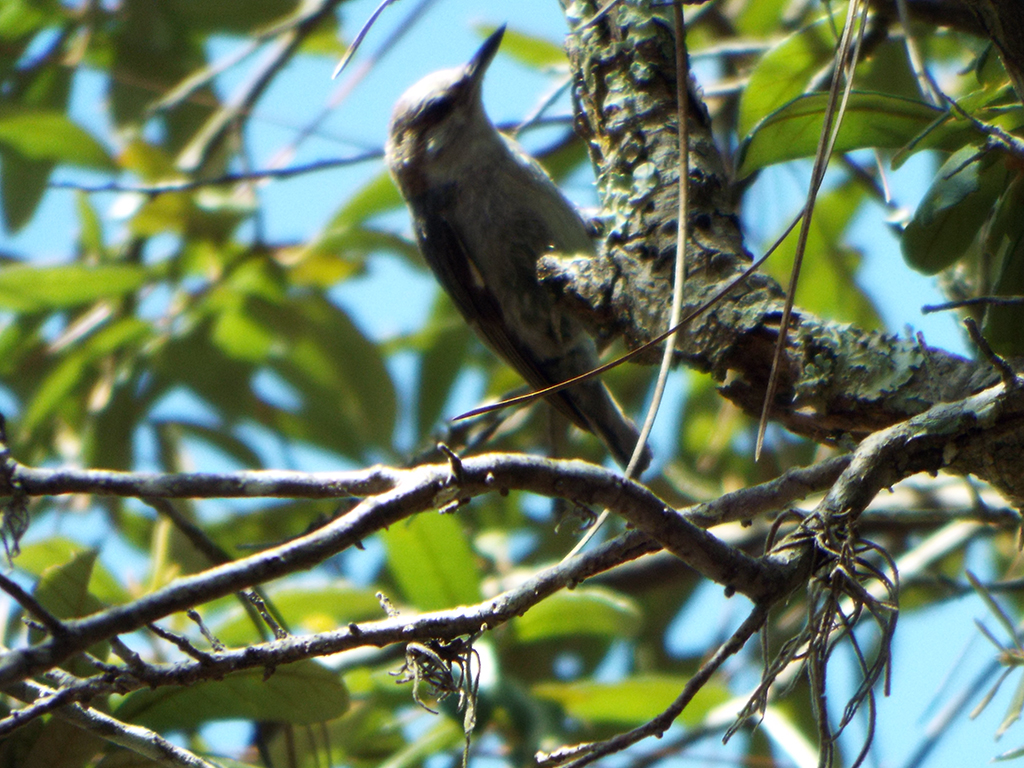
First, there were some high-pitched calls that sounded like squeak-toys. Getting out of the car near some bee hives suddenly a band of Brown-headed Nuthatches flew into the nearby pine branches.
Tiny bundle of energy.
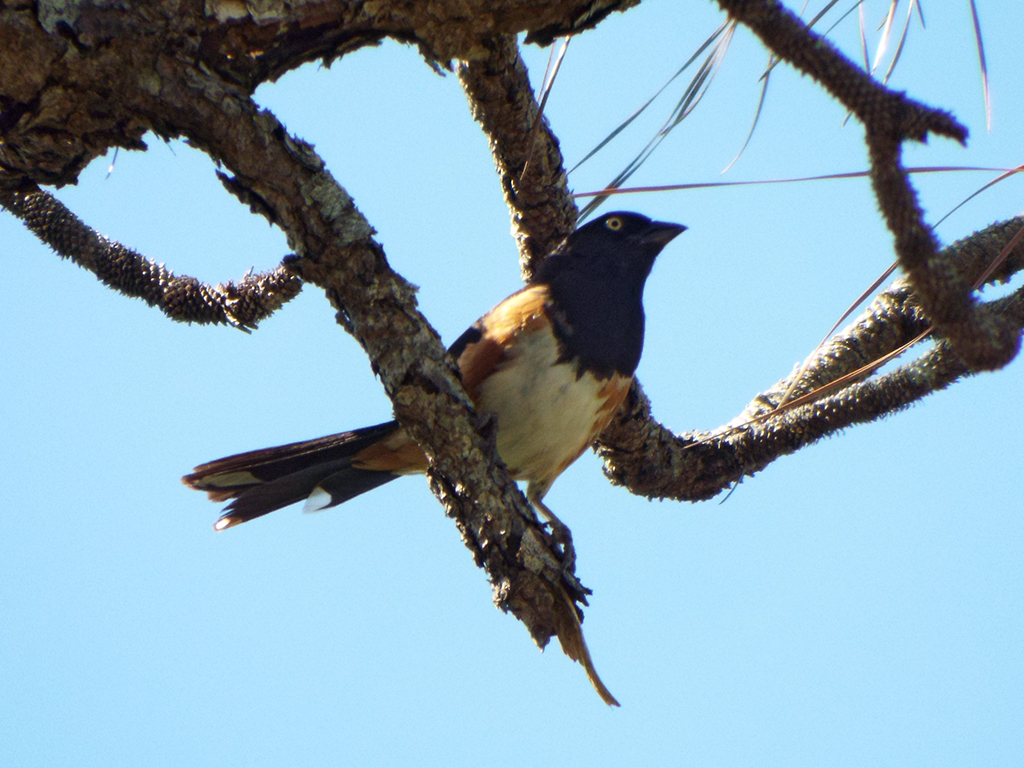
I had been hearing distant Eastern Towhees off and on all day, and finally one flew to a nearby tree, singing and fanning his tail (likely a territorial display). The woods were definitely getting more active as late afternoon approached.
Time to come out and play!
One the “Road 1” loop there was a flash of black and white, partially backlit, as a bird paralleled the car’s path down the road. It was a Red-headed Woodpecker! Soon another one was making small flights from tree to tree, barely staying in view. I was really excited. When I started birding in Massachusetts, New England was outside of the Red-headed Woodpeckers normally expected range, and I never saw one. When I went to grad school and worked in West Virginia, I never managed to see one. Even all the field trip with the Space Coast Birding and Wildlife Festival came up empty for me. So it was really thrilling to see them and to know where I can go and get some better looks in the future.
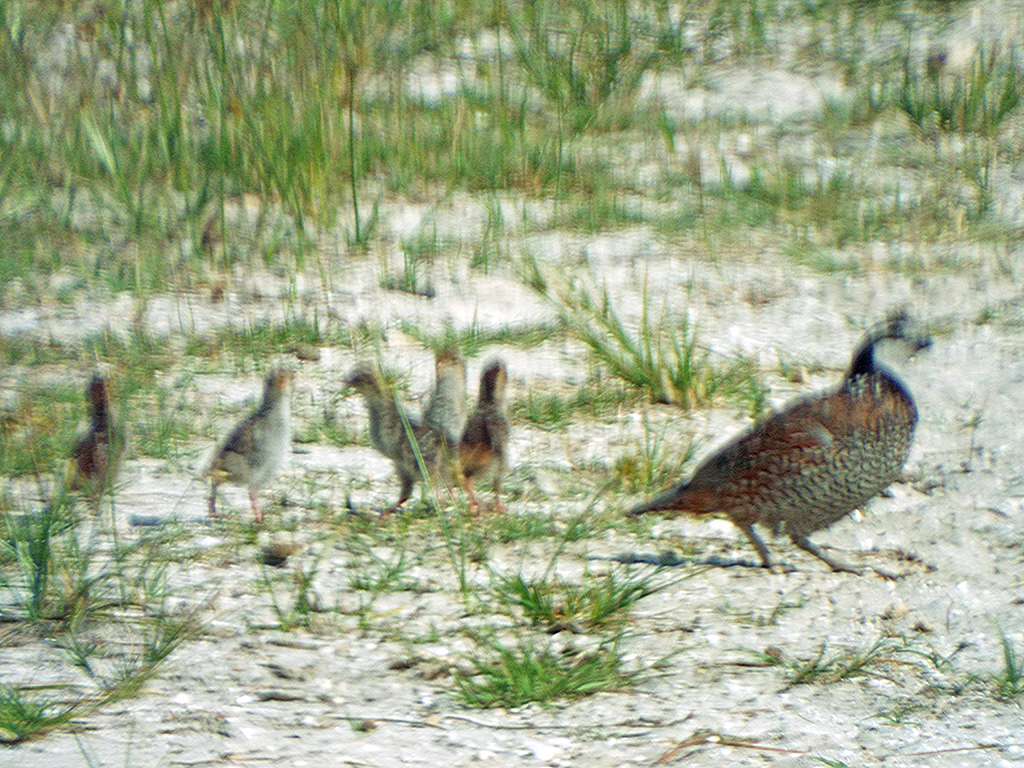
We came back out toward the main road and stopped to let a Northern Bobwhite and her chicks cross the road in front of us. She got confused, though and led them back where she had come out, the babies running for cover. I had to take the photos through the front windscreen, so these aren’t the best quality, but BABY BOBWHITES are cute! I know this photo is pretty atrocious, but look at those little babies! Something about the way they were following their mom reminded me of the beginning of The Partridge Family.
C’mon, get happy!
After that, there were quite a few Eastern Bluebirds that kept pacing ahead of the car, and a couple of Great Crested Flycatchers. We also passed various raptors coming out for their early evening patrols, including Red-shouldered Hawks and one Cooper’s Hawk.
It was a very long day – almost 12 hours of birding and I was really exhausted, but happy. Camille and I both got some life birds and got a good look at some habitat for future adventures.
There was one mystery for the day. Some time after seeing the Red-headed Woodpeckers, I heard a high, clear whistle that sounded exactly like a Carolina Chickadee song (“fee-bee bay-bay-bay-bay”). It called out several times, up in the taller pines, but I could not see it, and there were no good paths into the woods to try and track it. I know a lot of birds can sound alike, but this was very distinctive. The only “problem” is that a Carolina Chickadee at Three Lakes in June would be quite rare – even rarer than in Brevard County – but without a sighting, there’s no real way to “officially” say I got the bird. I choose to believe it was a chickadee – others, including well respected birders on the Brdbrain e-mail list say it probably wasn’t. I did get some encouragement from David Sibley (through a comment I left on a page about Titmouse songs on his web page). The bottom line is to get out there again and find that bird! Time will tell.
Here’s my species list for the entire “grand tour” for the day:
As the spring has progressed my birding goals this year have been changing focus. Some of this is no doubt from mentoring a new birder, but I think it really began back at the end of January when I was visiting Laura Erickson in Minnesota. While I try not to make any specific number a goal, most birders cannot deny the draw of seeing new birds or the same birds in new situations or locations. We mark this in different ways.
Some birders keep state, county and even city lists, for example. Laura’s adoption of Pip (the cutest birding dog around) provides Laura a fresh start with listing birds from an adorable puppy’s perspective. Some birders tweak their personal rules to make sure they count both sexes or tick off juveniles or fledglings. In any case, we are driven by the allure of new experiences and change. I’ve mentioned before how this sometimes conflicts with my urge to compare locations across time. If you’re often birding the same locale, you have less time to find new places, so there’s always a need for balance.
I’ve decided to shift the focus a little from location-based birding to species-based birding. Since I “ticked off” some boreal species this winter, I’m focusing more on finding species in the area I have not yet seen, and then finding places (or “hotspots” to use the eBird lingo) where they are likely to be found.
One group of birds I have have very little experience with are rails. Sure, I’ve seen several Soras, and I can count the Black Rail I heard two Januaries ago at the Space Coast Birding and Wildlife Festival. Coots and Gallinules are of the same family as rails, too. But I’d really like to see “prototypical” rails, such as King, Clapper or Virginia Rails.
I put the call out on the Brdbrains e-mail list that I was wanting to see rails, and that I would welcome any suggestions for location. I got a reply from someone saying that a friend of theirs was “regularly” seeing a King Rail and some chicks at the Viera Wetlands (that’s the Ritch Grissom Memorial Wetlands at Viera for the pedants).
In order to catch most rails, it’s best to go early or stay late, conventional wisdom says. How early?
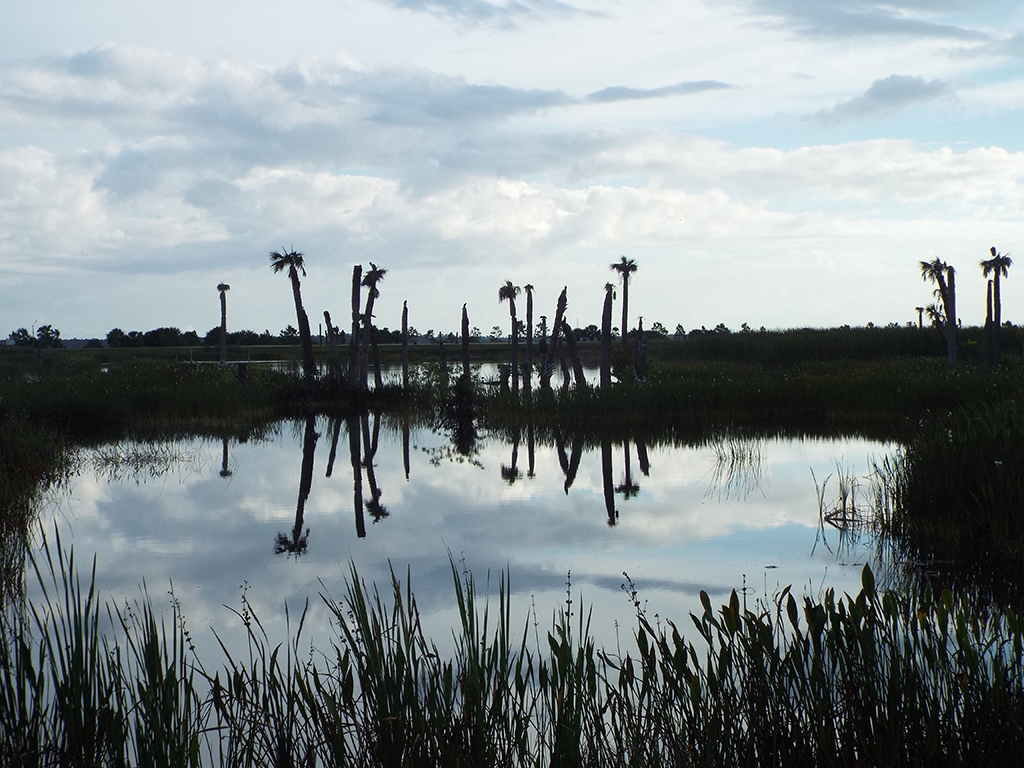
Viera Wetlands just after sunrise, when the lighting is dramatic, but maybe not the best anything other than silhouettes.
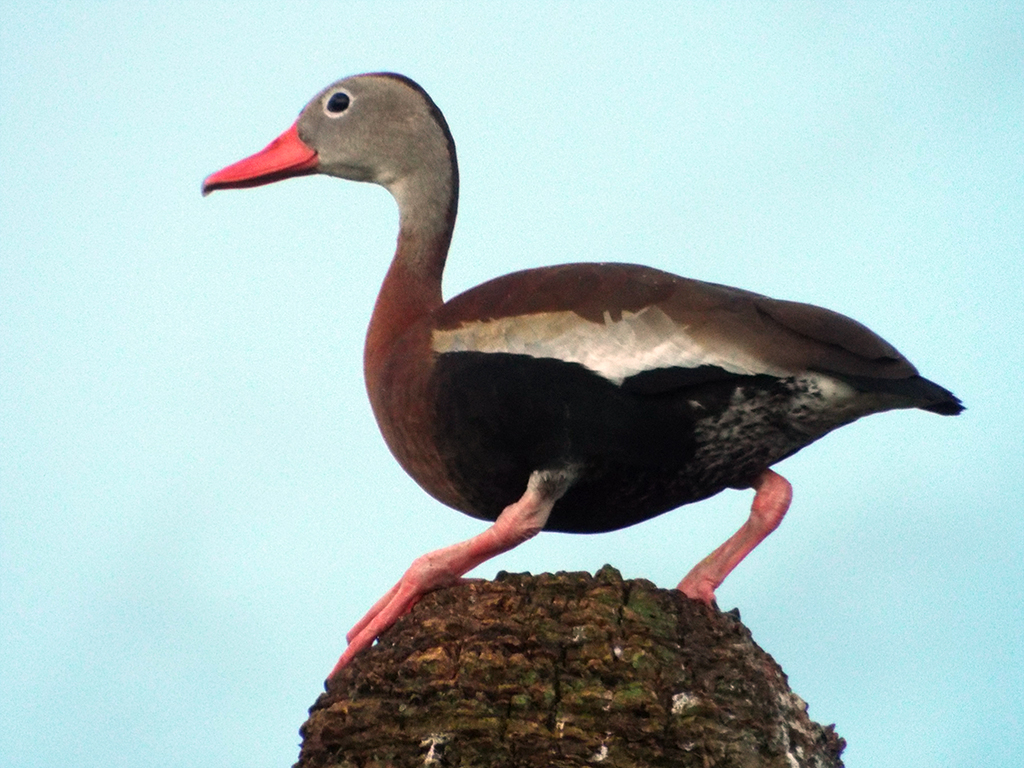
There was a good scattering of Black-bellied Whistling Ducks around most of the property, and my new camera doesn’t do too shabby in low light – at least once the sun angle is right.
Black-bellied Whistling Duck hanging on tightly to his tree.
I waited near the area described in the Brdbrains e-mail, but it seemed to me it was the quietest area in the whole Wetlands. I indulged one impulse to play a King Rail call and listen for a response, but I heard nothing. I decided to walk roads around the inner part of the Wetlands as the sun crept higher.
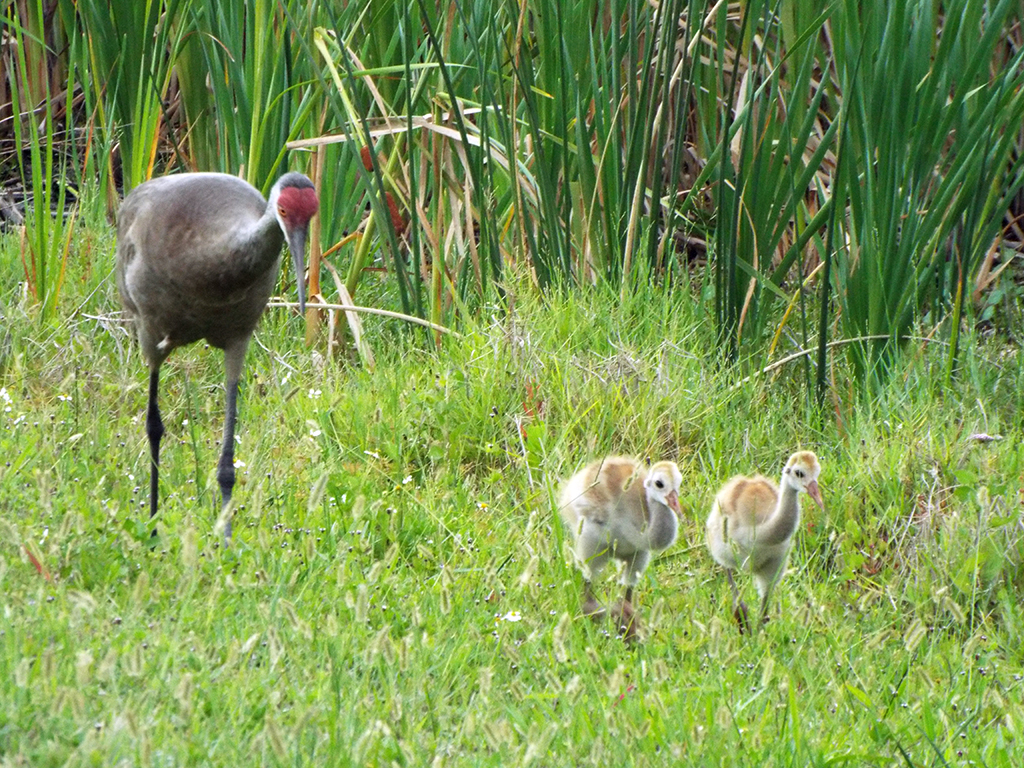
At least one pair of cranes is raising chicks at the Wetlands this year. I’ve noticed far fewer crane chicks this year then the past two. I wonder if it has to do with how wet our winter and early spring were, here on the Space Coast. Many of the nesting sites I am familiar with were inundated well into spring, so I am guessing many nest sites were just inaccessible. It’s possible some crane couples are starting their broods late this year, now that the water levels have gone down.
Mother crane and her two kids (Dad was off to the right).
The rookery island was busy with the usual Cattle Egrets and Ibises, with Anhingas thrown into the mix. The birds were getting their mornings going and having breakfast. There were Common Gallinules along many marsh edges, and some Least Bitterns were awkwardly flying in and out of the reeds. Many other herons and egrets were stalking prey or bickering among themselves, too. Male Red-winged Blackbirds were already displaying and chasing females around, and the Boat-tailed Grackles were piping and clicking away. One Crested Caracara soared quickly overhead, too.
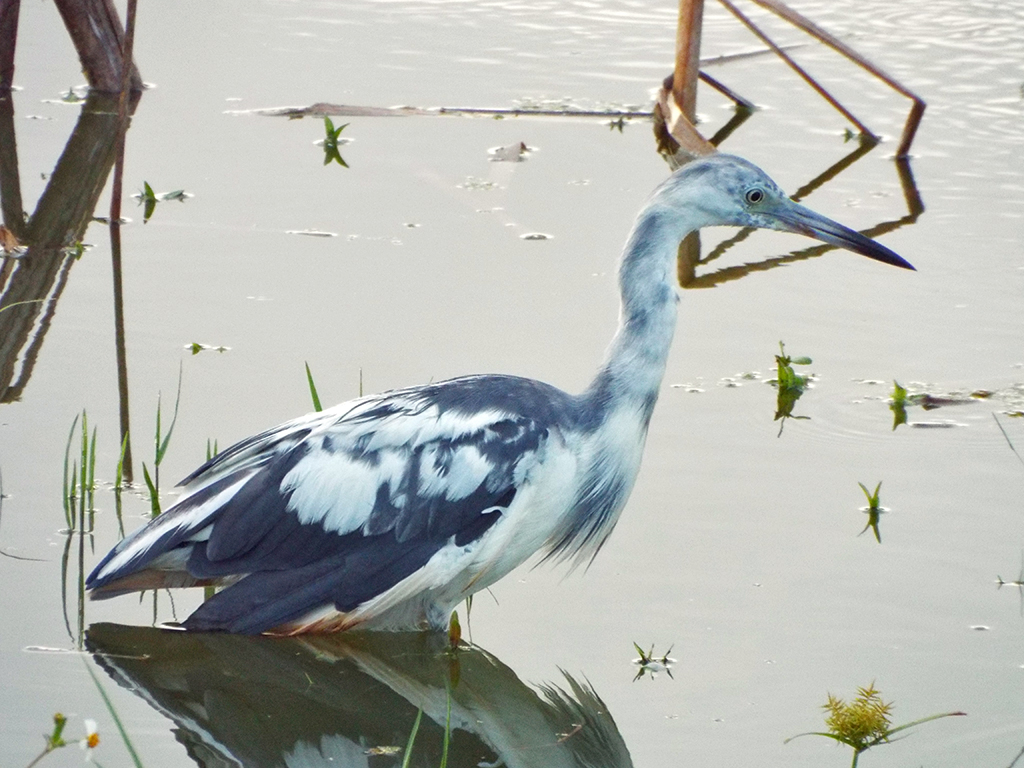
Little Blue Heron in transitional plumage.
It was clear I would not be seeing any rails, after spending a total of an hour or two at the Wetlands, I drove down to the Moccasin Island Tract to see what might be happening there.
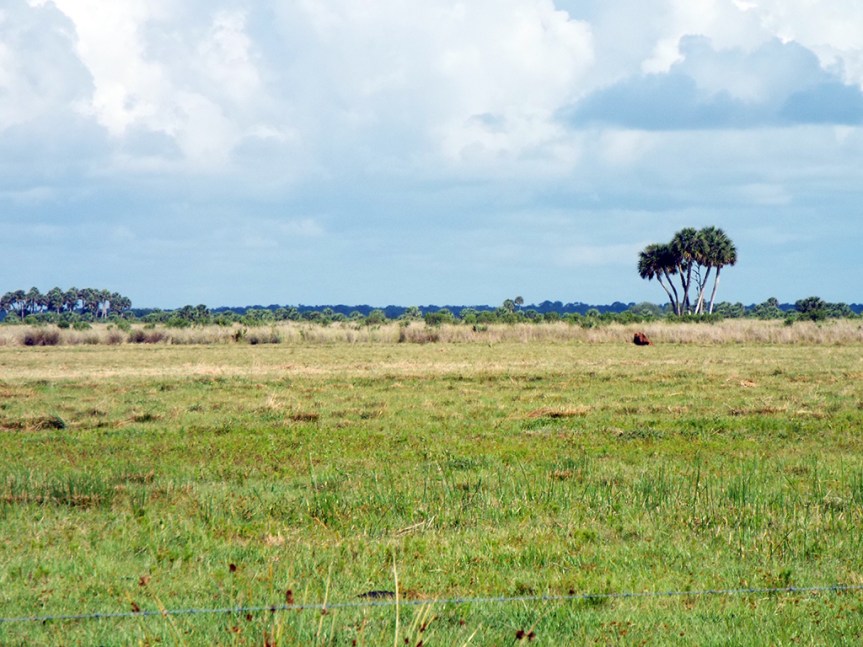
Home on the range.
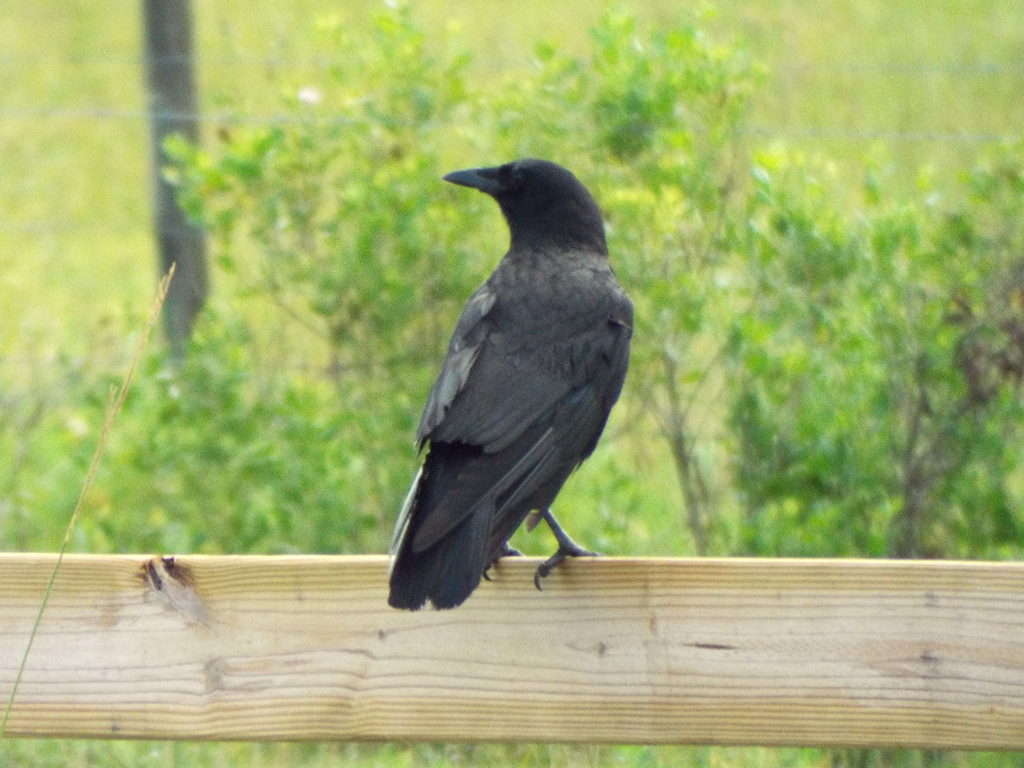
As I pulled into the parking area, a pair of American Crows was on the wooden fence, calling out loudly. They seemed a little perturbed at my arrival, so I parked on the south side of the lot. I wanted to walk the north corridor for about a half hour or so before heading back, which meant walking by the crows. They turned and used about a half dozen or so vocalizations in my general direction as I got closer. They flew off to the opposite corner of the lot, calling loudly. I called out “sorry guys!” as they flew off and went out of the parking area and started up the trail.
After I got several hundred feet up the trail, I could hear the crows calling behind me and some faint muffled thumps that sounded suspiciously like Saturn plastic door panels being whacked. I turned to see two crows attacking my car. In my binoculars I saw them attacking not just the mirrors and windows, but the windshield wipers, wheel covers, spoiler and tires. As I jogged closer, yelling they turned to vocalize at me (again, using several different calls). One even hopped on the roof and then slid down the back window, nails making screeching sounds all the way, several times. They defecated on the windshield and hood. I chased them off and one went off to the west and one circled by me and landed in the parking area a short distance away. To make my point, I ran after it. It flew off, slowly, just keeping ahead of me, calling out as I cursed at it. It finally flew off.
I stayed by the car for a few minutes as they met up on some posts up the northern trail and called out to each other. I eventually headed slowly down the southern trail instead, looking back a few times, but I think they left the car alone at that point.
Wanted for property damage misdemeanor.
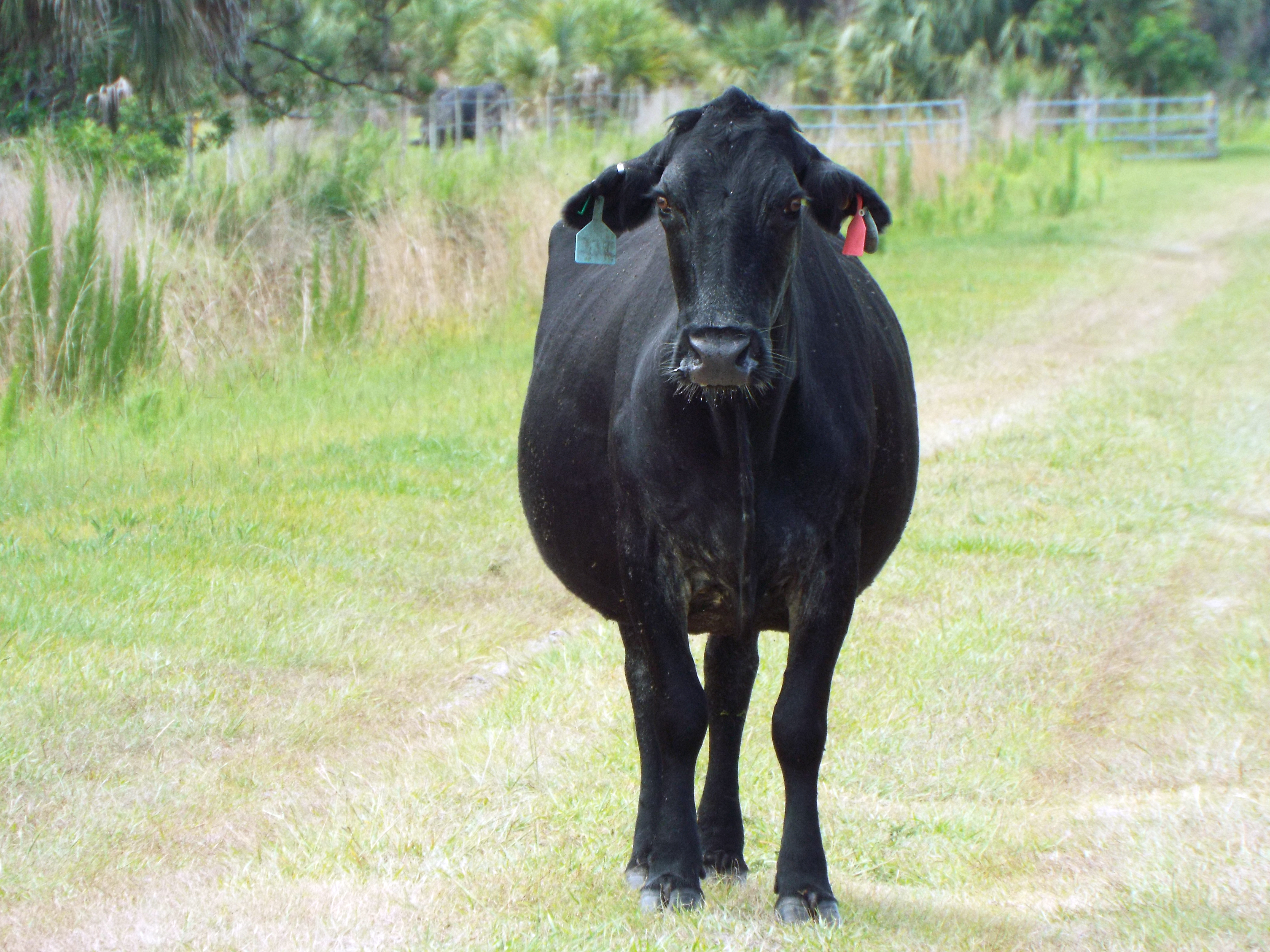
Two cows somehow managed to get on the wrong side of the fence and were pacing back and forth trying to figure out how to get back. They’d turn to face me, which gave me a slightly anxious feeling. I don’t generally have a fear of cows, but these are large animals whose intelligence might just take a back seat under high stress.
1,000 pounds of docile probably still hurts.
In the end, they generally stayed out of the way, even stubbornly so (there was another cow and a calf pacing along with them on the “right” side of the fence, but any time I tried to open a gate to reunite them, the two cows on the “wrong” side of the fence would freak out and run). I had to give up on any altruistic notions, and returned my attention to the birds.
There were a few Cattle and Great Egrets among the grazing and lazing cattle, plus a few vultures. The Eastern Meadowlarks were the most visible and vocal of the birds I saw. Many were busy rooting beetles and grubs out of the ground or snagging grasshoppers. I think they’d eat just about anything small, flying, and crawling.
“Hmmm. Must be time for Second Breakfast.”A musical and colorful puffball.
The Bald Eagles’ nest was empty and I saw no evidence of Eagles anywhere. As I left the upper fields (those closest to the entrance) the birds became less numerous and the fields on either side of me were very silent. I decided to head back to the car and call it a day.
Between the Wetlands and the Moccasin Island Tract, here’s the list of species for the day:
Northern Mockingbird
Black-bellied Whistling Duck
Roseate Spoonbill (just outside the Wetlands)
Red-winged Blackbird
Boat-tailed Grackle
White Ibis
Turkey Vulture
Double-crested Cormorant
Red-shouldered Hawk
Limpkin
Great Blue Heron
Anhinga
Glossy Ibis
Northern Cardinal
Loggerhead Shrike
European Starling
Common Gallinule
Pied-billed Grebe
American Coot
Sandhill Crane
Great Egret
Crested Caracara
Fish Crow
Least Tern
Osprey
Carolina Wren (♫)
Least Bittern
Snowy Egret
Little Blue Heron
Tricolored Heron
Green Heron
Black-crowned Night Heron
American Crow
Eastern Meadowlark
Black Vulture
Summer is generally considered a “slow” time for birding in Florida, but there’s always something going on if you know where to look. Like my brief detour in Orange County, there are birds breeding and raising young here. There are still heron chicks on the nest at the Wetlands, and the rookeries are noisy and busy. It just takes a bit more patience.









 Lonely Birder