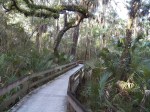
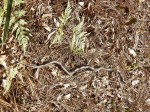
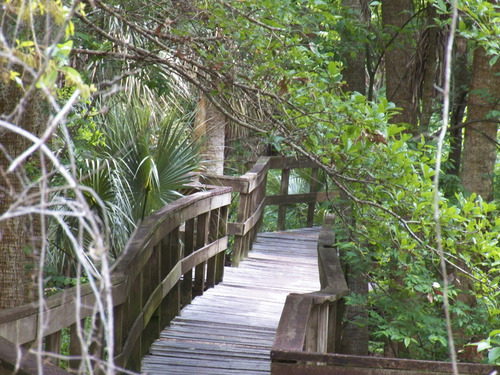
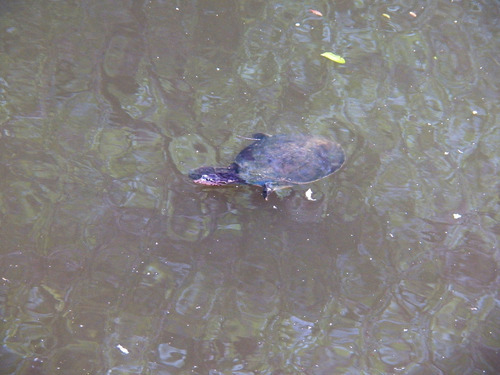
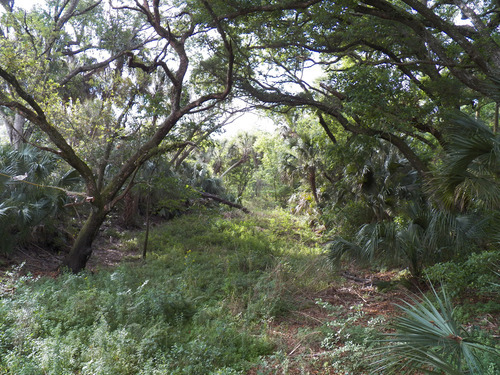
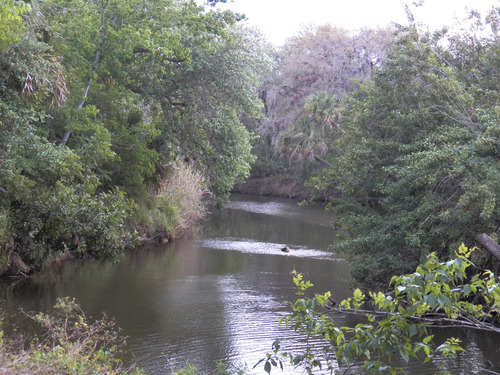
I went to Erna Nixon Park this morning to see what was happening there. At the first “Vista” stop along the boardwalk, there’s an overlook of some reedy vegetation and some grasses, adjacent to a pond that there is no path to get at. In that area I had the most success today. There were several Ruby-throated Hummingbirds (males and females, a lot of bickering), what sounded like House Wrens, and at least one Common Yellowthroat (which came quite close, but I was unable to capture on camera). Further along the boardwalk I did see a single male Northern Parula, and along the fire-path along the northern edge of the property was a nice little gathering of Blue-gray Gnatcatchers. The usual Northern Cardinals, Mourning Doves and Fish Crows were also in evidence. I did get a nice shot of a snake (not sure what species). Also heard some Carolina Wrens, but they stayed well out of sight.

Viera Wetlands/Moccasin Island, Part II: Moo for Meadowlarks!

The Moccasin Island Tract is part of the River Lakes Conservation Area and is adjacent to the Viera Wetlands. Where the Viera Wetlands are, well WET, the Tract is an upland area. In fact, much of the land around the Tract is a cattle ranch.

image

Cows ahead

image

Florida looking very Western (except for the palms). Click to enlarge

Of course, Stitch was with us.

image

Cedric took this photograph of me on a concrete bridge just near the entrance to the path we took into the Tract. Based on the trail map, there are quite a few miles of trails, but we stuck to one straight road and hiked in about a mile or so.

image

Look at me! Binocs AND camera! Starting to look profesh!

We came here to have a look at cows (and birds). We must have been on the right track.

image

Hey, man. Look at that hay.

The most obvious indication of any birds in the area was the beautiful flute-like song of the Eastern Meadowlark. In fact, this seemed to be THE bird of the day here. Every few fence posts and there was a meadowlark, singing away.

image

One of the many Eastern Meadowlarks that stake out the Tract

There wasn’t much else obvious in the way of birds, but with some careful listening, I caught a glimpse of some Red-bellied Woodpeckers and at least one Northern Mockingbird. As we walked up to a bit of remnant water off the side of the trail, we saw these two cute baby alligators!

image

Little Monsters

Cedric wondered aloud if Momma Gator was around, but these seemed a bit big to have Momma still watching them, but we scanned around just in case. Here’s a closer look at one of them.

image

What a beauty!

I had expected to see some caracaras over the upland areas, and I did see one. It must have been from the same camera-dodging clan as the ones in the Wetlands, so I didn’t manage to catch a photo of it. As I said, this is ranch land, and there were cows!

image

Cows of a feather flock together?

The cows were very interested in what we were doing, but kept their distance.

image

Curious Cows

image

Far away.

image

You lose something over here, Hondo?

The sky was gorgeous, and we had a tremendous time of it, but we had to head on out.

image

Big Sky Country, Florida style.

Thanks for the fabulous time, Cedric.

Viera Wetlands/Moccasin Island, Part I

Today I went to the Viera Wetlands and the neighboring Moccasin Island Tract (part of the River Lakes Conservation Area) with my friend Cedric. This picture of him was taken at our second stop, which you can see in Part 2.
imageHere’s the handsome guy

Cedric is not a ‘birder’; per se, but he’s a smart guy and loves to learn new things. He actually invited me to go birding today, which was a pleasant surprise.

Our first stop was the Viera Wetlands. A conservation area born out of the area’s wastewater management, for years now the Wetlands have been a haven for birds throughout the year, but in particular for birds that tend to favor marshlands and their surroundings. I’ll spare you the details, just visit this page to learn more.

Here are some highlights of the Wetlands portion of our outing.

Right off we saw some Red-winged Blackbirds chasing each other around in territorial displays and in hope of mating. Here’s one resting on a sign near the area in which we parked.
image
Pay attention to this Red-winged Blackbird
image
Pied-billed Grebe

There were several Pied-billed Grebes throughout the various ponds (“cells”), some alone, some in pairs.

At this point, a Crested Caracara surprised me and went past, too fast to get a shot. I love these guys, and it’s always a pleasure to see them in numbers. And in numbers they are! There were at least 1/2 a dozen individuals by my best estimate. But I couldn’t manage any photographs (but got great binoc views!).

image
American Coot (foreground) and Common Gallinule

As is typical through the Winter and early Spring, coots and gallinules were quite plentiful in most cells. I did not see any Purple Gallinules today. I don’t know why they were not there, but I’ll try to find that out.

image
White Ibis in flight

I’m proud of the above photograph. White Ibises are common enough, even in residential neighborhoods, but it’s really neat to see them in a more “natural” type habitat. This was my first attempt at a motion shot with my new camera.

More Crested Caracaras went by at this point, doing their level best to dodge my camera.

We came across some Glossy Ibises and a couple of unidentified shorebirds (perhaps a snipe?) and sparrows (what some birders affectionately called “LBJs” for “”Little Brown Jobs.” Savannah Sparrows seemed plentiful along most of the path edges throughout the morning.

image
Savannah Sparrow

This Tricolored Heron was one of several heron and egret species present throughout the Wetlands. We saw Green, Little Blue and Great Blue Herons. There were Great and Cattle egrets too. Many of these were in full breeding regalia, which was quite impressive. Also, below is a shot of a more immature Great Blue Heron that was stalking about the place.

image
Tricolored Heron with breeding plumes
image
Immature Great Blue Heron

This next picture is of one of a number of warblers seen along the path edges. Based on behavior and plumage indications, I want to say this is a Palm Warbler beginning to get it’s breeding plumage, but I am not sure. If anyone reading this blog can positively identify this bird, would you please let me know?

image
Perhaps a Palm Warbler?

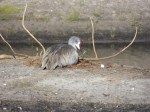
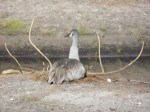
As we rounded the paths to head back to the car, Cedric pointed out some Sandhill Cranes rather close to us. To my surprise was the cutest thing EVER! LOOK!

image
Sandhill Crane parent and baby!
image
Sandhill Crane family

So awesome!

This handsome fellow swam by, too

image
OMG, alligator!

On the final walk out to the car, I finally got a shot of a Crested Caracara. These guys had been swooping around all morning. This one has a rather nasty bit of fish remains in his beak. But hey, scavenging is essential to any healthy ecosystem (even a human created one like this).

image

With that, we headed out to the Moccasin Island Tract and some upland habitat adventures. Oh. And cows.

Part II to come.

Viera Wetlands/Moccasin Island, Part I: Crazy About Caracaras!

Today I went to the Viera Wetlands and the neighboring Moccasin Island Tract (part of the River Lakes Conservation Area) with my friend Cedric. This picture of him was taken at our second stop, which you can see in Part 2.
imageHere’s the handsome guy

Cedric is not a ‘birder’; per se, but he’s a smart guy and loves to learn new things. He actually invited me to go birding today, which was a pleasant surprise.

Our first stop was the Viera Wetlands. A conservation area born out of the area’s wastewater management, for years now the Wetlands have been a haven for birds throughout the year, but in particular for birds that tend to favor marshlands and their surroundings. I’ll spare you the details, just visit this page to learn more.

Here are some highlights of the Wetlands portion of our outing.

Right off we saw some Red-winged Blackbirds chasing each other around in territorial displays and in hope of mating. Here’s one resting on a sign near the area in which we parked.
image
Pay attention to this Red-winged Blackbird
image
Pied-billed Grebe

There were several Pied-billed Grebes throughout the various ponds (“cells”), some alone, some in pairs.

At this point, a Crested Caracara surprised me and went past, too fast to get a shot. I love these guys, and it’s always a pleasure to see them in numbers. And in numbers they are! There were at least 1/2 a dozen individuals by my best estimate. But I couldn’t manage any photographs (but got great binoc views!).

image
American Coot (foreground) and Common Gallinule

As is typical through the Winter and early Spring, coots and gallinules were quite plentiful in most cells. I did not see any Purple Gallinules today. I don’t know why they were not there, but I’ll try to find that out.

image
White Ibis in flight

I’m proud of the above photograph. White Ibises are common enough, even in residential neighborhoods, but it’s really neat to see them in a more “natural” type habitat. This was my first attempt at a motion shot with my new camera.

More Crested Caracaras went by at this point, doing their level best to dodge my camera.

We came across some Glossy Ibises and a couple of unidentified shorebirds (perhaps a snipe?) and sparrows (what some birders affectionately called “LBJs” for “”Little Brown Jobs.” Savannah Sparrows seemed plentiful along most of the path edges throughout the morning.

image
Savannah Sparrow

This Tricolored Heron was one of several heron and egret species present throughout the Wetlands. We saw Green, Little Blue and Great Blue Herons. There were Great and Cattle egrets too. Many of these were in full breeding regalia, which was quite impressive. Also, below is a shot of a more immature Great Blue Heron that was stalking about the place.

image
Tricolored Heron with breeding plumes
image
Immature Great Blue Heron

This next picture is of one of a number of warblers seen along the path edges. Based on behavior and plumage indications, I want to say this is a Palm Warbler beginning to get it’s breeding plumage, but I am not sure. If anyone reading this blog can positively identify this bird, would you please let me know?

image
Perhaps a Palm Warbler?

As we rounded the paths to head back to the car, Cedric pointed out some Sandhill Cranes rather close to us. To my surprise was the cutest thing EVER! LOOK!

image
Sandhill Crane parent and baby!
image
Sandhill Crane family

So awesome!

This handsome fellow swam by, too

image
OMG, alligator!

On the final walk out to the car, I finally got a shot of a Crested Caracara. These guys had been swooping around all morning. This one has a rather nasty bit of fish remains in his beak. But hey, scavenging is essential to any healthy ecosystem (even a human created one like this).

image

With that, we headed out to the Moccasin Island Tract and some upland habitat adventures. Oh. And cows.

Part II to come.
Went With The Wind!

Continuing my adventures from Part 1, after walking McKinnon’s Way, I came out by a pumphouse just down from the Scrub Trail. The wind was doing some pretty funky things! These Mourning Doves were hanging onto this wire for dear life! But as you can see, sometimes the gusts seemed very localized. The bird on the left is really getting it, while the one on the right seems fairly unperturbed by the gust:

image

Hang on there, little fella!

From there, I headed to the scrub trail, along the jogging path.

I caught a very inexperienced looking Red-shouldered Hawk over a small clearing on the other side of some thick brush. It seemed to have a fair bit of white fluffy feathers near its tail, so I assume it was a juvenile (though the rest of the plumage was adult, and I have never seen that much puffy proliferation of feathers). It was odd, but it moved on after scattering whatever birds were present and sending the throngs of cardinals into a frenzy of chipping notes.

By this point, the wind was so bad, I figured my observing was over with for the day, but I heard more persistent “per-chick-oo-chick” calls from the White-eyed Vireos. While on one of the walks with Laura Erickson at the birding festival, she mentioned that if you see a warbler or vireo, scan around, because there are probably more birds hanging around.

She was right!

A benefit of birding alone is perseverance. When the group wants to move along, you can stay and wait it out. I could hear the vireo right in front of me, but I could NOT find it for the longest time. But in my scanning for it (both with the unaided eye, and with my binoculars), I caught a flash of yellow and black. It wasn’t enough to ID, but I stuck with it. After several minutes, not only did I catch another White-eyed Vireo, I got a glimpse of a male Prairie Warbler, a first for this year.

There was also some dusky looking small birds with faint streaking that I could not ID, and some very irritated sounding Blue-Gray Gnatcatchers.

From there it was off to the Scrub Trail, but the wind was really roaring by then, and apart from some vultures having a grand time of it, wheeling through the sky, it was time to go. Here are a couple of shots of the Scrub Trail.

imageimage

Not a bad morning, especially considering the weather.

I also learned that getting snaps of birds is REALLY hard with the branches swaying like a drunken construction crane. Hopefully I’ll get some shots next time when things are calmer.

Gone With the Wind!

It was a wild day at Turkey Creek Sanctuary today. The NWS had posted high wind warnings in anticipation of a gusty cold front about to pass through our area. I didn’t get very many bird pictures with my new camera. It was just too windy!

The morning started out breezy and ended up crazy! I managed to have a pretty good time of it, though. I managed to dodge the pelting palm fronds, and getting bushwhacked by some sort of sedgy grass things at one point was fun.

I also took out the new camera (see last post) and managed a few test shots. I don’t have an SD card yet (local shops were out of class 10 cards).

I did the Sand Pine Ridge Trail first, since that area would be harder to do once the winds picked up. I immediately got some nice views of a White-eyed Vireo, as well a the usual Northern Cardinals and a Downy Woodpecker. From there I went to the boardwalk loop.

image

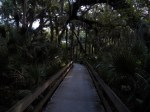
Boadwalk section at Tukey Creek Sanctuary

I didn’t have much luck along the boardwalk, except for a pair of Northern Parulas (a male and a female) and by then the wind had already started to pick up. At the canoe deck I practiced with the camera and caught this cutie down below:

image

A soft-shelled turtle!

There’s a nice sandy trail off the canoe deck called “McKinnon’s Way” that is usually pretty fun.

image

Some transitional vegetation near McKinnon’s Way

image

Overlooking the creek from McKinnon’s Way. This is where some sort of sedge stuff tried to beat me up!

More of my adventure in part 2!

Say “Cheese(y)!”

I finally scraped together the resources to purchase a camera to take with me on these lonely jaunts in the woods (or wherever). I opted for one of the “megazoom” cameras, since I haven’t the means to get a decent DSLR, and my cameras skills are … let’s just say NONEXISTANT.

The camera!

image

Smile! You’re on Lonely Camera!

This is a Kodak Easyshare Z990. The reviews on Amazon were very positive, and as a discontinued camera, the price was reasonable.

Should be fun!

March is Marching Past Me

What a crazy month, so far. Personal issues have prevented me from birding two weekends in a row now, and weekends are pretty much my only birding times right now, without taking vacation days.

[As an aside, does anyone know why I get these intermittent periods of phantom notifications on my tumblr dashboard? It’s very peculiar.]

At one point, at my parents house, I noticed a fair amount of Northern Cardinals, Northern Mockingbirds, Grey Catbirds, Palm Warblers, Common Grackles, and White Pelicans. Yes. Apparently, a decent contingent of 50 or more have been hanging around in one of the larger retention ponds in the large community my parents live in. I first noticed a flock of them the night before, flying over the house while my brother and I searched (unsuccessfully) for Comet PANSTARRS in the smoke-smeared twilight horizon. I’ve seen a LOT of White Pelicans this year.

Here’s my favorite White Pelican image, courtesy of  I Can Has Cheezburger (some years ago):

image

Introductory pelican is introducing.

SWALLOW-TAILEDS!!

I saw my first Swallow-tailed Kites of the year today! I was in a job status meeting and looked out one of the conference room windows and there they were! The Great Blue Heron might be my spark bird, and will always hold a treasured, majestic place in my heart, but Swallow-tailed Kites are my most-looked-forward-to birds of all time. I love them! 

Of course watching the pair of them did nothing for my concentration at the status meeting.  Here are a couple of shots I found online showing you this truly majestic bird.

image

Spectacular!

image

Stupdendous!

Fittingly, I think this marks my 100th species this year (whew, took far longer to get here than I thought!)