Embarrassment of Riches

I took a brief detour on my way somewhere this morning to check out a location that members of the FLORIDABIRDS-L mailing list reported as having a Western Tanager in recent days.

I stopped there and bumped into a list member, Earl, who was looking for the bird as well. I spent about 20 minutes or so, but the tanager never appeared. We did see some other birds, which I will list below.

On my way back to the car, I saw a very pale colored bird fly up from the brush along the roadside and into the top of a nearby tree. Perhaps it was the residual heady excitment of a Snowy Owl being reported near Jacksonville this winter that got into my head, but my first thought was, “Oh my goodness, that’s a Snow Bunting!” I took a few photographs of it before it flew away. I made the “honest” mistake of immediately going to the “SNOWBIRDS” page of my Peterson guide and looking at the Snow Bunting illustration to confirm my sighting. I didn’t once think to look at any potentially similar species.

My excitement was unabated until I reached my destination, and then used a laptop to upload the photographs to Photobucket and then fire an e-mail off to FLORIDABIRDS-L asking for verification of my Snow Bunting.

The responses I got were both ironicaly funny and ego-deflating. What I had seen was an American Goldfinch in winter plumage! 

Mildly embarassing, yes, but it was also funny and illustrative of the confirmation bias common in birding and in many other instances of our lives.

Here’s the otherwise rich list of birds seen this morning in 20 minutes of birding:

  • Black-bellied Whistling Duck
  • Northern Harrier
  • Eastern Phoebe
  • Blue-gray Gnatcatcher
  • Palm Warbler
  • Turkey Vulture
  • Black Vulture
  • Purple Martin
  • Tree Swallow
  • Mourning Dove
  • American Kestrel
  • Red-bellied Woodpecker
  • Northern Mockingbird
  • Bald Eagle

The unofficial 2014 species count is 48.

One week to go!

In just one week I’ll be attending various sessions and field trips at the Space Coast Birding & Wildlife Festival.

If anyone reading this is attending (or planning, though a lot of slots might be taken by now), here’s where I’ll be.

My schedule of events, beginning on next Thursday:

Thursday, January 23rd:

08:00 am – 11:30 am:  Birding with Laura Erickson
03:00 pm – 04:00 pm:  Annual Journey of the Swallow-tailed Kite*
06:30 pm – 08:30 pm:  Evening Owl Prowl at Sam’s House

Friday, January 24th:

06:45 am – 11:30 am:  Turkey Creek Tract – C. H. Bronson State Forest
                                    (This is not Turkey Creek Sanctuary)
04:00 pm – 07:00 pm:  Black Rails at the St. Johns NWR

Saturday, January 25th:

05:15 am – 11:00 am:  Red-cockaded Woodpeckers & More
12:30 pm – 02:30 pm:  Laura’s Conservation Big Year (Laura Erickson)*

Sunday, January 26th:

06:00 am – 12:00 pm:  Marl Bed Flats – Lake Jesup Conservation Area

Monday, January 27th:

06:30 am – 06:00 pm:  Pelagic Birding Boat Trip
[make-up/weather day is Tuesday, January 28th.]

* denotes classroom presentation

I’m getting excited! But dang, I am going to be getting up EARLY….

No Snow

[EDITED 2014 January 14: reports are coming in today that the owl has been sighted in the park today. Dang!]

My wife and I went to Little Talbot Island State Park this Friday in an attempt to see the Snowy Owl that had been sighted during and after the spectacular cold snap. It’s worth it to mention that the last documented Snowy Owl sighting in Florida was in 1994, during a similarly impressive cold spell (although I’ve read that there was a report in 1999 well).

Little Talbot is actually quite beautiful, a natural beach that is very close to what coastal Florida was like before tourists, hotels and bad septic systems.

But I digress. The owl had been sighted the previous afternoon about 3:30, and the rangers had the area marked off. It was about a half-mile walk to get there from the parking lot. The day started out very foggy. Visibility was less than 50 meters at times, which made trying to find the owl quite difficult. The fog only very barely lifted from the beach or dunes from time to time, up until the time we left. The owl was never sighted, and I believe she probably left now that the weather has warmed back up.

image
A landscape fit for Slenderman.

I still managed some bird identification, despite the fog, and documented some interesting behaviors. Most of the following photographs where edited in Photoshop to compensate for the fog.

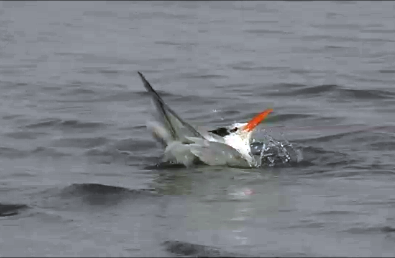
Mixed flocks of gulls and terns congregated in several places on the beach. Some were taking baths in the shallow surf. This Royal Tern seemed to especially enjoy it.

imageimage
♫Singing in the bathtub…♪

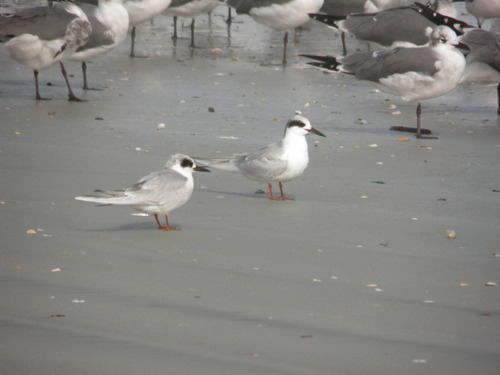
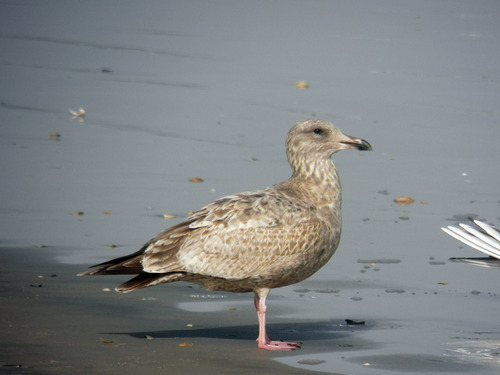
Among the Ring-billed Gulls and Laughing Gulls there were also some Forster’s Terns and a pair of 1st winter Great Black-backed Gulls.

image
A pair of Forster’s Terns.

image
Great Black-backed Gull, 1st year plumage.

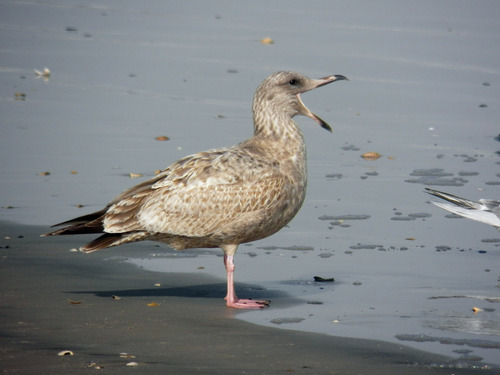
One impressive behavior I saw was when this particular gull yawned. I hadn’t realized how big of a gape gulls have!

image
Open wide!

The only shore birds I saw were sanderlings, and later on a small group of Ruddy Turnstones. The turnstones had me smiling as they did laps around a piece of a crustacean that washed up on the beach, each taking turns until one ran off with it.

Ruddy Turnstones at Little Talbot Island State Park  on Vimeo.

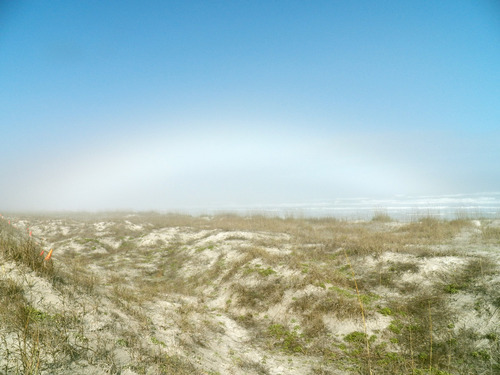
The fog along the beach made for some interesting optical effects, too. Here’s a faint glory (bright colored ring/spot centered opposite the sun) taken from the dunes near the last known Snowy Owl sighting spot. [Correction: this is actually a fog bow, not a glory. Rainbows, halos, and glories are caused primarily by refraction through water drops or ice crystals. Fog bows are caused by water droplets so fine that the light is diffracted around them, blurring the colors and spreading out the light.]

image
A glorious sight, I suppose.

Here’s the complete species list, including the drive to and from Jacksonville.

  • Hooded Merganser (mitigation pond next to motel room)
  • Palm Warbler
  • Savannah Sparrow
  • Sanderling
  • Ruddy Turnstone
  • Brown Pelican
  • Northern Mockingbird
  • Northern Harrier
  • Fish Crow
  • Ring-billed Gull
  • Laughing Gull
  • Herring Gull
  • Forster’s Tern
  • Royal Tern
  • Great Black-backed Gull
  • Yellow-rumped Warbler
  • Bald Eagle (juvenile)
  • Red-tailed Hawk
  • Pileated Woodpecker
  • Turkey Vulture
  • Black Vulture

I’ll have some more photo outtakes later this week, but that’ll do for now.

Shiny New Year

2014 is surely still new enough not to have gotten much tarnish yet, right?

So far I’ve had a couple of abortive attempts to head to Jacksonville and see the Snowy Owl that’s been at Little Talbot State Park for the past few weeks. I may get to head there on Friday, but I am not sure yet. I know every day I don’t go risks the owl departing, so that’s a bit frustrating.

Otherwise, I’ve casually seen about a dozen species so far for my 2014 species count (yes, I am doing “that” again).

The Space Coast Birding & Wildlife Festival is coming up in a couple of weeks, and I am getting excited! If anyone’s interested I’ll have a brief itinerary of my field trips and classroom sessions just because I’m feeling all social and share-y. 🙂

Pin The Tail On The Ducky

Today is (likely) the last birding adventure and blog update for 2013. I’ve done the final species audit and researched what unidentified birds I had notes on. 

I decided to make my last concerted birding effort at Merritt Island National Wildlife Refuge. Specifically, I drove the Black Point Drive loop. I have mixed feelings about Black Point. On the one hand, it is a very handy way to see birds. On the other, it’s about 40 minutes to an hour of slow driving, buring gasoline all the way, unless you turn off the engine for longer observing periods.

In any case, I drove the loop around 8:30am and managed to gain 5 new species for the 2013 count (* denotes new life-lister):

  1. Northern Pintail (they were there by the dozens!)* 
  2. Greater Scaup*
  3. Reddish Egret
  4. Bufflehead*
  5. Red-breasted Merganser*

photo pintails1.jpg
Northern Pintail males.

I was excited to see the Northern Pintails. They are very distictive and something I had hoped to see in an earlier trip to Pine Island. Of all the ducks I have seen, the pintails seemed to be the most synchronized in their foraging, so quite a few of my photographs show all the pintails with their heads underwater at the same time.

photo pintails2.jpg
Female and male Northern Pintails.

I don’t have very many good photographs, as the birds tended to stay far away, and the lighting was bad due to a very thick and low overcast. Most of what I took was for me to use later for verifying identification.

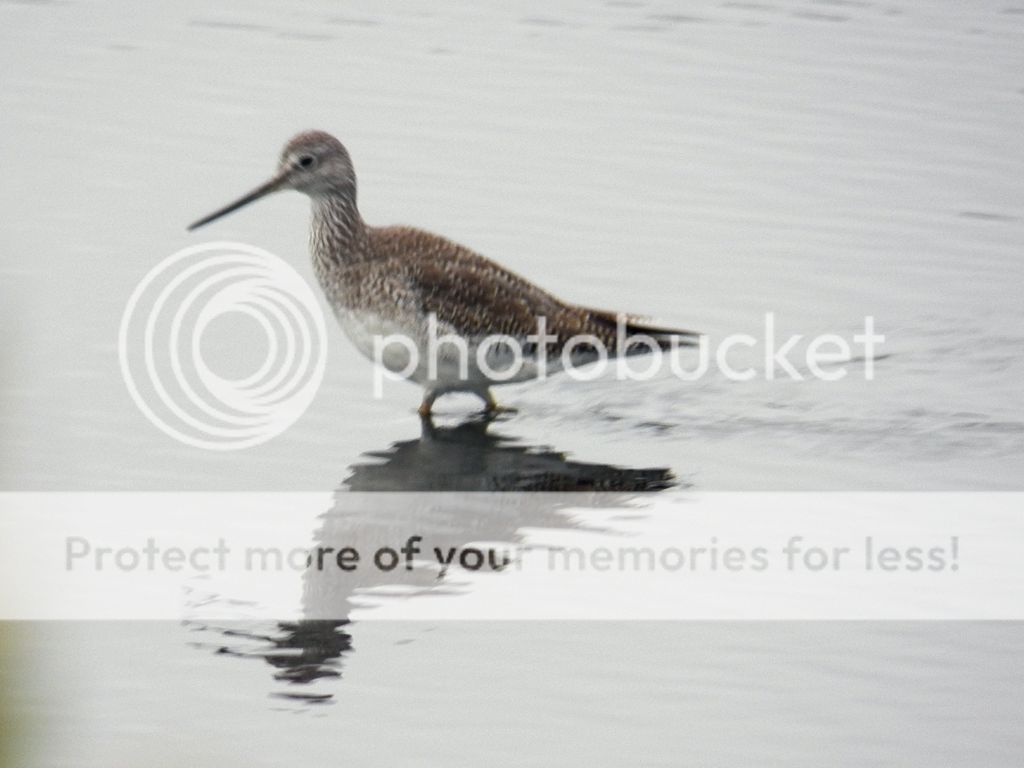
photo greater-yellowlegs.jpg
Greater Yellowlegs.

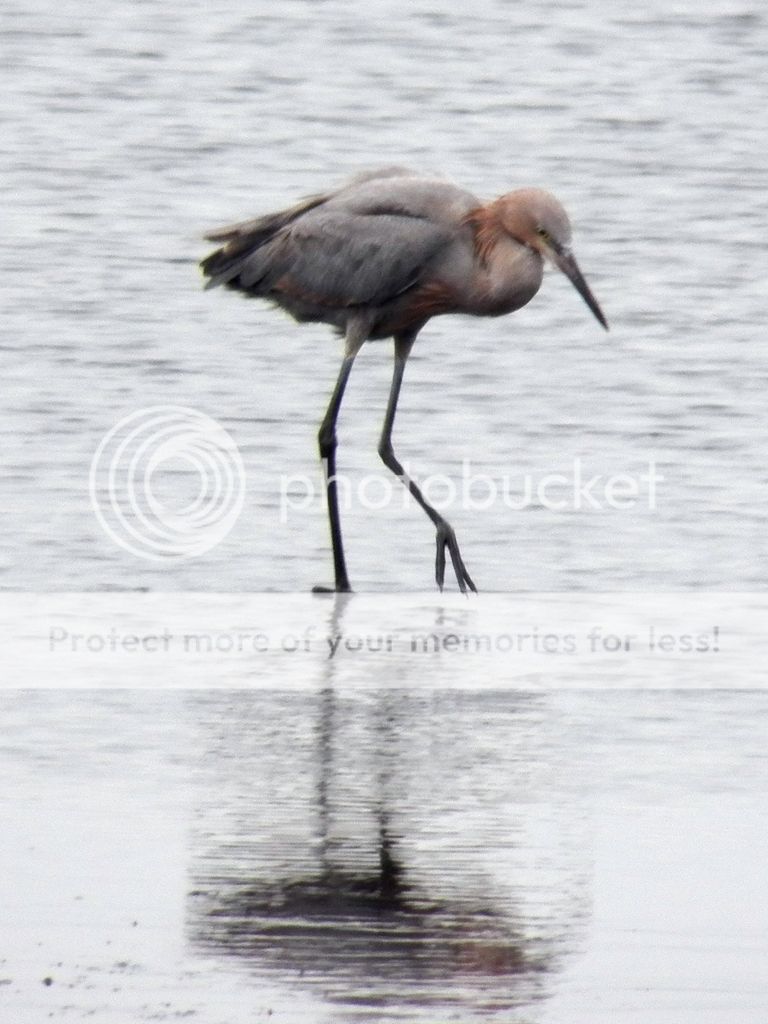
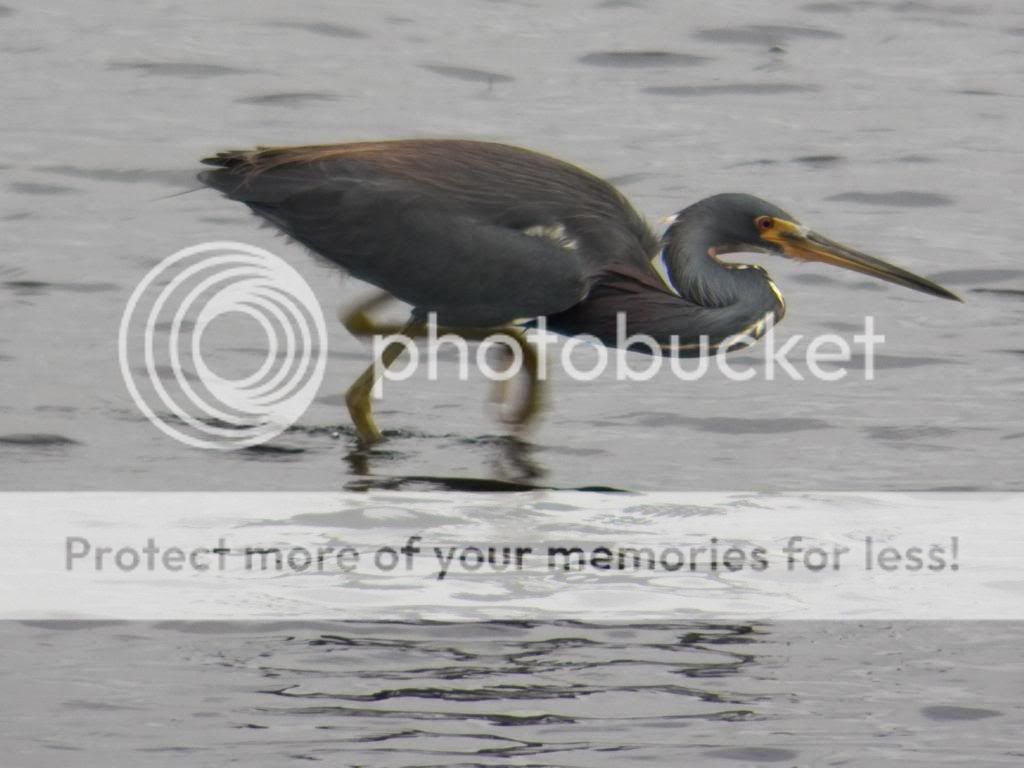
Here are some photographs of herons that came out looking pretty good, though. Interstingly (to me) I did not see a single Great Blue Heron this morning.

photo reddish-egret1.jpgphoto reddish-egret2.jpg
Two different Reddish Egrets.

photo tri-colored-heron.jpg
Tri-colored Heron lunging for food.

In addtion to the five birds listed above, I also saw the following:

  • Greater Black-backed Gull
  • Sandhill Crane
  • Willet (possibly the western subspecies)
  • Greater Yellowlegs
  • White Pelican
  • Turkey Vulture
  • Black Vulture
  • Tri-colored Heron
  • Little Blue Heron
  • Green Heron
  • Snowy Egret
  • Glossy Ibis
  • White Ibis
  • Double Crested Cormorant
  • Blue-winged Teal
  • Pied-billed Grebe
  • Northern Mockingbird
  • Boat-tailed Grackle
  • Belted Kingfisher
  • Fish Crow
  • Osprey

There were large flocks of sandpipers as well (hundreds), but they were too far away to ID even by binoculars.

photo sandpipers.jpg
Mystery Sandpipers!

The White Pelicans were numerous both in the air and rafting quietly on the water. Their size always amazes me. As with their cousins, the Brown Pelicans, White Pelican are surprsingly graceful on the wing.

photo white-pelicans.jpg
White Pelicans soar above Merritt Island.

The (likely) final 2013 species count is 149. While it’s certainly possible I might see a new bird for this year some time tomorrow thus rounding off the count to 150, I’m not counting on it (no pun intended, ha ha).

Happy, healthy and birdy New Years to all of you. Thanks for sharing in my birding adventures this year. Things will heat up pretty quick for 2014 at the Space Coast Birding & Wildlife Festival near the end of January.

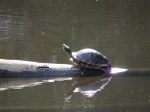
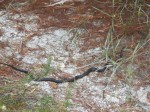
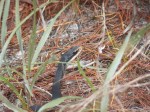
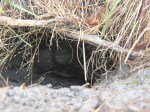
Some photos of my reptilian friends from yesterday’s walk through Turkey Creek Sanctuary.

  • Florida Red-bellied Turtle
  • Southern Black Racer (long shot and a close-up)
  • Gopher Tortoise in its burrow
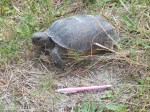
  • a different Gopher Tortoise with a pen shown for scale (a smallish individual)

Click to enlarge images.

Quiet Time

I went to Turkey Creek Sanctuary today and spent a silent walk through most of it. Besides various groups of birds flying or soaring overhead (vutures, crows and some smaller sparrows and/or warblers), I only saw 6 individual birds inside the Sanctuary, and 6 individuals upstream from the weir on the canal. That’s a pretty low bird density and count for about 3 hours.

Here’s the official list (including the overhead flyers I could positively identify):

  1. Ovenbird (1)
  2. Ruby-crowned Kinglet (1)
  3. Blue-gray Gnatcatcher (2)
  4. Turkey Vulture
  5. Black Vulture
  6. Fish Crow
  7. Northern Cardinal (2)
  8. Little Blue Heron (1)
  9. Cattle Egret (1)
  10. Pied-billed Grebe (1)
  11. Common Gallinule (3)

It was particulary noteworthy to me that I neither heard nor saw any Gray Catbirds at all. The Gopher Tortoises were out again en force, and I managed to catch a glimpse of one squirrel and one snake (a Black Racer, I believe). 

Merry Christmas and Happy Holidays everyone. Depending on my Christmas situation there may be a Christmas Count post upcoming, but I make no guarantees.

Do You Hear What I Hear?

The biggest “leap” of birding ability I made came when I started to really pay attention to the birds I was hearing, as well as the birds I was seeing. Most “expert” birders do much, if not most, of their observing by ear. Personally, I would say that sometimes well over half the birds I record and observe are first discovered by hearing them.

photo towhee-singing.jpg
..It’s just that I’d rather… just… SING!

I recently had a bit of a health scare. Last year, I noticed I was having to ask people to repeat what they were saying, and I developed tinnitus. I had a series of hearing tests over the course of several months which seemed to verify some hearing loss, especially in higher frequencies. I started to wonder if I was missing some bird calls and songs on my birding hikes.

It’s normal, as we age, to start losing our higher frequency hearing ability. From what I’ve read, this actually starts to happen earlier, on average, than we might think – by our 30s many of us are already losing the highest range. I had been blessed so far to have kept most of my higher frequency hearing, but it seemed that now as I entered my 40s, it was catching up.

image
Chart showing average hearing loss by age and gender. You can see that as a person ages, the ability to hear higher frequency sounds drops fastest.

The effect of losing one’s hearing really hit me when I’ve bumped into some very experienced birders in their 70s and early 80s. Their visual acuity never ceases to amaze me, but I noticed that, even with my nascent hearing loss, they were not reacting to most of the bird calls around us. On one visit to Turkey Creek, there was a massive commotion of Northern Cardinals giving their alarm calls. Interspersed with their calls were those of at least two other bird species. After seeing the person I was with not react at all, I hesitantly asked, “I wonder what all that noise is over?” To which my companion blankly stared at me and said, “Oh, what, you’re hearing some birds?” Hearing some birds? It sounded like the birds were expecting the Apocalypse!

We’ll all have to face up to the effects of aging, and for birders that means at some point many of us will start to lose a range of hearing that includes call notes of most warblers, sparrows and Cardinalids (as well as others).

For now, though, I have been given a bit of a reprieve. My last hearing test showed recovery of my high-frequency hearing to near to previoius levels (though my tinnitus hasn’t disappeared), and I’ve been able to still hear warblers and sparrows call while flying high overhead before dawn, the bickering of cardinals, and even the quietly beautiful bubbling of gnatcatchers.

Blue-gray Gnatcatcher softly singing.

I can only hope that when my hearing starts to fade that I can sharpen my visual ability like those of my experienced birding colleagues, who still seem to get whole-hearted enjoyment out of watching birds.