You’ll Never Walk Alone

I was a not-so-lonely birder today (Sunday) at Turkey Creek Sanctuary. After walking part of the boardwalk then McKinnon’s Way en route to the weir and canal, I first briefly bumped into Roy Book, and then Shirley Hills. Roy was on his way opposite myself and Shirley, so we waved “good luck” to Roy, and then Shirley and I headed back toward the boardwalk together.

Shirley has so much knowledge about the sanctuary and a keen eye for bird movement that birding with her is always exciting and fascinating. We hooked up with Juanita Baker, who runs the Florida Bird Photo-of-the-Month at Pelican Island Audubon. The three of us stuck together and did a few laps and back-and-forths along the side of the park near McKinnon’s Way. Although Shirley said it was much quieter compared to the previous few days, we did pretty well in terms of variety, if not numbers, of migrants.

Prior to running into my companions for the morning, I did have some luck along McKinnon’s Way. I had a very clear look at a Red-eyed Vireo, a female Ruby-throated Hummingbird, and an extensive hide-and-seek game with a mystery warbler.

photo f-btbw.jpg
Fall warblers can indeed be quite confusing. This little girl had me preplexed all day.

I speculated with Shirley that maybe this was either a Tennessee Warbler or an Orange-crowned Warbler. Shirley doubted the latter, due to timing, but as she has seen some Tennessee Warblers at her house, she thought that was a possibility. Keen-eyed readers will see, from the photographic evidence that it was a female Black-throated Blue Warbler. I was finally able to satisfy myself as to the ID of this bird thanks in part to The Warbler Guide, which provides a variety of diagnostic, partial views of all the warbler species. There was a decent sprinkling of Black-throated Blues in the sanctuary, and it was still a nice observing session, but I haven’t seen a Tennessee or an Orange-crowned yet this year.

The big hits for me were my very first (finally) Prothonotary Warbler, a small flock of Blackburnian Warblers, and the sanctuary’s first Blackpoll Warbler of the autumn.

Juanita asked me some questions about my bird photographs and my blog. She asked if my photographs were “documentary” or “nature photographs” (by which I think she meant what I call “glamor shots”). I told her that I consider them “geographic” photographs, in that they tend to show the bird in its place and habitat. The few clear photographs I took this morning are proof of that, as you can see. If you are interested in some great glamor shots, I highly recommend seeing my friend Corey Finger’s photographs over at 10,000 Birds [10000birds.com].

photo prothonotary.jpg
This Prothonotary Warbler was shy at first, but saved its best views for my binoculars.

Black-and-white Warblers are back now, and they allowed us to get quite near to them. Most of the birds at Turkey Creek of late have been quite skittish, probably due to low numbers, but as the Black-and-whites are winter residents, perhaps they feel more comfortable.
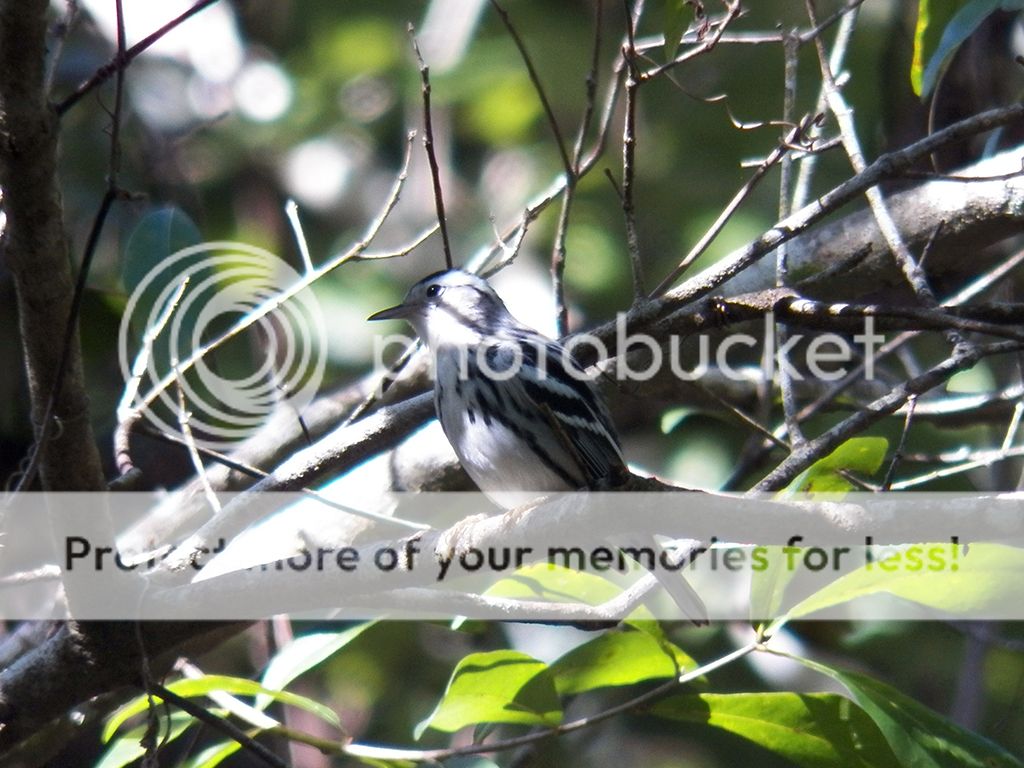
photo bww.jpg
Greetings, my monochromatic friend. So we meet again.

Along the jogging path, we were able to get quite close to this Downy Woodpecker as he foraged for insects on this sapling. At first, he tried to sidle around the backside of the little tree to hide from us, but as this was clearly futile, he gave up and just went back to feeding.

photo downy.jpg
Bug flavor must really be worth the taste of tree bark!

The creek level was still quite high, but receding. There were manatees along a good section of the creek, but few turtles in evidence. I also caught a very brief glimpse of what may have been a Short-tailed Hawk (dark morph), but it ducked into the canopy amidst a flurry of Blue Jay and Northern Cardinal calls.

On our way out, as we watched a small grouping of American Redstarts (they continue to be relatively numerous in the sanctuary), we saw this Yellow-throated Warbler skulking in and around some palm fronds.

photo yellow-throated.jpg
This warbler actually followed us along the boardwalk for a bit.

Birding with Shirley and Juanita was a lot of fun, and I think we did well, considering the state of the migration through Turkey Creek in recent years. The verifiable list for the morning follows:

  • Fish Crow
  • White Ibis
  • Blackpoll Warbler
  • Carolina Wren
  • American Redstart
  • Northern Parula
  • Red-eyed Vireo
  • Ruby-throated Hummingbird
  • Blue Jay
  • Mourning Dove
  • Common Ground Dove
  • Snowy Egret
  • Tri-colored Heron
  • Green Heron
  • Great Blue Heron
  • American Coot
  • Black-throated Blue Warbler
  • Cape May Warbler
  • Yellow-throated Vireo
  • Blackburnian Warbler
  • Prothonotary Warbler (*)
  • Yellow-throated Warbler
  • Blue-grey Gnatcatcher
  • Northern Cardinal
  • Downy Woodpecker
  • Black-and-white Warbler
  • Red-bellied Woodpecker
  • Pileated Woodpecker (♫)
  • Northern Mockingbird
  • Red-shouldered Hawk (♫)

As you can see from today’s photographs, not too much in the way of glamor shots, but by working with my camera’s limitations and capabilities, I think I capture the moments pretty well.

How rare is rare?

Just a quick update. I went for a quick walk through Erna Nixon Park before work this morning and had a couple of nice surprises. As the sun was rising I heard 2 distinct individual Eastern Screech Owls some distance away. They were alternating with each other, using a trill on a single pitch (rather than a whinnying call). Then as I was nearing the mid-point on the boardwalk I clearly heard at least 2 Carolina Chickadees calling. I know that Carolina Chickadees are rare for central and southern Brevard County, but this was a 100% certainty for me. Interestingly, when I posted my finds to the BRDBRAIN list, I got some lip from a fellow birder that this bird is SO RARE as to be unlikely, I suppose, but he was “Just saying”. Sometimes I wonder why I don’t just rage quit these e-mail lists.

Anyway, here’s the list:

  • Carolina Wren
  • Northern Cardinal
  • Yellow-throated Warbler
  • Blue-gray Gnatcatcher
  • Carolina Chickadee
  • Tufted Titmouse
  • American Redstart
  • Blue Jay
  • Red-shouldered Hawk
  • Pileated Woodpecker
  • Downy Woodpecker
  • Red-bellied Woodpecker
  • Mourning Dove
  • Eastern Screech Owl

Falling into Migration

When word came over the FLORIDABIRDS-L mailing list that a Canada Warbler was seen in Turkey Creek Sanctuary, it was clear that the first migrants have arrived in the area. When a rare bird alert goes out like that, it’s exciting enough, but to be at the local park I am most familiar with was even better.

I headed to the Sanctuary on Sunday with modest goals. I wasn’t expecting to see a Canada Warbler, but I figured some increased activity might bode well for the historically heavier migration month of October. As followers of this blog might remember, the past couple of years have been really bad as far as birding during migration.

Early on in the walk I saw what I thought were owl pellets (I even photographed them) but upon closer inspection I think they were some sort of scat (if you don’t know what that means, go ask your parents).

I ended up having a modest morning of it, all told. The most exciting bird encounters were a Wood Thrush (FOY) which I initially mistook for a Brown Thrasher and several warbler species. While none of the warblers were as rare as a Canada Warbler, they were a good indication that the migration is under way.

The most numerous warblers were by far the American Redstarts. There was a mix of what seemed to be immature and mature males. It’s possible some were females, but all had some amount of black or duskiness about them.

photo am-redstart.jpg
Ready for launch! American Redstarts are hyperactive, even for warblers.

While there have been Blue-grey Gnatcatchers in the Sanctuary all year, there was a definite increase in numbers and activity.

photo bgg.jpg
Blue-grey Gnatcatcher contemplating its next move.

At the end of the Floodplain Trail I got a very brief glimpse of a Worm-eating Warbler, then watched as three species of woodpecker bickered and chased each other around some trees. There was a Pileated Woodpecker really knocking things around and it eventually ousted a pair of Downy Woodpeckers and at least one Red-bellied Woodpecker. I assumed it was a youngster, it was so clumsy and spastic.

photo pileated.jpg
I think this Pileated Woodpecker sort of looks like Kramer from Seinfeld.

I ran into two area birders, both active on FLORIDABIRDS-L, and they were both hoping to catch a Canada Warbler. Mark Eden was on his way out and had seen a lot of activity by the Canoe Deck (activity which had sadly abated by the time I got there) and Jim Armstrong, whom I walked with for a time before we went our separate ways. Normally I tend to shy away from sharing my experiences while birding, even when perhaps I shouldn’t (hence my blog title). But this weekend it seemed natural to want to collaborate, and I hope Mark and Jim got something out of our mutual encounters as well.
The species list for the morning:

  • Yellow-throated Warbler
  • Wood Thrush (FOY)
  • Common Ground Dove
  • Prairie Warbler
  • Ruby-crowned Kinglet
  • Blue-gray Gnatcatcher
  • Carolina Wren
  • Northern Parula
  • American Redstart
  • Downy Woodpecker
  • Blue Jay
  • Red-bellied Woodpecker
  • Worm-eating Warbler (FOY)
  • Pileated Woodpecker
  • Palm Warbler
  • Fish Crow

Since yesterday I’ve seen more cautiously encouraging reports out of Turkey Creek Sanctuary, so here’s to hoping for a good Fall Migration.

Touch of Grey

photo grey.jpg
Lots of silver linings this morning.

It was a soggy start to the day today at Pine Island Conservation Area. To echo the somber mood, the birds that were visible looked suitably forlorn in the damp.

photo forlorn-vulture.jpg
Wet Turkey Vulture.

Believe it or not, I stayed in the car for quite a while until the conditions improved. The rain did very slowly taper off.

There were Barn Swallows zipping around, and I could hear Killdeers somewhere across the pond (though I didn’t see any until much later).

I managed to flush a pair of Bald Eagles, in adult plumage, from a nearby tree. In the mist I thought they were Black Vultures and didn’t have my camera ready. They flew across to the opposite side of the pond, where a nest was also visble.

photo distant-eagle-nest.jpg
Eagle’s nest through the drizzle.

photo distant-eagles.jpg
Bald Eagle pair in the distance through the rain (really working at my camera’s limit here).

I could hear Common Gallinules in the marsh areas, but they stayed mostly out of sight. I did see one Loggerhead Shrike and various herons. Most of them seemed skittish, though one Great Blue Heron stuck around long enough for a photo-op.

photo gbh.jpg
Great Wet Heron.

I did feel bad for the vultures. With the rain and lack of sunshine, there were no thermals for them to take advantage of, so they just sat in the trees, hunched like they were stuck in the rain waiting for the bus or a cab.

photo sad-vultures.jpg
Poor things looked so miserable.

As I said, eventually the rain began to let up, and with it my birding (and other) fortunes. Along the path running to the west of the pond I heard a “twit twit twit” call and came across my first Northern Waterthrush!

photo northern-waterthrush.jpg
The irony of finding a waterthrush on such a soggy day was not lost on me.

While I was watching that little one, I was paid an unexpected visit from a creature that was either really overly friendly or horribly near-sighted.

photo armadillo.jpg
Friendly neighborhood Nine-banded Armadillo.

I’ve had close encounters with armadillos while hiking and birding before, but I’ve never had one come up like this. It even sniffed by boot before scurrying off. I don’t think it was ill, just hungry and preoccupied (and nearly blind).

Quite a few butterflys were also around, despite the rain and drizzle. This Mangrove Buckeye was one of several.

photo mangrove-buckeye.jpg
The spots on the wings are designed to ward of predators. If you were looking to make a meal, it looks like the butterfly has huge eyes on its wings, watching your every move. Better to go find a less alert dinner!

I usually see White Peacock Butterflys too. Today they were either trying to mate or really chasing each other around for territory (or both). Note the lower left wing is missing a piece on this individual.

photo white-peacock.jpg
This species also has eye spots, though they are less obvious than on the buckeye species.

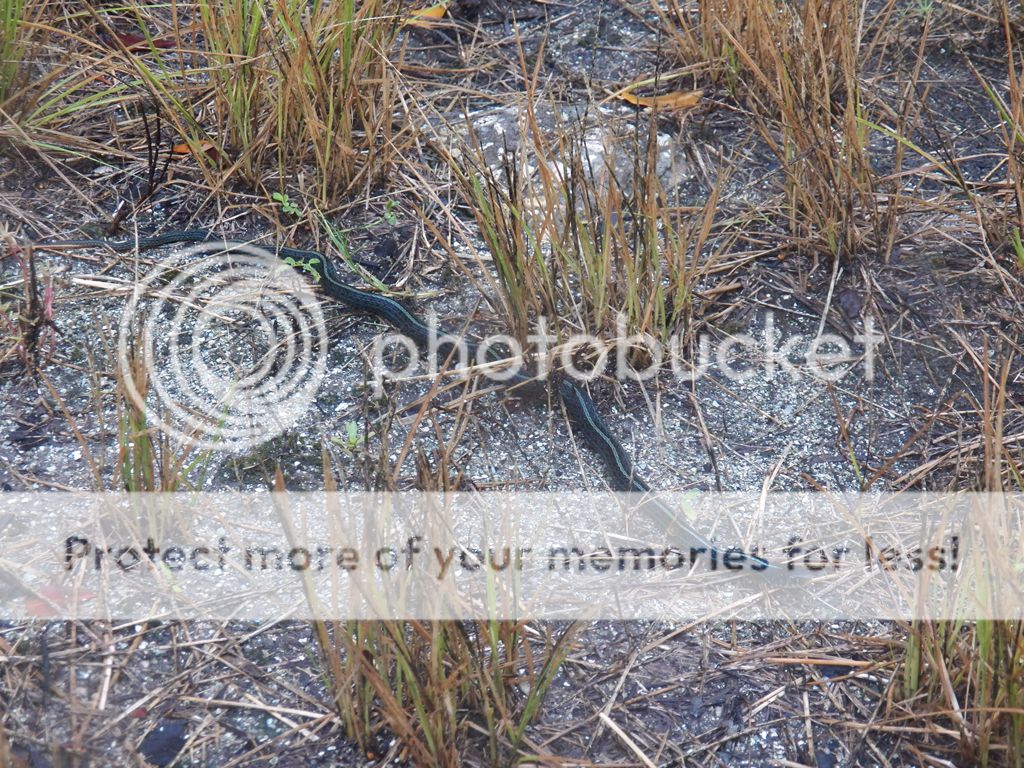
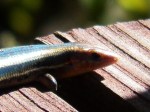
As a child who spent just about any available non-school hours outside catching frogs, snakes and anything else, I am quite familiar with garter snakes, but until today, I’ve never seen a BLUE one.

photo bluestripe-garter1.jpg
Bluestripe Garter snakes are normall found in northwestern Florida. I must admit it was a bit of shock seeing an otherwise familiar animal with such bright blue.

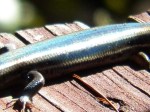
photo bluestripe-garter2.jpg
Close-up of the head. What a cutie!

[EDIT: Dr. Kenneth Krysko of the Florida Museum of Natural History and the University of Florida told me via e-mail that blue striped garter snakes are sighted all over the state. He also said, “Because of this, many of us suspect that this is another example of a named subspecies based on arbitrary color pattern.”]

As I began heading back toward the parking area, the sun started to break through the gloom. The first birds to perk up were the vultures. They used their broad wings as solar heaters to warm up and prepare to take advantage of the day’s first thermals.

photo vultures-spread.jpg
♫ Here comes the sun! ♪

I missed what could have been a pretty epic photograph because I was cleaning water off my camera lens. On one tree limb was a Downy Woodpecker, a Red-bellied Woodpecker and a Northern Flicker. They dispersed before I could get the camera set.

As I got closer to the car, I noticed a sparrow running through the grasses and undergrowth along the wide path and then in the parking area itself. Strangely, a mockingbird seemed to be shadowing its steps from atop the wooden railing around the parking area. It took some careful stalking, but I managed to flush it into a sapling long enough for some photos. I had to consult my Peterson field guide, and what do you know? It was a Lark Sparrow! Not impossible or unprecidented, but not common in eastern Florida, even in migration.

photo lark-sparrow1.jpg
Hello, what have were here? Welcome to Florida!

It’s continued to rain today, but I ended up not minding the touch of grey. I saw a life-lister, a blue snake and had a personal greeting from an armadillo.

The species list for the day, including Pine Island Road (in and out bound):

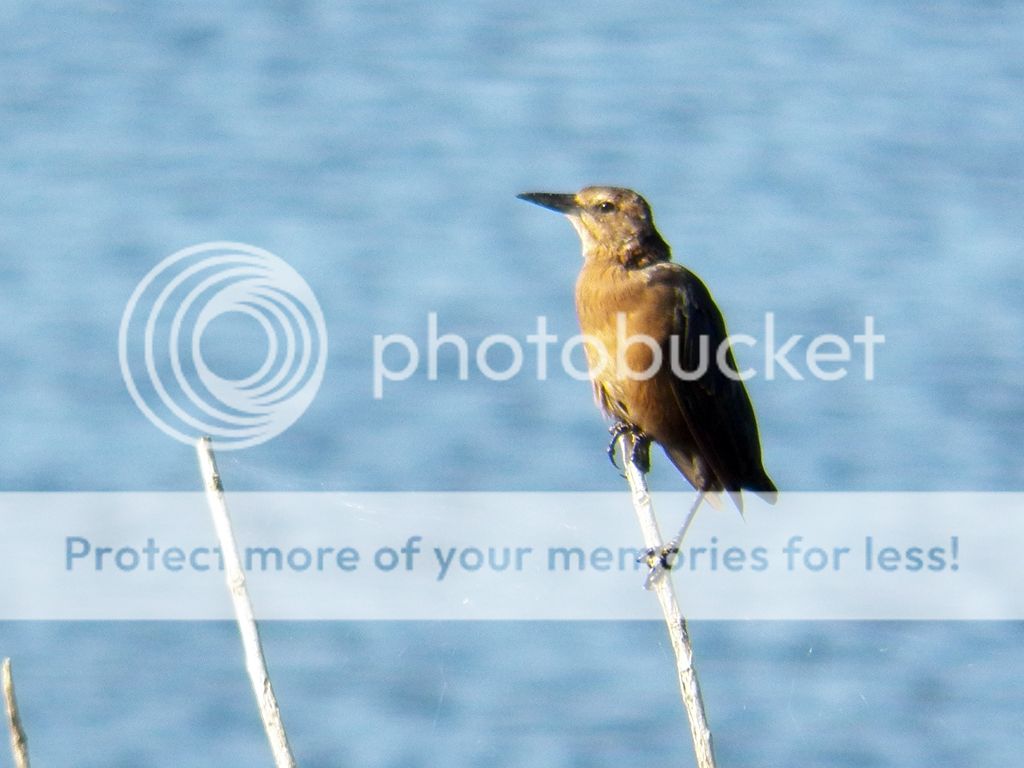
  • Boat-tailed Grackle
  • Common Gallinule
  • Red-tailed Hawk
  • Mourning Dove
  • Red-shouldered Hawk
  • Killdeer
  • Bald Eagle
  • Black Vulture
  • Barn Swallow
  • Loggerhead Shrike
  • Turkey Vulture
  • Great Blue Heron
  • Osprey
  • Green Heron
  • Great Egret
  • Snowy Egret
  • Little Blue Heron
  • Tri-colored Heron
  • Common Ground Dove
  • Northern Waterthrush
  • Anhinga
  • Northern Cardinal
  • Carolina Wren (♫)
  • Downy Woodpecker
  • Northern Flicker
  • Red-bellied Woodpecker
  • Northern Mockingbird
  • Lark Sparrow (*)
  • Rock Pigeon
  • European Starling

photo pink-flower.jpg
I wonder, who’ll stop the rain?

Stick Marsh/Goodwin Lake – August 31, 2014

Four weeks have passed since my prior visit to the Stick Marsh/Fellsmere Grade Recreation Area/T. M. Goodwin Waterfowl Management Area/etc. I returned there yesterday with two hopes. First, I wanted to get there early enough to have a better chance at identifying some rails (either visually or by voice). Second, I wanted to ascend the observation tower at “Goodwin Lake.”

You’ve heard what’s been said about the best laid plans.

I arrived later than I intended, and then helped some gentlemen that were stuck on the access road with a flat boat trailer tire. I rolled into the parking lot well after sun-up. I noticed right away that everything seemed much quieter than the last time. Most notably absent were the Common Gallinules. There were none to be seen nor heard anywhere near the boat ramp or nearby areas. The heron/ibis rookery was still a bit noisy, but there were not as many wading birds around either. Both species of vultures were present, but not in as great numbers as last time.

Also, instead of many pairs of Black-bellied Whistling Ducks, there were mainly solitary ducks, each staking out a tree-top or stump. I recall seeing only two or three pairs the entire morning.

photo bbwd-display.jpg
Black-bellied Whistling Duck in territorial display. They stretch their necks out and down like this to warn off other ducks.

For this visit I walked along the artificial lake southward. To my left were the extensive marshy areas, and in there were Roseate Spoonbills, some ibises and various herons and egrets. Along the lake side of the path, in rows of trees growing out of the water, there were Anhingas, which were there last time, and cormorants.

photo cormorant.jpg
Double Crested Cormorant. Cormorant is derived from old French (via Latin) meaning “sea raven”. Sounds portentous!

photo anhinga.jpg
Anhinga.

As the breeding and fledging season ends, birds are molting prior to autumn, which left a good deal of birds with unusual and missing plumage. Some birds had a patchwork of juvenile and adult plumage.

photo grackle-molt.jpg
This was the most this shy grackle would allow me to see of him. Note the black vest or jacket of adult feathers.

Many of the other blackbirds had missing tail feathers, which made for adventurous flights over the marsh as the birds tried to fly without the stability the tail helps provide.

photo tailless.jpg
One of many tailless blackbirds.

I turned around about half-way along the lake’s length and walked back to the parking lot. Along the way there were Barn Swallows and at least one Caspian Tern. While unusual, this last species is not unprecedented in the area in late summer but is a first of the year bird for me.

A Yellow-crowned Night Heron also flew overhead, which was also a  first of the year for me.

My bicycle was in the back seat of the car, so I took that opportunity to ride it with my gear over to the observation tower overlooking Goodwin Lake. It’s almost 4.5 km (2.75 miles) from the parking lot to the observation tower, and it was already getting quite hot. The roadside was populated by vultures and Cattle Egrets, with an occasional shrike and mockingbird. I could hear Common Gallinules and other marsh birds in the thick vegetation, but nothing that let itself be seen.

As I approached the observation tower, I could see the nearby picnic area was too overgrown to make any use of. As I got off my bicycle I was disheartened to say the least.


Overgrowth, a bee hive and a large spider web (complete with resident spider) kept me from ascending the observation tower by Goodwin Lake.

The tower was overgrown, and bees had taken up residence under the first step. If that wasn’t reason enough to forgo any ascent up the tower, a Corn Spider (or Black-and-yellow Argiope) had woven a 5 foot by 2 foot oval web across the first stairwell. There was little choice but to cycle my way back. The heat was really building, and the morning about over. It took a lot out of me to get back to the car, but luckily I had packed some reserve water to drink in case my CamelBak ran dry (it did).
My species list includes:

  • Black Vulture
  • Turkey Vulture
  • Cattle Egret
  • Boat-tailed Grackle
  • Limpkin (♫)
  • Northern Cardinal
  • Black-bellied Whistling Duck
  • Anhinga
  • Red-bellied Woodpecker
  • Least Sandpiper
  • Osprey
  • Double-crested Cormorant
  • Roseate Spoonbill
  • Great Egret
  • White Ibis
  • Red-winged Blackbird
  • Tri-colored Heron
  • Green Heron
  • Great Blue Heron
  • Barn Swallow
  • Yellow-crowned Night Heron (FOY)
  • Caspian Tern (FOY)
  • Red-shouldered Hawk
  • Northern Mockingbird
  • Loggerhead Shrike
  • Common Gallinule (♫)

I am more curious now than ever about what the field trip to this area are like during the Space Coast Birding and Wildlife Festival.