Transitions, Part II: Viera Wetlands

[For part I, from the Moccasin Island tract, click here.]

The Viera Wetlands (officially the Ritch Grissom Memorial Wetlands at Viera) are an important wintering area for many birds. Ducks, coots and gallinules  gather in large floating groups, called rafts, to feed and provide common defense. Mergansers and grebes mingle with them in pairs or small groups, and we even had Mute Swans this past year.

It’s a little early in the wintering season, but I thought it would be good to see how the Wetlands transition from summer to winter. The American Coots were already starting to gather in groups but other species, like this Pied-billed Grebe, were enjoying the larger stretches of still empty water before things get noisy and crowded.

image
Lone grebe as a picture of solitude.

The lake at the center of the Wetlands is a favorite place for gulls, terns and Ospreys to dive for fish. Normally when an Osprey goes after a fish, it strikes the water feet first and uses them to grab its prey and immediately flies back into the air. Osprey have special barbs, called spicules, on the underside of their feet that aid it in grasping fish and manipulating to to face head-first. This makes transporting the fish to either a nest of an eating perch more aerodynamic and therefore more energy efficient. What happens when an Osprey dives a little too hard and misses its meal?

image
A dejected and wet Osprey drips dry after diving in a little to hard for a meal.

Heron and egret activity was much reduced. I saw no Cattle Egrets and the rookery trees were empty. There were a few Green Herons across the lake from me, and I saw just one each Great Blue Heron and Great Egret. Now that breeding and nesting season is over, the males have molted and lost their plumes and lancet feathers, but still retain a simple beauty and grace.

image
A Snowy Egret standing patiently. Normally this species is an active feeder, using its bright golden-colored feet to stir up fish, crustaceans and frogs.

Herons sometimes amaze me with the focus and patience they have when stalking the edge of a pond or standing, head poised for a quick strike to grab a fish or a frog. There was a Little Blue Heron that was so intent on its foraging activities that it gave me almost no mind as I got within a couple of feet.

image
This Little Blue Heron was so focused, I could almost see laser beams coming out of its eyes.

Its nonchalance seemed to attract a Glossy Ibis and Common Gallinule; the normally more skittish birds hung close to it and only glanced at me once or twice before I moved on.

image
When you hear a Common Gallinule’s calls, you realize why this species used to be called the Common Moorhen (hen as in chicken).

Other birds have finished their end of summer molting as well. The small flocks of Red-winged Blackbirds and Boat-tailed Grackles are generally quieter now that the chaos of summer is over. The birds making the loudest ruckus were the Gray Catbirds in the trees and brush along the outside of the outer road.

image
This female Boat-tailed Grackles feathers looked almost like a burnished metal in the sun.

I walked back to my car and drove a partial loop to get to the exit, covering some of the same ground I did on foot. Not much had changed in the short time, except more Osprey were diving for food, and I hope this one wound up more successful, or at least less wet, than the first one I saw.

image
Best of luck and farewell.

Here is the complete species list, including my adventures at the Moccasin Island Tract. You can read about it in part 1.

  • American White Pelican
  • Boat-tailed Grackle
  • Sandhill Crane
  • Mourning Dove
  • Common Grackle
  • Tree Swallow
  • Purple Martin
  • Red-bellied Woodpecker
  • Great Blue Heron
  • American Crow
  • Eastern Meadowlark
  • Bobolink
  • Wilson’s Snipe
  • Tri-colored Heron
  • Great Egret
  • White Ibis
  • Glossy Ibis
  • Belted Kingfisher
  • Red-shouldered Hawk
  • Loggerhead Shrike
  • Roseate Spoonbill
  • Common Yellowthroat
  • House Wren
  • Northern Cardinal
  • White-eyed Vireo
  • Grey Catbird
  • Common Ground Dove
  • Northern Mockingbird
  • Blue Jay
  • Green Heron
  • Eastern Phoebe
  • Osprey
  • Anhinga
  • Red-winged Blackbird
  • American Coot
  • Common Gallinule
  • Little Blue Heron
  • Pied-billed Grebe
  • Snowy Egret
  • American Kestrel
  • Black Vulture
  • Turkey Vulture
  • Wood Stork
Transitions, Part I: Moccasin Island Tract

October in Florida is a time of transition. Florida has two dominant seasons: the wet season, which runs from May to October, and the dry season, which runs from October to May. The division between the wet and dry seasons is usually fairly predictable and quick. Sometime within the second week of October the humid and rainy pattern of the summer ends and the air masses tend to be drier. That isn’t to say we still can’t have some days with rain, but generally that is the trend. We seem to have crossed over this past weekend into that dry season.

This month is also the peak month for bird migration through the central part of the state, and many of Florida’s winter residents are beginning to set up house and gather in places where food and shelter are plentiful.

My goal, initially, was to head to Viera and check out the Click Ponds to see if any waterfowl or shorebirds have begin to congregate, but the gate to the roadway to the ponds was closed, and it remained so all morning. I used that as an opportunity to head to the Moccasin Island Tract for an hour or so. Interested readers can check out my blog posts here and here for previous adventures to this conservation area.

On the way along the road toward the parking area a large white bird caught my eye, far off in one of the fields (I think much of the area is a sod farm). The shape didn’t look right for an egret, but it didn’t seem tall enough to be a Whooping Crane. While we do have Whoopers in central Florida, associated with the Deseret Ranch, it would be quite a “thing” if one were to turn up in Viera! I stopped the car and took out my binoculars and had a look. It was an American White Pelican, standing by itself on a patch of sod. There were no other pelicans anywhere that I could see. As I watched it preen a little and look around, I wondered if it was tired and just plopped itself down wherever it could as I’ve never seen a pelican either not flying or floating.

I arrived at the parking area with the sun still pretty low, but it was warming up fairly quickly. I was first greeted, as I usually am at this location, by the singing of Eastern Meadowlarks. The fields adjacent to the dirt road leading north from the parking area were still covered in standing water from all the rain we had in last few weeks, and I flushed a couple of Wilson’s Snipes as I walked along.

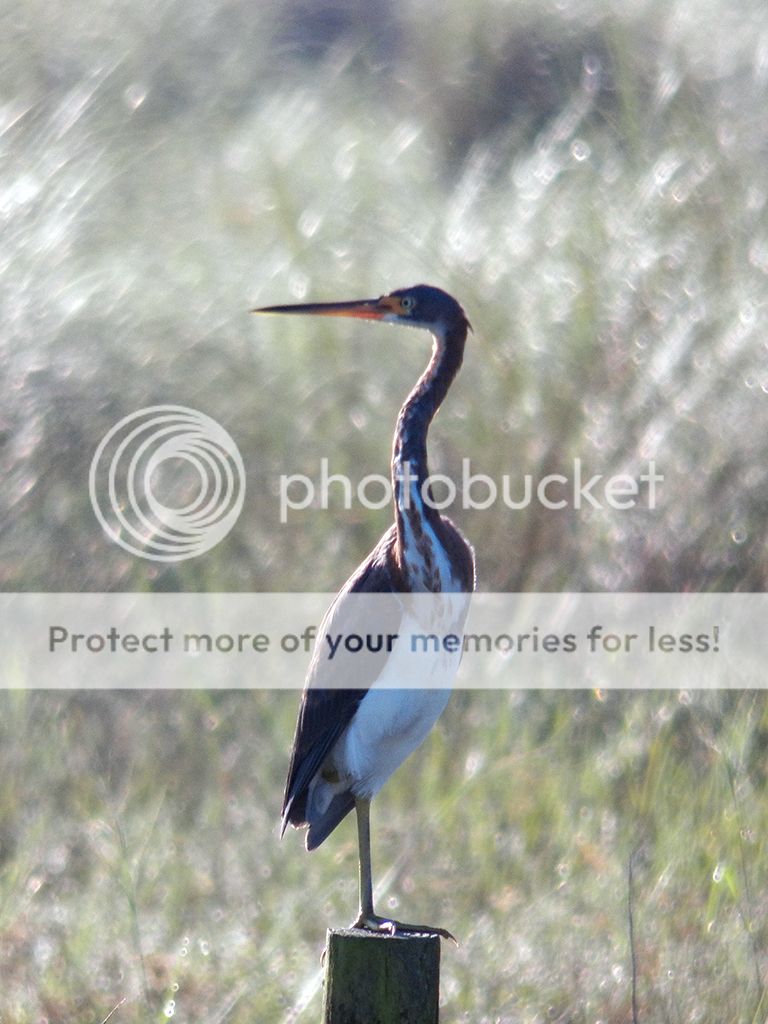
Most of the fence posts were occupied by Tri-colored Herons, who nervously watched me go past.

image
Herons sometimes strike the goofiest of poses, thanks in part to their long and flexible necks. Standing on one foot only added to this bird’s charm.

Further in the flooded fields were congregations of Great Egrets and both White and Glossy Ibises. Occasionally two or three ibises would take off and fly in a big circle around the fields and then land back with the group.

image
Herons and egrets are usually silent, except for alarm calls when startled or otherwise flushed out. When they are in groups like this, they have a surprisingly varied set of vocalizations.

I didn’t walk far up that particular path, since I wanted to explore along the drainage canal and road to the west of the parking area. As I walked back, a small flock of Bobolinks flew past. These had been reported over a week ago on the BRDBRAIN e-mail list, but I figured they were gone, so that was a pleasant surprise.

As I approached the parking area, I could hear American Crows and a Red-shouldered Hawk nearby. There were Belted Kingfishers chasing each other around as well. Some Red-shouldered Hawks in Florida are of a paler form that I don’t usually see until winter. This one may have just gotten its adult feathers.

image
This bird seemed inexperienced and a little clumsy, despte the adult plumage.

Along the path to the west, my presence stirred up some Northern Cardinals and some scolding notes that later turned out to be House Wrens. None of that ruffled the feathers (actually or metaphorically) of this Loggerhead Shrike.

image
Shrike populations are declining in many areas around east central Florida as we pave over more of their preferred habitat. It’s good to see them holding their own in conservation areas like this and Stick Marsh.

Along with the quite agitated House Wrens was this handsome Common Yellowthroat that popped out to check me out for a few seconds before disappearing back into the dense brush.

image
“Peek-a-boo! I see you! Now go away!”

Whenever I’m birding I try to stay in the habit of looking up now and again to see what might be there. This is particularly useful in catching raptors or other soaring birds that might be circling on thermals high overhead. This time I was surprised by a relatively large flock of Roseate Spoonbills. Normally I only see one or two at a time, so I felt this was a real treat.

image
Roseate Spoonbills doing the Missing Man Formation.

No birding trip in east central Florida would be complete without those tiny bundles of energy, the Blue-grey Gnatcatchers. This is one of several that was scolding me along with the House Wrens and Northern Cardinals.

image
Ever-present and always fun to watch!

I soon found my path blocked by a submerged section of the path with no way around it. Forced to turn back, I flushed some Common Ground Doves from the brush edges and watched some Blue Jays harass the Red-shouldered Hawk.

Before getting in the car to head to the wetlands, I watched a pair of American Crows walk through the parking area and saw an Eastern Phoebe perform some impressive acrobatics in pursuit of food. At the top of a palm tree stood this Great Blue Heron, a fitting end to the first part of my day.

image
Looking far more serious and determined than its smaller cousin at the start of this post, this Great Blue Heron had a commanding view of the landscape.

Here’s the complete species list, including those from the Ritch Grissom Memorial Wetlands at Viera, which you’ll get to see in part 2.

  • American White Pelican
  • Boat-tailed Grackle
  • Sandhill Crane
  • Mourning Dove
  • Common Grackle
  • Tree Swallow
  • Purple Martin
  • Red-bellied Woodpecker
  • Great Blue Heron
  • American Crow
  • Eastern Meadowlark
  • Bobolink
  • Wilson’s Snipe
  • Tri-colored Heron
  • Great Egret
  • White Ibis
  • Glossy Ibis
  • Belted Kingfisher
  • Red-shouldered Hawk
  • Loggerhead Shrike
  • Roseate Spoonbill
  • Common Yellowthroat
  • House Wren
  • Northern Cardinal
  • White-eyed Vireo
  • Grey Catbird
  • Common Ground Dove
  • Northern Mockingbird
  • Blue Jay
  • Green Heron
  • Eastern Phoebe
  • Osprey
  • Anhinga
  • Red-winged Blackbird
  • American Coot
  • Common Gallinule
  • Little Blue Heron
  • Pied-billed Grebe
  • Snowy Egret
  • American Kestrel
  • Black Vulture
  • Turkey Vulture
  • Wood Stork

Click here for Part II: Viera Wetlands

Falling into Migration

When word came over the FLORIDABIRDS-L mailing list that a Canada Warbler was seen in Turkey Creek Sanctuary, it was clear that the first migrants have arrived in the area. When a rare bird alert goes out like that, it’s exciting enough, but to be at the local park I am most familiar with was even better.

I headed to the Sanctuary on Sunday with modest goals. I wasn’t expecting to see a Canada Warbler, but I figured some increased activity might bode well for the historically heavier migration month of October. As followers of this blog might remember, the past couple of years have been really bad as far as birding during migration.

Early on in the walk I saw what I thought were owl pellets (I even photographed them) but upon closer inspection I think they were some sort of scat (if you don’t know what that means, go ask your parents).

I ended up having a modest morning of it, all told. The most exciting bird encounters were a Wood Thrush (FOY) which I initially mistook for a Brown Thrasher and several warbler species. While none of the warblers were as rare as a Canada Warbler, they were a good indication that the migration is under way.

The most numerous warblers were by far the American Redstarts. There was a mix of what seemed to be immature and mature males. It’s possible some were females, but all had some amount of black or duskiness about them.

photo am-redstart.jpg
Ready for launch! American Redstarts are hyperactive, even for warblers.

While there have been Blue-grey Gnatcatchers in the Sanctuary all year, there was a definite increase in numbers and activity.

photo bgg.jpg
Blue-grey Gnatcatcher contemplating its next move.

At the end of the Floodplain Trail I got a very brief glimpse of a Worm-eating Warbler, then watched as three species of woodpecker bickered and chased each other around some trees. There was a Pileated Woodpecker really knocking things around and it eventually ousted a pair of Downy Woodpeckers and at least one Red-bellied Woodpecker. I assumed it was a youngster, it was so clumsy and spastic.

photo pileated.jpg
I think this Pileated Woodpecker sort of looks like Kramer from Seinfeld.

I ran into two area birders, both active on FLORIDABIRDS-L, and they were both hoping to catch a Canada Warbler. Mark Eden was on his way out and had seen a lot of activity by the Canoe Deck (activity which had sadly abated by the time I got there) and Jim Armstrong, whom I walked with for a time before we went our separate ways. Normally I tend to shy away from sharing my experiences while birding, even when perhaps I shouldn’t (hence my blog title). But this weekend it seemed natural to want to collaborate, and I hope Mark and Jim got something out of our mutual encounters as well.

The species list for the morning:

  • Yellow-throated Warbler
  • Wood Thrush (FOY)
  • Common Ground Dove
  • Prairie Warbler
  • Ruby-crowned Kinglet
  • Blue-gray Gnatcatcher
  • Carolina Wren
  • Northern Parula
  • American Redstart
  • Downy Woodpecker
  • Blue Jay
  • Red-bellied Woodpecker
  • Worm-eating Warbler (FOY)
  • Pileated Woodpecker
  • Palm Warbler
  • Fish Crow

Since yesterday I’ve seen more cautiously encouraging reports out of Turkey Creek Sanctuary, so here’s to hoping for a good Fall Migration.

Cameron Preserve, July 27, 2014

It’s been a wild few weeks here at the Lonely Birder Perch, but after a solid week of heavy rain every afternoon and weekends full of non-birding fun, I got back to birding this past Sunday at the Cameron Preserve in Palm Bay. It’s taken me a while to get this post up, so thanks for hanging in there with me!

As I’ve probably mentioned before, the Cameron Preserve is an area of protected land between the East and West Malabar Scrub Sanctuary parcels. I’ve crossed the northern edge of it while traversing both Malabar and the Turkey Creek Sanctuaries. On Sunday I decided to have a closer look at the Preserve itself.

photo wet-dry-cameron-path.jpg
Believe it or not, this was one of the drier parts!

At first glance, the areas away from Turkey Creek (the hydrological feature) would seem to be filled what environmental biologists call “obligate” upland species of plants. That’s just a fancy way of saying that due to certain environmental features (like ground water level, elevation, slope, soils, etc.) one would expect species that must live in dryer, higher places. For the most part, the Malabar Scrub Sanctuary is full of obligate upland plants, once you move away from the creek. Much of the Cameron Preserve is contiguous with Malabar, but if you look carefully, some areas have what are called “facultative” wetland species. That’s another fancy term environmental biologists use. It means that usually those plants are found in wetland habitats, but sometimes they are found in upland settings.One reason these plants survive slightly drier times in the uplands is because the ground water level (or water table) remains high enough for long enough in the year to support them. Extended periods of drought can take their toll on these plants, though.

With the copious rainfall over the past week there was a LOT of standing water in the Cameron Preserve, and the “usually” wetlands plants were loving it. I’m not very good with my Florida wetland plant identification, but there were various reed-like plants and broad leafy ground cover that during dryer spells might blend in, but because of the water, they were really standing out.

In any case, I began my hike from the eastern part of the Malabar Scrub Sanctuary and made my way into the Preserve. My intent was to circle around in the Preserve and make my way back to where I started. Somehow, I got myself into the Preserve but when I tried to make my way back, I kept running into huge flooded areas or impenetrable scrub.

As I slogged around, I saw some Scrub Jays and Eastern Towhees, and several species of woodpeckers.

I find it interesting that while during the past couple of years the bird population density has been much lower than “normal” in the area, and that this has coincided with a decline in Northern Cardinals and birds of prey that hunt song-birds (like Sharp-shinned and Coopers Hawks, for example).

There were some loose flocks of Fish Crows, some with missing primaries (wing feathers), most likely as they molt and replace them.

The relative peacefulness of the morning ended abruptly, however, when a low flying helicopter passed over the Preserve and began circling over the Turkey Creek Sanctuary. This had the immediate effect of scattering most of the birds (an probably other animals) away from the sound.

photo heli.jpg
I’m pretty sure a whirlybird isn’t really a bird…

After further investigation i found that this is a Brevard County Sheriff’s Department helicopter. It’s equipped with pontoons for water search and rescue. I don’t know what was happening, but the helicopter circled and hovered for 20 minutes or more before either finding somewhere to land (not sure where that might be in that area) or heading off for a while. After about 15 more minutes, it returned for a few more minutes before heading out of the area.

Soon after the helicopter left, a group of Swallow-tailed Kites (click to see them in my previous photoblog post) came swooping over. I think it’s possible this was a family unit. It seemed like 2 adults and 3 juveniles, based on the tail length and the way they flew (the 2 adults were much more graceful).

photo stk-sky.jpg
I hope you get a sense of how perfect these birds are in the endless sky.

Because I could not find a way around the flooded areas, I walked down a residential street out to the main road. From there it was a relatively short walk to the Malabar Scrub Sanctuary East, where I got back to my car and headed home.

  • Florida Scrub Jay
  • Eastern Towhee
  • Downy Woodpecker (♫)
  • Red-bellied Woodpecker
  • Mourning Dove
  • Common Ground Dove
  • Red-shouldered Hawk (♫)
  • Blue Jay
  • Fish Crow
  • Northern Cardinal
  • Osprey
  • Swallow-tailed Kite
  • Black Vulture
  • Carolina Wren (♫)
  • White Ibis
  • Great Blue Heron

Apart from the lovely sight of a Swallow-tailed Kite family and some unexpected aircraft, I got two ankles full of fire ant bites to commemorate my hike this week.

Are 1,000 Words Worth A Picture? Turkey Creek – June 22, 2014

It’s the first full day of astronomical Summer in the Northern Hemisphere! Happy Summer!

In my excitement to get out and about early this morning, I left my camera behind, which was a big bummer. We have had a couple of days in a row with some heavy thunderstorms and downpours in the area, and I was anxious to see how Turkey Creek and the adjacent canal were affected. Haste makes waste, as they say, right?

It turns out the creek was about a foot higher than I last saw it, but it had dropped lower than that before the rains came this week. So I don’t know the total difference right before and after. In any case, there was a bit of debris washed over the trails, and evidence the creek had run up on the banks here and there, but otherwise nothing too epic.

On the way to the canal by the Scrub Trail there was a total of 4 immature Coopers Hawks in a dead tree. This is the same general area I saw a pair of the same species last year. They must be recently fledged, and they were making short, noisy flights around the western side of the sanctuary all morning.

The other “main event” of the morning was an apparently newborn manatee in the creek with its mother. I first saw a couple of manatees grazing along the creek banks along McKinnon’s Way, but when I got to one overlook, there was a smallish adult manatee just laying in the water, with its (her) back sticking up. It took a breath every minute or so. Then, I saw a tiny nose poke up next to her, then a small, smooth gray back. It was soo cool (and NO CAMERA!). A man and a woman came along the path from the Canoe Deck, and told me they had seen her in the same spot yesterday before the big downpour, and she seemed “in distress” which they thought might be labor. WIth a newborn manatee in evidence, I’d say they were right. 

I watched the manatees for a bit, then made my way around the park, doing the boardwalks first, then the Sand Pine Trail before exiting.

I know I don’t generally like wall-of-text posts, so I’ll wrap this up with my species list for today, generally in order of first identification (♫ = voice only):

  • Fish Crow
  • Osprey
  • Rock Pigeon
  • Carolina Wren (♫)
  • White Ibis
  • Northern Mockingbird
  • Coopers Hawk
  • Blue-gray Gnatcatcher
  • Northern Cardinal
  • Blue Jay
  • Mourning Dove
  • Great Egret
  • Snowy Egret
  • Green Heron
  • Common Gallinule
  • Chimney Swift
  • Double-crested Cormorant
  • Tri-colored Heron
  • Northern Parula
  • Downy Woodpecker (♫)
  • Red-bellied Woodpecker (♫)
  • Black Vulture
  • Turkey Vulture

Walk It Off

This past Sunday I decided to do my birding at the Moccasin Island Tract at the River Lakes Conservation area. In all my past visits here, I’ve headed south from the parking area and walked about a mile or so before turning back. I’ve generally avoided the northern trail because it leads to a hunting area in the Upper St. Johns Marsh WMA. But since (according to the post at the trailhead) no hunting is in season this time of year, I decided to head north.

Much of the Moccasin Tract is owned by the St. Johns River Water Management District and leased by the Duda cattle ranch, and they manage the conservation land jointly. (By the way, the Duda company also develops and manages Viera, FL.)

photo cow.jpg
A Duda cow watches, not impressed.

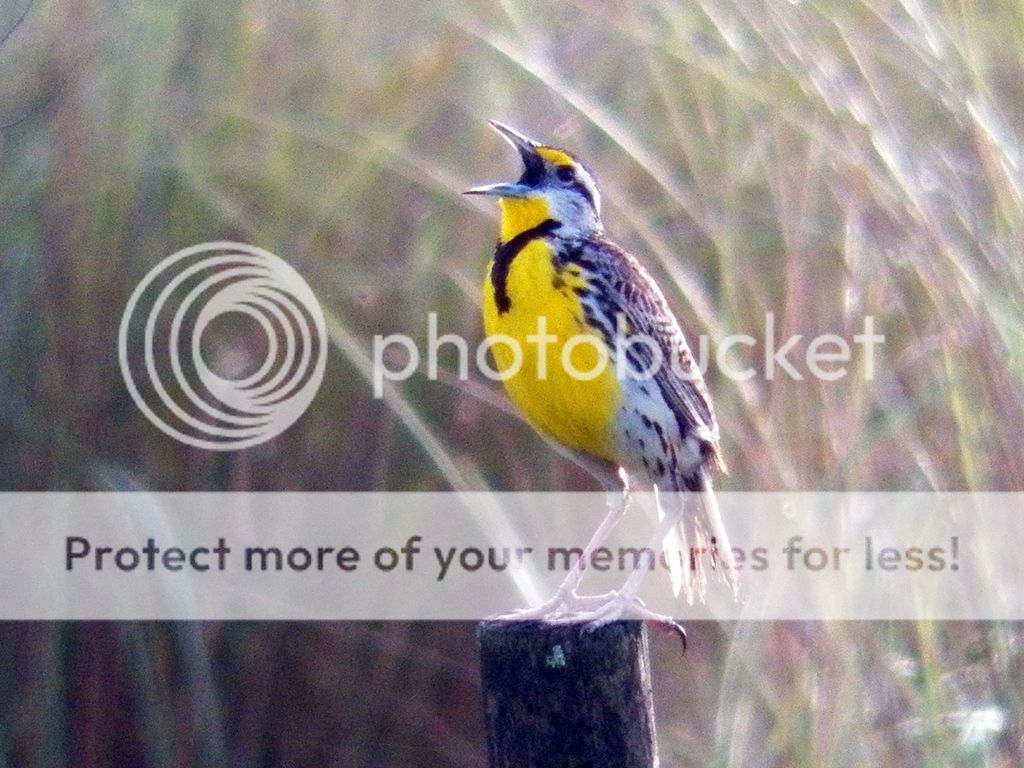
The first birds I heard were the ever present Eastern Meadowlarks and some American Crows (not Fish Crows!) in the distance. The crows only briefly appeared close enough for me to see once, otherwise they were content to stay well to my west. The meadowlarks were singing on prominent perches like fence posts and wires.

photo singing-meadowlark.jpg
As Ann Wilson says, “Sing, child, sing!”

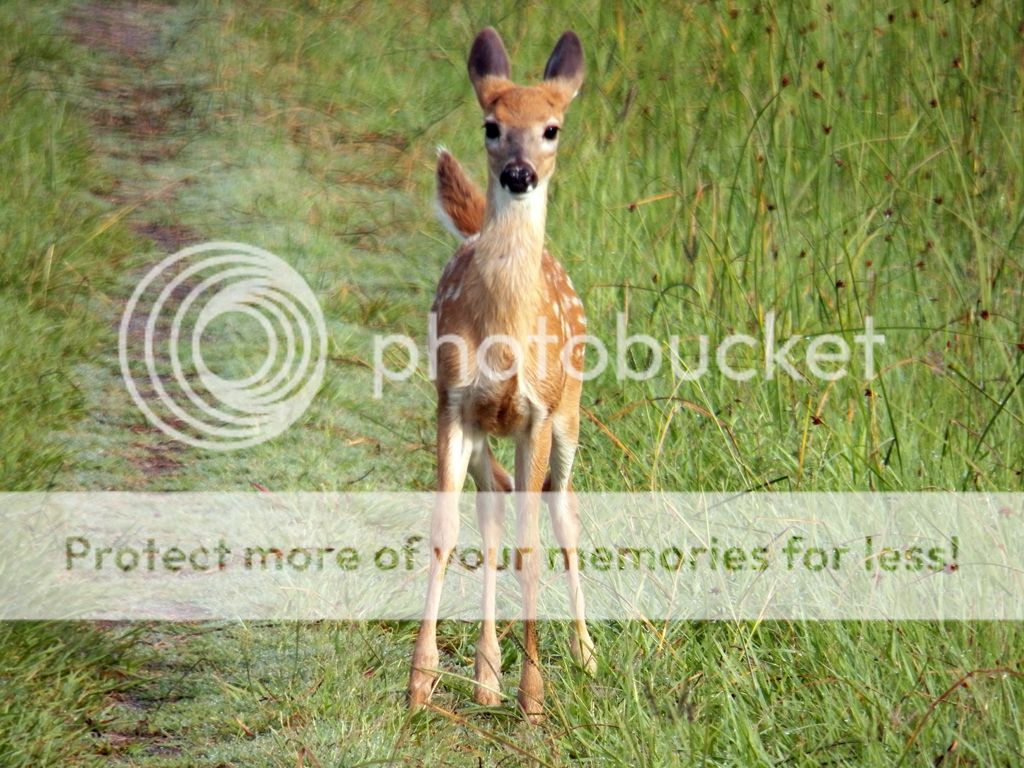
Further along the trail, I saw a fawn poke out of some brush onto the path briefly before ducking back in. A couple of minutes later, it came out again, but this time turned toward me and started walking in my direction! There were no adult deer anywhere to be seen, and I stood still as it came closer. It eventually got to within 7 or 8 meters of me before stopping.

photo fawn0.jpg
A curious fawn.

photo fawn1.jpg
I didn’t want to fawn all over it, scaring it away.

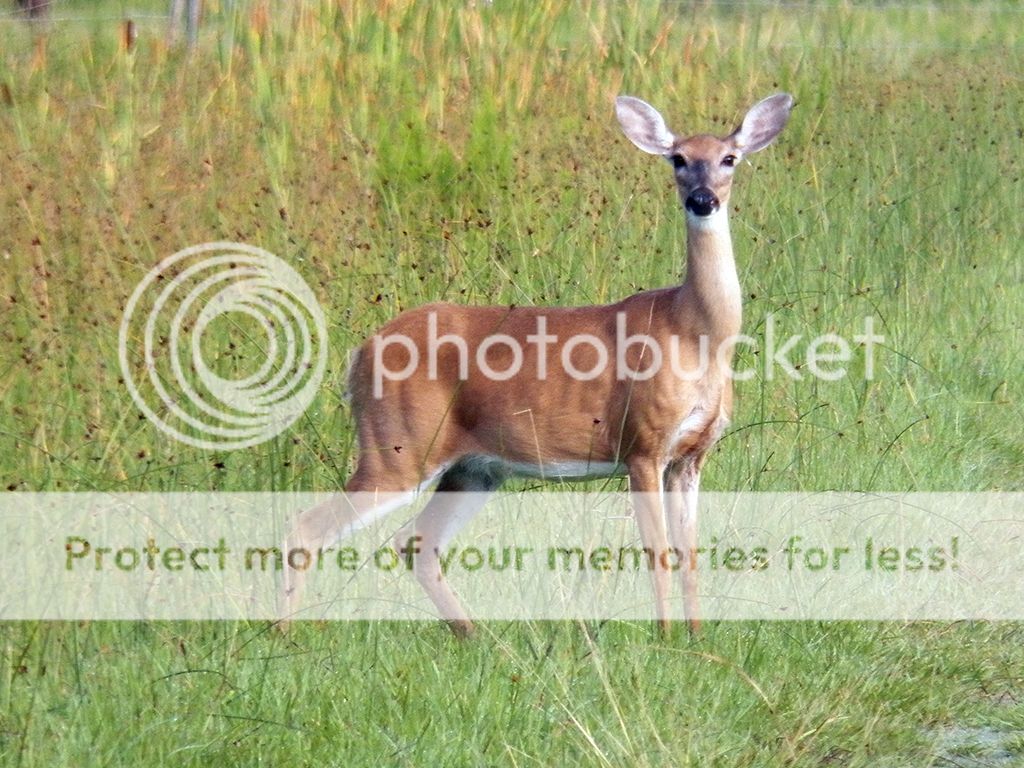
Finally when it was just a few meters away, an adult (Mom, I suspect) came out of the brush and was not pleased her baby was so close. She made a snorting sound before bounding across the trail and over the barbed-wire fence, stopping to look back.

photo mom-deer.jpg
Mom nervously looks on.

Finally after another squeaky snort, the fawn found a low spot along the barbed-wire and leaped across, and mother and baby bounded off into the brush and trees to the east.

The northern trail is about 4 kilometers (2.5 miles) long, and I thought I stopped about half-way. Later when I consulted an online map, I realized I walked almost to the end of the trail near Lake Winder. That made my total walking distance over 8 kilometers (5 miles)! If I had known I was that close to the end of the trail and the lake, I would have gone the extra distance, but in the end, I wound up pretty sore.

I stopped at a couple of points on the trail where there were copses of trees. A pair of Downy Woodpeckers were tapping around some palm trees in one area, and another larger grove of Live Oaks was sheltering some Northern Mockingbirds, Northern Cardinals and at least one Carolina Wren.  

There were many Cattle Egrets, as you might expect on a cattle ranch. In addition, I saw or heard a couple of dozen other species typical of eastern central Florida.

  1. Wood Stork
  2. Mourning Dove
  3. Cattle Egret
  4. Great Blue Heron
  5. Black-bellied Whistling Duck
  6. Common Ground Dove
  7. Great Egret
  8. Eastern Meadowlark
  9. Boat-tailed Grackle
  10. Common Grackle
  11. Red-winged Blackbird
  12. Pileated Woodpecker (♫)
  13. Northern Cardinal
  14. Carolina Wren
  15. Northern Parula (♫)
  16. Downy Woodpecker
  17. Red-shouldered Hawk
  18. Northern Mockingbird
  19. Northern Bobwhite (♫)
  20. Black Vulture
  21. Turkey Vulture
  22. Tri-colored Heron
  23. Snowy Egret
  24. Glossy Ibis
  25. Black-necked Stilt
  26. Mottled Duck
  27. Little Blue Heron
  28. White Ibis

It ended up being a long walk, but it wasn’t as hot as last week. Despite the sore legs and feet, it was a fine morning.

Out in the Flat

My wife and I had a guest the past few days, named Stanley. Flat Stanley. He was mailed to us (on account of a bulletin board flattening him in class one day), which seems a darn great way to travel. I took Stanley out to Turkey Creek and Malabar Scrub Sanctuaries so he could experience some of central Florida’s natural world.

photo stanley.jpg
Flat Stanley chilling out by Turkey Creek.

We started the day at Turkey Creek, but I had us do most of the park in reverse order from my usual walks. I started by heading out to the weir, but recent heavy rains washed most of the mucky debris behind the orange flotation barrier. This is where most of the wading birds would hang out, but there was just one Green Heron skulking along the shore. There were plenty of bird songs along the rest of the walk. Stanley and I identified quite a few birds by voice and by sight.

photo red-bellied-woodpecker.jpg
Red-bellied Woodpecker feasting on ants.

After exiting via the Sand Pine Trail, we drove to the Malabar Scrub Sanctuary. Stanley wanted to do the “Red Loop Trail” and I thought that was fine. We identified more birds and even saw a large snake! About midway around the trail we came across a loud group of Florida Scrub Jays. Stanely was excited to see them, as I had shown him my photos from last week in the sanctuary.

photo florida-scrub-jay.jpg
Florida Scrub Jay. Unlike last week, this was just one of about a dozen we saw in 2 separate family groups.

One of the area middle schools built an educational platform in the heart of the sanctuary. Stanley and I learned a bit more about Florida’s scrub habitat and had a nice view of the surrounding landscape.

photo educational-stanley.jpg
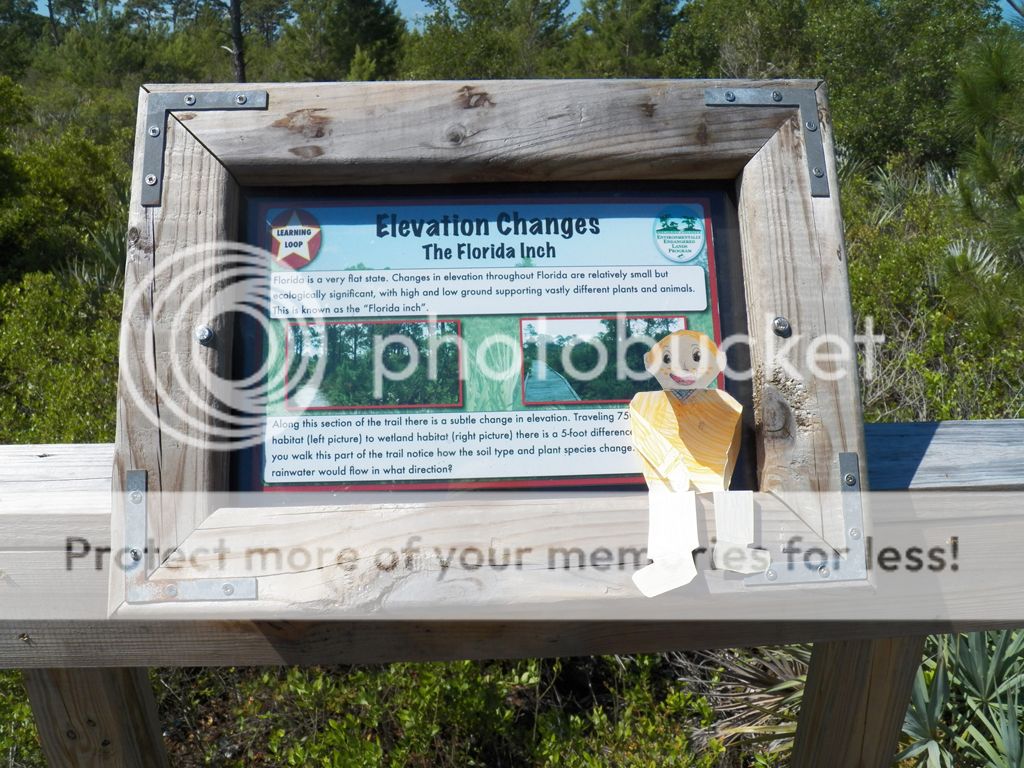
Educational board showing how “flat” Florida is.

The second half of the trail was through some habitats I hadn’t seen there before, with lots of scrub oaks making archways over the path, and pockets of Blue-gray Gnatcatchers here and there.

Here is our list of bird species for both parks (loosely grouped by family rather than order seen).

  • Mourning Dove
  • Eurasian Collared Dove
  • Rock Pigeon
  • Common Ground Dove
  • Hairy Woodpecker
  • Downy Woodpecker
  • Pileated Woodpecker (♫)
  • Red-bellied Woodpecker
  • Blue-gray Gnatcatcher
  • Northern Mockingbird
  • Brown Thrasher
  • Carolina Wren
  • Northern Cardinal
  • Indigo Bunting
  • Eastern Towhee
  • Fish Crow
  • Florida Scrub Jay
  • Blue Jay
  • Ovenbird (♫)
  • Yellow Warbler (♫)
  • American Redstart
  • Northern Parula
  • Wood Stork
  • European Starling
  • Black Vulture
  • Turkey Vulture
  • Boat-tailed Grackle
  • Common Grackle
  • Red-winged Blackbird
  • Osprey
  • Green Heron
  • Snowy Egret
  • Cattle Egret
  • Great Egret
  • Great Blue Heron
  • White Ibis
  • American Brown Pelican
  • Great-crested Flycatcher
  • Eastern Kingbird (FOY)
  • White-eyed Vireo
  • Northern Rough-winged Swallow
  • Chimney Swift

It was great having Stanley around, but he has to leave early tomorrow. We’re having him head home in style, though, in a USPS Priority envelope, along with photos and descriptions of his time with us here in Florida.

photo me-and-stanley.jpg
Me (actual photo!) and Flat Stanley at Turkey Creek Sanctuary.

It’s Alive!

I had a much more exciting morning at Turkey Creek Sanctuary than I anticipated yesterday (Sunday). Having bemoaned the lack of bird activity in my last post, it seems the birds had to prove me wrong. Which is fine by me!

After a nice “good morning!” song from this Carolina Wren near the main trail-head, I headed off through the relatively new Turkey Oak Trail.

photo carolina-wren.jpg
Nothing could be finer than a Thryothorus ludovicianus in the morning…

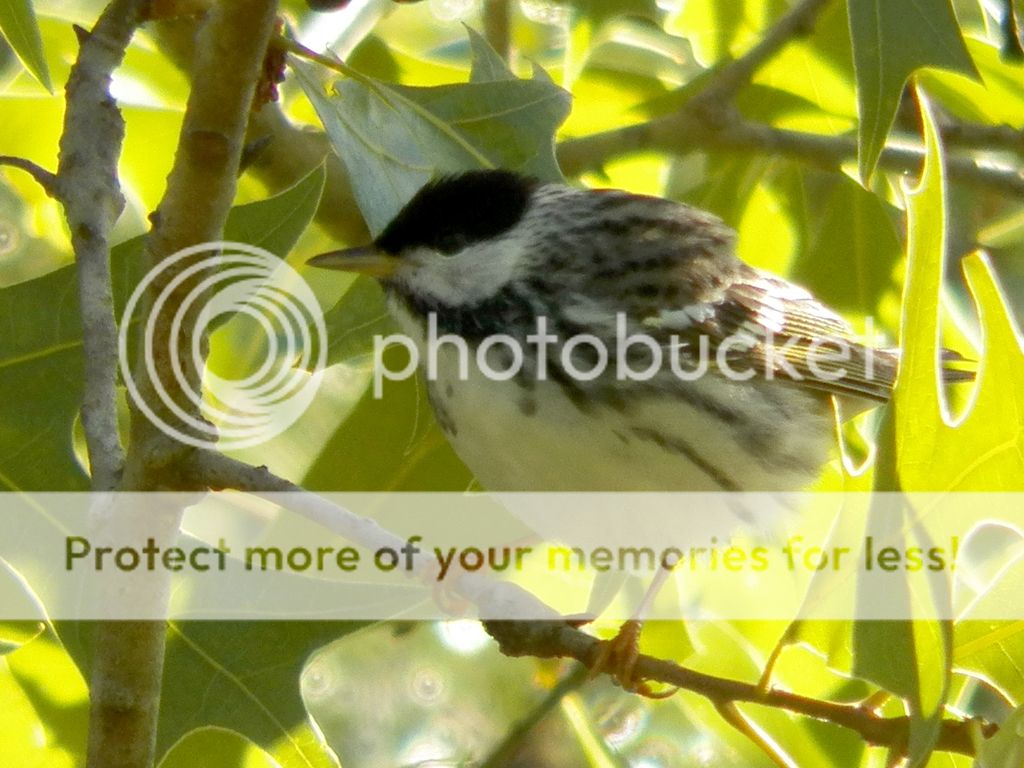
I was immediately surrounded by warbler call notes and fluttering activity. Blackpoll Warblers were everywhere. Some were quite curious about me and would momentarily perch just feet away and cock their little heads at me before zooming off.

photo black-poll-male.jpg
Puffball – er, I mean Blackpoll Warbler.

One female was a little more defensive and wary, following me along the path and looking at me as if to say, “I’ve got my eye on you.”

photo blackpoll-female.jpg
Several ounces of latent hostility.

I know from experience that some warbler species come in pairs. Usually when there are Blackpoll Warblers there are American Redstarts. Sure enough, there were many of those as well, in all stages of plumage. Pretty much anywhere in the sanctuary I went, there were American Redstarts nearby Blackpoll Warblers. The only exception was one spot near the end of the Turkey Oak Trail where instead of redstarts, the Blackpolls were mingling with Black-throated Blue Warblers. I find American Redstarts somewhat difficult to photograph with my current equpiment. They seen to almost never sit still, and the leap out of frame just as i get my finger on the shutter button.

photo american-redstart.jpg
This little guy stopped long enough for me to get this shot.

The Black-throated Blues were almost as numerous as the redstarts, but tended to stay lower in the canopy and among the Sabal palms.

Further along the way, I got a good look at a yellow warbler but was having an issue getting a good ID. I manged some photos that showed the facial markings pretty well, and decided to check at home with my Warbler’s Guide to pin down what it was. As it turns out, the Warbler’s Guide led me to conclude it was perhaps a Hooded Warbler – either a female or a male that had yet to molt into its bold head pattern. In the end, I posted the photo to Facebook and asked some of my friends what they thought. Corey Finger immediately IDed it as a Prairie Warbler. Upon another look I can see the distinctive “mustache” facial pattern. So not a FOY bird, but cool none-the-less.

photo prairie.jpg
Prairie Warbler.

The Turkey Oak Trail was uncharacteristically productive for me, as I also cataloged my first of the year (FOY) Scarlet Tanager, heard a Blue-headed Vireo, and a very secretive Ovenbird.

There were also several noisy Great-crested Flycatchers that were more-or-less moving in the same direction as me. They stayed pretty high up in the canopy, but came close enough to harrass me a few times, but never got in a good position for a photo-op.

By the time I got to the boardwalk, I was feeling pretty good. The boardwalk itself was a little quieter, but I did get a quick look at an Indigo Bunting male as well as more Black-throated Blues and American Redstarts.

I scared up a couple of Solitary Sandpipers as I got off the boardwalk on the path toward the jogging trail (I guess they weren’t so “solitary” if they were a pair?).

The biggest question, though, is what kind of thrush did I see as I made my way to the emergency boat ramp? I got a very clear look and I can say it was either a Gray-cheeked Thrush or a Bicknell’s Thrush. These two species are almost impossible to distinguish in the field. There is an accepted but challenged difference in their songs, but neither this bird, nor the one I saw further down the jogging path later, did any singing.

photo thrush.jpg
The only shot of the thrush I was able to get. Anyone see anything diagnostic?

At the weir and canal there were some Spotted Sandpipers, a few Green Herons, Cattle Egrets and a Common Gallinule.

That was about it as I walked back toward the picnic area and saw a few more Black-throated Blue Warblers and heard a few bickering Blue-gray Gnatcatchers.

Here’s the total species list for the outing yesterday morning:

  1. Blackpoll Warbler (FOY)
  2. American Redstart
  3. Black-throated Blue Warbler
  4. Black-and-white Warbler
  5. Northern Parula
  6. Prairie Warbler
  7. Ovenbird
  8. Scarlet Tanager (FOY)
  9. Great-crested Flycatcher
  10. Downy Woodpecker
  11. Red-bellied Woodpecker (♫)
  12. Fish Crow
  13. Blue-gray Gnatcatcher
  14. Blue-headed Vireo (♫)
  15. Spotted Sandpiper
  16. Green Heron
  17. Cattle Egret
  18. Common Gallinule
  19. Northern Cardinal
  20. Carolina Wren
  21. Common Grackle
  22. White Ibis
  23. Black Vulture
  24. Turkey Vulture
  25. Blue Jay (♫)
  26. Northern Mockingbird
  27. Indigo Bunting
  28. Solitary Sandpiper
  29. Mystery thrush

It was good to see the old place looking more “birdy” this spring. I am wondering if the migration was a bit delayed, given the brutal winter most of eastern North America had this year, but we’ll see.