After taking the previous week off from birding, I went back out to Lake Apopka with Camille, but instead of starting at the Wildlife Drive, we first attempted to drive up to the small ponds and marshes to the west of the lake. Last time here, we drove to the Apopka-Beauclair Canal Lock and Dam and saw there might be access along the canal to the ponds, but we did not stop there. This time we attempted to go in, but were stopped by a facility employee who told us the area was actually off limits. I found this to be odd, as the location is listed as an eBird hotspot. Before leaving we did see a few dozen Barn Swallows, along with some other birds.
Since access to the ponds proved to be fruitless that way, we parked at the Loop Trail entrance and walked part of the trail, eventually getting out near the canal, south of the locks. As we approached a bridge over the canals, a bright yellow bird caught my eye in some brushy vegetation. At first I thought it might be a Yellow-breasted Chat, but on closer inspection I saw that it was a tanager! In fact there were three tanagers – all female Summer Tanagers, to be specific. Their appearance caught me off guard, and at first there was some confusion as to what they were. But after checking the field guides and some online photographs, I was satisfied that these were Summer Tanagers. This species was a life bird for the both of us, so that was something to cheer about.
Instead of crossing the bridge to continue on the trail, I realized the only way back to the parking area was to walk up the east side of the canal. This meant not being right adjacent to the ponds, but there were good views of it nonetheless. Apart from more of the usual suspects (egrets, herons, blackbirds, Osprey), nothing much was happening. Eventually getting back to the car, we decided go to the Wildlife Drive.
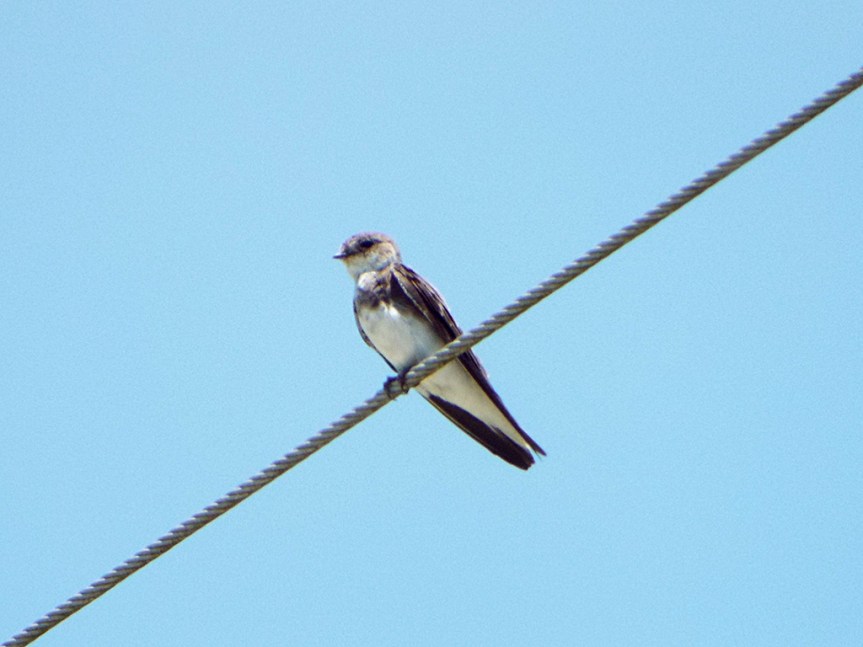
There had been reports of a Bank Swallow hanging out with the Barn Swallows (much like the lone Tree Swallow from a few weeks ago). As we approached the area the swallows seem to favor, I scanned the wires. To my delight, there was the Bank Swallow!
A Bank Swallow staying in FL for the summer.
Otherwise, as we drove the most notable species were the Anhingas (dozens), Cattle Egrets (several dozen) and Common Gallinules. Many of the gallinules had immatures with them – only a few had very small chicks, as the summer is wearing on.
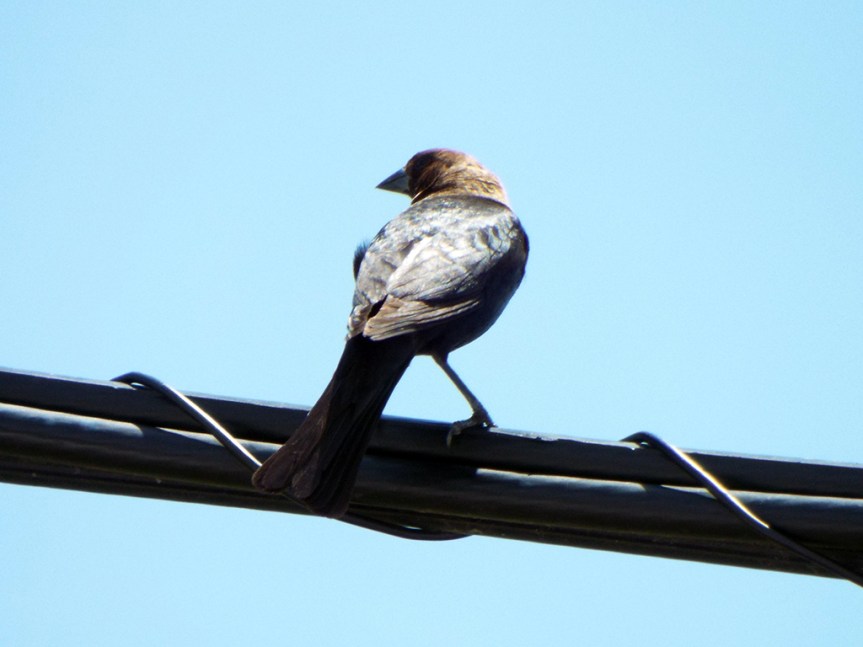
At the area we saw the Swallow-tailed and Mississippi Kites last time, there were several Swallow-tailed Kites very high up and this Brown-headed Cowbird, but that was all.
Brown-headed Cowbird
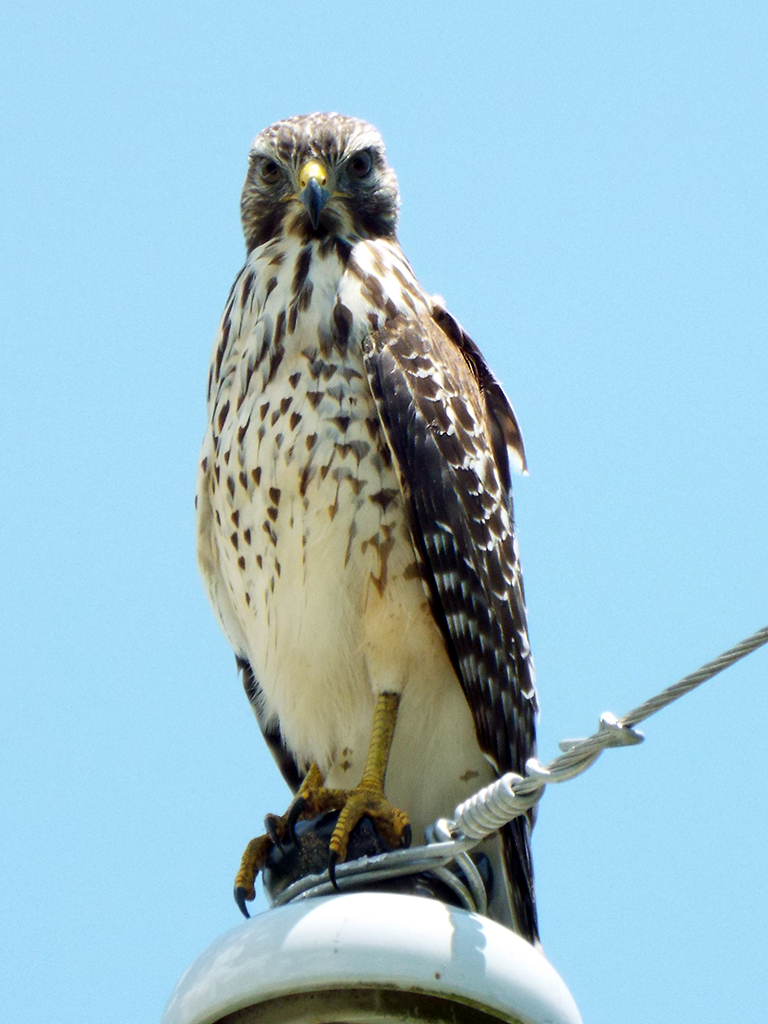
There were a few Red-shouldered Hawks, including one young bird that posed on a utility pole for a while. Further along the drive as we approached the exit, a Cooper’s Hawk and an adult Red-shouldered Hawk had a disagreement over airspace, with the Cooper’s actually driving the Red-shouldered Hawk away.
Another satisfying trip to Lake Apopka. It’s going to be really great birding there in the fall when the shorebirds and waterfowl come in, and again in the spring. During the normally quiet summer this has been one of the few productive birding spots in Central Florida.
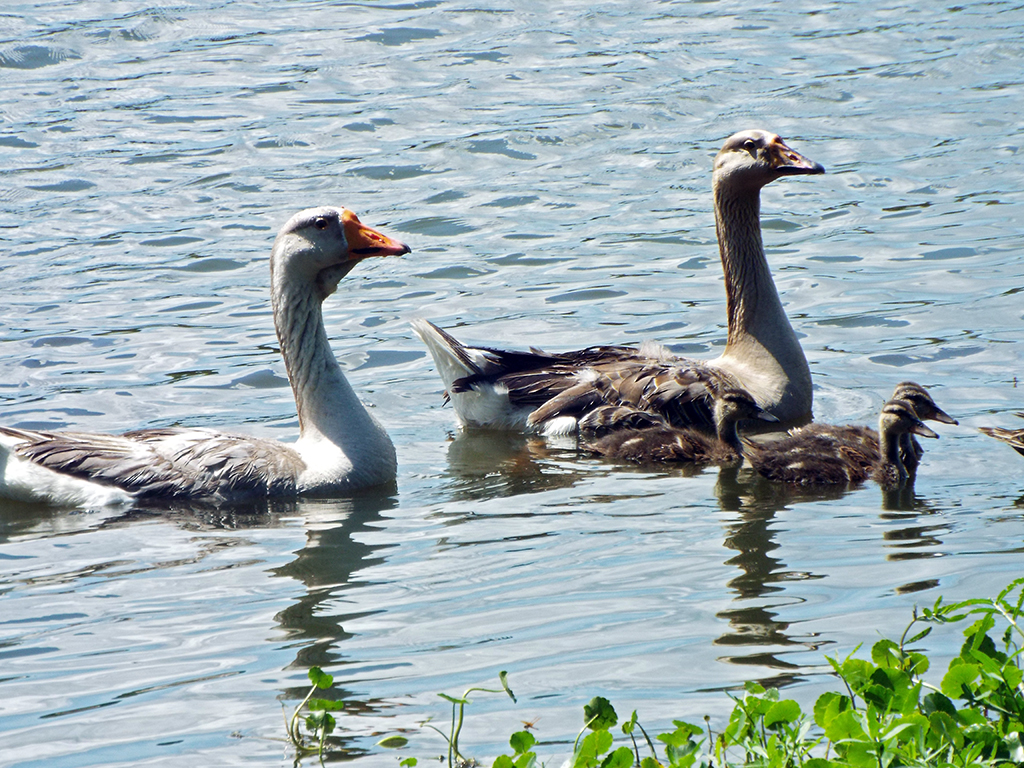
So the ABA doesn’t “allow” Greylag Geese to count in any official capacity, and if you list it on eBird, it doesn’t increment your bird counts.
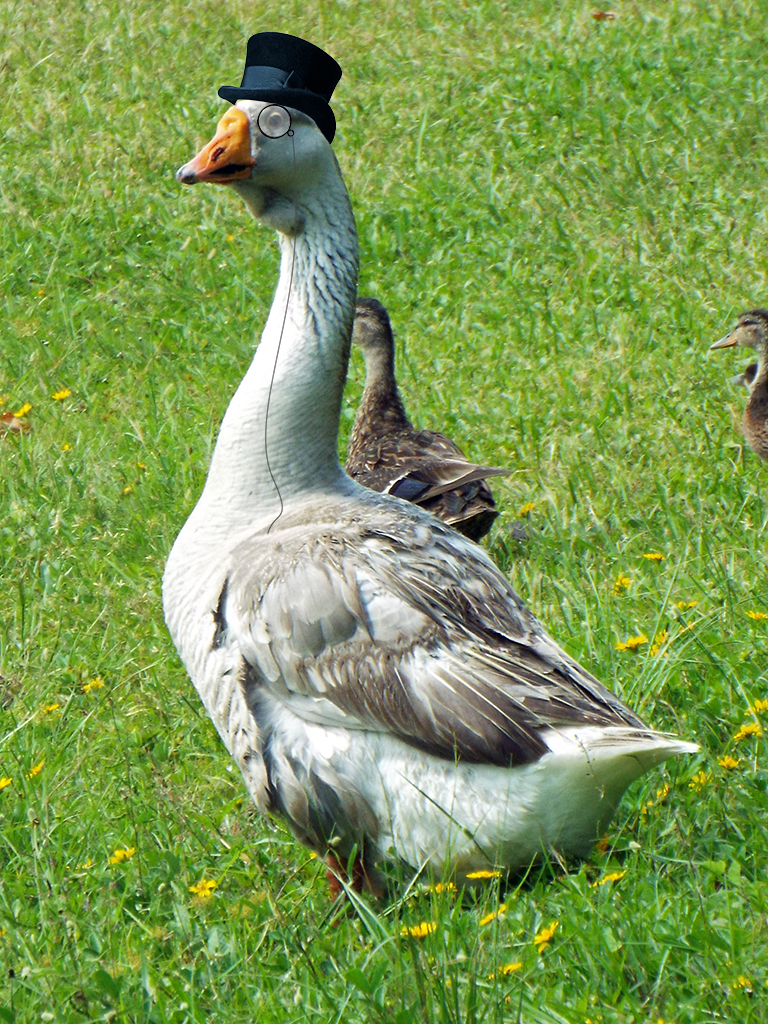
A mated pair of Greylag Geese, somewhere in Kissimmee. This particular pair seems to have sort of adopted a Mottled Duck family and follows them around a lot. Pretty wild, eh?
The reason for this, apparently, is that this species isn’t “wild” enough.
I can’t imagine what they’re talking about!
Ah, ok, once they got out of the water, it all became clear!
This past weekend’s adventure was all about the rails! After some good tips from both eBird and some local birders, Camille and I headed north to Spruce Creek Park for Clapper Rails. A few leads said that they were easily observed and calling loudly throughout the park.
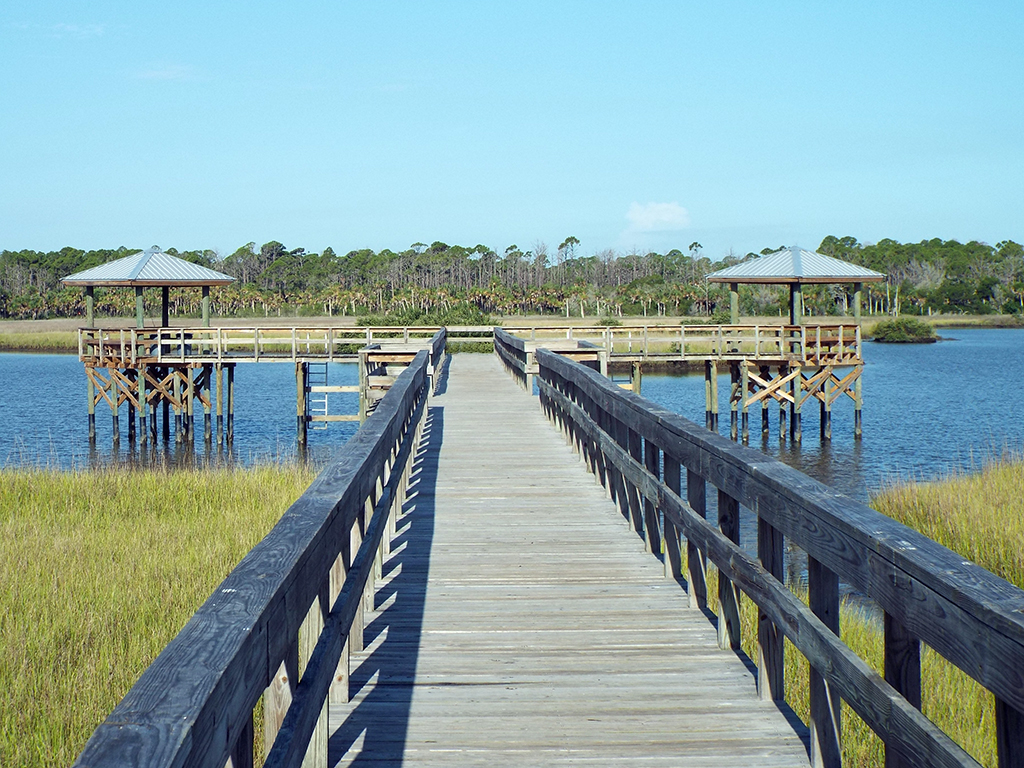
The park is over 1,600 acres in size and has a boardwalk overlooking the marshes and mudflats of Spruce Creek. There are also a few miles of hiking trails, but since the focus of the trip was rails, we didn’t really hike them.
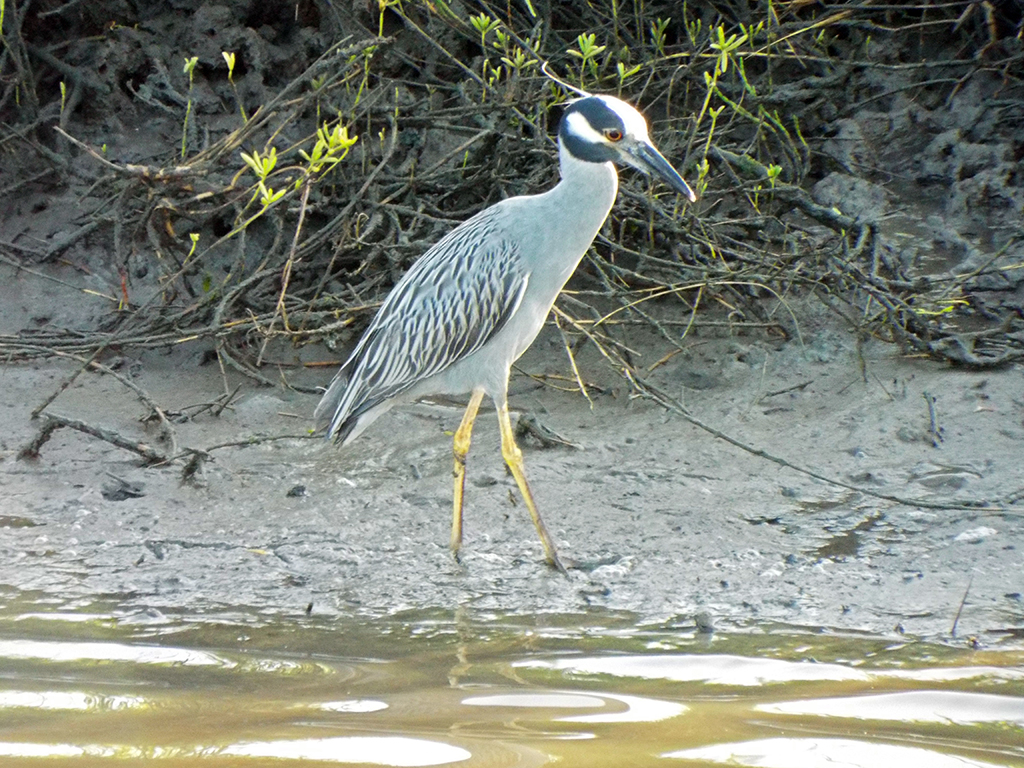
As soon as we stepped on the boardwalk we could hear Clapper Rails calling from all around the marsh, but we couldn’t see them. Other wading birds were working the perimeter of the mudflats (which were mostly underwater), including a Yellow-crowned Night Heron (my first of the year, finally).
Several Ospreys were soaring overhead, occasionally making a dive for fish, but more often chasing each other around the sky. I assumed they were young birds still associating with their parents.
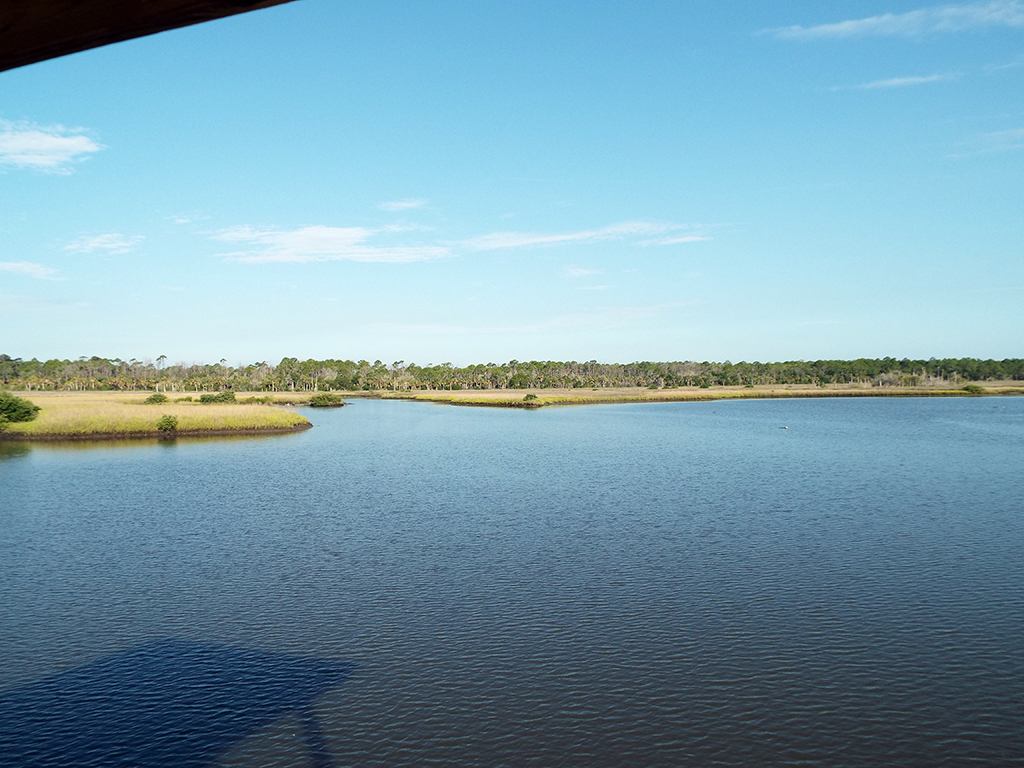
The marsh is beautiful and the stretch of water the boardwalk and pavilions overlook is expansive.
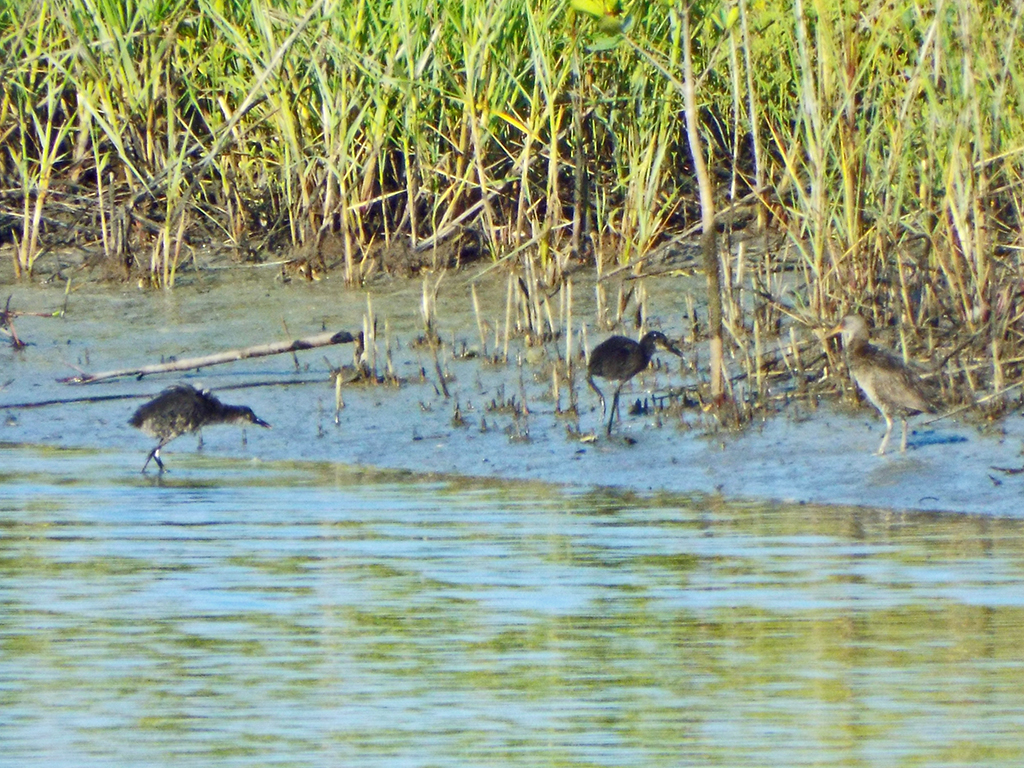
After waiting about 20 minutes or more, and continuing to hear the “kek-kek-kek-kek!” of Clapper Rails around, its was discouraging. But finally, I caught a glimpse of several gray bird shapes across the water cautiously emerge from the vegetation to the water’s edge. Just at the edge of my binoculars and camera range, I made out the characteristic rail shape.
Part of the rail family before heading back to the safety of the vegetation. These chicks look nearly adult sized.
There seemed to be two adults and several chicks. The adults’ gray plumage matched the mud almost perfectly, while the chicks were still sporting many black and dark gray feathers. The birds stayed in a group and wandered a bit along the vegetation before one by one, slipping back into the marsh.
After scanning the marsh another time, I saw a single rail even further away, but well into the open and in full sunlight. It ducked back out of sight after just a few minutes.
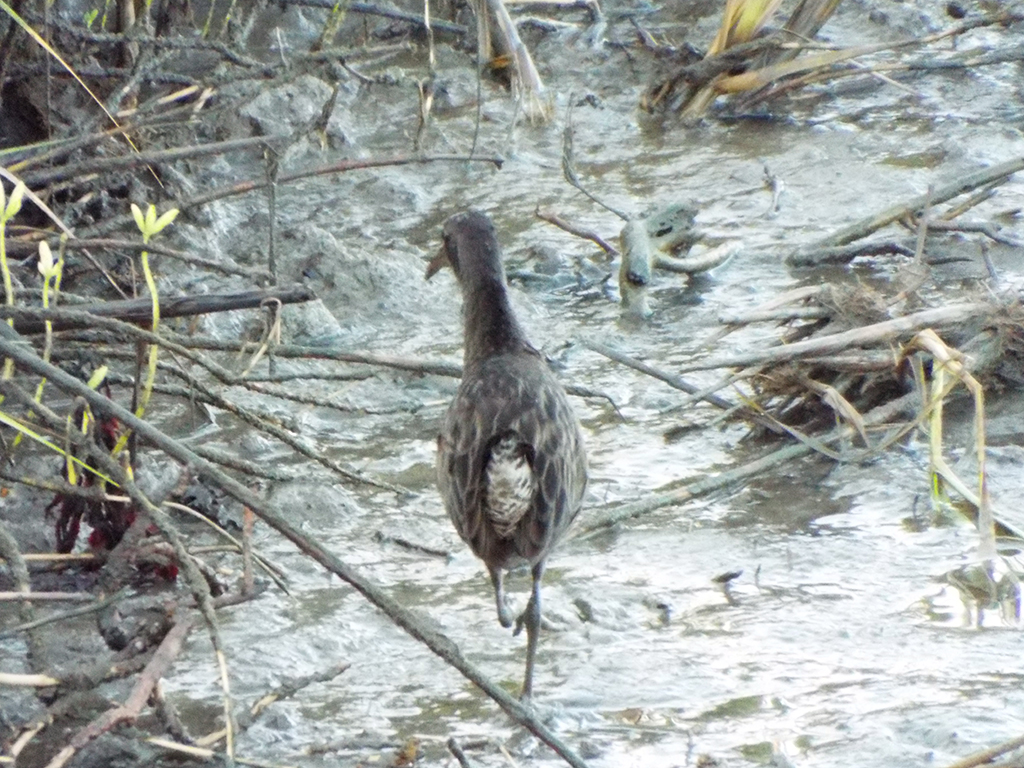
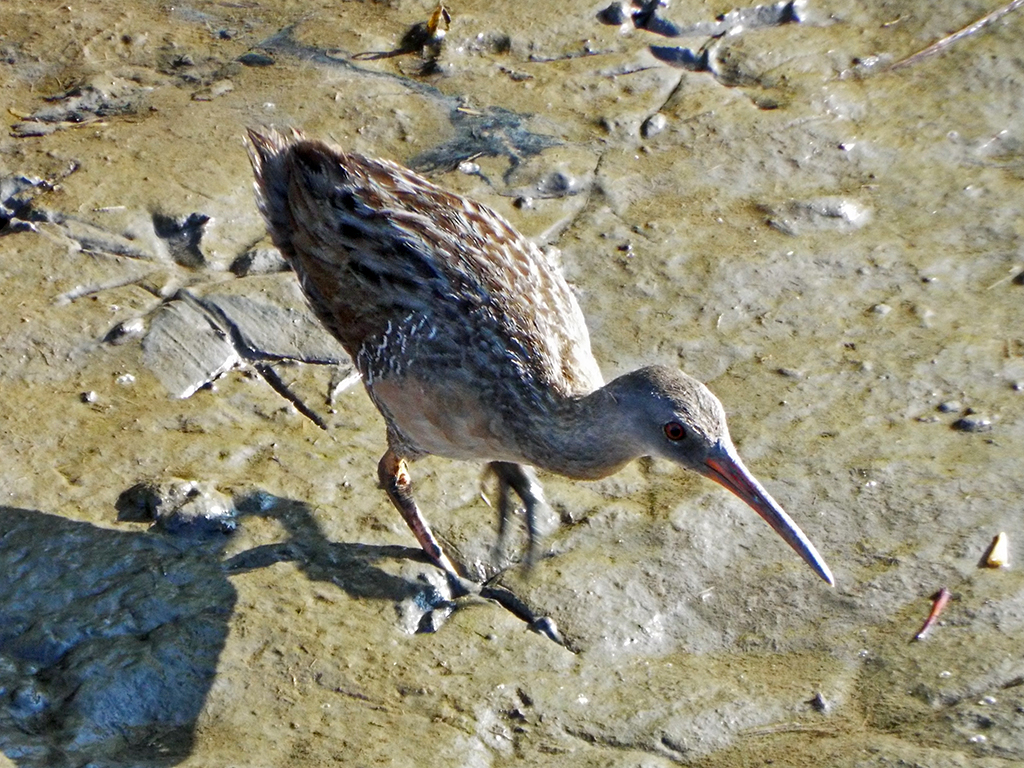
I figured that would be it, but Camille and I were excited to have finally seen rails! We began to slowly work our way back from the boardwalk to the parking area, but a bit of movement caught Camille’s eye as she saw something rail-like briefly fly above the vegetation before dropping down. We watched the spot where it disappeared for a minute before continuing on our way. Then a Clapper Rail walked right out in the open just below the boardwalk! It walked briskly away from me before running back under cover.
This was quite an unexpected treat. You can see from the laterally flattened body where the term “thin as a rail” comes from. Like bitterns, rails are exquisitely adapted to walking and running through reeds and other marsh vegetation, only very rarely flying in the open.
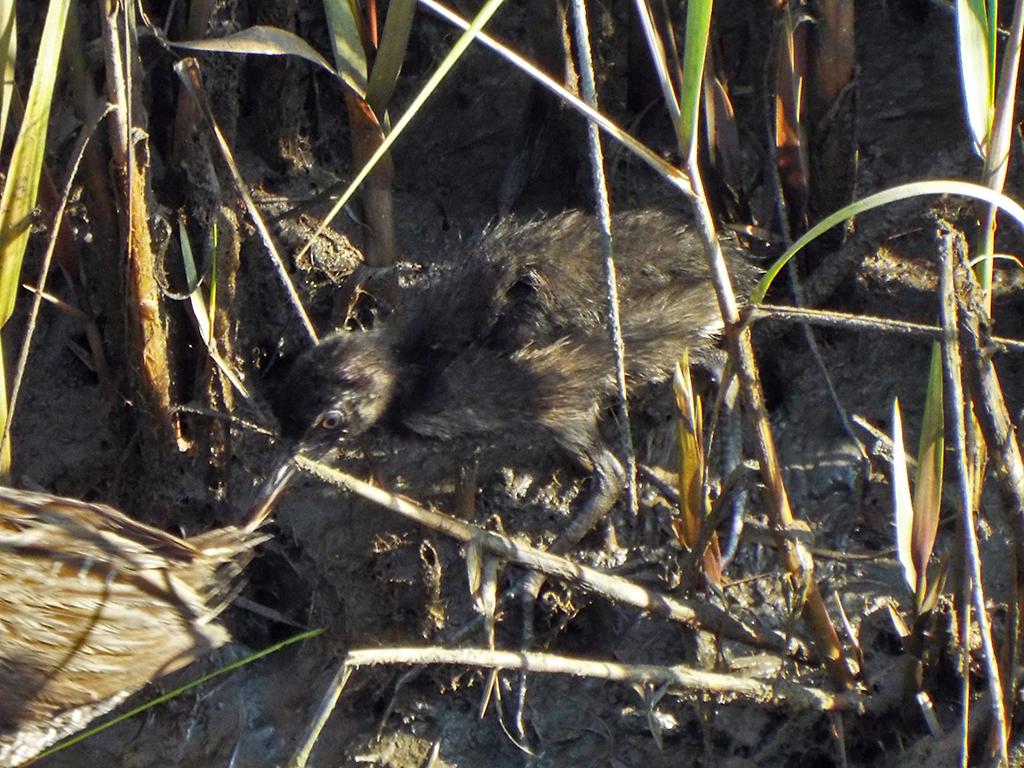
After a few more steps, I glanced over the other side of the boardwalk and another rail came out into the open, this one with a single chick following it! It paid us very little mind before making its way back into the marsh, followed by its chick.
The adult rail had only one chick following it. I don’t know if that means only one survived or hatched, or if more chicks were with the other parent.
Another bird I have not seen (at least not this year so far) is the American Oystercatcher. Recent sightings in Volusia county, not far from Spruce Creek Preserve, gave me some hope to see them. But after stops at the Port Orange Causeway Park and Seabird Island, no oystercatchers were in sight.
We did see a large number of Brown Pelicans (approximately 200 adults and nearly fledged chicks) as well as Double-crested Cormorants and a few egrets on a small island and sandbar near Seabird Island.
The last place we searched for American Oystercatchers was the Ponce Preserve. The eastern portion of the park is mostly vegetated sand dunes while the western portion (closest to the Halifax River) is a tidal marsh and mudflat habitat similar to Spruce Creek. Indeed, we heard more Clapper Rails (including one right below my feet under the boardwalk).
“Under the boardwalk, we’ll be hearing rails…”
Clapper Rails’ homeland.
That about wrapped up the morning, except one mystery. While we were exiting the dune portion of the Preserve and again later while on the boardwalk on the marsh, I heard a distinct, high-pitched, two-toned whistle that sounded exactly like a Mississippi Kite. I sort of joked about it to Camille, but then as we approached the end of the boardwalk, there was a very raptor-like silhouette on a small snag to our left. Perhaps it was that call plus the odd way the bird was perched, but we both really thought it was a small gray raptor. Each of us took a long series of photographs, but the bird was just far enough away to make it hard to know what we were looking at, even in binoculars. Upon closer review on my camera, it became embarrassingly apparent that it was merely a Mourning Dove, but that left the mystery call unresolved. As we were walking back along the boardwalk a small raptor did appear, this time soaring in quick circles, just after another two-tone whilstling call. I got a pretty decent look at the bird, and Camille got two slightly blurred photographs, but I can not make heads or tails out of what I saw. The most likely candidate would seem to be an immature Cooper’s Hawk; however, the mystery kite-like call and some aspects of this birds plumage have me wondering (Cooper’s Hawk calls sound much different than a kite). I’m going to take a closer look at the photographs and compare some other resources to see if anything definite can be determined.
But this is part of the fun and challenge of birding. You can’t always identify every bird you see or hear, and often the birds either refuse to cooperate in terms of posture or lighting, or they can look like a totally different bird. Since they have wings, species can be found far from where you’d expect (as Laura Erickson says, birds are functionally illiterate. They can’t read the field guides to know where they are supposed to be).
Here are the links to my eBird lists and identified species:
With the uneven migration season nearing its end, I had an additional impetus to get myself back to the Merritt Island National Wildlife Refuge (MINWR) when it was reported that a Curlew Sandpiper was seen there last week. I was hoping it would hang around another day or so, and on Sunday I made my way over the causeway and into MINWR. On the way in I saw some small birds mobbing a Red-tailed Hawk on a utility pole, and some Northern Mockingbirds chasing a Fish Crow. Exciting times!
Since many of the reports stated early morning viewing was very difficult, I decided to try both the Peacocks Pocket drive (which I had not done before) and then Blackpoint before circling back to Pumphouse Road.
Peacocks Pocket is a small bay-like feature of the Indian River Lagoon, near where it joins with Banana Creek (not the Banana River Lagoon). It has some popularity as a fishing spot, and there were several groups out fishing there. Here’s a map:
Due to the sun angle, I started down the eastern end of Peacocks Pocket and looped to the west. The sections of road in and out of Peacocks Pocket are relatively wide. If you needed to pull a bit to the side to let another vehicle pass, it’s pretty easy. The rest of the road is actually pretty narrow with very few turnouts, especially compared to Blackpoint, as an example. Luckily, I was early enough that I encountered few vehicles, and those I did see, I had plenty of time to find either a turnout or ride a slightly wider berm to get by.
“But what has it got in its pocketses, eh?”
I had heard from Camille that there were nesting Black-necked Stilts along this drive, and I did see stiilts along most of its length, but they did not appear to be nesting. I don’t know the incubation period for stilts, but it was wholly possible they had finished nesting and were dispersed. If that was the case, I expected to see chicks, but at first I just saw adults.
Sometimes bird names are completely pragmatic.
There was the usual assemblage of herons and egrets, many of them just getting into their morning routines. One Great Blue Heron was standing, facing the sun, in an odd pose I have only seen one other time (and never quite this extreme). I know I haven’t seen photos of it before in my general searches and browsing.
No, this Great Blue Heron wasn’t trying to sell watches. Many birds need to wake up their metabolism when they get up in the morning. You often see vultures spread with their backs to the sun. This must work for the heron, though it does look a bit funny, if we anthropomorphize.
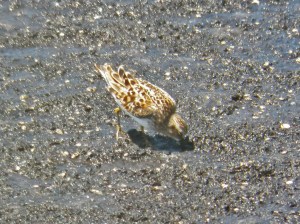
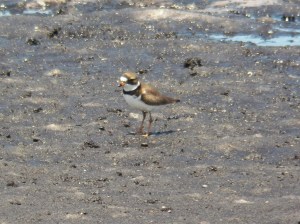
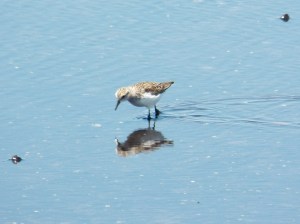
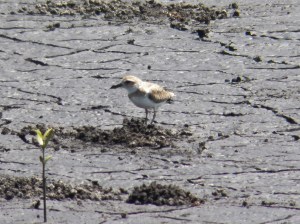
I noticed quite a few small sandpipers in the mud and shallow water. I had heard a Killdeer or two nearby, so when I first focused on some of the browner birds, I thought I was looking at a few more; however, a closer look showed only a single breast-band and much smaller bill. These were Semipalmated Plovers, and I was quite happy to see these. I have limited shorebird identification prowess, and this is the first certain identification I have of this species (that’s a long-winded way of saying it was a lifer!). Curiously, upon closer inspection of the other small birds, I saw the yellow legs of Least Sandpipers, but then the black legs and stoutish bills of Semipalmated Sandpipers! Lifer number two (I never did resolve if the slightly larger “peep” from the Orlando Wetlands earlier in the year was a Semipalmated or a Western Sandpiper). I watched the birds running about for food and chasing each other around. They let out a collective series of avian epithets when an adult Bald Eagle flew by and landed in some taller vegetation.
Aside from more egrets and stilts, the blackbirds were vigorously defending their terrtories and nests for each other and the occasional large bird (I saw both Ospreys and vultures being harrased out of the area). Both the Boat-tailed Grackles and the Red-winged Blackbirds were busy keeping threats away and singing, some quite close to the car.
Male Red-winged Blackbird.
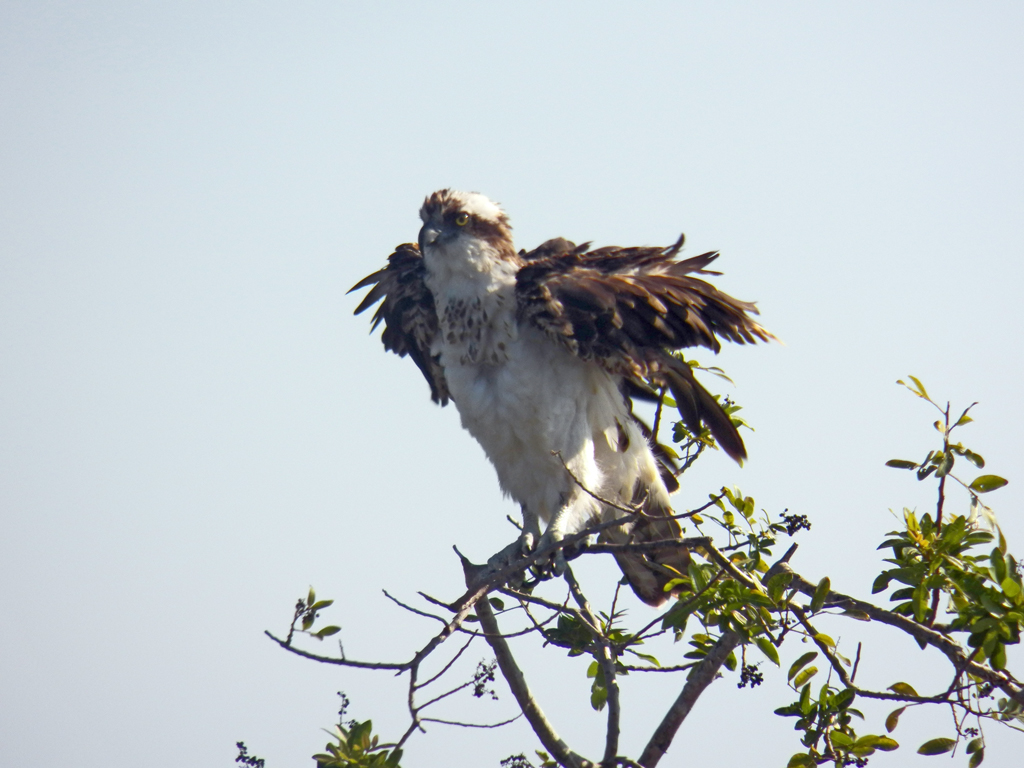
A pair of Loggerhead Shrikes really ruffled the feathers of an Osprey as they chased it so hard it almost dropped into the water! I saw it land on a small tree farther up the trail, where is stayed until I passed it several minutes later.
An aggravated Osprey after almost being forced into the water by a pair of hostile shrikes.
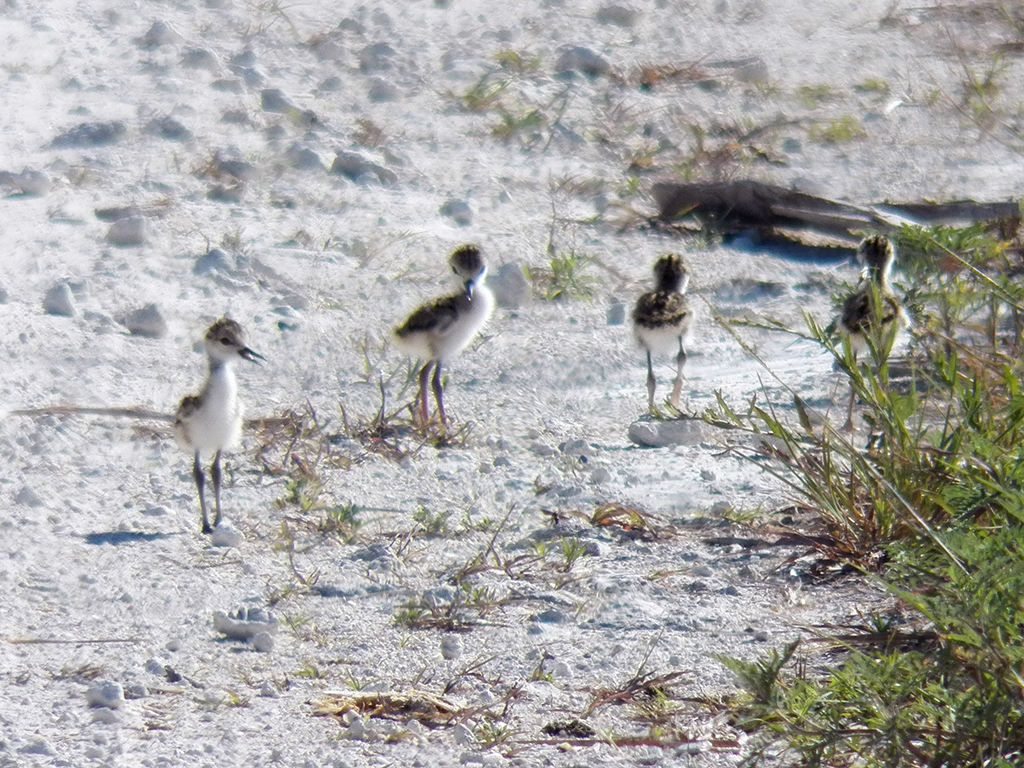
Farther up the road I heard some very loud Black-necked Stilt calls, and seeing 2 adults on the road in front of me stopped and slowly got out to take a photo. Right as I closed the car door, the birds went crazy, calling loudly and one of them doing a sort of wounded-flutter just above the road, legs dangling. I realized that there must be either a nest of chicks nearby, given the faux display (similar to what a Killdeer might do on the ground, feigning injury to draw away a predator).
“Keep up, kids!”
There were four stilt chicks, walking the road. The parents got really worked up and after taking a few photos, I backed off and returned to car, apologizing and letting them be on their way. It’s very possible that many of the “dispersed” stilts I saw earlier had chicks nearby, but due to their coloring, size, and distance, I didn’t notice them.
Cuteness overload!
Bird activity further long the road was sparse, and as I made my way toward the other end of the road, I started to encounter more vehicles coming the other way, most of them with fishing gear visible. At this point the road widened and I came back out of the main road, just west of Blackpoint.
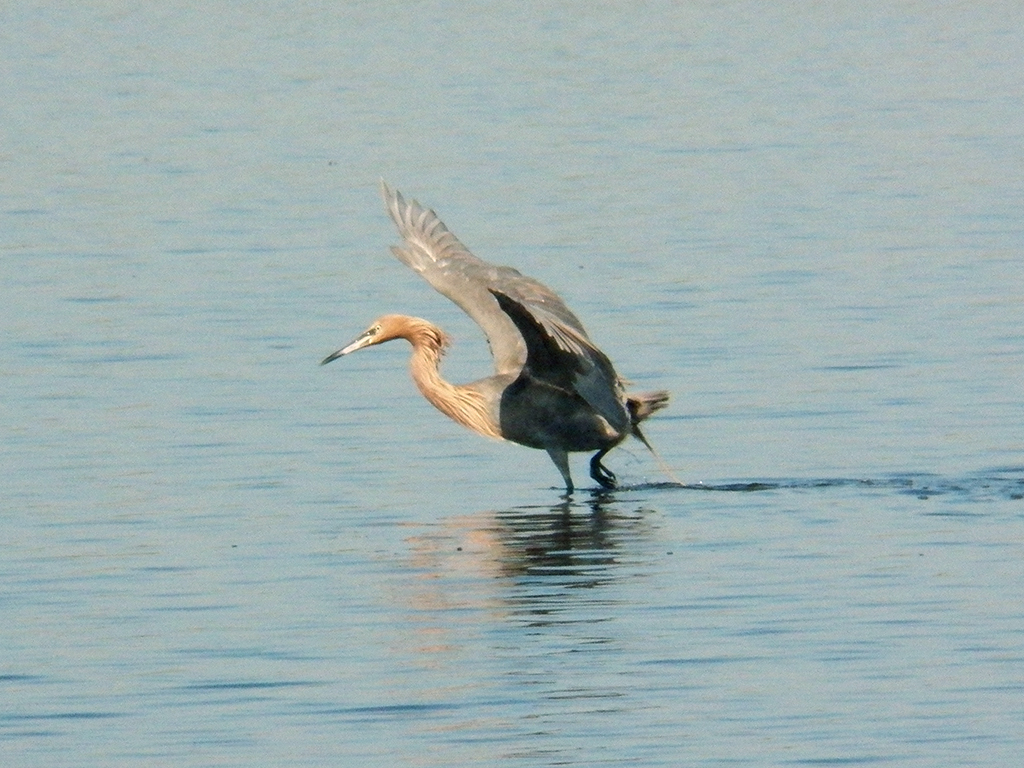
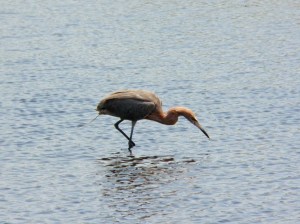
Blackpoint Wildlife Drive was quite devoid of birds, as it typical for this time of year. Except for the odd, small groupings of American Coots and Common Gallinules, there was nothing until I happened upon this Reddish Egret, dancing around to get its meal. This is the same spot I’ve seen a Reddish Egret during the winter, but I have no way of knowing if this is the same bird or not.
“Ho! Ho! and up she rises. Ho! Ho! and up she rises. Ho! Ho! and up she rises, Early in the morning!”
A bit further along the drive were a scattering of sandpipers and plovers, mainly Willets and Killdeer, with perhaps some other peeps mixed in, but nothing really close by to get a good look at, until this Glossy Ibis.
“Yes?? Can I help you?”
By this point it had reached late enough in the morning for the lighting to improve along Pumphouse Road and the potential for the Curlew Sandpiper, and whatever else might be close enough to grab with my binoculars.
The comments from the Brdbrain e-mail list indicated that views of the bird in question were just over a quarter of a mile down the road. As I stepped over the chain barrier onto the road I noticed a couple of birders ahead of me, both with scopes. I was clinging to a tenuous hope that maybe one of them would let me have a glance in their scope if they came across anything interesting.
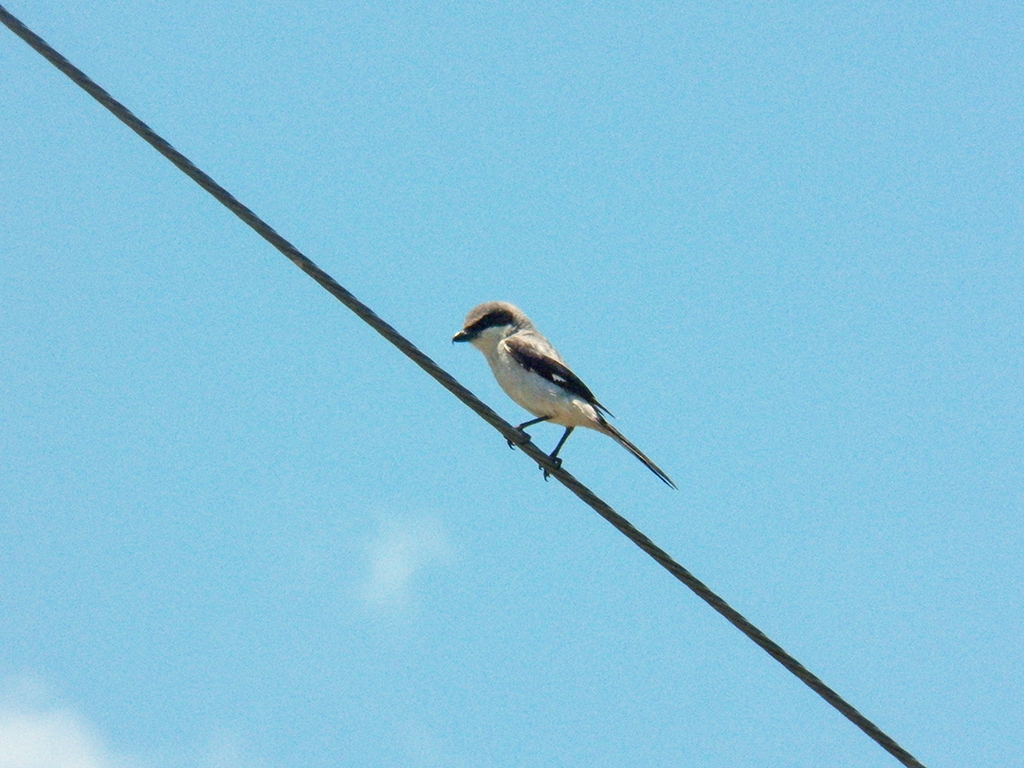
Loggerhead Shrike watching me as I entered the Pumphouse Road Loop.
The first two men were decidedly cool and almost clinical, so I didn’t feel very comfortable asking for a look in their optics. They scanned a flock of mostly Semipalmated Sandpipers, looking for the Curlew Sandpiper to no avail. Another man walked in and began setting up his scope. I think I recognized him from the Space Coast Birding and Wildlife Festival; he ran the Diceandra Scrub Sanctuary trip, I believe. He was quite friendly, and I thought he might be more friendly regarding the use of his optics.
Let me pause here for a short paragraph. It’s not that I feel entitled to others’ optics, it’s just that even a somewhat decent spotting scope is seriously out of my budget, and is likely to be for some time. Unfortunately, for any good looks at shorebirds or if something interesting is happening across a lake, it’s really tough with 8 power binoculars. It’s even tough with 10 power, to be honest. So the best hope that we scopeless folks have is to depend on the kindness of strangers (or any friends that are lucky enough to have procured a scope!).
All three men generally agreed that the mudflats and shallow water we were looking over had dried considerably since they’d last been there a couple of days before, and that the birds were therefore farther out and harder to discern.
I walked further up the road, scanning the two main groups of shorebirds just in case I caught a hint of reddish head and breast that might indicate the Curlew Sandpiper’s presence. Meanwhile, I got some good binocular looks at some of the smaller plovers and sandpipers that were venturing closer to the road.
Least Sandpiper
Semipalmated Plover
Semipalmated Sandpiper
Wilson’s Plover
There were also some Willets, Greater Yellowlegs, quite a few Dunlins, Killdeers and even a single Piping Plover in the area. I walked back to where the men had been scanning with their scopes, but they had all departed while a few more people with scopes were coming in. I milled around and talked a bit with them about the Curlew Sandpiper and what other birds were present. I asked one couple if they saw anything of interest, would it be ok to have a look in their scopes. They said yes, they’d be happy to share, so I watched the nearer birds for a while. They finally had the scopes on some birds of interest (no Curlew Sandpiper, though) and I had a look at some American Avocets, more Reddish Egrets, a Black-bellied Plover and, a first for me, a Stilt Sandpiper.
By then it was getting hot and it was past lunchtime, so I headed out. On the way, I passed some more egrets.
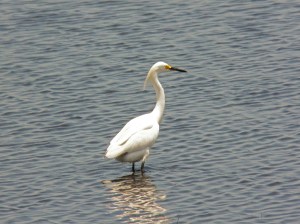
Snowy Egret
Reddish Egret
Great Egret
I took brief look overhead on my way the car and saw a mix of vultures, Wood Storks, and American White Pelicans soaring on an early afternoon thermal. The pelicans had brown primary feathers, so I believe they were juveniles. With that, it was time to head home.
Here is a list of the 53 species I identified, roughly in the order in which I saw them:
Double-crested Cormorant
Northern Mockingbird
Fish Crow
Red-tailed Hawk
Red-winged Blackbird
Snowy Egret
Black Skimmer
Black Vulture
Bald Eagle
Great Egret
White Ibis
Mourning Dove
Roseate Spoonbill
Killdeer
Least Sandpiper
Black-necked Stilt
Glossy Ibis
Tricolored Heron
Great Blue Heron
Semipalmated Plover
Caspian Tern
Osprey
Laughing Gull
Ring-billed Gull
Little Blue Heron
Greater Scaup
Boat-tailed Grackle
Loggerhead Shrike
Mottled Duck
Turkey Vulture
Anhinga
Least Tern
Reddish Egret
Green Heron
Red-bellied Woodpecker
American Coot
Common Gallinule
Northern Flicker
Willet
Semipalmated Sandpiper
Black-bellied Plover
Dunlin
Wilson’s Plover
Stilt Sandpiper
Piping Plover
Sanderling
American Avocet
Greater Yellowlegs
Red-shouldered Hawk
Common Yellowthroat
Wood Stork
American White Pelican
Cattle Egret
It turned out to be a pretty good day, even without a Curlew Sandpiper. It turns out that no one saw it at all that day or since. Such is the way with migrants. I can’t complain, though. I saw a good mix of beautiful birds, talked with some nice people, and enjoyed a great morning out.
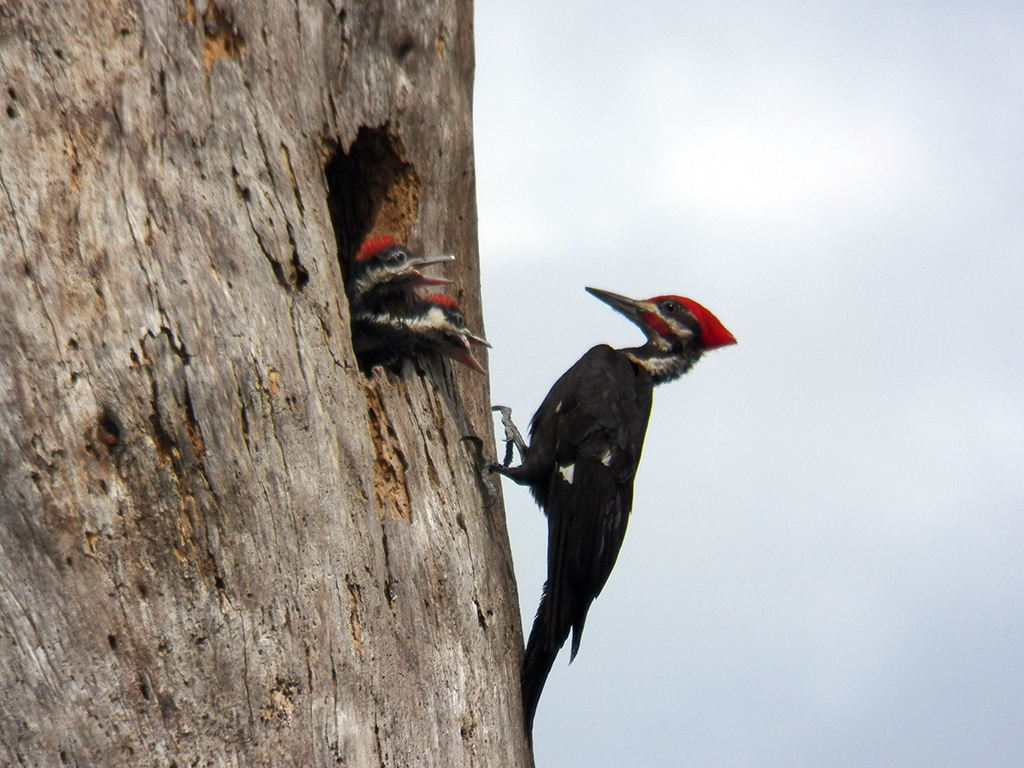
Here’s a (slightly wavery) video of the Pileated Woodpecker chicks getting their breakfast from their dad. These chicks’ punk-rock mohawks will grow into the handsome crests as they get out of the nest and mature this spring.
It’s always an interesting balancing-act for me to decide where to go birding. I like to vary my experiences, but the (very) amateur scientist in me likes to see the changes in the same location over time and under varied circumstances. In the end, I wind up visiting the same places many times each year, sprinkled with the odd foray into somewhere new (or at least less visited by me). As this weekend approached, the decision seemed to come down to either Lori Wilson Park or Turkey Creek Sanctuary. Camille and I actually talked about it a bit, wondering if either one might prove more fruitful than the other. It remained up in the air until late Saturday when I decided that Lori Wilson Park would be a good place to start. If things were too quiet there, there would still be time enough try something else. At that time I was thinking Turkey Creek again.
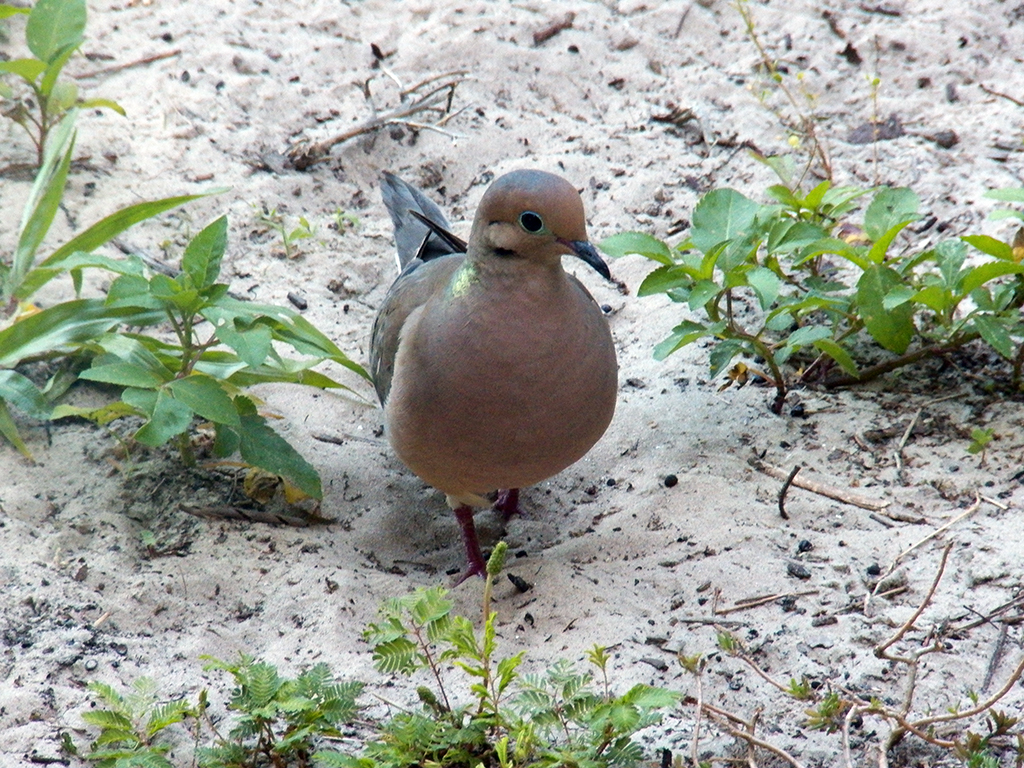
I met up with Camille and it turns out that, yes, Lori Wilson Park was very quiet. Phyllis Mansfield was there, talking with 2 men who were staking out the small water feature (optimistically referred to as “the pond”) with it’s dripping hose. This is actually a good bird attractant, but this time there were only some Mourning Doves and House Sparrows in the vicinity.
Lovey-dovey Mourning Dove walks in for a closer look at us.
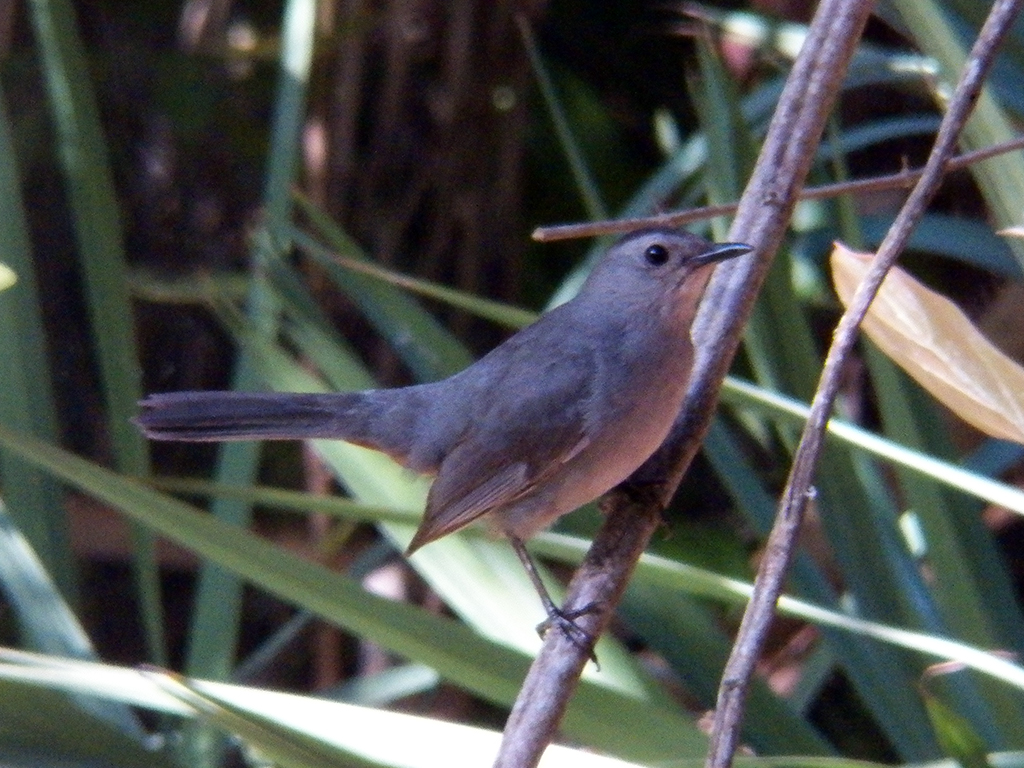
On the boardwalk loop, the park was dominated by white butterflies. There were dozens of them all over. I caught a couple of very brief glimpses of two Ovenbirds, and we heard and saw several Common Yellowthroats. Of course the Northern Cardinals were ever-present, and as we got back to the entrance/exit a bit later, we did see some Common Grackles, a single American Redstart, and a Gray Catbird near the pond.
Proving, again that birds are functionally illiterate, this Gray Catbird is still hanging around Florida.
On the way out we flushed a couple of Palm Warblers and watched some Northern Mockingbirds go about their day. There were some Brown Pelicans flying overhead as we decided what to do next. With Lori Wilson Park so quiet, the prospects for Turkey Creek Sanctuary seemed bleak. I thought maybe trying something new might spruce the morning up a bit and we could head to the Helen and Allan Cruickshank Sanctuary. As a scrub preserve there was bound to be some Eastern Towhees (which for Camille would be a life bird) and who knows what else. At least the Florida Scrub Jays would be a pretty sure bet.
Here’s the list of birds seen and heard at Lori Wilson Park, including the parking area:
Northern Mockingbird
House Sparrow
Common Grackle
European Starling
Mourning Dove
Fish Crow
Northern Cardinal
Blue Jay
Ovenbird
Common Yellowthroat
Brown Pelican
American Redstart
Gray Catbird
Palm Warbler
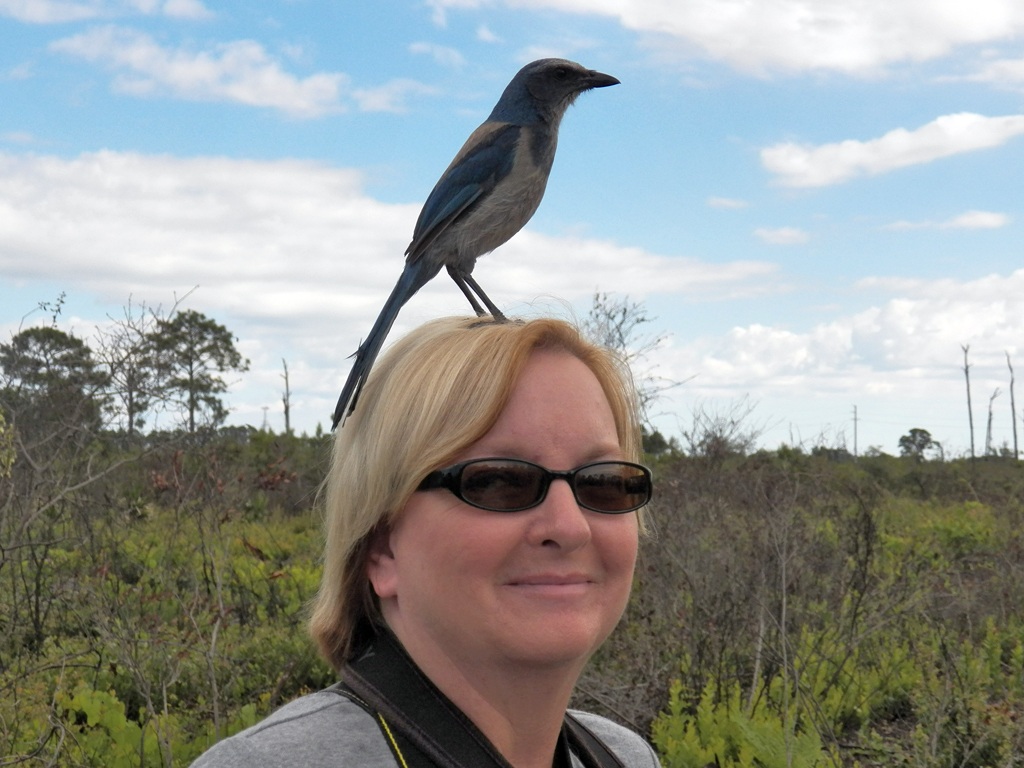
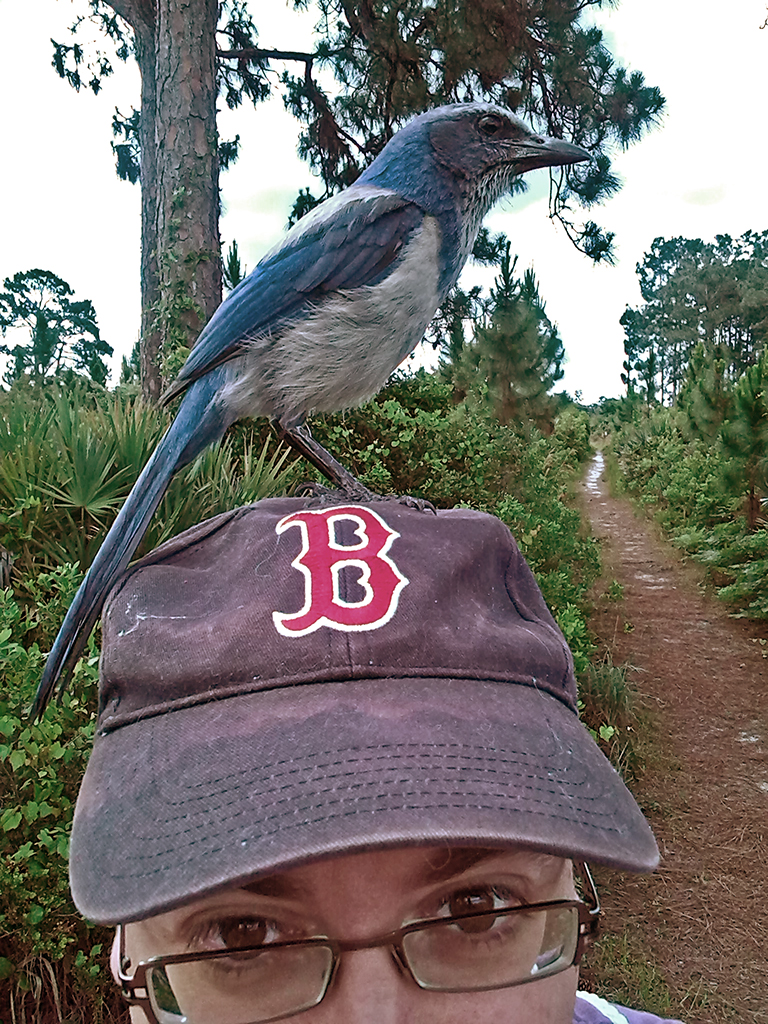
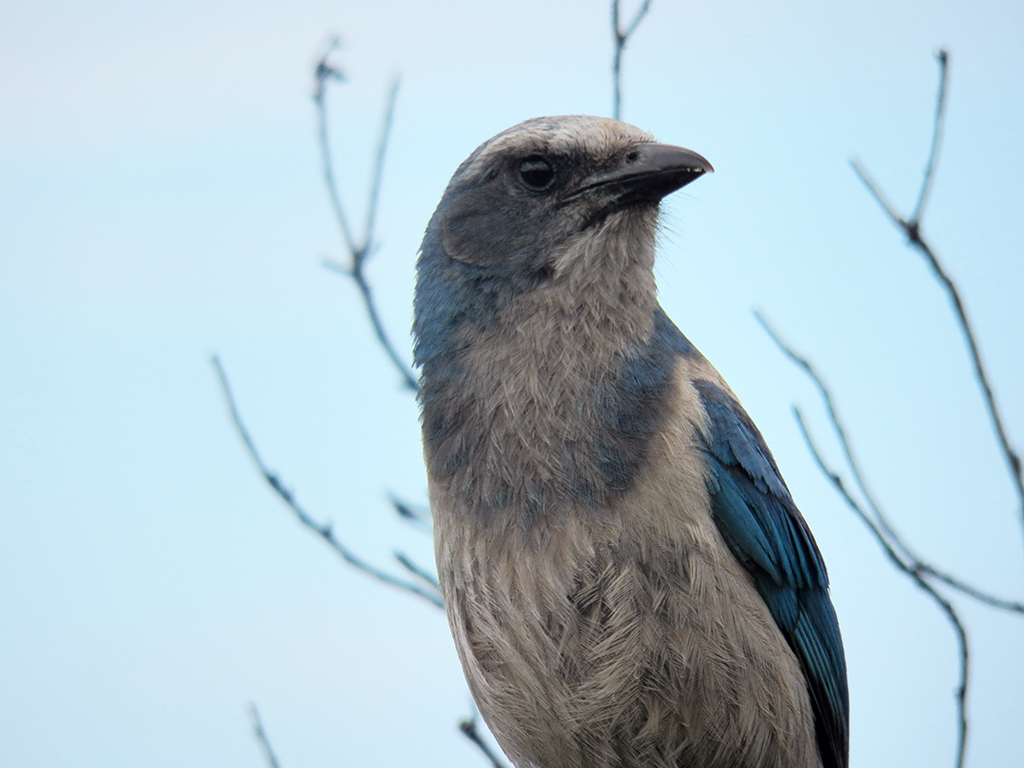
We arrived at Cruickshank about 20 minutes later and walked to the trailhead. The southern part of the sanctuary had been burned fairly recently, but it was growing in nicely. We quickly had our first birds of the day: some very inquisitive Florida Scrub Jays! I know in the past that visitors often would (sometimes at the encouragement of the sanctuary’s caretakers) feed the jays peanuts. They would land on people and even eat out of their hands. This is strongly discouraged now, but as these birds still seem want to land on people, I have to wonder if people aren’t still feeding them on the sly. I know that as recently as a couple of years ago the caretakers were still feeding them by hand. While it makes for great public relations (and fun photos!), the long term impact of this on the jays’ behavior isn’t clear.
This isn’t what is generally meant by a “feathered headdress,” but you have to admit it’s pretty striking!At least it’s not a Blue Jay (go Red Sox!)
When not being fed peanuts (or stealing snacks from visitors’ pockets), these jays are omnivorous, feeding on berries, nuts (like acorns) and insects. I’ve seen them run down ants and catch bees in mid-air. After it became apparent we had nothing to offer them, the jays took to the ground, grabbing bugs and seeds in the dirt.
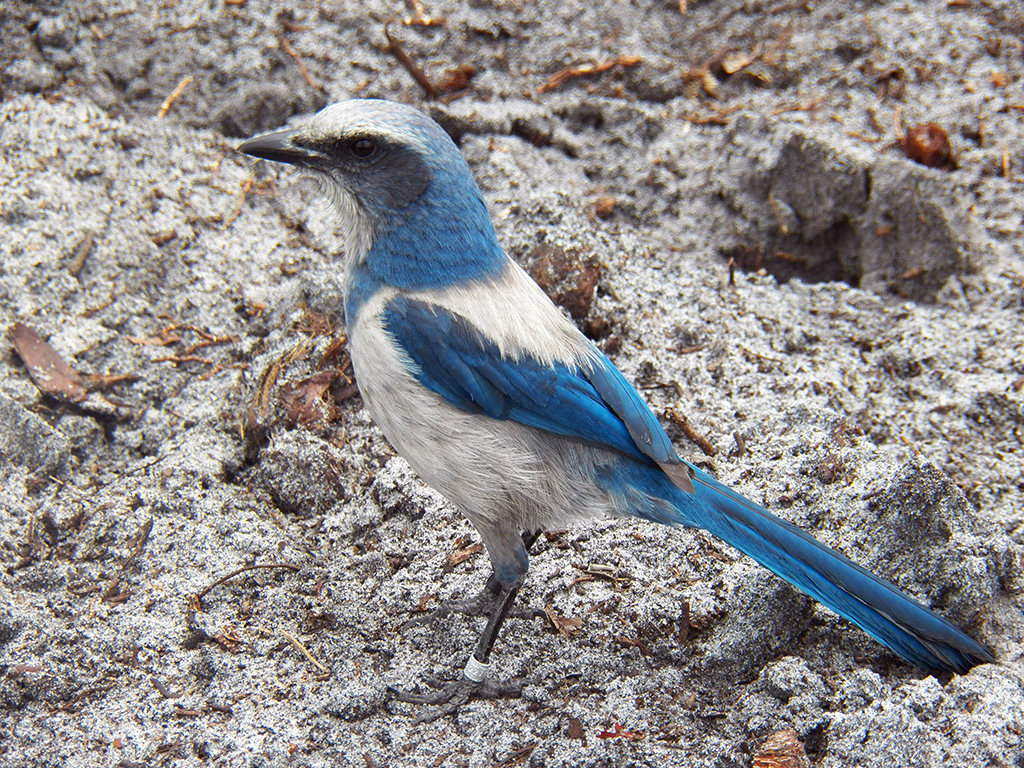
Like most of the Florida Scrub Jays in the sanctuary, this bird has a band for identification and tracking.
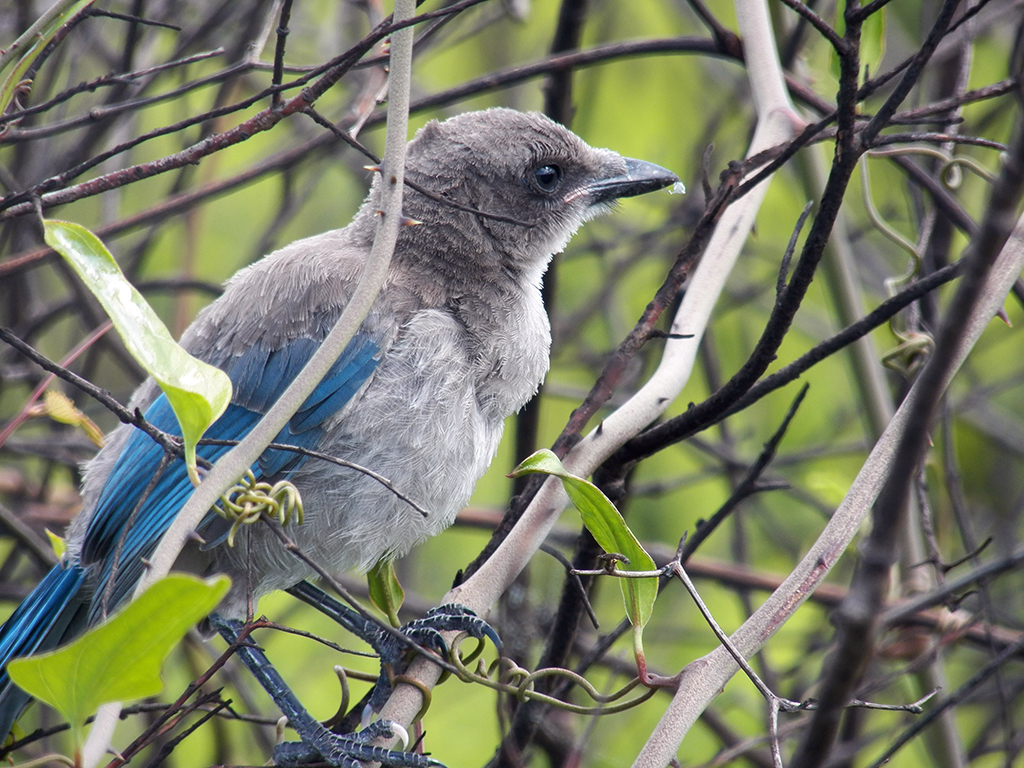
There were several fledglings calling and making short flights through the scrub. I’ve not seen scrub jay fledglings before and it was fun watching them try to navigate their world while family members looked on. These youngsters stayed very low in the vegetation and made only tentative attempts at crossing larger, open spaces.
A young Florida Scrub Jay taking a break during flight training. In a few weeks it’ll be winging its way like a pro.
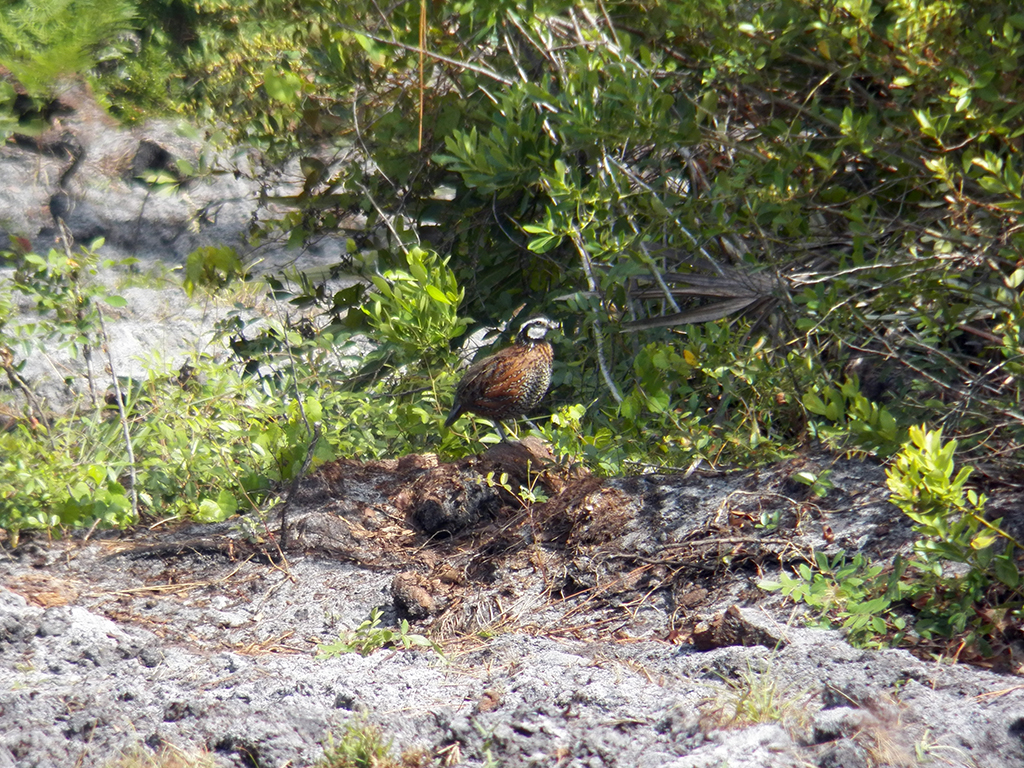
As we progressed further in the sanctuary, we could hear Eastern Towhees calling to each other in the dense scrub. As we walked the 1-mile hiking trail I was hopeful we’d see some and add the bird to Camille’s steadily growing life list. This is when we had our first surprise of the morning. A Northern Bobwhite was out in the sunshine by the edge of the wider dirt path, singing while in his best breeding plumage. We heard a few of them throughout the sanctuary, but only this one stayed out long enough to get a good look at. This was a life bird for Camille, and one that I had not anticipated.
This Northern Bobwhite was loudly and proudly calling his name out at the edge of the trail. We didn’t get much closer than this, though, before he scurried into the brush.
As we made our way along the trail, we finally did track down a singing male Eastern Towhee, while many others called nearby. Some swallows overfly us, too and I was confused because at first I thought they late-lingering Tree Swallows. In the end, I think they were Bank Swallows but I never quite got a good enough look at their throats to be sure. There were a few Barn Swallows as well (another Camille life bird), and at least one Purple Martin. One lone Sandhill Crane also flew overhead at one point, and there were several Anhingas soaring nearby.
As we approached some large, dead, oak trees, some very raucous calls started coming from one. A Pileated Woodpecker had landed next to a large, oval hole. Then, we had our second surprise of the day!
Papa woodpecker feeding his two babies. There was a female nearby as well. These two stretched their necks out so far I don’t know how they didn’t fall out!
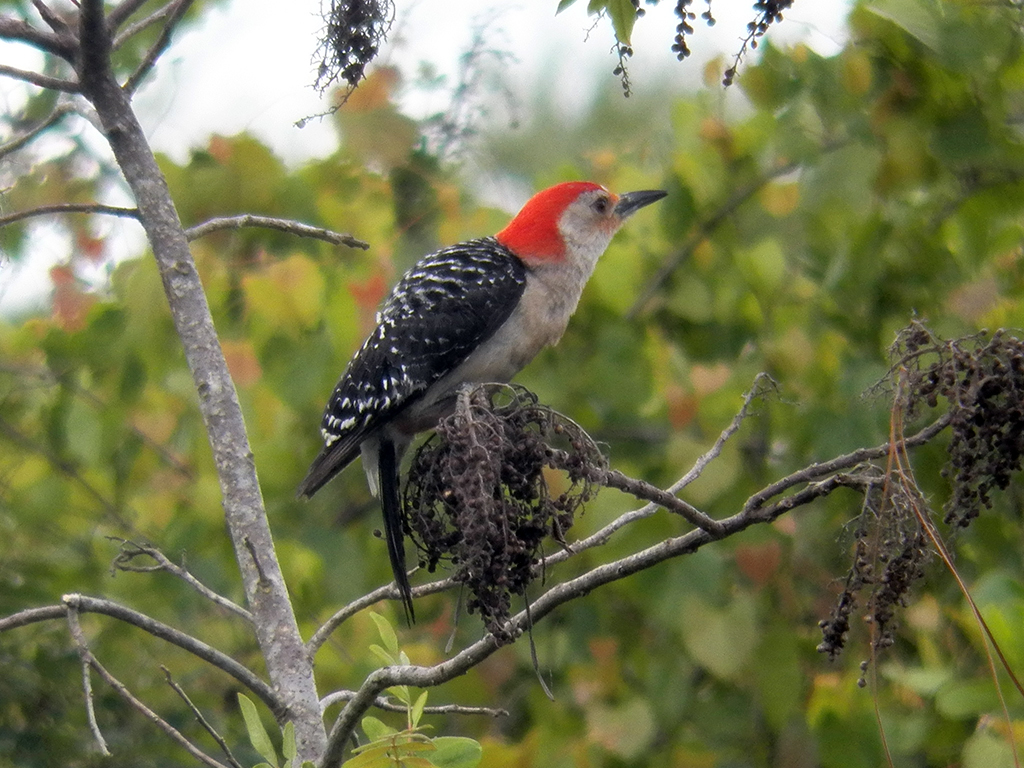
In addition to the Pileated Woodpeckers, two other species of woodpecker were present. Red-bellied Woodpeckers are fairly ubiquitous, but this one was foraging more like a chickadee. Just before the next photo was taken, it was swinging upside down under that tangle of seed pods.
Red-bellied Woodpeckers tend to be more versatile than other woodpecker species, even perching on wires on occasion.
We also had one of an apparent pair of Northern Flickers stop in a nearby tree. We could hear them clear across the sanctuary for a while before one finally came close enough to get a decent binocular view of. Flickers were always very common in my back (and front) yard as a child, and were a staple find in my early biding years. They are less common around my usual birding spots now, so it’s always a pleasure to hear or see them.
After that, we headed toward the parking area, stopping to watch the Scrub Jay fledglings again and have some more birds land on our heads. Florida Scrub Jays are scrappy little birds, and I am glad we’ve set aside some sanctuaries for them. My hope is that we come up with a better development and land-use strategy in central Florida to manage our scrub habitats and let the population roam and expand.
Unofficial Florida State Bird.
The total species list for the Cruickshank Sanctuary:
Florida Scrub Jay
Eastern Towhee
Northern Bobwhite
Blue Jay
Chimney Swift
Red-bellied Woodpecker
European Starling
Pileated Woodpecker
Purple Martin
Anhinga
Fish Crow
Sandhill Crane
White Ibis
Barn Swallow
Great Egret
Wood Duck
Northern Flicker (FOY)
Common Yellowthroat
Roseate Spoonbill
It turned out to be a pretty good choice, going to the Cruickshank Sanctuary. There are other less explored parks in the area I’m keen to visit. The normal migration season is beginning to wind down now. There will still be some birds moving through the rest of the month, but then the Space Coast and nearby areas will get into its usual summer regime. I’ve got some hopeful adventures planned for the summer. Let’s see how they pan out.
With some better reports coming in from along some parts of the Space Coast, I thought it might be a good time to return to Turkey Creek Sanctuary. The better forecast for migrants is for later in the week, but the winds have been out of the south for the past few days, making for at least some marginally good conditions. I met up with Camille again and we set out along the Sand Pine Trail on our way to the boardwalk where there are generally reliable sightings.
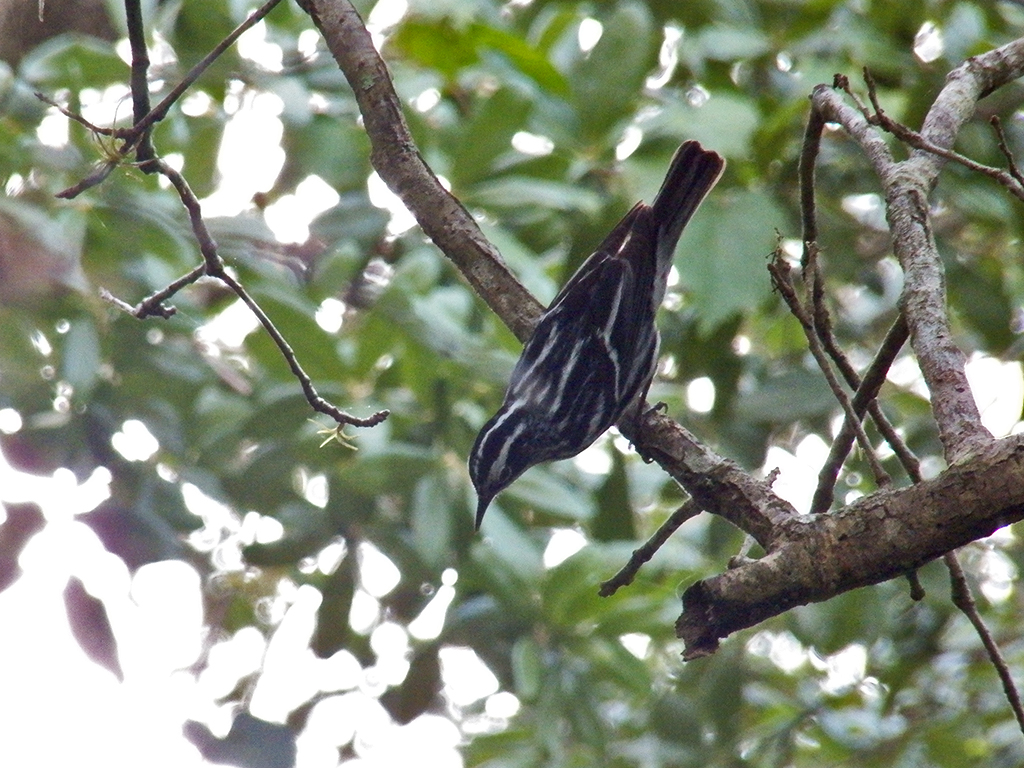
Aside from the usual Northern Cardinals and Carolina Wrens singing up a storm, we did encounter a decent sized, mixed flock of Black-and-white Warblers and Blackpoll Warblers, mostly high in the pine trees. Since different warbler species often associate with each other, we gave this group a really good look to make sure we weren’t missing any other species before moving on down the trail. The flock more-or-less followed us along the trail, but we didn’t see much else. I could hear Chimney Swifts above us, but never got a good look, and there were Blue-gray Gnatcatchers nearby as well.
We got to the boardwalk to an area where Camille (who had run into Bill Haddad last week) had seen some warblers, and is known to be a pretty good hot-spot. At first we didn’t see to much, but then we heard some gnatcatchers (often a preamble to warbler or vireo activity). Sure enough, we wound up with a nice group of Blackpolls, Black-and-Whites, American Redstarts, and even a Black-throated Blue Warbler!
This Black-and-white Warbler was hanging around with some Blackpoll Warblers.
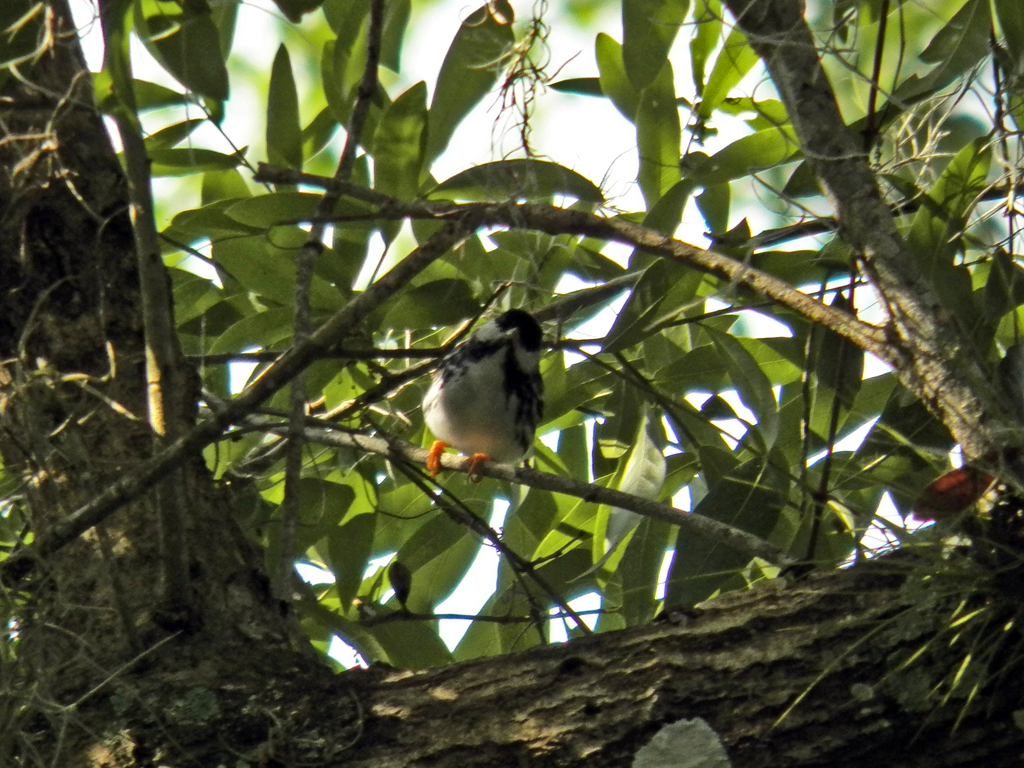
Sometimes it can be hard to distinguish the Blackpolls (especially the females) from some other species when the birds are in the canopy or in poor light (most of the birds we saw were very backlit). A key identifier for Blackpoll Warblers is their orange feet.
“He did tell you about the feet.”
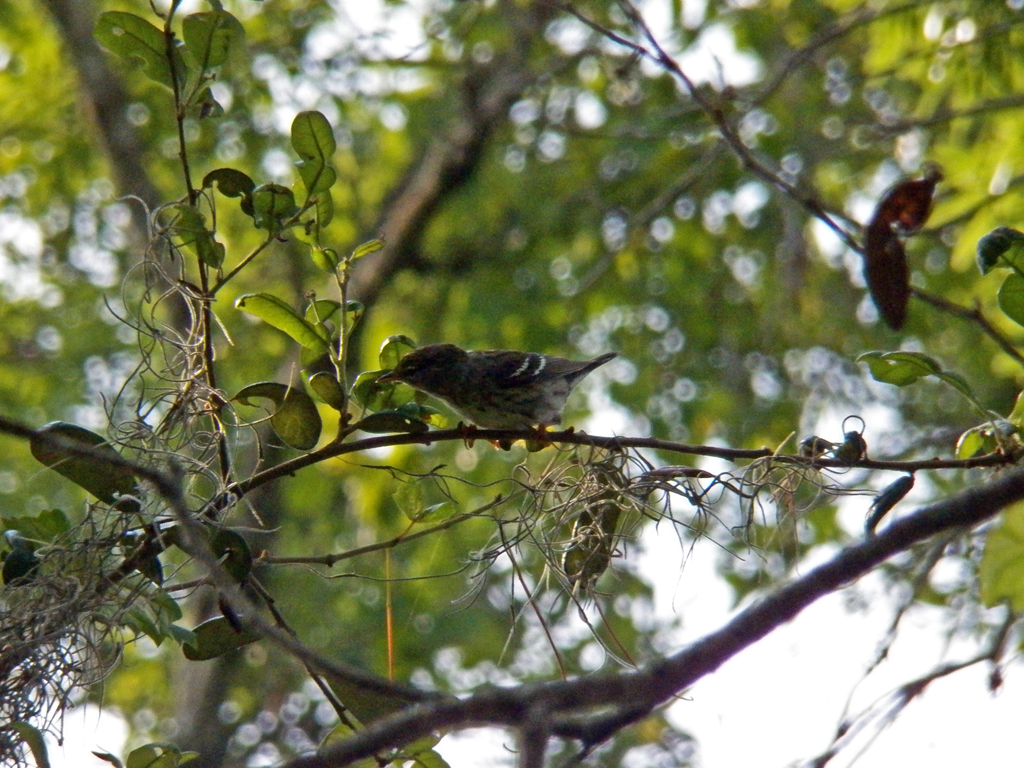
Female Blackpoll Warblers lack the dashing black cap (or “blackpoll”) of the male, but they have a pretty olive-yellow tint and subtle streaking. Again, those orange feet are a good field mark to differentiate the females from other, similarly colored birds.
Prominent wing-bars are also a great field-mark for Blackpolls.
Most of these birds were engaged in three types of foraging: creeping, gleaning, and flycatching. Creeping is when birds walk along the bark of a tree trunk or limb, grabbing small invertebrates as they move along. When birds hop or walk from branch to branch or on twing, reaching up or across to grab food, that is gleaning. Flycatching, of course, is what just what it says: the bird will dash out from a perch to grab a flying insect from mid-air, often performing stunning aerial acrobatics to do so.
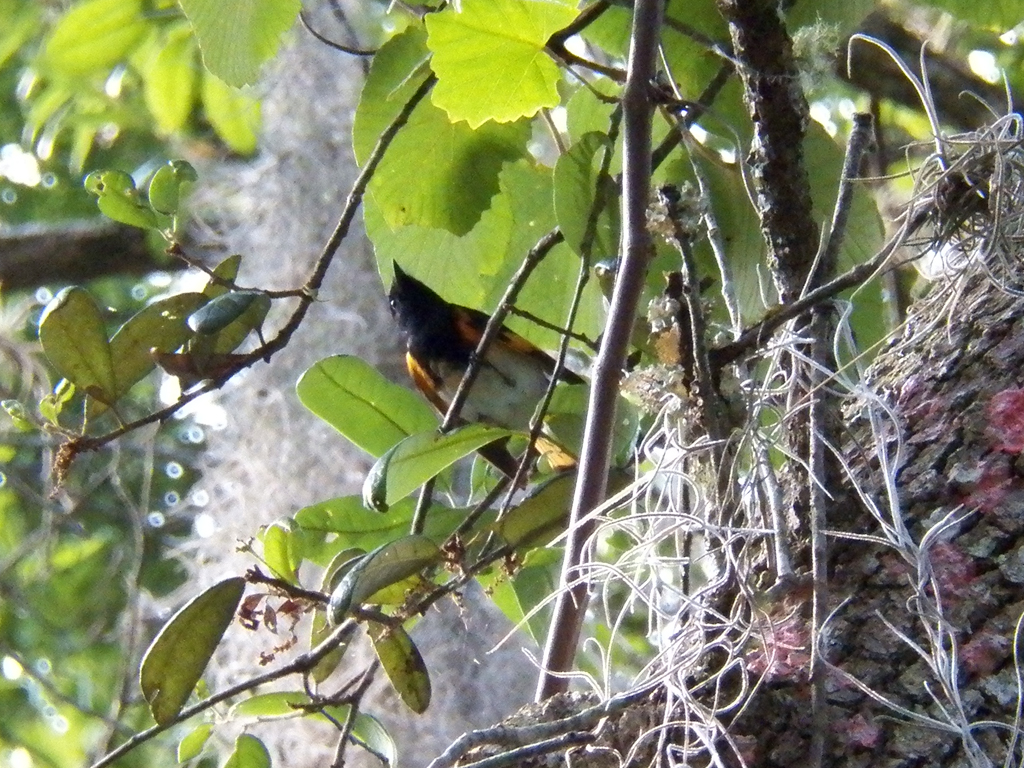
Along with our “monochromatic” friends (being mostly black and white), this flock of birds had a fair amount of American Redstarts among them. Redstarts are fun birds. The males are strikingly black and orange colored and they constantly flutter about, drooping their wings and fanning their tails. They will often drop off a branch and flit down, like a falling leaf, only to swoop back up and start again. The females are just as active as the males, though their colors are a little more muted (olive-brown and yellow).
Fast and furious, it’s hard to get a good shot of an American Redstart.
The overall effect of these three species moving through the canopy was one of almost dizzying chaos. It was hard to know where to center the eyes, binoculars, or camera. There was at least one Black-throated Blue Warbler among them, but it was hard to know if any more were in the melee of feathers.
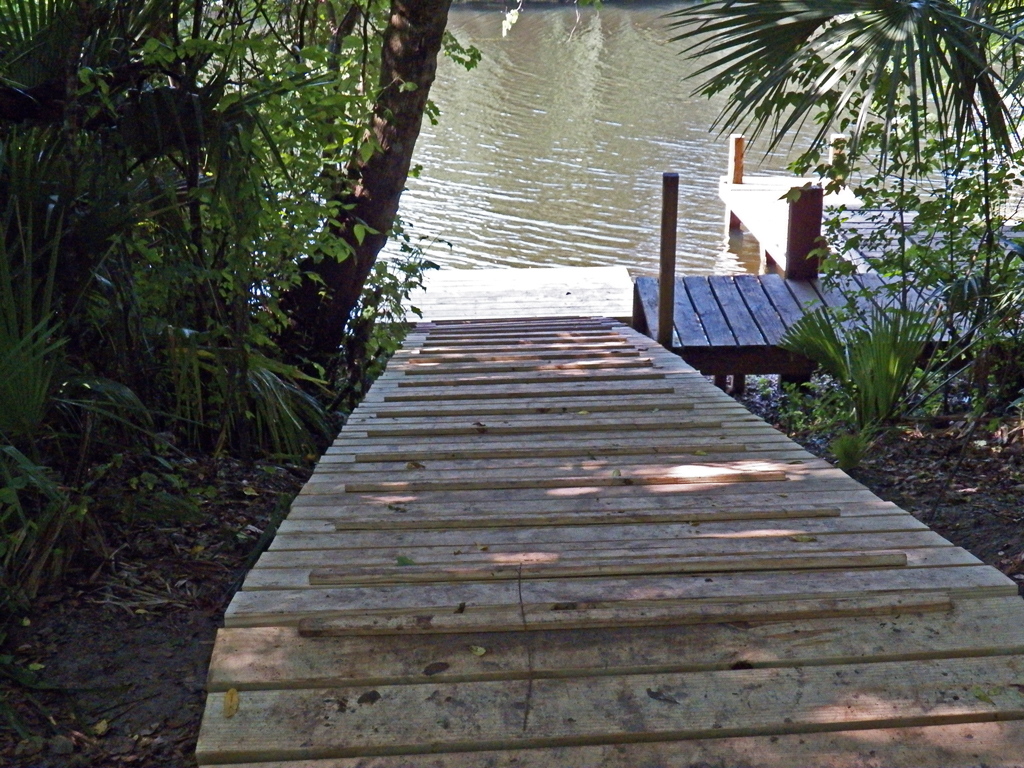
It was fairly quiet further along the boardwalk and onto McKinnon’s Way. We would hear some high-pitched calls here and there, but it was difficult to see much in the canopy. I got a glimpse of a Blue-gray Gnatcatcher, and we picked out a few more Blackpolls, but that was mostly it, until we got to the weir. First, I had a look at the “emergency” boat ramp. If you remember from last time at Turkey Creek, the high waters had likely removed the ramp’s deck (which was a bit rotted anyway). Repairs have been made, and there’s even a new platform at the base of the ramp.
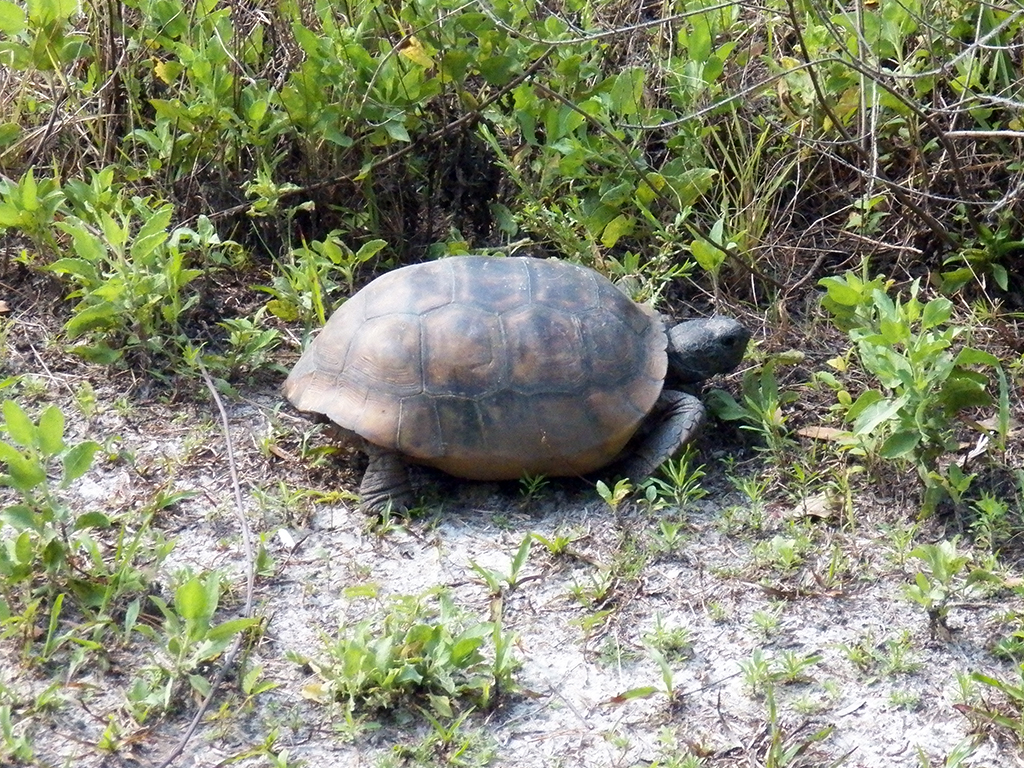
As we came out of the woods, we saw some movement along the trail up ahead. There was an overturned Gopher Tortoise! I quickly walked up and turned it upright. It didn’t hiss all that much and walked on its way.
It was a real topsy-turvey day for this tortoise!
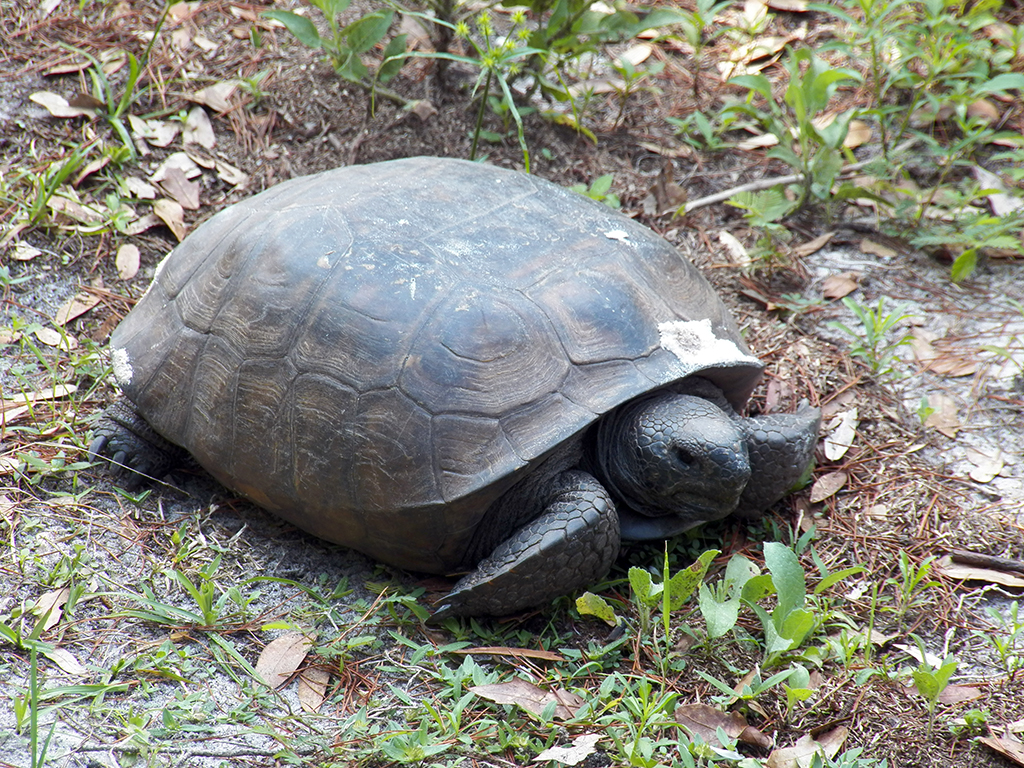
There was a larger tortoise further down the path, and Camille wondered if maybe they had a tussle or mating encounter that went awry (at least for the first turtle). I actually recognized the second tortoise from it’s shell markings and size, which was kind of cool.
This tortoise was much more grumpy and hissed a lot before lumbering on its way.
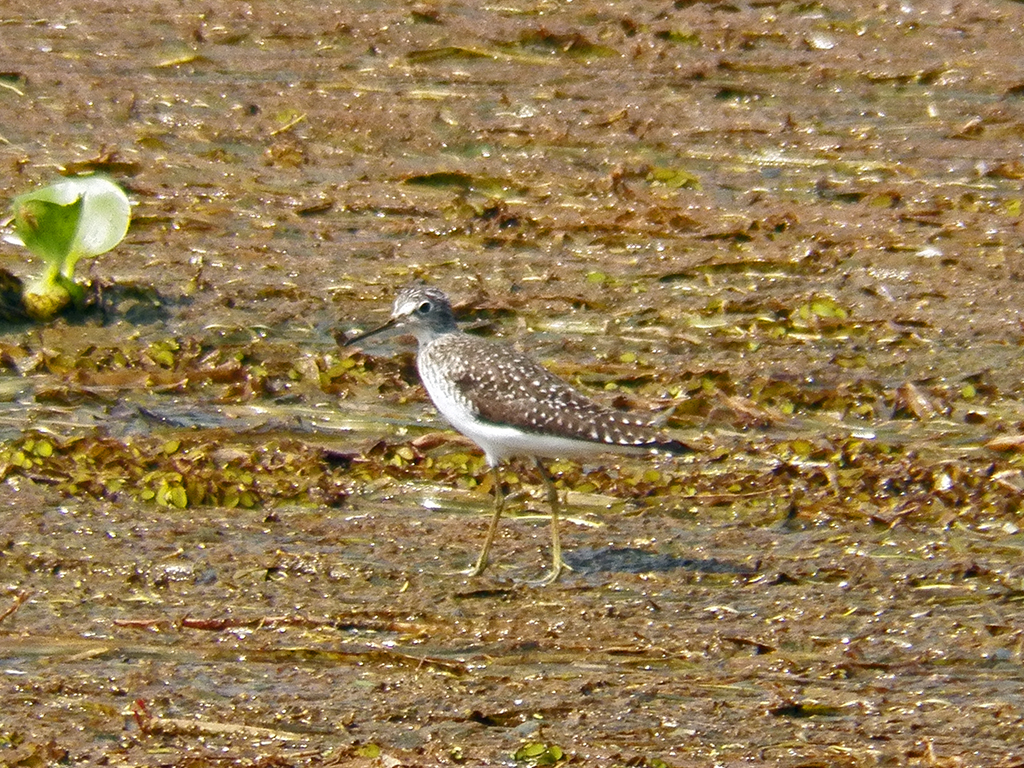
At the weir there were 2 spillways open, since the water was still somewhat low on the canal side. At first the area behind the orange float barrier seemed completely bird-free, but upon closer inspection there was a single Killdeer, one Green Heron, and then a lovely surprise. A pair of Solitary Sandpipers! This was another life bird for Camille, and a first of the year for me. I’ve actually encountered this species before, along the trail leading to McKinnon’s Way from the boardwalk. It was odd that they were so far into the wooded trail area, and i don’t know if this is the same pair or not.
One of two Solitary Sandpipers walking in the muck.
With the day wearing on and the heat climbing, it was about time to wrap things up. We walked back up the western side of the Sanctuary, past the Scrub Trail, to where there are sometimes Indigo Buntings or vireos, but it was really quiet. We had one more look at some Blackpoll Warblers before heading on toward the Picnic Pavilion and then out.
Overall, it wasn’t a bad day for birding, especially given there wasn’t any special fall-out event or anything. Clearly Blackpolls and redstarts dominated the Sanctuary this weekend. What we didn’t see in species variety was more than made up for in the numbers of warblers. Here’s the species list in no particular order:
Carolina Wren
Northern Cardinal
Black-and-white Warbler
Blackpoll Warbler
Northern Parula (♫)
Chimney Swift
Downy Woodpecker (♫)
Blue Jay (♫)
Black-throated Blue Warbler
American Redstart
Blue-gray Gnatcatcher
Fish Crow
Green Heron
Killdeer
Solitary Sandpiper
Red-bellied Woodpecker (♫)
Gray Catbird
The weather forecast calls for potential fall-out inducing conditions early this week, but not so much for the coming weekend, so we’ll see how that pans out.
[My apologies – this post is late and delayed due to a really bad head cold I am just now getting over]
In contrast to the morning at Meade Botanical Gardens, the second part of our day was a lot quieter. After some lunch at Einstein Bros. Bagels, we drove over to the Lake Berry Overlook. The boardwalk out to the overlook is in a very posh neighborhood, and just gawking at some of the homes could be a daily hobby. Our hope was to see a Red-headed Woodpecker that has been reported on eBird. The boardwalk traverses some nice transitional vegetation, and we could hear Northern Parulas and cardinals along its length. Toward the end there were several pairs of Red-bellied Woodpeckers, and we manged to glimpse three male Wood Ducks through the swampy trees and brush. At least one Red-shouldered Hawk flew nearby, as well as a raptor we didn’t quite get a good enough look at. It seemed to lack most of the obvious field marks for a Red-shouldered Hawk, but nothing definitive. Unfortunately, the Red-headed Woodpecker did not appear, though we heard some encouraging call notes. On the way back out near the boardwalk entrance some Chimney Swifts flew overhead, the first I’ve seen this year.
We continued on to the Harry P. Leu Gardens to try our luck there. Leu Gardens, as I’ve said, is more formal and organized that Meade. It has a membership structure and entrance fees to help pay for its upkeep and events. People often hold weddings and other formal affairs there. There are more exotic plants, with many paved paths. This was all very beautiful, but either a combination of the non-native vegetation and the heat, or just luck of the draw, we didn’t see much in the way of birds (and certainly warblers).
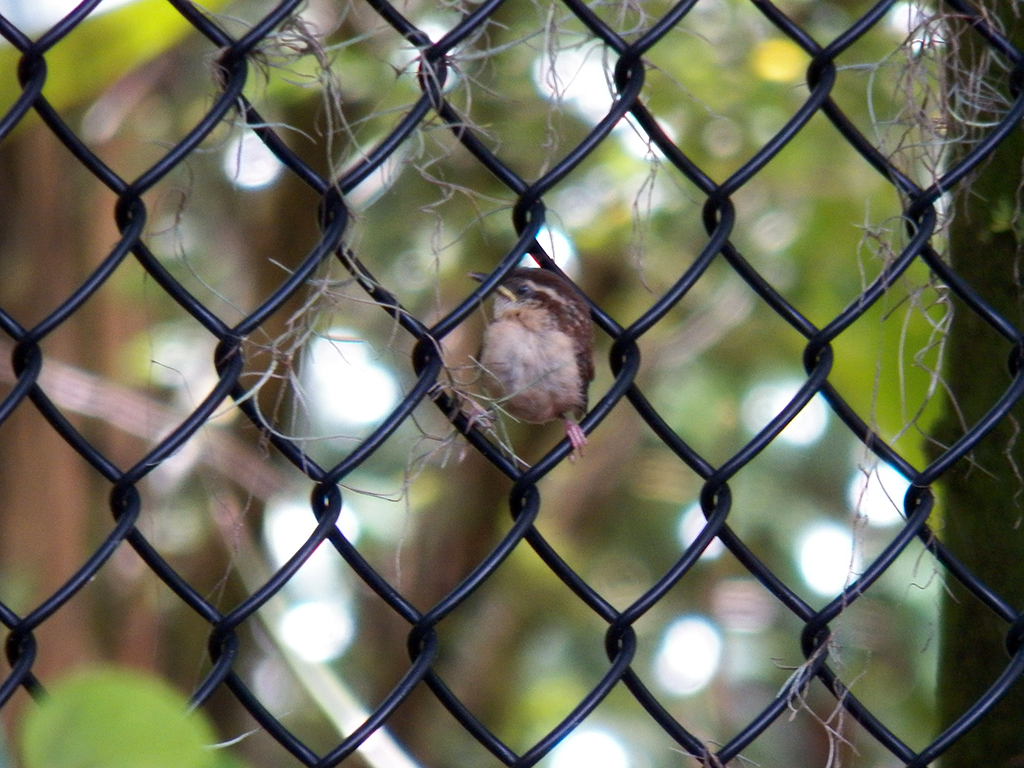
We did see some activity along the chain-link fence by the parking lot. At first I thought they were Worm-eating Warblers, but a closer look was cuter!
Baby Carolina Wren! The fence spacing here is much smaller than a standard chain-link fence, so this bird was small.
Apart from that, we did see a few larger birds, like crows, Anhingas and even an Osprey. We tracked a Northern Parula through the canopy for a while before getting any sort of decent look. Otherwise, despite the beautiful surroundings, we were getting tired.
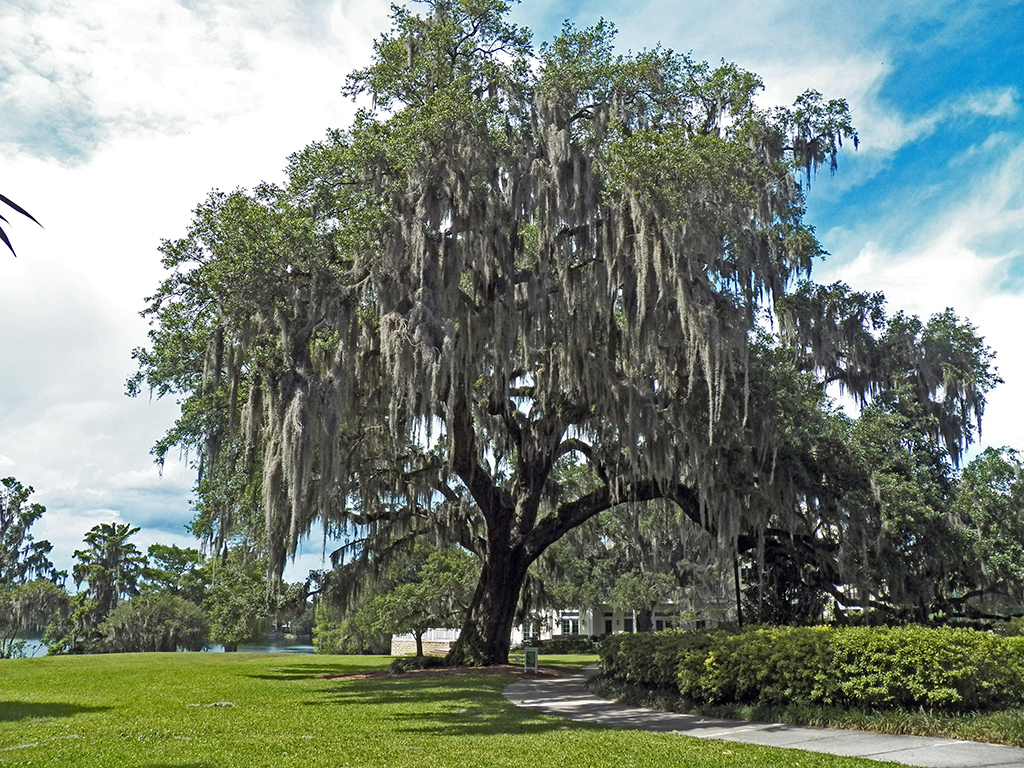
Marvelous oak tree with Spanish Moss.
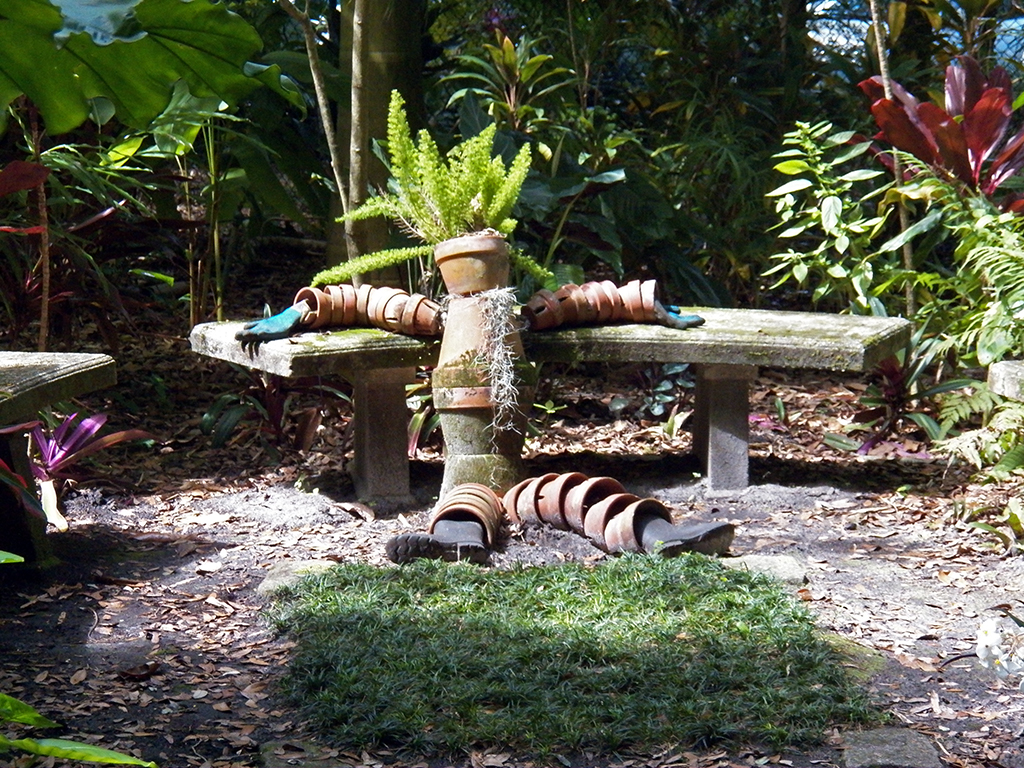
There were a few more whimsical garden areas, too. This “pot head” was definitely a work of art, with some butterflies nearby and Blue-gray Gnatcatchers singing in the trees above.
“What’re you doin’, man?” “Just chillin’, dude.” “Yah..”
And that was our day out at Winter Park. For any “score keepers” out there, we can round out our afternoon species list:
Red-bellied Woodpecker (Lake Berry Overlook)
Northern Parula (♫ LBO)
Red-shouldered Hawk (LBO)
Wood Duck (LBO)
Chimney Swift (LBO)
Carolina Wren
Blue-gray Gnatcatcher
Blue Jay
Fish Crow
Northern Parula
Osprey
Anhinga
Northern Mockingbird
Black Vulture
Turkey Vulture
My apologies for the delay in getting this out. Spring head colds are the worst!
Let’s face it, it’s been a very slow early migration season in east central Florida. If the past two years give any indication, it’s to expect another hit-or-miss month of April. During Easter week my friend and newly minted birder, Camille discussed alternatives to get some of her first migrating warblers and other birds this spring, since some of my usual haunts and both of our other endeavors have not really gotten us a very good sampling of birds that should be passing through the state on their way northward. We hit upon doing some urban birding around Orlando.
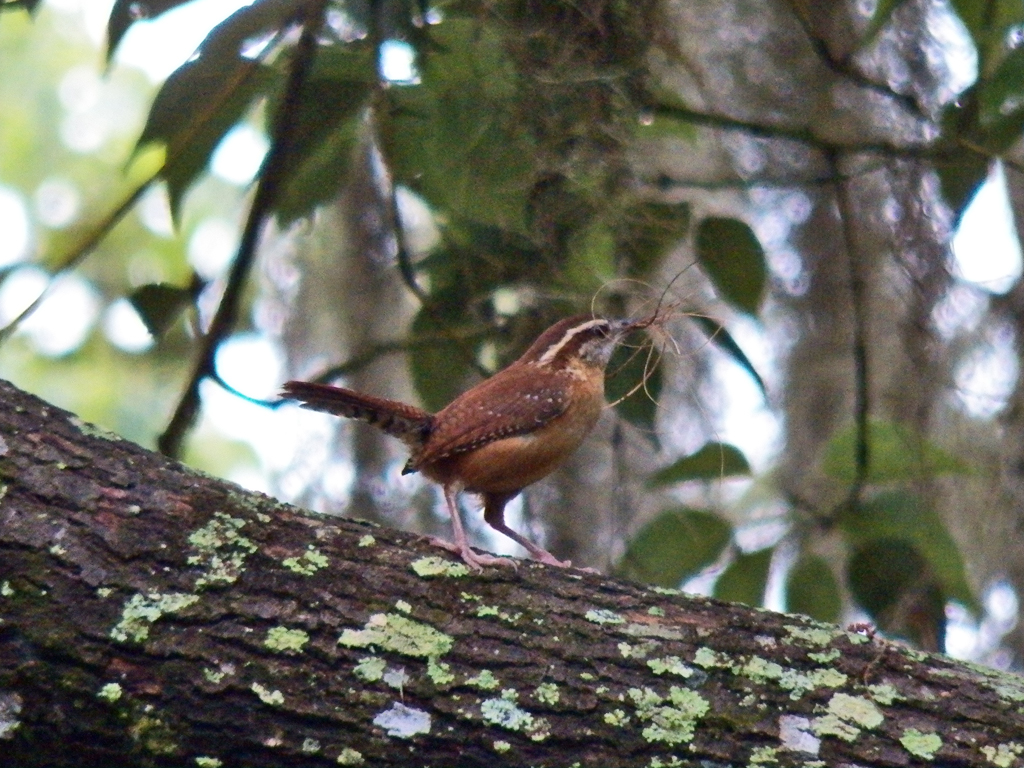
Winter Park has a number of different parks and gardens, so we chose two: Meade Botanical Gardens and the Harry P. Leu Gardens. Meade is a little more native and informal, while Leu is a little more formal. We had read via eBird and the mailing lists that some migrants had been seen in and around both parks, and that Meade Gardens had a resident Barred Owl as well as Wood Ducks. Camille loves owls, so getting a nice daytime owl was high on our list. On our way toward the reported owl location, we had luck with some good views of the typical winter residents: Carolina Wrens, Northern Cardinals, Northern Parulas, and others. The Carolina Wrens were not shy at all at the southern end of the gardens.
While April is normally the month for lots of migratory birds to pass through the area on their way to their breeding grounds, the year-round residents are busy making house right here.
Mixed in with the Carolina Wrens were several House Wrens, singing their perky and bubbly songs.
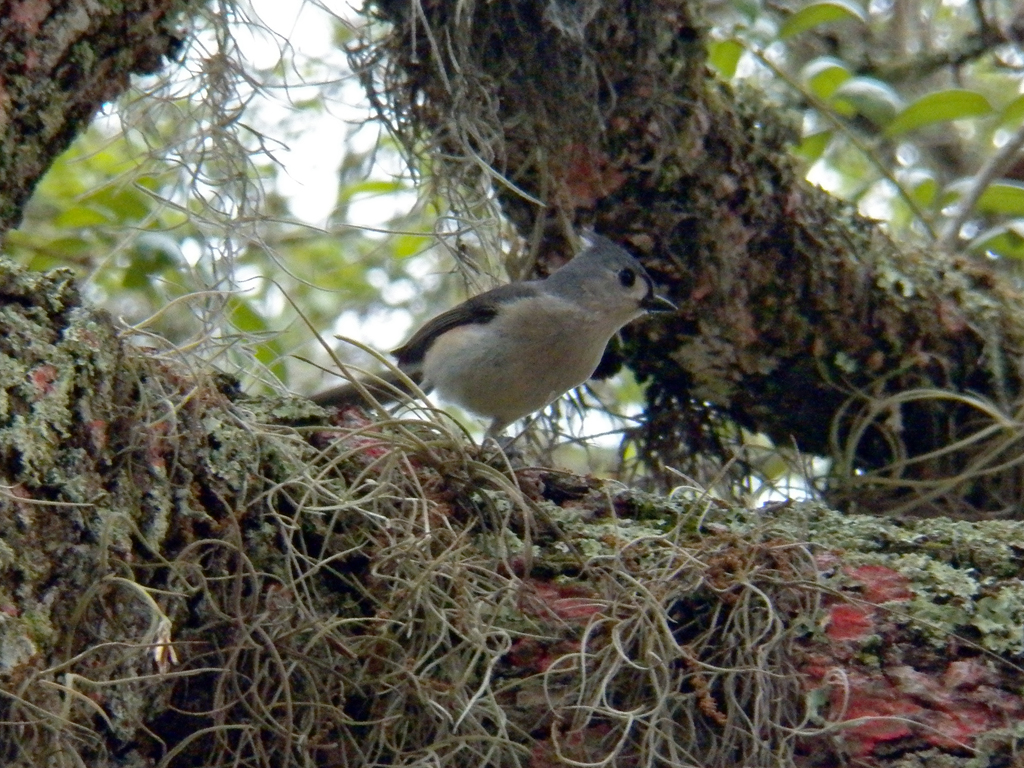
We also heard and saw a fair number of Tufted Titmouses. There are a few mated pairs using birdhouses with chicks present (at least based on the peeping we could hear within).
Titmouses share their chickadee cousins’ acrobatic antics. This one barely stopped long enough for a photo-op.
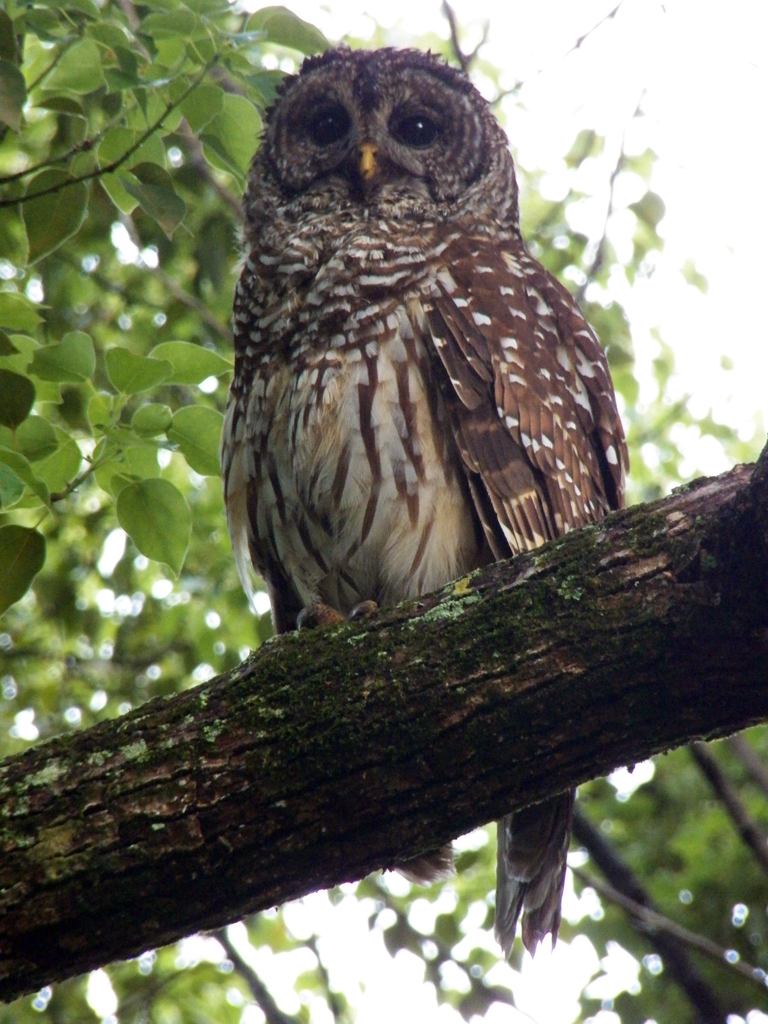
We were not having much luck finding any owls, but we heard at least one calling to our north, perhaps out of the park. We followed the sound to a creek, but we saw that across the creek was someone’s house and there was no apparent way to cross it. Then I heard a faint, low, “coo” and asked out loud, “What the heck is that?” and looked at an oak limb just above Camille’s head.
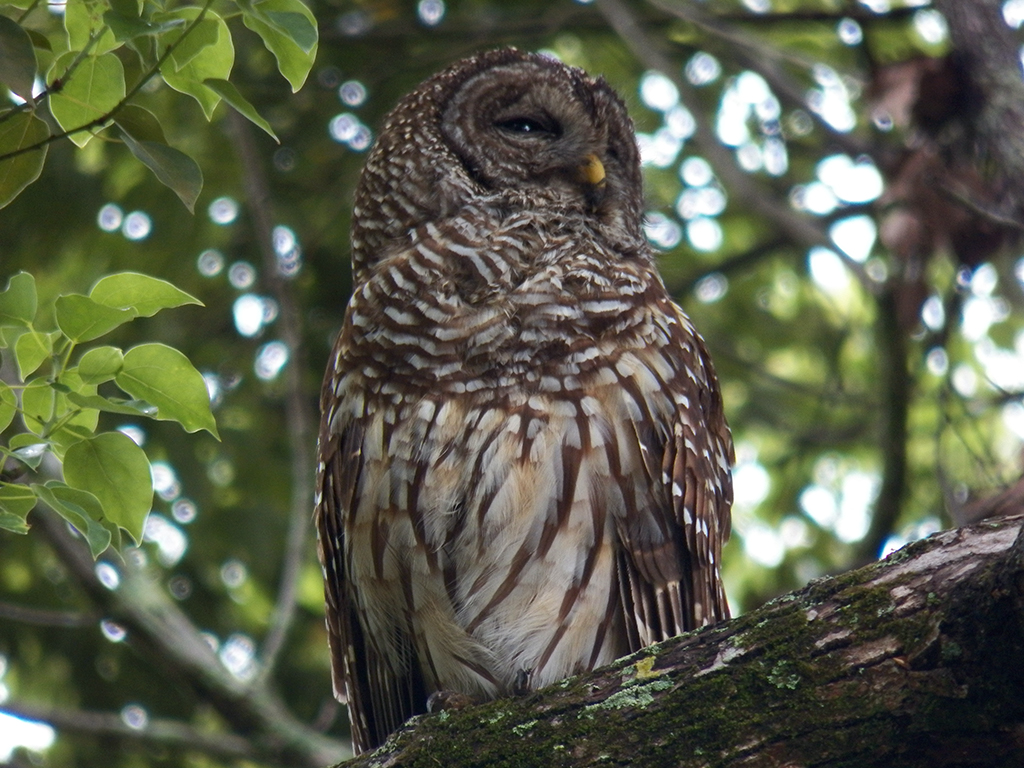
Who’s that cooking up a beautiful pose?
A VERY patient Barred Owl was perched about ten feet up, looking around and not at all ruffled by our presence. We found out later that this was the female of a mated pair that has two youngsters nearby. We did heard what was presumably the male further out, We both took a large number of photographs before reluctantly moving on through the gardens.
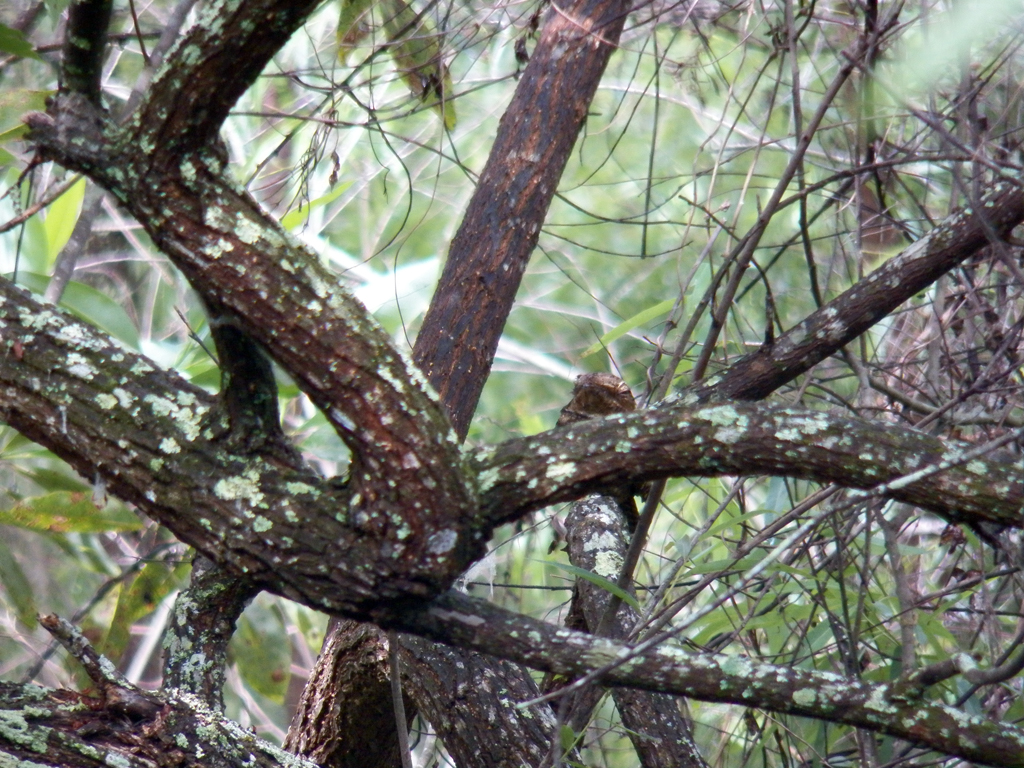
We started passing some other birders along the trails, and one man asked if we had seen the “Chuck” yet. I wasn’t sure what he was asking, but it turns out a larger group of birders had flushed a bird and were very carefully stalking it and trying to avoid spooking it again. Here’s a shot from the first set of photographs I took. Can you see what the fuss was all about?
Where’s Chuck?
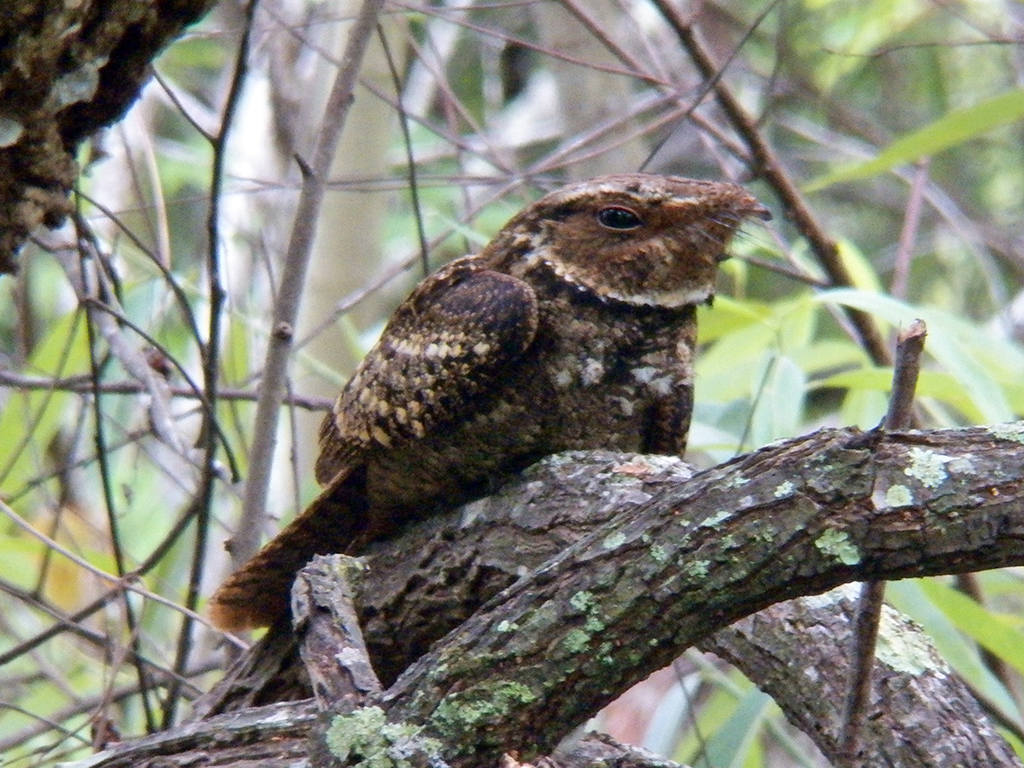
Do you see it? No? Just right of center, that slightly warmer brown “knob” is, in fact, a Chuck-will’s-widow. Chucks are members of the nightjar family, which includes Whip-poor-wills and Common Nighthawks (among others). Locally common, Chucks are normally a bit hard to find. They blend in with branches and leaves (as you can see), and prefer to stay motionless to fleeing. But if you get too close, it will quickly fly through the woods to another spot and take another cryptic pose. This was a life bird for me!
We managed to get some side looks at the bird along the boardwalk as we continued, staying with the birding group for a while. Camille saw and identified a Swamp Sparrow (despite my best attempts at derailing her – she had a better view than I did!), and before the other birders IDed it. toward the end of the boardwalk, we heard some Gray Catbirds singing along with what sounded like a Painted Bunting. The catbirds did eventually show themselves a bit, but the buntings did not.
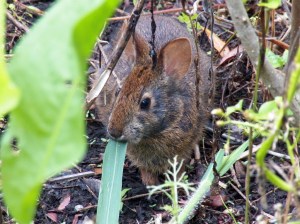
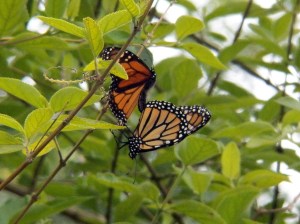
Along the same section of boardwalk, we saw some non-avian friends, including a Florida Box Turtle and a Marsh Rabbit. Near some flower gardens, we got to see a mated pair of Monarch butterflies flying together, along with other butterflies.
Florida Box Turtle high-tailing it out of sight.
Marsh Rabbit crunching on a leaf.
Spring is in the air for Monarchs
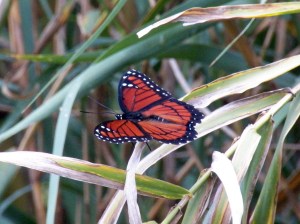
Viceroy (a Monarch mimic) having a rest.
Camille and I decided to track back through the boardwalk to get another look at the Chuck-will’s-widow and eventually get back to the Barred Owl. On the way past the second viewing spot for the Chuck, we bumped into none other than Reinhard Geisler. We last saw Reinhard at the Orlando Wetlands, where he helpfully gave us a park map before shooing us out the door from his photography workshop. He was with a small group taking some photographs of the bird from the boardwalk. I asked if he had taken any “good shots” and he laughed and said, “depends on your definition of good.” The bird was in a tough spot to photograph from that vantage point. Camille and I decided to go down a path past the limb the Chuck was sitting on to both get a better photo, and to see more of the gardens. I went back and asked if everyone in the group with Reinhard had gotten a good look, because we intended to pass close to the bird, and we didn’t want anyone to miss out if it should flush and fly away. It seemed as if everyone agreed, so Camille and I proceeded. I managed to get a couple of decent close shots before the bird did indeed fly off to a new spot.
Hey, Chuck! Here, you can more clearly see the dead leaf and bark pattern typical of nightjars. They’ll often rest with their eyes almost completely closed. This bird was actually fairly alert and observant. It fled before we got much closer. Sorry Reinhard, I hope you got your best photos.
We eventually caught up to the larger group of birders, and then we all made our way back to the Barred Owl, which was sitting in the same place, though looking somewhat sleepy.
It was well past this owl’s bedtime.
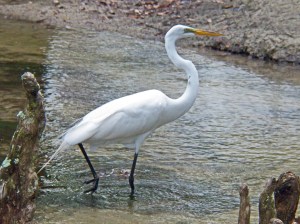
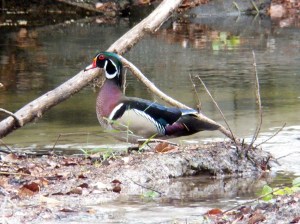
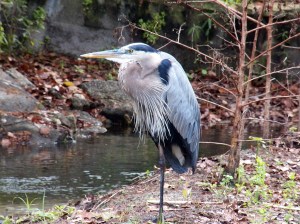
Further out on the creek, there was a pair of Wood Ducks, one male and one female. A Great Blue Heron was resting one one foot nearby. Shortly they were joined by a Great Egret that landed even closer to us and nervously stalked the creek among the cypress knees.
What a great egret.
Male Wood Duck.
Typical heron resting pose.
To this point we still hadn’t seen any migrating warblers, though other birds were active and present. Back at the parking area we saw more Tufted Titmouses, a Palm Warbler, at least one Prairie Warbler and a Black-and-white Warbler. There were more Carolina and House wrens singing, as well as the ever present Northern Cardinals. I kept hearing Great Crested Flycatchers all morning, but it wasn’t until we were back at the parking lot getting ready to head out that I finally saw one. Despite all the vocal presence at work, in my backyard and in various area parks, I finally got my first visual confirmation of a Great Crested Flycatcher at Meade Gardens.
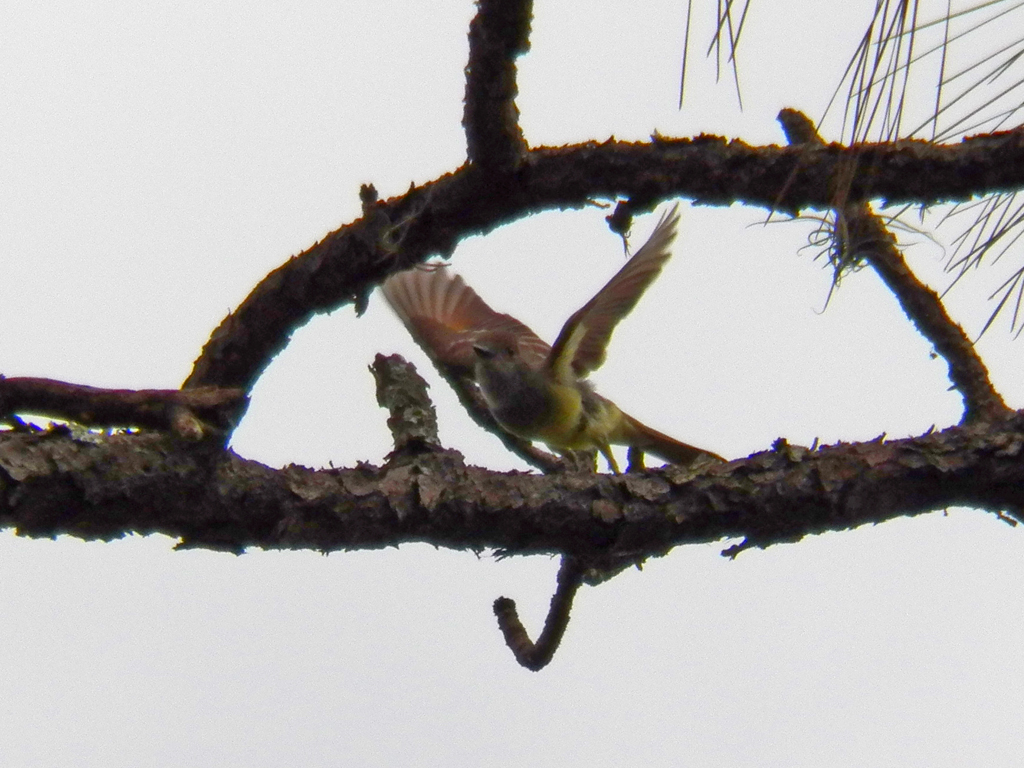
Great Crested Flycatcher taking flight.
Not far from the parking lot is an area called “the clay pits” that led down to more water and some marshy ground. I could hear Painted Buntings down in the nearby brush, so I descended into one of the pits trying to get a closer look. I finally managed to flush a pair of buntings, just catching a blur of the red, blue and green colors of a male Painted Bunting before they flew out over the gardens and out of sight.
We had one last surprise before we left. Suddenly, right in front of us, an outburst of angry tweets and chittering came from one of the larger trees. Two Great Crested Flycatchers whirled into view, feet locked, spiralling down to the ground in a mini tornado of wings. They actually hit the ground before disengaging and flying off, calling out to each other.
Here’s the list for Meade Gardens, mostly in order:
Mourning Dove
Northern Cardinal
Northern Parula
Red-bellied Woodpecker
Carolina Wren
House Wren
Common Grackle
Tufted Titmouse
Red-shouldered Hawk
Barred Owl
American Crow
Downy Woodpecker (♫)
Mallard
Fish Crow
Red-winged Blackbird
Chuck-will’s-widow (life)
Swamp Sparrow
Gray Catbird
Blue Jay
Northern Mockingbird
Wood Duck
Great Blue Heron
Great Egret
Blue-gray Gnatcatcher
Palm Warbler
Prairie Warbler
Pileated Woodpecker (♫)
Black-and-white Warbler
Great Crested Flycatcher
Painted Bunting
Our next and ultimate destination was the Harry P. Leu Gardens, but we first got a bit of lunch and decided to detour to nearby Lake Berry Overlook. A Red-headed Woodpecker has been reported there, and we thought it worth our while to check it out. One of the birders we bumped into earlier was also getting lunch and casually mentioned they saw a single Cape May Warbler in the parking area, but we had yet to see any migrating warblers. We hoped our luck would be better at Leu Gardens. We’ll pick up the story in Part 2.








 Lonely Birder