A few weeks ago, I had a short trip to New England (hopefully you saw my whale watch photos). I’ve not had a chance to update the blog until now, so I’ll dump a few photos now.
The bulk of my pictures are from Cape Cod. I started at Morris Island [map](near Chatham) and Chatham Light, then worked my way over to Coast Guard Beach [map] (via the trail from Doane Rock [map]), then walked south toward Nauset Beach [map], where some Least Terns and Piping Plovers were finishing their nesting season (behind some wire fencing). I ended that day with a drive to and a hike at Beech Forest Park in Provincetown [map].
Chipping Sparrow at Morris Island feeder station.
American Goldfinch on the salt marsh
Semipalmated Sandpiper at Morris Island
Eastern Towhee, Morris Island
Trail at Morris Island
Doane Rock (a glacial erratic)
Ovenbird near Doane Rock
Old Coast Guard Station from Coast Guard Beach
Old Coast Guard Station
Salt Marsh at Coast Guard Beach
Immature Great Black-backed Gull on Coast Guard Beach`
Gray Seal near Nauset Beach
Gray Seal “water basking”.
Just some of the Gray Seals near Nauset Beach
Common Tern near Nauset Beach
Piping Plover near Nauset Beach
Least Tern nesting near Nauset Beach
Piping Plover chick, near Nauset Beach
Piping Plover parent!
White-breasted Nuthatch at Beech Forest Park
Black-capped Chickadee at Beech Forest Park
The trail at Beech Forest Park
To avoid parking issues, I cheated a bit and parked at the Doane Rock Picnic area and walked a trail to Coast Guard Beach. Technically, there’s an hour limit for parking at the picnic area, but I’ve never known the lot to be full, so I thought it was worth the risk of a ticket. It paid off, with nice paths and some surprise birds, like Red-breasted Nuthatches. The biggest surprise, though, was a group of Grasshopper Sparrows that flew into the area around the rock for a few seconds, before flying away.
There was a large number of Gray Seals (with a few Harbor Seals) just off the beach where Coast Guard Beach ends, at the inlet north of Nauset Beach. They were lounging in the shallows, some of them looking like they were basking in the sun, but while submerged.
Over at Beech Forest Park, I enjoyed a nice short walk in the woods, with more chickadees and a few White-breasted Nuthatches, as well as Canada Geese in the parking lot.
Here are all the Cape Cod related eBird lists, for those of you as are interested:
Hello, readers, and thank you for your patience in my getting Part 2 of my Lakeland adventure out to you.
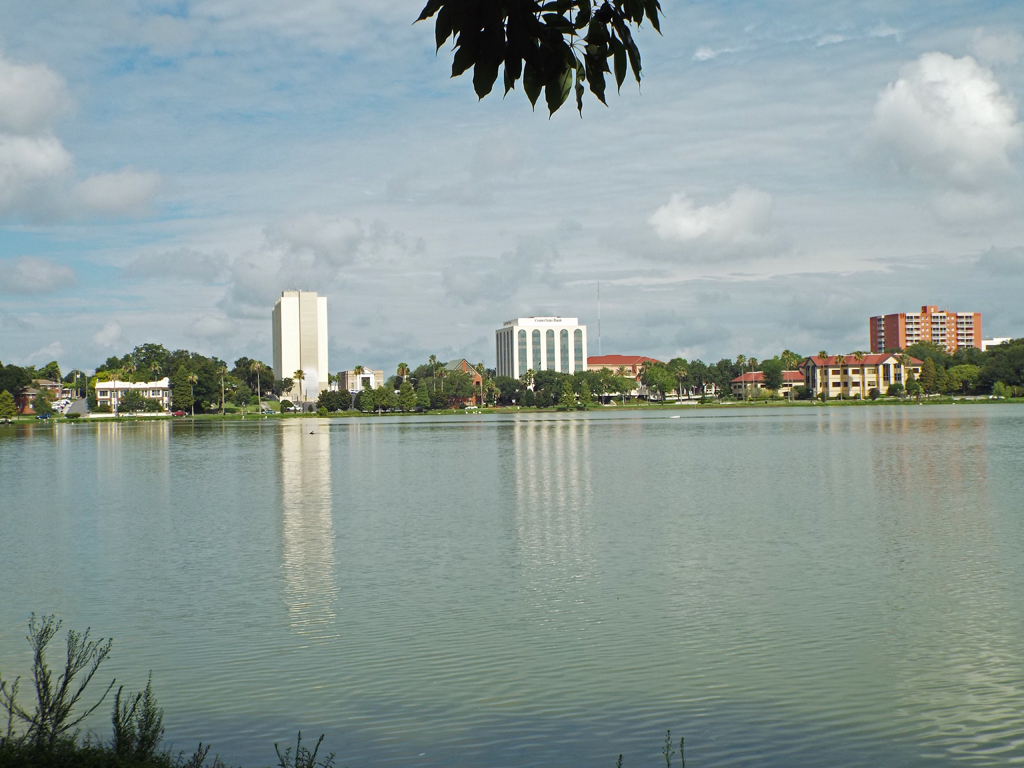
Whereas the focus on Part 1, at Lake Mirror, was on ducks, this part we’re going to talk mostly about the swans on Lake Morton [map].
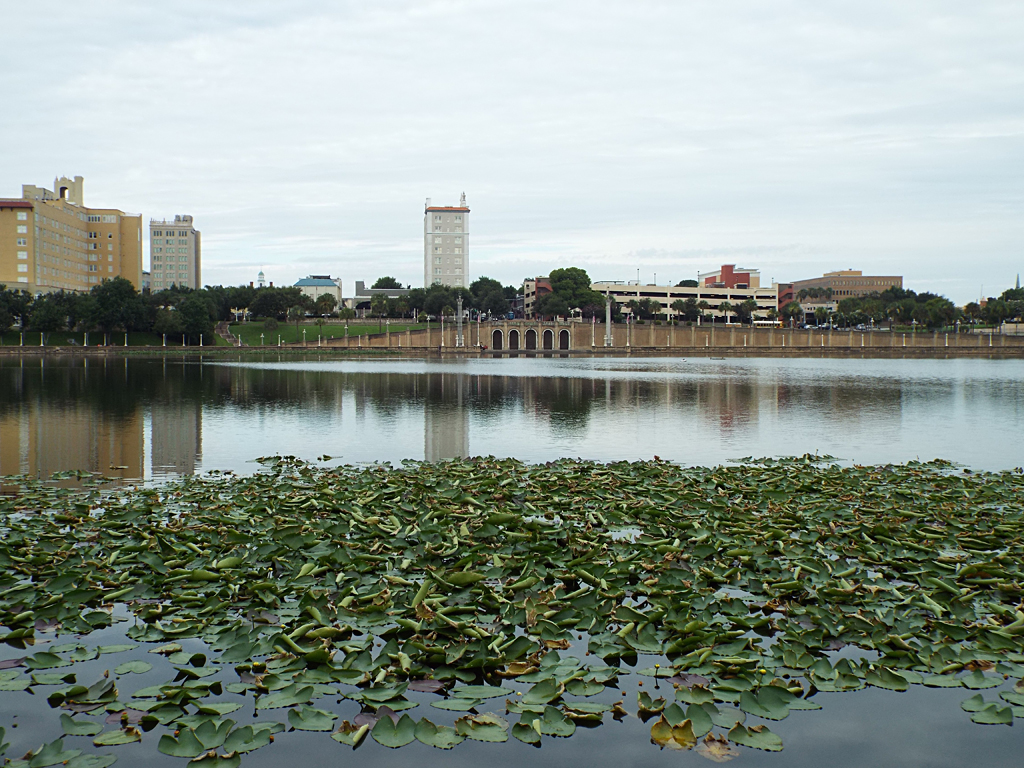
Lake Morton, as the overcast started to break up.
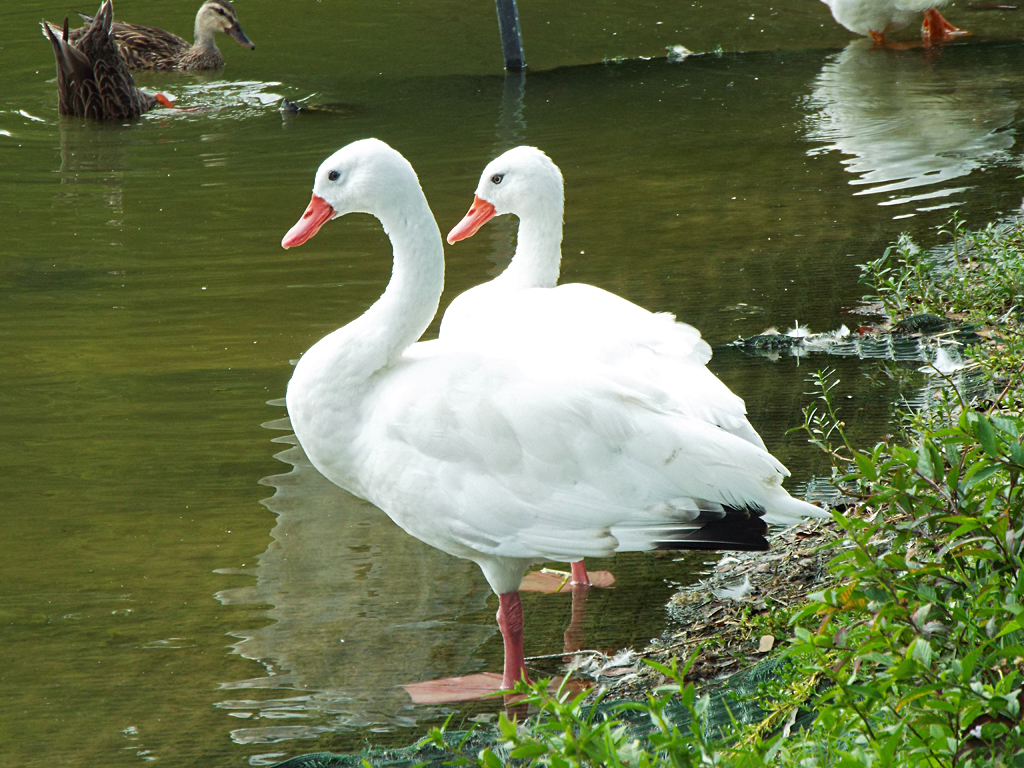
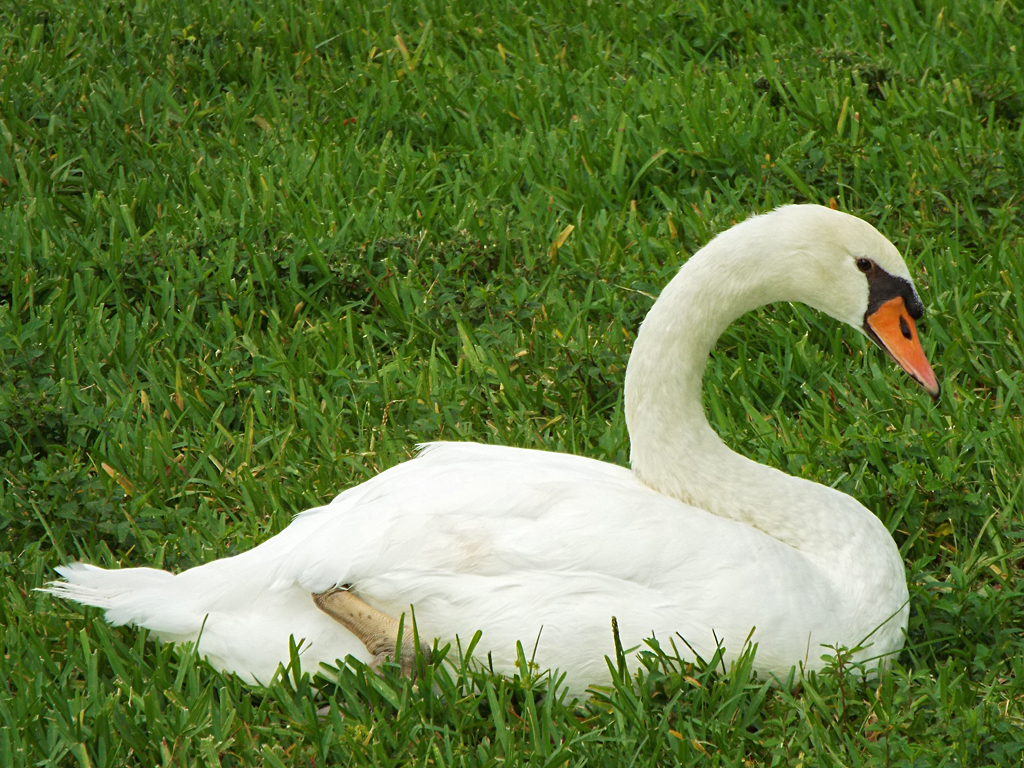
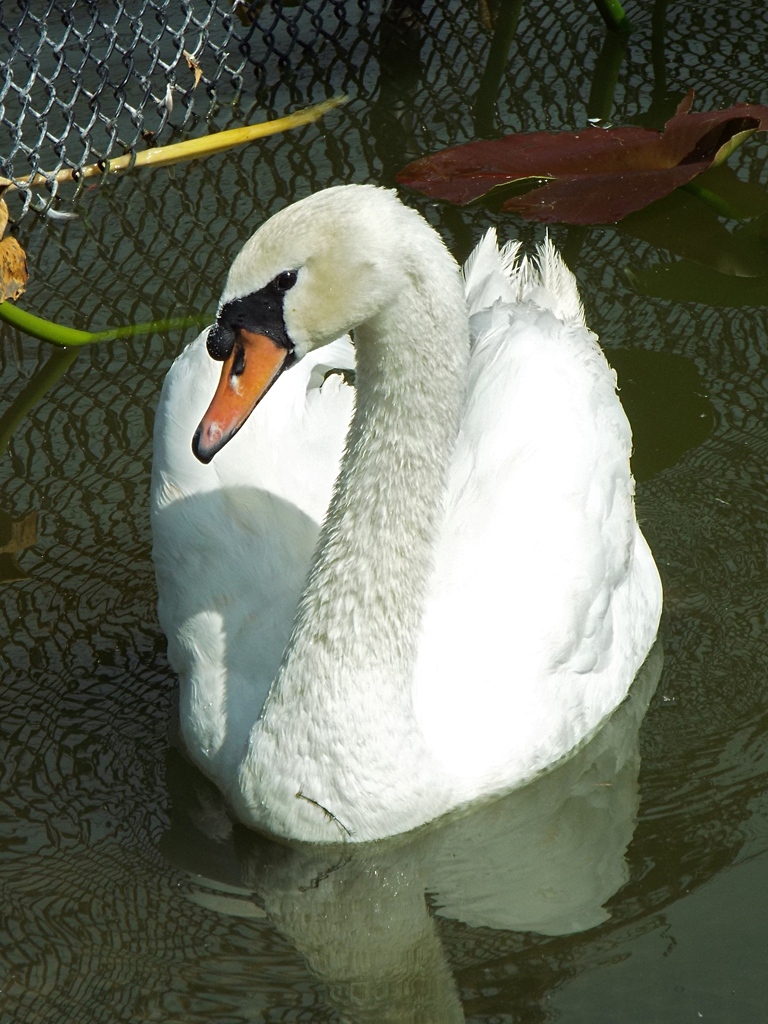
There have been swans in Lakeland since at least the 19th century. While local histories call these birds “native”, it’s important to state that North America’s only two indigenous swan species, the Trumpeter and Tundra Swans, do not have historic ranges in the southern United States. But swans (probably Mute Swans) had been around since at least the early 1920s. Their numbers dwindled until the last swans were gone (probably by alligators) in the 1950s. When a former Lakeland resident living in England heard about this, she asked Queen Elizabeth II (so the story goes) to help. A pair of “royal swans” (Mute Swans descended from Richard the Lion-Hearted’s flock) were eventually sent, and the city’s swans were restored. Through the years, other swan species have been introduced to Lake Merton, including at least one pair of Coscoroba Swans and Black-necked Swans. Both Mute and Black Swans remain the most numerous.
There’s a concerted effort to keep the birds in and around Lake Morton and other city lakes, and the birds are “rounded up” each year for health checks and to have their wings clipped, in an effort to keep the swans in and around the city from spreading into the area. Swans are an invasive species in Florida, so keeping the birds contained is an important (but probably, ultimately, futile) task.
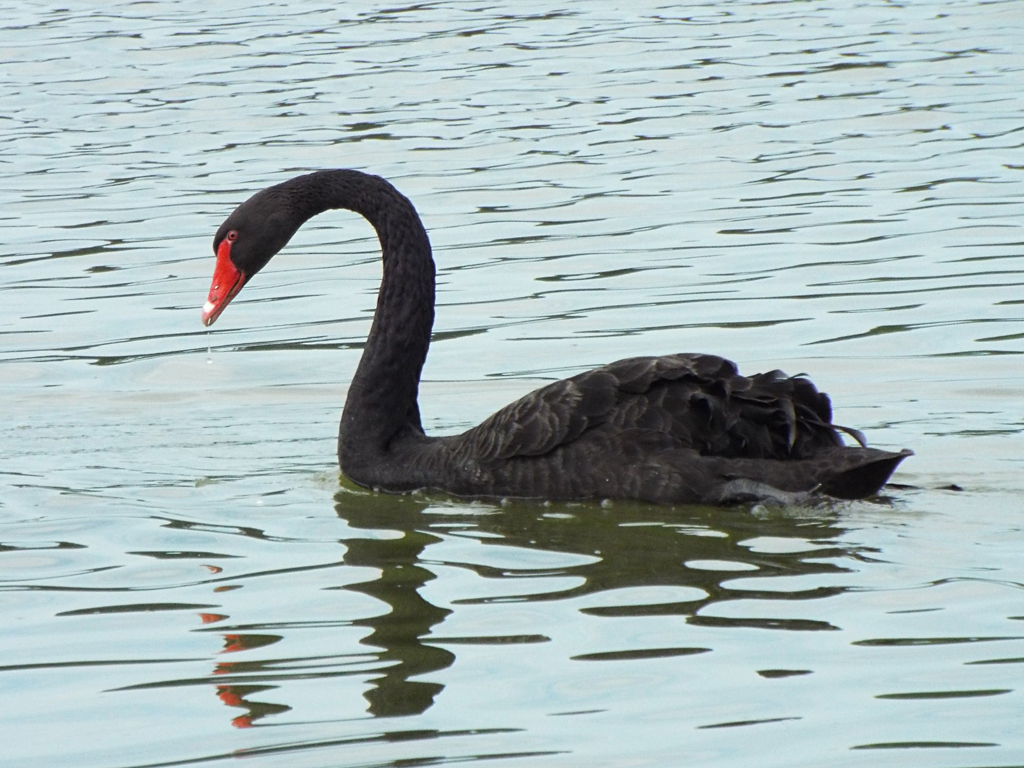
But there’s no denying the birds are beautiful to look at. Here are some photos from Lake Morton and it’s iconic swans.
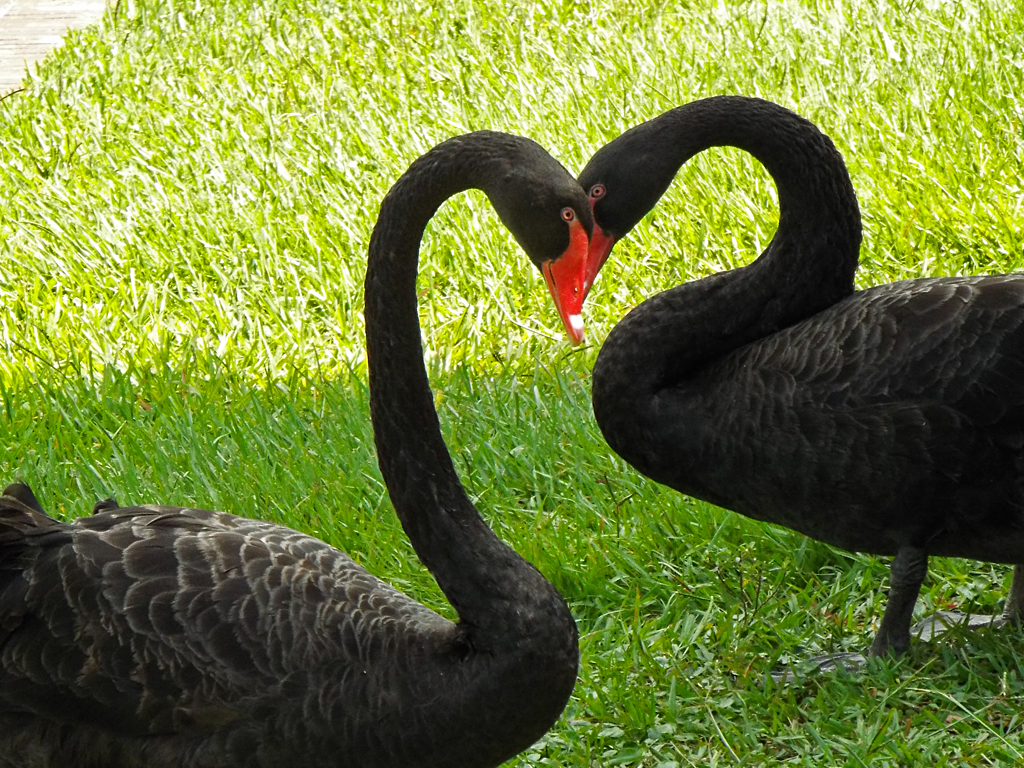
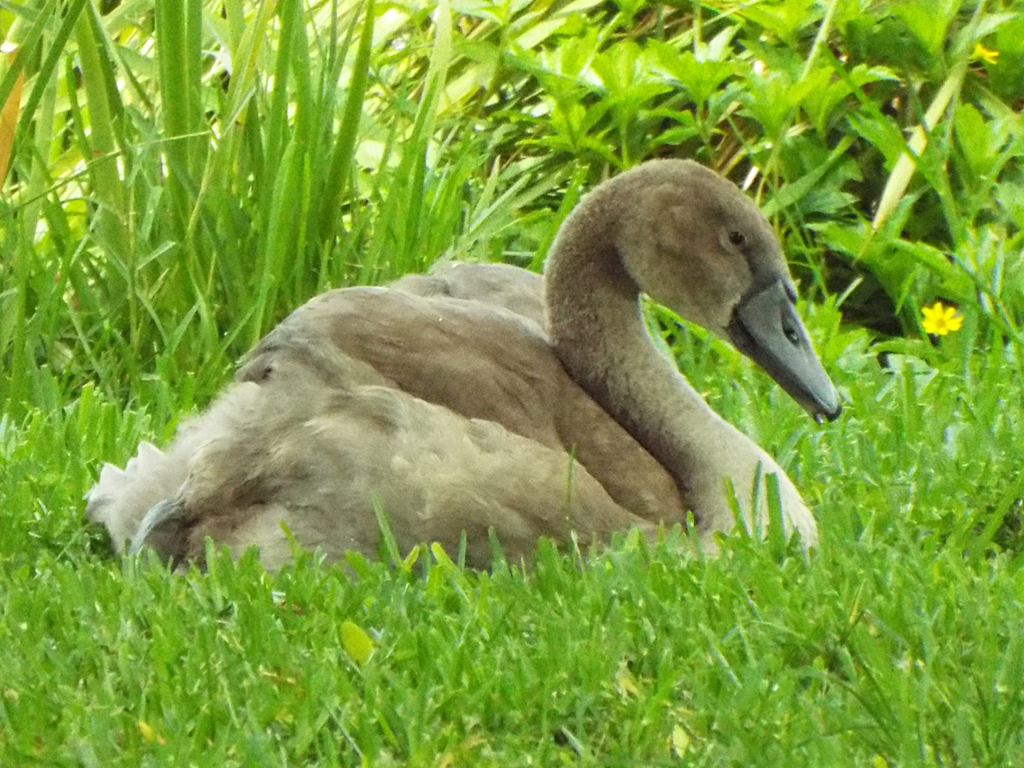
Black Swan on the lake.Mated pair of Black Swans. They were doing some kind of courtship/bonding dance.This is a pair of Coscoroba Swans.Most of the Mute Swans were sitting in the grass, sleeping or preening.One of two aptly named Black-necked Swans.Although quite beautiful, Mute Swans (as with most swans) can be very territorial and aggressive. This one was sizing me up as I took the photo.One of several Mute Swan cygnets.
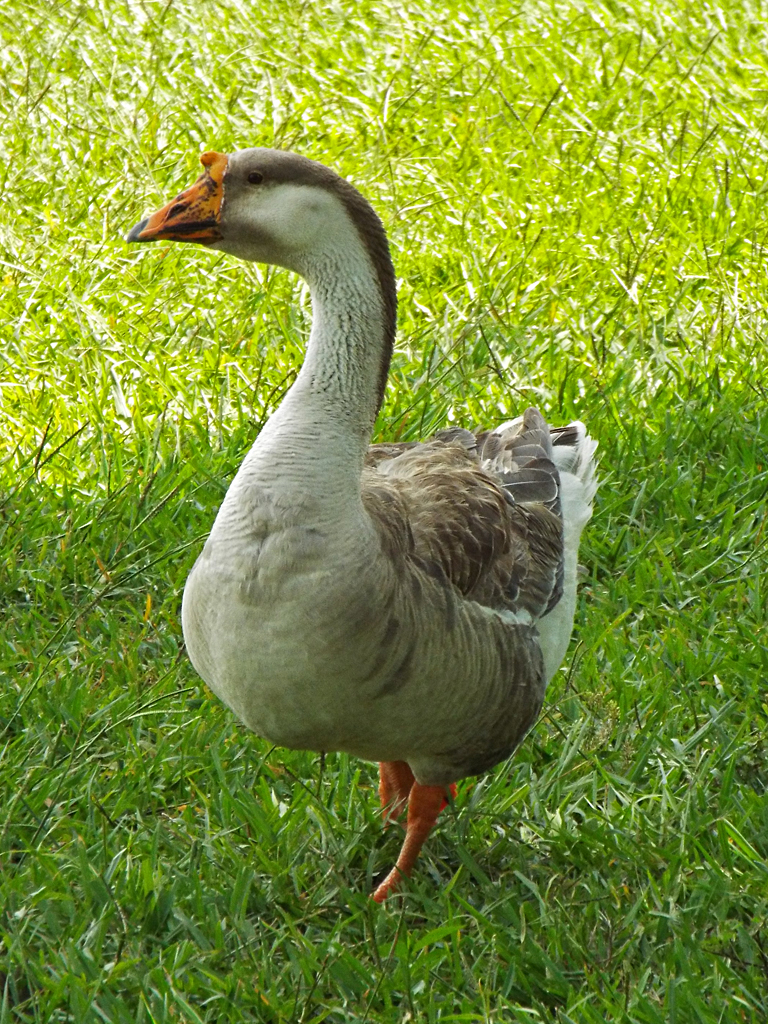
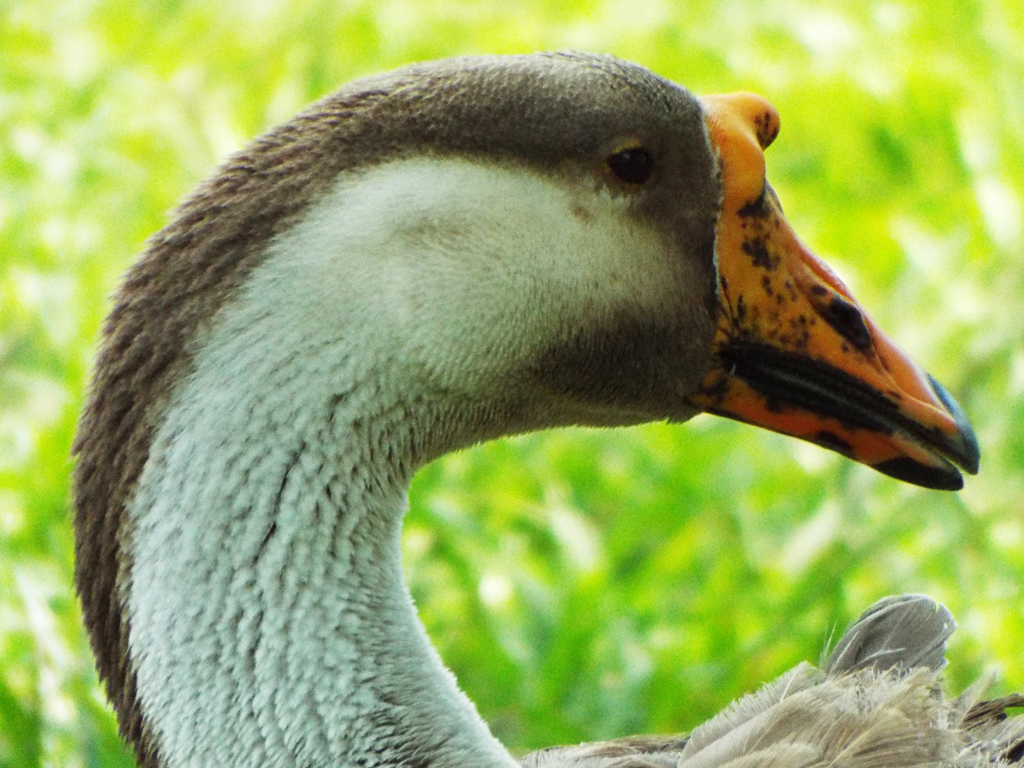
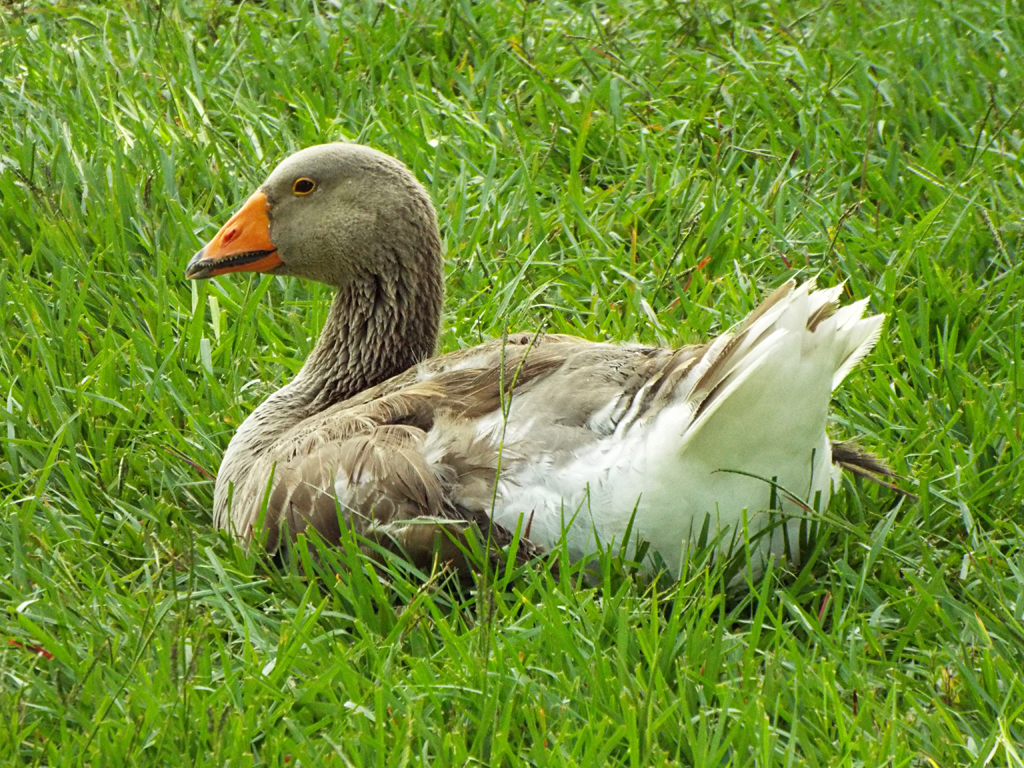
Another bird of interest on Lake Morton is the Swan Goose. It looks very much like a Greylag Goose, but with a dark nape and a knob on the bill.
Swan Goose.Close-up of a Swan Goose head.Greylag Goose for comparison.
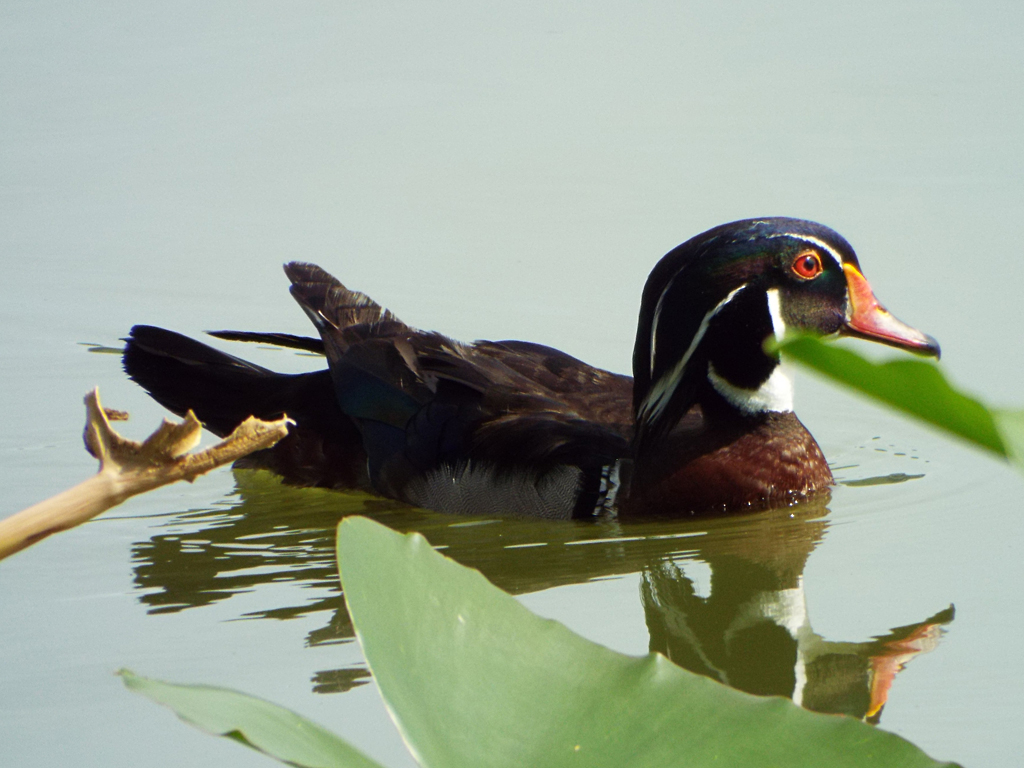
Of course there were also a good representation of native birds on the lake. With the sun out, the colors of the Wood Ducks were easier to see.
Wood Duck drake, better lit.
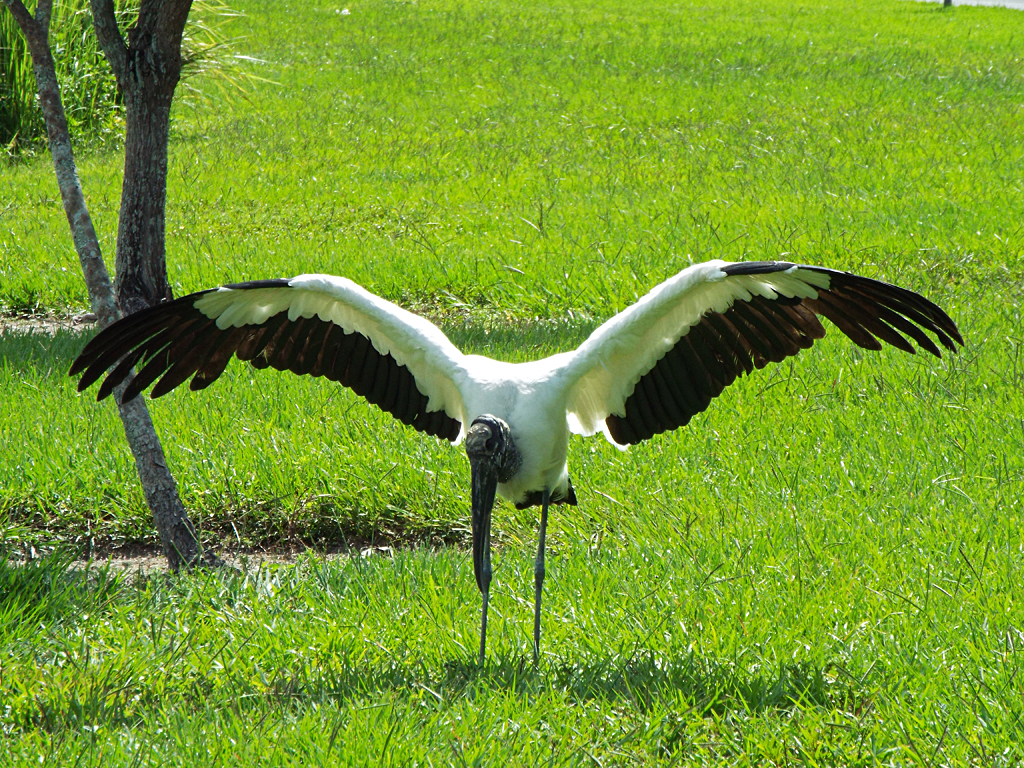
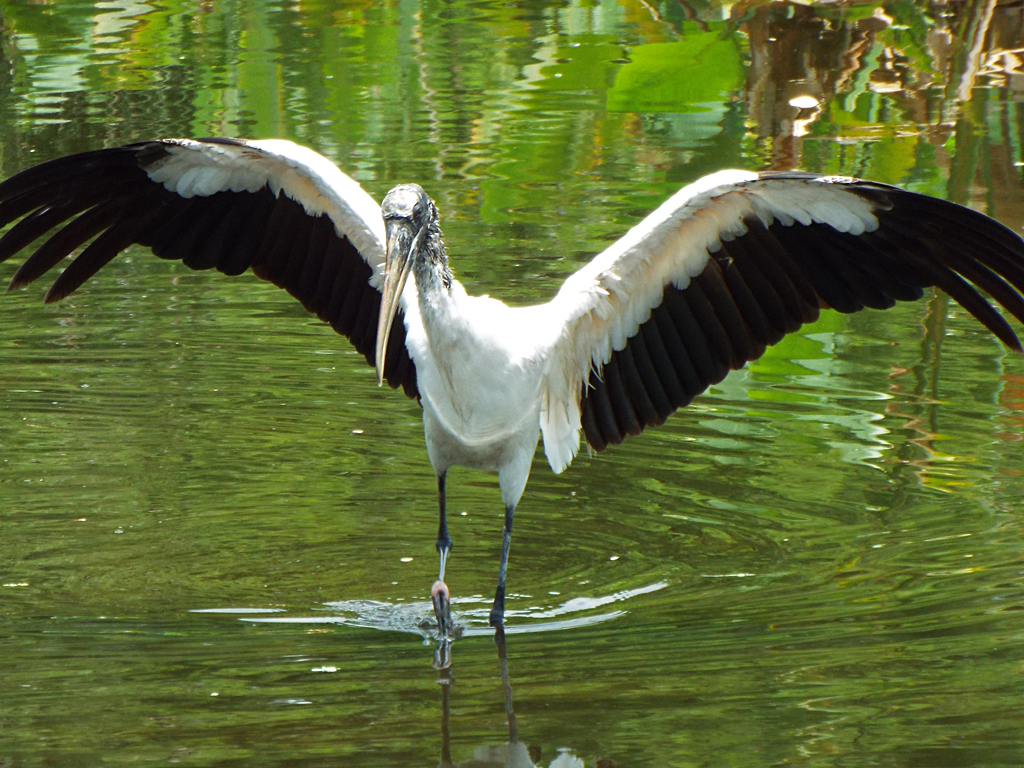
One side of the lake had a small flock of Wood Storks, mostly resting. One bird was standing apart from the rest, with its wings outstretched, slowly walking and turning about. Storks don’t normally forage in the grass, and it was a warm morning, so I am not sure what this posture was indicating.
Wood Storks are large birds, with wingspans of up to 1.8 meters (6 feet).
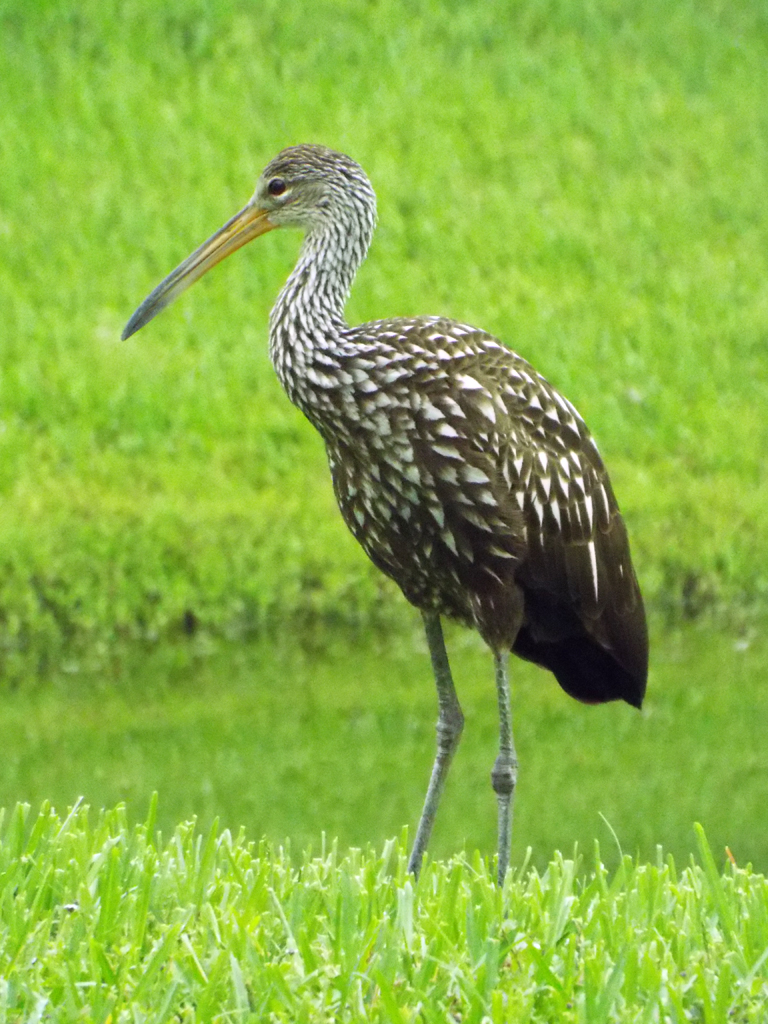
Various wading birds were present, including a few Limpkins (some with nearly fledged chicks).
Limpkin.
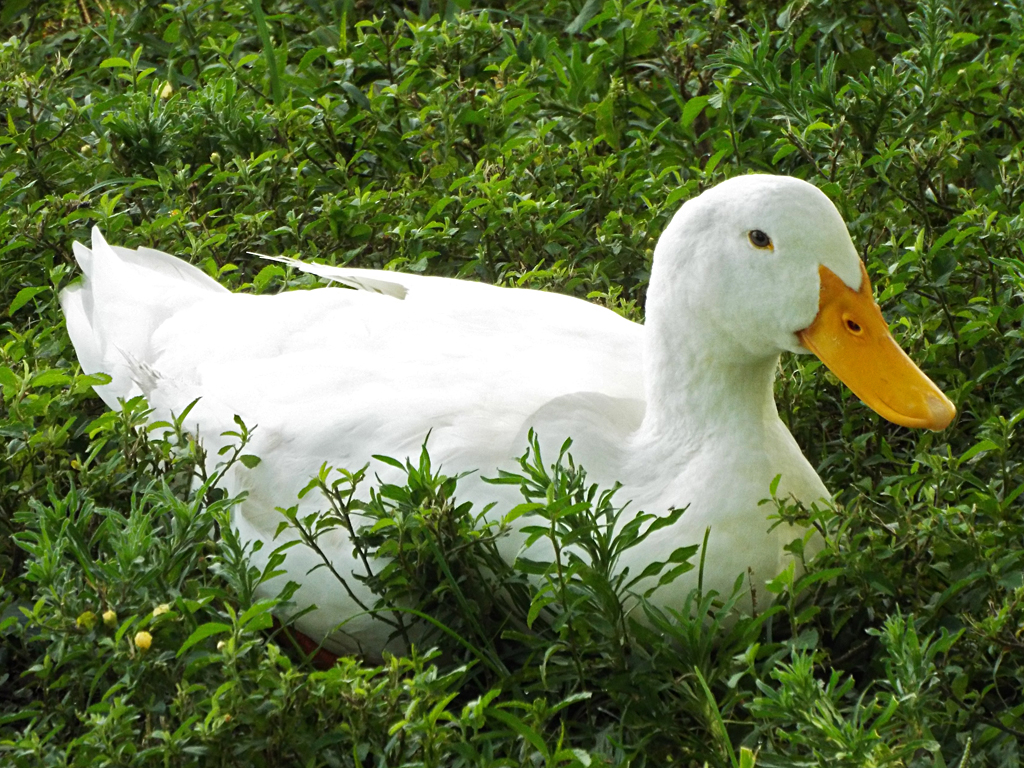
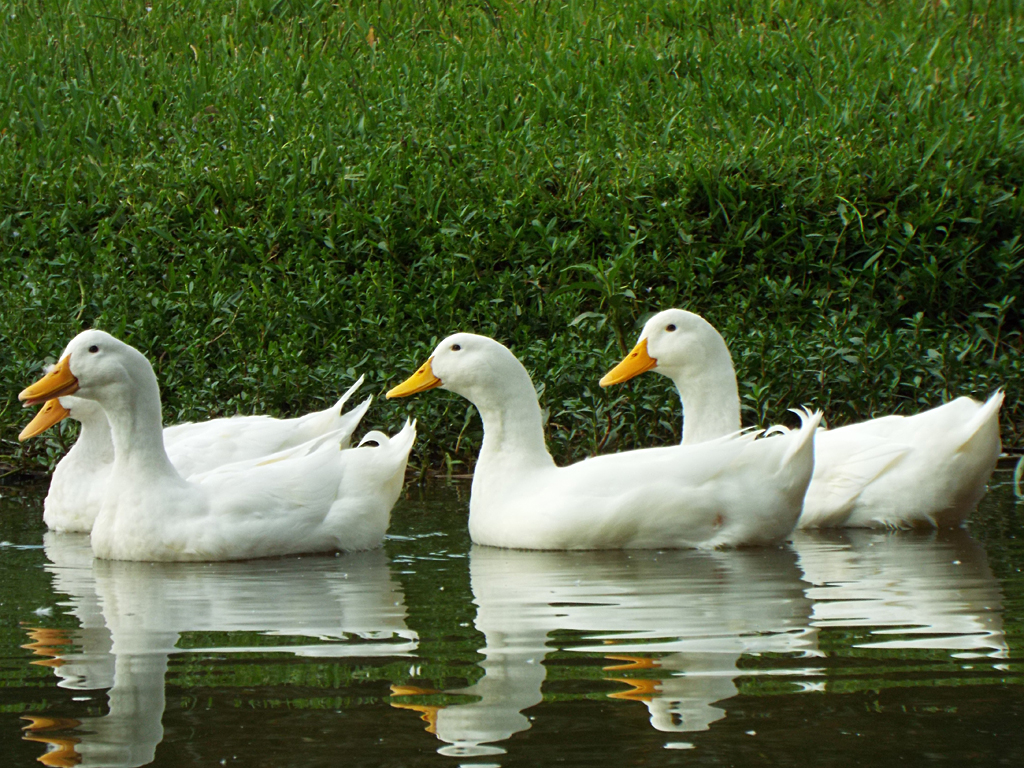
Lastly, I wanted to leave you with a couple of photos of domestic or Pekin Ducks. I’m quite partial to ducks, and since these guys are certainly never considered in official birding lists or eBird, I like to give them at least a little space in my blog when I can.
Pekin Ducks are the prototypical white duck. Think Donald Duck.Cute quackers.
With another adventure in the books, it was time to head toward home. With its swans in good hands, Lakeland will continue to be a unique and beautiful Florida destination for years to come.
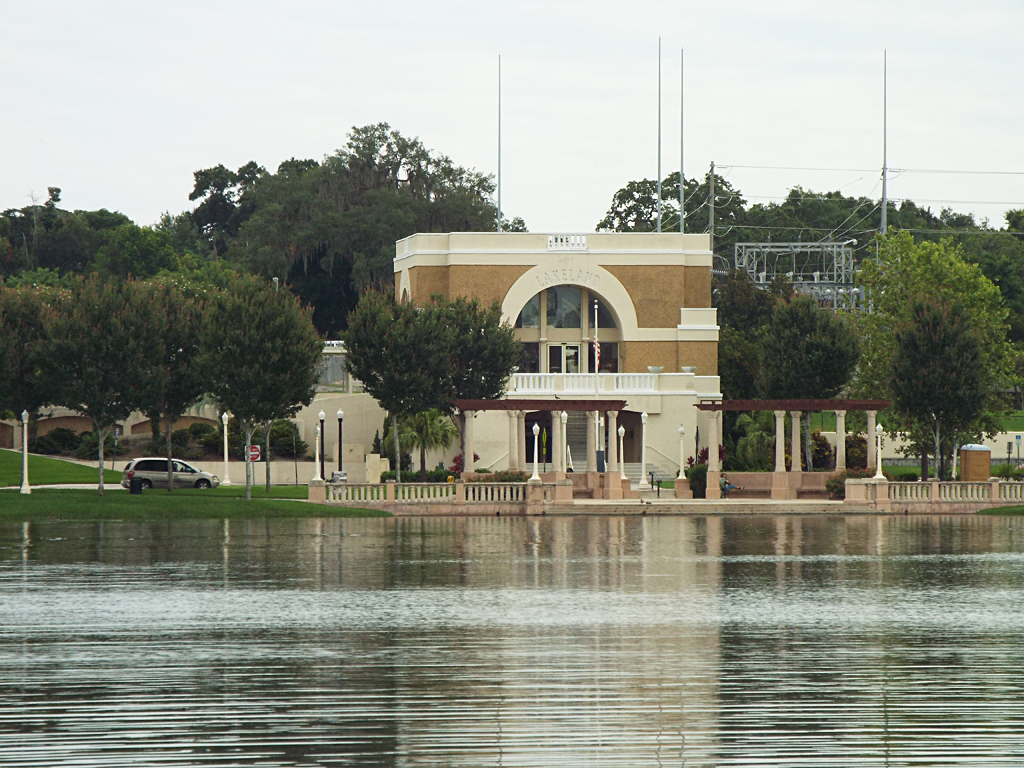
Two weekends ago, before the U.S. Independence day holiday, I had the opportunity to visit the city of Lakeland, Florida. Lakeland is home to many lakes. Obviously. I visited two of them – Lake Mirror and Lake Morton – with Camille to get a look at some introduced waterfowl, along with local birds.
Lake Mirror is known to have at least 2 species of “exotic” ducks, which I’ll get into a bit later in the post. These are either escapees from somewhere or were deliberately introduced to the lake.
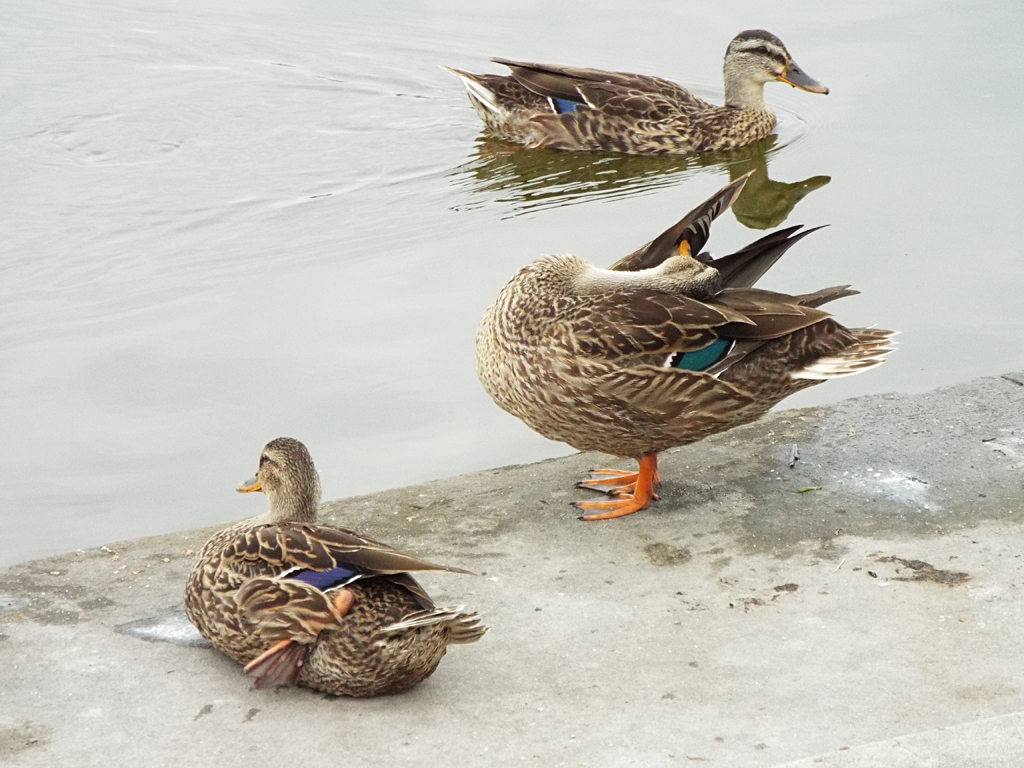
The vast majority of the duck population on Lake Mirror are various mixes of Mallards and Mottled Ducks. These tend to fall into two broad categories: Mallard/Mottled Duck hybrids and Mallard/domestic crosses.
Lake Mirror shortly after dawn.
The first group tend to superficially look very similar to one another and have a typical Mottled Duck/Mallard body and coloration.
Three “muddled” ducks. They look pretty similar, but note the 3 different looking speculums (the color band of feathers in the wing).
Various individuals in this group had bill and speculum colors of Mallards and Mottled Ducks, as well as slight differences in body feathers, making it impossible to assign any definitive species to them. (I know speculum colors are iridescent, so they don’t always appear the same, but to the unaided eye, these three definitely looked different at almost every angle). A large part of the reason is due to the intentional release of domestic-type Mallards in Florida. You can read more about this issue in this article on the 10,000 Birds site: Mallards are a Threat to Mottled Ducks in Florida. More and more ducks are hybrids of one type or another. It takes a very keen eye (and sometimes a genetic test) to really know the identity of an individual.
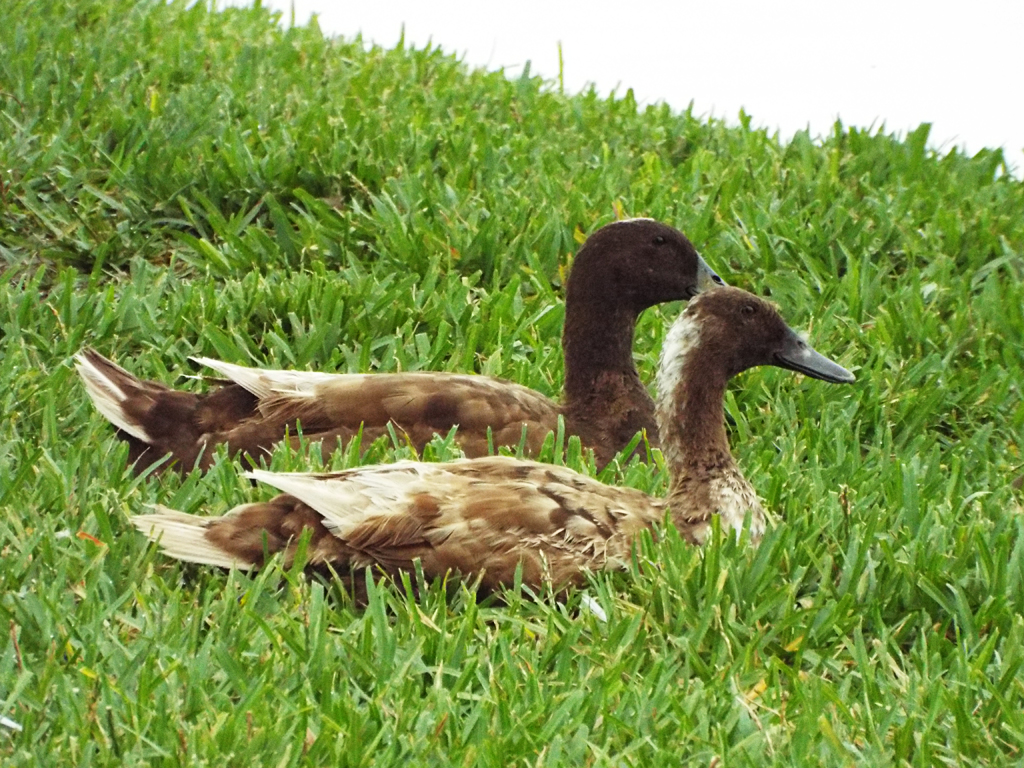
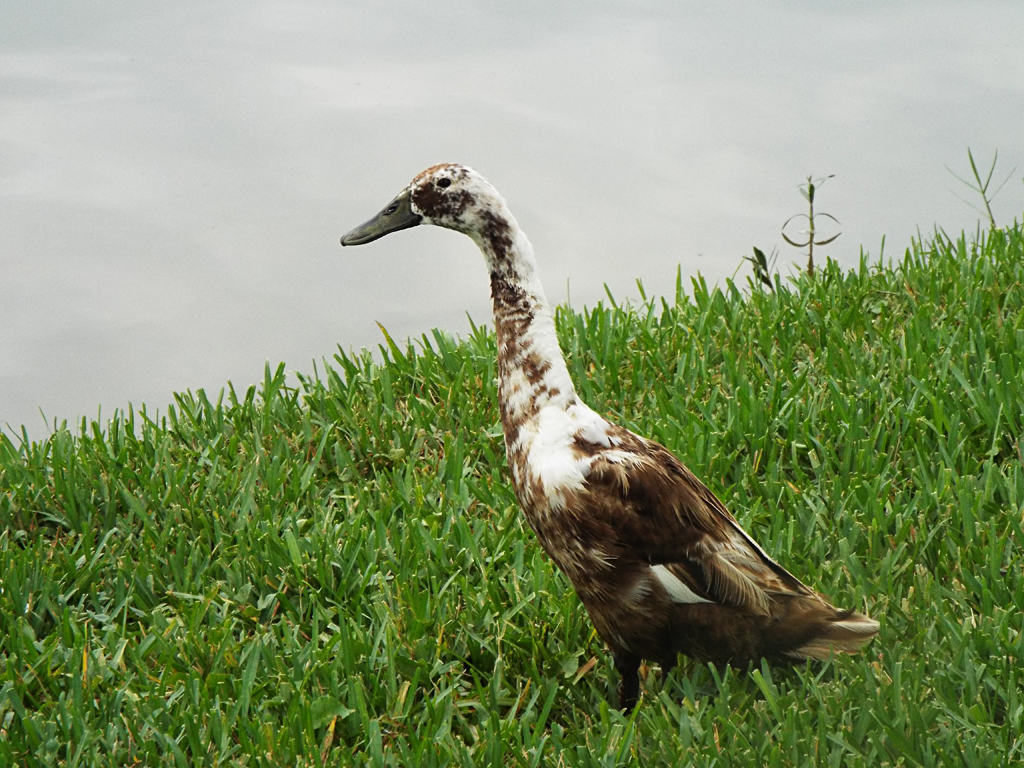
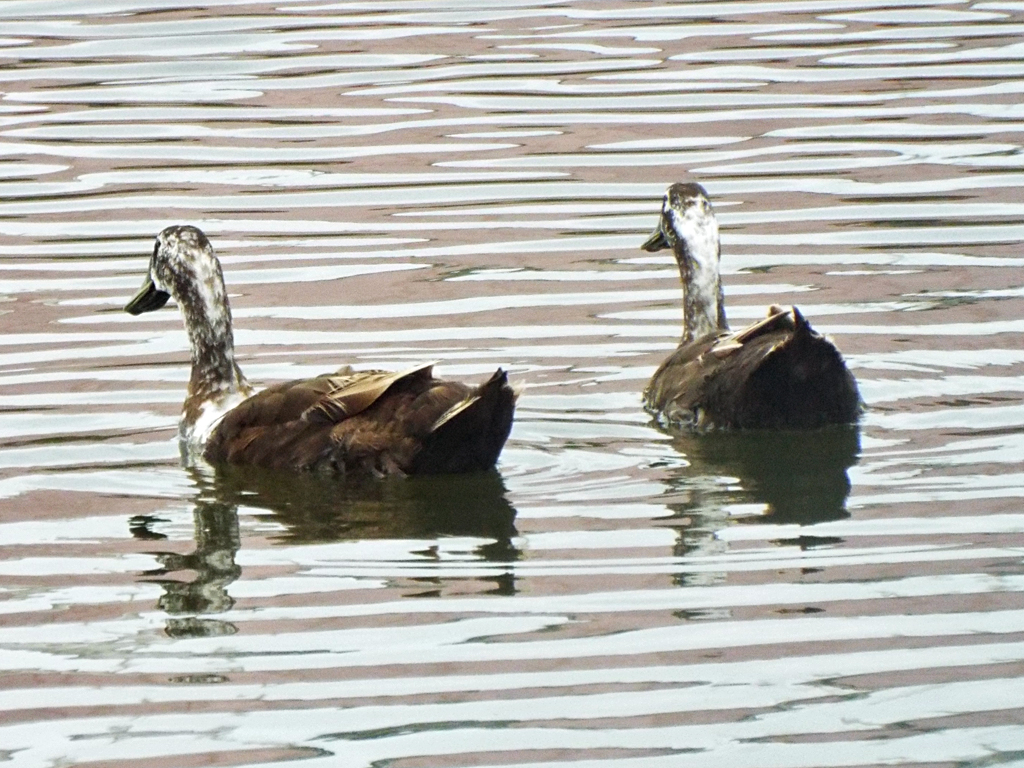
The second large population of ducks are of the Mallard/domestic cross variety. These ducks have a lot of white in their plumage, and many have dusky or cinnamon feathers. They also tend to be a bit larger than the other Mallard types.
A resting pair of ducks, showing quite a bit of chocolate brown and cinnamon.I noticed most of the ducks with this type of plumage tended to walk with this upright posture.Another domestic cross pair, with more white about their heads.
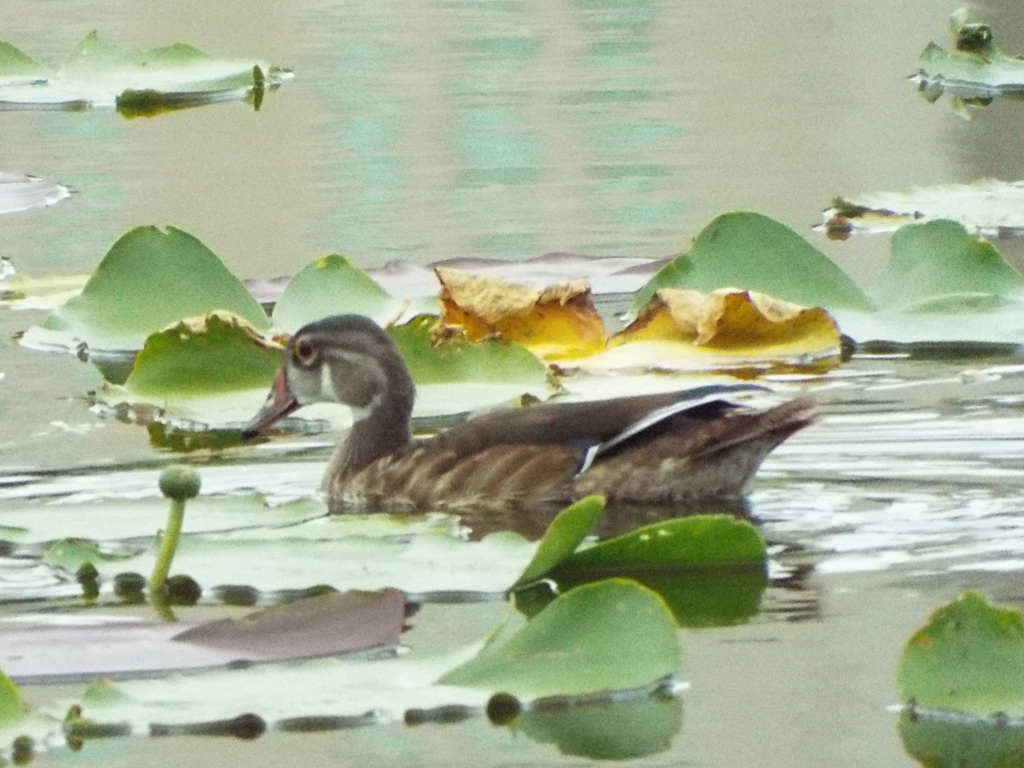
Lake Mirror (as well as Lake Morton) also have a number of Wood Ducks. The first ones we noticed were immature males. They were just getting their facial markings, but had not developed crests and their coloring was still subdued.
An immature Wood Duck among the lily pads.Another immature Wood Duck drake.
d
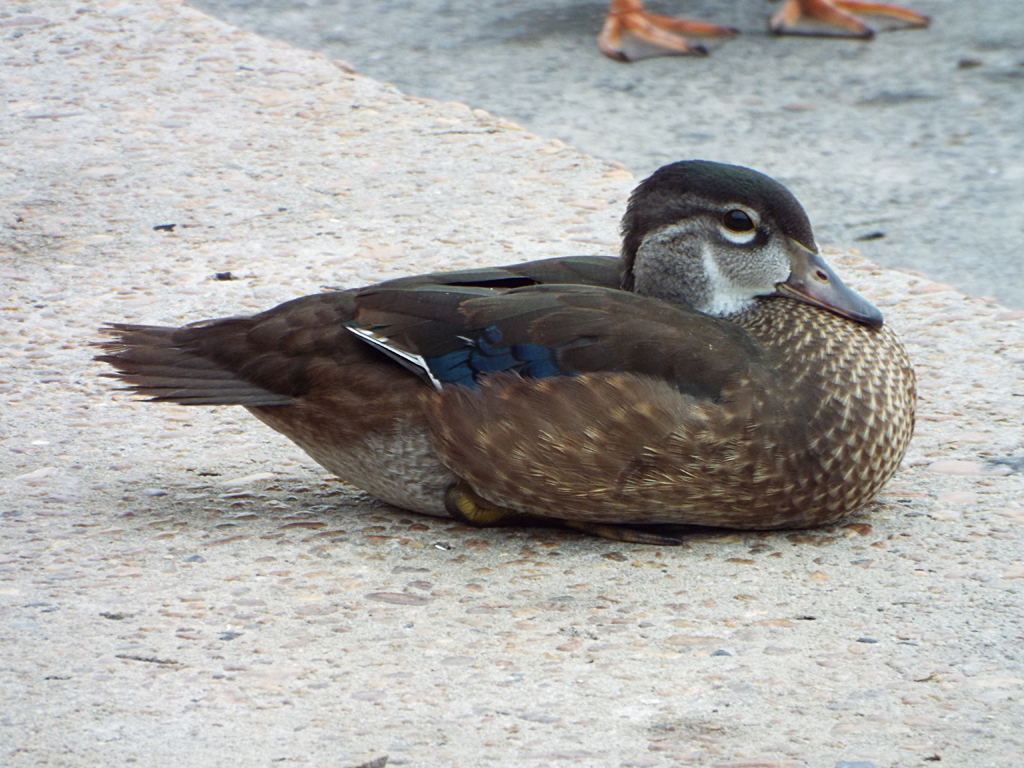
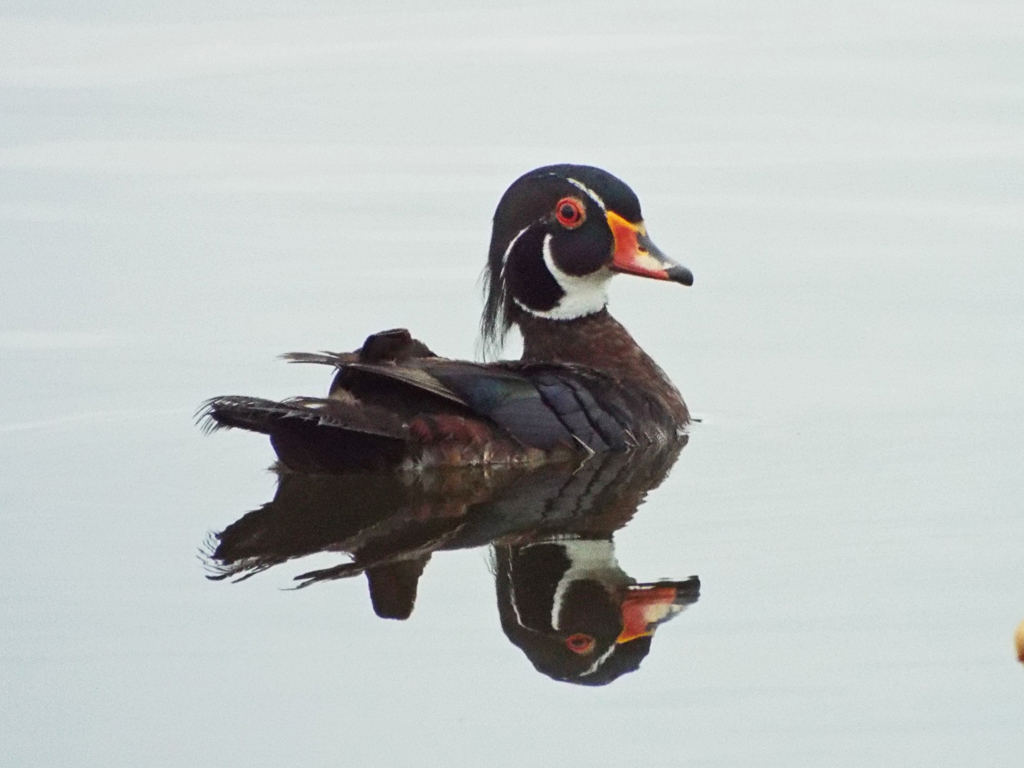
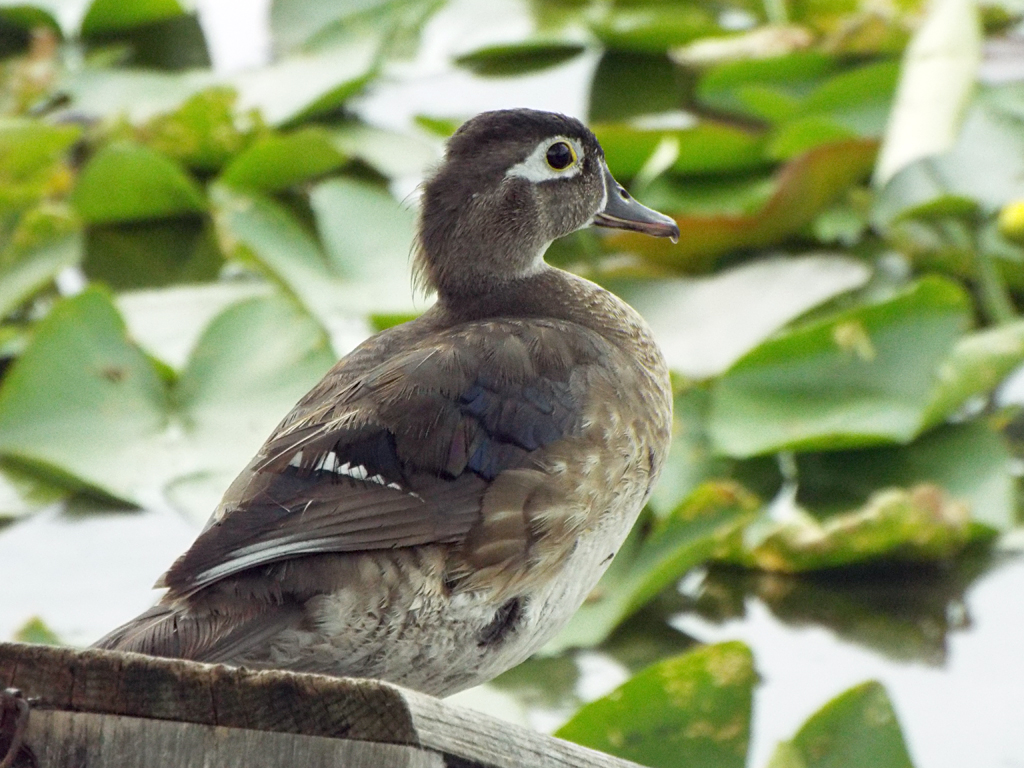
A distinguished Wood Duck drake.Another Wood Duck drake.Female Wood Duck on her nest box.
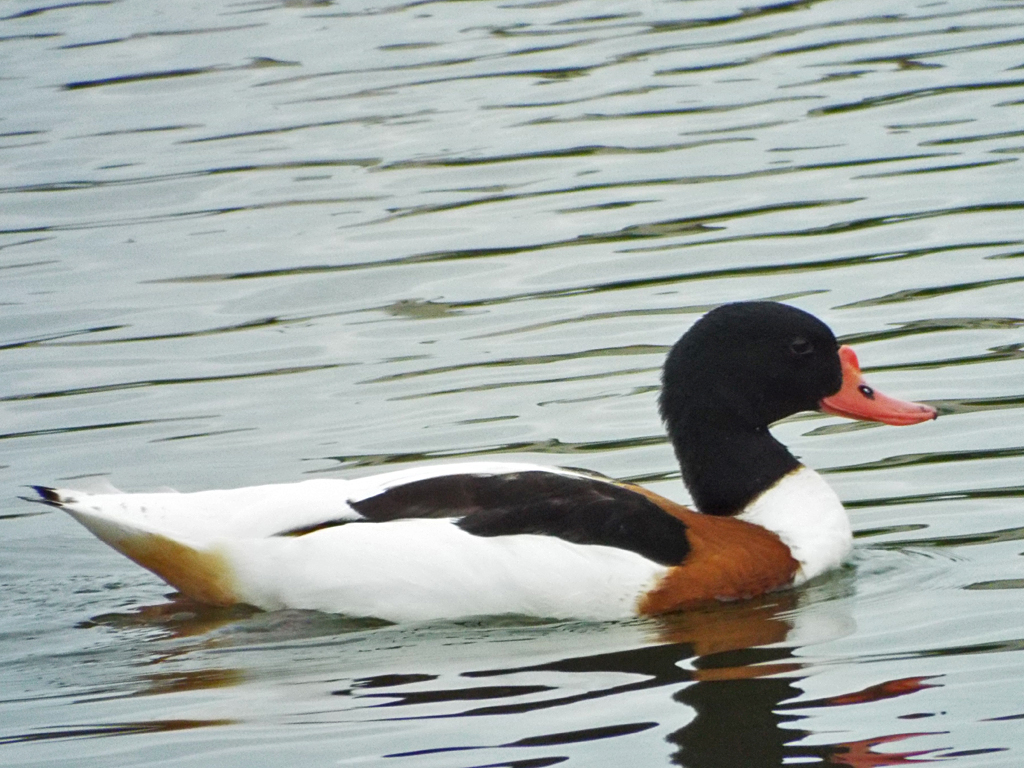
But the main reason for coming to Lakeland at all was for the chance to see more out-of-the-ordinary birds. Lake Mirror is home to two species of introduced exotic duck species. One, the Common Shelduck, is native to Eurasia. Sightings of vagrant birds are rare in North America. I’m not sure of the origin of the 3 birds at Lake Mirror, but I would lean towards thinking they were deliberately introduced.
Common Shelduck!
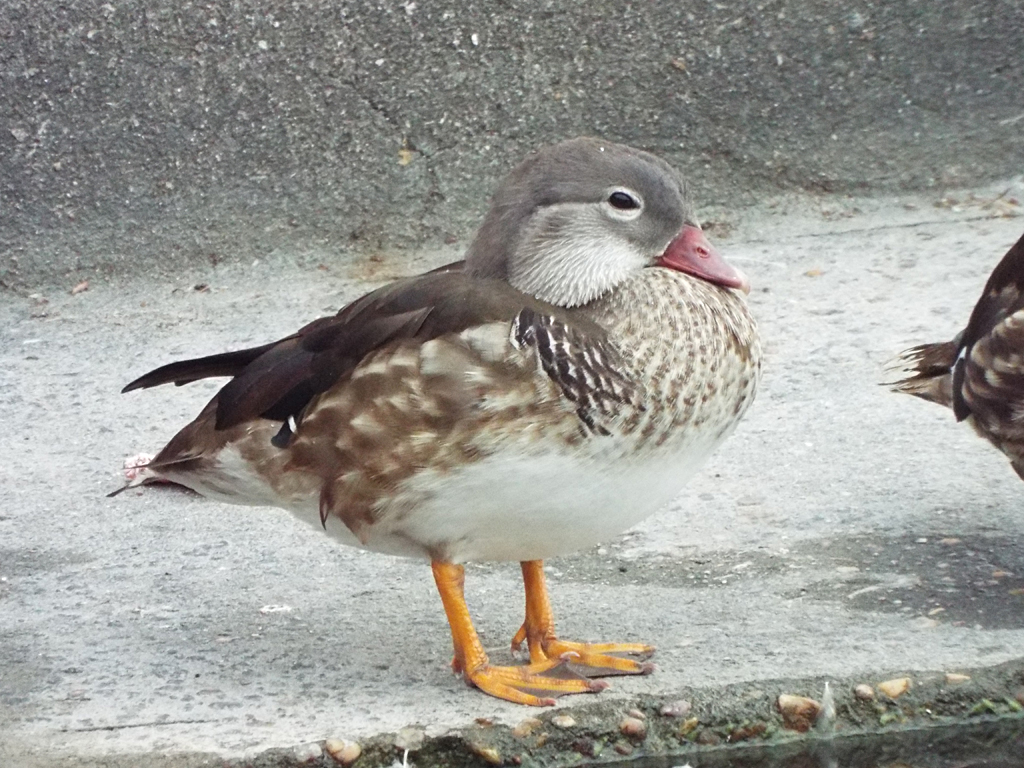
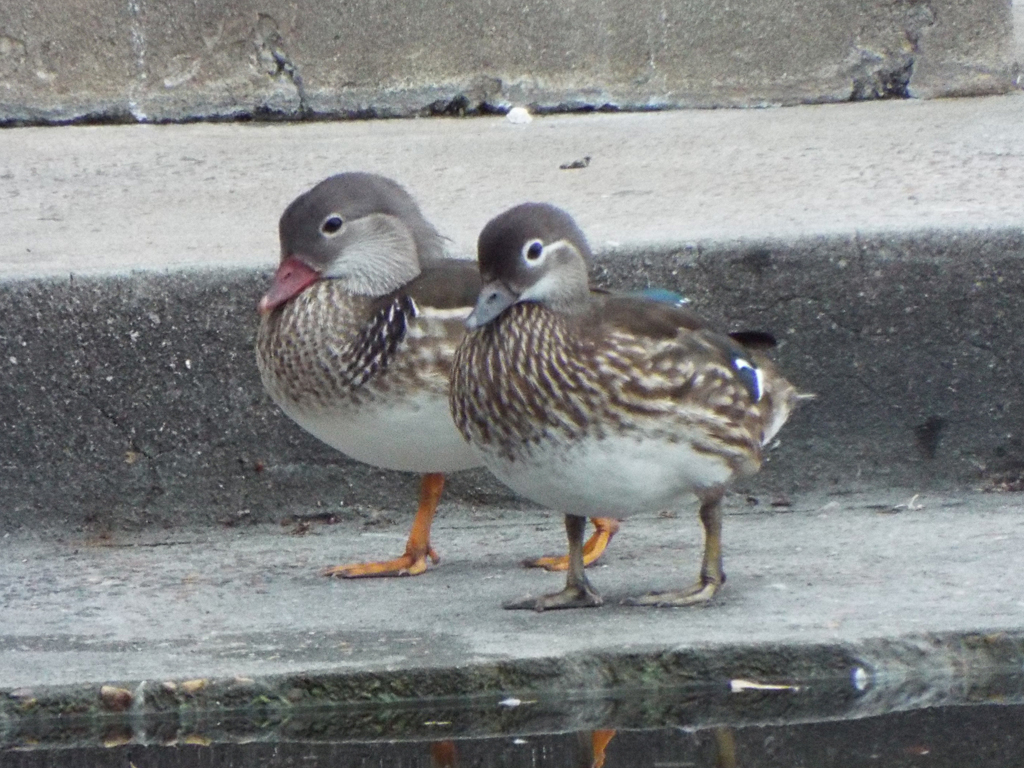
The other rare species of duck at Lake Mirror is the Mandarin Duck. As it’s name might suggest, this duck’s native range includes parts of northern and eastern China, but the largest concentration of breeding birds is found in Japan. Mandarin Ducks are closely related to Wood Ducks, as you might tell from their appearance. The single male (or drake) we saw was in “eclipse plumage”, and thus more drab in appearance than he would be when breeding. The females look very much like Wood Duck females. Like the shelducks, it’s a safe bet these birds were introduced as “ornamental” ducks.
Male Mandarin Duck (eclipse plumage)!
The male Mandarin Duck (on the left) and one of two females.
Both of these exotic species have only been reported, via eBird, in Lakeland since 2013. They do not appear to be successfully breeding yet, but perhaps time will tell if they can become established.
The morning overcast began to clear as we made a complete circuit around the lake, and it was time to head to Lake Morton and the swans! Stay tuned for part 2…
Things have been a little hectic at Lonely Birder Central, but I hope to be back on track soon. After a lovely sojourn to Lake Apopka and then Belleview two weeks ago, I travelled to Lakeland, Florida for the first time to see the various swans that have been a part of the city for years. Stay tuned, and I’ll have something up as soon as I can.
Meanwhile, here are a few photos and comments from last weekend. First, from the Lake Apopka Wildlife Drive.
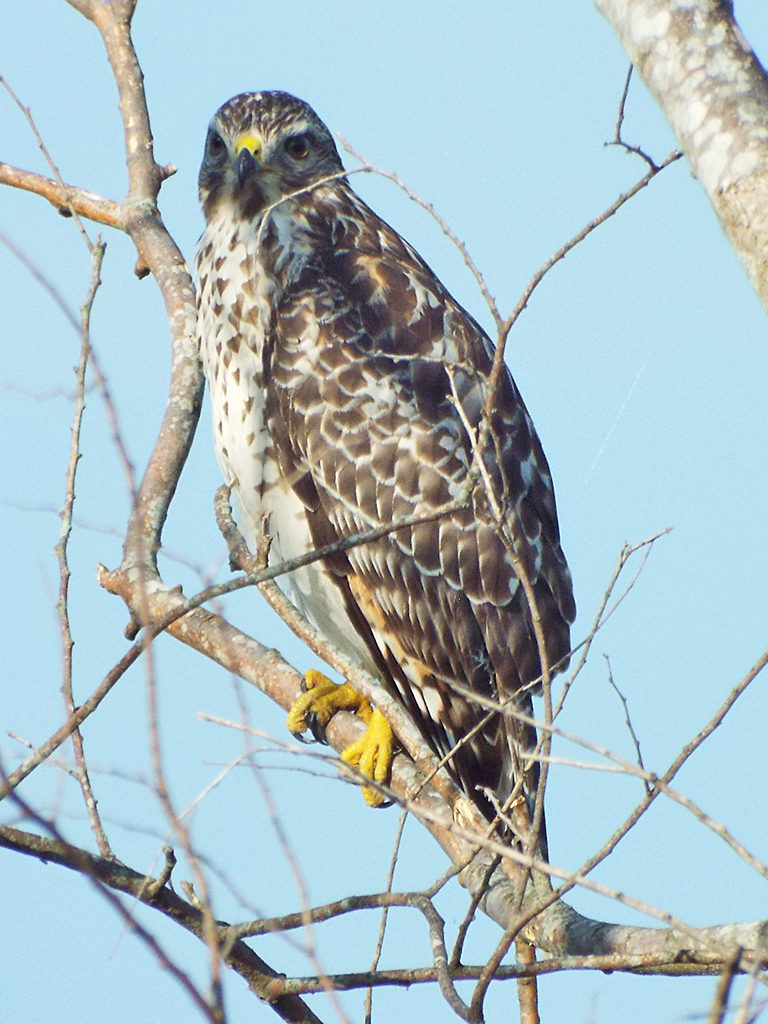
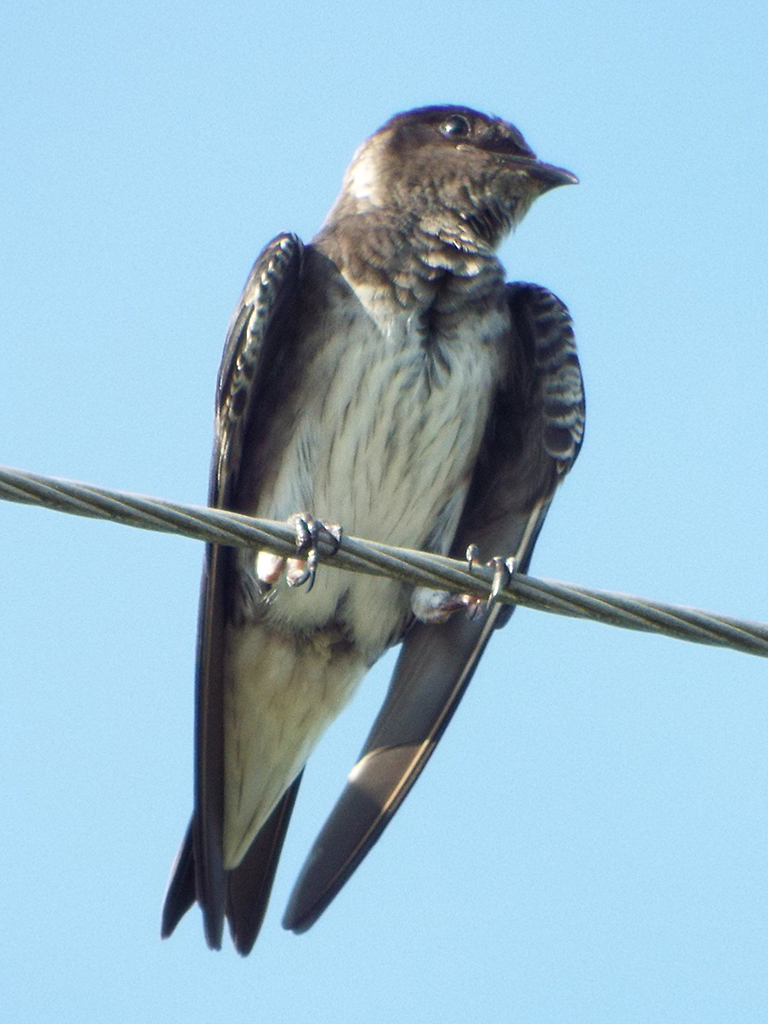
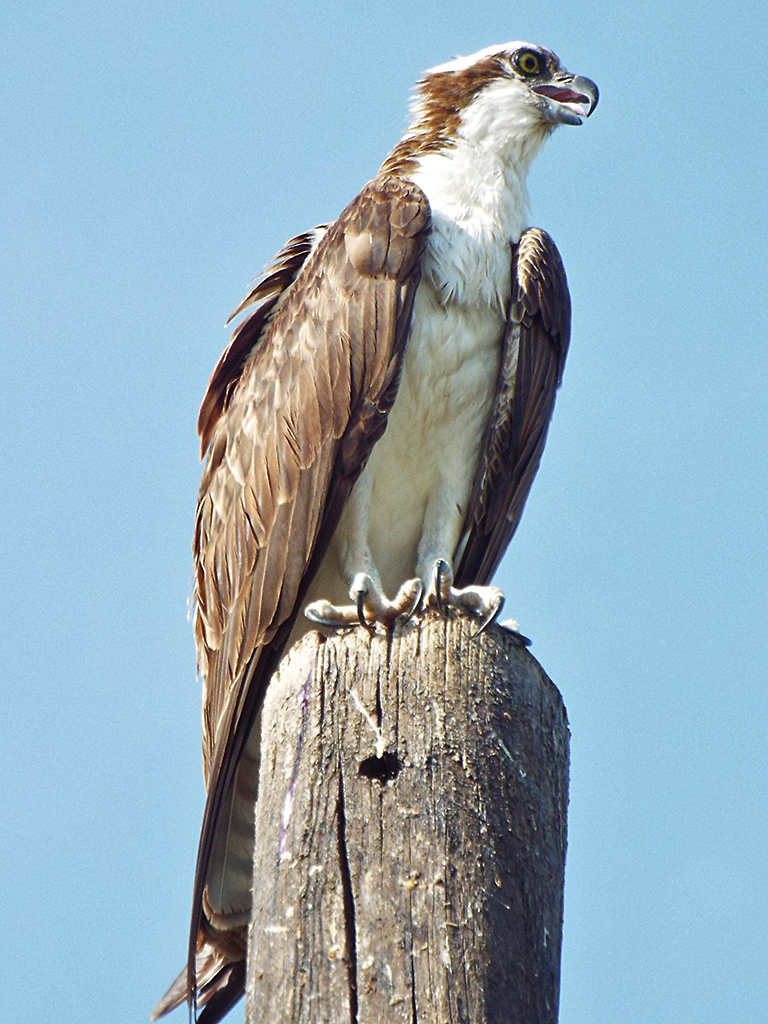
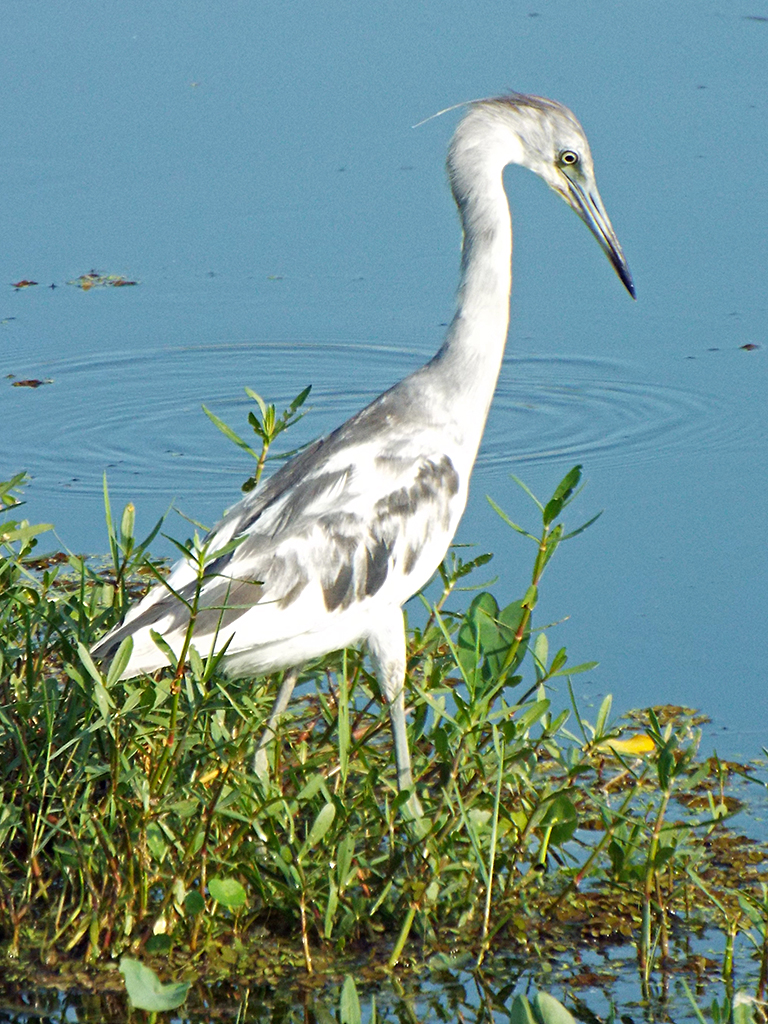
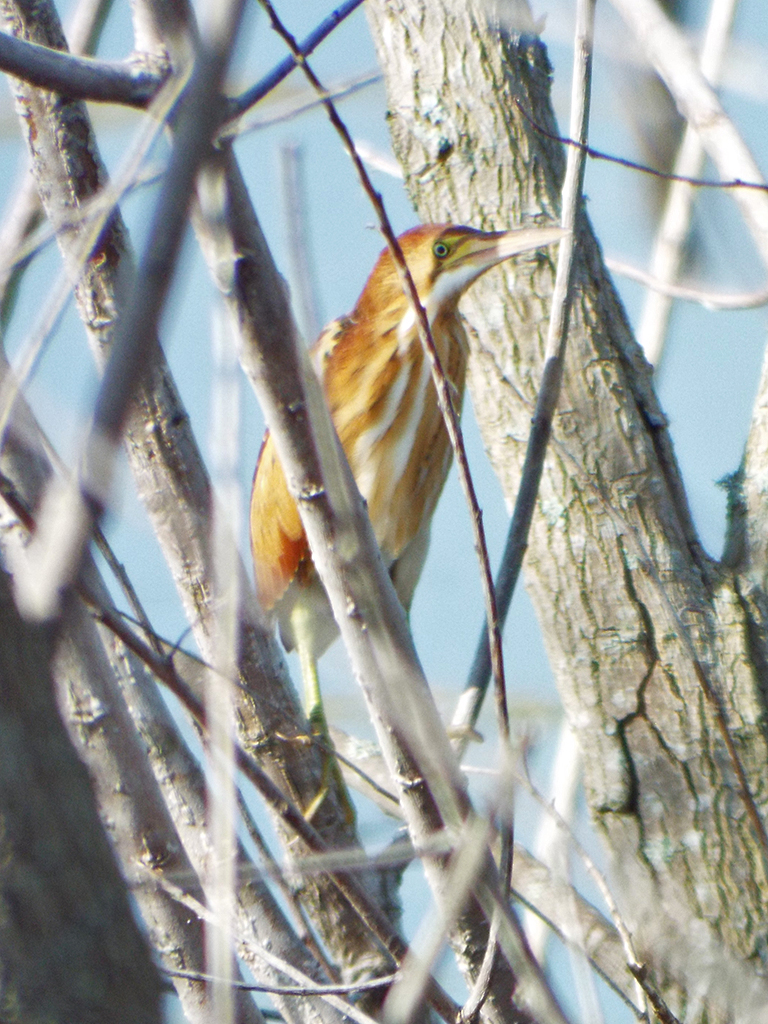
Immature Red-shouldered HawkYoung Purple MartinOsprey, panting due to the heatAn immature Little Blue Heron, just starting to get adult plumageLeast Bittern
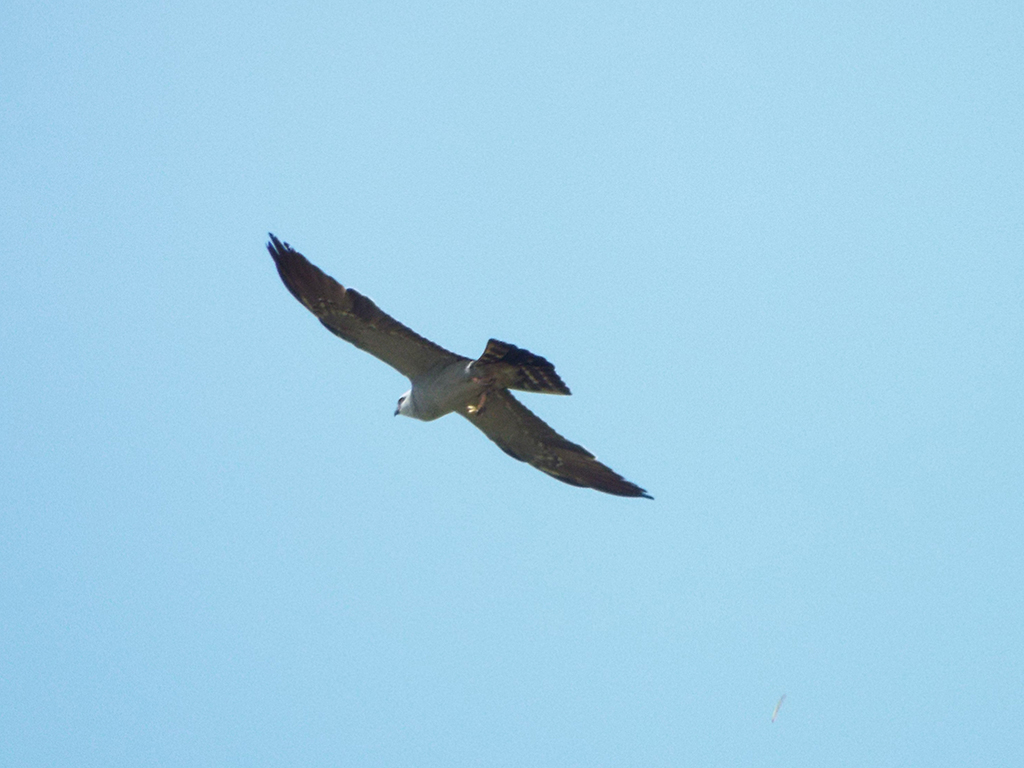
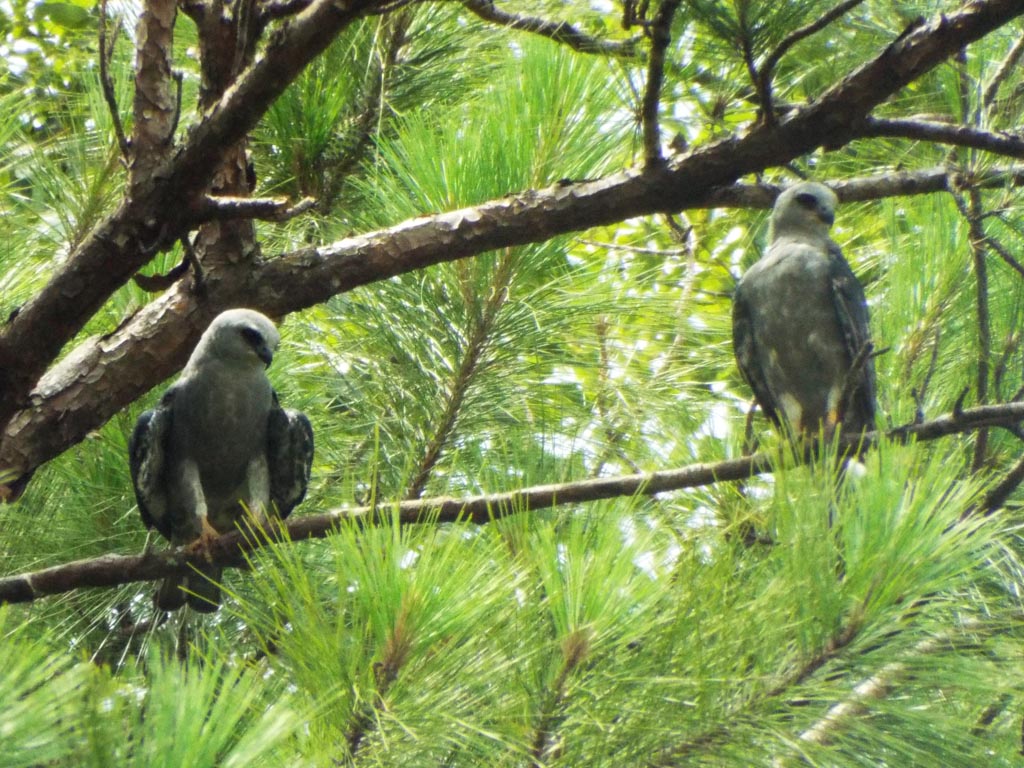
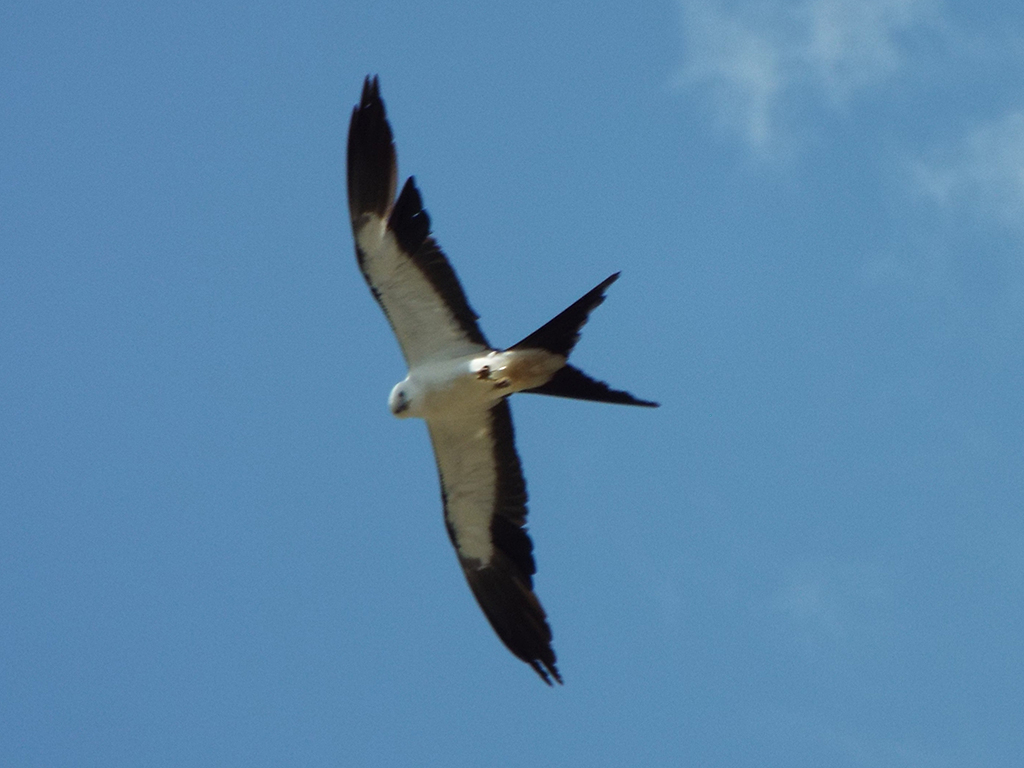
There was also a large congregation of Mississippi Kites in Belleview (near Ocala). There’s been a mild infestation of large grasshoppers in parts of central Florida, and the kites have been taking great advantage of it. Here are just a few photos, one showing the lone Swallow-tailed Kite (which usually predominates in central Florida).
One of several dozen Mississippi Kites that descended upon a residential subdivision. This one is carrying a grasshopper in its right talons.Two Mississippi Kites scanning the ground below for grasshopper targets.It’s hard to make out, but this Swallow-tailed Kite is holding a large grasshopper in its left talon.
As central Florida begins to settle into a summer pattern, I thought it would be a good weekend to stay more local and see what was happening both at the Helen and Alan Cruickshank and Turkey Creek Sanctuaries this past Sunday.
As expected, it was a quiet morning at both places, but it is breeding season for most of the resident birds. That means fledglings!
There were at least a couple of Purple Martin families flying high above the Cruickshank Sanctuary, with many of the fledged birds taking food from adults while on the wing. Purple Martin calls can sometimes sound almost like a Star Wars blaster effect or a metallic twang, and these sounds filled the air for the whole time I was there.
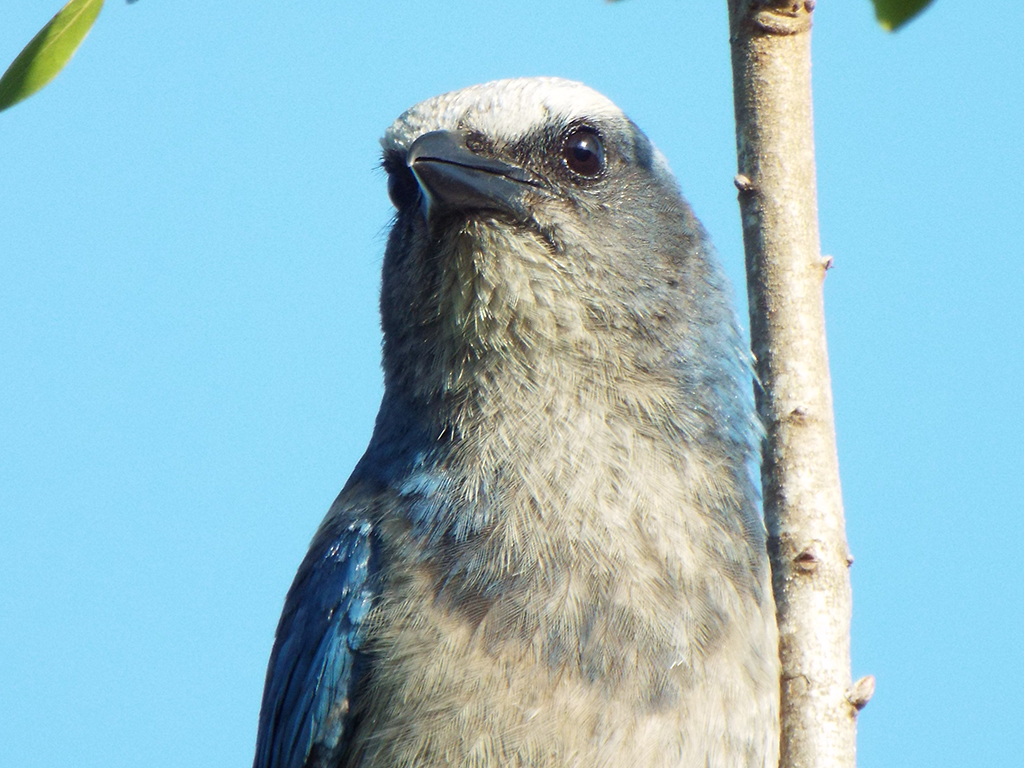
Also fledging are the Florida Scrub Jay chicks. Almost immediately upon stepping into the sanctuary, I had inquisitive youngsters fly up to take a close look at me.
This immature Florida Scrub Jay is a little older than a fledgling, but is yet to molt into his adult plumage.
Some of the younger fledglings were having trouble flying long distances, so stuck close to the lower scrub, while the older and more bold youngsters tried to keep up with the adults (who were feeling quite feisty!)
An adult Florida Scrub Jay acting as a lookout.
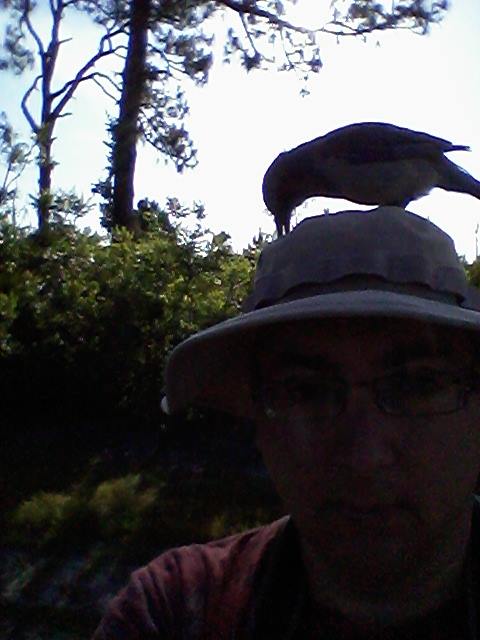
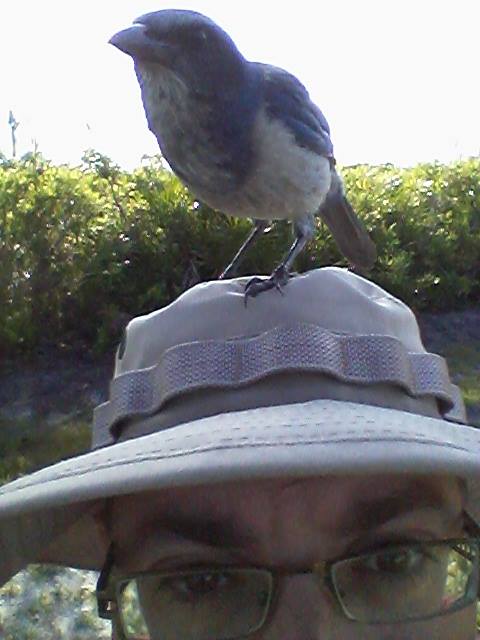
At one point an adult landed on my head. This isn’t unusual at this sanctuary. In the past, scientists and hikers alike fed these birds peanuts, which took advantage of this species bold and gregarious tendencies. It was found that in the long run this was not helpful for the long-term rehabilitation of the species (especially if the birds were ever relocated to colonize new habitats in the future), so the practice was officially discontinued. Unfortunately, many visitors continue to feed these birds, and some of them have come to expect the hand-out. In the case of this particular bird, it began pecking me on the head!
OW!This bird pecked at the phone right after this shot.
After I pulled my hat back far enough to get the bird off of me, it landed on the ground and then looked up at me, confused, as if it had done nothing wrong.
“What the heck is YOUR problem?”
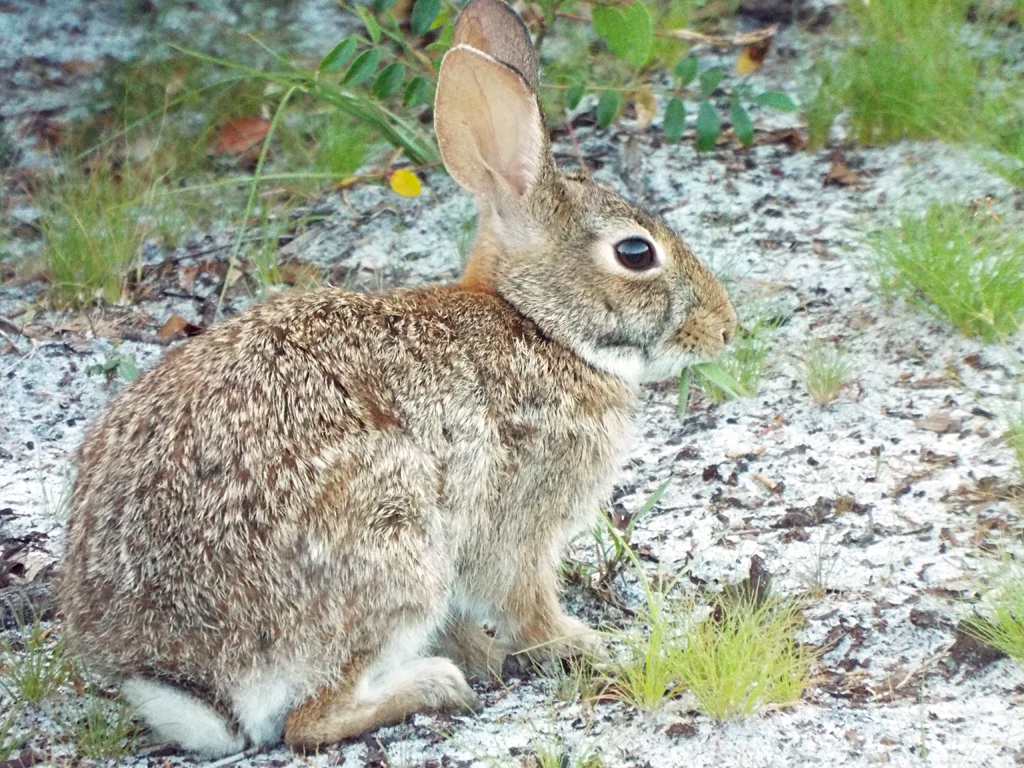
There were some non-avian friends about the place, too, including a nice collection of Eastern Cottontails, some Green Anoles and other lizards, and frogs, singing in the trees.
BUNNY!
A pair of Wood Ducks were sitting up in some of the dead trees. I suspect they may have a nest nearby, though they either already had a brood of chicks or the female has yet to lay eggs (or it may be both; Wood Ducks may have 2 broods per season). Wood Ducks nest in cavities that may be over 50 feet off the ground! When the young hatch, they jump to the ground just a day or so later, surviving a harrowing fall and running off to join their mother, usually to the relative safety of a pond or stream.
A Wood Duck pair, high above. The nest up and to their right is an Osprey aerie.
Overall, it was a pleasant morning and I left this sanctuary before the heat of the day. You can see the complete list of birds I identified below.
I then drove south to the Turkey Creek Sanctuary to get a look at how it was faring, post-migration. It was relatively quiet, though the woods were full of Carolina Wrens and Northern Cardinals singing and calling. It started to get a little warm as the day progressed, but there was a reasonable amount of bird activity spread throughout the portions of the sanctuary I visited (I did not walk most of the boardwalk).
Many Northern Parula chicks have fledged, and were begging for food high in the canopy as their parents gleaned food for them, and at the weir there were some first year Common Gallinules and one transitioning Little Blue Heron.
This immature Little Blue Heron has gotten most of its adult primary feathers.
The biggest surprise was a Gray Catbird out by the turn-around by the boat ramp and end of the jogging trail. It’s not the first time I’ve seen one in the area in the summer, but it is unusual. I may have heard a second one, but I can’t be certain. That’s one of many reasons to love birding: you never know what to expect and surprises are always possible.
In the United States, one aspect about birding that has stood out to me is how “white” it is. There have been a number of papers and articles about this, with varying degrees of acceptance or scorn, and I don’t aim to have a solution here (this is a RANT after all), but consider the following two pieces on the subject. One is a USDA Forest Service Technical Report from 2005 and the other is a 2014 article from National Geographic. I heartily recommend reading both pieces.
Not what I meant.
In the Forest Service report, author John Robinson sent out questionnaires to birders and African Americans to gauge how each group perceived birding and the diversity of its participants. In his conclusion, Robinson brings up an interesting point. He says that one way to respond to the dearth of African Americans (and indeed, other minorities) is by saying, “What’s the point?” That is, every individual is free to choose to bird or not. I like to call this the “Libertarian Argument.” Minorities are not birding, says this line of thinking, because they freely choose not to. Surely if someone wanted to bird badly enough, the resources exist to do so.
The Libertarian Argument, of course, fails to address any systemic barriers to certain populations, or of larger cultural attitudes. Robinson says that on reason for a lack of interest in birding among African Americans is part of larger tendency for that group to be less involved in other nature-related activities. The reasons for this are multiple. One reason is that many core African American populations tending to be more urban and historically having less access to green spaces. Another reason is what Robinson describes as a “Don’t Loop”. He says of birders, “many of these individuals most likely got started in birding as a result of having been introduced to it by someone else.” If someone never gets a chance to meet or interact with a birder, then they cannot pass the activity on to others, thus perpetuating the cycle.
In the eleven or so years since the paper was published, there has been little change in African Americans’ participation in birding.
Robinson’s paper is focused on self-identifying African American birders, though he does mention the overall concern with the lack of other minority groups. It doesn’t take much looking around in most field trip buses to extrapolate these trends to other demographics.
The 2014 National Geographic article, by Martha Hamilton, delves a little more into why diversity in birding (indeed, in any activity) is desirable, and how some organizations are tackling the issue.
This includes outreach programs that send birders (and other environmentalists) to schools and organizations, particularly dealing with kids, to get them interested and excited. But some organizations are realizing the need to attract adults, too. It’s very hard to convince someone that any aspect of the environment needs attention or “saving” if they aren’t somehow invested in it themselves. Teaching adults to connect the dots and see how their actions are related to their environment is key. Birds are a visible and accessible way to do that.
The author also brings to light the potentially hidden attitudes certain groups or clubs have toward “other” groups, without necessarily thinking much of it. It will take an explicit and dedicated outreach effort to pull diverse people into these groups, which will have to first identify and then challenge their own inherent biases. My own birding experience, for example, has been seriously lacking in diversity. I’ve had to decide how important that is to me.
What do you think? Is there a racial bias in birding? If so, is it something we should worry about? How would you address the problem, if you see one?
This morning, I took a drive to the Blackpoint Wildlife Drive at Merritt Island National Wildlife Refuge [map]. It ended up being a pretty good birding day, all things considered. It was hot early, and the Spring migration is all but over. I saw or heard about 50 different species, but the three most interesting all have something in common. In their life-cycle, each one sports black and white plumage.
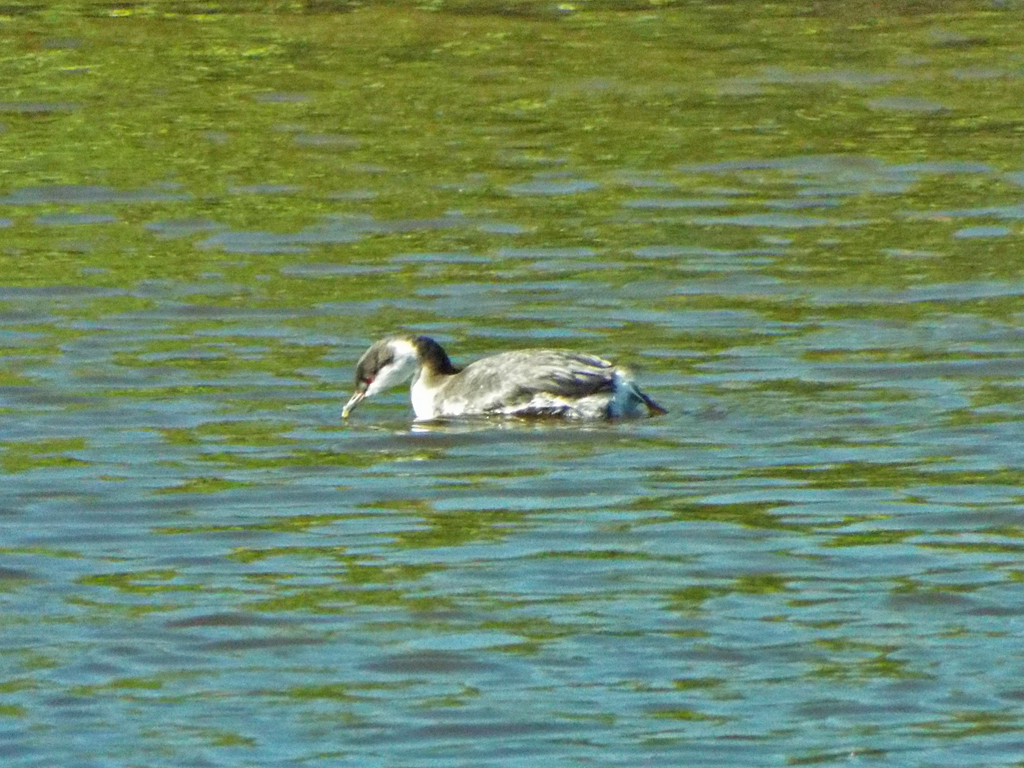
First, there had been reports of a Horned Grebe along the drive, which is unusual this time of year. Normally these birds might winter over (and many did this past Winter), but for one to be hanging around in May is a bit odd. Additionally, the bird was reported to be transitioning into breeding plumage. The normal breeding range for a Horned Grebe is the western half of Canada into southeastern Alaska. Here’s my photo of an apparently injured Horned Grebe from this past winter:
Injured Horned Grebe taking refuge in the Refuge. Note the primarily black and white plumage.
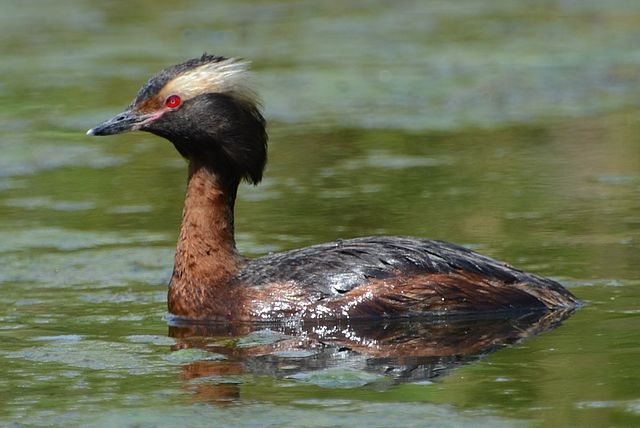
These grebes, and the very similar Eared Grebe, look very different during the breeding season, losing their black and white feathers in exchange for warm browns and some wild, buffy-colored head tufts!
I did not get very good photographs of the bird today, so here’s one taken from the Wikipedia entry on the Horned Grebe:
By Connon Mah (Own work) [CC BY-SA 3.0 (http://creativecommons.org/liceses.by-sa/3.0) or GFDL (http://www.gnu.org/copyleft/fdl.html)%5D, via Wikimedia Commons.I speculate (with nothing more than circumstantial evidence) that this is the same, injured bird. It might not be, but it would be a bit improbable, in my opinion.
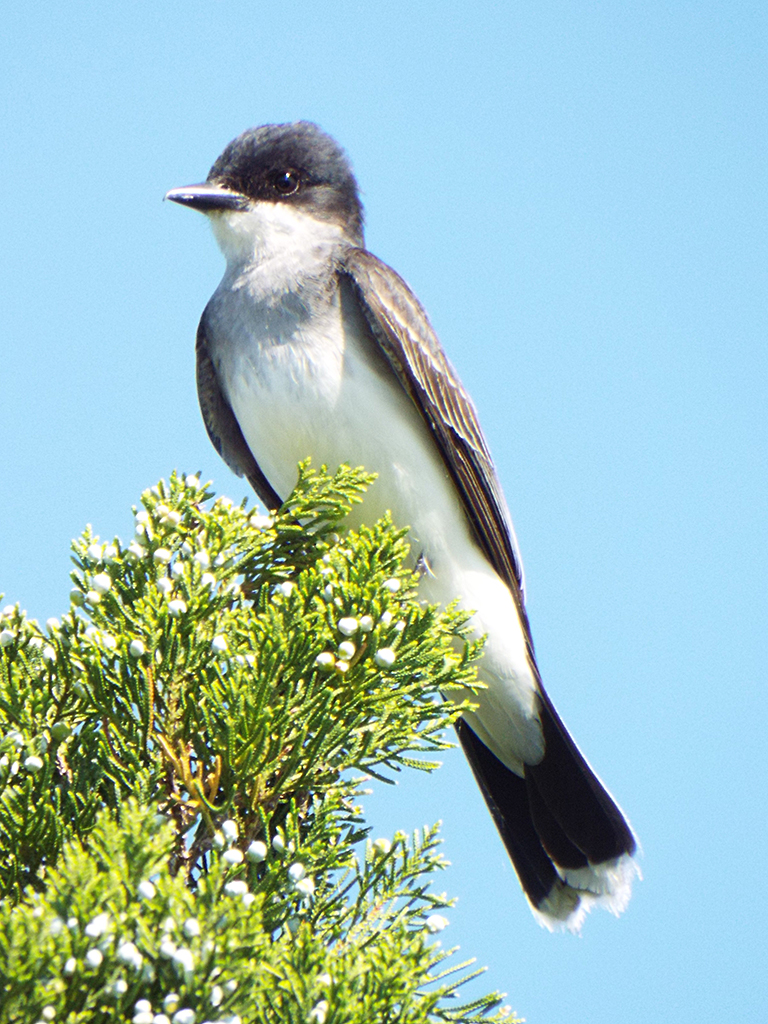
The next “black and white” bird I’d like to highlight from my adventure today, was a fairly accommodating Eastern Kingbird. This species has been a little harder to come by of late, at least when I’ve been out. We used to have one or two that would hang around the back yard some years ago, and I’d seem them in passing from time to time around town. The past few years it seems they’ve been more dispersed. In any case, this bird sat for a while in a nearby tree along the road and let me take a few photos before casually flying off.
This Eastern Kingbird would have likely arrived recently from central or northern South America, where it was staying for the winter.
In addition to the striking black and white color scheme, male Eastern Kingbirds have a small patch of red (or sometimes yellow or orange) feathers on the crown of their heads, which are almost never seen in the field, expect at close range when the bird is agitated or upset.
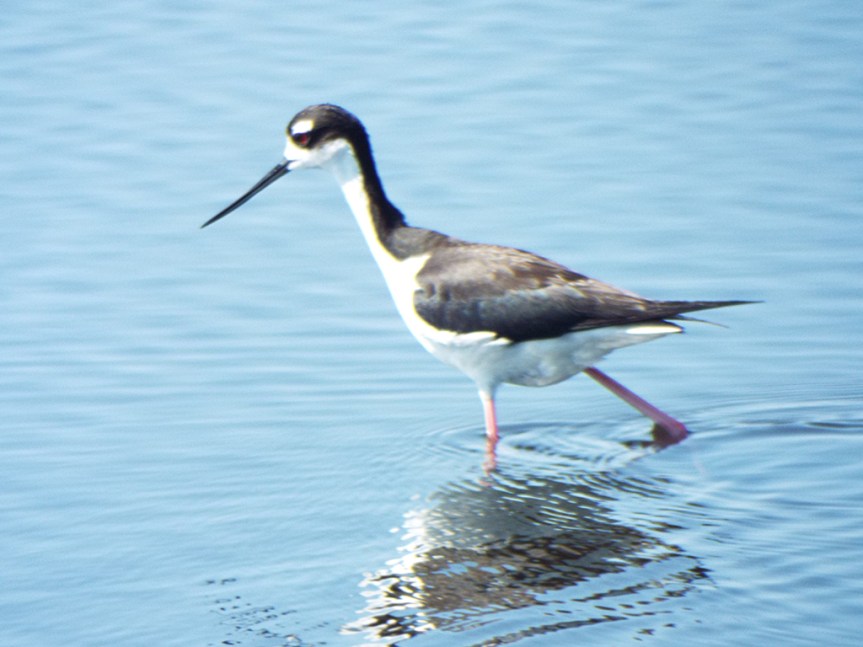
The final bird I’d like to focus on with black and white plumage, from today, is the Black-necked Stilt.
Although a bit out of focus, you can see the striking black and white pattern on this Black-necked Stilt. Less than 1/2 of the bird’s right leg is showing.
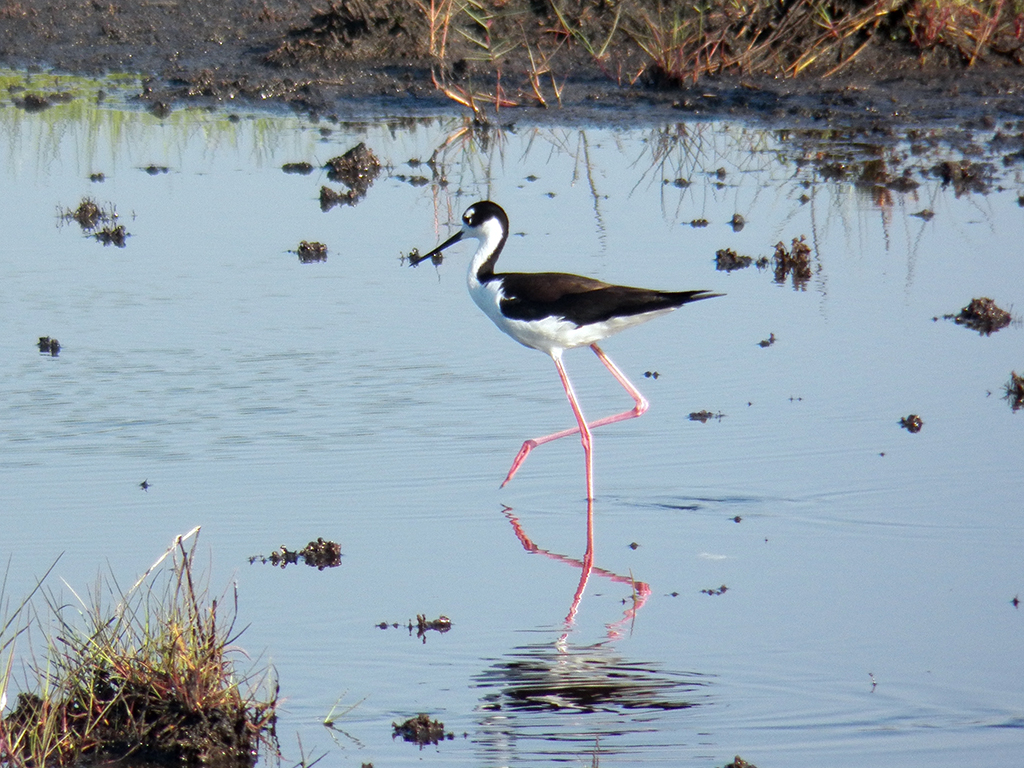
Black-necked Stilts are beautiful birds, and their conspicuous, long, red legs are second only to flamingos in their relative length to their bodies. Here’s another photo I took last year, showing how long their legs are.
A Black-necked Stilt showing off those amazing legs!
Those legs are likely an adaptation to allow stilts to wade in deeper water than other wading and shorebirds of it’s size, so it is not directly competing with them. This is sometimes referred to as “resource partitioning.”
Of course, I saw and heard other birds. If you’re interested, I’ve linked to my eBird checklist below:
May is rapidly drawing to a close and the relative quiet of Florida’s Summer is almost here, but I expect I’ll have plenty more adventures throughout the next few months, including a trip or two to more temperate climes. Stay tuned!
Saturday was the second annual “Global Big Day“, promoted by the Cornell University Lab of Ornithology. Just as a birder’s “Big Year” would be an attempt to rack up as many bird species in a year as possible (usually over a large area, like a country or continent), a “Big Day” is an attempt to identify as many birds as possible, in a smaller area, in 24 hours. It isn’t unusual to see goals of 100 or more species for the day. I’d even seen one statewide (not Florida) goal of 200 species.
My Big Day was a bit more modest. There have been a couple of rare species reported since the winter in Palm Beach County, but I haven’t been able to take advantage of any opportunities to head there all year. Using the Global Big Day as a catalyst, Camille and I decided it would be a good time to go. We’d try for the rare species and tally up as many birds as we would see throughout the day.
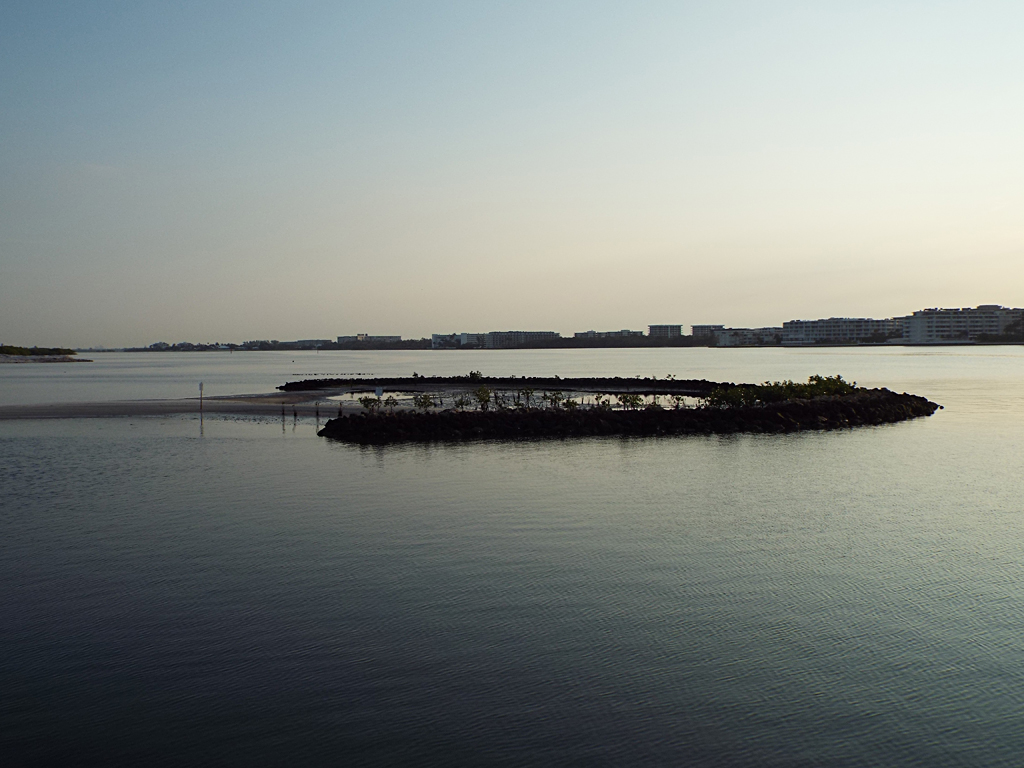
In the hopes of catching some shorebirds, we started at the relatively new (and still under construction) Snook Islands Natural Area [map]. I’ll leave it up to the reader to decide the level of irony involved in having a natural area under construction.
One of the created islands of the Snook Islands Natural Area. This one was mainly pigeon free.
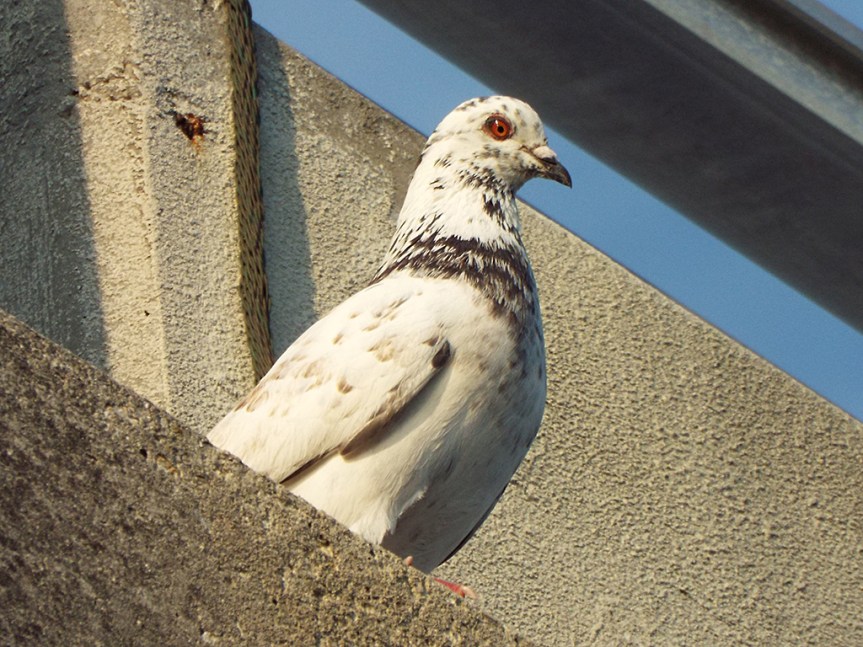
There were many Rock Pigeons in the area, including the islands. Rock Pigeons are considered an established feral species and are known for their plumage variations, probably due to mixture with domestic stock. At least 40 were flocking by the boardwalk’s start, with more walking on or flying over the artificial islands.
A strikingly pale-feathered Rock Pigeon. Plumage variations like this are common in feral pigeons.
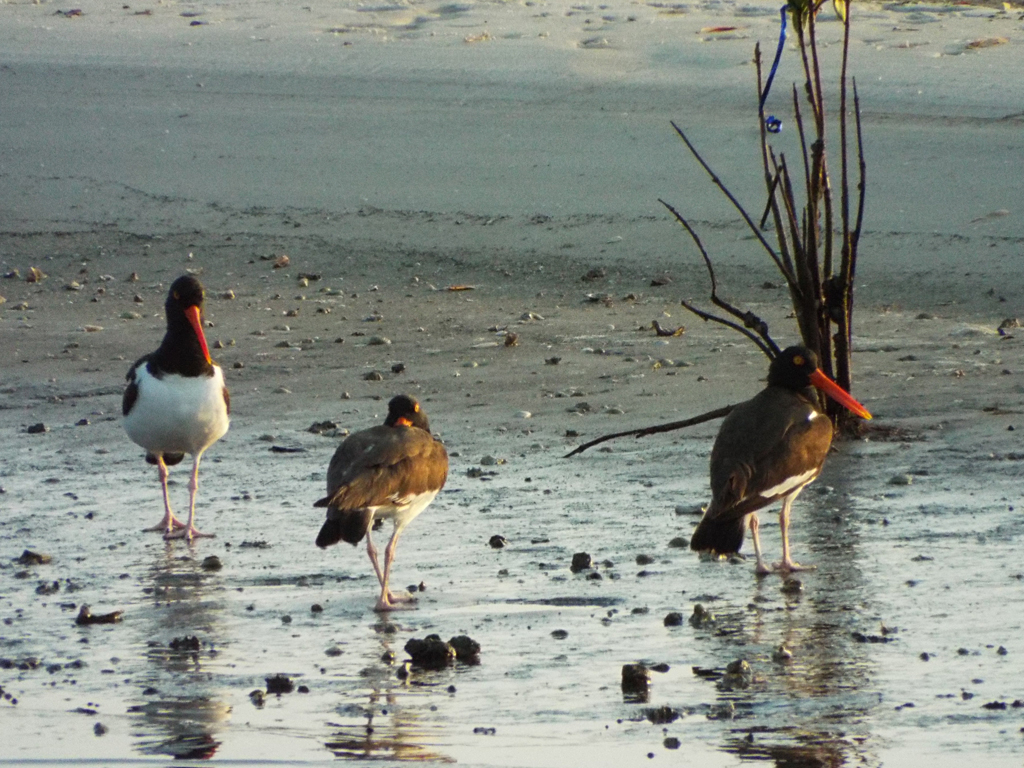
There were a few shorebirds, too. While watching a small group of Ruddy Turnstones, a trio of American Oystercatchers flew onto one of the islets closest to the boardwalk we were on. These birds are loud, by the way.
Some of the American Oystercatchers at Snook Islands Natural Area.
We heard a Black-throated Blue Warbler and saw some other smaller birds we couldn’t identify. There was a surprising lack of larger terns or gulls, and no Ospreys were nearby.
Our next stop was Loxahatchee National Wildlife Refuge [map].
The boardwalk at the visitors’ center makes its way through a cypress swamp, with a variety of birds singing and calling. A Swallow-tailed Kite soared overhead, and there were Pileated Woodpeckers, Wood Ducks, Northern Cardinals, Carolina Wrens, and over a dozen Common Grackles. Several Northern Parulas could be heard singing, too.
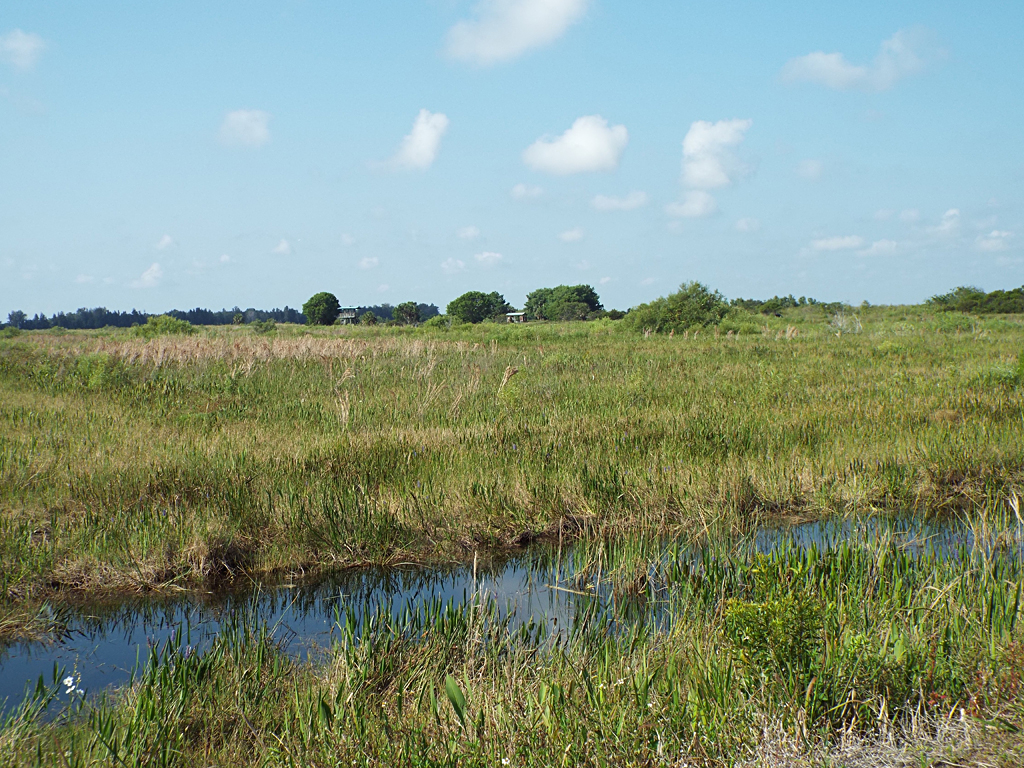
Loxahatchee is part of the Everglades ecosystem, with some sawgrass, wet prairie, and hammock habitat, interrupted by sloughs and sluices. The areas accessible to the public are primarily former agricultural tracts, and are less expansive than the bulk of the refuge, or of Everglades National Park, but contain ample examples of plant and animal communities native to South Florida. Loxahatchee is separated from the rest of the Everglades by dikes and canals.
A typical Loxahatchee landscape, on the Marsh Trail.
Near the Lee Way levee is a large rookery of wading birds. White Ibises were the most numerous, but there were many heron and egret species, with individuals shuttling back and forth with food and nesting material.
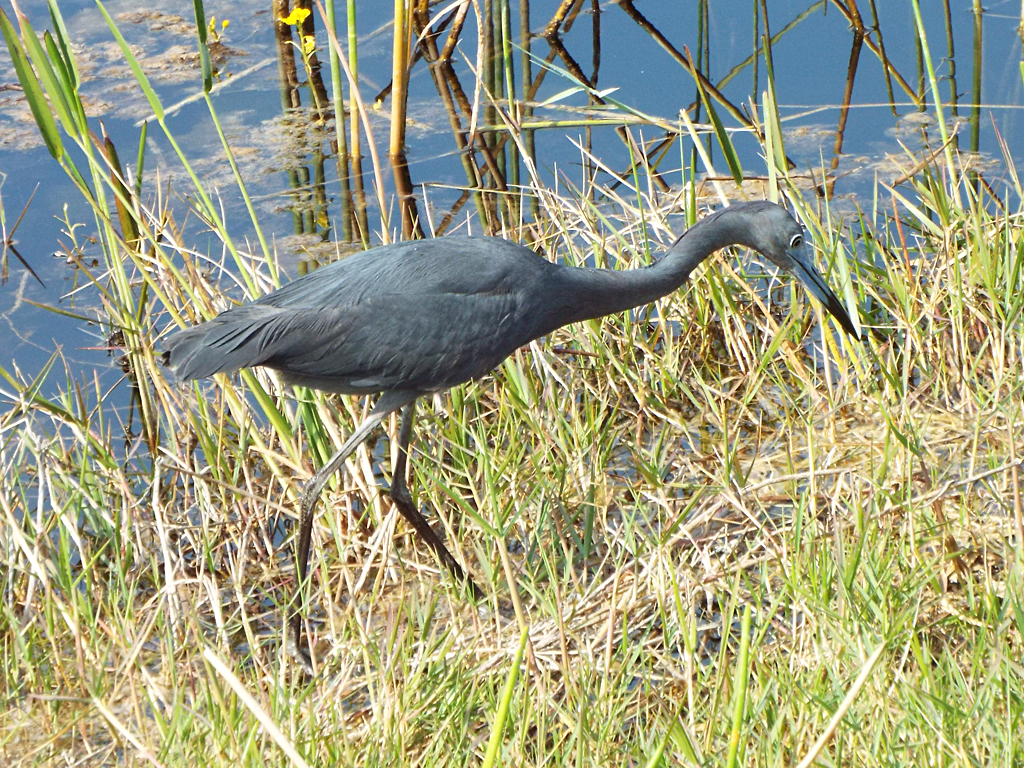
An adult Little Blue Heron stalking frogs and insects.
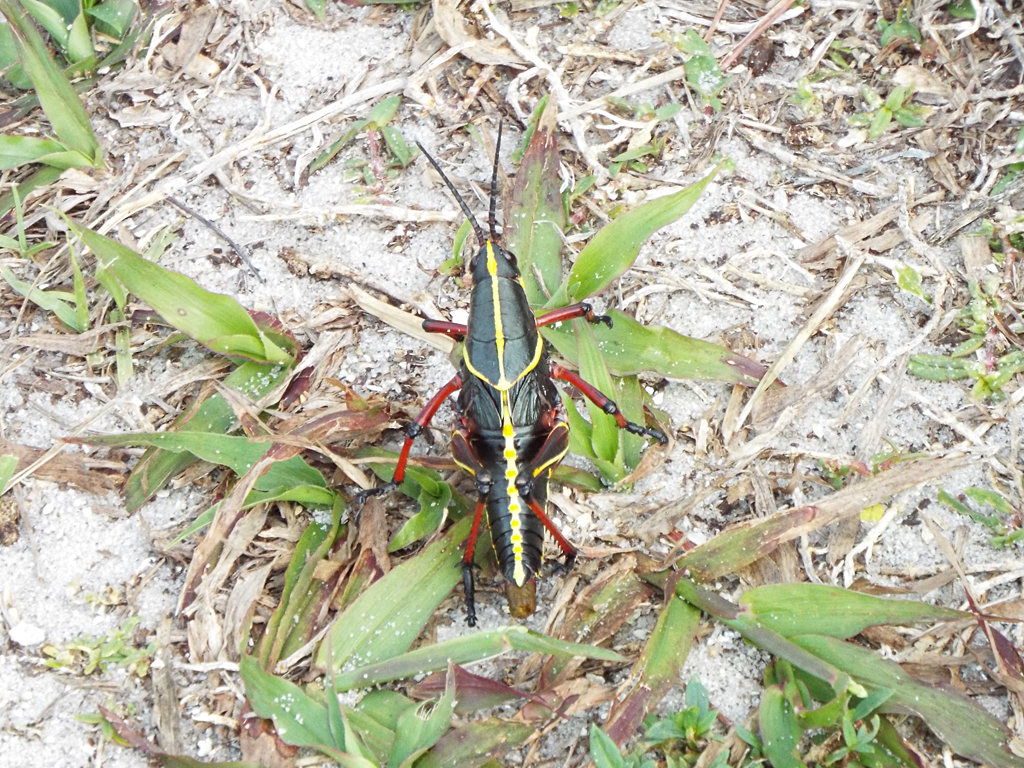
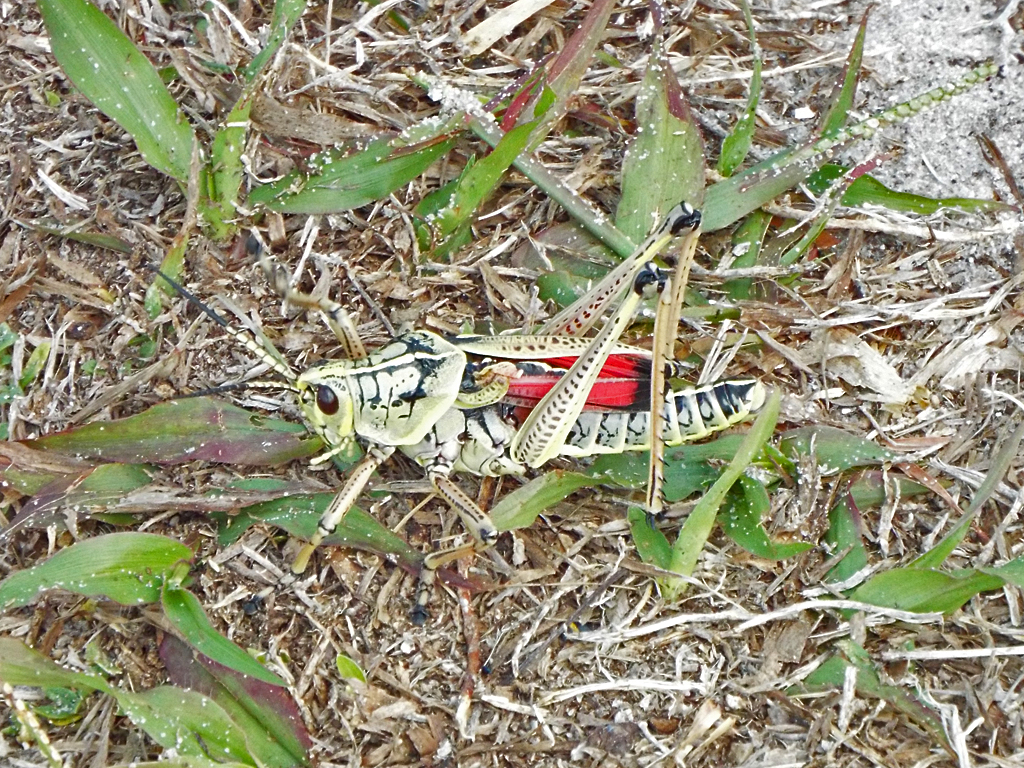
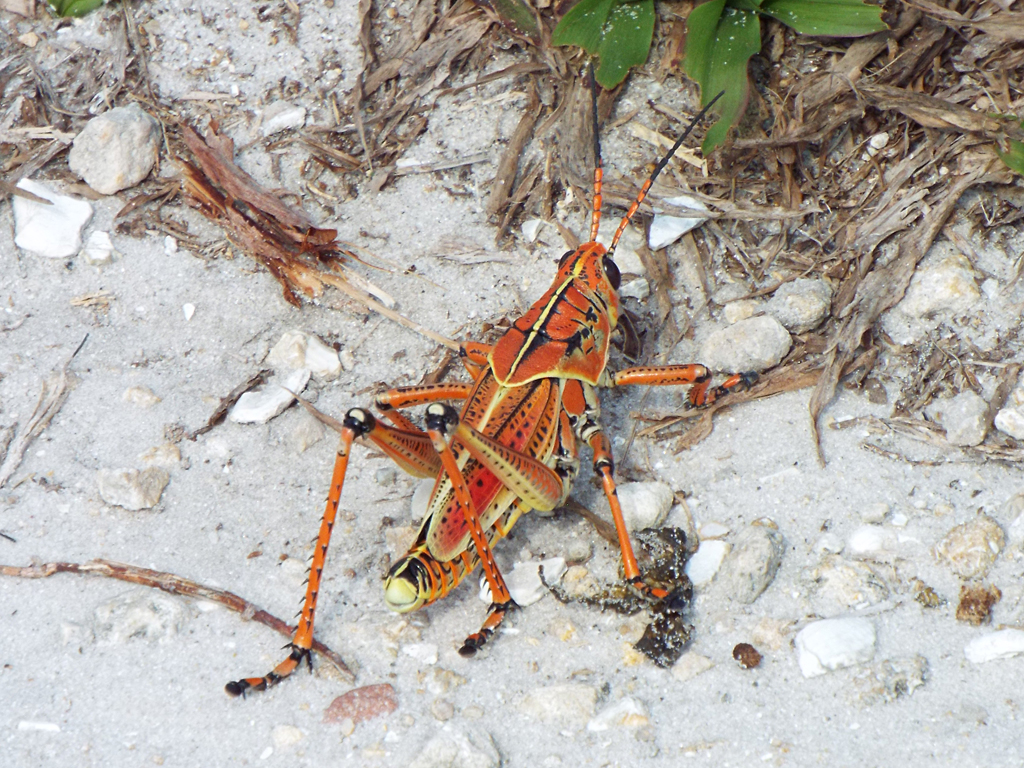
Along most of the Marsh Trail there were hundreds of large grasshoppers. There were at least three distinct looking varieties (shown below). They covered the trail and were sometimes slow to get out of the way. I spent a lot of time looking ahead on the ground to try and step around or over them. I did not see many birds eating them, though, so I wonder how palatable they are. The larger individuals of each type were easily about 5 cm (2 inches) long.
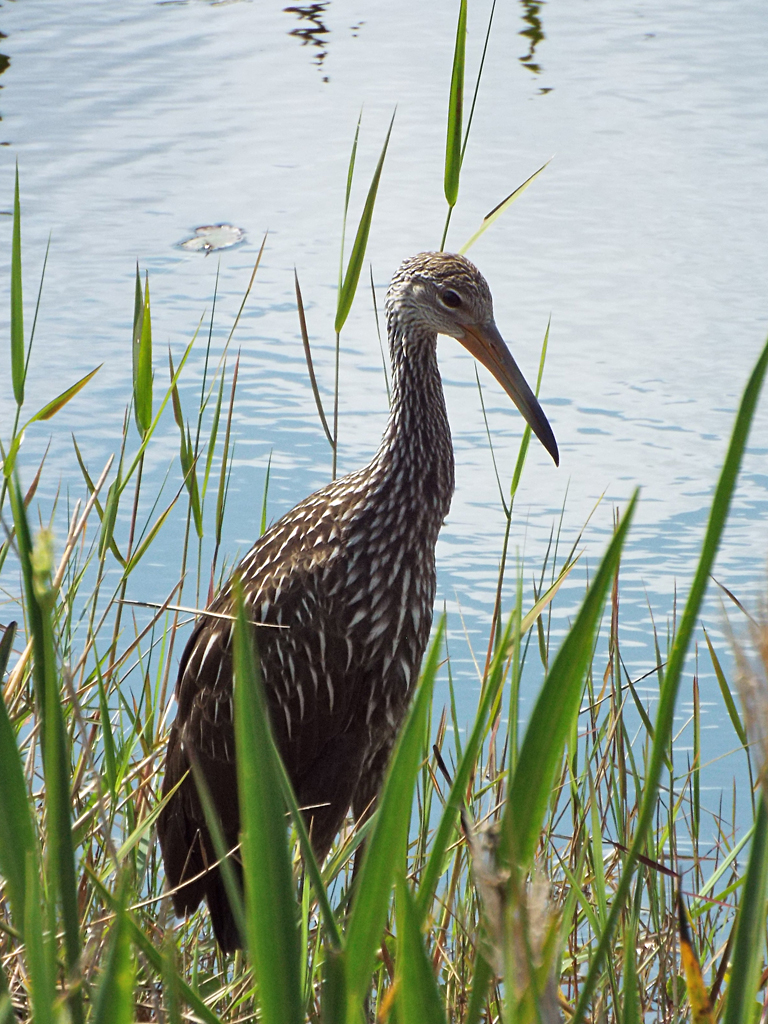
There were Limpkins there, too, eating Apple Snails. Snail Kites have been regularly reported, but we didn’t see any. In fact, to this point in the day, we’d only seen one other raptor (besides the Swallow-tailed Kite over the Loxahatchee NWR visitors’ center).
A Limpkin, seemingly lost in thought.
Even after consulting some notes on where to find the Smooth-billed Anis that are regularly reported there, we came up empty.
There are two smaller parks not far from Loxahatchee, Wakodahatchee Wetlands (a converted water treatment area) and Green Cay Wetlands. Both are run by Palm Beach County.
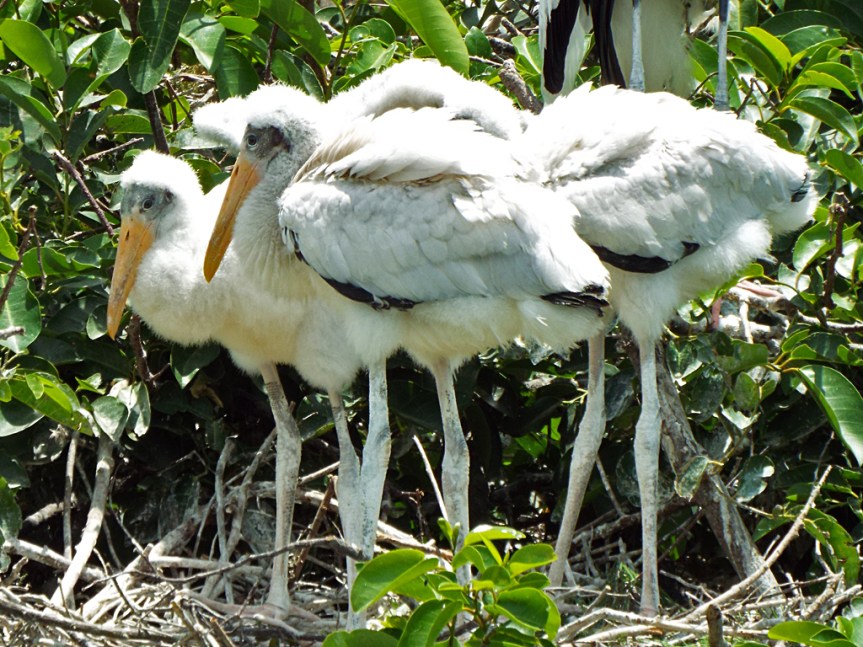
Wakodahatchee [map] has several rookeries on it, very close to the boardwalk. Here, there were dozens of Wood Storks, including nests with several chicks each, as well as Double Crested Cormorants, Great Egrets, Cattle Egrets, and Anhingas – all nesting and rearing young.
A Wood Stork, scaring up prey, at Green Cay Wetlands.
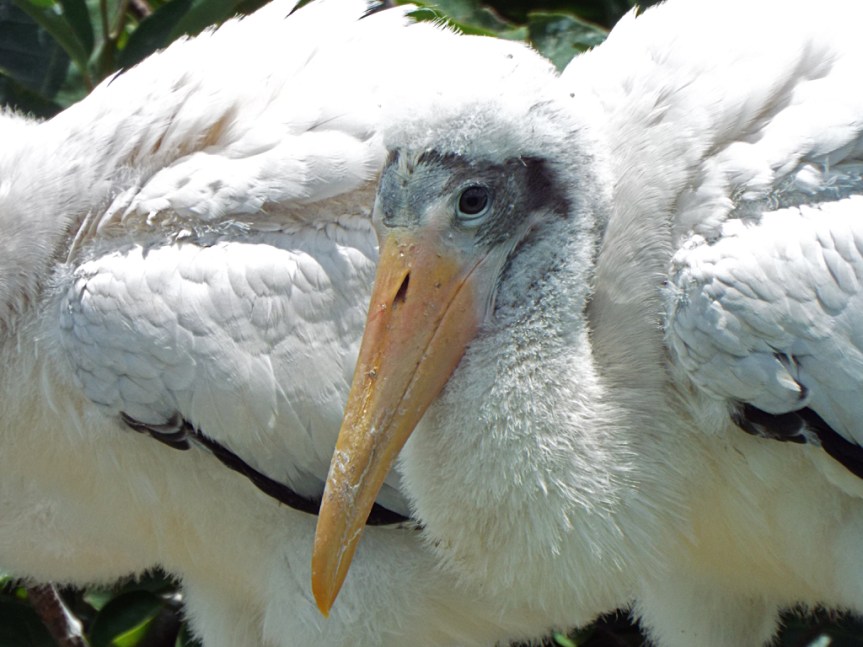
I’ve never seen Wood Stork Chicks before, so it was exciting to see some youngsters so close and accessible. Whenever the chicks in one nest would start to call out (presumably for food), chicks in the other nests would start begging, too.
Three Wood Stork siblings.
This chick, and its siblings, are already starting to lose some head feathers.
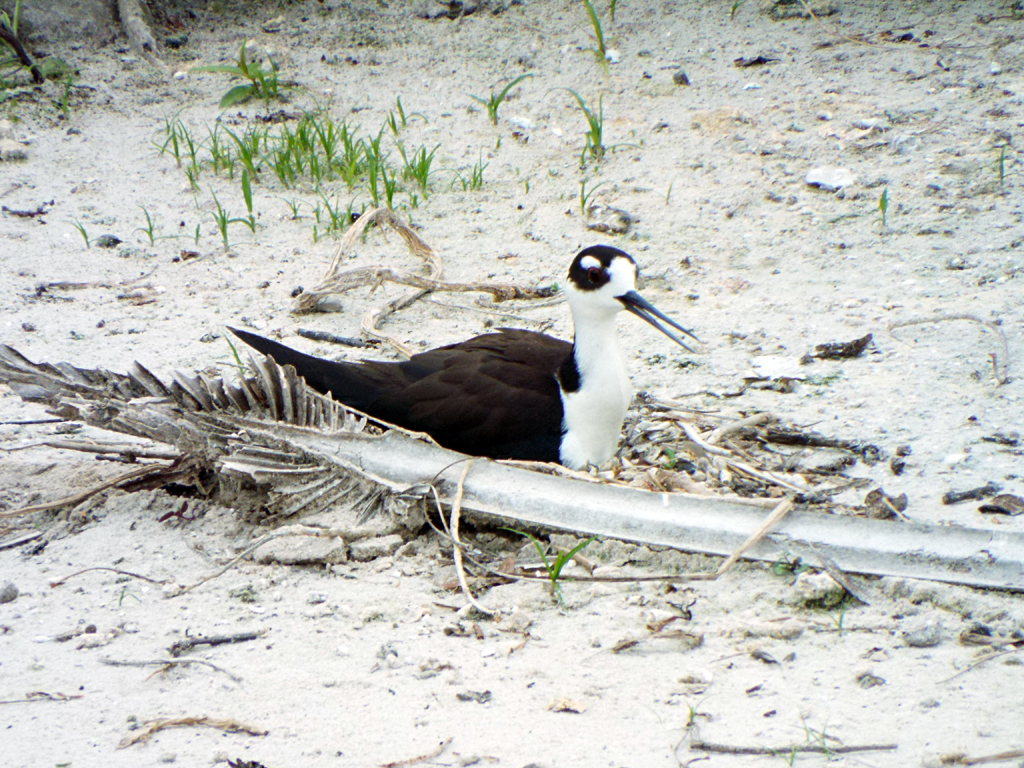
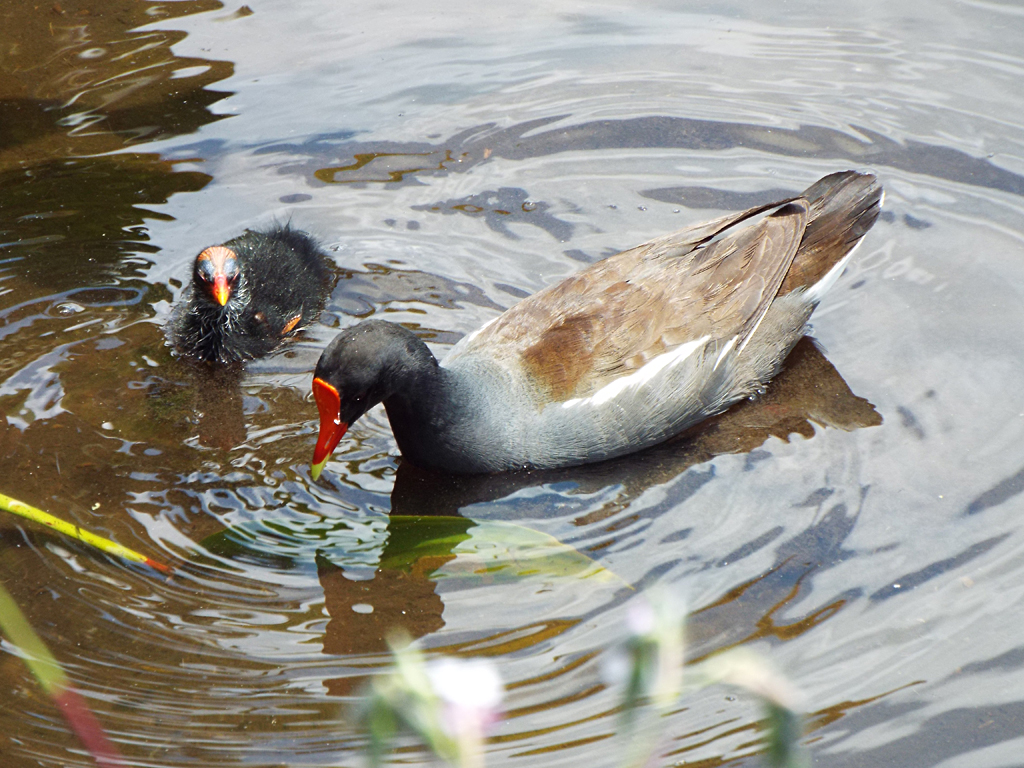
There were also many fledgling Tricolored Herons as well as nesting and incubating Black-necked Stilts, as well as several Common Gallinule pairs with tiny chicks.
Black-necked Stilt sitting on eggs.
Common Gallinule parent with one of its chicks.
Warblers were scarce, and had been all day, so it as a pleasant surprise to see a Northern Waterthrush timidly hop out among some grackles and gallinules.
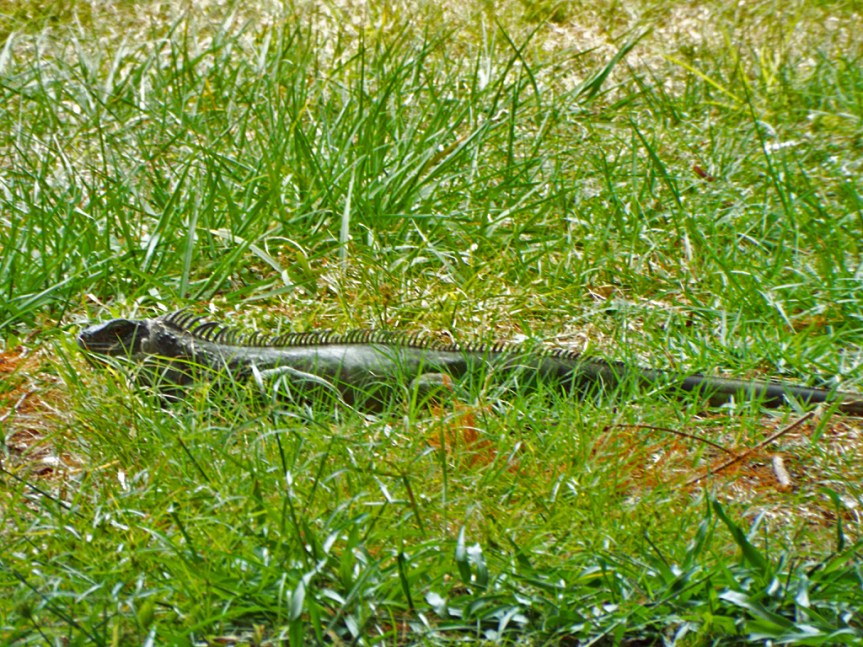
The park is also known for a population of feral iguanas. I only saw a few, including this larger one. It was a hot day, and they seemed to be resting in the in the shaded areas.
This iguana had just walked out from some shady trees toward the water.
Just down the road from Wakodahatchee is Green Cay Wetlands [map], which has a more extensive boardwalk and a nature center (which was closed soon after we arrived).
Nature Center at Green Cay Wetlands.
Many of the same species seen at Wakodatchee were present, but none of them were nesting. There were also several White-winged Doves, and one unhappy Red-shouldered Hawk (only our third raptor of the day) getting dive-bombed by families of Purple Martins and harassed by Red-winged Blackbirds.
I got some decent looks at Grey-headed Swamphens (I only got a few glimpses at Wakodatchee in the thick rushes). Grey-headed Swamphens are relatively new arrivals in Florida, competing with Purple Gallinules for food and nesting territories.
As their populations rise and move northward, there is concern that the larger and more robust Grey-headed Swamphens may outcompete the native gallinules.
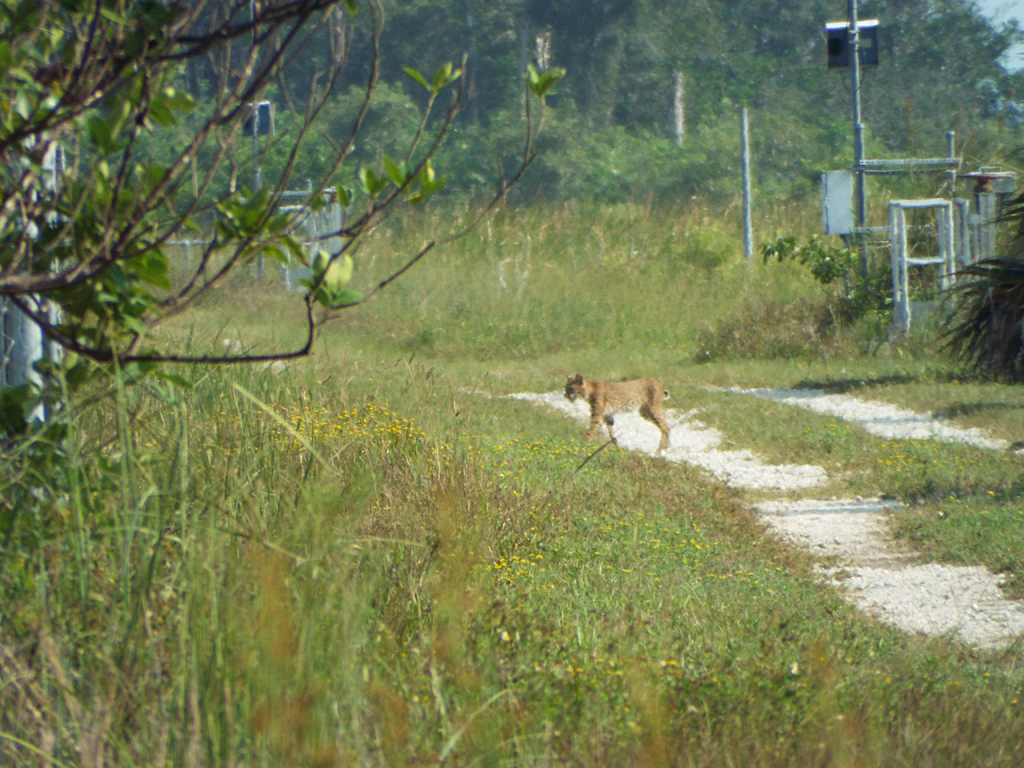
We decided to give the Smooth-billed Anis one last try at Loxahatchee, late in the afternoon. We cut across the Marsh Trail area up to the levee road. As we got to the western sluice gates a bobcat came out of the brush onto the path, quite a distance away. I watched it in my binoculars and I could see the instant it either saw us or caught our scent, because it jerked its head up and immediately changed direction onto another path and then off into a slough area. About half a dozen egrets and ibises immediately flew up, and a Little Blue Heron seemed to dive-bomb the bobcat (which was out of view) a couple of times before clearing off. That’s the last we saw of the bobcat. You can see from the photo below that it was fairly large.
A bobcat out for a late-afternoon stroll.
We worked our way up to the levee road (Lee Way) again and had a look around before crossing back to the parking area. I have to admit it was a little disappointing to miss seeing a Smooth-billed Ani, but it wasn’t for lack of trying.
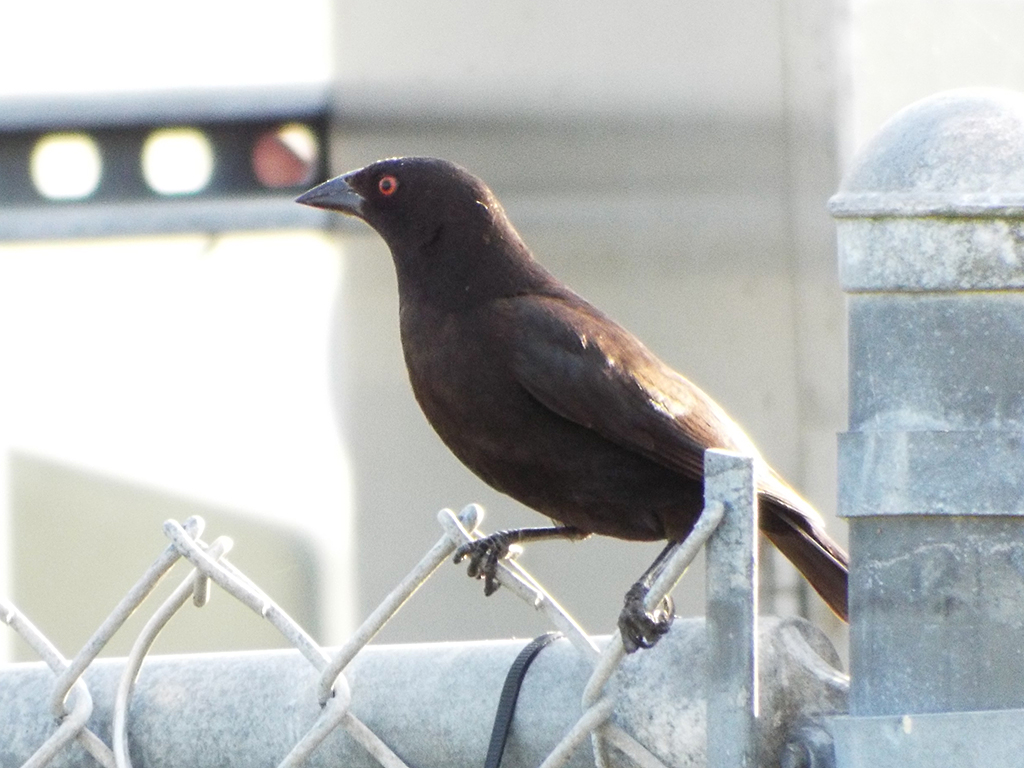
The last stop was at the Peaceful Waters Sanctuary [map] where a Bronzed Cowbird has been reported since earlier this Spring. The sanctuary is a beautiful, created wetland park with a boardwalk and some nature trails, tucked into a city park. The cowbird, however, had been seen working a chain-link fence around a retention pond adjacent to the sanctuary. Sure enough, that’s where we found it.
Bronzed Cowbird. Note the red-orange eye and relatively large bill.
In the sanctuary there were numerous Boat-tailed Grackles, some Red-winged Blackbirds, and several large rafts of Mottled Ducks with ducklings of varying ages. There was even a pair of Wood Ducks with a couple of ducklings of their own.
I’ve read that the winter-time birding here is even better, and some nearby parks, including the Wellington Environmental Preserve and the Royal Pine Beach Pines Natural Area, are good spots to check out when the weather is cooler.
That concluded our Global Big Day around Palm Beach County. The big numbers might not be there, but over 60 species for southern Florida after peak migration season isn’t terrible. Besides, I got to see 2 lifers and explore a part of the state I’d only driven through until that day.
April is peak Spring migration in Florida, and Ft. De Soto is usually the center of the action. On Friday, some weather came through behind strong southerly winds, and on Saturday there were reports of many migrants in the park. Camille and I couldn’t get there until Sunday, but the birding activity was still high.
The five islands (keys) that comprise the park jut across the entrance of Tampa Bay, south of St. Petersburg [map]. Its location along the Gulf migration route (and not terribly far from the Atlantic coastal route, depending on prevailing winds and weather), make it a migrant trap. Its relatively undeveloped beaches and sandbars are a haven for shorebirds and gulls and terns (at least where public access is limited).
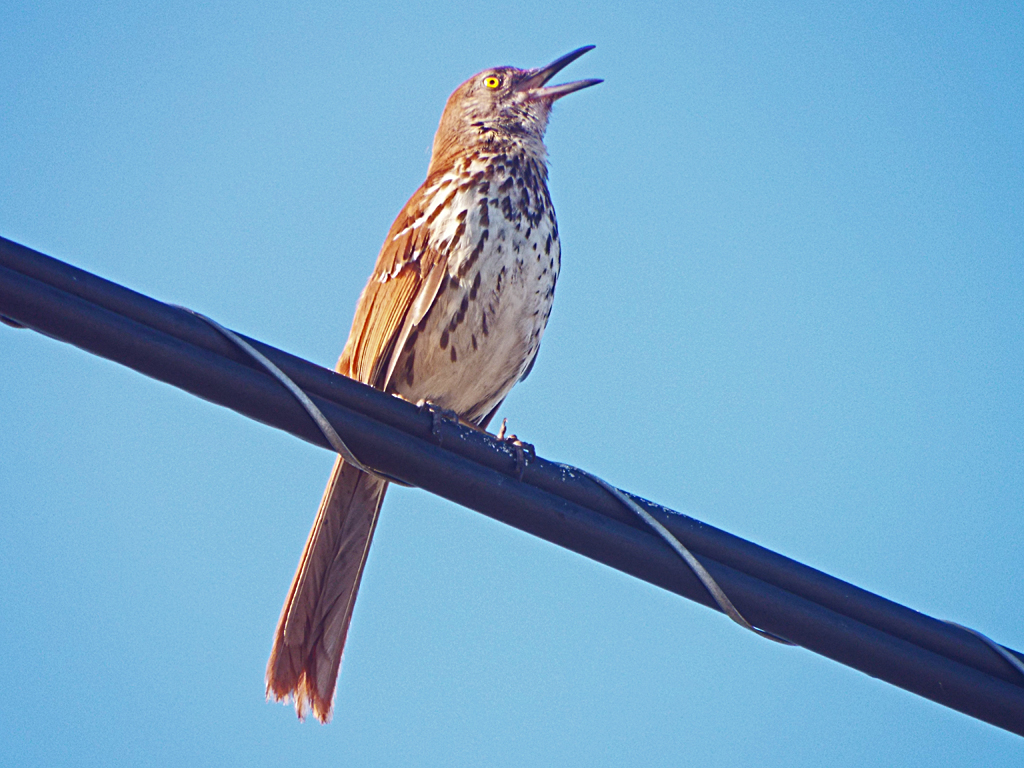
A Brown Thrasher greeted us in the parking lot.
It was nice to see a Brown Thrasher (above) out singing. This normally more reclusive relative of the mockingbird also mimics other birds, though a little less forcefully.
Of course, the main draws to Ft. De Soto this time of year are migrants, including warblers, orioles and finches (among others).
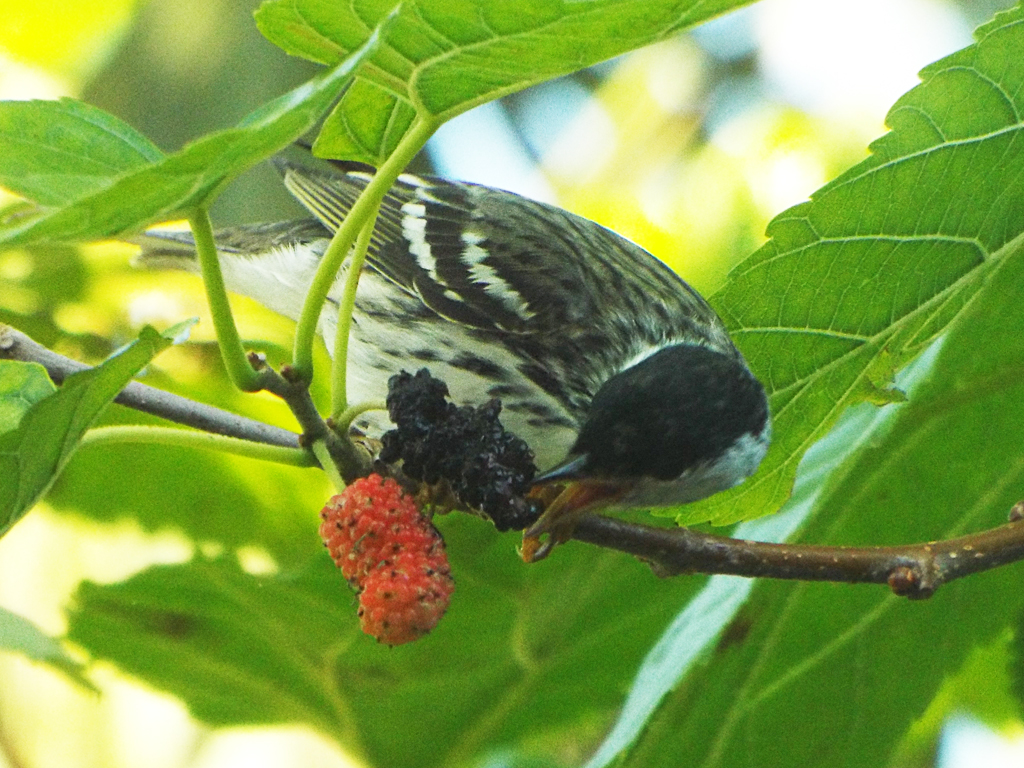
A male Blackpoll Warbler eating mulberries.
We had a nice number of warblers through the day, including resident birds like Black-and-White Warblers and Northern Parulas. Migrants included Blackpoll, Yellow, Magnolia, and Hooded warblers.
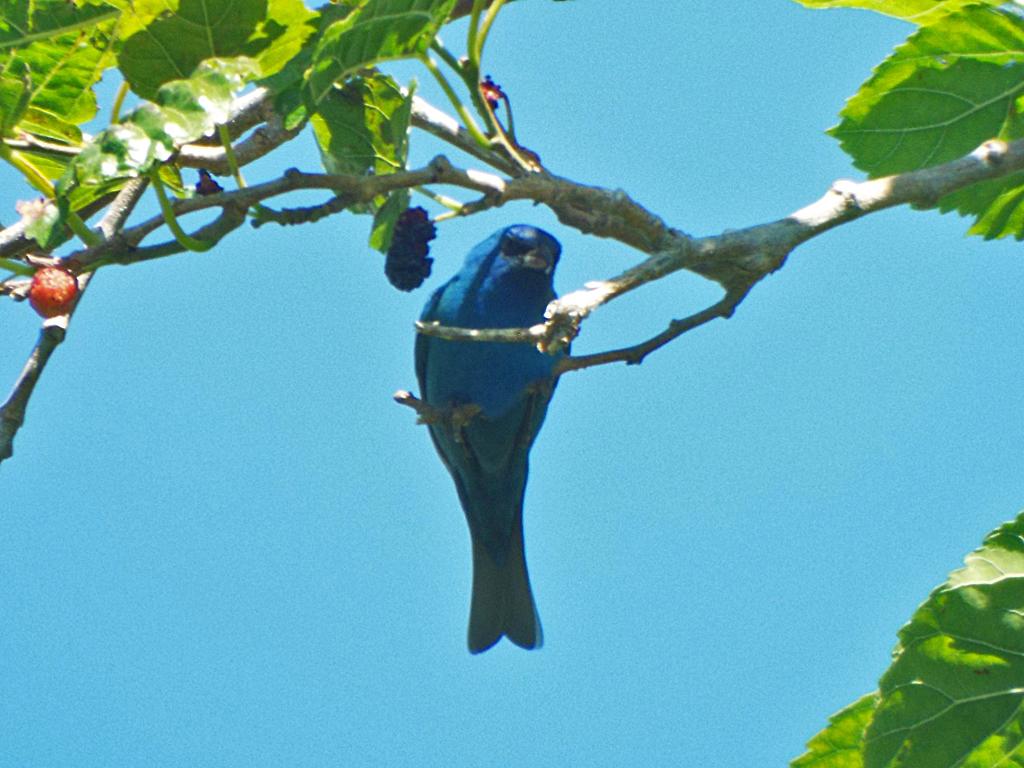
Most of the activity centered around the Mulberry Trees by the rangers’ residence, with birds flying in and out of the trees, occasionally singing. The Indigo Buntings had a long feeding session before some Fish Crows broke up the party.
An Indigo Bunting.
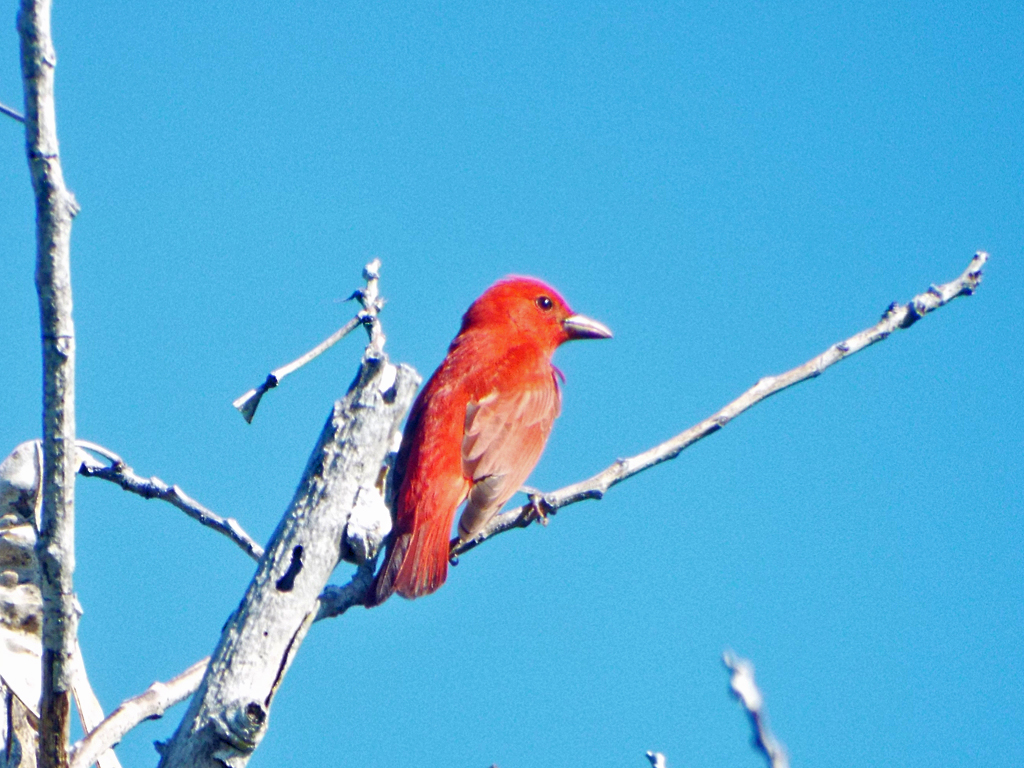
Some male Summer tanagers obliged us by perching out in the open. Having not seen this bird for so long, I was happy to see them just a few weeks apart.














 Lonely Birder