Quiet Times at Turkey Creek Sanctuary

I decided to go to Turkey Creek Sanctuary this weekend, as it had been a while since I last checked in. The area had some weather move through that made me hopeful some early migrants had made a pit stop overnight.

Hope springs eternal, as the saying goes. It turned out to be another eerily quiet morning for the majority of the sanctuary. There were pockets of Northern Cardinals and the winter residents are still hanging on, though their numbers are much lower. Any activity was in widely spaced pockets, with only a few individual birds.

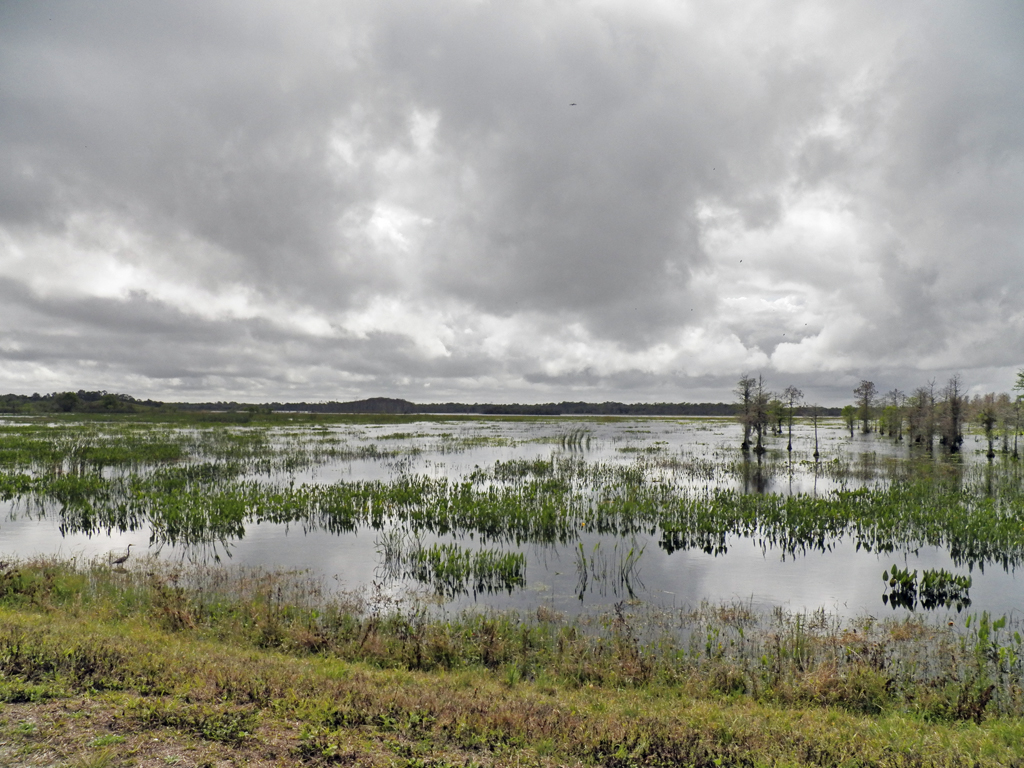
turkey-creek
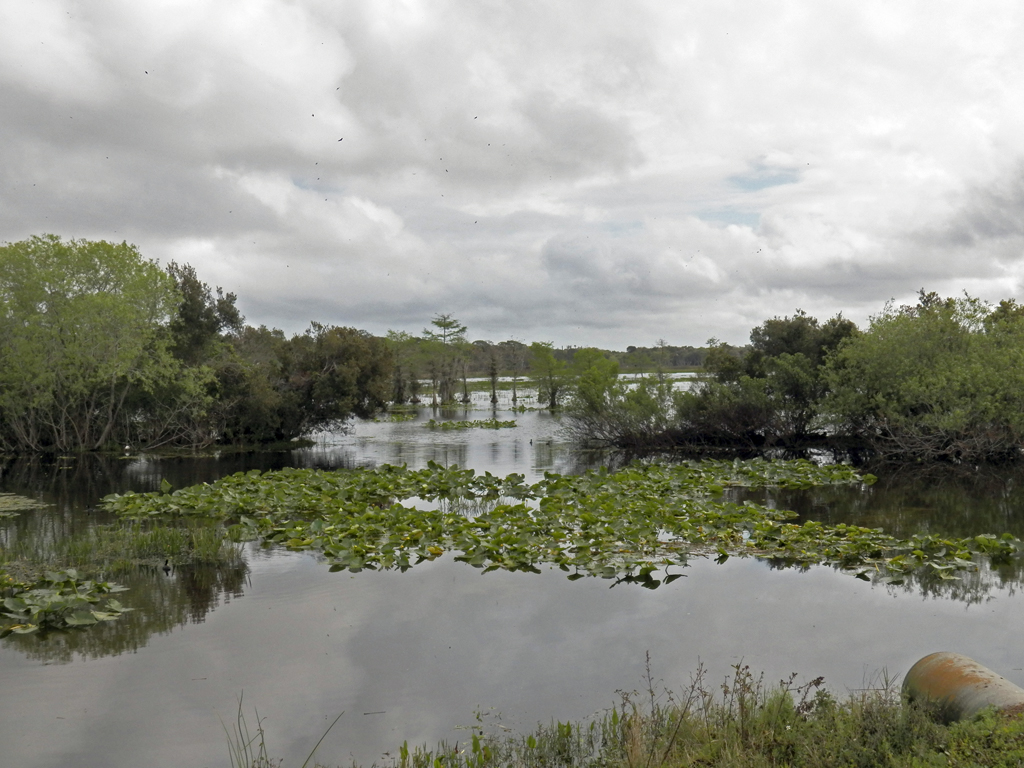
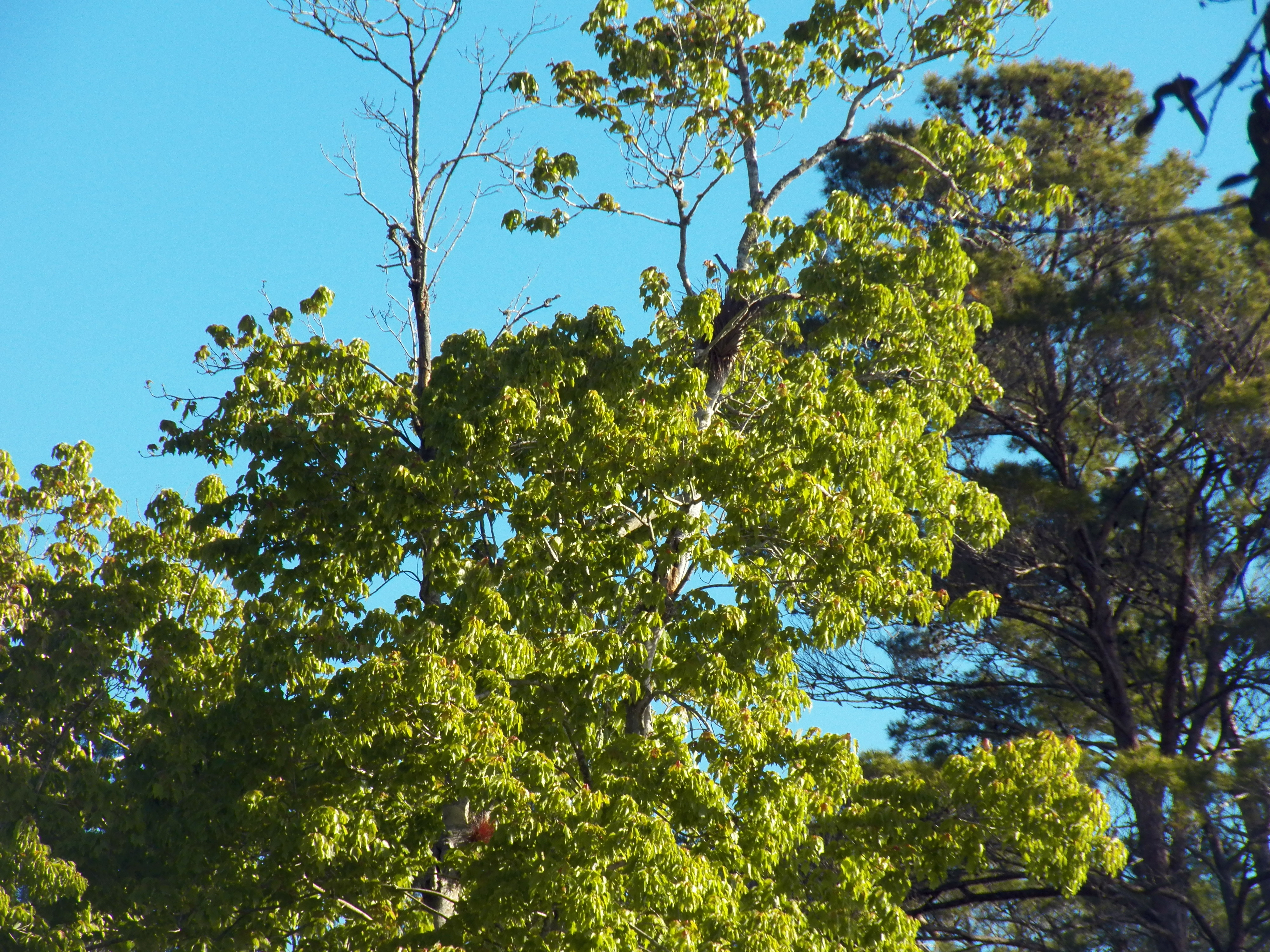
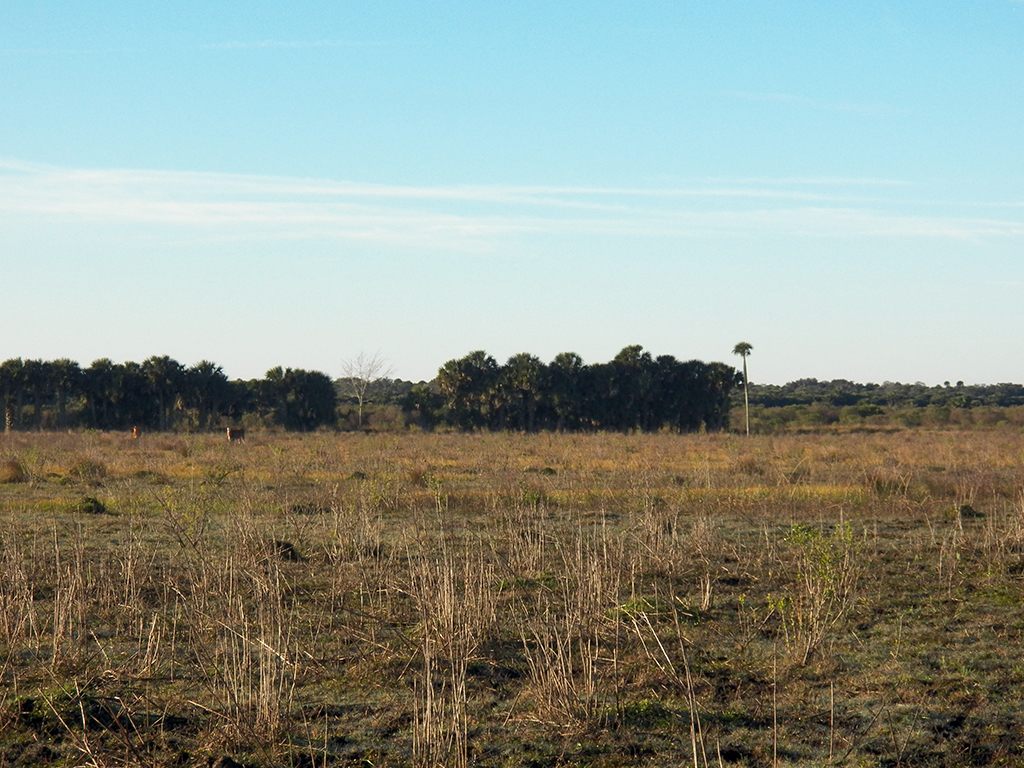
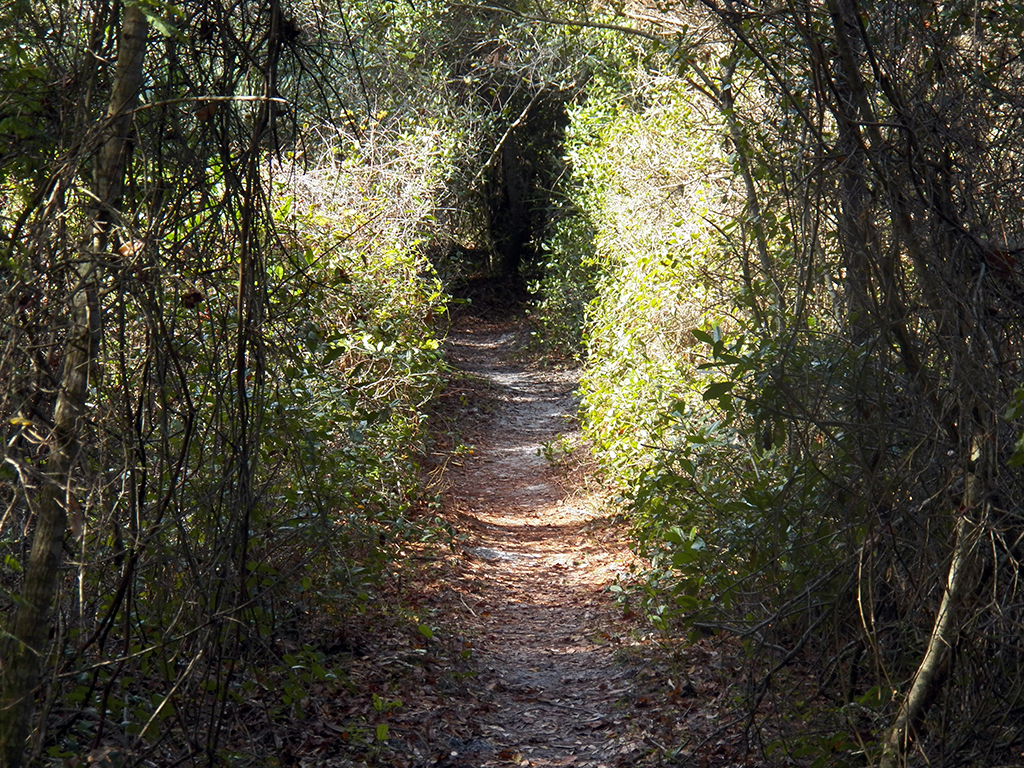
Some typical Turkey Creek Sanctuary habitat.

Besides the cardinals, I encountered a couple of Gray Catbirds in the Saw Palmetto along the boardwalk loop and I could hear Northern Parulas up in the canopy. I also came upon small bands of Prairie Warblers both on the boardwalk loop and later, along the Sand Pine Trail.

I heard Yellow Warblers and Blue-headed Vireos together as I approached the canoe deck. It’s been a mild source of frustration for me that for a few years in a row, in the same general location, I can hear Yellow Warblers high in the canopy but have been unable to get any decent binocular views, to say nothing of photographs. Some patient watching did get me some good looks at the vireos singing and hopping below the canopy, though.

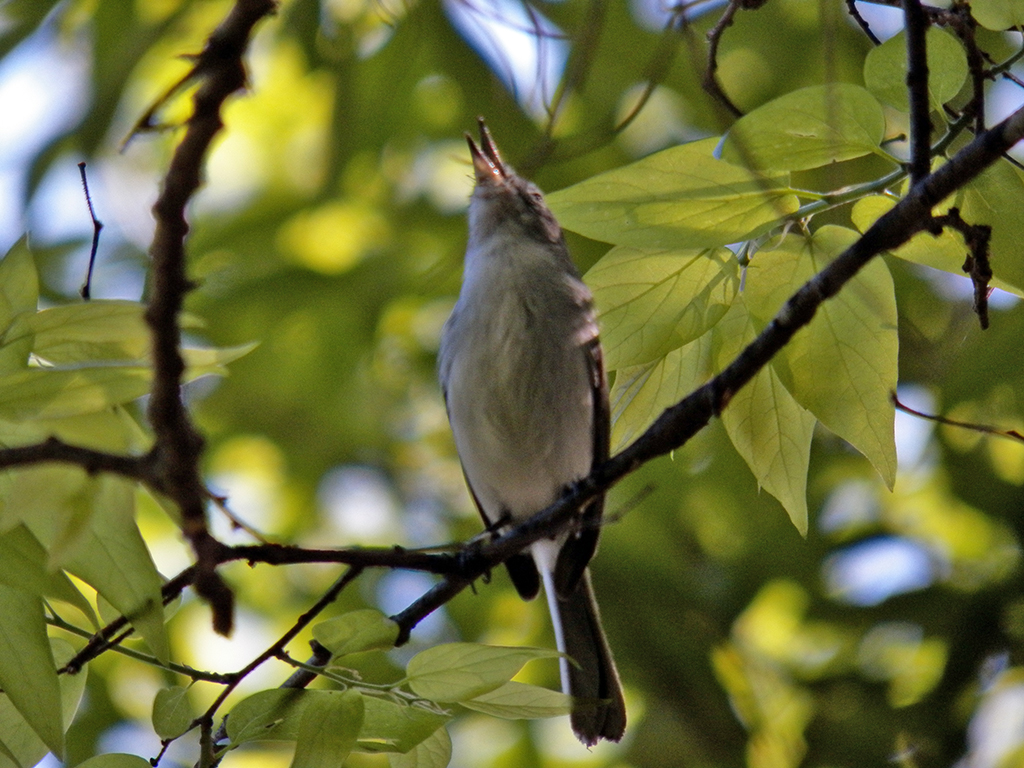
blue-headed-vireo
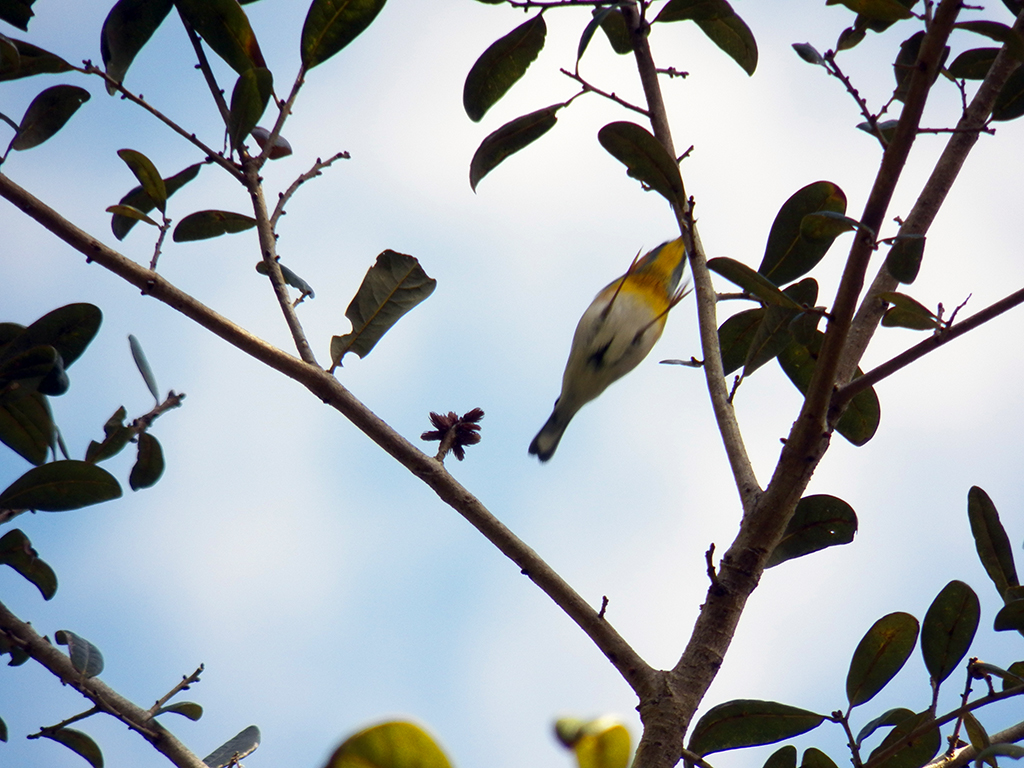
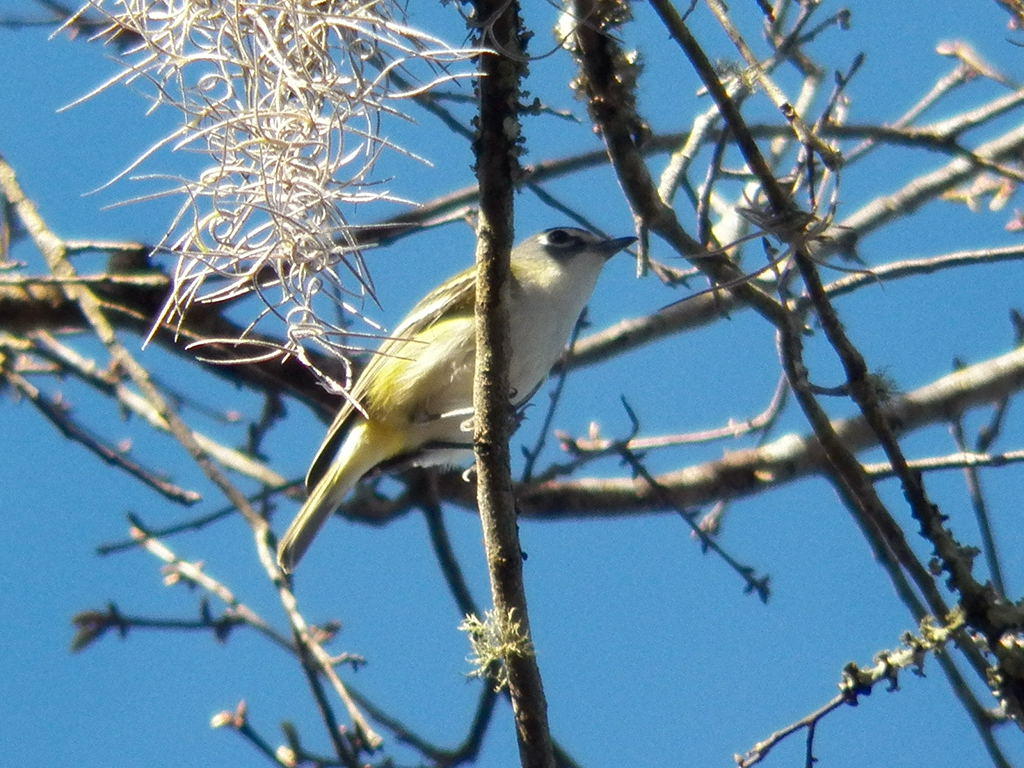
The Blue-headed Vireo’s song is a bright, “Cheerio! See you later!” (at least that’s how I hear it). True enough, this is the last view I had of it before it moved out of view.

I saw almost no birds at all along the creek overlook boardwalk (though there were quite a few Northern Parulas singing). I spooked an Osprey down by the boardwalk on the Flood Plain Trail, but otherwise there were no birds present there either. I met up with an out-of-state couple who were visiting the sanctuary for the day. They asked me if I had seen “anything good,” and I had to admit it was seriously quiet. They had heard that the sanctuary was a decent place for spring migrants. I explained that it was probably still a bit early for most of the migrants, but that also the sanctuary has been very quiet for a couple of years now, even during migration seasons. But, as I told them, you never know what you might see on any given day.

I had two surprises on the Sand Pine Trail which would later come to cause me some small embarrassment. First, somewhere near the mid-point of the trail I heard some distinct whistling notes close by. I knew the birds had to be very near, but I was not detecting any movement. I noted, in the back of my mind, that further up the trail I could hear something that sounded somewhat vireo-like as well, but I was trying to focus on the birds at hand (or at ear, I guess). Finally, after trouncing back and forth on the trail trying to get a good vantage point I saw movement and got a look at a brown warbler skulking in the mid-story, and then another nearby. Based on the facial pattern and overall shape (and later confirmed when I played the bird’s song) I identified the bird as my first of year (FOY) Swainson’s Warbler. How exciting! A spring migrant after all!  I took a few photographs that I thought would be pretty decent and clear enough to convince the (at times) über-skeptical e-mail lists that I had indeed seen Swainson’s Warblers. This would come back to haunt me.

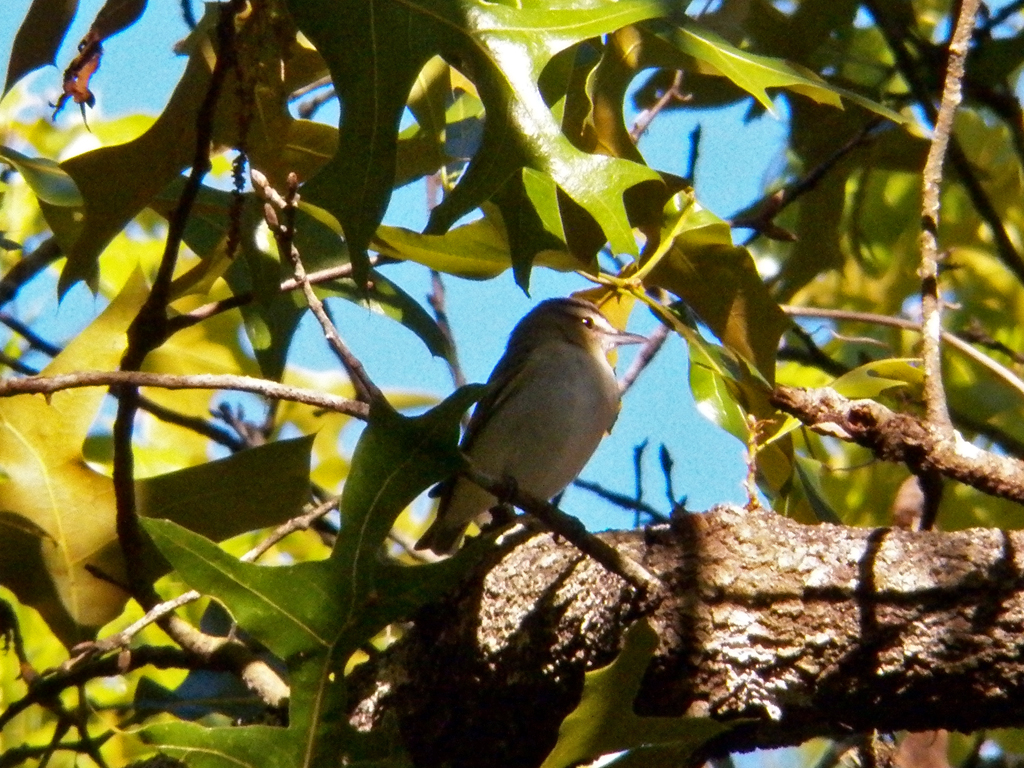
I walked further up the trail, and again heard the vireo song, but much closer. About 10 or 12 feet up in some of the smaller trees I saw two Red-eyed Vireos. One of them let me get some great binocular views before moving off a bit. The light and shadow through the trees made the photographs a bit tough, but I got some good shots, including this one.
red-eyed-vireo
Red-eyed Vireo

At this point I did not realize that my Swainson’s Warbler photographs did not properly write to my camera’s memory card. Later that afternoon I went to post to BRDBRAIN and FLORIDABIRDS-L that I had seen FOY/FOS Swainson’s Warblers, and only quickly looked at what photographs I had pulled form the card, I attached this vireo photograph! As you can imagine, I received some properly amused replies that I had actually seen a Red-eyed Vireo, not a Swainson’s Warbler. You can imagine my dismay as I checked and sure enough, in my excitement I had posted the wrong photo. I had not realized I had no Swainson’s Warbler pictures! I quickly posted another message to the e-mail lists explaining my error, but I am sure it’s already added to the body of lore I’ve managed to accumulate there (to examples: I once jumped the gun that a winter American Goldfinch was a Snow Bunting, and my hearing two Carolina Chickadees at Erna Nixon Park was roundly scoffed at by a couple of list members).

This isn’t the first time my camera (or the memory card) has failed me like this. Since my trip to Minnesota the camera hasn’t been right. Whether or not it was due to the cold, or just a coincidence, I seem to lose some pictures and the controls react more sluggishly than they used to.

I heard more Prairie Warblers on the Sand Pine Trail, but had my best photo opportunity interrupted by a loud, if well meaning family. I couldn’t stay too angry about it, since the kids were genuinely interested in nature and the wildlife they might see. They weren’t being obnoxious, and the parents were encouraging this in them. I also reminded myself that the bird photographs are icing on the cake. It’s great just to be out and see these magnificent creatures.

As a last minute decision, I went down to McKinnon’s Way and then over to the weir and canal, but there wasn’t much happening there either.

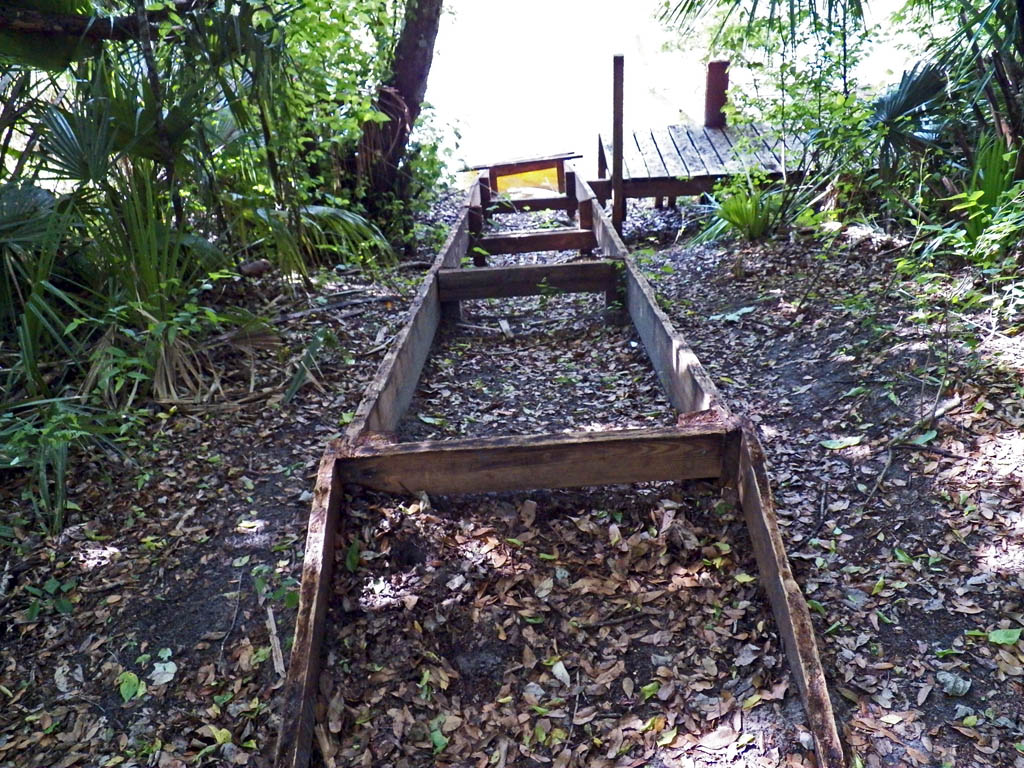
The boat ramp has yellow caution tape at the entrance to the path leading to it. I peered around it and saw that the decking had been removed. I don’t know if this was from the minor flooding a few months back or from the planks being removed for repair (the wood seemed to be a bit rotted from what I could tell). The creek level is down to normal now, and the lower and newer parts of the ramp’s deck seem fine, if a little more crooked.
ramp
Remnants of the “emergency” boat ramp.

At the canal and weir there was one Little Blue Heron and one Cattle Egret. The canal level was surprisingly low. We’ve had a relatively wet winter and early spring, but the past few weeks have seen some above normal temperatures with little rain. This must have been enough to drop the water level down quite a bit. Even the heavy showers from previous days must not have made much of an impression. Only one discharge was open on the weir, and there were turtles stacked up at the edge of the others, taking advantage of some prime basking real estate.
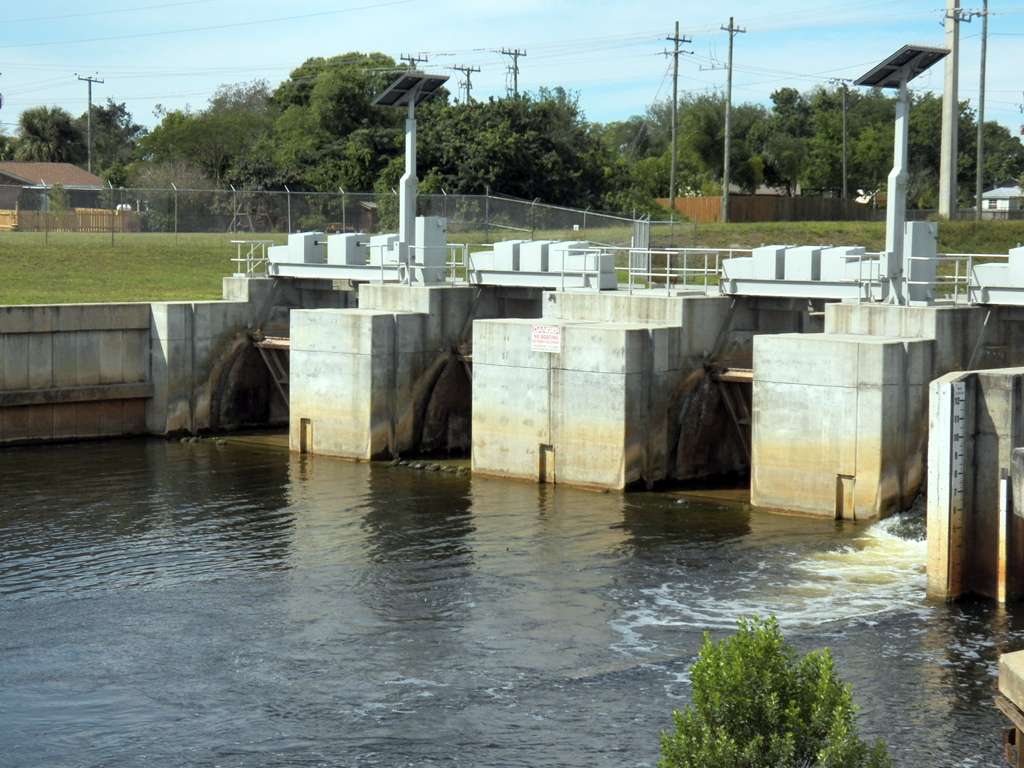
creek-side-weir
Turtles bask along the discharge openings of the weir at the Melboune-Tillman Canal and Turkey Creek.

The low discharge can be explained better by looking at the next two photographs, showing how low the canal level is.

I stirred up some more cardinals on my way back toward the sanctuary entrance, but saw little else in the way of bird life. I saw one Black Racer (a snake species), which quickly slid away from me before I could even get my camera up to take its picture, and of course the lizards are ever prevalent.

Here’s the total species list. Except for the Prairie Warblers, most of these were single or pairs of birds, widely spaced apart throughout the sanctuary.

  • Common Grackle
  • Mourning Dove
  • Eurasian Collared Dove
  • Osprey
  • Northern Mockingbird
  • European Starling
  • Carolina Wren
  • Northern Parula (♫)
  • Northern Cardinal
  • Gray Catbird
  • Red-bellied Woodpecker
  • Fish Crow
  • Prairie Warbler
  • Great Blue Heron
  • Blue-gray Gnatcatcher (♫)
  • Purple Martin
  • White-eyed Vireo
  • Red-eyed Vireo
  • Swainson’s Warbler
  • Blue Jay
  • Yellow Warbler (♫)
  • Blue-headed Vireo
  • Little Blue Heron
  • Cattle Egret

The lack of bird life here and in many other parks is perplexing. Certainly the amount of insect and reptile life seems to be about the same, and the plants (apart from some more invasive species than a few years ago) seem healthy. There are still very large gar in the creek, and the manatees come upstream as they always have. But something is affecting the birds’ ability or willingness to stop and stay at many of the areas they used to frequent. Last year Shirley Hills told me that it was the quietest year to her recollection, and she had been birding Turkey Creek for decades. I really hope things pick up in April, as the main body of spring migrants make their way through. The birds have either found better places to stop or are vastly reduced in numbers. How much of that would be part of normal population fluctuations and how much from something we ought to be alarmed about isn’t something I am able to know as yet.
Joe Overstreet Road and Landing

This weekend’s adventure was to Joe Overstreet Road and Landing. I haven’t been to the area since three winters ago during the Central Florida Specialties field trip. Some Whooping Cranes are somewhat regularly seen from the road on the Double C Bar Ranch on Canoe Creek Road, just before Joe Overstreet Road. I did not see any Whoopers on this trip, though.

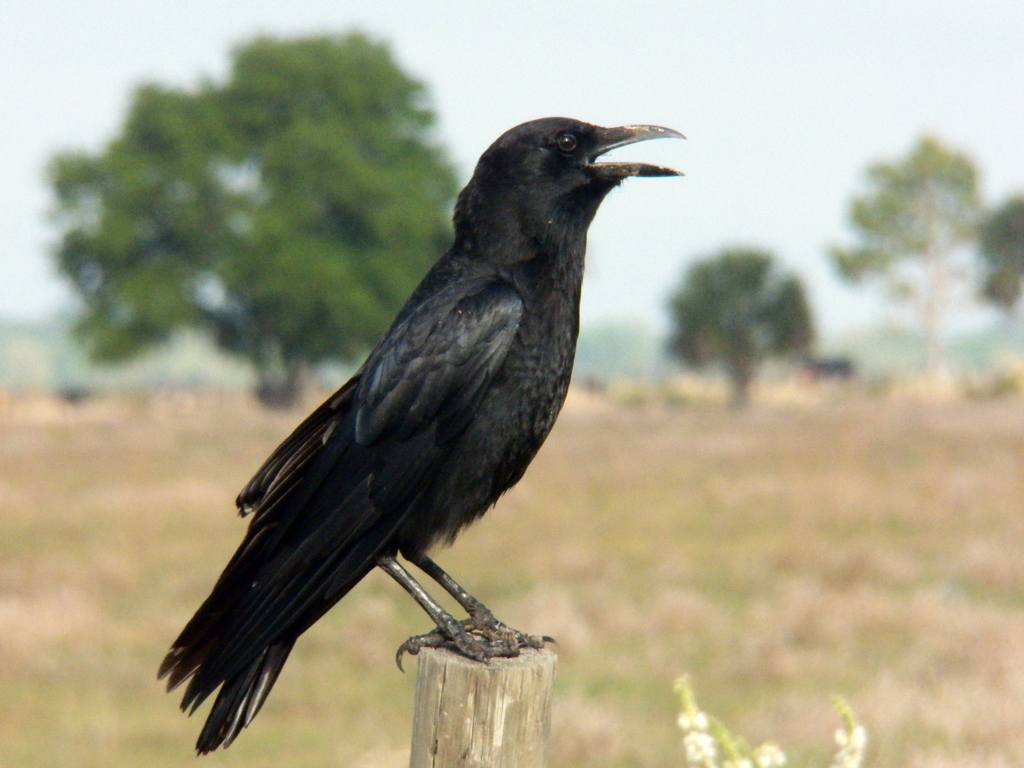
From Canoe Creek Road and for most of Joe Overstreet Road the landscape is dominated by upland fields and scattered trees. As one gets closer to Joe Overstreet Landing at Lake Kissimmee of course the landscape changes to marshes and open water, with some wet meadows (much of the land along the road is a cattle ranch). The transition from upland to wetland/lake was best illustrated by the change of crows, with American Crows along most of the road and Fish Crows closer to the lake. Not only were the voices a clear indication of species change, but the American Crows I saw seemed perceptually larger and more robust than the Fish Crows. Usually I have a much harder time telling the difference by sight, as the two species have a significant overlap in their sizes. For whatever reason the American Crows in this part of the state are quite large.

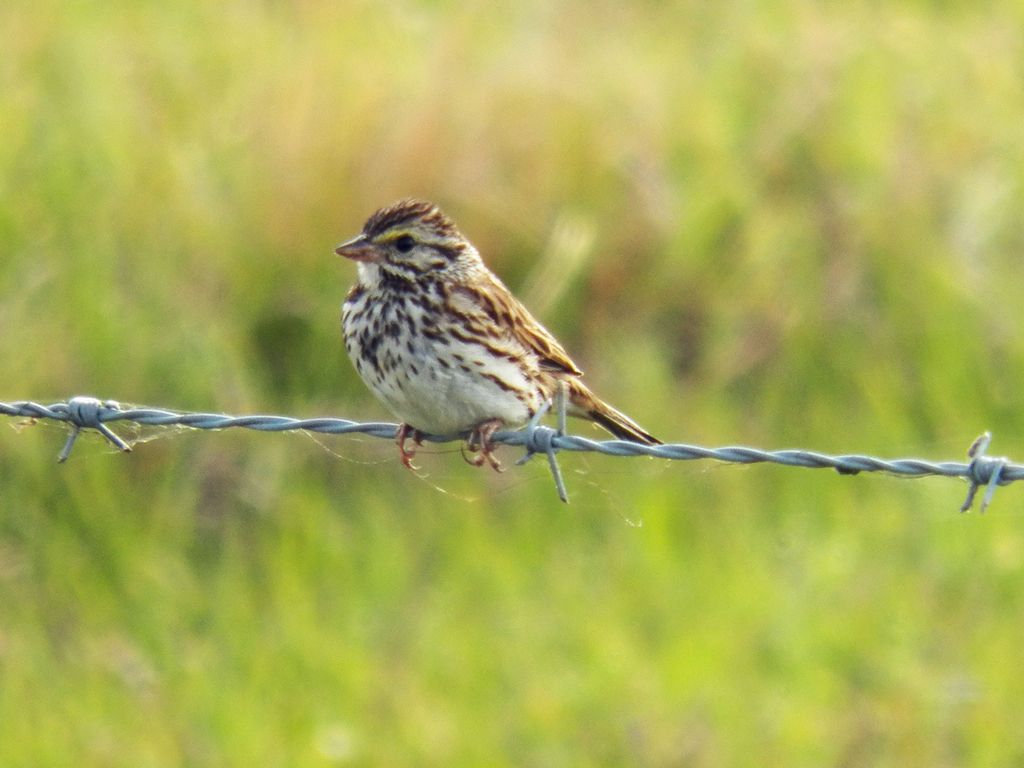
There were small bands of Savannah Sparrows along the barbed-wire fences. For the most part they seemed content to watch me, only fleeing if I stepped a little too close, but never really flying too far.

savannah-sparrow
The Savannah Sparrow equivalent of sitting on the front porch. Someone fetch this bird some lemonade!

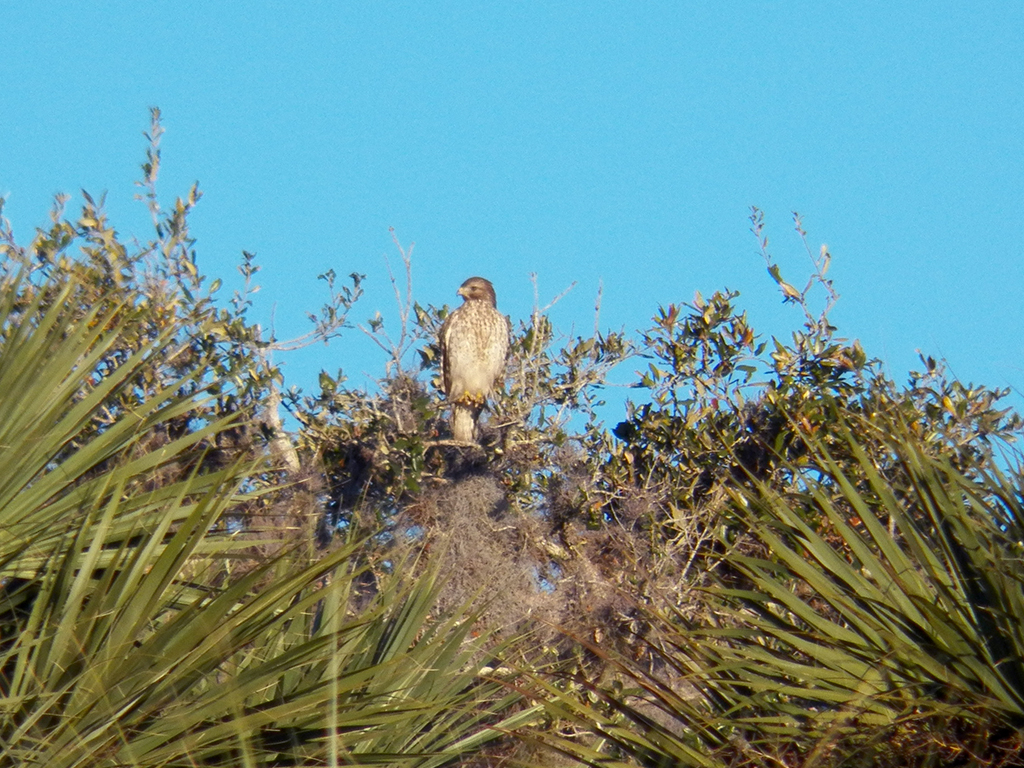
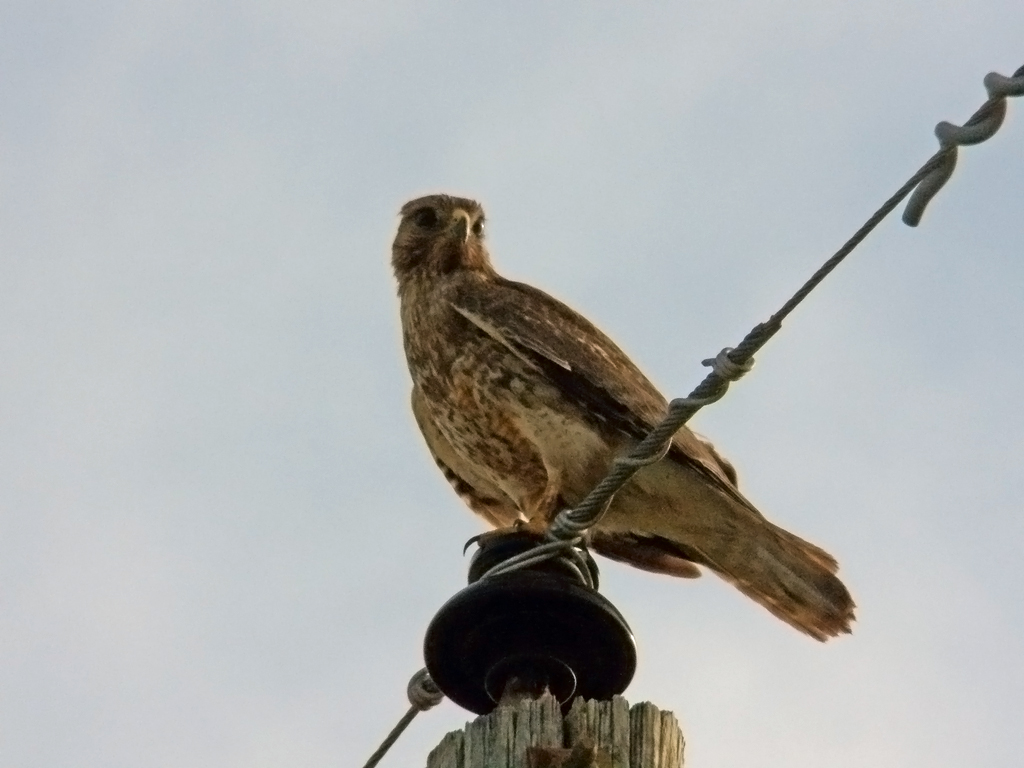
Even the birds of prey were relatively approachable. A juvenile Red-shouldered Hawk sat just outside my car’s window, paying me little mind. It didn’t fly off the post it was on until I got out of the car, and even then it just swooped up to the top of the nearest utility pole.

red-shouldered-hawk

The nearby power lines and widely spaced trees make good perches for the raptors to hunt from. I saw both “regular” and “Florida form” Red-shouldered Hawks, including some that flew into a copse of pine trees and harassed a Great Horned Owl (from the sounds of it). The American Kestrels hung around nearby too, making the sparrows a little nervous, but the heavy hitters in the intimidation department were the Bald Eagles. Any time their shadows fell nearby, the sparrows and meadowlarks would dive for cover.

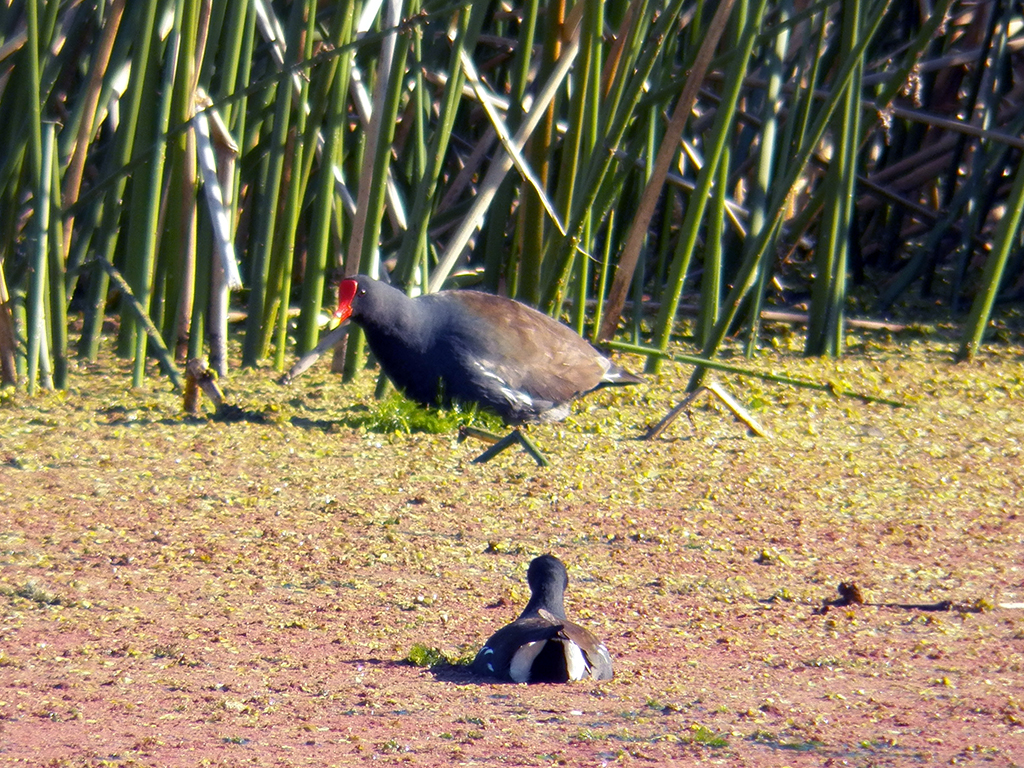
Down at the boat ramp by the lake there were American Coots, Common Gallinules, a Pied-billed Grebe and some Cattle Egrets. I scanned the lake and its more distant far shore for Snail Kites, but I did not see any. There were some gulls, terns, and a couple of Bald Eagles. I saw one Osprey and very few herons (I think I saw one Great Egret and a small group of Little Blue Herons). I could hear at least one Limpkin calling, but aside from some Boat-tailed Grackles and Red-winged Blackbirds, it was fairly quiet at the lake.

Crows are opportunistic scavengers and omnivorous, and are not above raiding the nests of songbirds (for eggs or young), and will eat lizards and small mammals if given the chance. They also will eat carrion. During nesting and fledging season, this does not endear them to smaller birds, and they will sometimes be chased or mobbed like hawks, eagles, or owls.

crow
This is what an American Crow looks like after being repeatedly dive-bombed and defecated on by 2 very angry Northern Mockingbirds. The small white specks are remnants of the altercation.

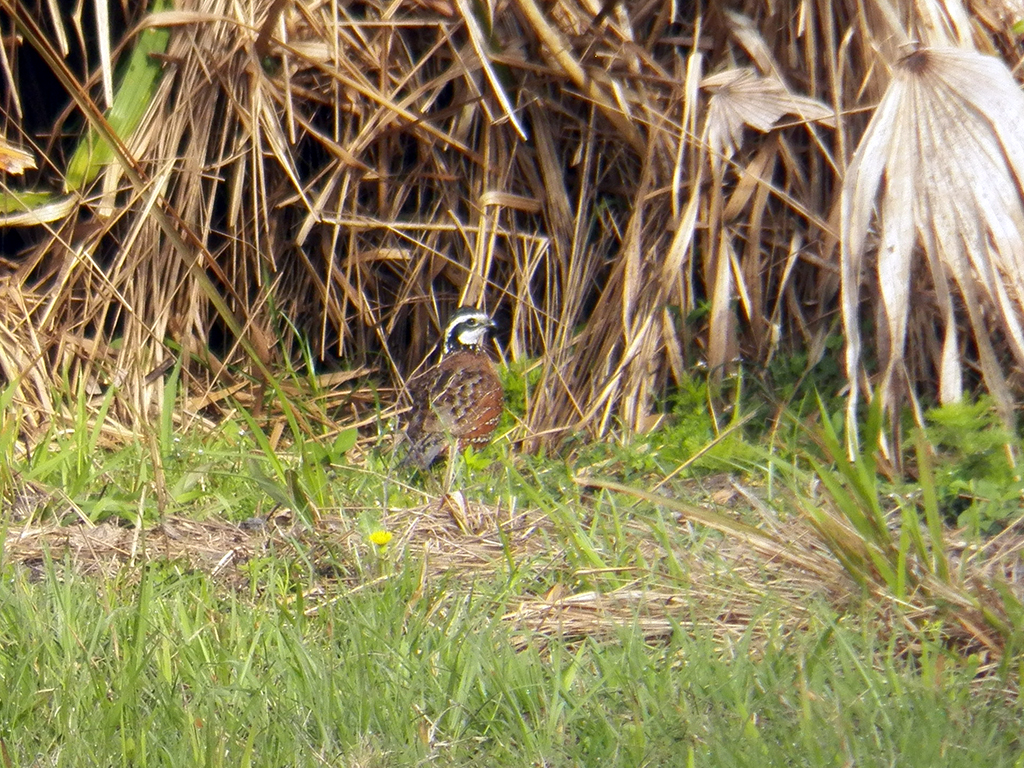
It was a final treat of the morning to see several Northern Bobwhites. I’ve heard them in various places in my adventures, but I haven’t had a solid visual identification. I saw one step out of some dead palm fronds for a moment, before a Red-shouldered Hawk caused it to take cover. I also managed to flush some females out, where they had been hiding in plain sight. They blended into the brown grasses and small shrubs so well that I didn’t know they were there until they quickly spang up in a burry flight to another concealed spot.

bobwhite
A Northern Bobwhite quail moments before dashing back under cover.

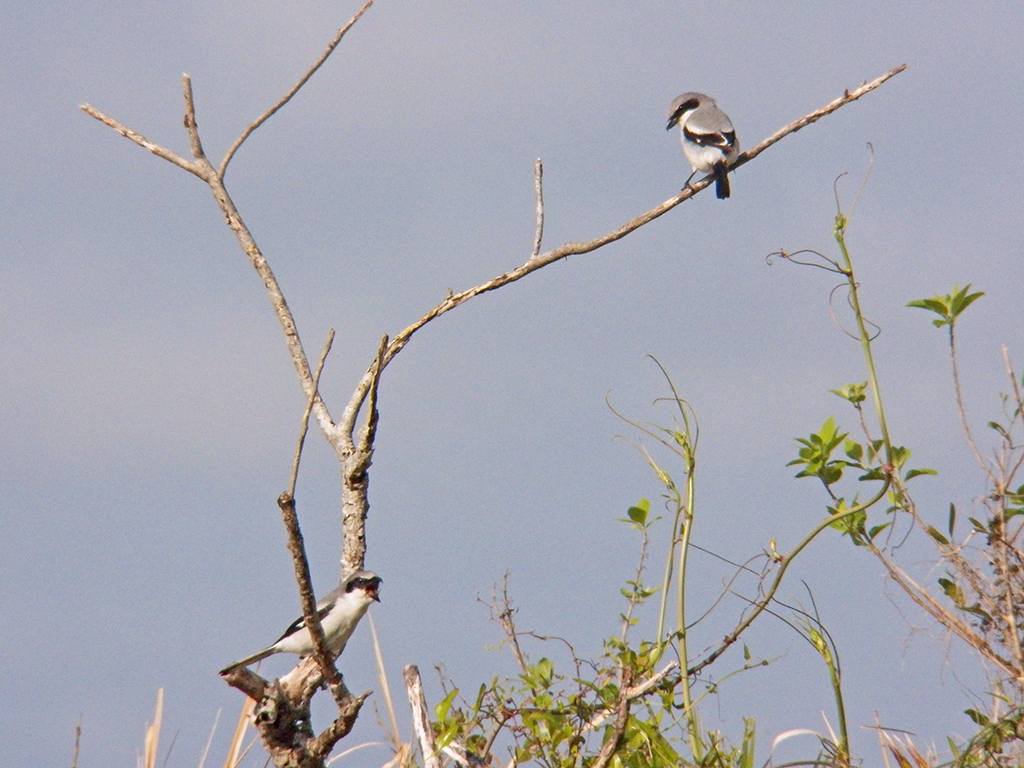
Besides birds attacking the American Crows, the Eastern Meadowlarks were courting and having territorial disputes. A pair of Loggerhead Shrikes were chasing each other around, too. I almost got one of my hope-for photographs, but the moment was so brief, I didn’t even have time to lift my camera. There was a Northern Mockingbird on a dead limb of a small tree, and the shrikes flew up in to the same tree. For an instant both a Northern Mockingbird and a Loggerhead Shrike were in the same tree, in the same field of view! I would really like to get such a photograph, showing the similarities and differences between these two birds.

shrikes
Moments after a Northern Mockingbird was chased off the limb on the right side of this dead tree-top. The bird at the bottom seems to be eating something as its companion watches.

Before turning onto Canoe Creek Road again, I stopped to watch a few Eastern Bluebirds fly and catch insects. I actually thought they were flycatchers at first, but the orange breast threw me off. When I finally got a good binocular view in full sunlight I saw they were actually bluebirds. Nearby, a Tufted Titmouse was calling and hopping through some branches while Northern Cardinals sang nearby.

I drove up to the Double C Bar Ranch for one final search for Whooping Cranes but coming up empty, I headed for home. I took a quick detour to the Wild Florida wildlife park and passed some Sandhill Cranes on the road leading to the parking lot. I didn’t really have time to look around, so I just circled the lot and headed back to the main road.

Here’s the trip’s species list in approximate order of positive identification:

  • White Ibis
  • Cattle Egret
  • Savannah Sparrow
  • Mourning Dove
  • Eastern Meadowlark
  • American Crow
  • Red-shouldered Hawk
  • American Kestrel
  • Blue Jay
  • Black Vulture
  • Bald Eagle
  • Northern Mockingbird
  • Boat-tailed Grackle
  • European Starling
  • Osprey
  • Fish Crow
  • American Coot
  • Cattle Egret
  • Glossy Ibis
  • Limpkin (♫)
  • Palm Warbler
  • Red-winged Blackbird
  • Common Gallinule
  • Ring-billed Gull
  • Pied-billed Grebe
  • Turkey Vulture
  • Killdeer
  • Eurasian Collared Dove
  • Loggerhead Shrike
  • Blue-gray Gnatcatcher (♫)
  • Red-bellied Woodpecker
  • Great Horned Owl (♫)
  • Northern Bobwhite
  • Eastern Bluebird
  • Tufted Titmouse
  • Northern Cardinal
  • Sandhill Crane

I’m hoping to check eBird and the e-mail lists to see if the Whooping Cranes are still being seen there, and to get some better tips for getting a good look. I’ll likely head back to Joe Overstreet Road soon, before the weather gets too hot.

Finally (Fly)catching up with Orlando Wetlands Park

I bucked the Lonely Birder trend again this past weekend by heading out to the Orlando Wetlands Park with my friend Camille. She is such an enthusiastic new birder, it’s great to head out with her and see whatever we can. This trip was focused on two things:

Thing 1: Neither of us had been to Orlando Wetlands Park before. It is closed seasonally from November through all of January which includes the usual dates for the Space Coast Birding and Wildlife Festival.

Thing 2: A male Vermilion Flycatcher was reported there this winter (and apparently the past several winters), a rare and desirable bird for this area. It’s getting late in the “wintering” season in central Florida, so it’s likely he’ll head north soon. This weekend was a good opportunity to see him.

scenic
This is actually a really big park. We walked at least 5 or 6 miles in the course of the day.

We arrived during a light rain shower, and (along with several other birders, including a group of photographers) used some small shelters near the parking area to wait out the rain and watch what birds were in the nearby trees and brush. We could hear a lot of “chipping” notes which turned out to be a large number of Yellow-rumped Warblers. Interspersed with them were some American Goldfinches, and I could hear at least two White-eyed Vireos. There was one Yellow-throated Warbler (one of several life birds for Camille).

There’s an education center nearby, and we went there to find a park map, and apparently interrupted a photography workshop lead by Reinhard Geisler, who tried to whisk us out, until we told him we just wanted a map. He grabbed one for us and quickly shut the door!

As we passed some large blue plastic tubs, ostensibly for a plant experiment, we saw some more Yellow-rumped Warblers, as well as Blue-headed Vireos, and some Carolina, House and Marsh Wrens in the brush nearby. I thought I caught a glimpse of an Ovenbird, but not enough to really be sure. I also caught a quick look at a Ruby Crowned Kinglet.

blue-headed-vireo
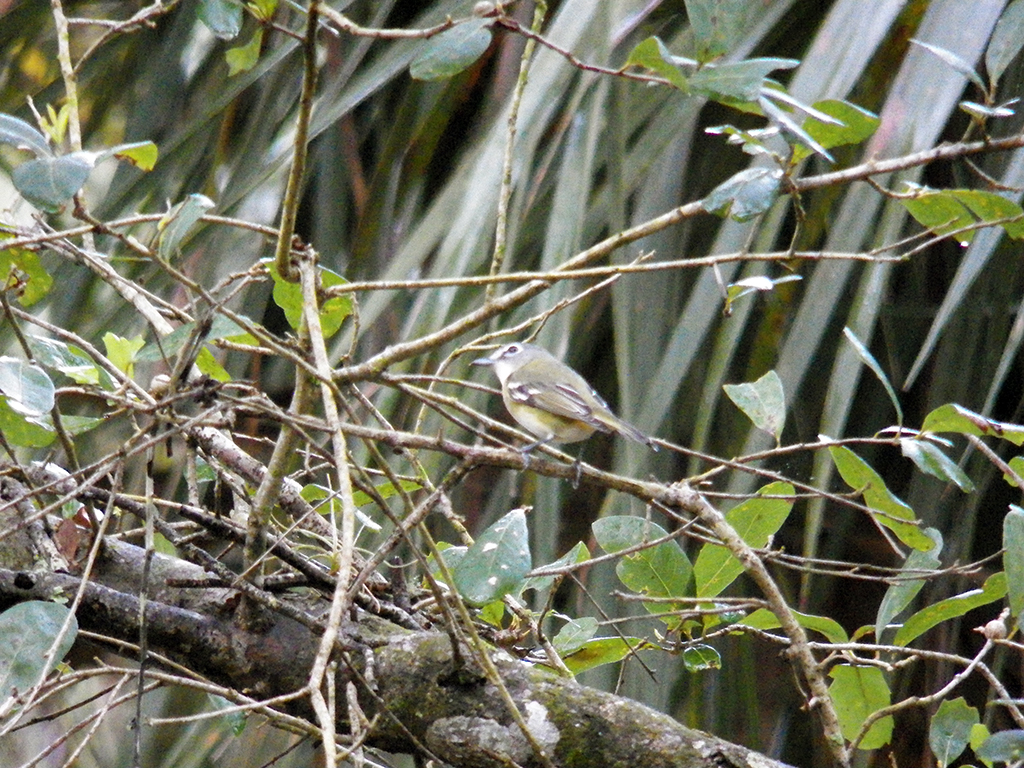
A Blue-headed Vireo shows off its white spectacles and yellow-green flanks.

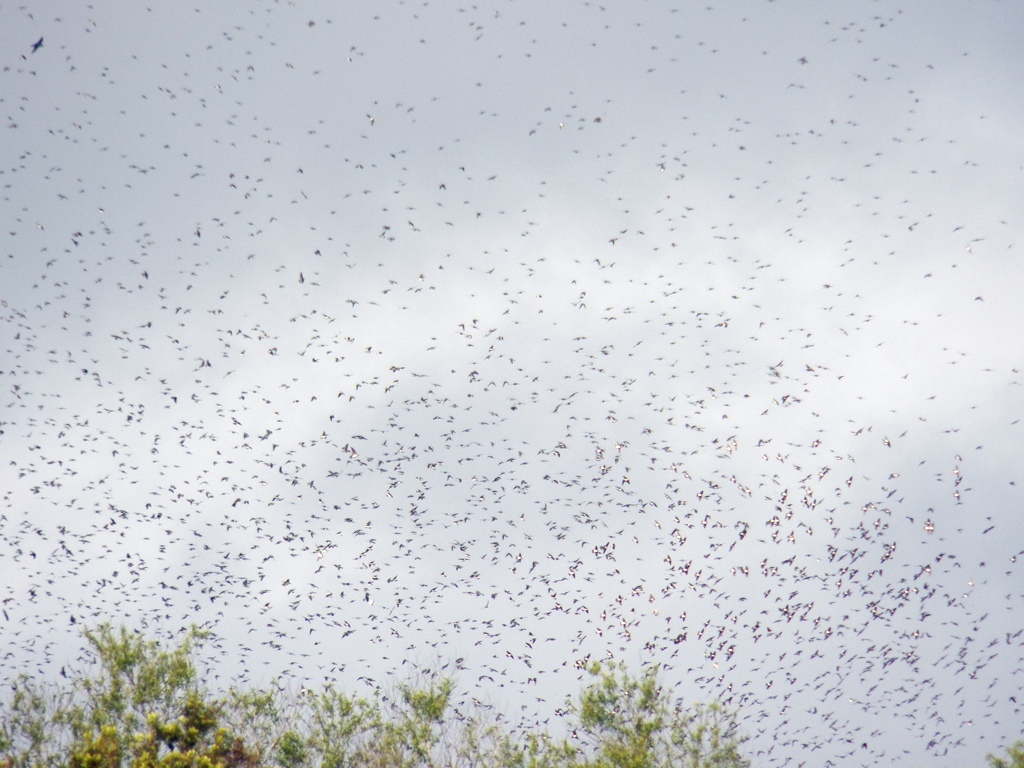
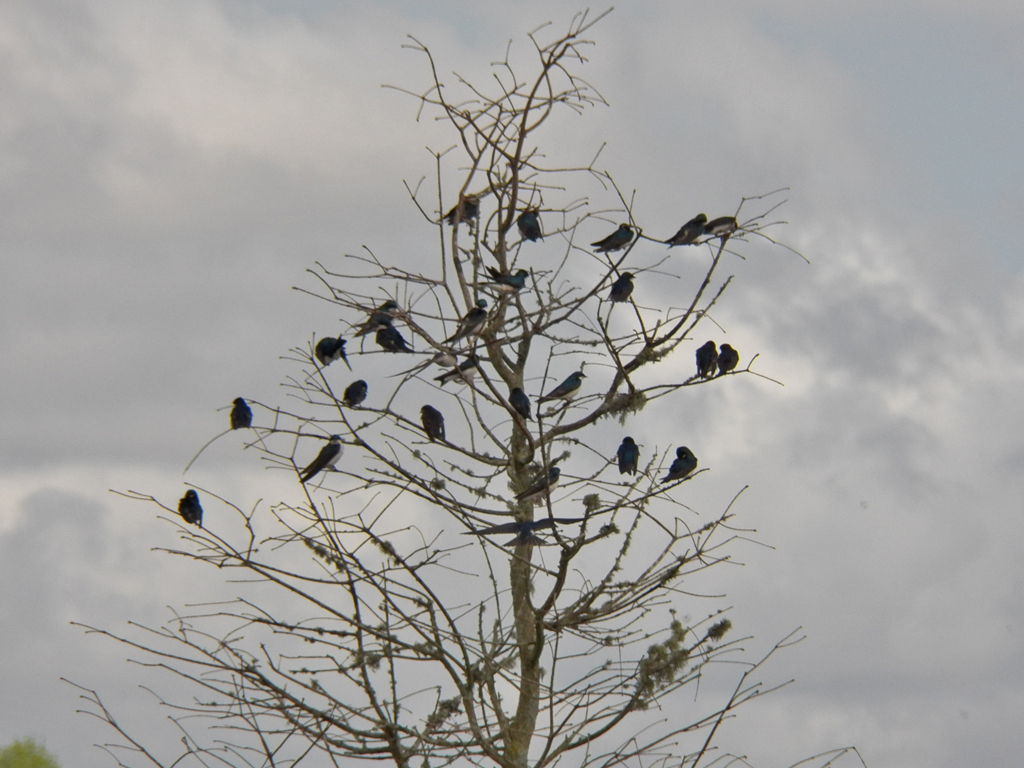
As we got out past that area near some open marshland, there were dozens of Tree Swallows all around us, and then looking farther out, a huge flock of many hundreds (perhaps even a thousand!) were swirling. Everywhere we went, all day, there were Tree Swallows.

tree-swallows1
One of several swirling masses of Tree Swallows we saw throughout the day.

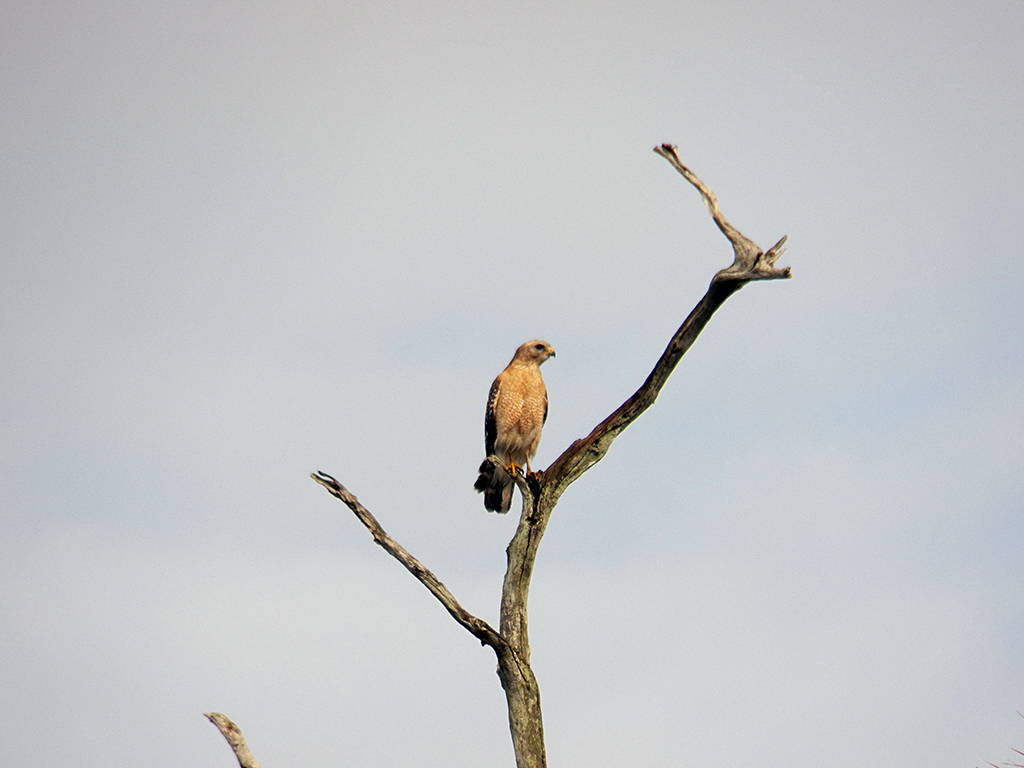
We saw our first herons and egrets, as well as some American Coots, and further along, Common Gallinules. In a dead tree there was a pale adult Red-shouldered Hawk that we spotted quite a distance away. We saw several of that species through the day (of course, some may have been repeat individuals), all the pale “Florida form.”

red-shouldered-hawk

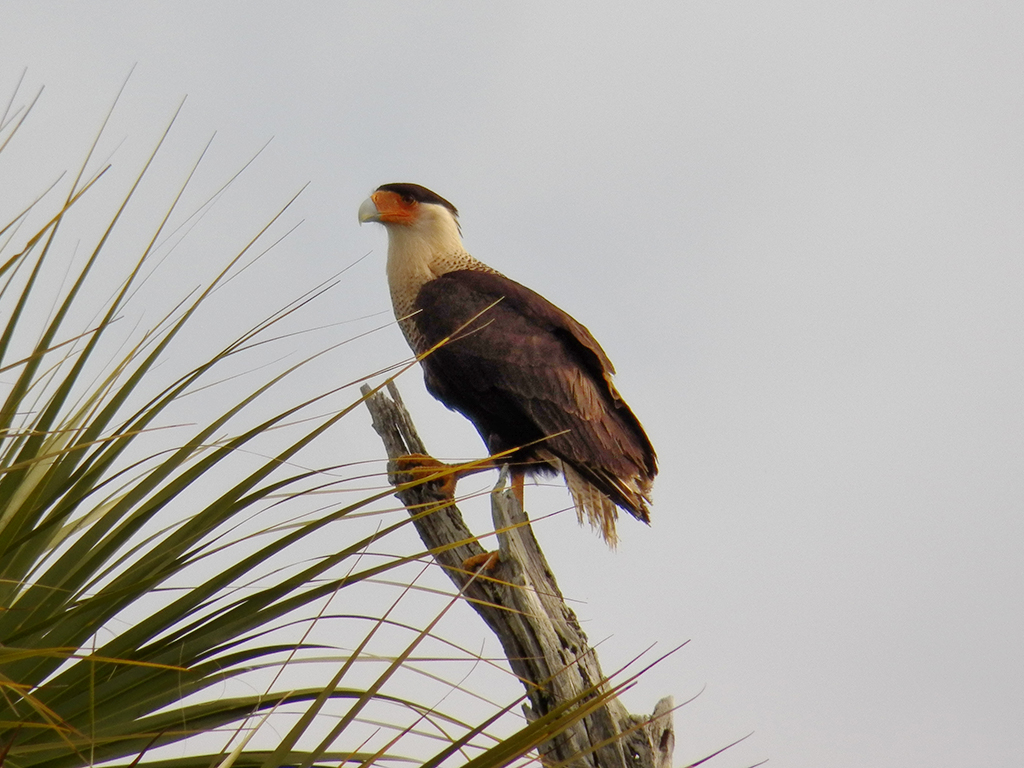
More impressively, Camille was wondering if we’d see any Crested Caracaras, and shortly thereafter in a tree not far from that hawk, was an impressive caracara, alternating between grooming and watching us approach. Just about all of the Crested Caracaras I have seen in Florida have been banded at least once, but this one was not banded and quite majestic.

crested-caracara
Crested Caracaras are majestic looking birds.

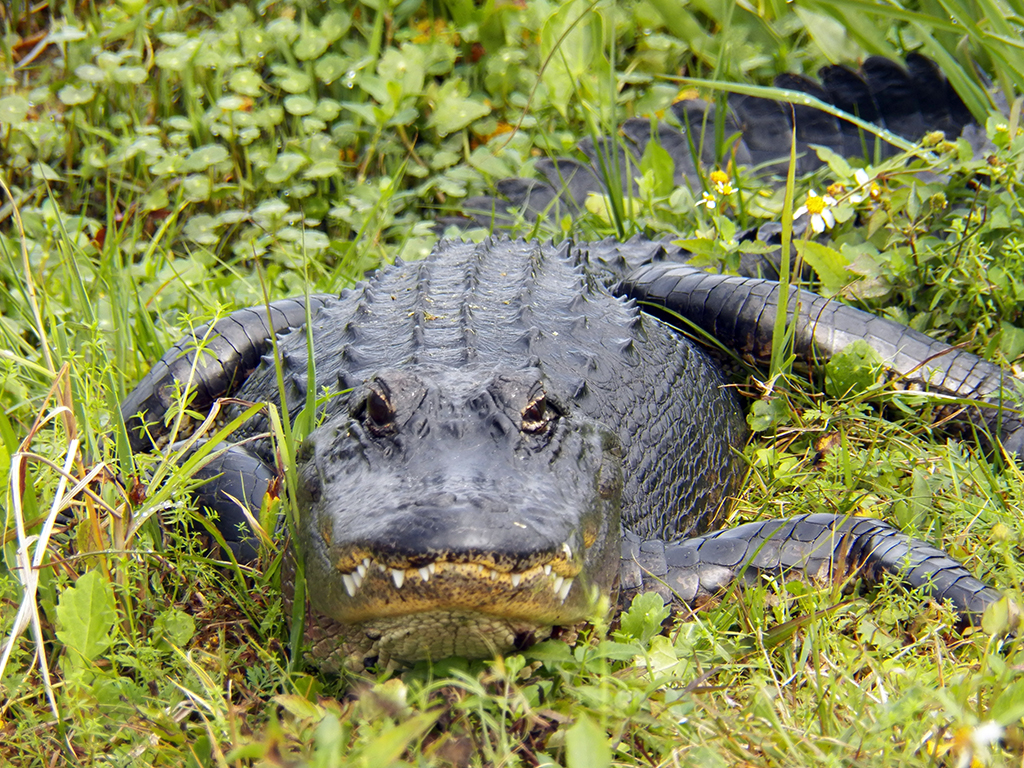
The park also has an impressive number of alligators. Every embankment we walked along had at least several, sometimes in close proximity. The largest I saw was over eight feet long, and there were some small 2-3 foot long ones as well. Many seemed to be snoozing or at least disinterested, but some were alert and intently watching us as we went by. At one point, near the end of the day, a woman we spoke with was saying how, even as a native Floridian, she sometimes gets a little nervous with so many alligators out and about.

two-gators
“One medium and one large ‘gator to go, please.”

Her comment made me realize that while I used to be a little intimidated and anxious at some of the larger alligators I would see, now I just harbor a great deal of respect and admiration. I’ve never felt threatened by an alligator. In fact, more often than not, even the larger ones will panic and head straight for the water in a startling splash if I accidentally seem to be getting too close.

front-gator
“This IS my happy face.”

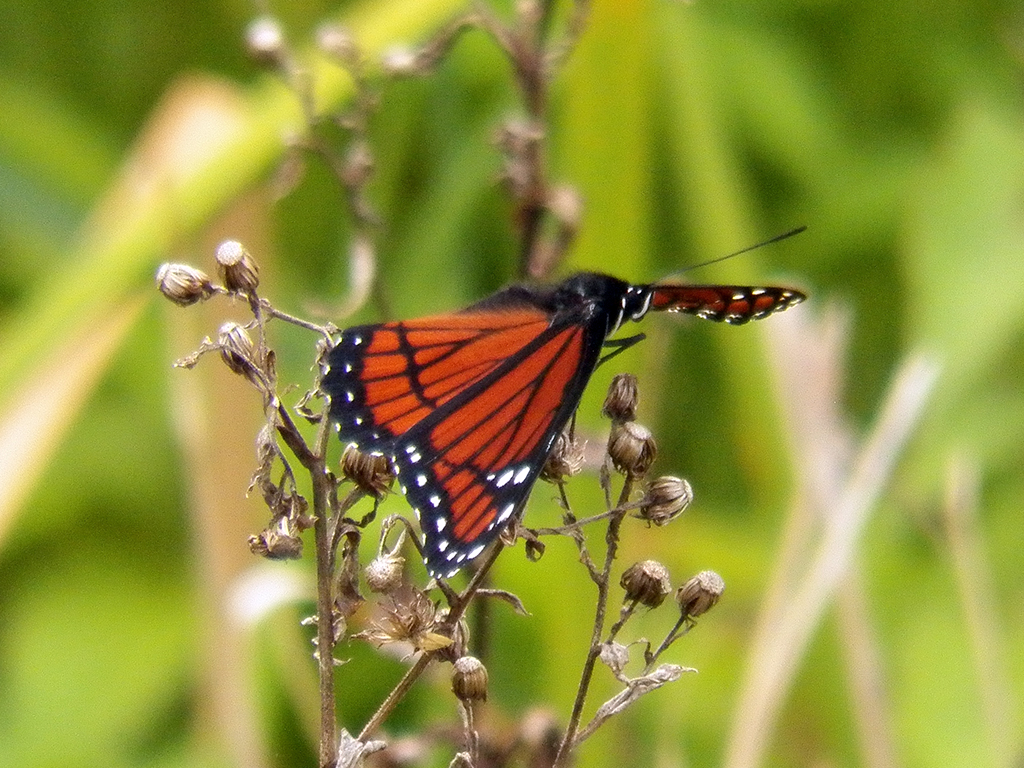
Alligators weren’t the only non-avian species present. There were turtles sunning in most of the ponds and open wetlands and various butterflies. I did not notice any dragonflies, but it may be too early in the year to expect the adults to have emerged from the water yet.
This is a Viceroy, a mimic of the better known Monarch butterfly. The extra thicker black line running across the thinner lines is the defining field mark.
This is a Viceroy, a mimic of the better known Monarch butterfly. The extra, thicker black line running across the thinner lines is the defining field mark.

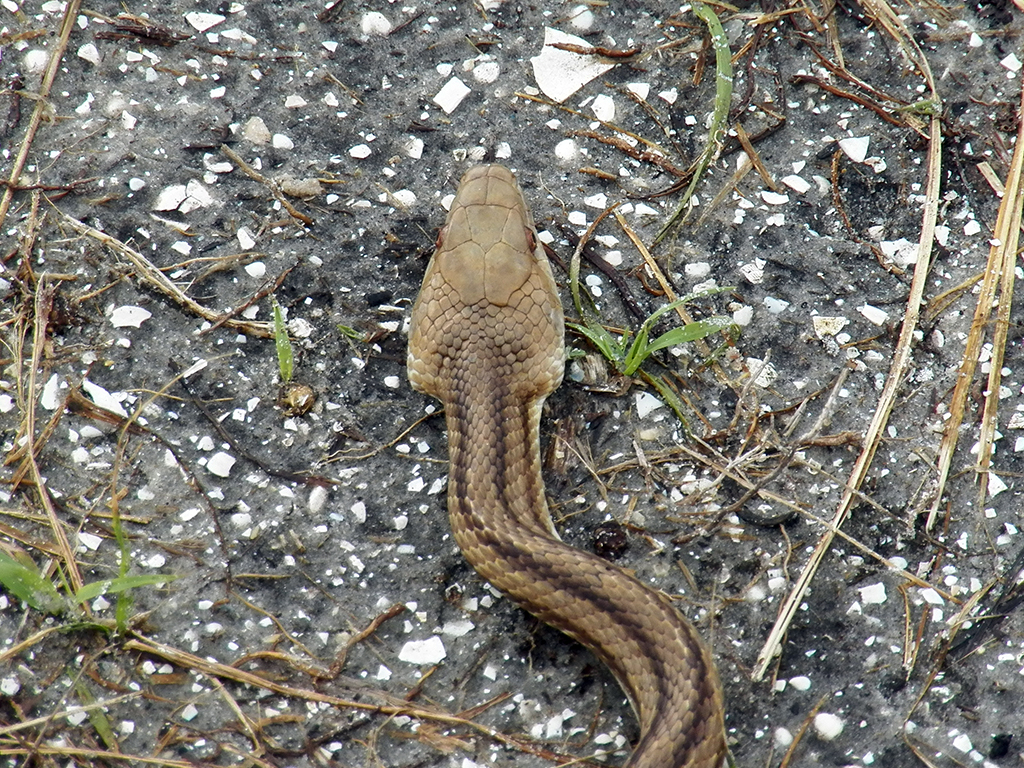
We came across a three-foot long snake on one path that Camille almost stepped on. I looked up what species it was after getting home, and it was a yellow striped Rat Snake. Normally this species is nocturnal, and I thought maybe this individual had expended some energy before dawn and was waiting for the sun to warm it up so it could get about its business.

rat-snake-head

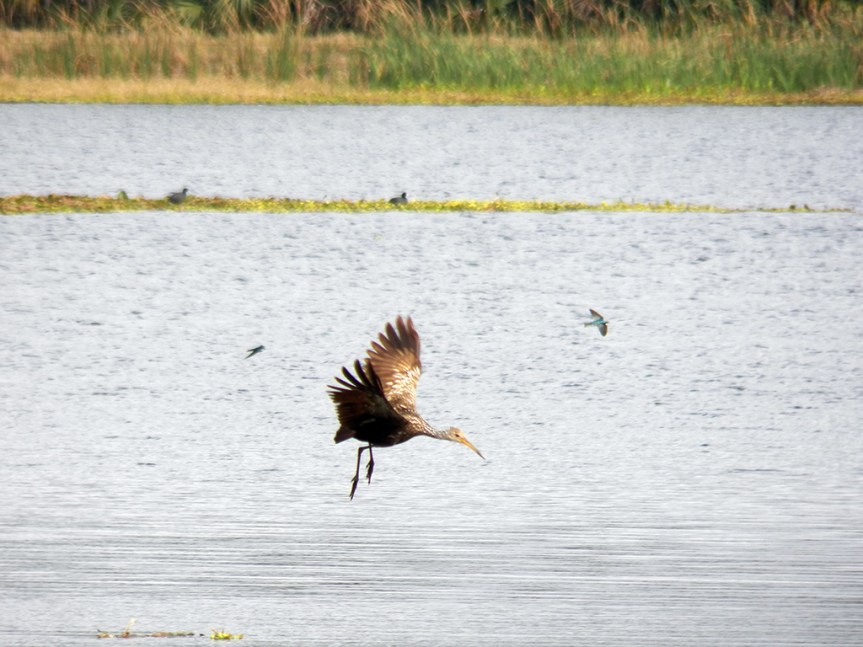
A major difference between this park and something smaller, like the Wetlands in Viera, is the density of bird activity. With so much room to spread out, there didn’t seem to be as much bickering and posturing among the wading birds. There were Limpkins around, but they only flew out in the open a few times. The herons were mainly standing alone, with only the usually grumpy Tricolored Herons making any regular fuss. It’s possible we caught the park on a quiet day, with things transitioning from Winter to Spring, but I’ll have to revisit a few times to know for sure.

flying-limpkin
A Limpkin with a Tree Swallow escort comes in for a landing.

As I mentioned above, one reason for coming to this particular park was to see the Vermillion Flycatcher. We had some vague idea of where it might be based on eBird reports and some e-mail list messages, but as the scale of the park became evident to us, we realized we needed specific help on where to find it. As we were walking down the aptly named “Alligator Alley” a couple of men approached our location and asked if we were trying to find the Vermillion Flycatcher. They then gave us very specific instructions on where to walk and what to look for.

So off we went, via their directions, across the park. We walked quite a long distance, well over a mile, until we came and area to that most closely matched their description. There were a few things wrong, however, with what we had read about where it would likely be and this location. There were no “small” cypress trees, for example, and the only cypress stand that might have been close to the two men’s description was apparently accessible from other trails, making it unlikely that we’d have to be out where we were to see it. As we searched for the flycatcher, we did see some Caspian Terns, a perched Osprey, and several Great Blue Herons in the cypress dome across the water. We decided to head out and either ask someone else, or just take our chances in another area of the park.

After we walked a way down the trail just a short way, we saw a photographer setting up a tripod and asked him if he knew how close we were to the flycatcher’s location. He told us we were no way near it, and in fact we had to cross almost the entire park to find it! We were a bit frustrated and amazed because of how specific the first set of directions had been, but this man had photographed the bird the previous day and was very confident in where we needed to go.

There were Red-winged Blackbirds in moderate numbers. Most were busy finding food and looking around. The majority of the males had their red shoulder patches (called epaulets) in eclipse, showing mainly the yellow border. The epaulets are exposed when the bird is looking for a mate or staking out his territory.

red-winged-eclipse
Most of the male Red-winged Blackbirds seemed content to walk the edge of the water with very little fuss. There were some singing here and there, but nowhere near the frenetic activity the species often exhibit at Viera.

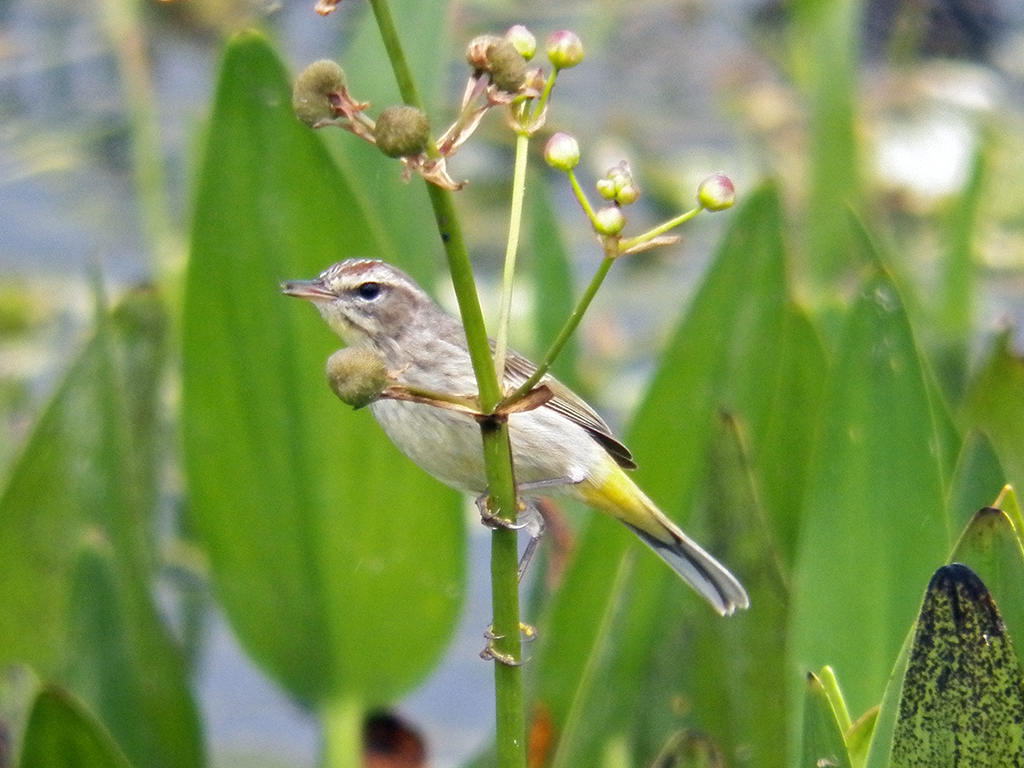
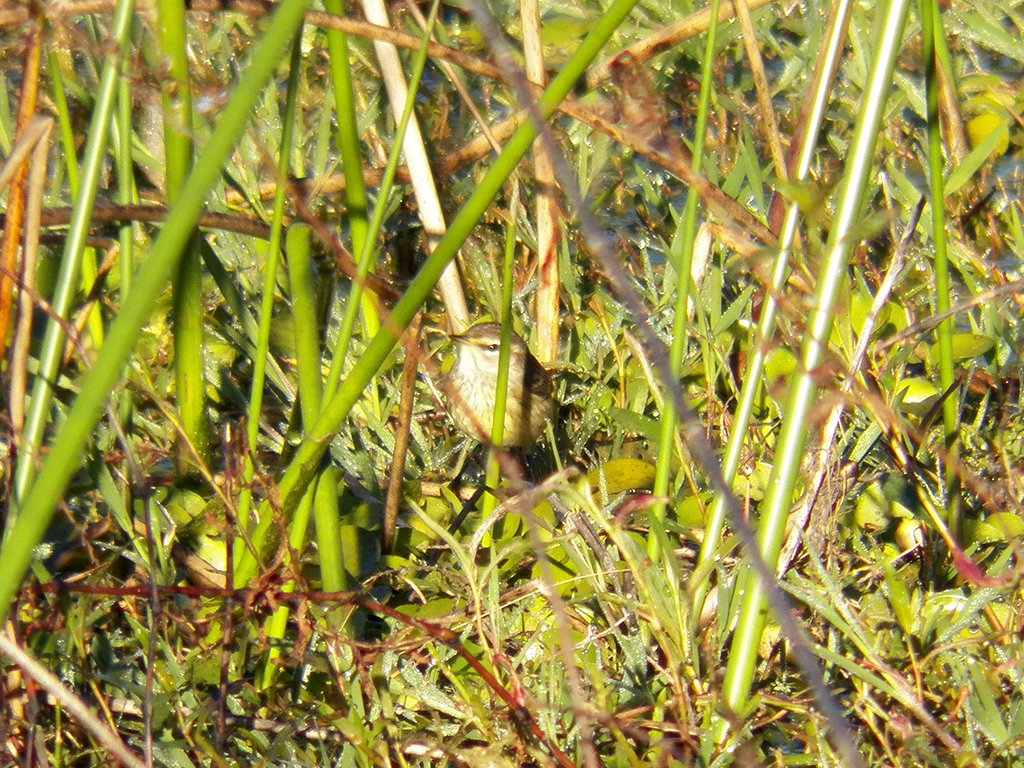
Some smaller birds were flying along the trail, including Savannah Sparrows and Palm Warblers. Most of the Palm Warblers in central Florida during the winter time are of the gray “Western” variety, with limited yellow to their tail coverts and sides. One Palm Warbler was foraging along the reeds and other water plants near us, and it stood out because of how pale it was compared to other Palm Warblers I’ve seen this winter.

palm-warbler-2015-mar-01
Pale Palm Warbler eating tiny bugs.

Just across the road along the shoreline of the pond I was slightly startled to see several very small birds wading within a few feet of me. At first I thought they were sparrows, but once my brain adjusted to what it was seeing, I realized they were very small sandpipers. Other than Sanderlings and Ruddy Turnstones, I’d never been that close to small shorebirds, and it turns out these were Least Sandpipers (I had to double check at home because Western Sandpipers are also small, but they have dark legs whereas Least Sandpipers have yellowish legs).

least-sandpipers-2015-mar-01
Hangin’ with my peeps at Orlando Wetlands Park.

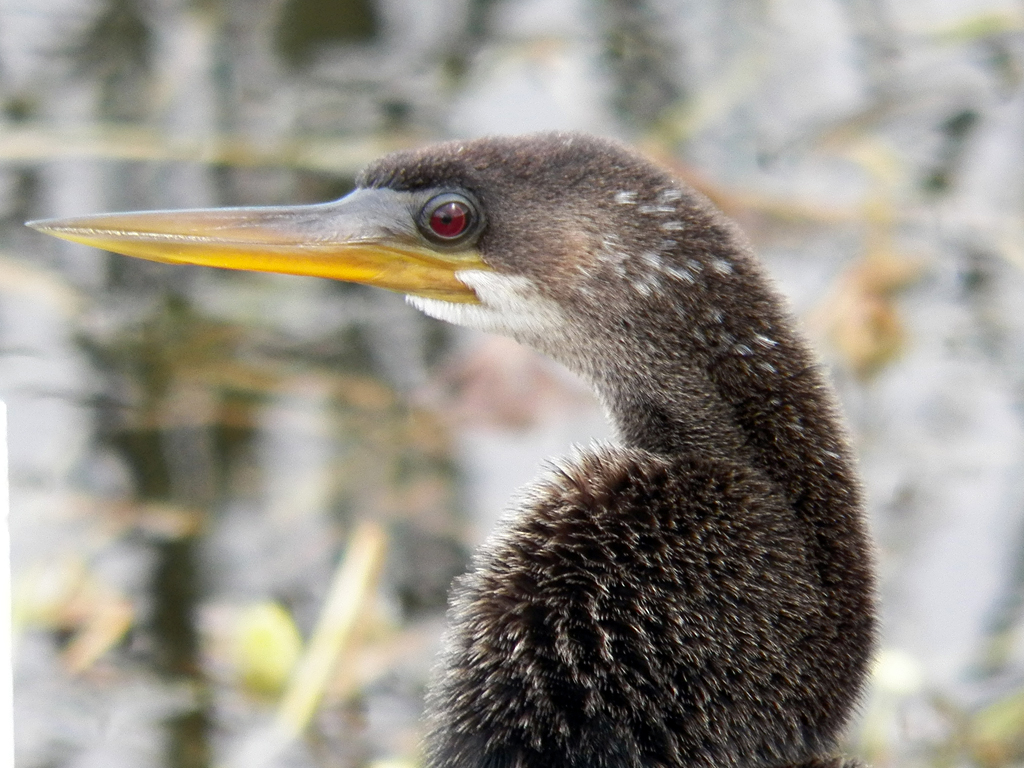
Anhingas were distributed fairly evenly around the park. I don’t know when the normal breeding season is for them, though I know they can breed any time of year in places. We encountered one Anhinga that seems to be a juvenile or an immature bird. Other Anhingas in the area (Viera, for example) have blue skin around the eyes and lores (area in front of the eyes) which indicates breeding adults, but this one does not have those markings.

imm-anhinga
A young Anhinga nervously watched us as we passed by.

A flock of American Wigeons took to the sky at one point, marking the largest group of ducks we’d seen all day. Aside from a few isolated Blue-winged Teals, and later a few Mottled Ducks at the end of the day, these were the only ducks we’d see.

As we continuted to follow the photographer’s directions, we eventually came upon some birders who had just seen the Vermillion Flycatcher and were happy to point out where to stand and what to look for. It turns out we were just around the corner from the spot when the first two men had us go in the complete opposite direction! I don’t know if they were being malicious or were confused themselves over where they had been that morning, but it was frustrating at first. But the walk, though hard on the feet, was not a waste, as we did get to experience areas of the beautiful park we’d likely have walked through anyway. We were warned that without a high powered scope or telephoto lens, we weren’t likely to see much more than a reddish dot or smudge, but we knew that going in. Any glimpse of the bird was worth it.

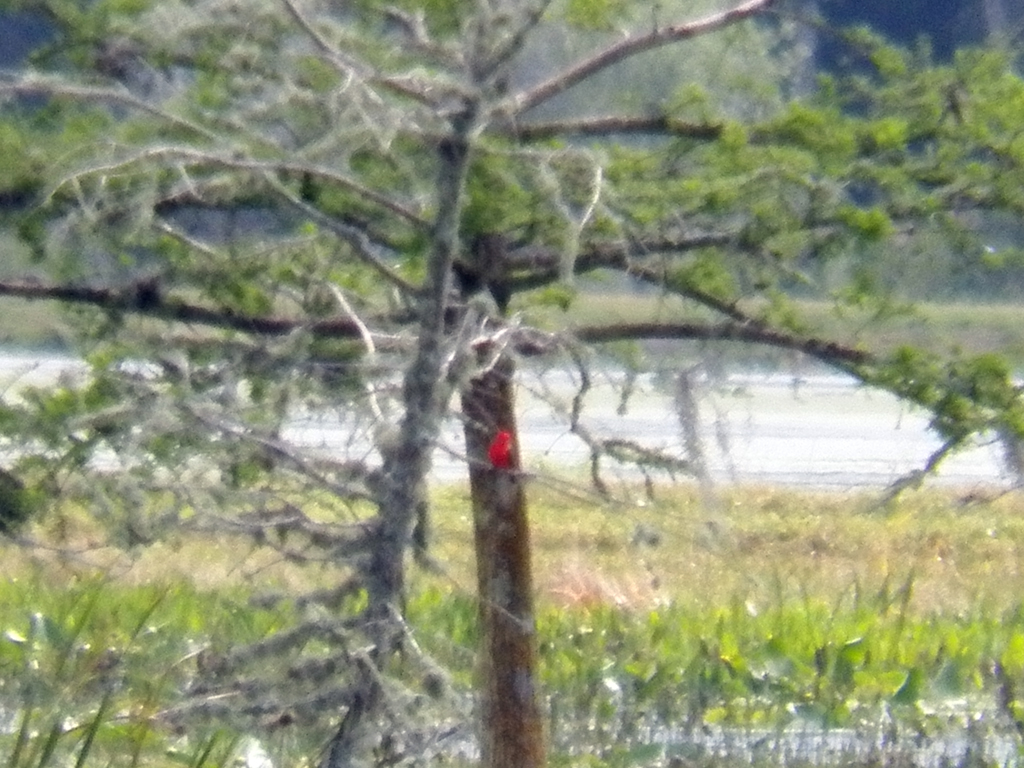
We stood at the spot and scanned the small cypress trees for several minutes and were just about second guessing ourselves when I finally caught a flash of red in my binoculars and saw my very first Vermillion Flycatcher! Soon, Camille had it in her sights as well, and we watched that little red smudge sally over the water and back to the same perch several times. I decided to take whatever image my camera could capture, even if just a red blob.

vermillion
It’s not much, but that red blob is a male Vermillion Flycatcher! Worth every minute, mile and foot ache!

We watched him for a while longer before finally heading back down the trail, where we came across a woman setting up a spotting scope, looking toward the trees the flycatcher was in, from the opposite direction. We talked to her for a few minutes, and found out that she birds with the man running the photography workshop (Reinhard Geisler) and had seen the flycatcher from that vantage point some days earlier. She very quickly got it in her scope and let us have a look. In her scope one could see his face clearly, including the black eye-line.

We continued to walk back toward the education center and the parking area, stopping to look at a few more birds. As we did, the woman with the spotting scope walked by us and pointed out Tree Swallows perched in some small trees out in the water, relatively close to us. After seeing so many hundreds, if not thousands, of these birds flying all day, it was nice to see some sitting quietly.

more-swallows
A small group of Tree Swallows taking a bit of a break.

We walked a little further on and saw another bird we had hoped to see there, but had eluded us all day: a Purple Gallinule. We’d both seen this species this year, but they’ve been comparatively rare lately and are such a neat bird, we really were wanting to get it on this trip.

Just as we were arriving back toward the parking lot, one of the large swirling masses of Tree Swallows was descending along the trees along the trail. There were two main components to the flock, and as the two flocks interacted, they started noisily calling out and descended further. Eventually hundreds landed in just a few trees at the edge of the road, causing the entire tree to sag and bend. This caused the birds to loudly launch off the trees en masse and take to sky in a frantic surge. They did this a few times before heading off a short distance.

Thus ended our day at Orlando Wetlands Park. It lived up to its hype, and we got lots of good birds, including a good handful of lifers for Camille. We didn’t leave the park until after 3:00, which was much much later than I anticipated, and even realized it was. Our feet and backs were sore, but it was an amazing adventure.

Here’s my complete species list in general order of first positive identification.

  • Yellow-rumped Warbler
  • American Goldfinch
  • Northern Parula (♫)
  • White-eyed Vireo (♫)
  • Carolina Wren
  • Common Ground Dove
  • Gray Catbird
  • Northern Cardinal
  • Pine Warbler
  • Boat-tailed Grackle
  • Ruby-crowned Kinglet
  • Blue-headed Vireo
  • House Wren
  • Red-bellied Woodpecker
  • Yellow-throated Warbler
  • Marsh Wren
  • Tree Swallow
  • Palm Warbler
  • Turkey Vulture
  • Black Vulture
  • White Ibis
  • Sandhill Crane
  • Great Blue Heron
  • Tricolored Heron
  • Red-shouldered Hawk
  • Crested Caracara
  • American Coot
  • Great Egret
  • Pied-billed Grebe
  • Blue-winged Teal
  • Belted Kingfisher
  • Little Blue Heron
  • Limpkin
  • Red-winged Blackbird
  • Common Gallinule
  • Anhinga
  • Green Heron
  • Common Yellowthroat
  • Swamp Sparrow
  • American Bittern
  • Savannah Sparrow
  • Snowy Egret
  • Cattle Egret
  • Glossy Ibis
  • American Wigeon
  • Fish Crow
  • Sora (♫)
  • Least Sandpiper
  • Greater Yellowlegs
  • Killdeer
  • Caspian Tern
  • American White Pelican
  • Bald Eagle
  • Osprey
  • Black-crowned Night Heron
  • Vermillion Flycatcher
  • Mottled Duck
  • Purple Gallinule
parting-shot
A parting look at the beautiful Orlando Wetlands Park (those black specks in the sky are more Tree Swallows).

Springing Into Action at Turkey Creek Sanctuary

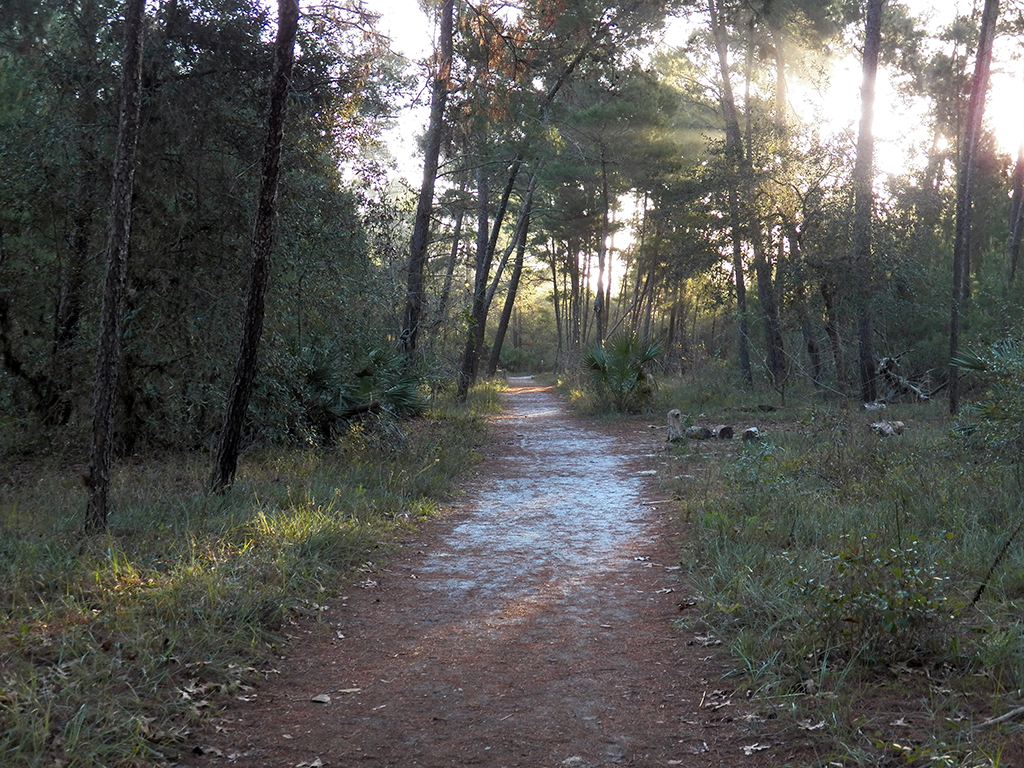
With Spring starting to get under way in Florida, I thought it was a good morning to check in on the Turkey Creek Sanctuary and see what was going on. Bird migration is still some weeks away, so I wasn’t expecting an influx of warblers or anything. The morning started off a little cool and foggy in spots. Here’s the view from the Sand Pine Trail as the Sun was burning off some mist.

sand-pine-trail
Plenty of sand, pines and it’s a trail!

The first birds I heard after getting on the trail were Northern Cardinals and Carolina Wrens. These species are usually the staple of Turkey Creek Sanctuary, though as I’ve previously discussed, the cardinals have been down in numbers of late. There was a pretty strong contingent this particular morning, though. It amazes me how well hidden Northern Cardinals can be, given how brightly colored they are, but both the males and females tend to stay low in the brush, occasionally popping up into a pine tree. When one does venture into the open, even a far way off, it’s unmistakable.

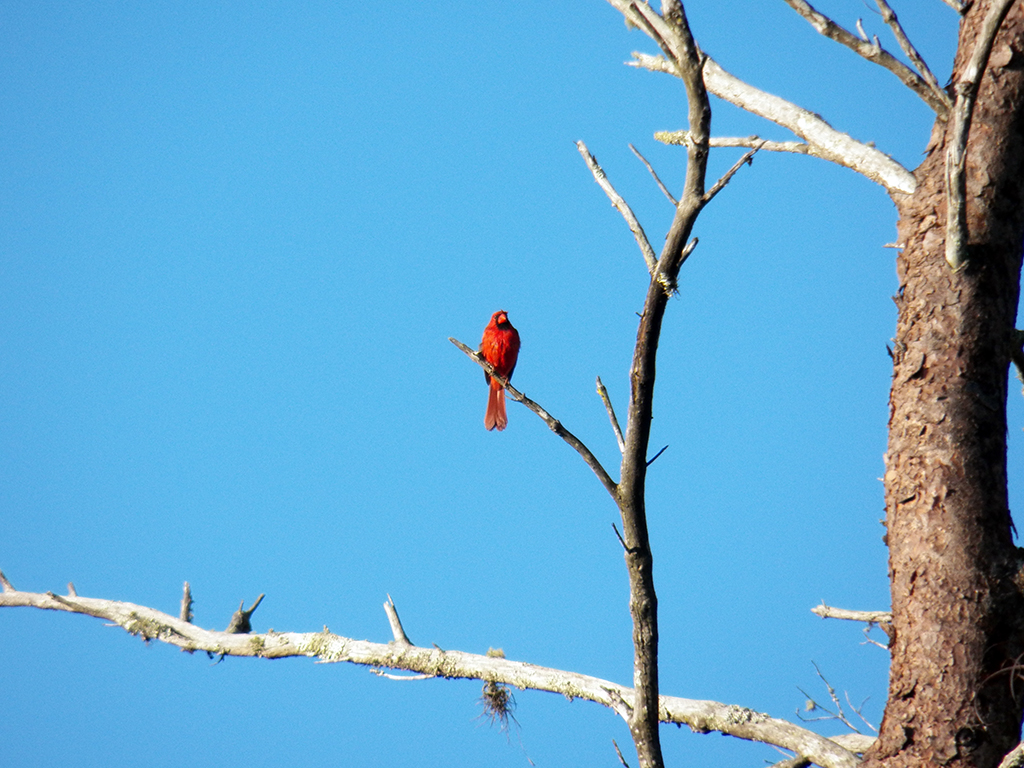
cardinal
Along the Space Coast we don’t get to see Northern Cardinals contrasting with fresh snowfall. Then again, we don’t get fresh snowfall either 😉

Throughout the sanctuary the Winter and year-round residents were active and vocal, as the longer days help gear them up for the Spring. A large number of the Blue-gray Gnatcatchers were singing their soft, bubbly songs in between bouts of their nasal call-notes.

singing--gnatcatcher
A Blue-gray Gnatcatcher in “full song.” This is probably the longest I’ve seen one hold still (a total of about 15 seconds!).

Commonly, other birds (like vireos or warblers) associate with gnatcatchers, so I paid close attention to any other movements in the canopy. I had heard Northern Parulas singing, so I knew they were around. The Northern Parulas that I saw were quite active and in either the canopy or the thick brush. There were males, already with their breeding colors, and females foraging.

leaping-parula
Things were really hopping at the Sanctuary!

Deciduous trees in Florida do lose their leave every Autumn, though there’s no real period with bright red and gold colors like there is further north. By February they are beginning to leaf-out, and by the time the migrant songbirds start arriving in March, there’s plenty of canopy for them to hide in.

leaves
It’s easy being green. For a tree.

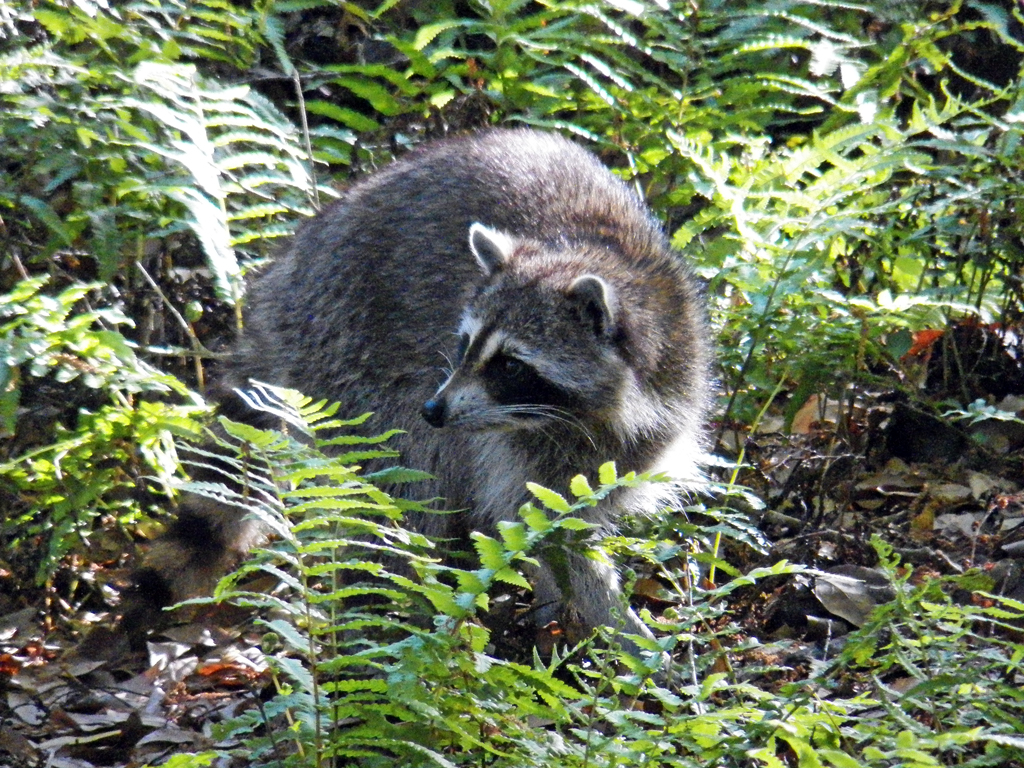
The understory and ground cover has been growing in as well. Ferns figure in fairly prominently in the habitats adjacent to Turkey Creek.  Away from dumpsters and trashcans, raccoons forage on the forest floor looking for bugs, nuts and anything else edible.

racoon
This raccoon was intently watching something for several minutes. After a while, it went back to digging in the ferns for food.

Racoons are perhaps an ultimate victim of human development. They are intelligent and highly adaptable, which has made them pests in some places, as they scavenge for food and find places to live that don’t always agree with human settlement. But that adaptability has made them survivors, (despite us infecting their population with rabies) and we should at least admire them for that while taking humane measures to keep them out of harms (peoples’) way.

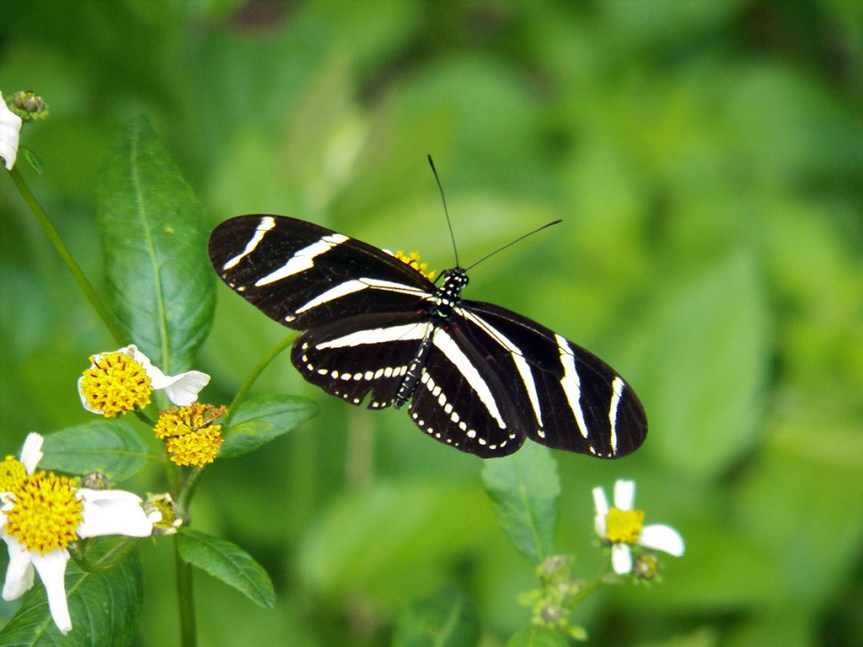
Butterflies have been an almost constant all Winter where I’ve looked, and this day was no exception. The majority of the species I saw this time were the Zebra Longwings, which are Florida’s official state butterflies. Here, you can see where they get their name.

z-longwing
“Am I black with white stripes, or white with black stripes?”

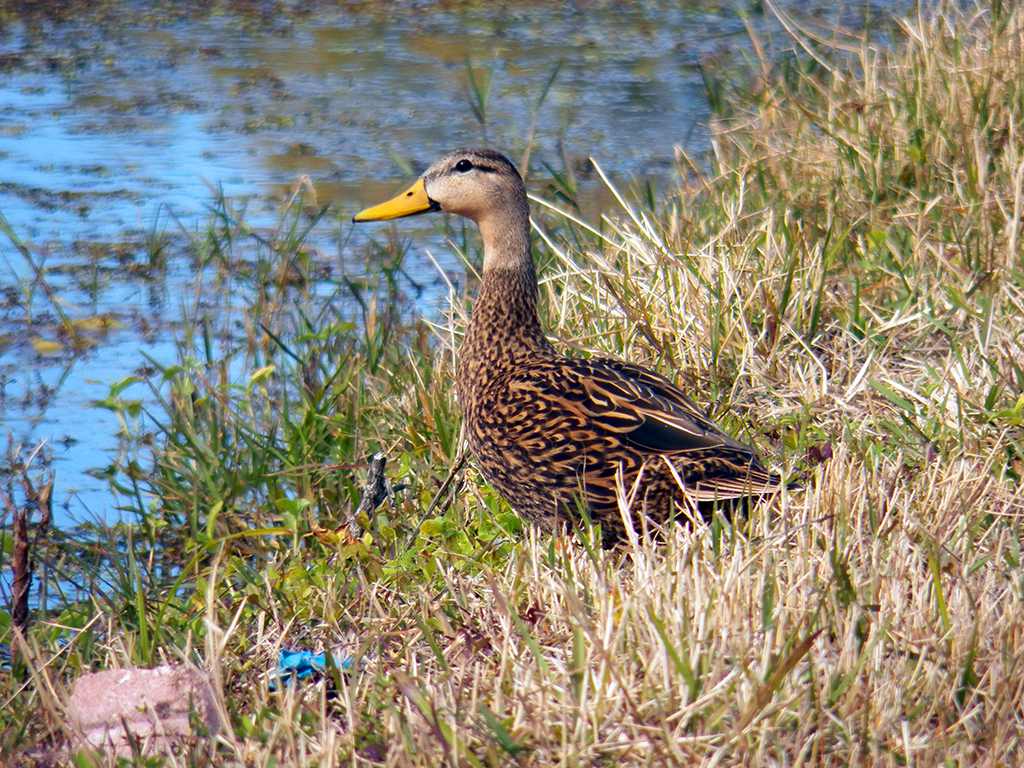
I walked out to the canal and weir, and there was a small collection of herons nearby, as well as some Mottled Ducks. This drake was standing alone on the edge of the canal, his bright yellow bill and recently refreshed plumage should make him a striking figure and a good catch for the lady-ducks!

mottled-duck
Mottled Ducks nest from February until Summer, and most are already paired up, but there’s still time for this guy to find a mate.

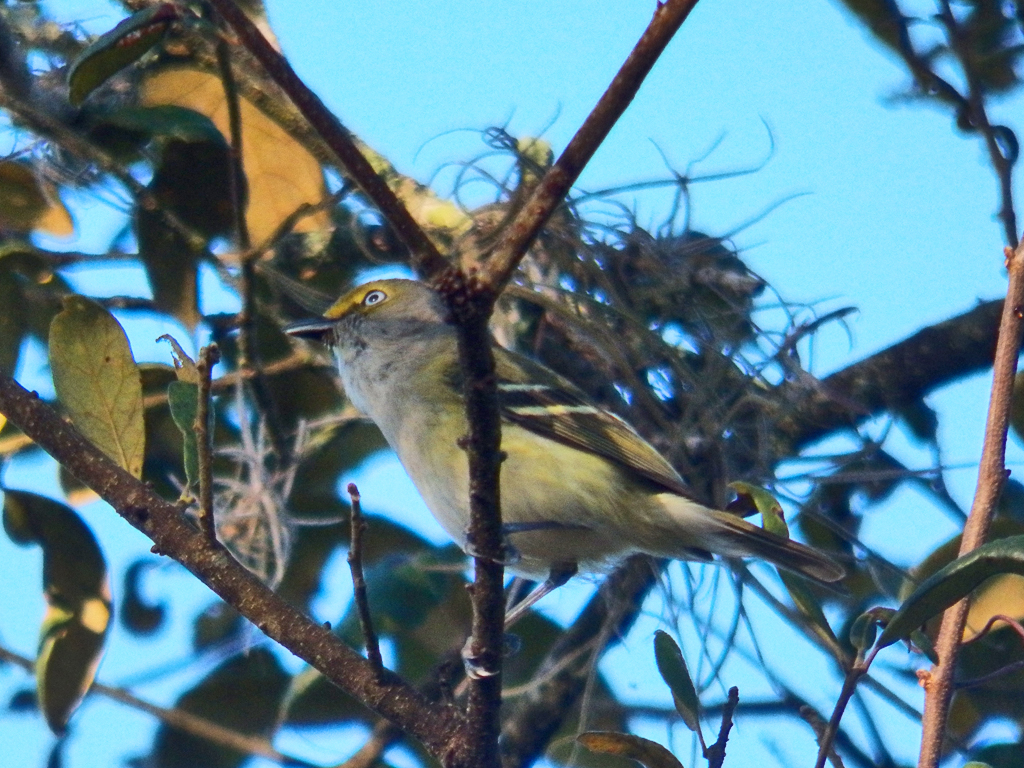
Back in the Sanctuary, as the morning progressed, more birds were foraging in the middle layers of the woods, including White-eyed Vireos and some warblers. Soon, more vireo species will be moving in, as the wintering Blue-headed Vireos move out. White-eyed Vireos are resident all year, though.

white-eyed-vireo
Most passerine birds have black eyes, and a few have red eyes. In Florida, two have white irises: the White-eyed Vireo, and the Eastern Towhee.

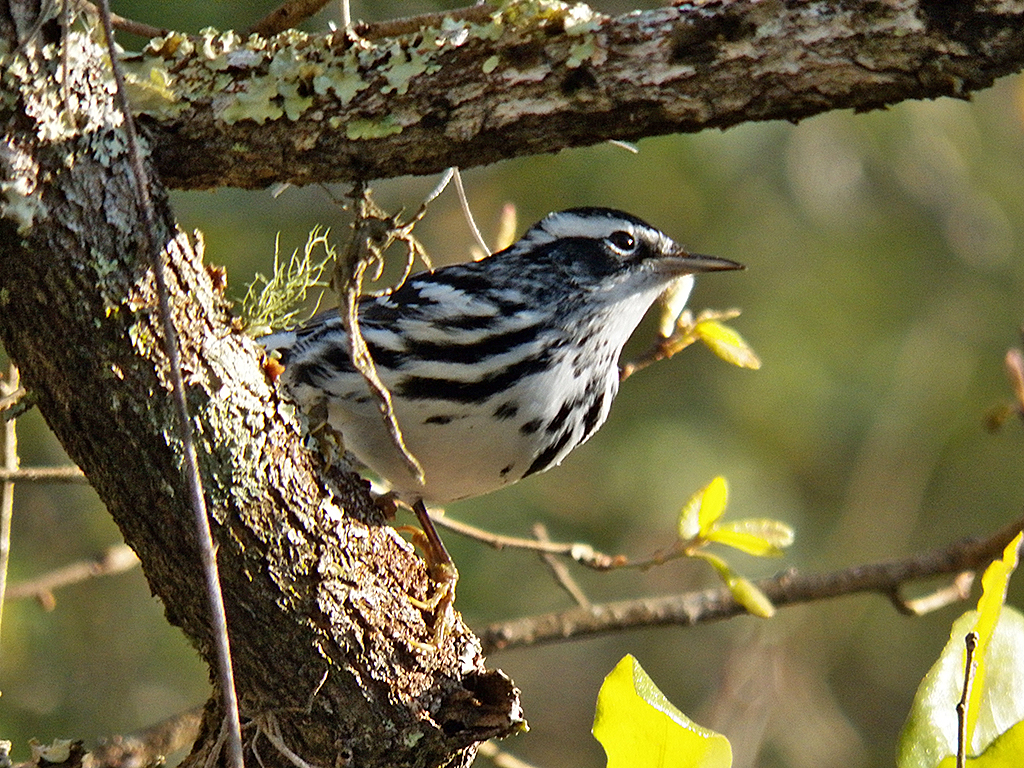
Black-and-white warblers are also Winter residents in Florida, and the time of year just before migration finds them gleaning bugs from tree bark as they prepare to fly north. They tend to be a little less shy, too. You can find them associating with vireos and Blue-gray Gnatcatchers, as I did. I couldn’t remember what their song was like, and had intended to quietly play it on my phone, but had the volume up louder than I expected. This resulted in this bird flying down to eye level to scold me.

b-w-warbler
A displeased Black-and-white Warbler glared at me after giving me an earful for playing a bogus song.

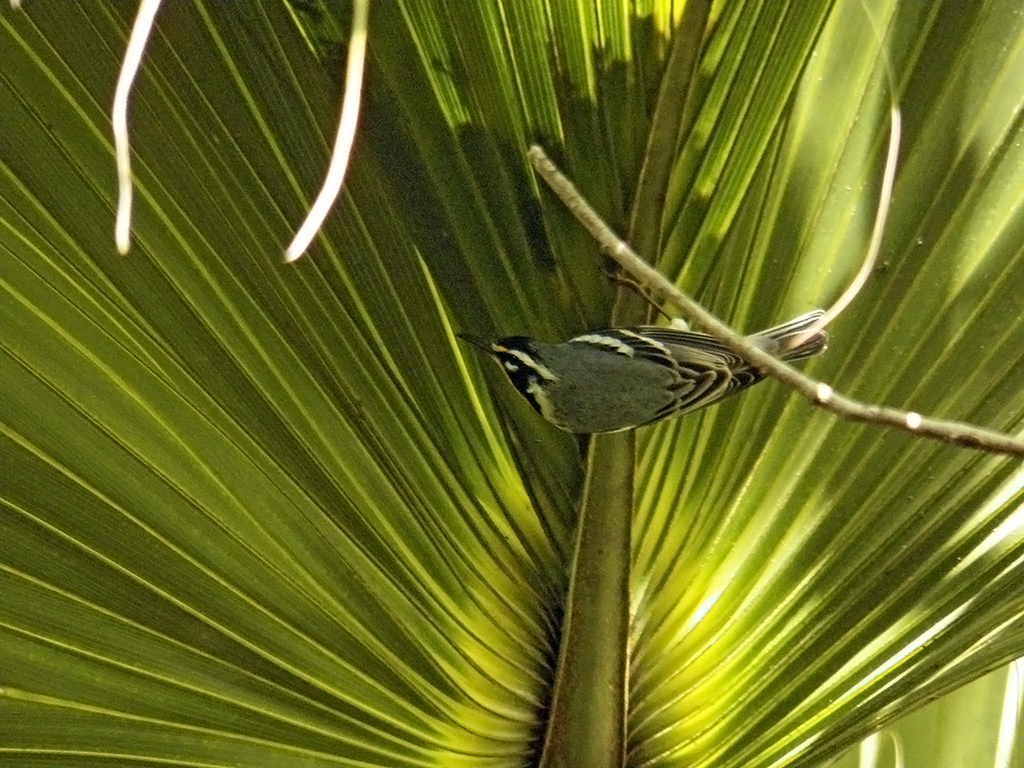
Yellow-throated Warblers also hang around all year, and the Space Coast is near the southern limit of their breeding range. You can usually find some hanging around during the summer, but they generally stay out of sight. I often find them on the underside of palm fronds, like this, eating insects and spiders. It’s easier to see their brilliant yellow throats when they are up in the canopy.

yellow-throated
This Yellow-throated Warbler couldn’t hang around long.

The Sanctuary was certainly coming alive with the longer days and hopes of warmer weather ahead. Only time will tell how this year’s migration will go, but the amount of activity among the resident birds was perhaps an encouraging sign that the ecosystem is healthy enough to support the migrants, should they stop by this year.

Here’s the list of identified species for the morning, mostly in order of first encounter:

  • Carolina Wren
  • Purple Martin
  • Gray Catbird
  • Northern Cardinal
  • Red-bellied Woodpecker
  • White-eyed Vireo
  • Northern Parula
  • Black-and-white Warbler
  • Blue-gray Gnatcatcher
  • Fish Crow
  • American Robin
  • Eastern Phoebe
  • Downy Woodpecker
  • Black Vulture
  • Turkey Vulture
  • White Ibis
  • Tree Swallow
  • Blue Jay
  • Cattle Egret
  • Little Blue Heron
  • Green Heron
  • Mottled Duck
  • Anhinga
  • Common Gallinule
  • Great Blue Heron
  • Red-shouldered Hawk (♫)
  • Brown Thrasher
  • Yellow-throated Warbler
  • American Goldfinch
  • Mourning Dove

I finished the morning with a couple of satisfying things. One was finally confirming to myself that there are American Goldfinches in the Sanctuary (I’ve heard snippets of their calls now and again) by seeing a winter female (I believe). I also noticed some trail maintenance near the canal and Harris radio tower, making access to the weir a little easier. The trail leading from the canoe deck to McKinnon’s Way was also clearer, making access to that area of the park much easier. Much thanks goes to the volunteers for that!

Viera Wetlands, Take Two!

I met with my friend Camille on Sunday to have a look at the Viera Wetlands (Ritch Grissom Memorial Wetlands at Viera, formally). Camille has been a conservationist and wildlife watcher for a long time, but birding as a dedicated activity is new for her, with all the excitement and wonder it comes with. She’s already upgraded her camera and lens to get the kinds of photographs she wants. The two of us had a fun morning, with some new “lifers” for her. It was a privilege to be able to show her some aspects of birds and birding that are new to her.

It’s mid-February in Florida, and that means Spring! Many of the waterfowl have already begun moving out of their wintering spots, herons and egrets are building nests and mating, and Sandhill Cranes are making arrangements for eggs and babies.

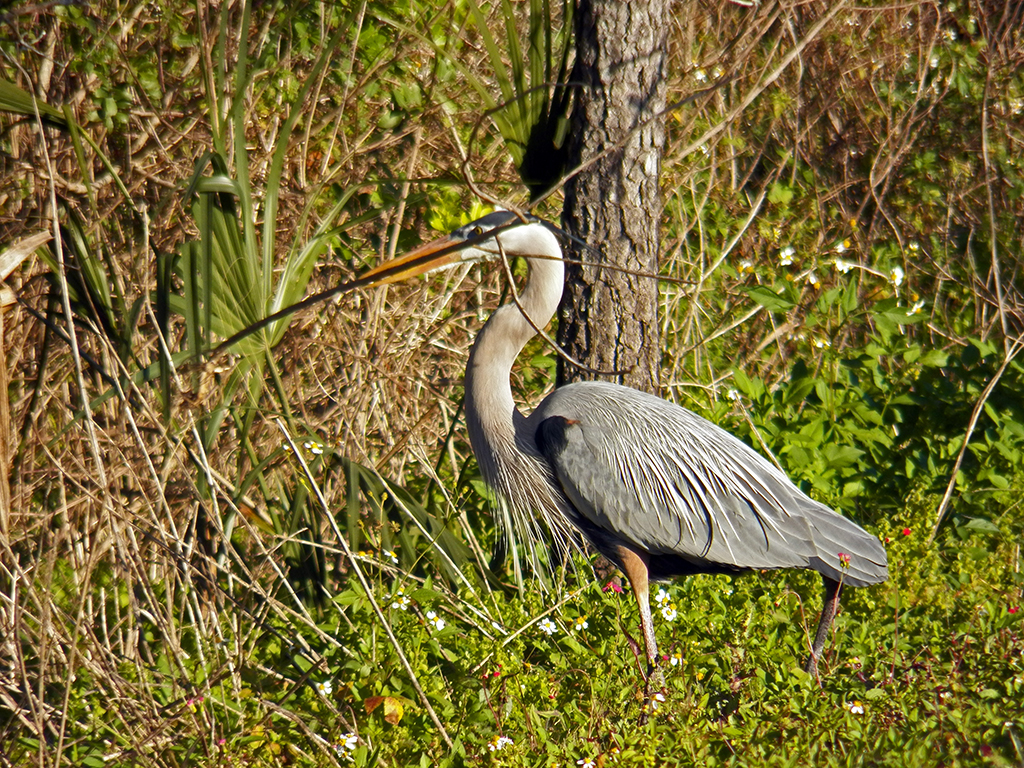
Some birds, like male Great Blue Herons will fly to the margins of the Wetlands and pluck branches or even small saplings, fly to the nest site, and present the object to their mates. Each species has its own rituals and methods for preparing for the next generation.

gbh-stick
This Great Blue Heron male seemed quite pleased with his stick selection.

Another sure sign of Florida spring is the dispersal of waterfowl. Although the number and density of duck species was down this year in the Wetlands, there has been a clear exodus. We saw a handful of Blue-winged Teals and a small group of Ring-necked Ducks in the western ponds, but that was it. Even the coots are starting to move out and separate. There was still one large raft of coots in one pond, but the other larger congregations seem to have gone. The Common Gallinules were a little less conspicuous than usual, although this rather large individual really caught our eye. I speculated it might be a gravid (with eggs) female, but I can’t be sure, because even its head seemed larger.  It was clearly at least 50% larger than the other adult gallinules in its vicinity. We did not see the Purple Gallinule that’s been reported in the past few weeks (though Camille did see during the prior weekend).

huge-gallinule
Everything about this Common Gallinule seemed big.

We saw both species of bitterns, too. The first American Bittern was in no mood for photo-ops and stayed well hidden in a clump of vegetation. In fact, it was quite impressive that a bird the size of an American Bittern could be that well concealed. If the volunteer who spotted it hadn’t alerted anyone to it while it was still more in the open, I don’t know if anyone would have noticed it, and it was only 10 feet away.

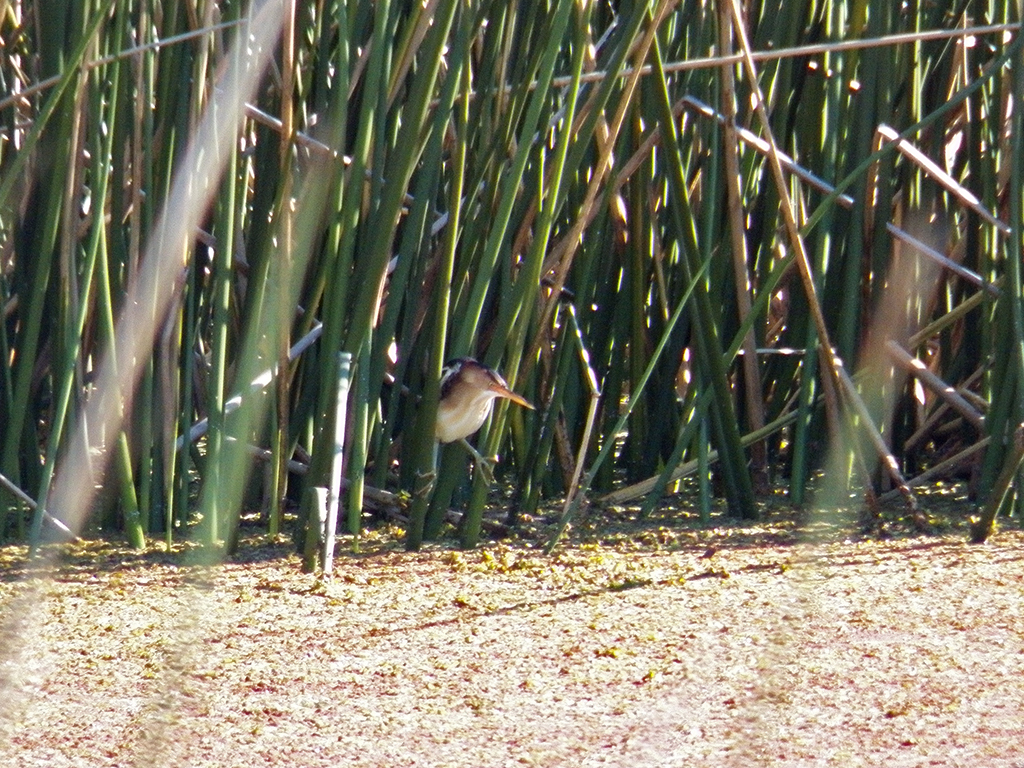
But in one area that Camille has said Least Bitterns have been in consistently, we saw an adult creep out between the reeds. Least Bitterns prefer to climb through vegetation rather than fly, though while raising chicks they will make brief forays into the open. Least Bitterns are the smallest of the herons, not much bigger than many song birds.

least-bittern2
If you look closely, you can see the Least Bittern’s relatively large feet and toes which it is using to easily grasp the reeds. Like most herons, Least Bitterns wait patiently at the edge of the water for a prey item to get in striking range.

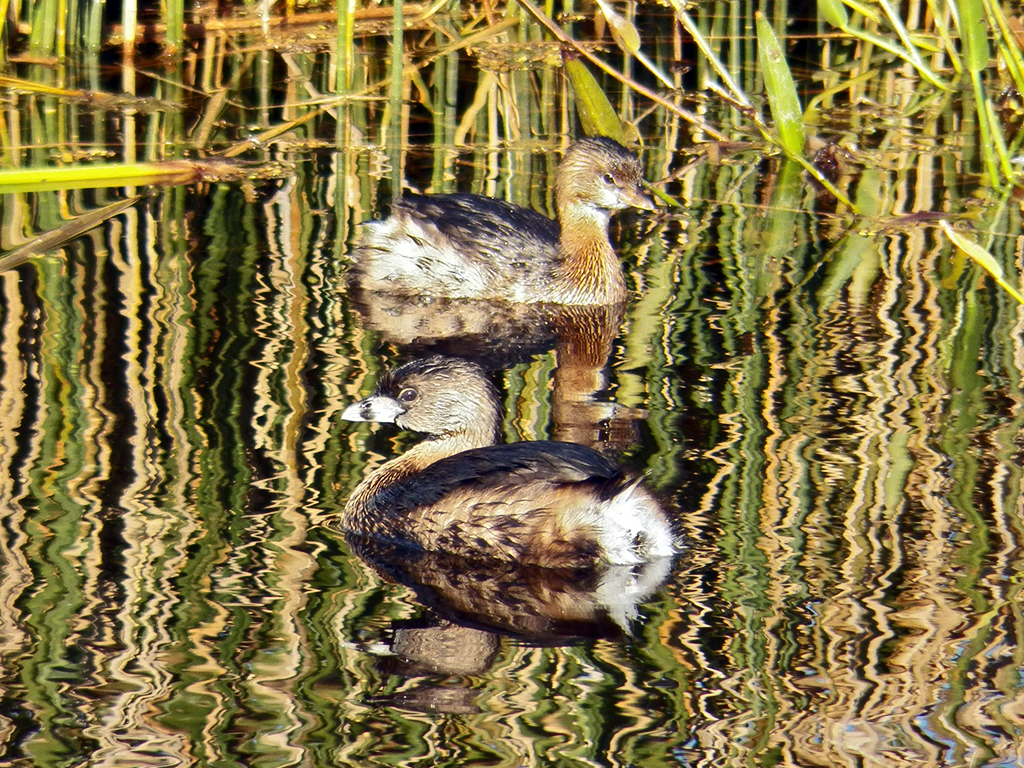
Quite a few immature Pied-billed Grebes were present, along with adults in various stages of molting into their breeding plumage. Pied-billed Grebes lack the more gaudy breeding plumage some of their cousins have, but they do perform ritualistic dances and displays during mating season. They will do pirouettes, dives and even submerged swimming races!

2-grebes
The younger bird, in the back, still has a relatively thin bill, while the adult in the foreground is sporting the “pied bill” that gives the species its common name.

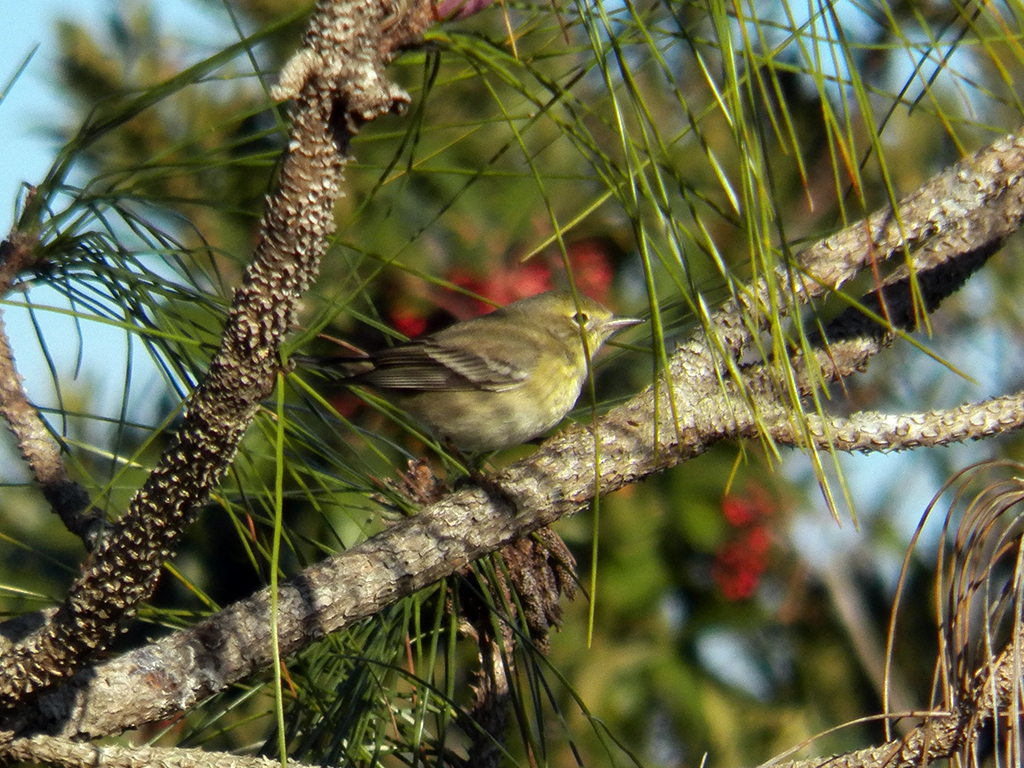
We could hear a lot of Palm Warblers and other small call notes along the outer edge of the road, but it was surprisingly difficult to see any of these birds in the thick underbrush and palm branches. At one point, we both saw a warbler that stood out because of its lack of tail-bobbing. Luckily, I got a descent enough shot of it to confirm later in the evening that it was Pine Warbler.

pine
This isn’t a glamor shot, I know, but more representative of what you’re likely to see when birding.

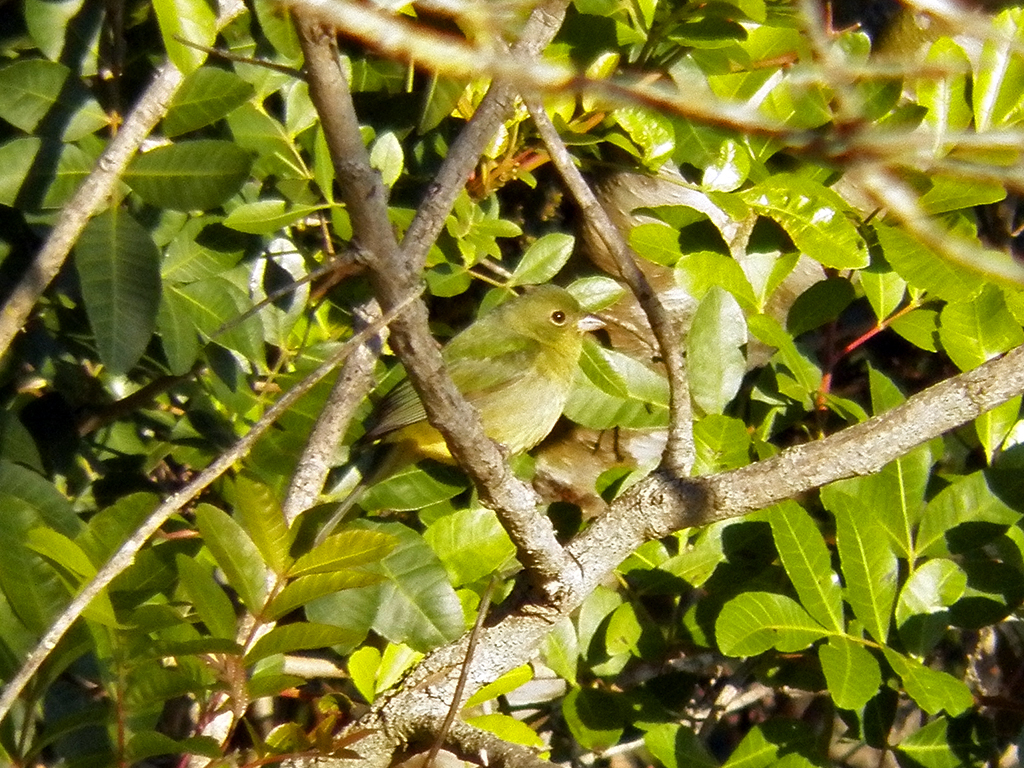
While trying to get good views of the warbler, some bright colored movement caught my eye in some lower branches. Sitting in the sun was a lime-green little bird. In my binoculars the shade of green was almost shocking in its intensity. As my mind went through the usual identification characteristics (size, overall shape, bill shape, etc.) a description my Peterson Guide had to knock at the back of my head a few times before it clicked. There are no bright green North American birds except for Painted Buntings; specifically immature males and mature females are described as “electric green above” fading to an olive or yellowish below. I’ve seen female Painted Buntings at the Merritt Island National Wildlife Refuge Visitors’ Center, and while clearly green, I would never venture to call it “electric green.” This bird, however, was brilliant green. I don’t know if it was a fresh plumaged female or an immature male, but it was stunning.

painted2
It’s hard to explain how much more vibrant this bird looked in the binoculars vs. what the camera captured, but you can see that this bird is GREEN.

Another difference between this bird and the buntings at the feeder at MINWR is that this bird was “puffed out” due to the relatively cool morning (it was in the 40s when we started). Bird shape and apparent size can change a lot depending on what the bird is doing with it feathers, be it for display, warmth or alarm.

painted

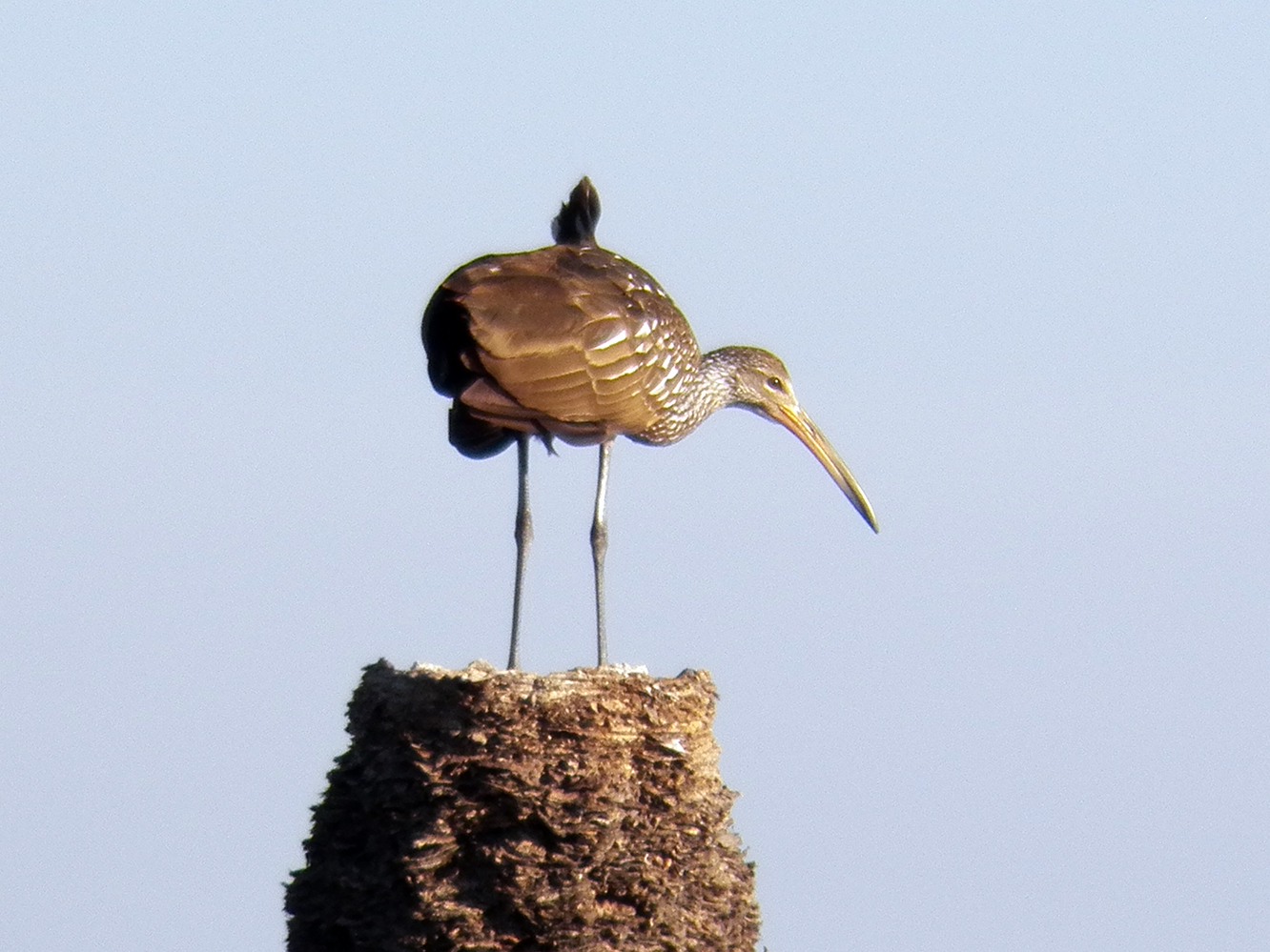
In addition to the several Great Blue Heron nests, there were a few Limpkins chasing each other around in what was either a territorial dispute or an attempt to impress a female. One would fly away and land on top of a dead palm tree only to be chased off to another. This was going on constantly with the Limpkins calling out their strange wailing calls.

wind-blown-limpkin
A wind-blown Limpkin prepares for an incoming challenger to chase him off his pedestal.

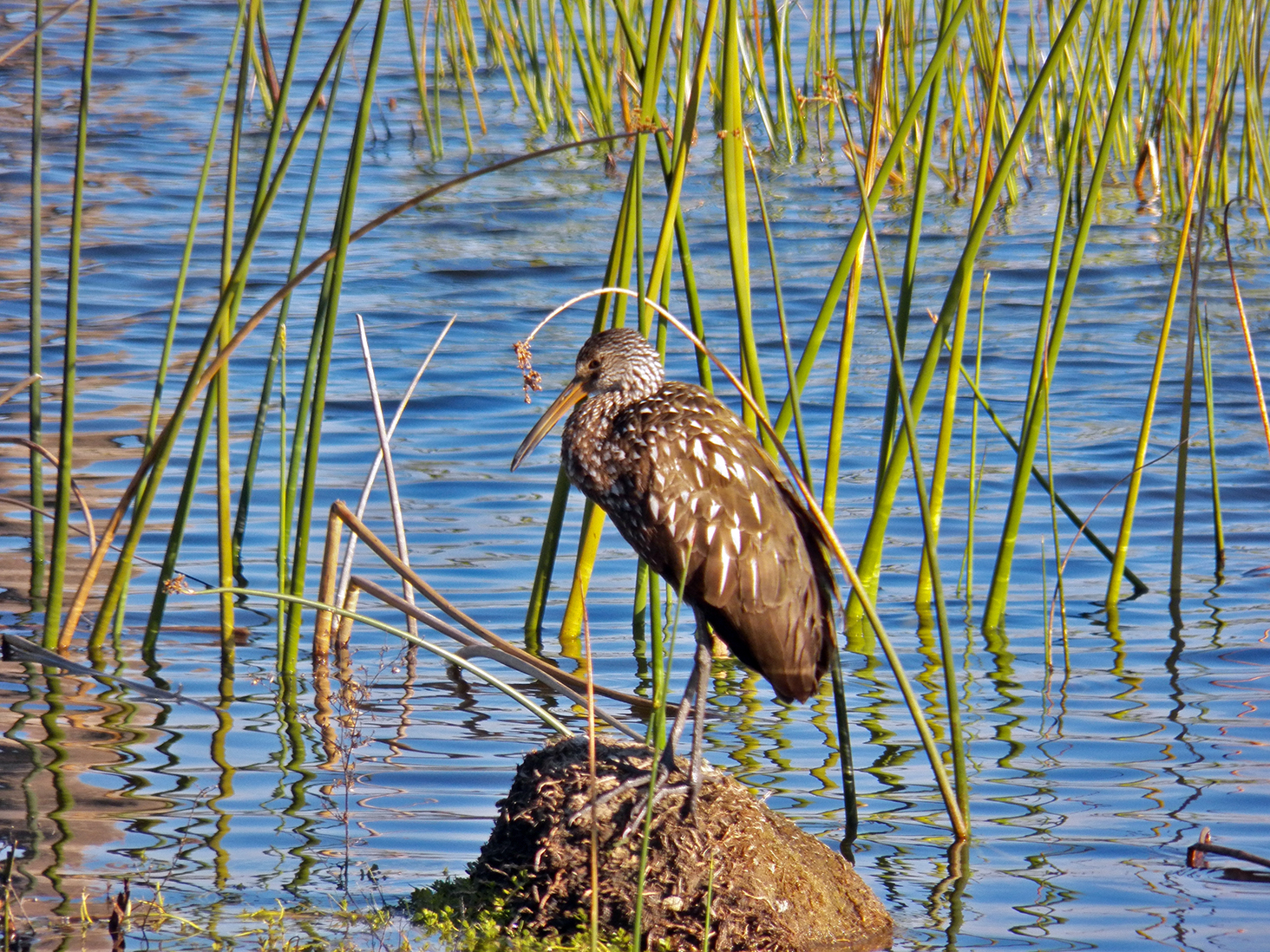
I assumed this quietly resting Limpkin was the female, resting quietly and seeming to ignore the raucous goings on over her head.

resting-limpkin
Not impressed with the boys at all.

We could also hear Sandhill Cranes calling, mostly in pairs, from various parts of the adjacent ranch properties. The cranes will begin nesting very soon, including the mated pair that hangs out near the building I work in. They successfully raised one chick last year (they lost one) after losing both their chicks the year before, likely due to traffic collisions on the busy road nearby.

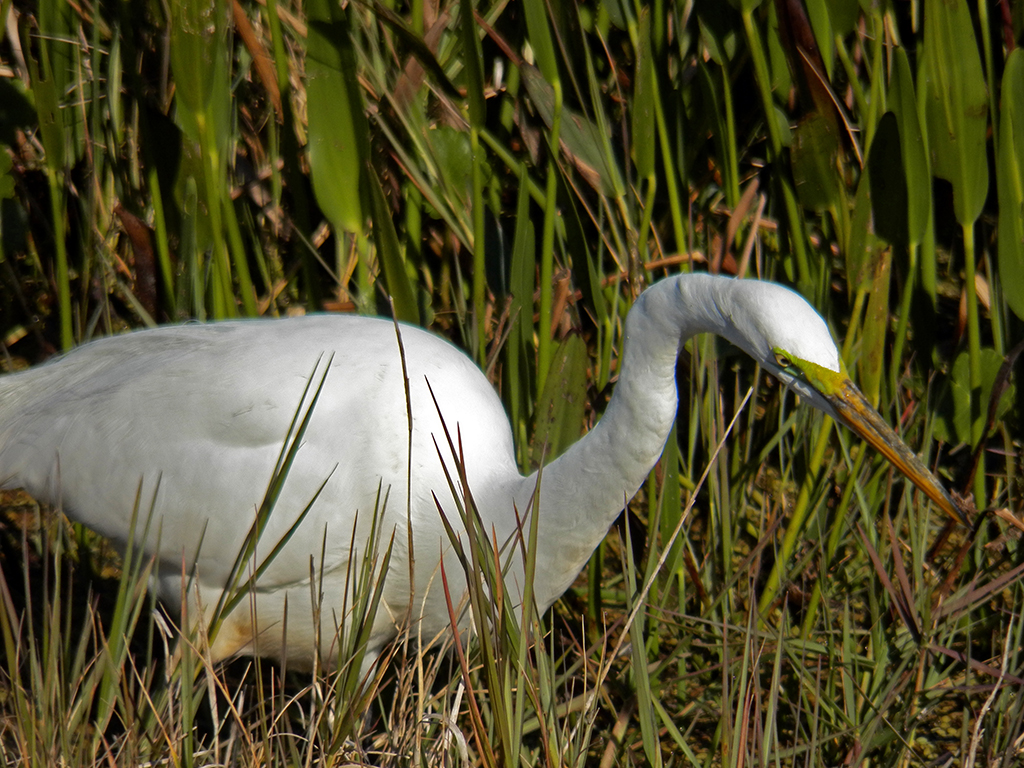
Herons and egrets are getting their breeding plumage, too. In addition to head plumes and aigrettes (the shaggy, pointed feathers, sometimes called lancets), many egret and heron species develop bright colored lores (the area between the eyes, below the forehead). In Great Egrets this is usually lime green, and their bills, which have become dull over the winter, become bright yellow.

great-egret
This Great Egret’s bill and lores are transforming to the brighter colors of the breeding season.

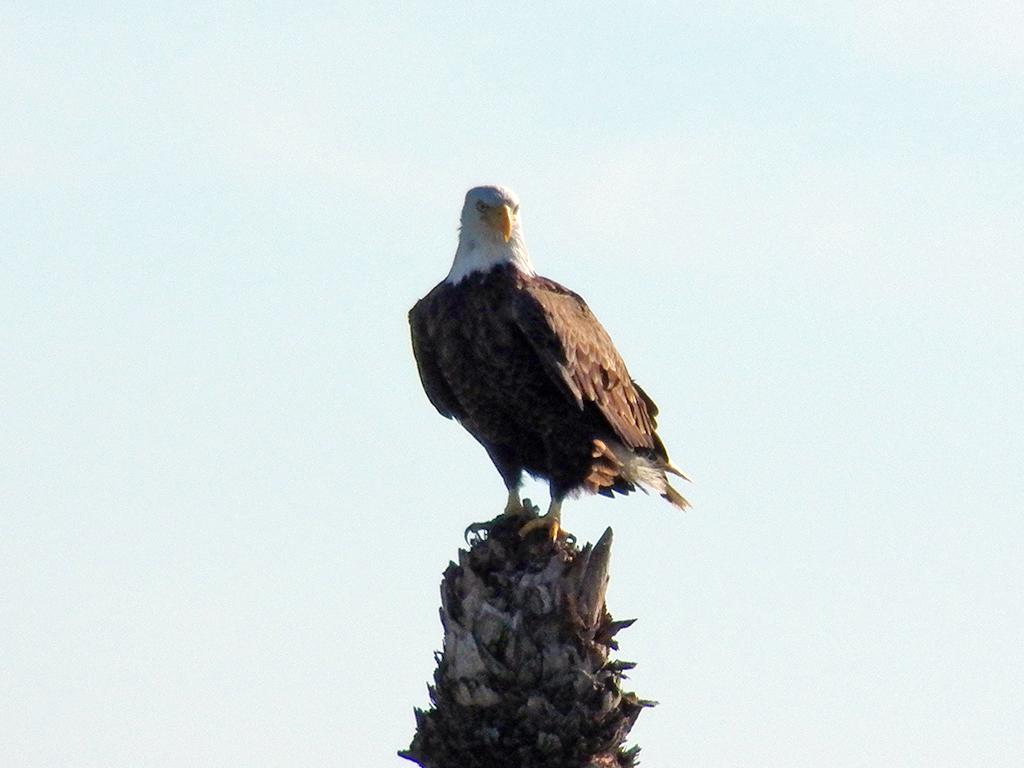
We had a couple of other interesting encounters. A Crested Caracara buzzed over our heads while we were watching a well concealed American Bittern. Later, an adult Bald Eagle stopped awhile on the top of a dead Cabbage Palm. I know there are nesting eagles in the general area, so presumably this is one of the resident adults.

eagle
Dramatically back-lit eagle poses dramatically.

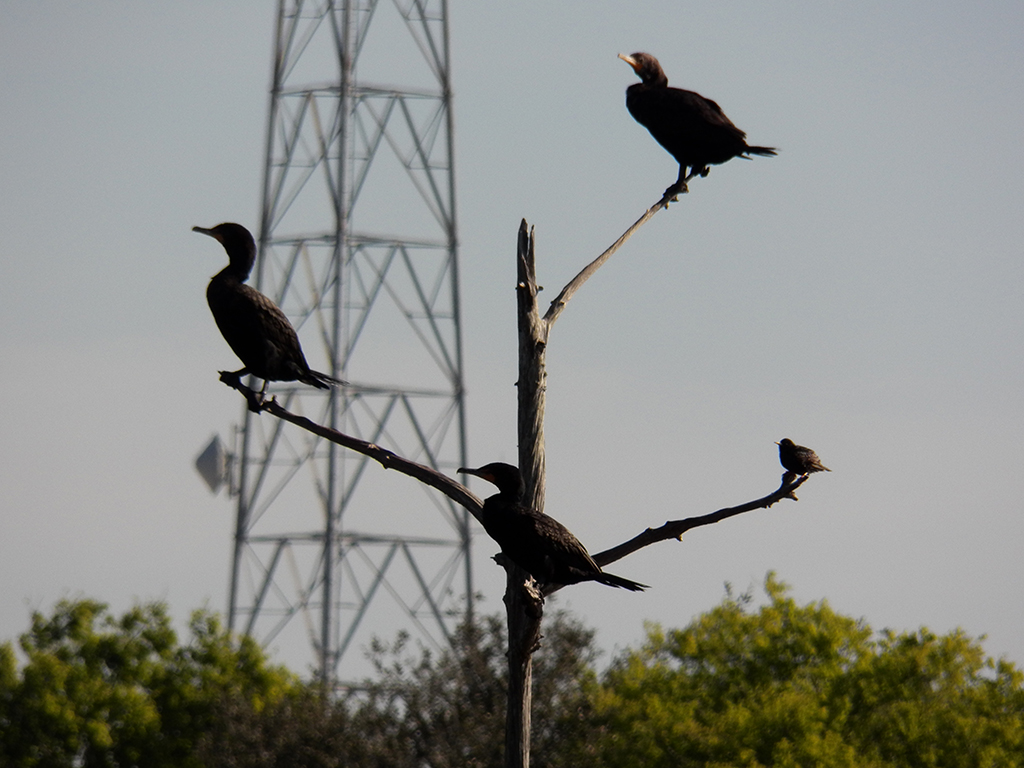
In one of the dead trees on the way toward the exit, I saw this arrangement of birds. Maybe it was convenience, or the hope of a fallen morsel on the starling’s part. I’d like to think they adopted the starling into their family and love him as their own.

one-of-these-things
A peculiar family of Double-crested Cormorants?

Before leaving the Wetlands for a quick (and uneventful) stop at the Moccasin Island Tract, we saw an American Bittern walking the edge of one of the cells, occasionally walking into obscuring brush and reeds, then coming out again with just a slightly wary concern about all the humans watching and taking photographs.

am-bittern
American Bitterns are normally secretive and prefer to keep hidden. Spring time (hormones!) tend to make some species a bit bolder and conspicuous for a time.

My species list for the morning in no real particular order:

  • Tree Swallow
  • Wilson’s Snipe
  • Sandhill Crane
  • Great Egret
  • Great Blue Heron
  • Cattle Egret
  • American Coot
  • Common Gallinule
  • Tri-colored Heron
  • Common Grackle
  • Boat-taiiled Grackle
  • Red-winged Blackbird
  • Hooded Merganser
  • Ring-necked Duck
  • Blue-winged Teal
  • Northern Harrier
  • Belted Kingfisher
  • Eastern Phoebe
  • Turkey Vulture
  • Black Vulture
  • Pied-billed Grebe
  • Palm Warbler
  • Yellow-rumped Warbler
  • Eastern Meadowlark (♫)
  • Carolina Wren (♫)
  • American Robin
  • Pine Warbler
  • Painted Bunting
  • Limpkin
  • Anhinga
  • Double-crested Cormorant
  • Red-bellied Woodpecker
  • Crested Caracara
  • American Bittern
  • Least Bittern
  • Green Heron
  • Bald Eagle
  • Forster’s Tern
  • White Ibis
  • Glossy Ibis
  • Little Blue Heron
  • Bonaparte’s Gull
  • Herring Gull
  • Loggerhead Shrike
  • European Starling
  • Killdeer
  • Northern Mockingbird
  • Osprey

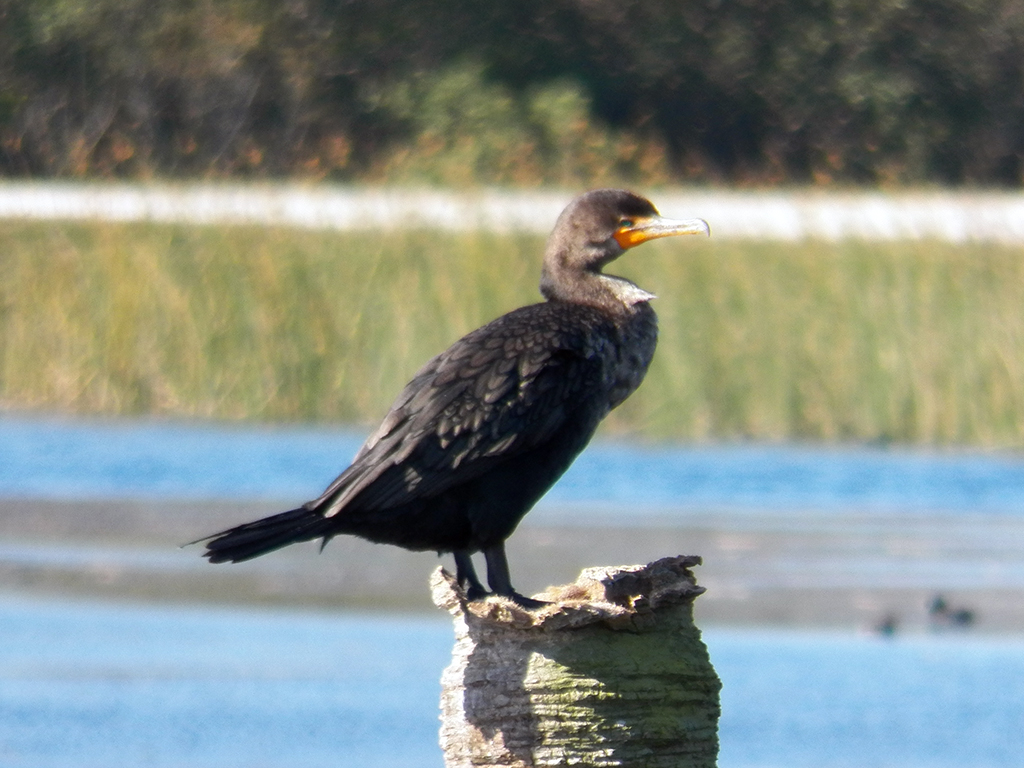
I’ll note that by mid-morning, the wind had really picked up, likely grounding some species and making others hard to locate by sound. The birds most prominently perched by the end of the morning were Anhingas and Double-crested Cormorants, who seemed to take the gusts in stride (and probably using them to help dry their feathers after a dive and swim, looking for Sunday Brunch).

cormorant
“Mmmf. Sunday drivers!”

It was a nice change of pace, and it’s hard not to get excited with a new birder along. I’ve known Camille for a long time now, and I’m sure if she puts her mind to it, she’ll go a long way with birding or any wildlife observations she chooses to pursue.

SCBWF 2015 : January 25 : Marl Bed Flats and Lake Jesup : MINWR II

Now that my winter break is over, and I am back in sunny Florida, it’s time to pick up where we left off with the Space Coast Birding and Wildlife Festival.

On Sunday, the 25th, I had my only repeat field trip from last year (besides the pelagic trip). The trip leader this year was Corey Finger (co-owner of the 10,000 Birds blog). I stayed in touch with Corey mostly through Facebook after last year’s field trip, and I had hoped to be able to spend at least a lunch or something with him this year, but as hectic as these festivals are, we weren’t able to make that happen. Corey is, of course, a fine birder and excellent photographer.

Another difference between last year and this year is the amount of rain we had here in east central Florida. This made the Marl Bed Flats very muddy and meant we were situated much further away from the wetlands and thus less able to pick out interesting shorebirds or other action going on closer to the lake. Also, the increased water didn’t allow the thicker ground cover to grow that sparrows prefer, so we had very few sparrows this year compared to last.

Marl Bed Flats are flat.

We had some decent spotting scope views of some birds, but most stayed fairly well out of my camera’s effective range. This Red-tailed Hawk was close enough to get a photo, though.

red-tailed
You can tell this is a young bird by the limited banding down the breast and belly.

By far the most numerous bird species that morning were the American Robins. Robins migrate into Florida from adjacent southern states, and set up in woods and scrub in enormous flocks. In winter, these robins are much more gregarious (hanging out together) and out of sight than in spring and summer, when they are a main-stay of many suburban yards. There was a constant stream of them flying overhead all morning. Our best estimate was over 2,000 birds.

We saw a handful of Savannah Sparrrows, but most of the small birds were Palm Warblers. Since most were of the “Western” or gray variety, it was often the tell-tale bobbing tail that gave away the identification of the bird.

The Palm Warblers were happy to skitter around in the thick grasses.
The Palm Warblers were happy to skitter around in the thick grasses. You can see how non-descript the “Western” form is.

We walked along some more wooded areas on our way out of the Flats and encountered some more upland birds, including Blue-headed Vireos, Yellow-rumped Warblers, and a Ruby-crowned Kinglet.
From the Flats, we drove around the lake to Lake Jesup Park to see what birds were hanging around. Last year we flushed a pair of Great Horned Owls from the nearby Live Oaks, and we heard reports that they were present, but we never saw one; however, a woman on the trip and myself both heard a distant day-calling Great Horned Owl, but we were unable to locate it.
lake-jesup
Boat access to Lake Jesup. Just off the end of this little inlet were several Bonaparte’s Gulls, elegantly swimming on the surface.
Beyond the boat access inlet were Bonaparte’s Gulls and some herons. Bonaparte’s Gulls are small, hooded gulls in summer. In winter they have a distinctive “ear” patch. That patch, along with their size and proportions, are diagnostic identifiers. They swim more buoyantly than most gulls and are as graceful in the air as any tern.

After some searching about, we did get some Black-and-white Warblers and other warbler species. Corey and a few others saw a Prairie Warbler, but I was unable to verify the ID for myself.

Species list (eBird order – Thanks, Corey!):

  • Wood Duck
  • Blue-winged Teal
  • Pied-billed Grebe
  • Wood Stork
  • Double-crested Cormorant
  • Anhinga
  • Great Blue Heron
  • Great Egret
  • Snowy Egret
  • Little Blue Heron
  • Tri-colored Heron
  • White Ibis
  • Glossy Ibis
  • Black Vulture
  • Turkey Vulture
  • Bald Eagle
  • Red-shouldered Hawk
  • Common Gallinule
  • American Coot
  • Sandhill Crane
  • Killdeer
  • Greater Yellowlegs
  • Bonaparte’s Gull
  • Ring-billed Gull
  • Forster’s Tern
  • Common Ground Dove
  • Mourning Dove
  • Red-bellied Woodpecker
  • Pileated Woodpecker
  • American Kestrel
  • Eastern Phoebe
  • Loggerhead Shrike
  • Blue Headed Vireo
  • American Crow
  • Tree Swallow
  • Tufted Titmouse
  • Carolina Wren (♫)
  • Blue-gray Gnatcatcher
  • Ruby-crowned Kinglet
  • American Robin
  • Gray Catbird
  • Black-and-white Warbler
  • Common Yellowthroat
  • Palm Warbler
  • Yellow-rumped Warbler
  • Savannah Sparrow
  • Northern Cardinal
  • Red-winged Blackbird
  • Eastern Meadowlark (♫)
  • Boat-tailed Grackle

On the way back to Titusville, I decided to try once again for the Long-tailed Duck near Parrish Park. The wind had died down considerably from previous days, and the sky was clear. I first searched along the north side of the bridge, and saw two birds swimming that looked very grebe-like.

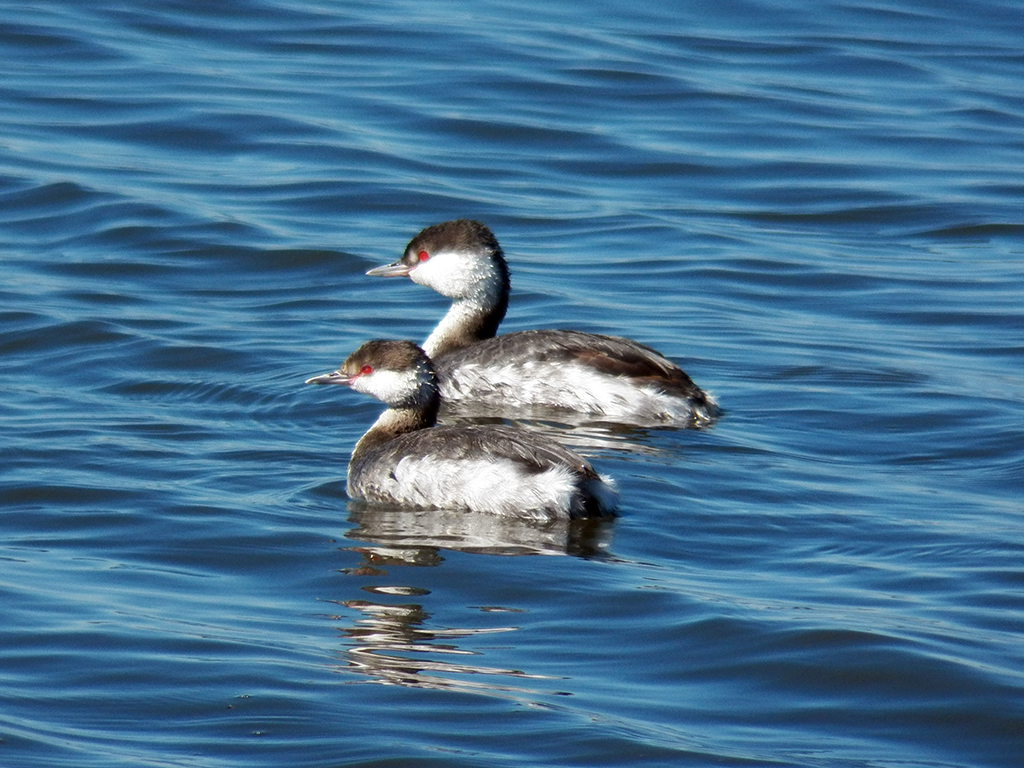
horned-grebes
Super-cute Horned Grebe couple.

My first Horned Grebes were swimming and diving together. Based on the size difference, I assume this is a mated pair. Horned Grebes look much different in summer than in winter, but are quite handsome birds either way.

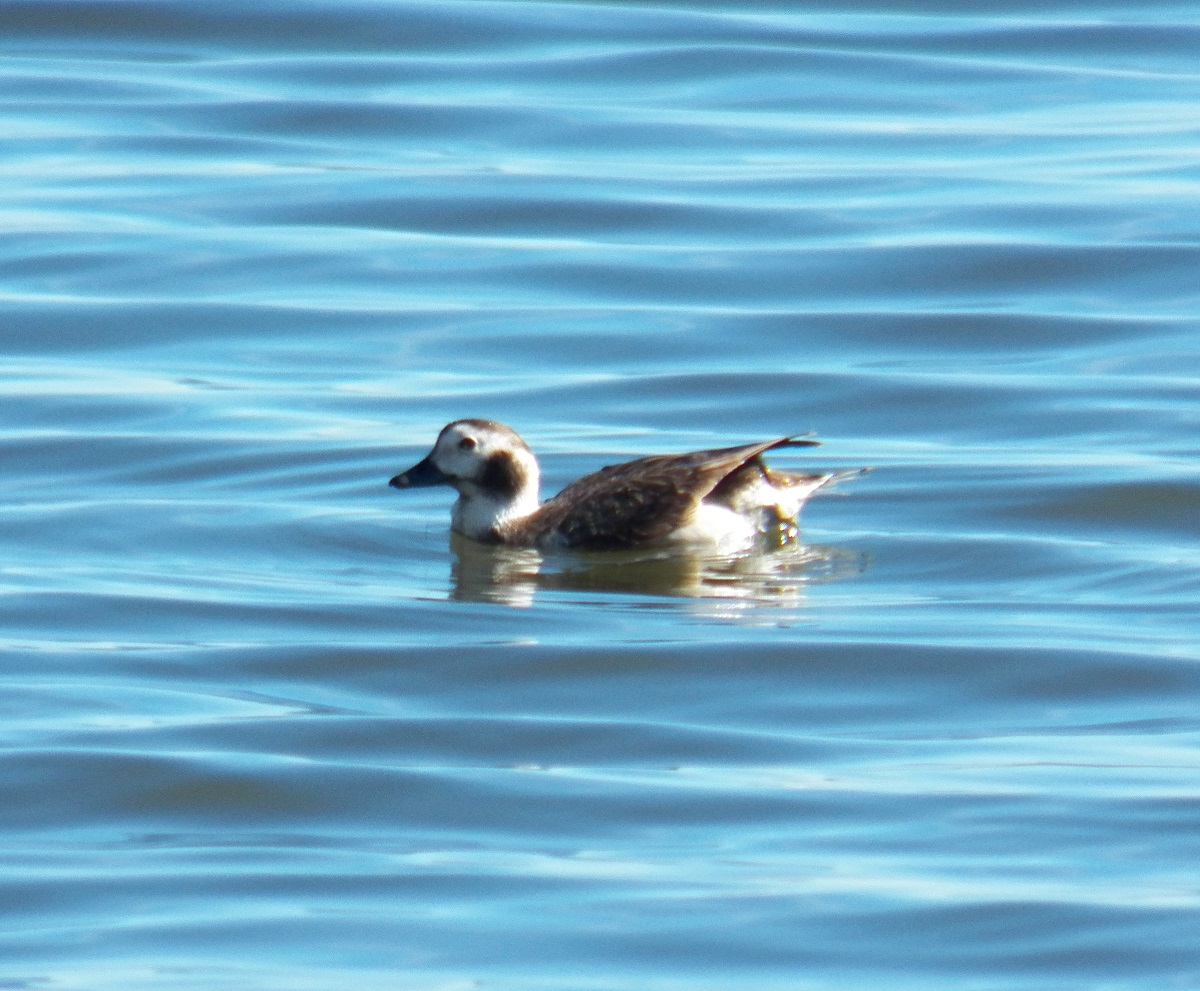
An older gentleman approached me and asked if I was looking for the Long-tailed Duck. Of course, I was, and he told me a couple had pointed out to him that it was on the south side of the bridge, close in with a small group of scaups. And there it was, a 1st-year winter male Long-tailed Duck. This is a rare bird for Florida (though not exceedingly so), and after two days of looking, it was nice to finally see him. [Edit 2015 Feb 17: Some observers have identified this as a winter female, but based on the information I have, I’m sticking with the first year winter male ID unless someone has something else that’s more definitive.]

long-tailed-duck-7
I’m glad I ducked under the bridge to find this bird. Otherwise I might have gone quackers wondering where it was.

After watching both the grebes and the Long-tailed Duck for a while, I decided to do Blackpoint Wildlife Drive again now that the weather was calm. I was hoping more duck species would be out in numbers, and perhaps a few more shorebirds.

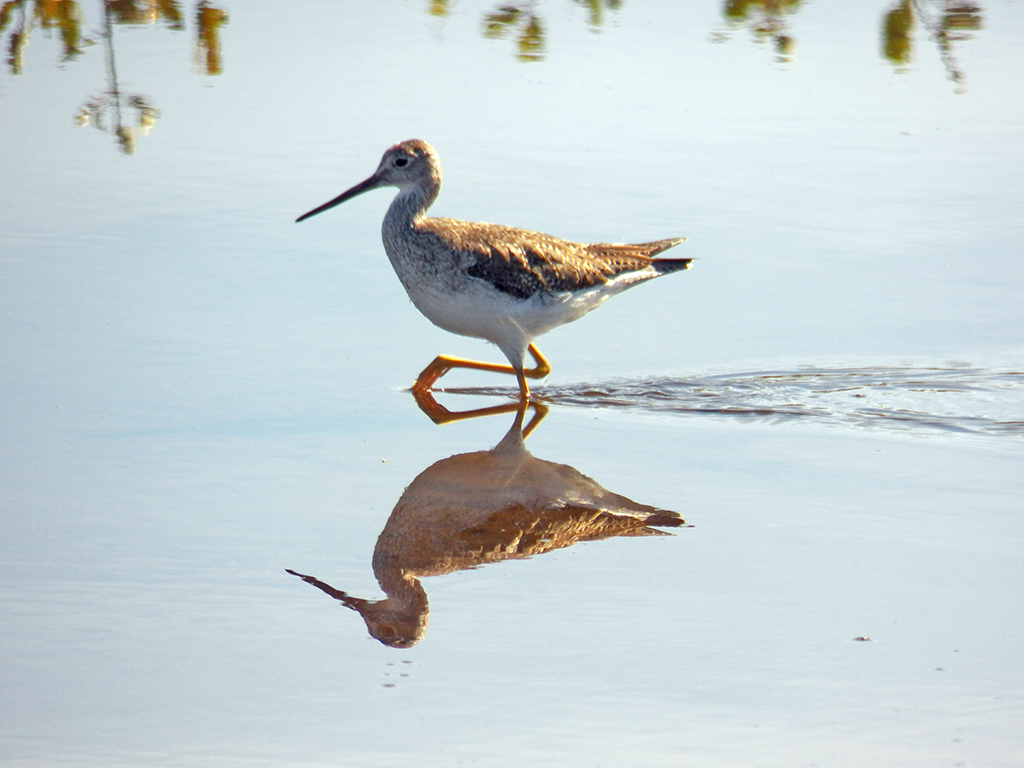
High-stepping Greater-yellowlegs.

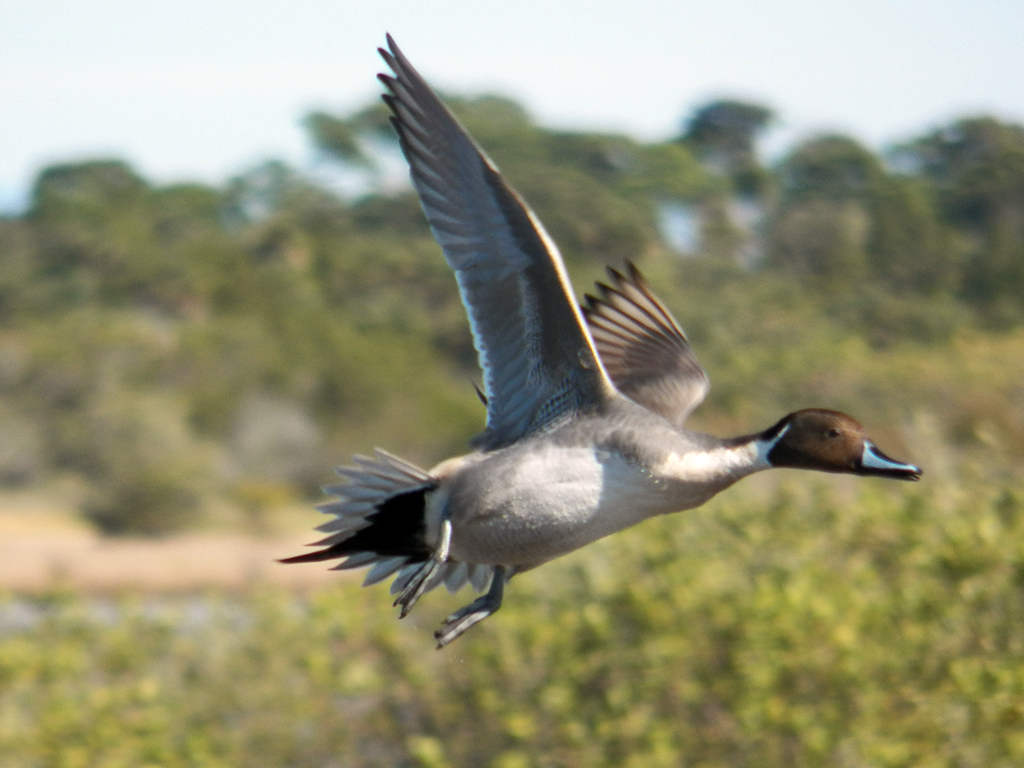
There were some wading birds a little more accessible than previous days, and there were more Northern Pintails in the open water, too. I heard that some Redheads and Ruddy Ducks were seen by some people, but I couldn’t find them. There were still some distant large mixed rafts of American Coots with Ring-necked Ducks, Blue-winged Teals and other ducks that could have been hiding these birds. The pintails and shovelers were more active and about, with several in flight at any give time.

pintail-flight-MINWR
Northern Pintail cleared for landing.

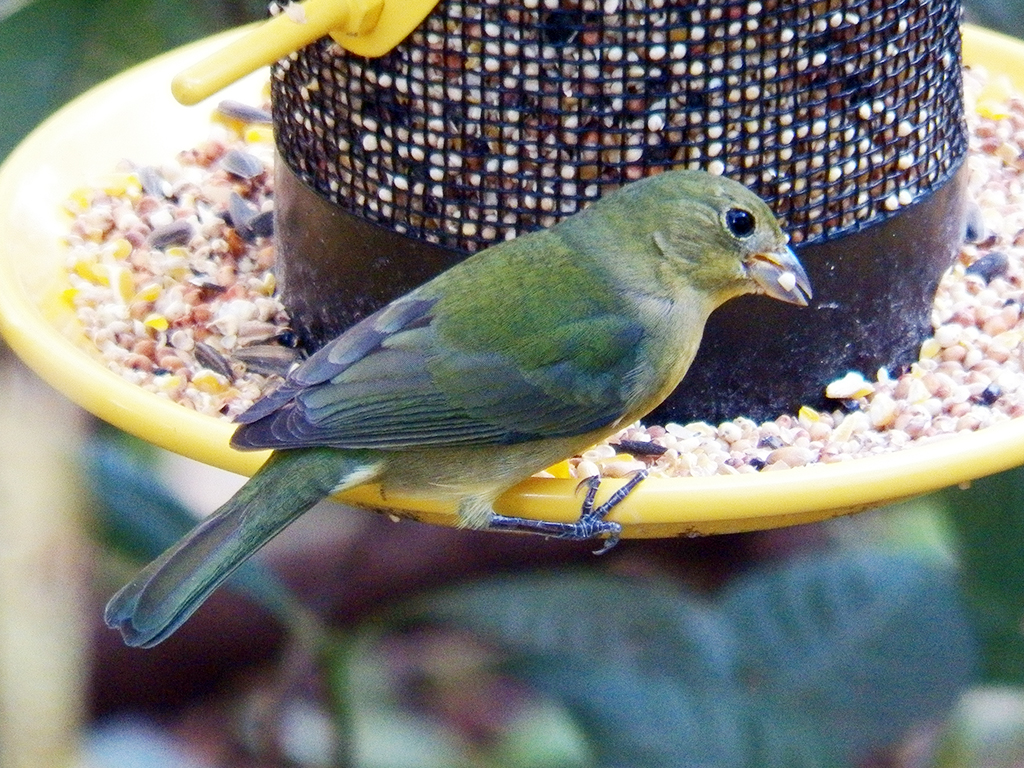
As the sun began getting low, I stopped at the MINWR Visitors’ Center and did finally see a single female Painted Bunting at their feeder, and then it was time to go home and get some rest for the final adventure of the Festival: the pelagic boat trip.

painted
Female Painted Bunting at the Visitors’ Center.

Birds seen at MINWR:

  • Great Egret
  • Snowy Egret
  • Tri-colred Heron
  • Little Blue Heron
  • Great Blue Heron
  • Reddish Egret
  • Belted Kingfisher
  • Greater Yellowlegs
  • Lesser Yellowlegs
  • Killdeer
  • Dunlin
  • American Coot
  • Double-crested Cormorant
  • Anhinga
  • Caspian Tern
  • Royal Tern
  • White Ibis
  • Glossy Ibis
  • Turkey Vulture
  • Black Vulture
  • Roseate Spoonbill
  • American White Pelican
  • Northern Pintail
  • Blue-winged Teal
  • Northern Shoveler
  • American Wigeon
  • Pied-billed Grebe
  • Wood Stork
  • American Avocet
  • Palm Warbler
  • Common Yellowthroat
  • House Wren
  • Painted Bunting
  • Red-winged Blackbird
  • Boat-tailed Grackle
  • Mourning Dove
Snowy-MINWR
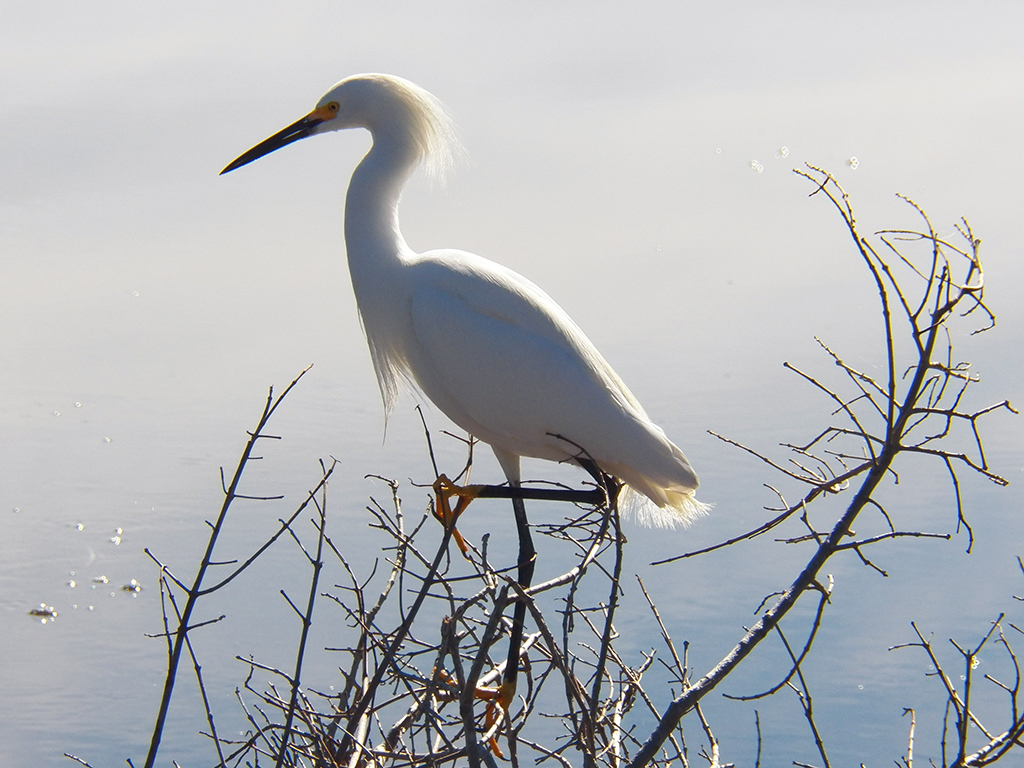
Snowy Egret at sunset.

Will It Fly High Like A Bird Up In The Sky?

This past Sunday was my first birding-specific outing of the year, and I decided to check in on my old favorite haunt, Turkey Creek Sanctuary. The weather has been pretty mild, so I was hopeful for some good bird activity.

The past couple of years have really been a let-down for the Sanctuary. Birds seem to be utilizing the park less and less, and good activity is much more sporadic. I’ve seen a couple of reports via the BRDBRAIN and FLORIDABIRDS-L e-mail lists of some decent sightings there, but my morning was more typical of my other outings there.

One major change in the Sanctuary from two or three years ago is the relative dearth of Northern Cardinals. Regular and long-time readers will note my somewhat antagonistic love-hate relationship with these birds. They are beautiful to see and hear, but they had nearly overrun the Sanctuary. It had gotten to the point that their calls and songs were drowning out those of other birds I was trying to find and observe. Oh, how I wish for the good ol’ days! I saw a total of 2 and heard perhaps half a dozen cardinals for the entire morning.

What were plentiful were the American Robins and Blue-gray Gnatcatchers. Right upon entering the park and nearing the boardwalk, the first of what would be at least half a dozen overflights of a 10 or 15 American Robins flew overhead. American Robins are migratory; birds from the southern USA make their way to Florida and Mexico for the winter, while birds from further north move into the southern USA. The end result is a north-south shift of the the robins’ range, out of Canada, with a large section of the country having robins all year, though probably not the same robins. I never saw any robins in the park, just flying high over my head, en route to whatever winter roost they will use until they leave in the Spring.

Image ©2007 WhatBird.com

I caught up to a small flock of gnatcatchers on the boardwalk and enjoyed watching them hop and flit about the tree-tops, singing out their wheezy little calls. I was also watching the group closely because often other small birds will associate with the gnatcatchers. Sure enough, a small group of Blue-headed Vireos was there in the same tree. Both the gnatcatchers and the vireos are quite active, but I managed to snap some photographs, clearly showing the Blue-headed Vireos’ diagnostic fieldmarks: white spectacles on a gray head, with yellow flanks and an olive-greenish tail.

bh-vireo
This Blue-headed Vireo was palling around with some Blue-gray Gnatcatchers.

A breeze picked up by mid-morning, sending leaves and other debris swirling around the more open areas. By this time of year at the Turkey Creek Sanctuary the deciduous trees have dropped most of their leaves and the canopy is much more open, which makes observing any overflying birds (like the American Robins) easier. On this day I noted White Ibises, Black and Turkey vultures, a Double-crested Cormorant, and even a high-soaring Anhinga. A pair of Ospreys also went by, calling to each other as the wind swiftly carried them out of sight.

Some typical winter residents were also present, though in very low densities. I saw a single Yellow-throated Warbler, one Downy Woodpecker and two Ruby Crowned Kinglets. My very first visit to this park in 2002 coincided with a mass visitation of kinglets. There were literally hundreds of them throughout the park, hopping on the boardwalk railings and filling the adjacent trees with chittering notes.

I took the opportunity this trip to walk the Scrub Trail. I tend to neglect this trail, mainly due to low bird activity, but it’s a nice loop off the trail leading to the jogging and exercise paths.

path
“A path! A path!”

As I returned back along the western and northern edge of the park toward to exit, I caught the song of a Yellow-throated Vireo over the fence-line. It sound like it came closer a few times, but I never did catch sight of it. I hung around for a while (getting a fire-ant bite on my finger for my troubles) before moving along and out.

Species seen by approximate order of identification:

  • Black Vulture
  • Ring-billed Gull
  • Rock Pigeon
  • White Ibis
  • American Robin
  • Northern Cardinal
  • Blue-gray Gnatcatcher
  • Blue-headed Vireo
  • Carolina Wren (♫)
  • Fish Crow
  • Turkey Vulture
  • Yellow-throated Warbler
  • Downy Woodpecker
  • Gray Catbird
  • Anhinga
  • Ruby-crowned Kinglet
  • Ovenbird
  • Palm Warbler
  • Blue Jay (♫)
  • Double-crested Cormorant
  • Yellow-throated Vireo
  • Osprey
  • Red-bellied Woodpecker (♫)

Happy New Year everyone, and here’s to another great year of birding!

Scaup ID: A Few Tips

Two varieties of scaups frequent east-central Florida. Telling them apart can be a little challenging, especially if they are not seen together, but there are a couple of tips that might help.

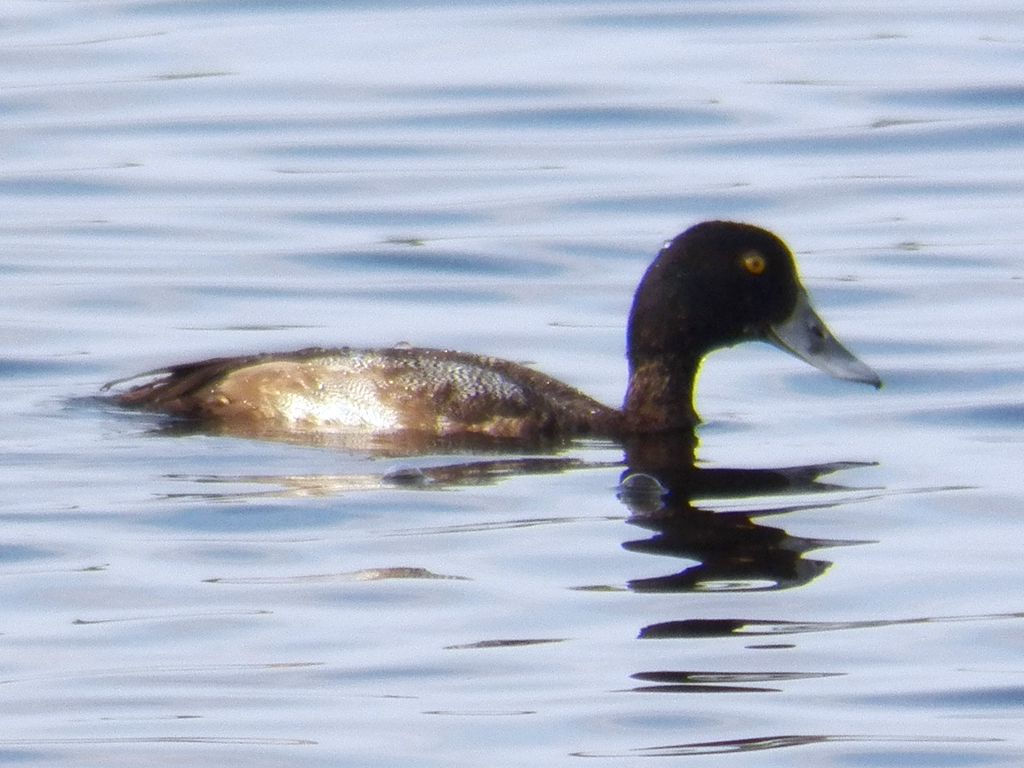
Greater Scaups generally have flatter or rounder heads, compared to Lesser Scaups. Lesser Scaups often have a slight crest or point at the top of the head, behind the eye. Head color is sometimes mentioned as a way to tell them apart, and in the photos below you can certainly see how the Lesser Scaup has a redder head. My experience in the field, however, shows that sometimes the head colors are almost indistinguishable.

g-scaupl-scaup-alt

When seen from the front, Greater Scaups have a wider head bill and nail (the spot at the tip of the bill). The Lesser Scaups’ bills and nails tend to look “squished” sideways. The photo below and to the right isn’t exactly head-on, but you can see how the nail is almost completely round, while the nail on the Greater Scaup (on the left) is a bit wider than it is tall. There is certainly overlap, and viewing angle can complicate things, but at least it is another ID tool that might help with a positive identification.

g-scaup-frontl-scaup-front

Remember, not all birds can be positively identified every time. I have ambiguous bird sightings almost every time I’m out (birding or just doing errands). For example, more subtle point between these two species is the amount of white showing on the sides when these ducks are on the water. Normally, more white shows on the Greater Scaup, while less is evident on the Lesser Scaup. In the photos above, you can see more white on the Lesser Scaup. Trying to figure out what’s what is sometimes its own reward. The joy of birding is in the journey.

Will It Go ‘Round In Circles?

Another year and we’ve about circled around again. It’s fitting that I end the year at the same place I ended last year: at the Merritt Island National Wildlife Refuge’s (MINWR) Blackpoint Drive. This year I saw some of the same cast of players as last year, but hopefully with a keener eye and with some surprises on the way.

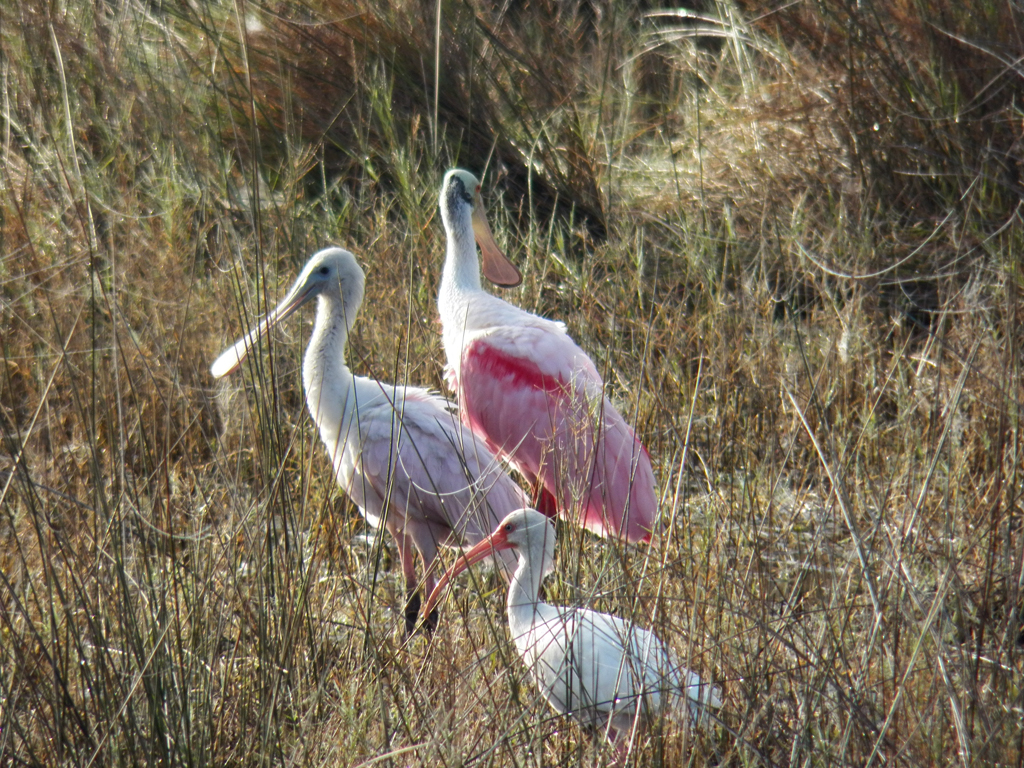
The main stars this time were the Roseate Spoonbills. At several points along the drive, several cars were pulled over and everyone was out taking pictures of relatively large flocks of spoonbills. I was fortunate to catch a good look at this pair, pictured below. I’ve not seen an immature Roseate Spoonbill until now.

spoonbills-young-old
An immature Roseate Spoonbill (left) and an adult (right) with a White Ibis in the foreground.

The spoonbills were aggressively feeding with a group of mixed herons and ibises, along with smaller interlopers like Hooded Mergansers and Boat-tailed Grackles.

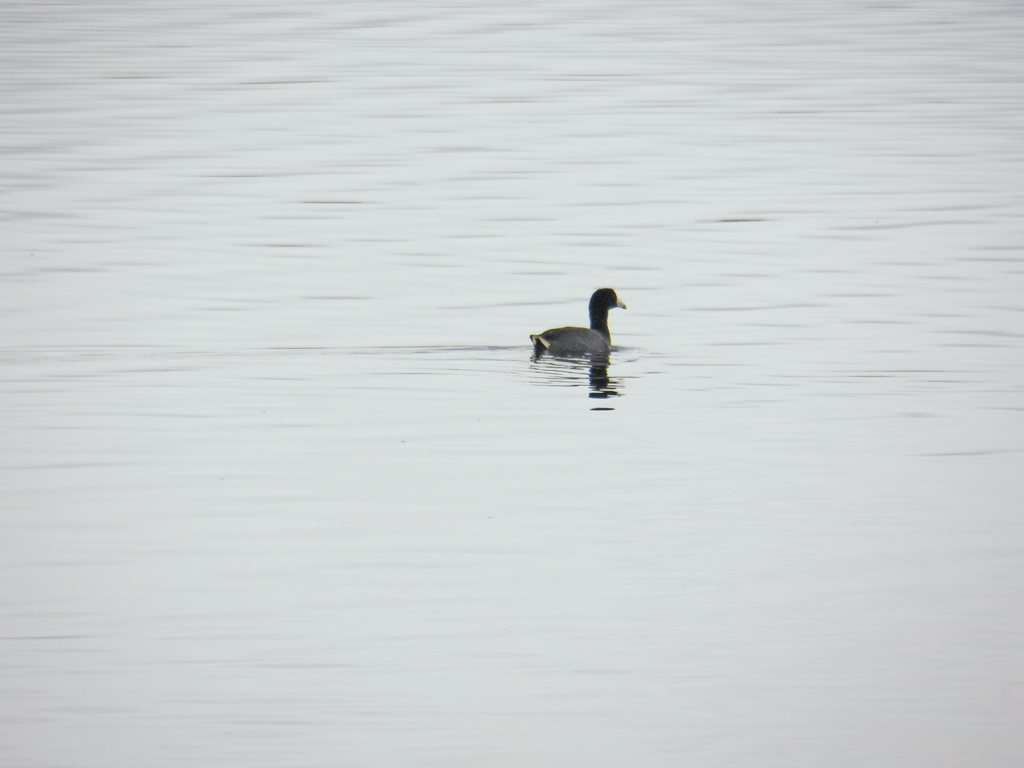
As I made my way around Blackpoint Drive, the most obvious birds just about everywhere were the American Coots. It must not take much to make a coot happy. They are generally present in large numbers, especially during the winter. Unlike Common Gallinules, American Coots seem to thrive equally in brackish or fresh water. Overwintering ducks often raft with them, I imagine for protection (safety in numbers).

coots-n-things
Going incognito: Look closely and you’ll see Lesser Scaups and Pied-billed Grebes in with the American Coots. I think there’s even a RIng-necked Duck back there somewhere.

I was surprised to learn this past year that Reddish Egrets are actually fairly rare and of conservation concern in Florida. I’ve only seen them at MINWR and at Fay Lake Wilderness Park. I was able to make a short video clip of one feeding, using it’s characteristic “drunken” dance strategy.

“What will we do with a drunken egret? What will we do with a drunken egret? What will we do with a drunken egret? Early in the morning!”

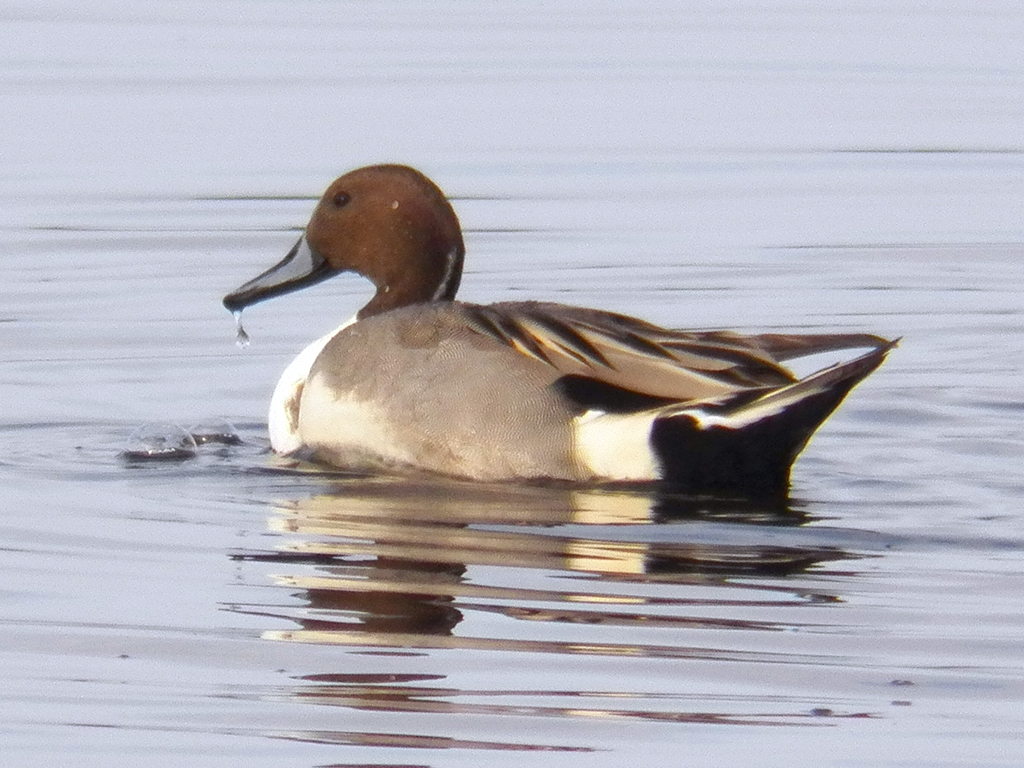
MINWR is a good place to find Northern Pintails, too. Pintails are dabblers; they tip back-end up to reach their food and then briefly upright themselves before tipping back down again. Dabblers will often synchronize their tip-ups, looking like some mad duck Esther Williams wannabes.. This would seem to be counter to an effective predator look-out system, since there is significant time where their heads are all underwater, but it seems to work.

pintail-male
Male Northern Pintail after coming upright. This one has either recently lost or has not yet grown in his long “pintail” for which the species gets its common name.

Both species of scaups were present, though as usual the Lesser Scaups far outnumbered the Greater Scaups. There are a couple of good pointers for telling the two apart, especially if they are both present near each other. I’ll have that as an upcoming post, after the New Year holiday.

g-scaup
Oh, great, a scaup! He is Greater than any other scaup I’ve seen!

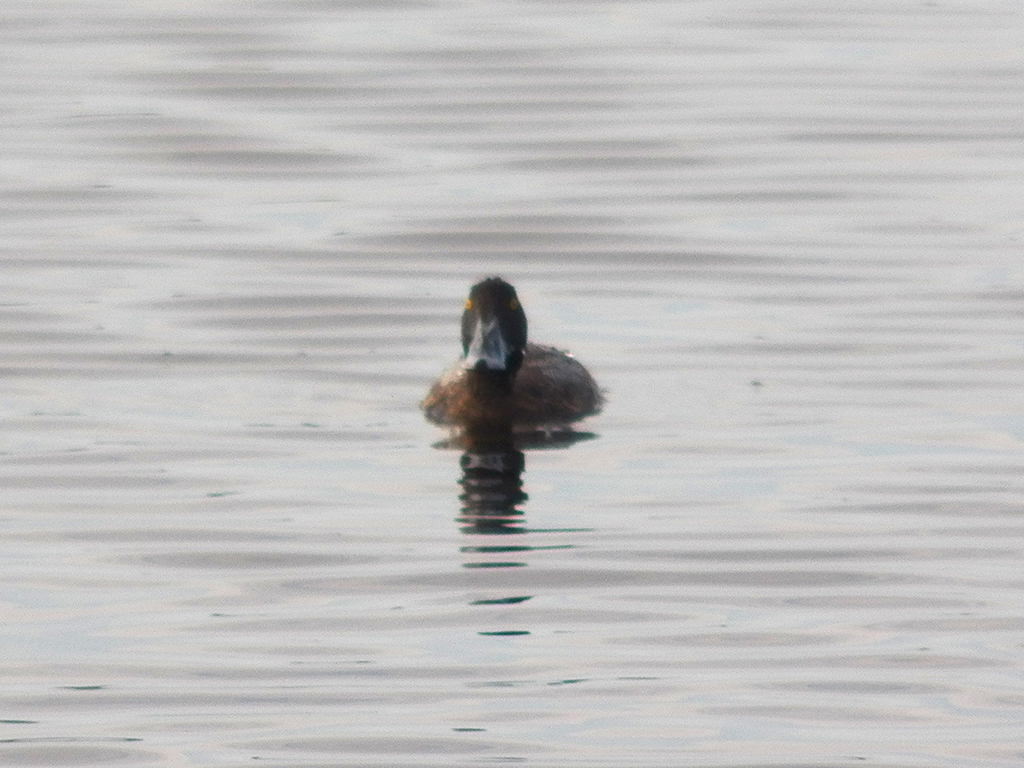
Scaups are diving ducks. Like grebes, they will often quickly submerge when they feel threatened and resurface quite a distance from where they first went under water. This can cause some consternation when trying to focus on them in a viewfinder and suddenly they have vanished and you have to remember to put the camera down and wait for it to resurface.

invisible-scaup
This is not a photo of an American Coot. OK, well, it IS a photo of an American Coot, but it’s SUPPOSED to show a Greater Scaup.

Blackpoint Drive is definitely a “waders and rafters” sort of experience for many visitors. There might be the occasional hawk or eagle, and in the shallower sections there can be sandpipers and other shorebirds. But even with my 8x40s the shorebirds can be hard to distinguish. I did bump into a couple that had a nice digiscope out and that was useful in identifying some gulls, terns and sandpipers. There were hundreds of Dunlins, but also a few yellowlegs (both Greater and Lesser species) and some Black-bellied Plovers. Black-bellied Plovers seem so gentle and almost fragile in their winter plumage. They walk very delicately, compared to the frantic running and dashing of the yellowlegs, and the purposeful striding of the Willets.

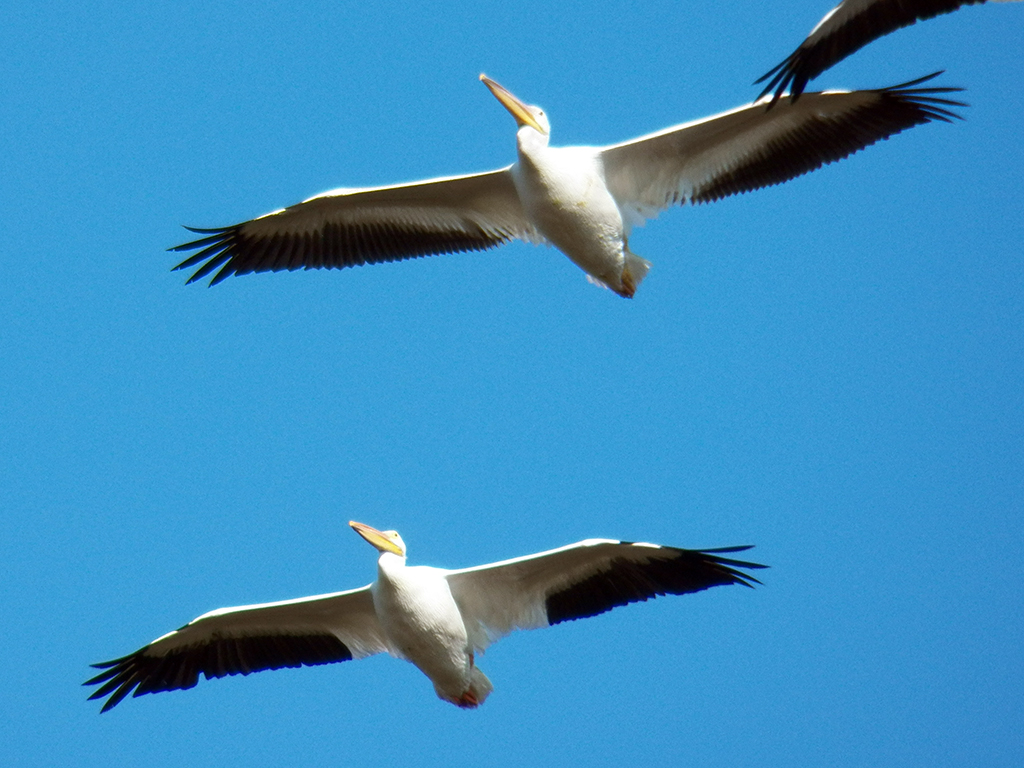
Just as last year, flights of American White Pelicans soared overhead. I am always awed and impressed with these huge birds. They are ponderous, yet graceful and majestic, yet slightly goofy.

pelican

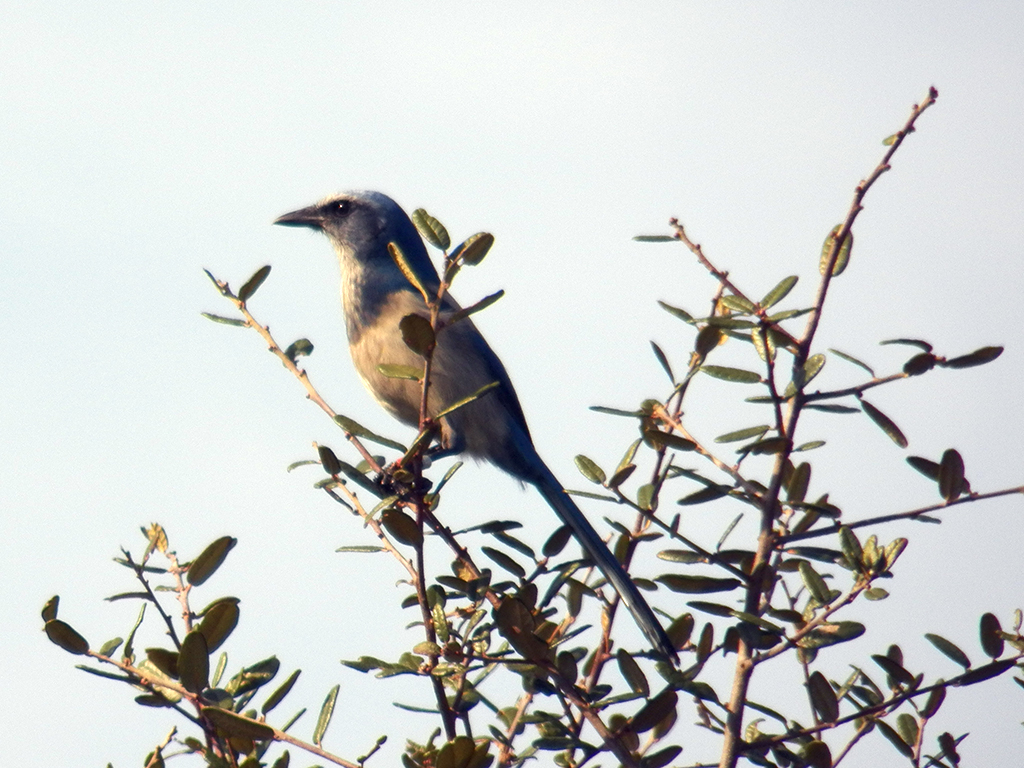
On the other side of MINWR from Blackpoint Drive’s entrance, just a short drive away,  is the short Scrub Ridge Trail. This trail loops through a small section of upland scrub vegetation adjacent to the marshes and ponds and provides some habitat for Florida Scrub Jays. There had been an e-mail alert the previous day about a Groove-billed Ani sighting near the parking area, so I was hopeful, especially after missing the ani pair that had been seen at Lake Apopka. Unfortunately, I did not see the ani, but I did encounter a family of Florida Scrub Jays. These jays were much more skittish and more prone to hide than the ones I’ve seen at the Malabar Scrub Sanctuary.

scrubjay
This jay acted as a sentinel for the others who would dash out into the grass or shrubs for a few seconds before launching up and over the tops of the bushes and out of sight.

Along the Scrub Ridge Trail the most numerous birds were the Tree Swallows, Yellow-rumped Warblers and Palm Warblers. I heard a few Eastern Towhees, and one female Northern Harrier raced past, scattering coots in a nearby pond. After completing the trail loop, it was time to head home.

Here’s the complete species list, roughly in order of confirmed identification:

  • Great Egret
  • White Ibis
  • Roseate Spoonbill
  • Snowy Egret
  • Glossy Ibis
  • American Coot
  • Boat-tailed Grackle
  • Red-winged Blackbird
  • Reddish Egret
  • Little Blue Heron
  • Great Blue Heron
  • Wood Stork
  • Double-crested Cormorant
  • Fish Crow
  • Pied-billed Grebe
  • Northern Pintail
  • Blue-winged Teal
  • Tri-colored Heron
  • Hooded Merganser
  • Lesser Scaup
  • Northern Shoveler
  • Ring-necked Duck
  • Caspian Tern
  • Ring-billed Gull
  • Herring Gull
  • Dunlin
  • Belted Kingfisher
  • American White Pelican
  • Willet
  • Greater Yellowlegs
  • Lesser Yellowlegs
  • Black-belled Plover
  • Anhinga
  • Turkey Vulture
  • Black Vulture
  • Osprey
  • Merlin
  • American Wigeon
  • Eastern Towhee (♫)
  • Red-bellied Woodpecker
  • Florida Scrub Jay
  • Palm Warbler
  • Yellow-rumped Warbler
  • Tree Swallow
  • Northern Mockingbird
  • Downy Woodpecker

That likely ends by birding excursions for the year. It was fun to come full-circle to MINWR,  and the adventures will continue, with the Space Coast Birding and Wildlife Festival in January, and a short trip to see my friend Laura for Superb Owl Sunday!