How Do You Prepare for Spring? Scrub!

The Helen and Allan Cruickshank Sanctuary is a small but important conservation property here in Brevard County [map]. As their brochure says:

The Helen and Allan Cruickshank Sanctuary was originally part of a larger span of high, dry scrubby habitat. Whenever possible, the EEL Program acquires land to help connect existing natural areas. However, as landscapes are developed with buildings and roadways, natural habitats become fragmented (broken up and isolated). Because scrub is favored for development, the Cruickshank Sanctuary has become an “island” in the midst of a developed landscape.

You can learn more about Brevard County’s EEL ( Environmentally Endangered Lands) Program by visiting their website.

As a scrub habitat adjacent to residential development, near the Indian River Lagoon, a diversity of species is to be expected, and that’s what I saw, including a heron fly-over. There were some Tree Swallows near the entrance, and a smattering of American Robins (small groups of robins were also seen, here and there, throughout the morning).

As with the Northern Mockingbirds around the county (and the state), the thrashers are singing in preparation of mating and reestablishing their territories. A sure sign of spring.
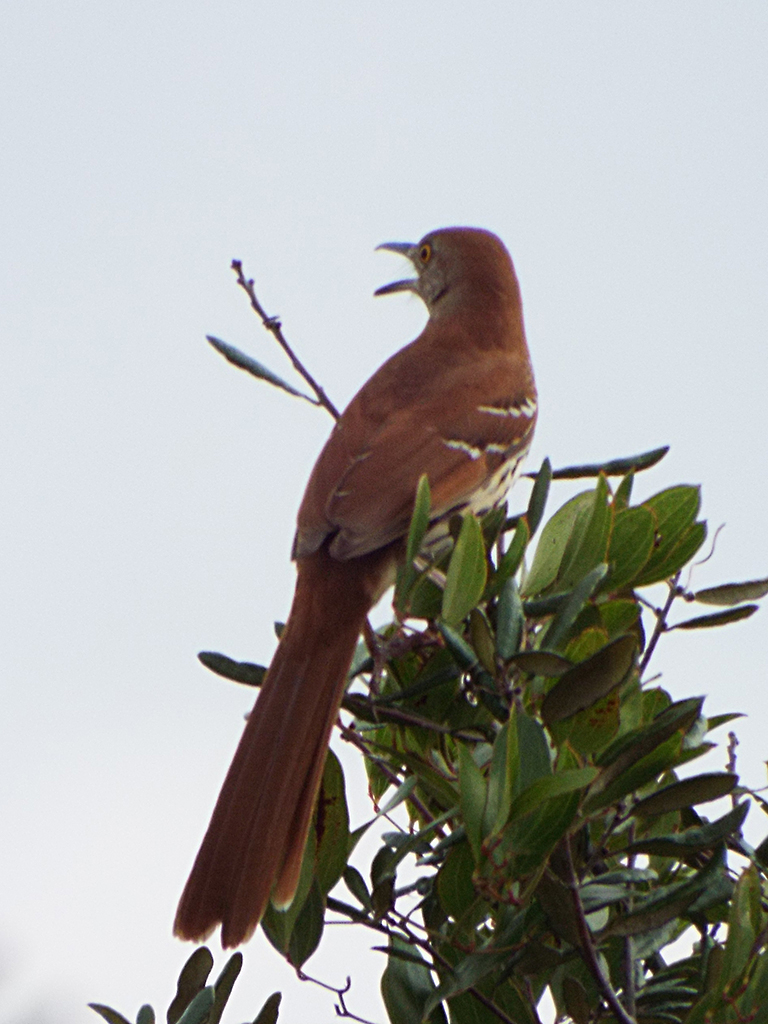
brown-thrasher
One of several Brown Thrashers I saw throughout the morning. Note the rich, russet brown of the back and wings.

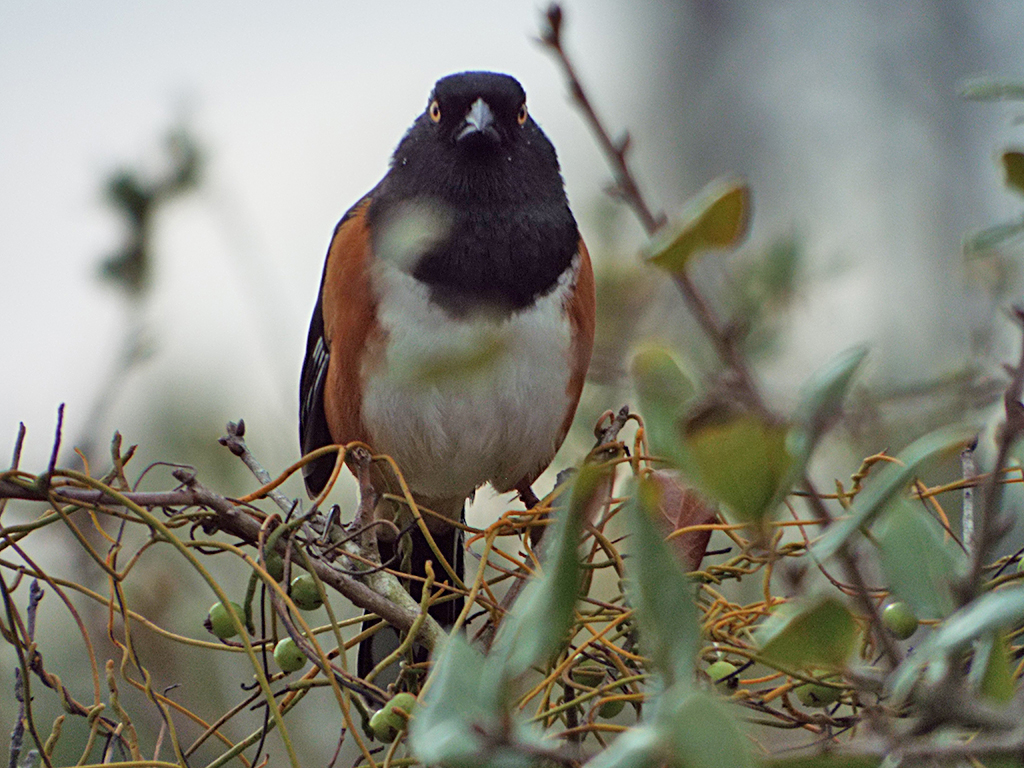
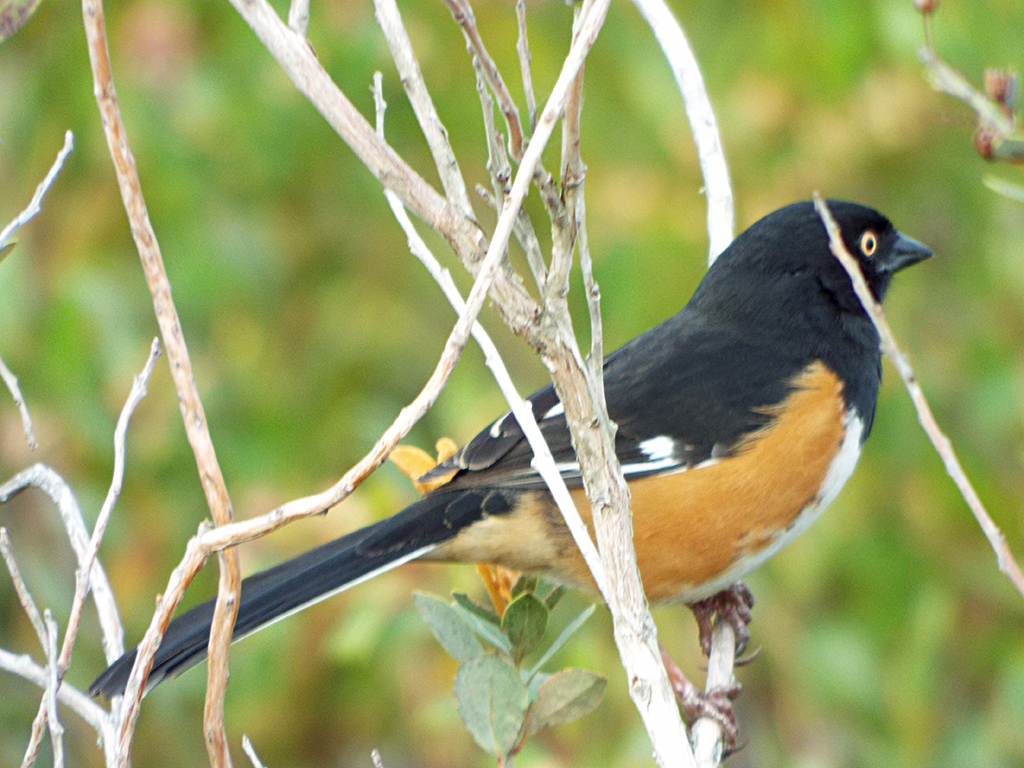
Male and female Eastern Towhees were scrambling around in the underbrush, scratching for insects in the leaves and other debris. The birds were calling out to each other a lot, with their “chewINK” calls, but very little singing by the males. The males were more bold and inquisitive when I approached a few times, popping out into the open to check out what I was doing, and sometimes scolding me.
another-eastern-towhee
“Hey! Get off of my scrub!”
eastern-towhee
Before the mid 1990s, Eastern and Spotted Towhees were considered a single species, “Rufous-sided Towhee”. Here, you can see why that was an apt name.

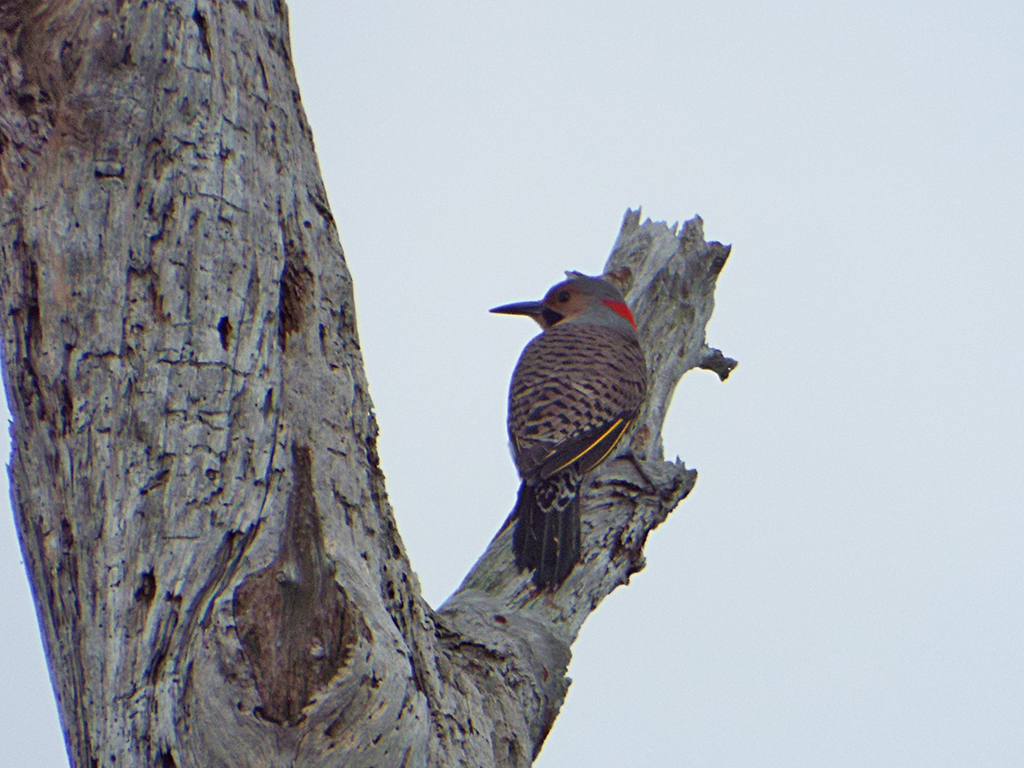
The Sanctuary is a great home for various woodpeckers, including the elsewhere-rare Northern Flicker. I heard it mentioned during the Space Coast Birding and Wildlife Festival that Northern Flicker numbers are declining, with the exact cause not yet known (though habitat loss and development pressure are always likely candidates). In addition to several flickers, I also saw Downy, Pileated, and Red-bellied Woodpeckers. A Red-headed Woodpecker was reported earlier in the week, but I did not find that bird during my visit.
northern-flicker
Even in bad light, you can see the yellow feather shafts that gave this species it’s former name “Yellow-shafted Flicker” before it was merged with the “Red-shafted” variety into the Northern Flicker. A reminder that genetics aren’t always as ordered and simple as we think.

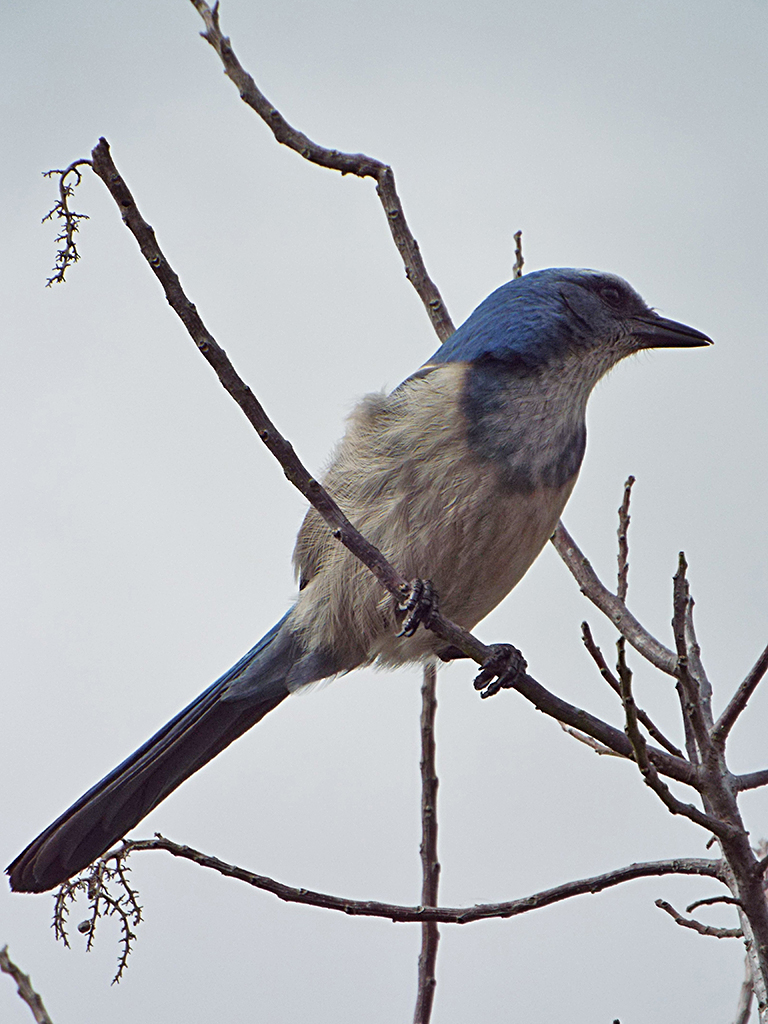
Of course the star “attractions” of the Sanctuary are the Florida Scrub-Jays.
scrub-jay-1
As usual, one of two birds will perch up on higher branches to act as look-outs for the rest of the family group as they forage and fly around their territories.

Many of the jays are banded, as researchers use these birds (and other scrub-jays on other properties) to research and conserve this endangered species. Naturally inquisitive and bold, this long-running research has also made the birds acclimated to human presence, making them approachable and easily photographed.

Long-time readers of my blog have seen some of the photos of Florida Scrub-Jays perched on my head. The birds look for people to hand them food (usually peanuts), as researchers had trained them to make it easier to band and examine the birds, and returning visitors used that “trick” to get close and personal with the jays.

Much of that has stopped, and with education and signage, the birds seem to expect handout less, and not a single bird landed on my head this time.
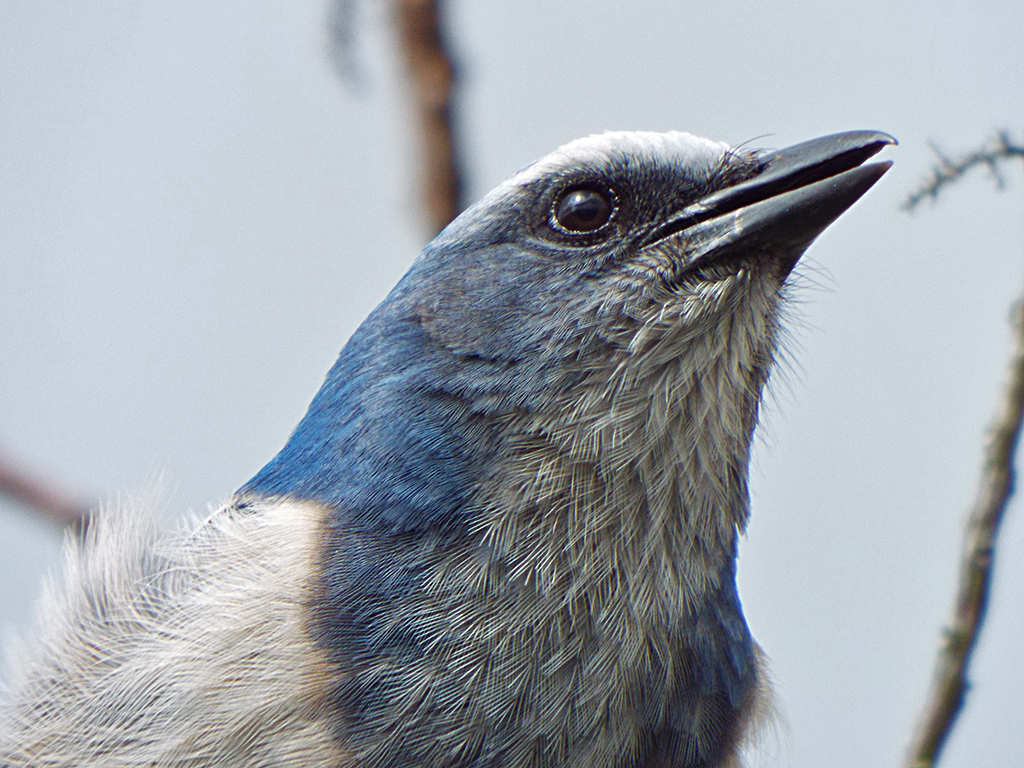
scrub-jay-2
This bird was warily watching a pair of Ospreys build a nest nearby. 

There was an Osprey pair building a nest, carefully placing large twigs and branches, one by one. Although Ospreys are fish eating raptors, small birds and other animals are always careful to watch for anything hawk or eagle-like in their skies.
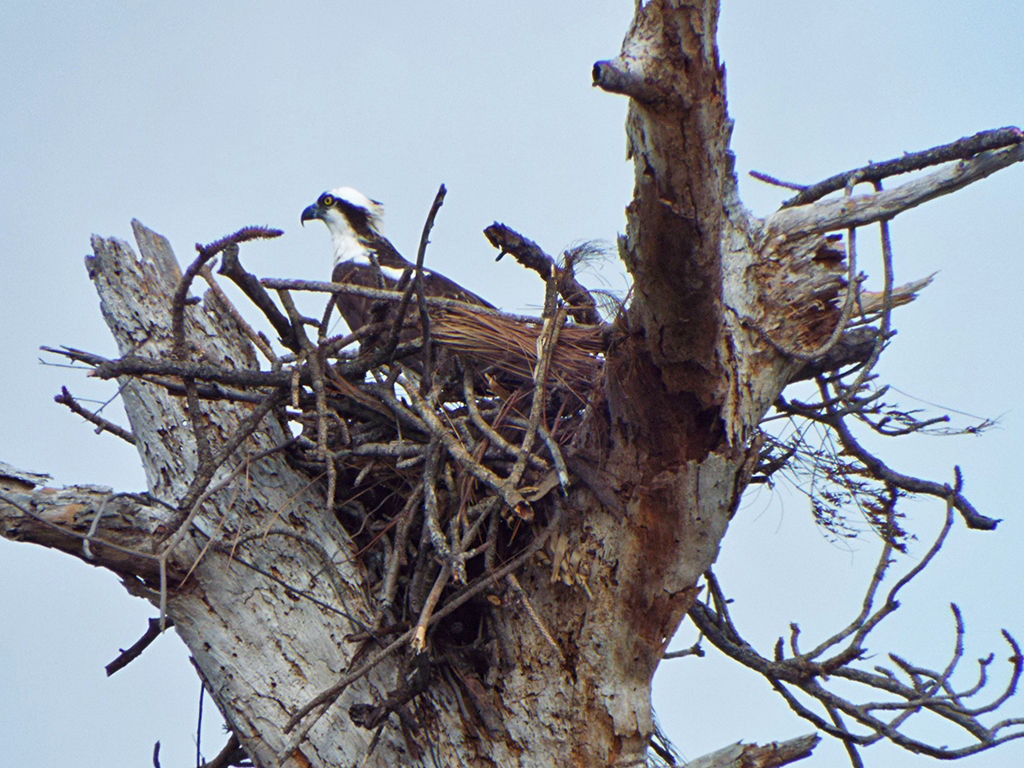
osprey-nest
There had been a largely complete nest here last year, but winds (likely from Hurricane Matthew) knocked it down. 

After placing some branches another Osprey couple approached. There was a brief fight over the nest site, with the building couple chasing the others away.

Meanwhile, the scrub-jays looked on and continued on their business. There were other raptors around, including a Red-shouldered and a Red-tailed Hawk, but they did not seem interested in the jays.
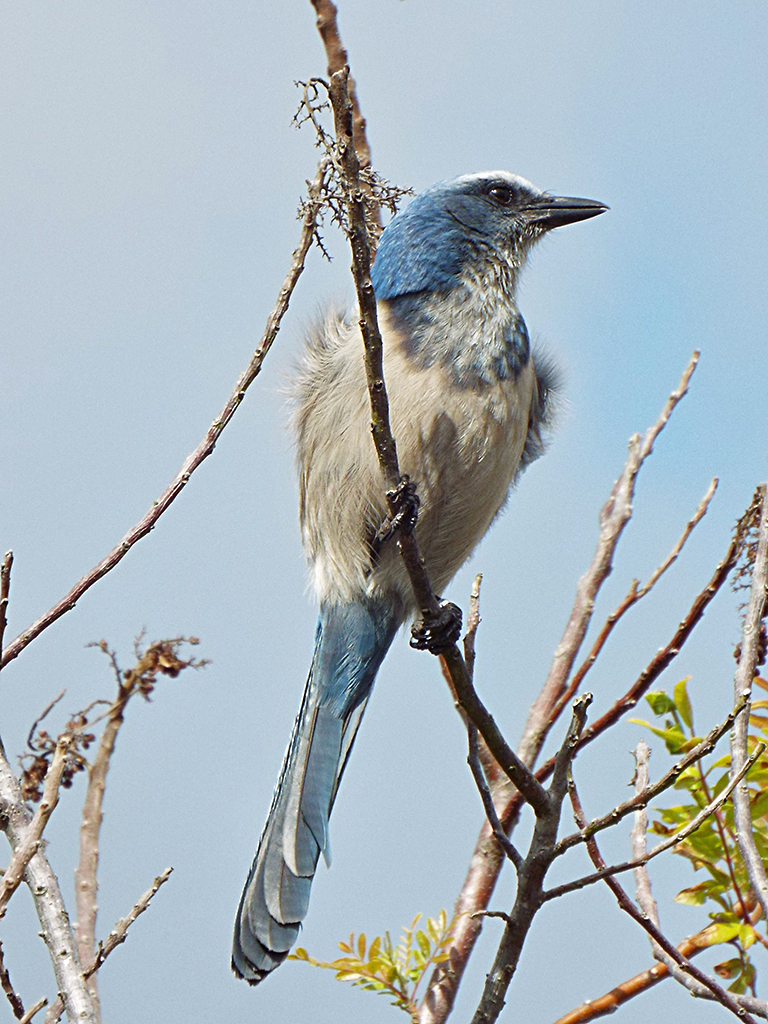
scrub-jay-3
Another sentinel.

I also scared up a flock of mixed sparrows into some scrub, where they lingered for a few minutes, allowing me to get some reasonable looks at them. There were Savannah, Field, and Chipping Sparrows, as well as two rare Clay-colored Sparrows.
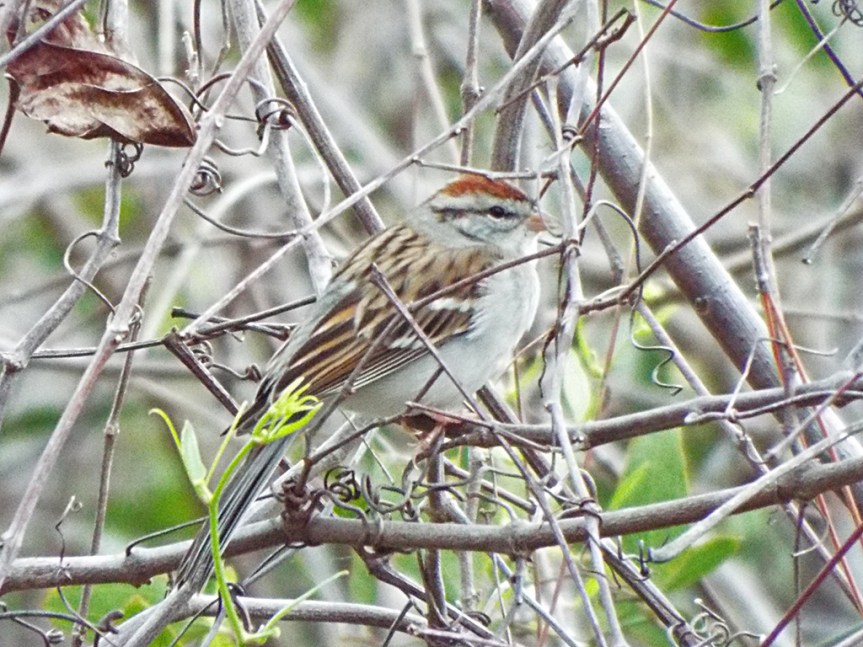
chipping-sparrow
One of the Chipping Sparrows, with the distinctive rusty cap and black eye-line.

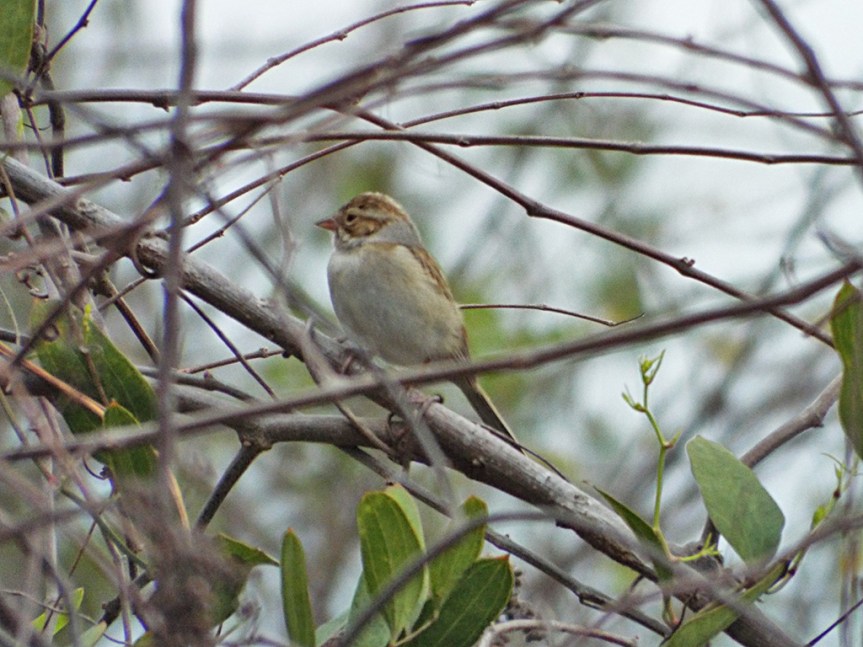
Clay-colored Sparrows are rare visitors to Florida. They breed in the north-central United States and south-central Canada and winter in Mexico. According to published information, they like to stick to scrub and brush along field edges, even in winter, so finding it in a scrub sanctuary, surrounded by residential development made this species a nice find.
clay-colored-sparrow
Clay-colored Sparrows have a bold cheek pattern and darker grey collar, on an unstreaked breast, which help identify them.

Most of these sparrows will soon be departing for their breeding grounds, well north of here. Their presence, along with the Osprey nest-building and increased singing and displaying of resident species indicates that we’re on Spring’s doorstep.

For those who like to follow along with eBird, here’s the “official” list.

http://ebird.org/ebird/view/checklist/S34511049

I haven’t been posting links to my eBird lists lately, but I think there’s some value to making that information more easily available, so I’ll start doing it again more regularly.

After wrapping up my hike at the sanctuary, I did a quick stop by Riverwalk Family Park, but it was mostly quiet there, so I headed for home.
SCBWF 2017 Day 3: Wet Orlando Wetlands Park and More!

The weather for my Day 3 of the Space Coast Birding and Wildlife Festival did not hold, and we were cold and rained on all day at Orlando Wetlands Park [map].

In case you don’t know, Orlando Wetlands Park is the first large-scale created wetlands for wastewater treatment in the world. You can read about it’s history and operations at the City of Orlando’s website.

Since I (along with most others) decided to keep my camera safe from the weather, there aren’t any photos to post. Despite the rain, we had a decent showing of birdlife. The trip was a trailer tour, so we did not do much walking and were able to cover a lot of ground in just a few hours.

Highlights included several Soras, feeding out in the open in a few places, hundreds of roosting Black Vultures, and several Bald Eagles.  I saw an Orange-crowned Warbler at one stop, but it scuttled out of sight before anyone else could see it.

There were Black-crowned Night Herons roosting out in the open near the start of the tour, and a roost of Wood Storks, vultures, and Roseate Spoonbills at the Oyler Overlook. A King Rail or two called from that area as well.

This is the first year Orlando Wetlands Park was open during the Festival. Previously, the family that sold the land to the city of Orlando so the park could be developed retained hunting rights during the winter. A couple of years ago, the family sold the hunting rights off, too, so now the park is open all year.

We ended the tour a little early, as the rain intensified and spent a few minutes at the education center before heading back toward the Space Coast.

The weather started to improve a bit, and Camille and I decided to go to Merritt Island and do Black Point Wildlife Drive [map].

reddish-egret
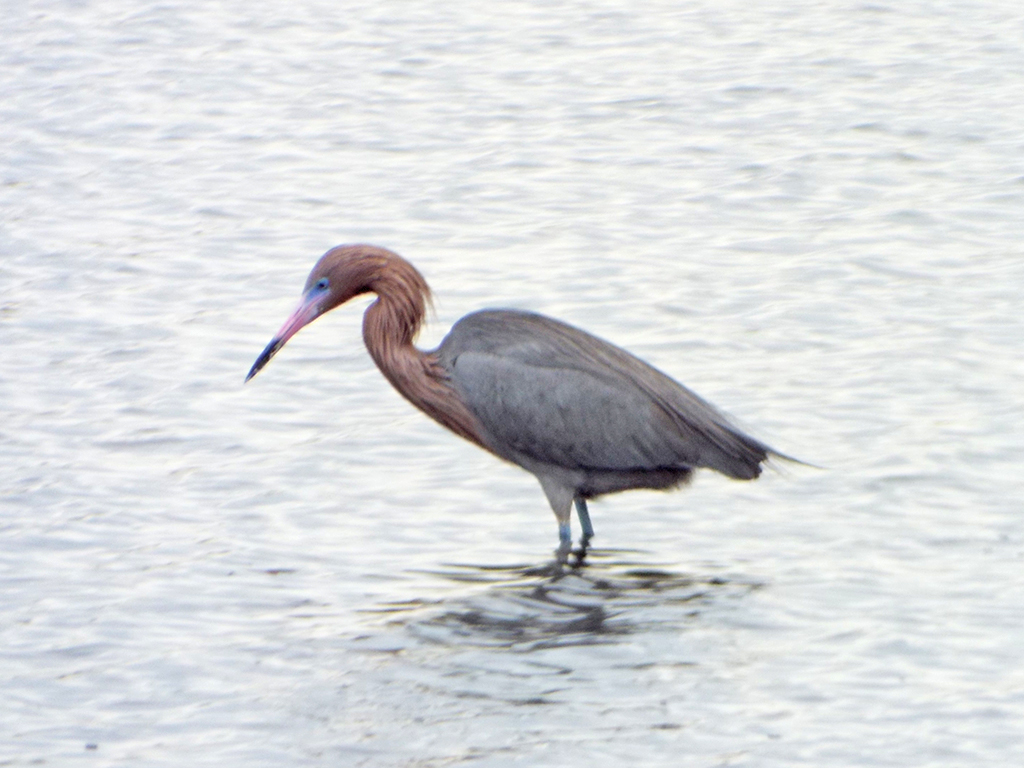
The weather even seemed to dampen this Reddish Egret’s spirits. Usually seen “drunkenly” lurching about to scare up prey, this bird was mostly still and made a few half-hearted attempts at spearing something.

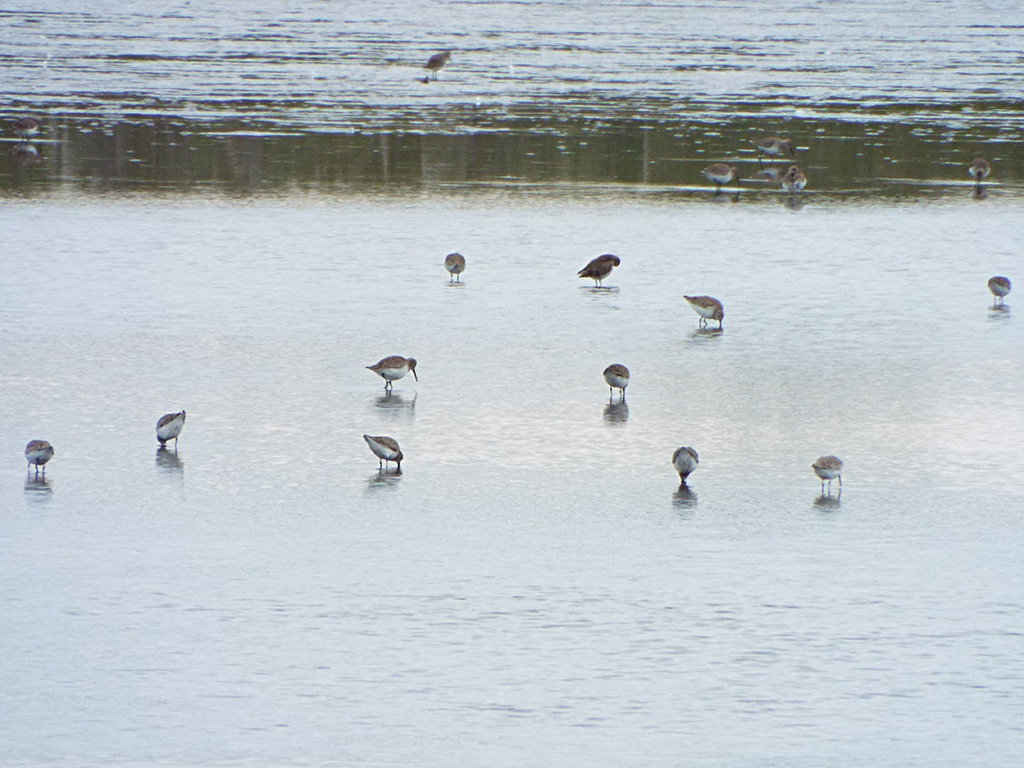
There were pockets of active shorebirds feeding all along the drive, including Killdeers, Long-billed Dowitchers, and what turned out to be a large flock of Dunlins on the mudflats, tucked away along a long path, on the other side of Boggy Pond [map]. The Dunlins were hanging out with some Semipalmated Plovers, yellowlegs and near a large number of gulls and terns.

dunlins
Some of the Dunlins foraging on the mudflats. There were many more, further away, along with American Avocets, what turned out to be Black-bellied Plovers (identified by the unique black axillaries – or “armpit” feathers).
gulls-terns-skimmer
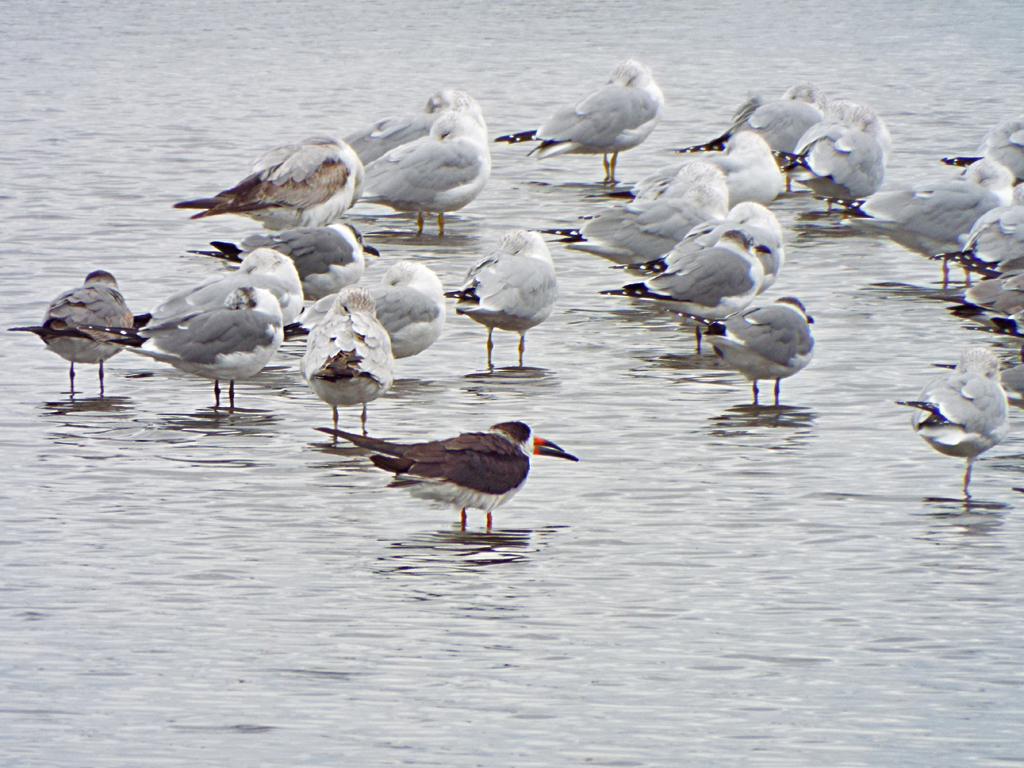
Part of a large resting flock of Ring-billed and Laughing Gulls. A flock of Black Skimmers was nearby, although one skimmer seemed to prefer the gulls’ company.

Many of the ducks have left MINWR already, but a large flock of Northern Pintails were still there, along with a few Northern Shovelers and Blue-winged Teals. It seems to me that for the last several years the ducks have not stayed long when wintering over, even when there is still a cold-snap or two to be had to the north.

male-pintails
Male Northern Pintails are handsome and elegant birds, even in winter plumage. 
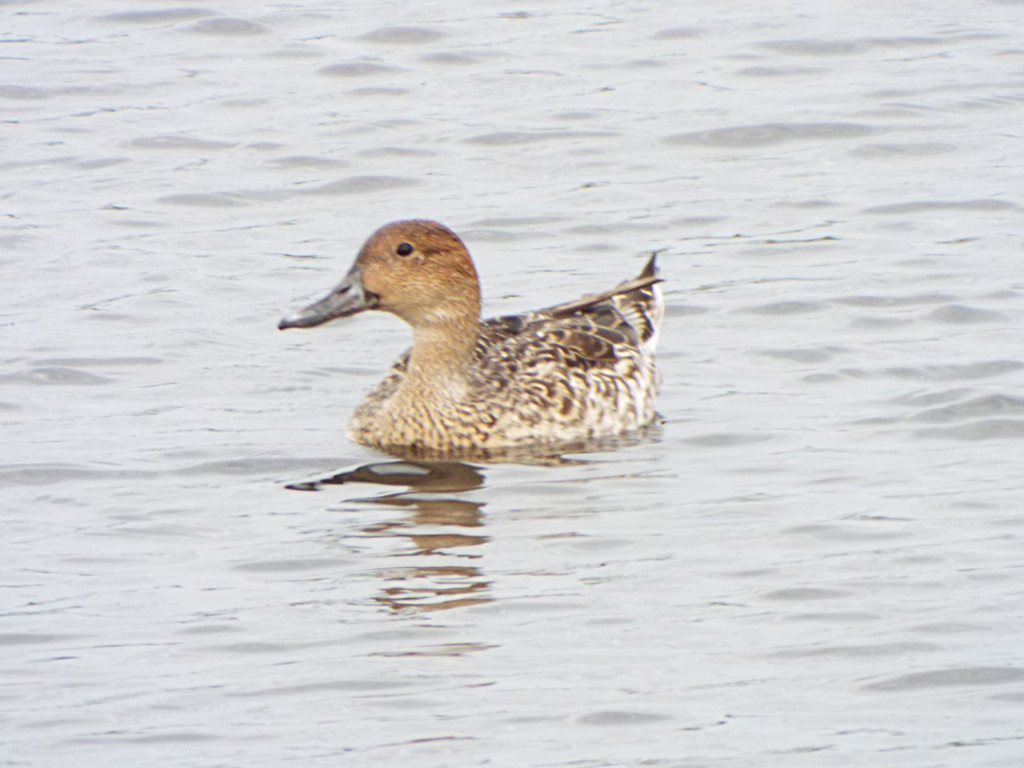
female-pintail
Female Northern Pintails have a subtle grace and beauty.
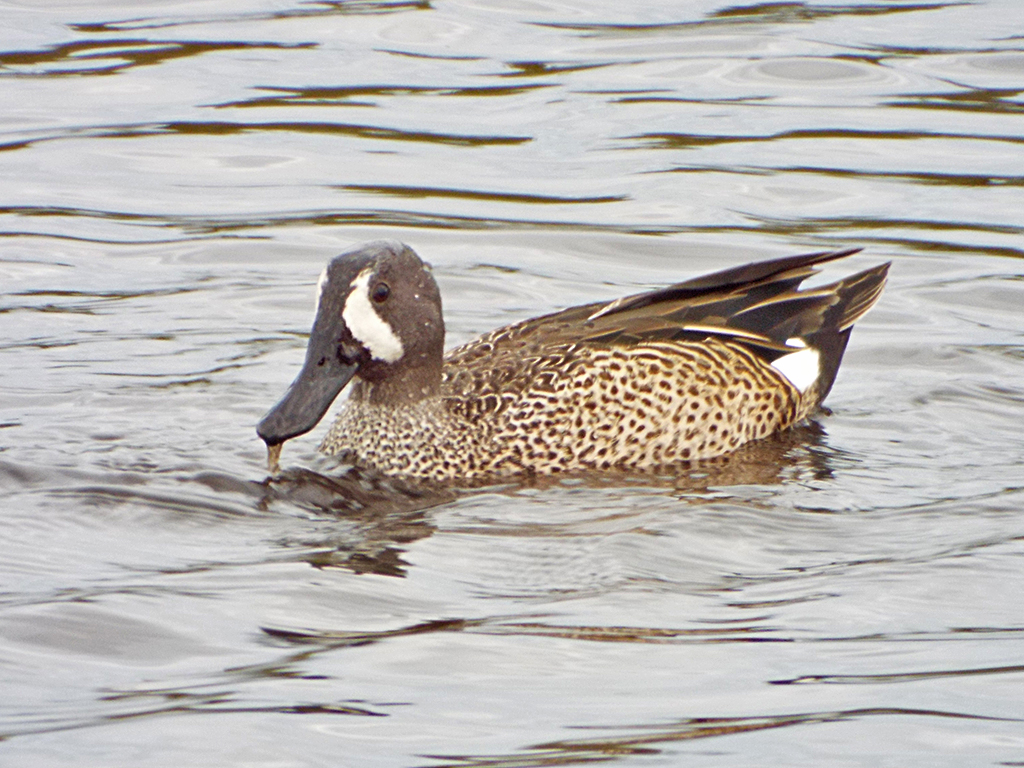
blue-winged-teal
This male Blue-winged Teal had just surfaced from dabbling for food. This species will stay in Florida well into the start of spring. Some individuals will stay all summer.

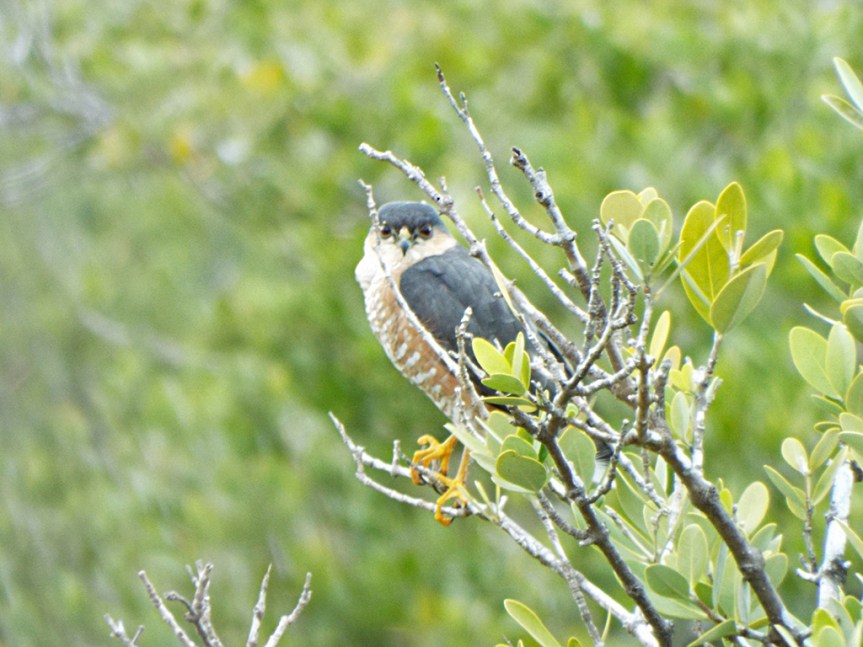
Along part of the drive we came upon a very small raptor, close by the road. It took a minute to sort out what it was – at first we thought it falcon – because we had to pull forward and over to not be a bottleneck to the cars behind us. By that point, the bird flew off, giving us a good underside view and confirming it as a Sharp-shinned Hawk.

sharp-shinned-hawk
This bird’s plumage was so fresh and vibrant, it was almost confusing. Sharp-shinned Hawks are winter residents in central Florida, unlike the similar but larger Cooper’s Hawk that can be found year-round.

After leaving Black Point, we did a quick survey at Parrish Park and the Max Brewer Causeway, hoping to see Horned Grebes or Common Loons, but we did not see either species. Last year the Horned Grebes, in particular, were numerous throughout the winter. This year, however, the reported numbers are much lower and more typical.

And that, my friends, ended my 2017 Space Coast Birding and Wildlife Festival. For the first time in several years, I did not join the offshore boating trip, though I understand the weather was cold and windy, causing the boat to stay in the lagoon most of the time.

Next year will bring another festival and more opportunities for fun and adventure. Until then, it’s back to lonely (and sometimes not-so-lonely) birding. See you around!

Christmas Passed

Here we are, right between Christmas and New Year’s Day. Since the middle of December many regions are once again in the throes of the “CBC” – the Christmas Bird Count. This Audubon sponsored endeavor is one way that bird population trends are tracked, long term, across the continent. Count season starts before Christmas and ends just after the New Year.

Last count season, I took part in the CBC in my home county. This time around, I helped my friend David Goodwin and his team with the east Pasco County count, the day after Christmas.

In order to get started on time, I had to leave my house before 3am for the 2+ hour drive to our meeting place at a Denny’s by the interstate, just outside St. Leo. From there we hit several spots in our designated part of the count circle (for an explanation of the CBC and count circles, visit the Audubon CBC webpage).

We started before dawn at the Tyndall Road Marsh [map] to catch birds most active at or before dawn. Much of the day required that we drive on McKendree Road – an unpaved stretch with washboard ridges and potholes – and other rural streets to get to our various hot spots.

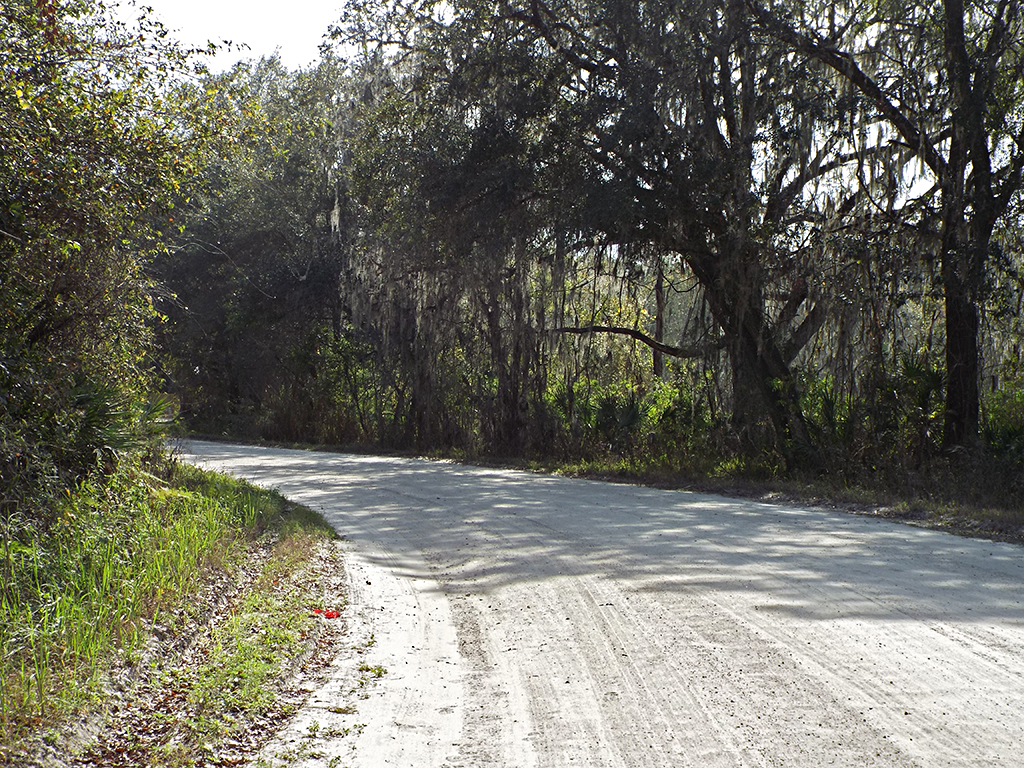
road
This is a typical road in east Pasco County.

As a group, we found 107 species for the day (I personally identified 99). Some of the good “gets” for the count were American Woodcock (seen by Dave Goodwin before dawn), American Pipits, a couple of Red-headed Woodpeckers, and a Merlin.


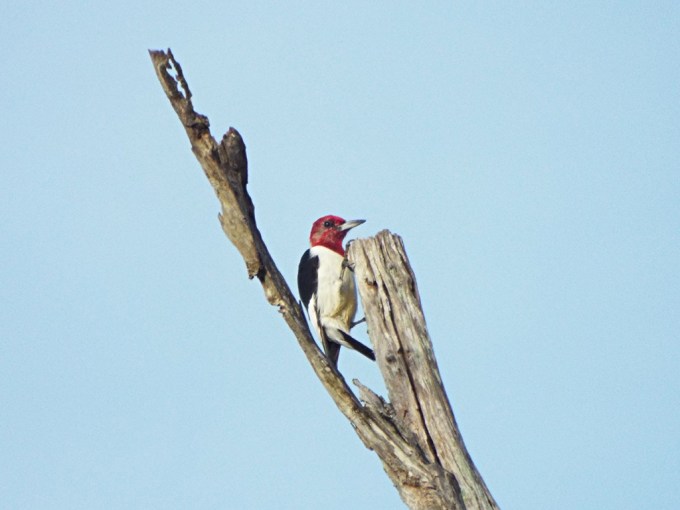
red-headed-woodpecker
The closest and longest look I’ve had of a Red-headed Woodpecker!


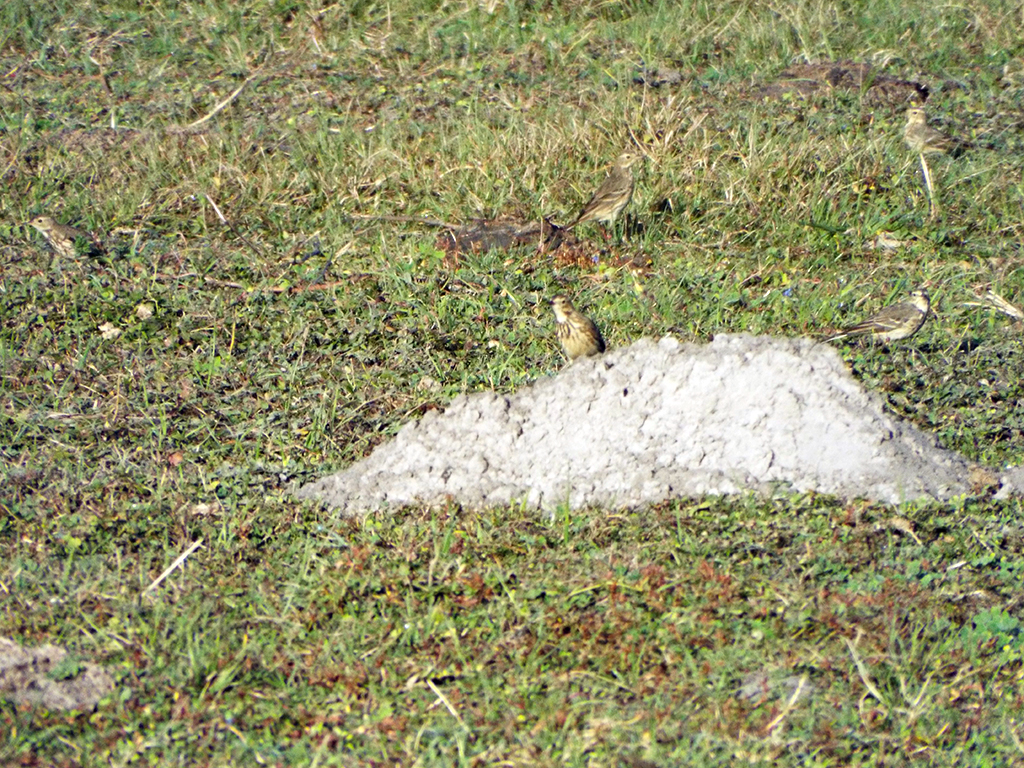
american-pipits
If you look closely, you’ll see 5 American Pipits in this shot. They blend in very well on the ground where they forage for insects.

The parts of Pasco County we birded are all quite rural, making for some lovely scenes, and we were only downwind of some of the more fragrant aspects a couple of times.

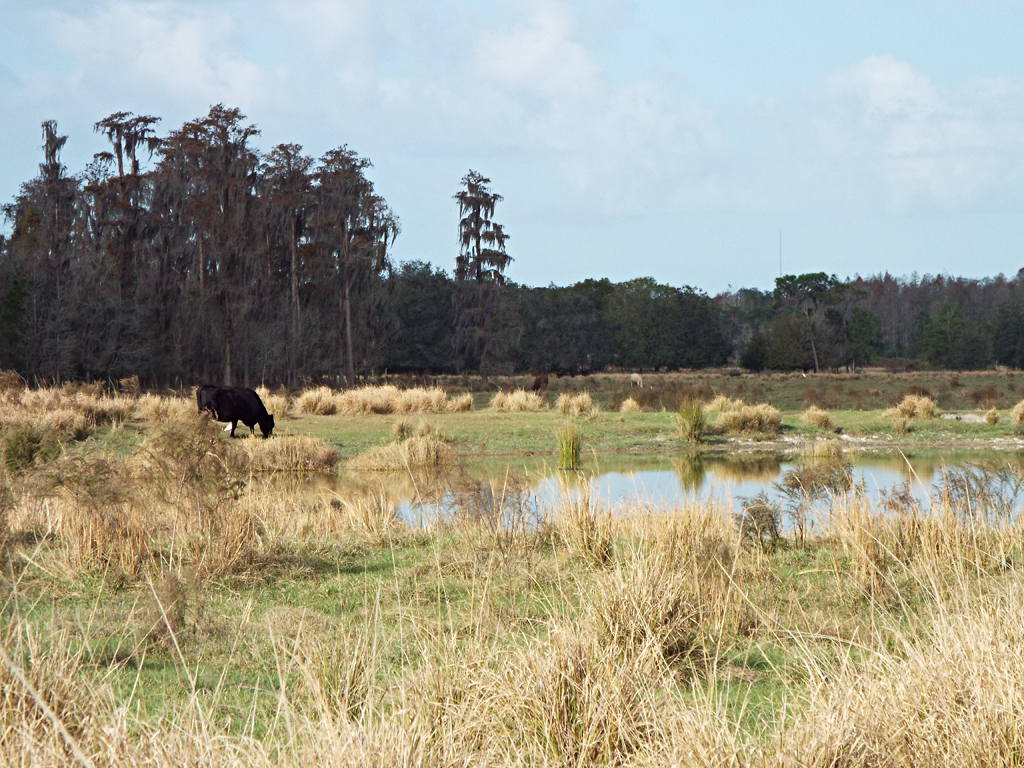
cow-and-pond
This cow pasture has an obligatory watering hole and an attendant cattle egret, behind the cow. Note the remnant of a cypress dome on the left.
pasco-barn
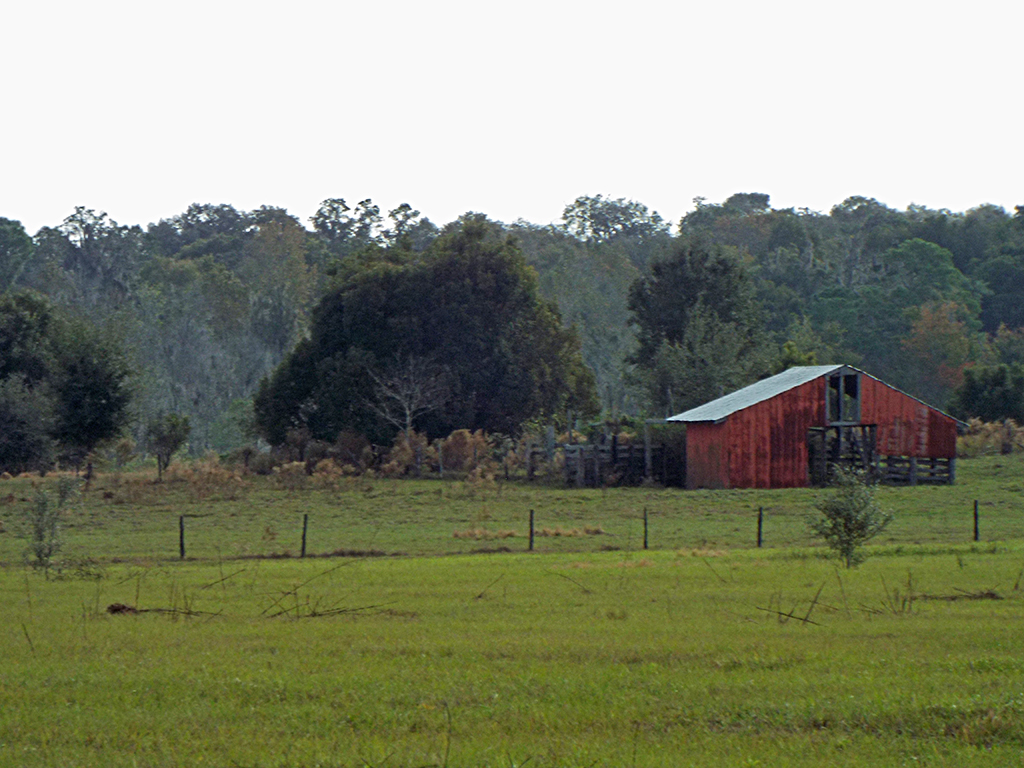
Florida isn’t all palm trees and thrill rides. I leave it up to you if that’s a good or bad thing.

At Wesley Chapel District Park [map], Erik Haney got a pair of Ovenbirds to respond to a recorded call of that species, but they remained very well hidden. We managed to scare up a Carolina Wren or two, and on the way out, a singing Blue-headed Vireo briefly got us back, scanning the woods to see it.

carolina-wren
Carolina Wrens share the same habitat as Ovenbirds, but are often a little less secretive.

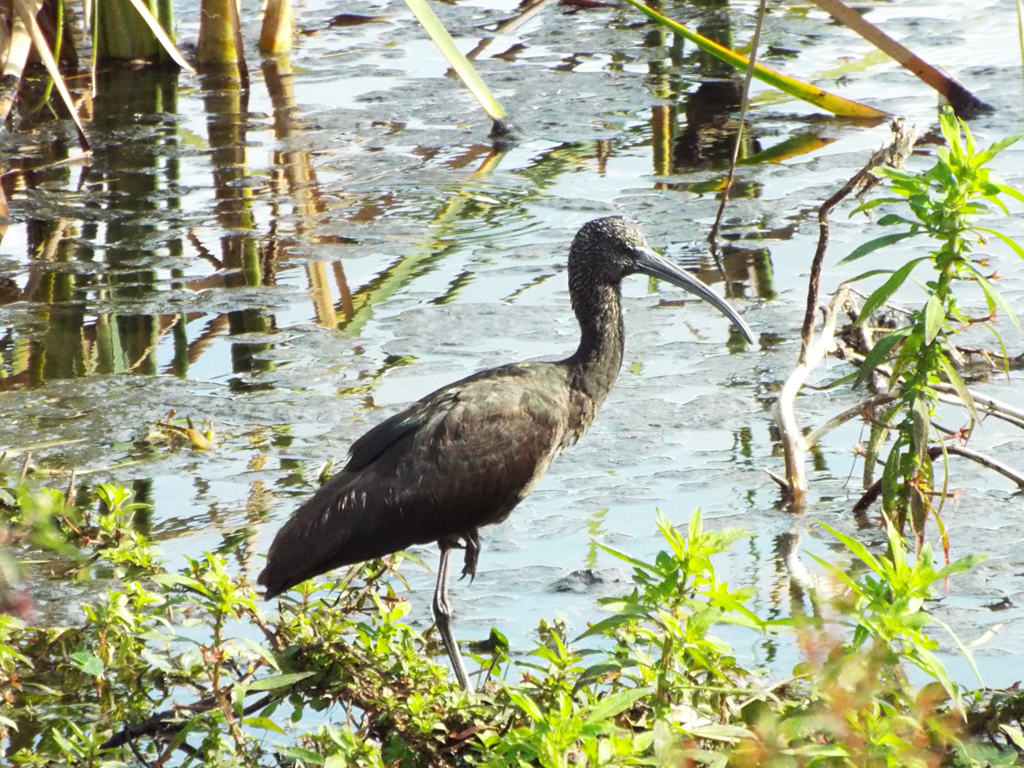
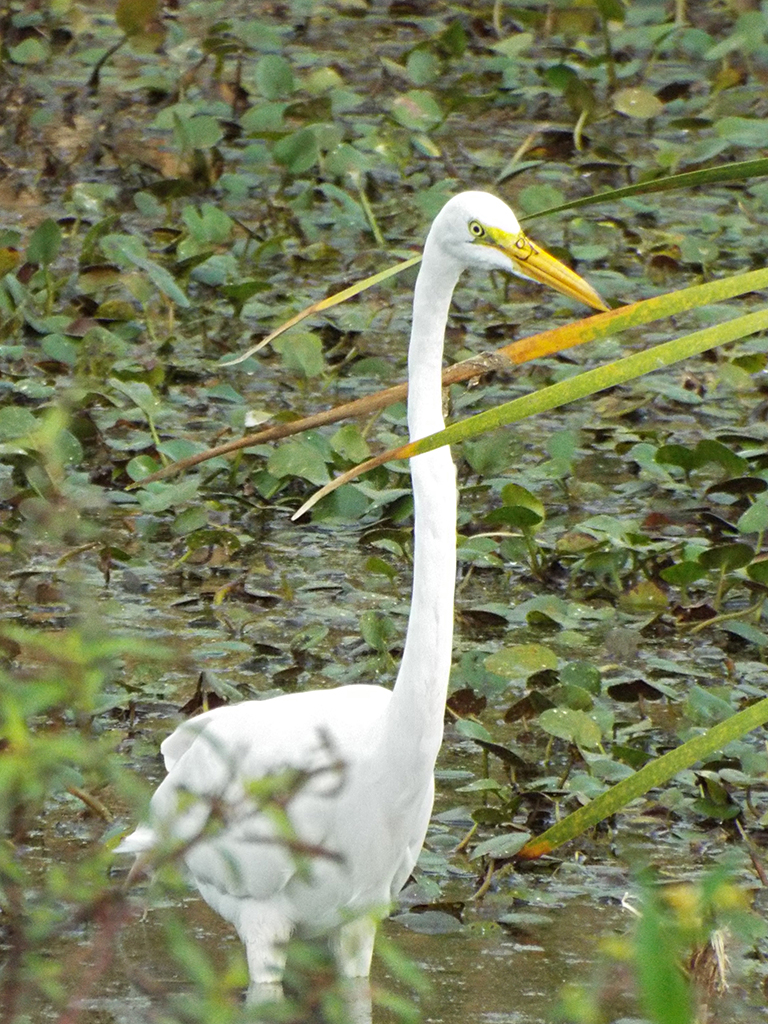
In general, the concentration of wading birds was low throughout the day. The only large numbers were from a distant rookery before dawn, as they dispersed. There were just two wading birds at Wesley Chapel District Park. A Great Egret and a Glossy Ibis were quietly feeding in a small wetland area.

glossy-ibis
A Glossy Ibis, looking a bit less than glossy, over the winter.
great-egret2
A really great Great Egret!

The goal of any count is to see as many birds of as many species as possible. To achieve this birders, of course, use skill, patience, and optics. But there is an even greater urge than usual to “pish” at birds to get them to come out into the open or to use recordings. It is much easier in these days of smartphones to get high quality recordings of almost any bird to draw it out. And it’s not just the recording of the target bird. Some birders use the distress calls of other birds (the Tufted Titmouse is a favorite among eastern birders) or even predator calls, such as screech owls. There’s an always ongoing debate as to how much of this is necessary or causing stress/harm to the birds. It’s generally accepted that the least one uses these measures the better, but it can be hard when doing something like a CBC or a paid field-trip.

hermit-thrush
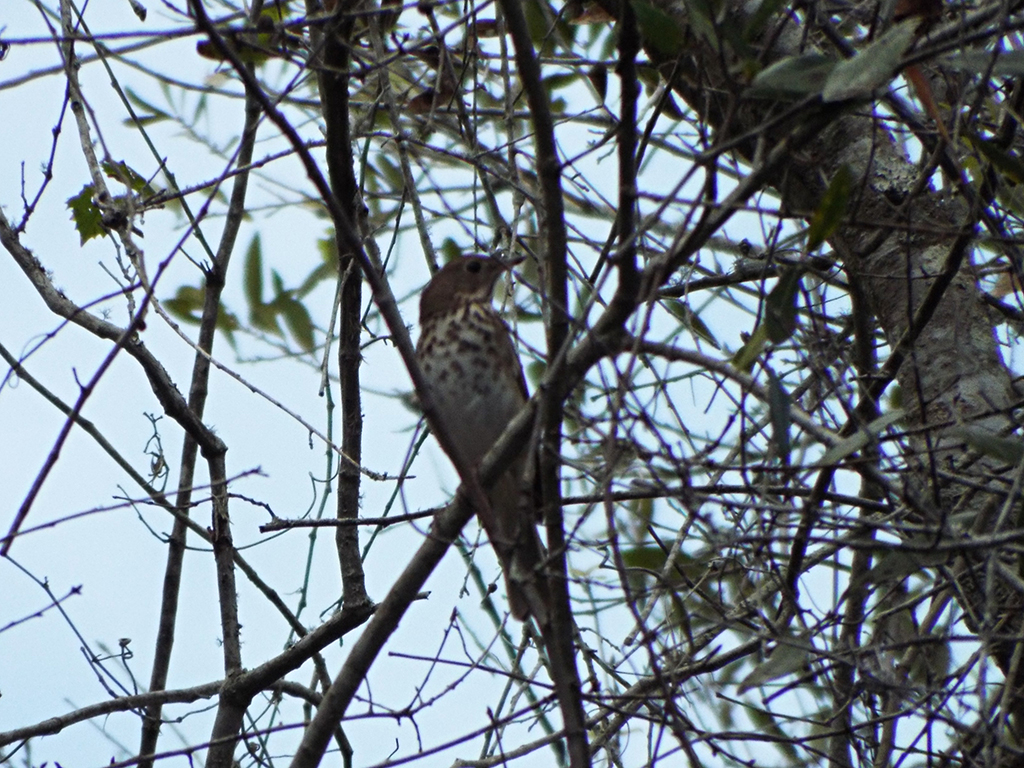
Hermit Thrushes were among the birds pulled into clear view due to the persistent playing of an Eastern Screech Owl recording.

Our group made a lot of use of titmouse and screech owl recordings to lure birds out. We relied on it much more than I am comfortable with, but probably did no permanent harm to the birds in the areas in which we used them.

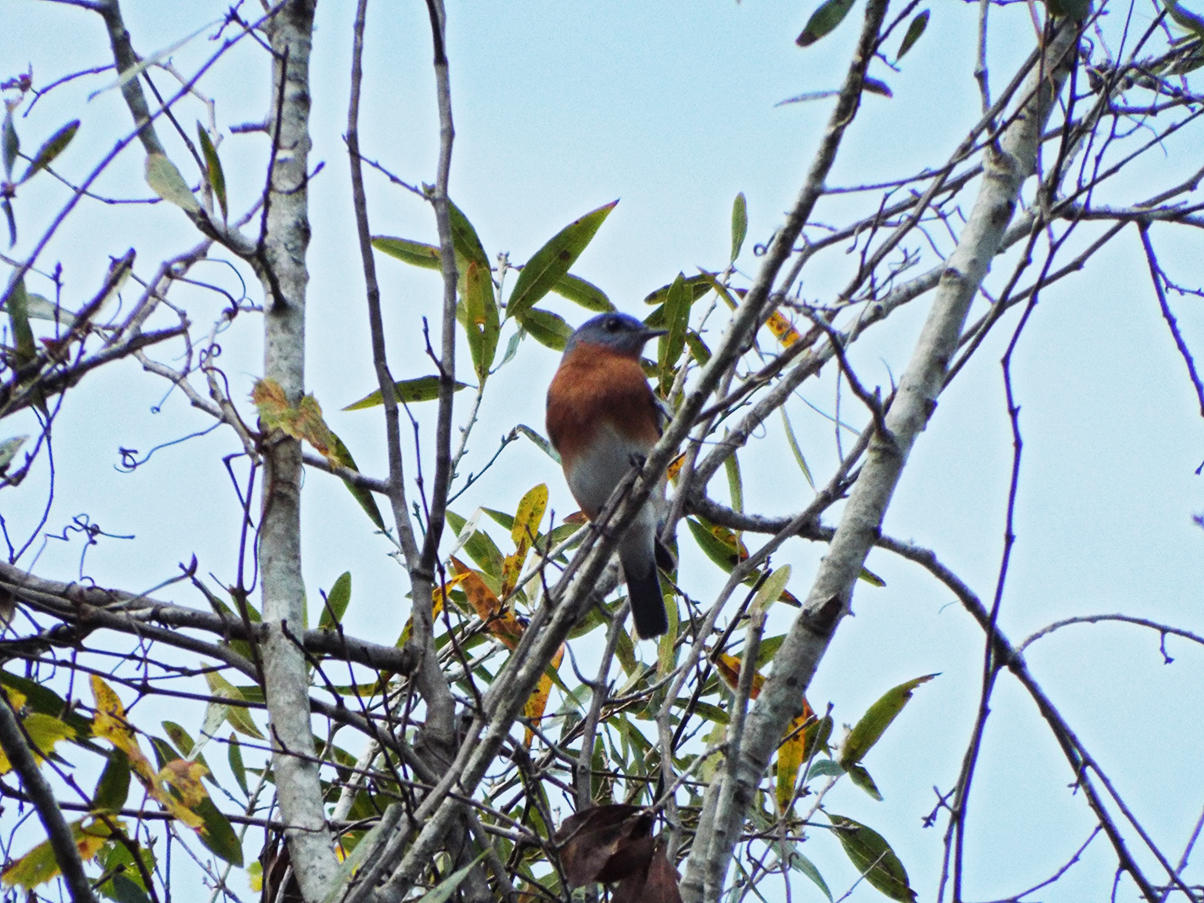
eastern-bluebird
Eastern Bluebirds are normally birds of open or semi-open country, but our recordings lured more than a few into more wooded areas to see what the hubbub was about.

We ended the day with a walk through an old field, looking for sparrows in the brush and weeds and then circling back to McKendree road for a final look for ducks and shorebirds at pond we had scoped out earlier in the day. Throughout most of the day, Dave Goodwin had been commenting on us not having seen a Northern Harrier. By sundown, we still hadn’t seen one. But as I made one last scan in the fading light, I caught one in my binoculars skimming low over the fields. I found it fitting that I found the bird that way. On my first field trip with Dave at the Space Coast festival, our group was heading home in the tour bus, going over our day’s list. The only hoped for or expected bird we didn’t have was a Northern Harrier. Just after Dave commented on how nice it would be to have that bird before we arrived back at the festival HQ, I looked out the window and there was a Northern Harrier, about to fly over the road. “You mean, like that one?” I said to him. It was a cool moment.

For the so-inclined, here are all the eBird lists for our stops. If you poke around eBird, you’ll see Erik’s lists too, which differ slightly from mine. This isn’t for lack of trust or disagreement, it’s that sometimes we were looking in slightly different areas and saw different birds.

Tyndall Road Marsh: http://ebird.org/ebird/view/checklist/S33203139
McKendree Road: http://ebird.org/ebird/view/checklist/S33205152
Wesley Chapel District Park: http://ebird.org/ebird/view/checklist/S33206770
Mariners Harbour Drive: http://ebird.org/ebird/view/checklist/S33210038
Wesley Chapel-Overpass Road: http://ebird.org/ebird/view/checklist/S33207398
Tyndall Road: http://ebird.org/ebird/view/checklist/S33209070
Tyndall Road Curved Woods: http://ebird.org/ebird/view/checklist/S33210011
Kenton Road: http://ebird.org/ebird/view/checklist/S33210738
Old Pasco Road Sparrow Field: http://ebird.org/ebird/view/checklist/S33212110
Hadlock Drive: http://ebird.org/ebird/view/checklist/S33212564
Gray Catbird Loop: http://ebird.org/ebird/view/checklist/S33242919
Wesley Chapel School complex: http://ebird.org/ebird/view/checklist/S33242790
Bridgewater Development: http://ebird.org/ebird/view/checklist/S33242525
McKendree Road, across from pond: http://ebird.org/ebird/view/checklist/S33242994

I would have liked to stay for the end of the day count up from all the teams in the CBC circle, but I had a 2+ hour drive ahead of me. So I said my good-byes and headed home. Birding with Dave is always fun and informative. CBC days are long. You have to drive, walk, talk and share with people for hours, and sometimes the birds are less than cooperative. Birders, as a general rule, get along pretty well. After all, we’re united by this passion for birds. But having Dave head up a team is special, and all four of us did pretty well, and had fun doing it.
Unlimited Ducks!

As much of the nation went into a deep freeze last week, the cold air brought with it those promised ducks to Florida. As I mentioned in my last blog post, ducks and other waterfowl only tend to migrate south when the weather or food supply dictate. When ponds and lakes freeze over, these birds cannot forage and have to move to warmer places.

The ducks came in to the Merritt Island National Wildlife Refuge in massive amounts last weekend. Thousands of birds settled into their usual digs along Black Point Wildlife Drive [map], along with a growing contingent of shorebirds and gulls and terns.

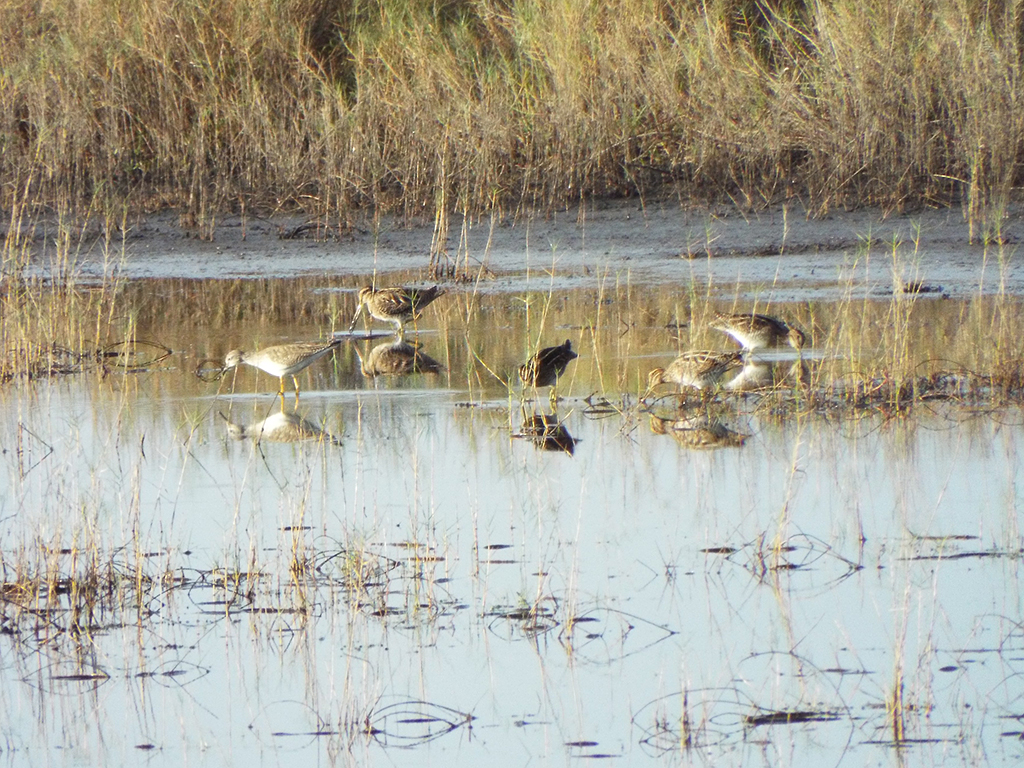
The first most noticeable difference along Black Point was the relative abundance of Wilson’s Snipes, feeding in the open. Snipes are usually fairly cryptic and will suddenly take to the air in an erratic zig-zag flight pattern only when approached very closely, often startling whomever is walking by. They rely on their camouflaged plumage to stay hidden. This was the largest single grouping of Wilson’s Snipes I’ve seen – almost 40 birds.

snipes-yellowlegs
Normally secretive Wilson’s Snipes feeding in the open with Greater and Lesser Yellowlegs.
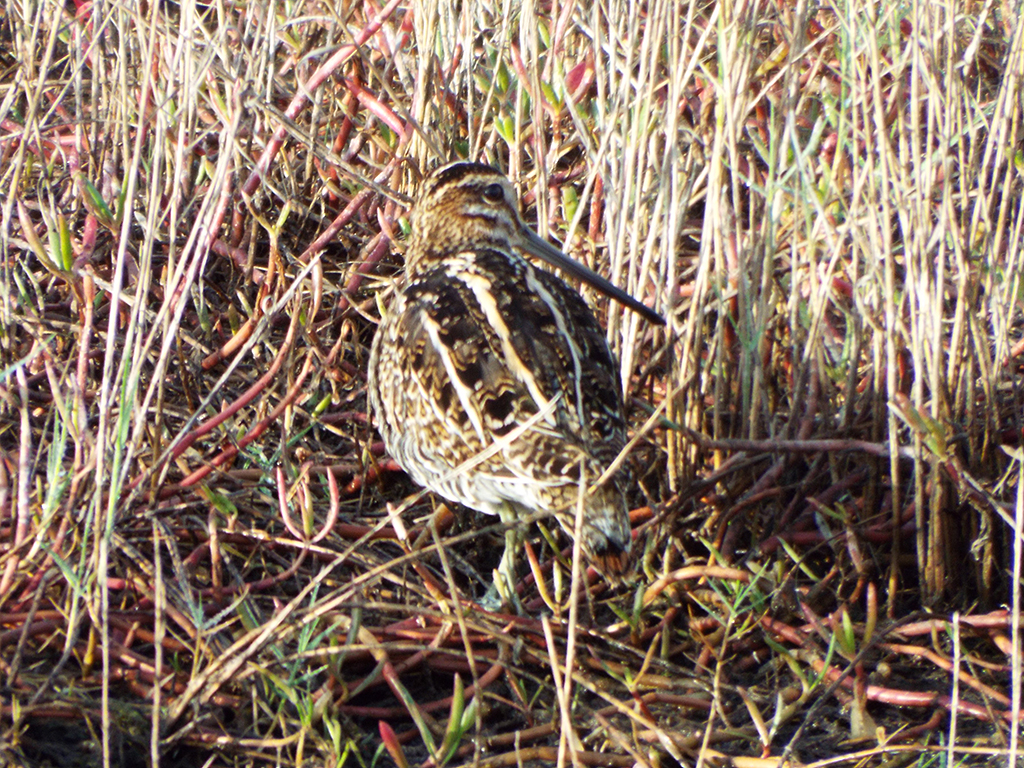
wilsons-snipe1
Snipe’s bills are similar in size and shape to those of dowitchers, and their feeding methods and posture seemed much alike. This bird was resting in the margin of some tall marsh grass.

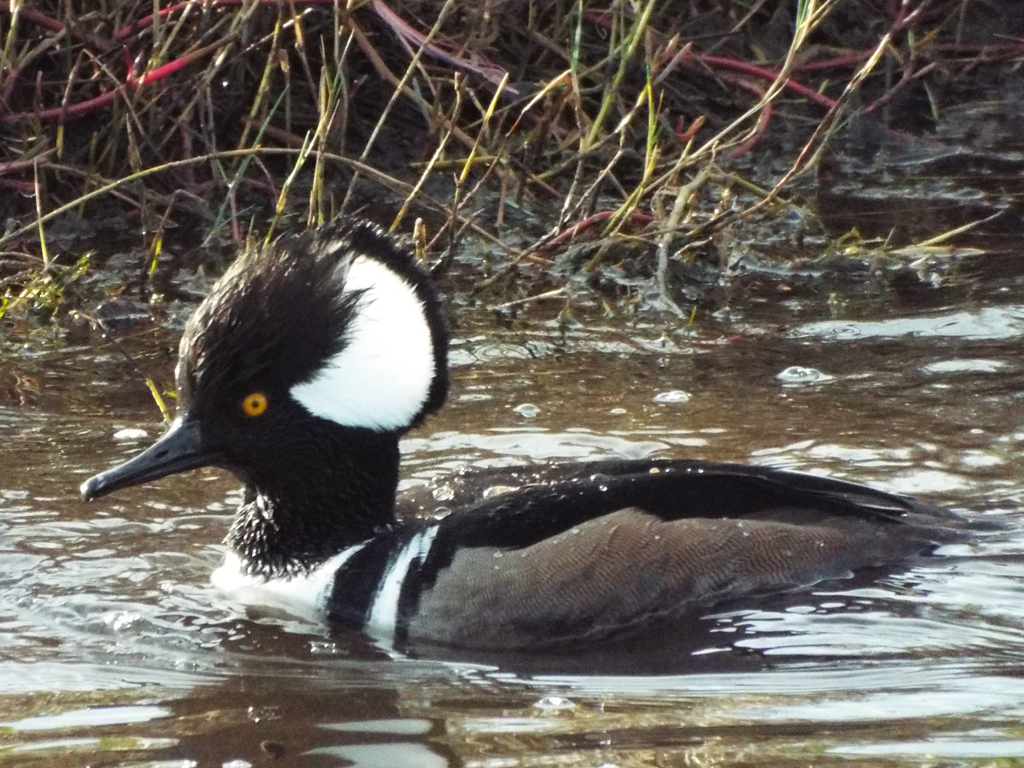
Ducks started appearing farther along the drive. First, Hooded Mergansers in small groups, quickly diving and scouting for prey. When food is abundant, these birds are in almost constant motion and only fully on the surface for a few seconds at a time.


hooded-merganser
A Male Hooded Merganser in an alert posture (crest up).

Blue-winged Teals had already arrived in numbers earlier in the Fall, but they have been joined by Northern Shovelers and Northern Pintails.

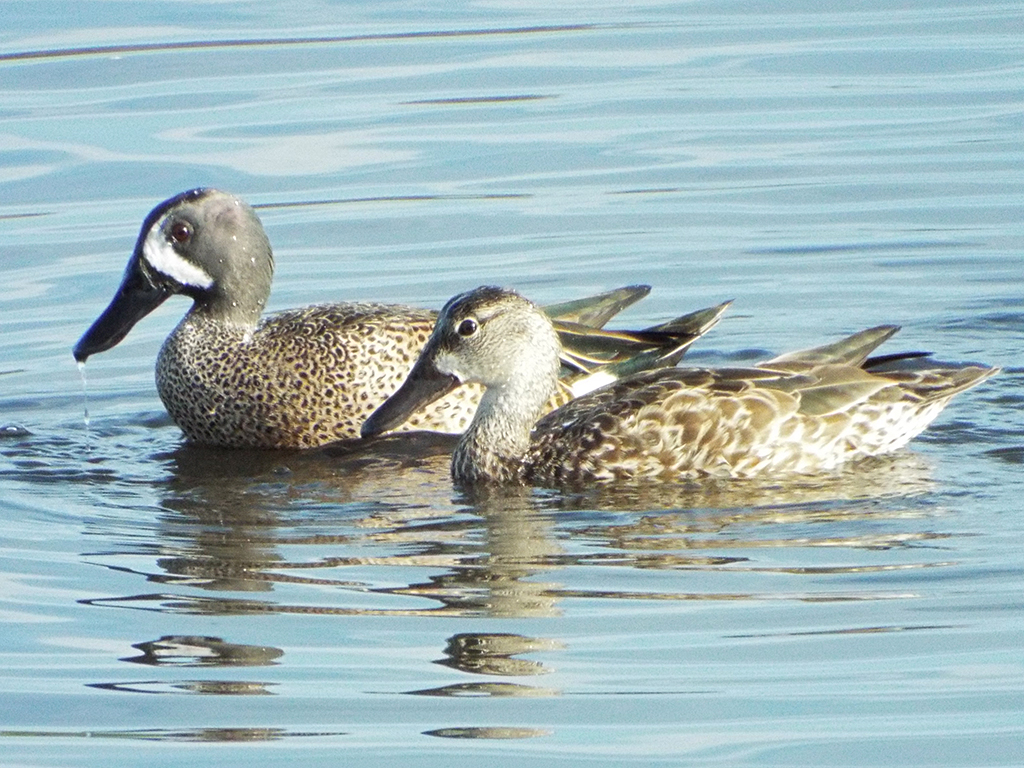
blue-winged-teal-couple
This male (left) and female (right) Blue-winged Teal pair have likely been at MINWR for weeks.
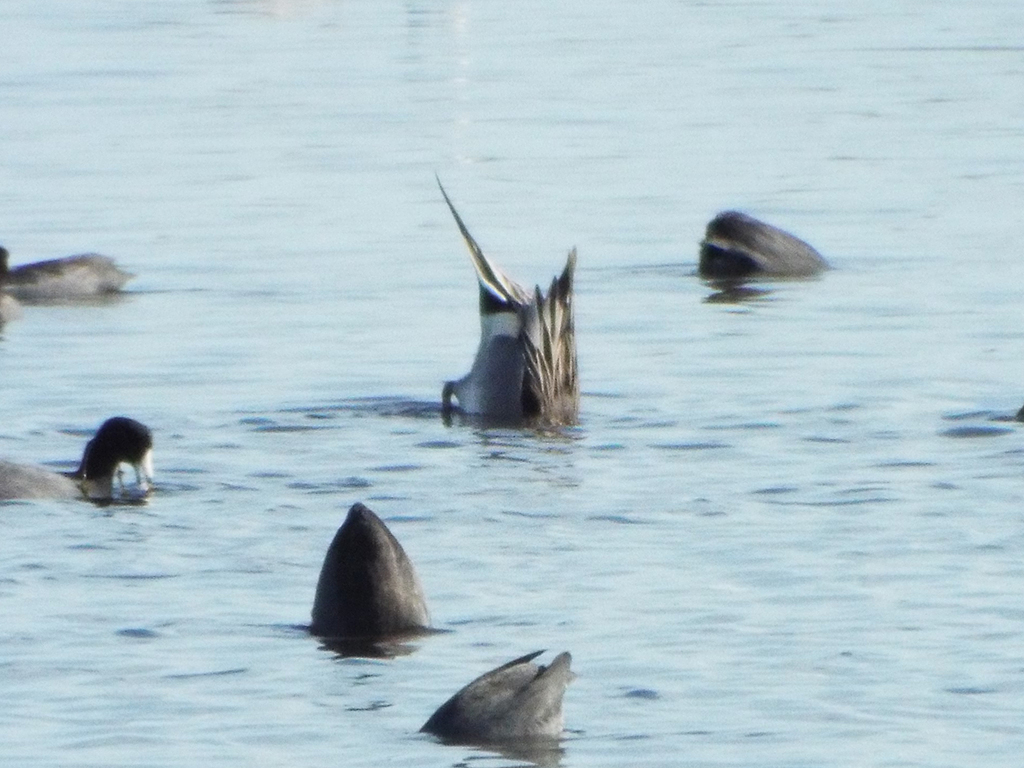
pintail-tail
Bottoms up! Even without breeding plumage, you can see how pintail ducks got their name.
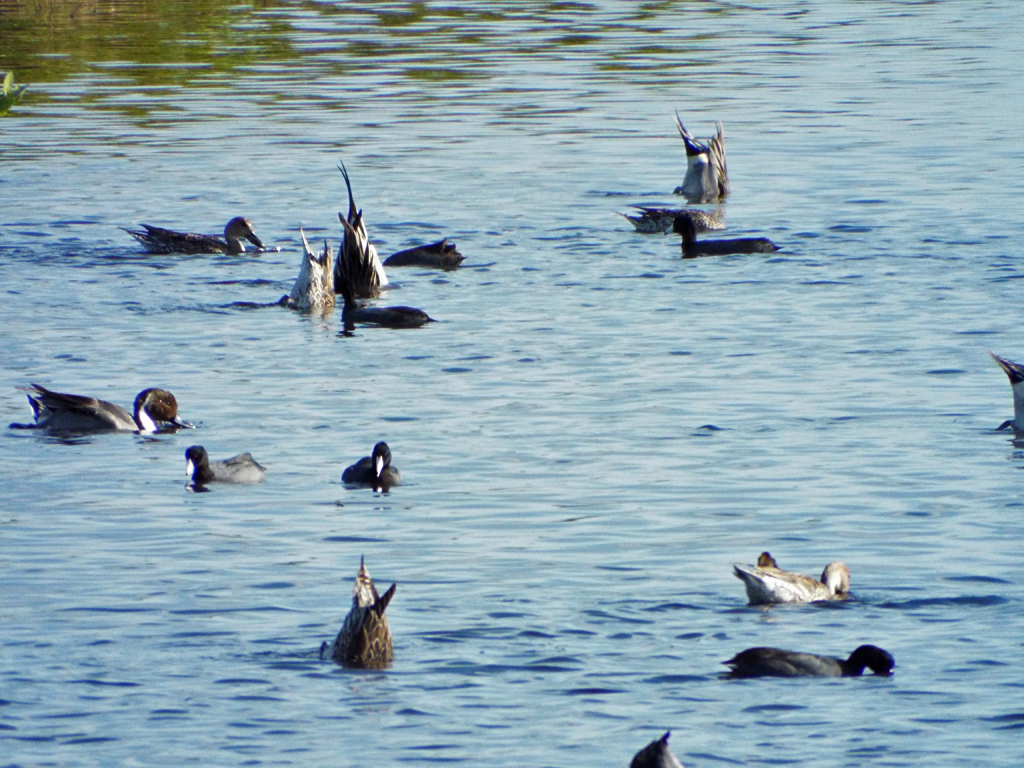
shovelers-pintails-coots
A wider shot showing Northern Shovelers, Northern Pintails, and American Coots together. Large areas of the ponds on the west side of the road (north of Cruickshank) were like this.

A large flock of Redheads were just within binocular range, as well as smaller pockets of Gadwalls, Ring-necked Ducks, and even an overflight of Black Scoters. Overhead and in spotting scope range (for those that had them) were many hundreds of more ducks, too distant or backlit to identify.

Of course, winter means American Coot time. Coots gather in huge rafts over the winter, using a “safety in numbers” survival strategy from predators, such as Bald Eagles. Sometimes other birds use the coots as cover, some blending in better than others. The largest rafts of coots were actually along Playalinda Beach Road (402) in some mangrove-screened ponds [map]. Google Maps erroneously calls this Max Brewster Memorial Parkway.

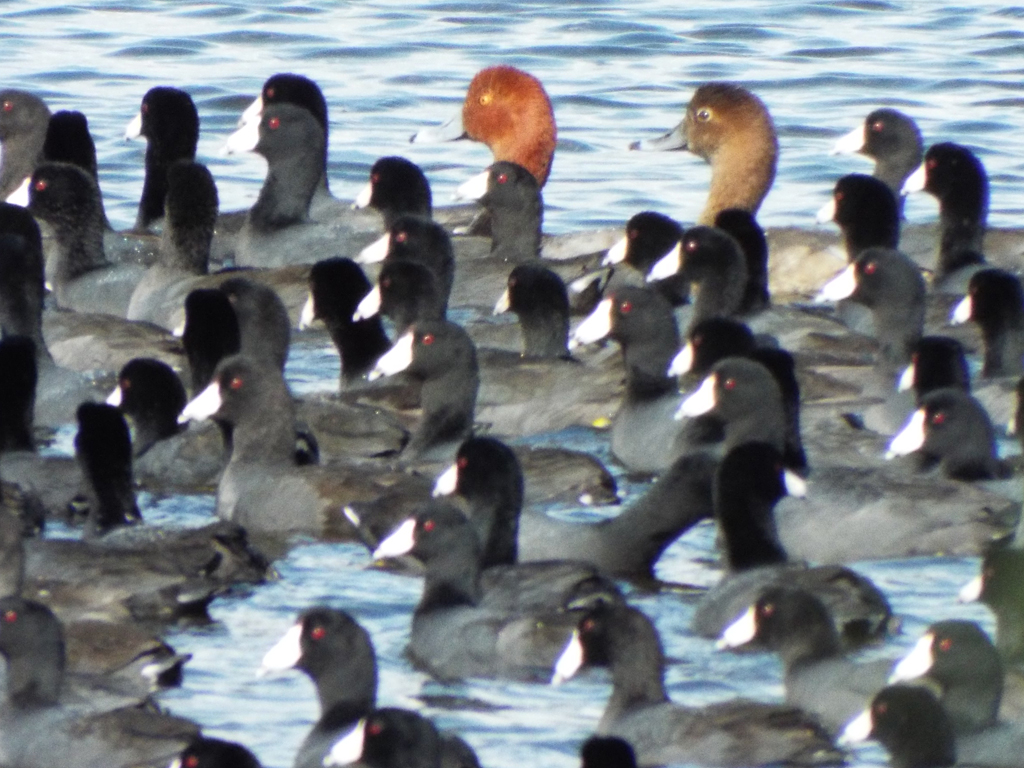
redheads-coots
A pair of Redheads trying to fit in.

The main event the past few years along this stretch has been the large and vocal numbers of American Wigeons. Whether it’s the added privacy of the mangrove hedge or something about the ecology of the area, the wigeons have staked it out.


american-wigeon
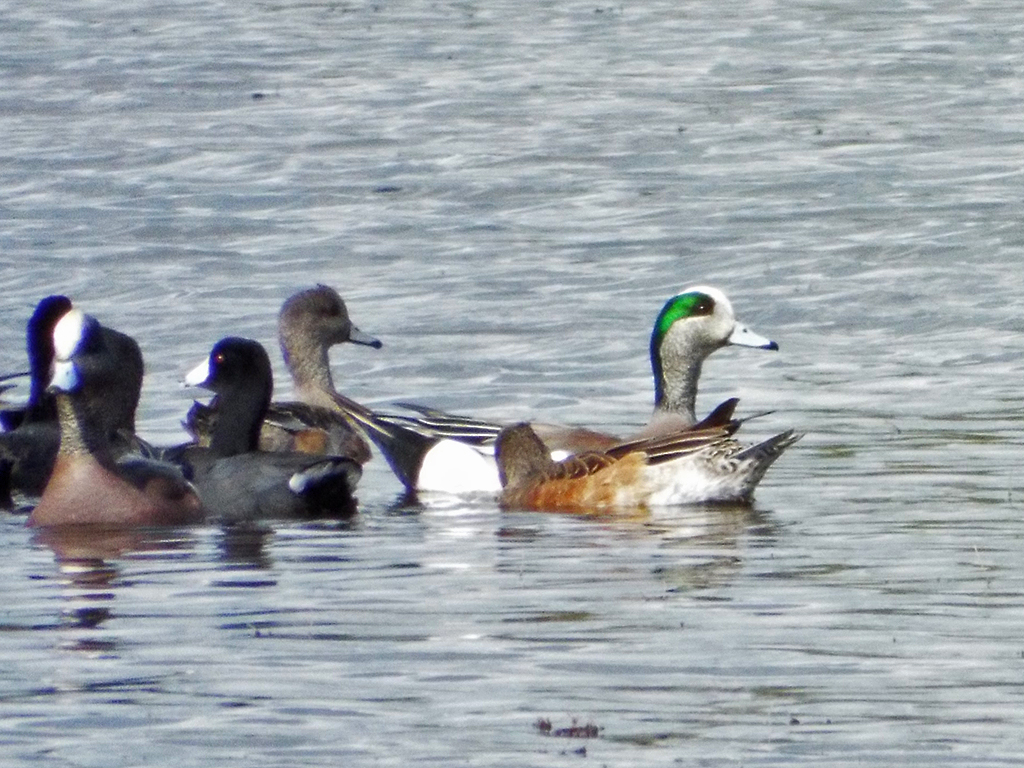
The few gaps in the mangroves allowed for some photos. The green feathers on the male American Wigeons are spectacular when they catch the sunlight.
many-wigeons
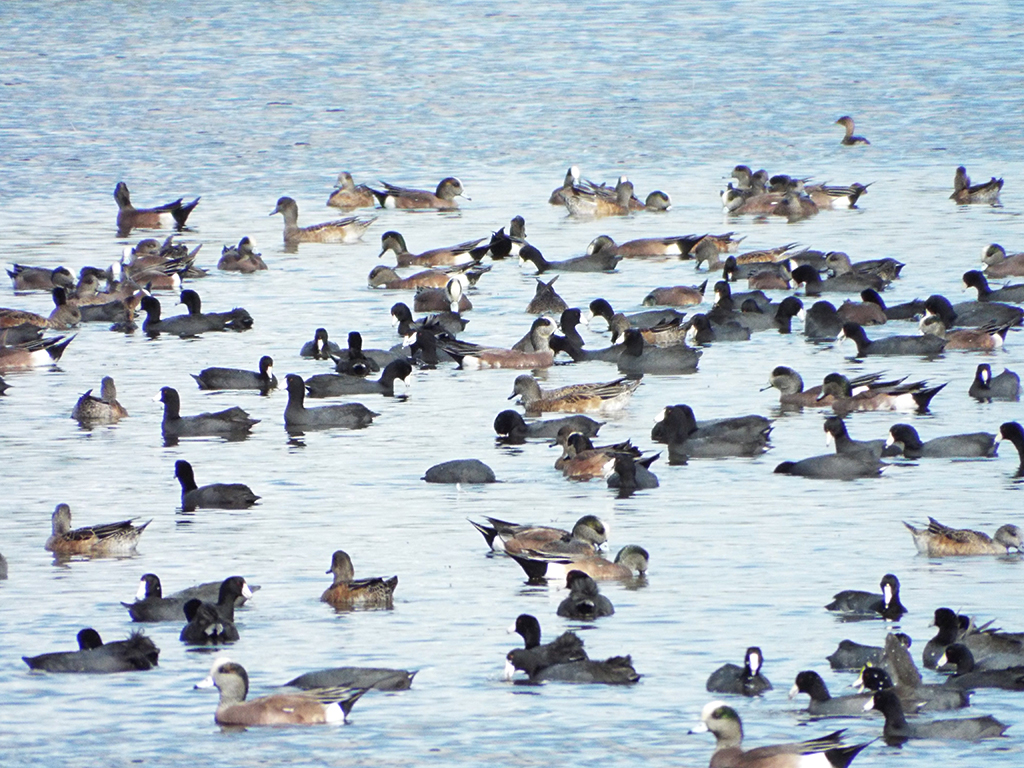
Many American Wigeons (and coots, of course). There might be a grebe or two in there, as well.
wigeons-flight
The wigeons were a bit skittish. It seemed like they took to the sky at the slightest approach through the mangroves. The large flocks would break up and circle in smaller groups like this before settling down again.

Hopefully the ducks will stay over longer this winter than they have. The Space Coast Birding and Wildlife Festival begins in just over a month, and the impressive array of ducks at MINWR would be a great treat for field-trip attendees!


Look Who’s Ducked in for a Visit

The major bird “events” that many people look forward to in Florida are the Spring and Fall songbird migrations. In the Fall, hundreds of northern species funnel south through the state either to stay for the winter or on their way to Central and South America. The process is reversed in Spring when these species pass north on the way toward their breeding grounds.

There’s another migration that happens, though. In November, ducks by the thousands begin to arrive on the coasts, lakes, ponds, lagoons, and estuaries. Unlike most songbirds, whose drive to migrate is dictated primarily by length of day, many ducks and other waterfowl migrate when the food supply or weather dictates. If a winter is comparatively mild and food is abundant, these birds may not arrive in Florida until later in the winter, if at all.

One thing to count on, no matter when the ducks arrive, is that there’s almost always a vagrant, rare or unusual species that pops up here and there in central Florida.

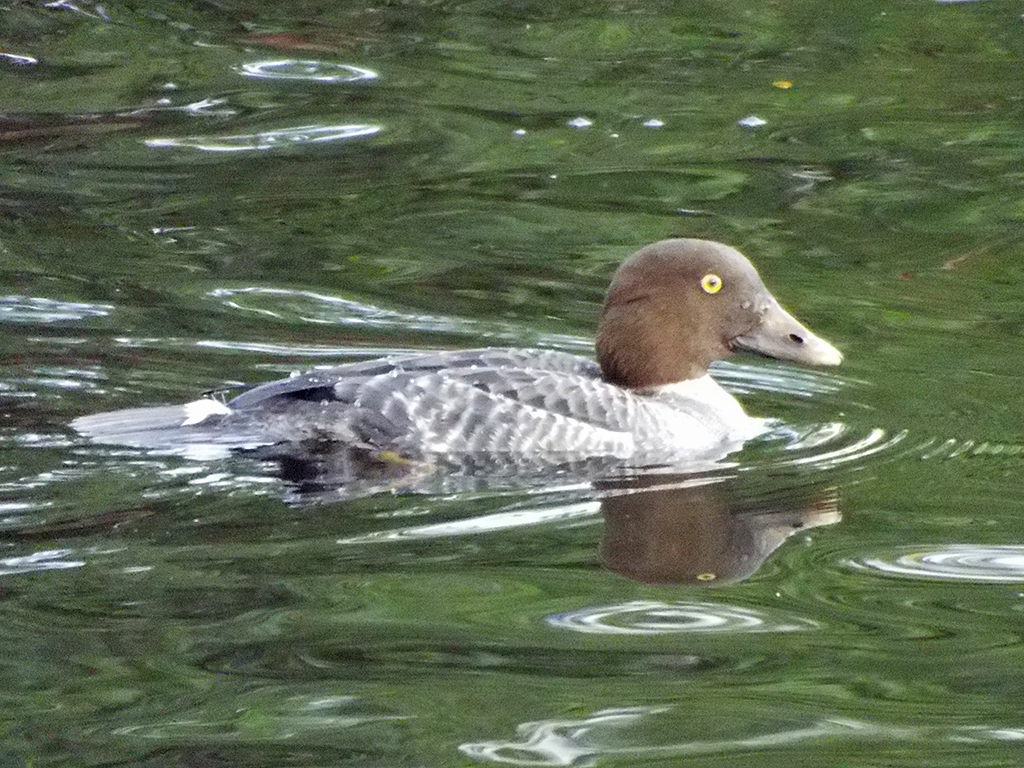
For example, there has been a Common Goldeneye at a small retention pond in Melbourne for the past couple of weeks. This particular bird has been hanging out with a flock of Hooded Mergansers. Common Goldeneyes normally winter as far south as the Gulf Coast and the Carolina Coast (though they are increasingly found in northern Florida).

common-goldeneye1
The brown head indicates that this is a female. Note the gold-colored eye that gives this bird its name.
common-goldeneye3
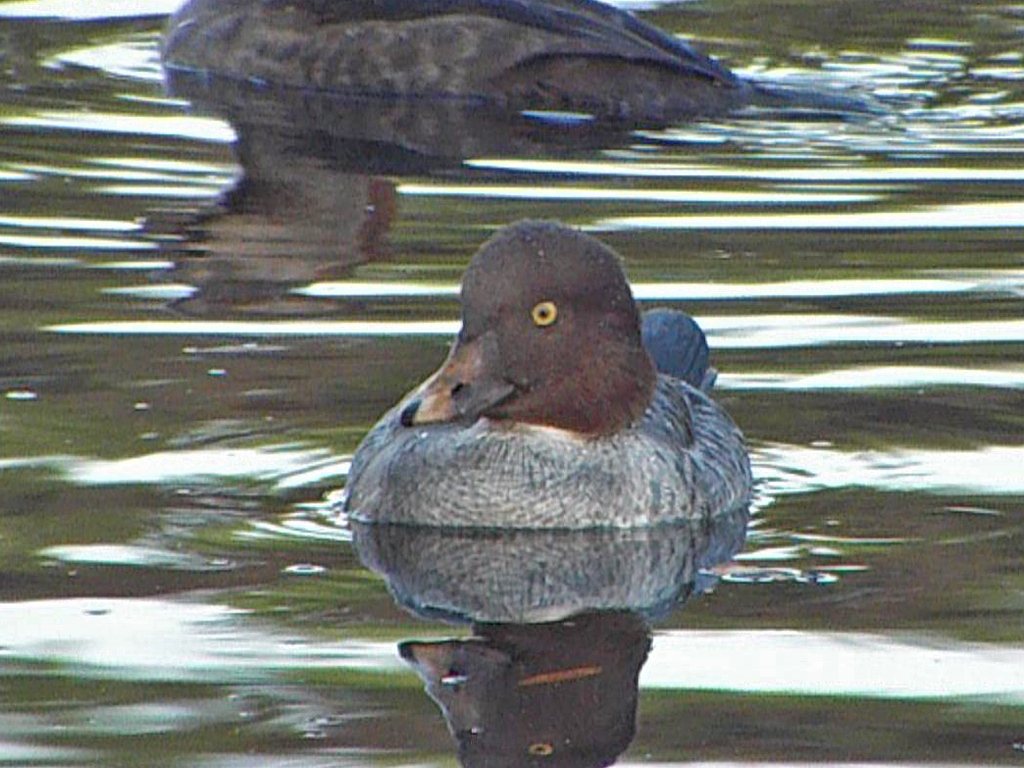
In breeding season, the tip of the bill would be brighter yellow, contrasting with the almost black base. The black area at the tip of a duck’s bill is called the nail and is sometimes useful for species identification.

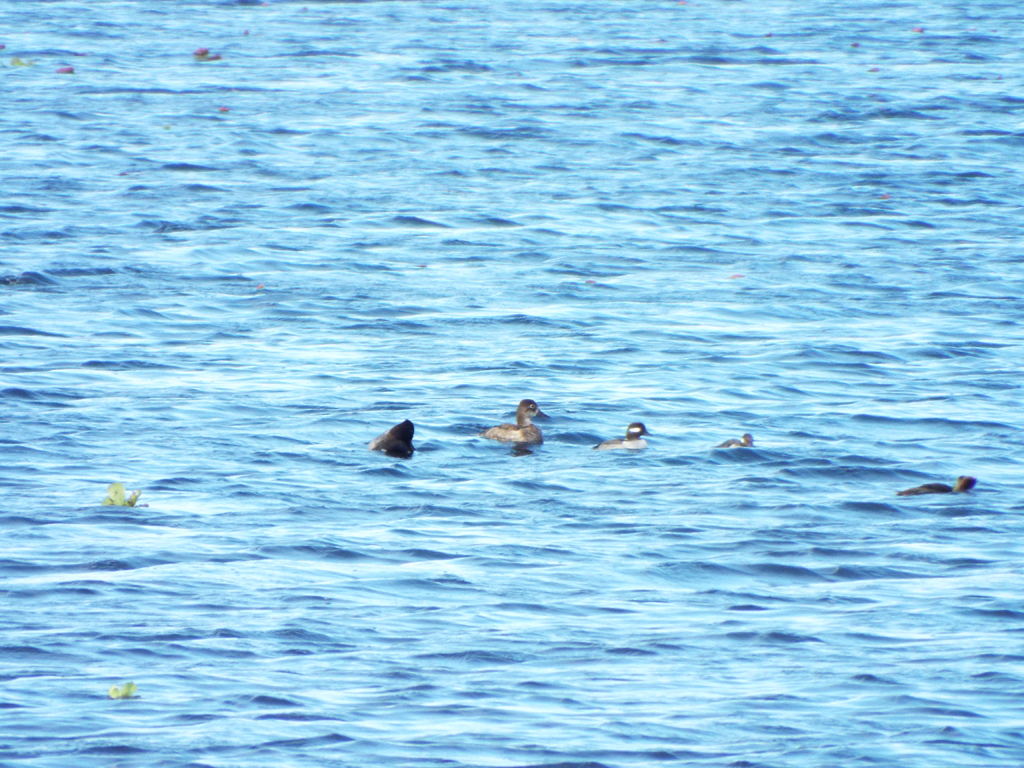
A few days earlier,  another rare but regular visiting duck species was seen at Orlando Wetlands Park. Buffleheads are small diving ducks, usually seen in saltwater bays or along the coast in winter (though they do breed near northern lakes). These Buffleheads (either females or immature males) were swimming and diving with Hooded Mergansers, Lesser Scaups and a Ring-necked Duck. The typical winter range for Buffleheads just extends into extreme northern Florida.

bufflehead-in-there
The Buffleheads are the 3rd and 4th ducks from the left, in this distant shot. The first duck is tipped tail-up, feeding. The white head-stripe was noticeable, even without binoculars.
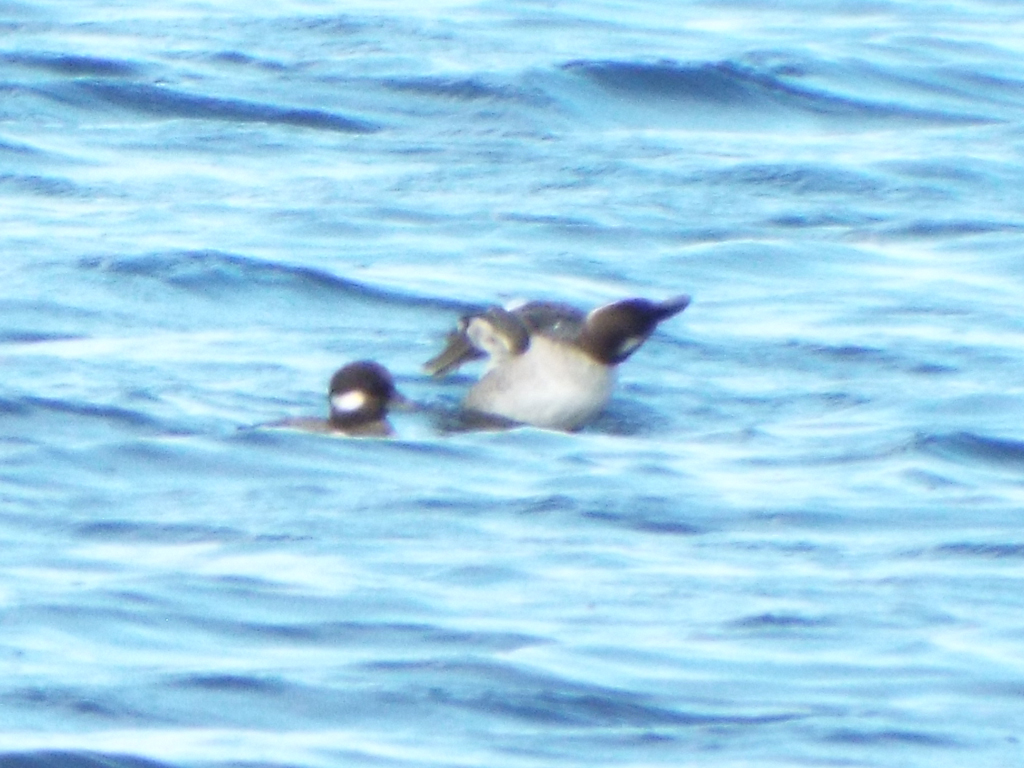
bufflehead-in-there2
Here’s a close crop of the birds on the wind-ruffled surface of one of the artificial ponds that make up the park.

The two duck species above are among the more often seen, since their historical winter ranges are not that far away.

Other rarer, but regular waterfowl visitors to Florida include Snow Geese, Ross’ Geese, Mute Swans, and Long-tailed Ducks (the latter usually along the coast or in coastal lagoons). Over-wintering ducks and other waterfowl aren’t always that picky on where they stay, either. It often pays off to drive by suburban and urban retention ponds. Keep your eyes open!

Memory and Mystery

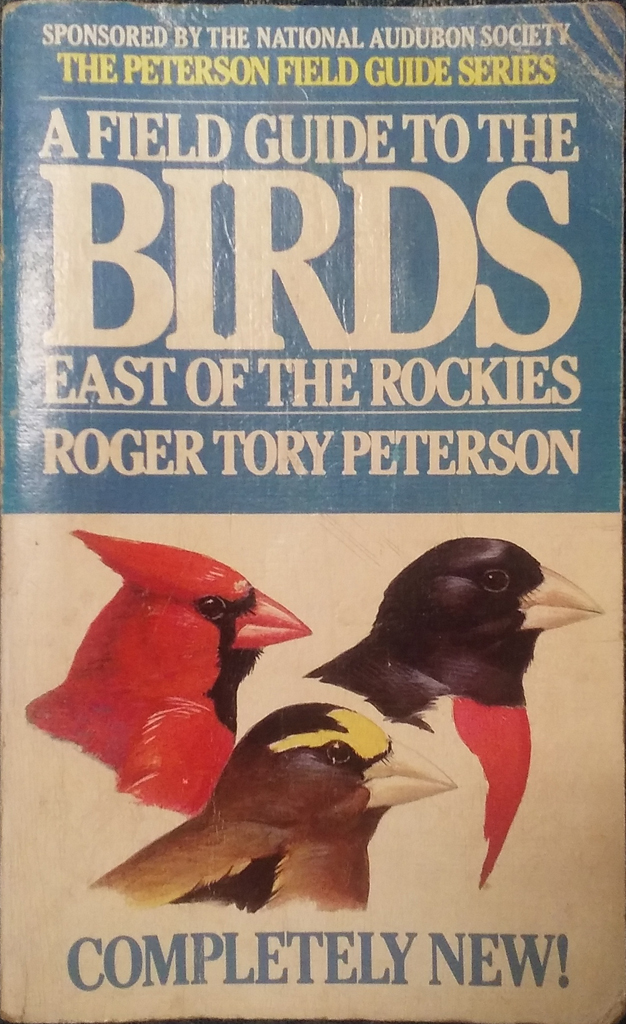
After over a decade, I was finally able to recover my 4th edition of A Field Guide to the Birds East of the Rockies, by Roger Tory Peterson. It was given to me by an aunt soon after I had my spark as a high-school senior to be a birdwatcher. Years ago, I lent the guide to a friend with whom I almost immediately lost regular contact with. I purchased a 5th edition, after making do with my Stokes guide for a time (which is fine, if you like photo-based vs. illustration based guides – a discussion for another time).

peterson-4th
The cover of my Peterson’s 4th Edition with the 3 (sort of now formerly) finch heads. Since this edition, cardinals and grosbeaks are still “together”  (family Cardinalidae) but separate from finches and sparrows (family Emberizidae). Back in 1980, they were all in family Fringilidae. Taxonomists live and die by their Latin, of course.
Its recovery also includes attendant checklists and notes, some made in the margins of this  well-worn volume. But with it came a mystery! I have “Scrub Jay” noted, seen in Montana.
Why is this significant? At the time I “lost” the guide, I had not yet seen a Florida Scrub-Jay. It is also important to note that the 4th edition was published in 1980. As many of my birding readers know, bird taxonomy (the practice and science of classification) is in a constant state of flux. Back in the early 1980s, birds such as the Baltimore and Bullock’s Oriole were lumped (or re-lumped) into “Northern Oriole” and there was only one “officially” recognized species of Scrub Jay on the continent. Since then, the Scrub Jay has been split and/or redefined at least twice.
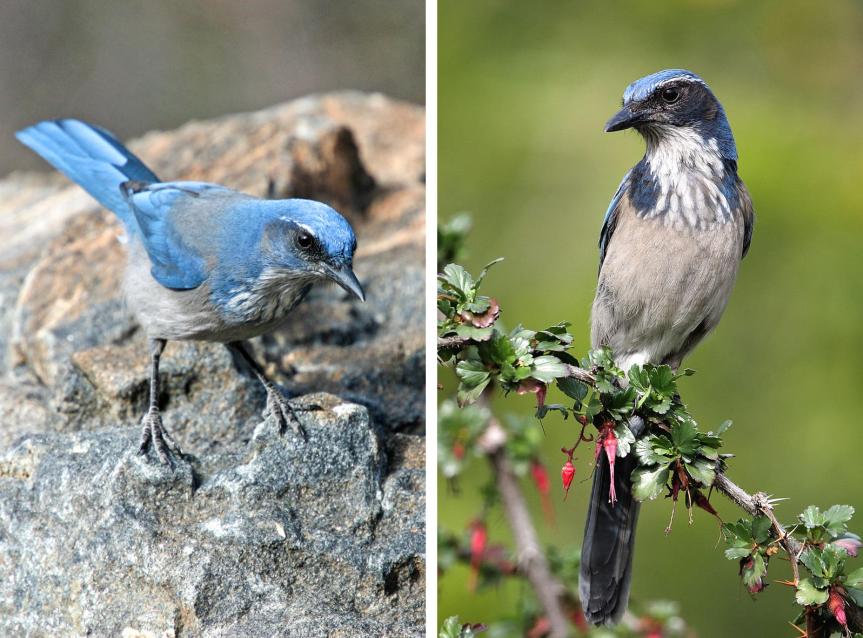
What to make of this simple note of a Scrub Jay in Montana in 2001? The two most likely candidates are the California Scrub-Jay and Woodhouse’s Scrub-Jay; both were formerly part of the “Western Scrub-Jay” prior to a taxonomic split this year. In 2001 the Western Scrub-Jay was already a distinct species from the Florida and Island species, but my 1980s era guide didn’t tell me that.
sfw_gbbc_2014_5238_western_scrubjay_lou_orr_arcadia_ca_habitat_kk
From left: Woodhouse’s Scrub-Jay. Photo: FLPA/Alamy; California Scrub-Jay. Photo: Lou Orr/Great Backyard Bird Count (Not my photos).
The problem is larger than this, though. For either “probable” species of scrub jay, neither is terribly likely in the places I visited back then. Our track took us from Fort Benton, along the Missouri River to Great Falls, south to Helena and eventually to Three Forks. According to eBird (which risks becoming the “Wikipedia” of the bird-sighting world, I realize) there are no reports of a scrub jay within hundreds of kilometers of my locations. The closest mapped species is the California Scrub-Jay, seen near the Thompson Falls Reservoir. But it’s the least likely given the habitat. The closest Woodhouse’s Scrub-Jay is mapped near the Cress Creek Nature Trail in Idaho, well to the south.
Unfortunately I did not make any further notes on this sighting (or if I did, they are lost to both my memory and physically). Was the bird or birds I saw pale or strongly colored? I want to say pale, but memory is notoriously faulty and I can’t rely on a decade-and-half-old recollection.
Realistically, this doesn’t mean a whole lot in practical terms. It’s one “count” on my life-list I can’t really add. The best I can do is note, in today’s taxonomy, “Woodhouse’s/California Scrub-Jay” and leave it at that. It’s an almost imperceptible blip in the vast store of bird sightings both within and outside of eBird.
This illustrates the importance of notes and photographs. It hasn’t really been until my adoption of eBird to track my sightings and my use of a camera that I’ve had any semblance of good record-keeping with my birdwatching activities (and even still, I could do much better). I am not by nature an organized person. For these and other past records, they’ve passed on into memory and thus into obscurity and I’m left with a handful of sightings that will be best served as personal myth.

Fun with Anis

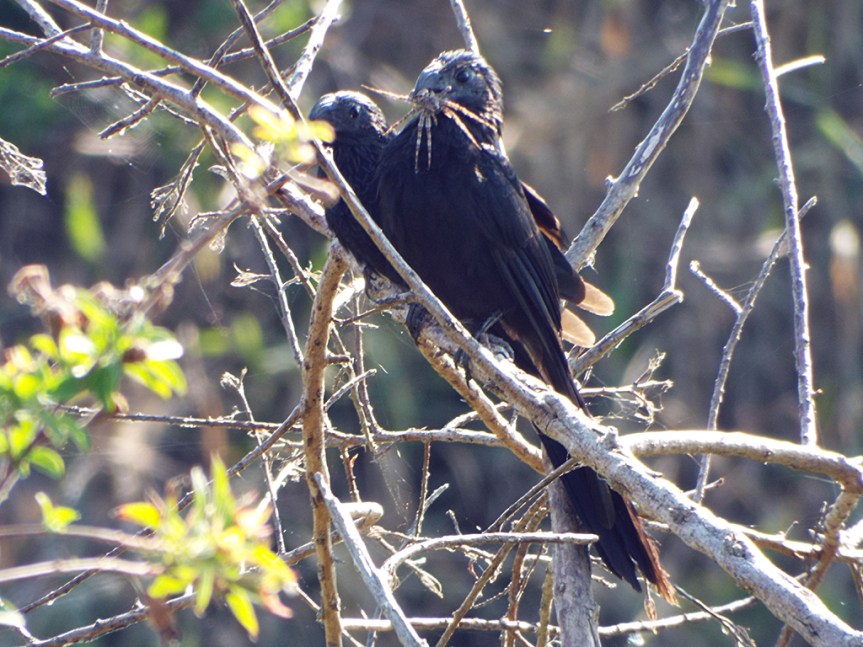
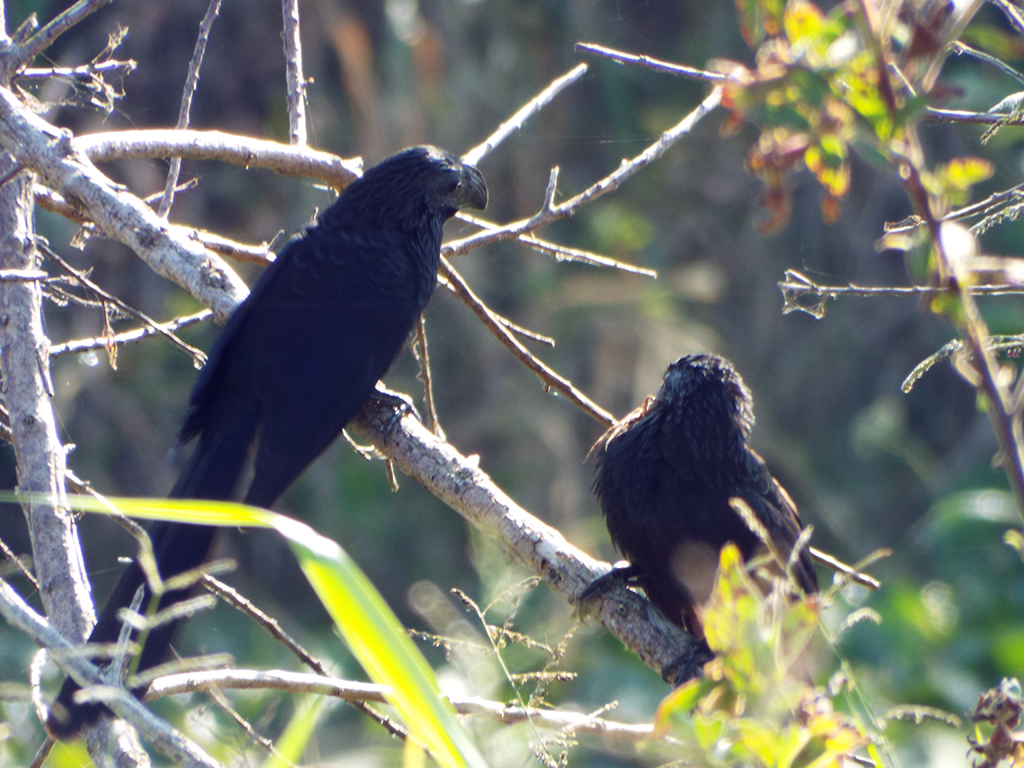
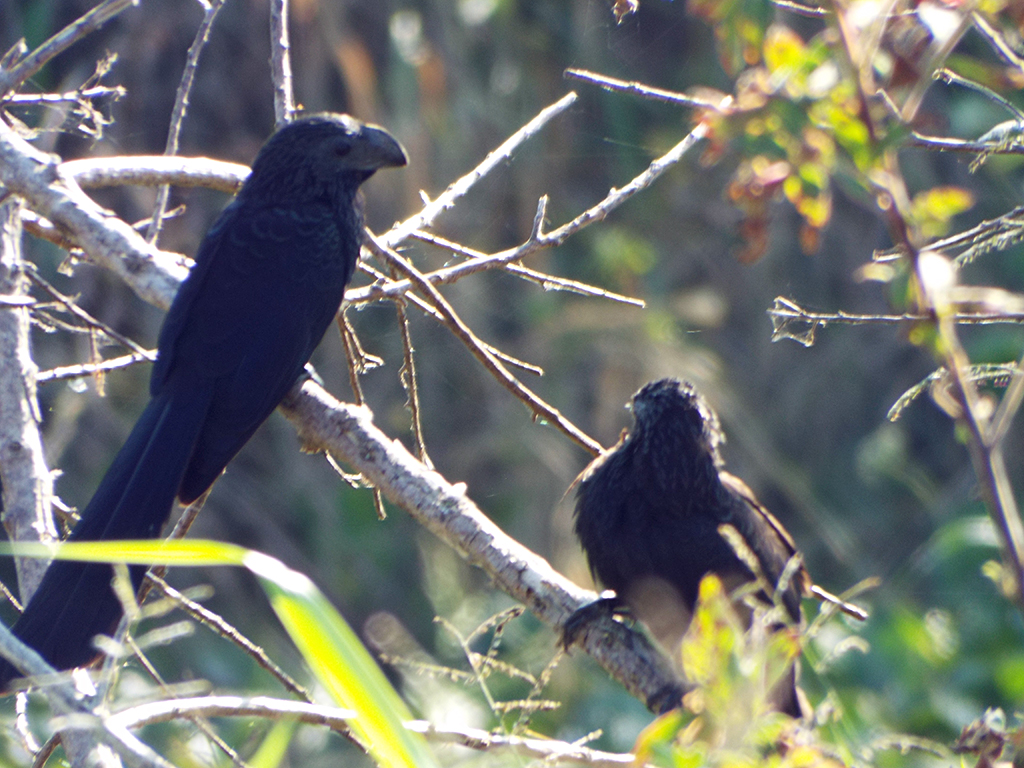
At Lake Apopka this morning, we had this fun little interaction between the two Groove-billed Anis that have been seen there all week.

what-is-that1
“Oh yeah, what you got there?”


what-is-that2
“Uh…wait. I don’t think I like this…”
 
what-is-that3
“What? This thing is GREAT!”           “…keep that thing away from me…”
The bird with the spider tried to give it to the other one several times, even chasing it a bit up the branch!
Oh, and Groove-billed Ani? Lifer!

Fellsmere Friends

Here are just a few of the friends I met down near Fellsmere this past week.

t-vultures
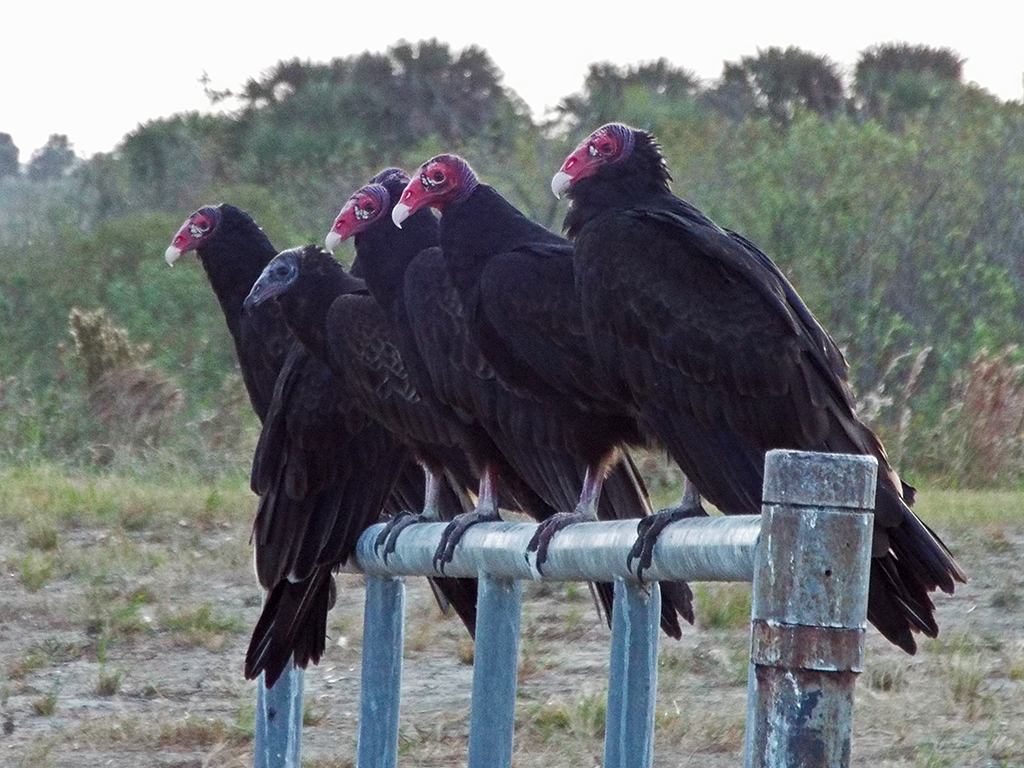
Can you spot the youngster in this line of Turkey Vultures?
red-shouldered-hawk
This “Florida form” of Red-shouldered Hawk has lost (perhaps molted) its tail. It is just growing back.
shrike
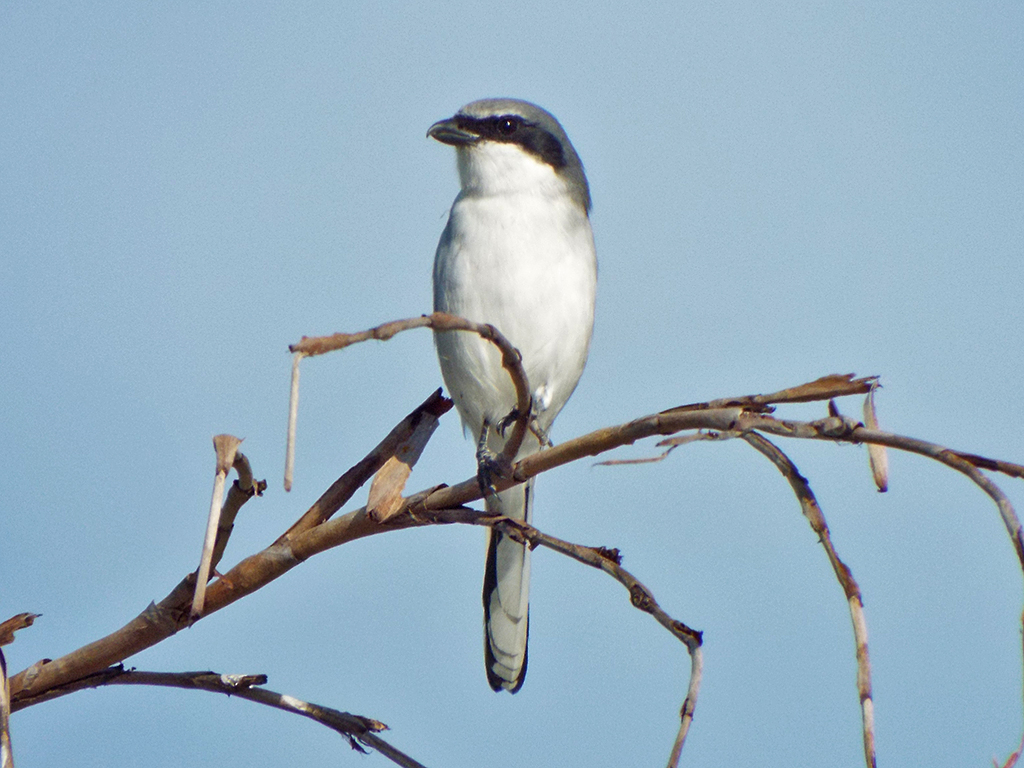
Loggerhead Shrikes are so named because of the relative large size of their heads to their bodies. Loggerhead Sea Turtles are named for the same reason.


Miami Thrice: 3 Lifers and the Joy of Suburban Birding

As I mentioned in my last post, I’ve had a couple of bigger birding adventures this fall. Two weeks ago, in a push to try and see some south Florida exotics and specialties, Camille and I went to the Miami area for a day trip. Our main goal was to find Spot-breasted Orioles, Red-whiskered Bulbuls, White-crowned Pigeons, and Common Mynas. Parrots were also a good possibility.

Hurricane Matthew had passed offshore the week before. There was still evidence of coastal flooding and inundation here and there, but no major damage that I could see.

We stopped at A.D. Barnes Park [map] first, since there had been a report of a Sulphur-bellied Flycatcher there several days before. Unfortunately, we struck out with that bird, and we dodged raindrops and tough lighting most of the morning.

palm-warbler
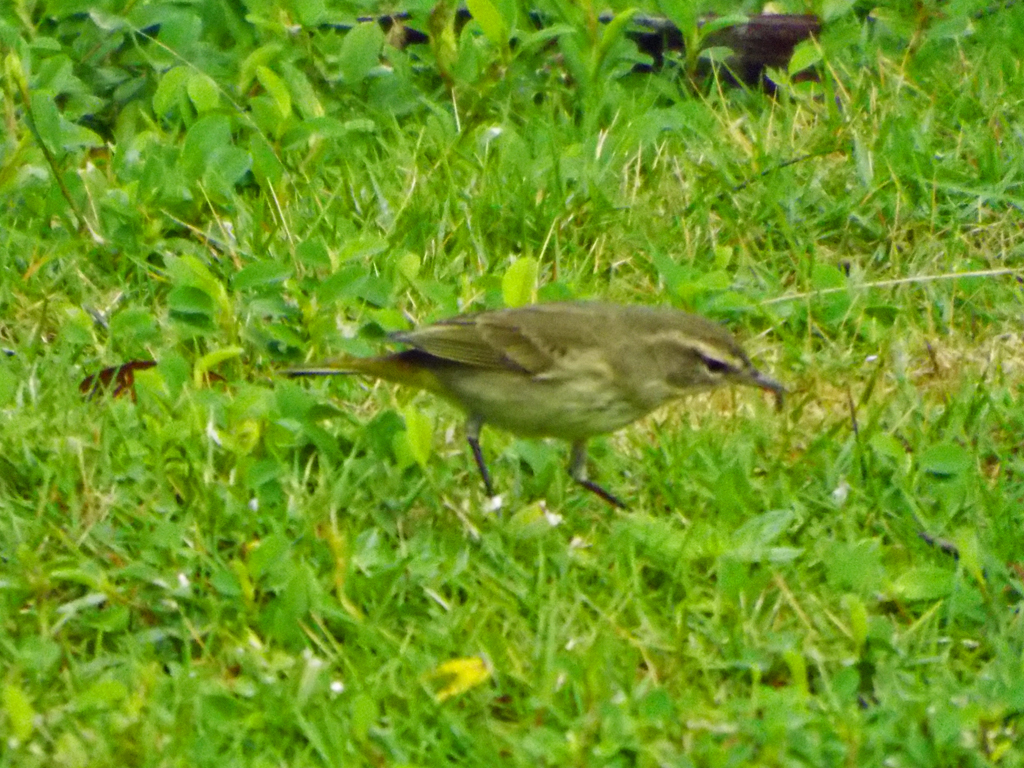
Palm Warblers were really hopping about in many places, here for their winter stay.

There were a few different warbler species in the wooded sections of the park, including by the nature center, but nothing in large numbers. Some parrots would circle nearby from time to time, but the canopy kept us from identifying which species it was. There are several established parrot species now in south Florida, including the now familiar Monk Parakeets (also known as Quaker Parrots) and Blue and Gold Macaws.

worm-eating-warbler
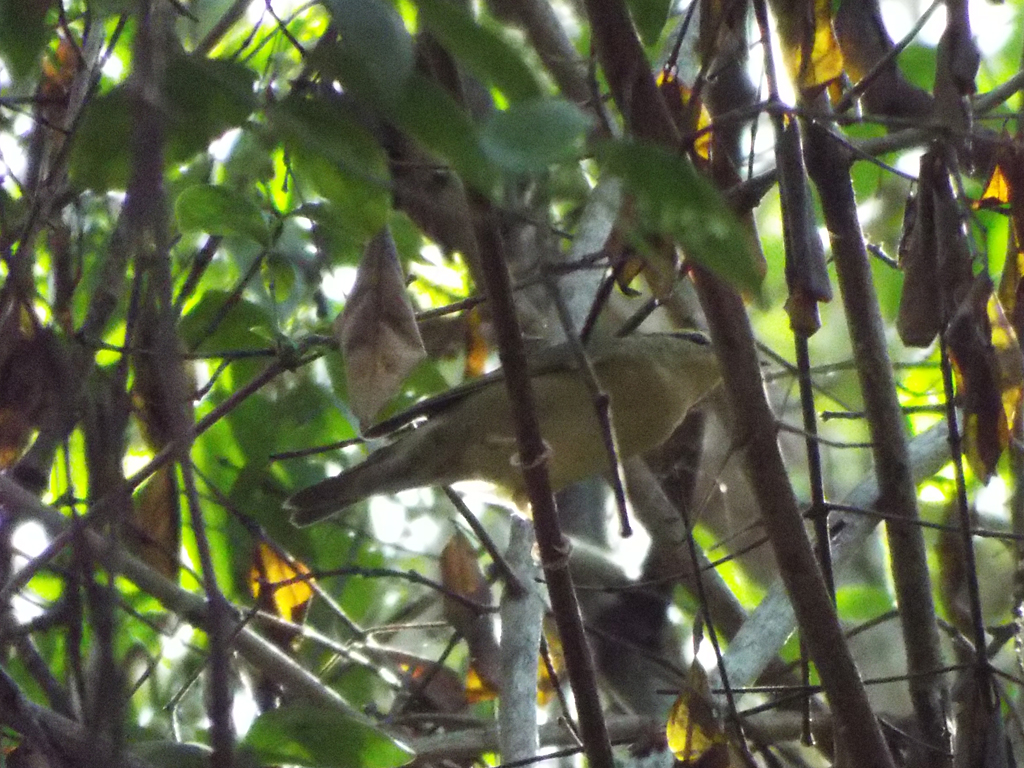
This Worm-eating Warbler may not be as flashy as a parrot, but it was a nice find.

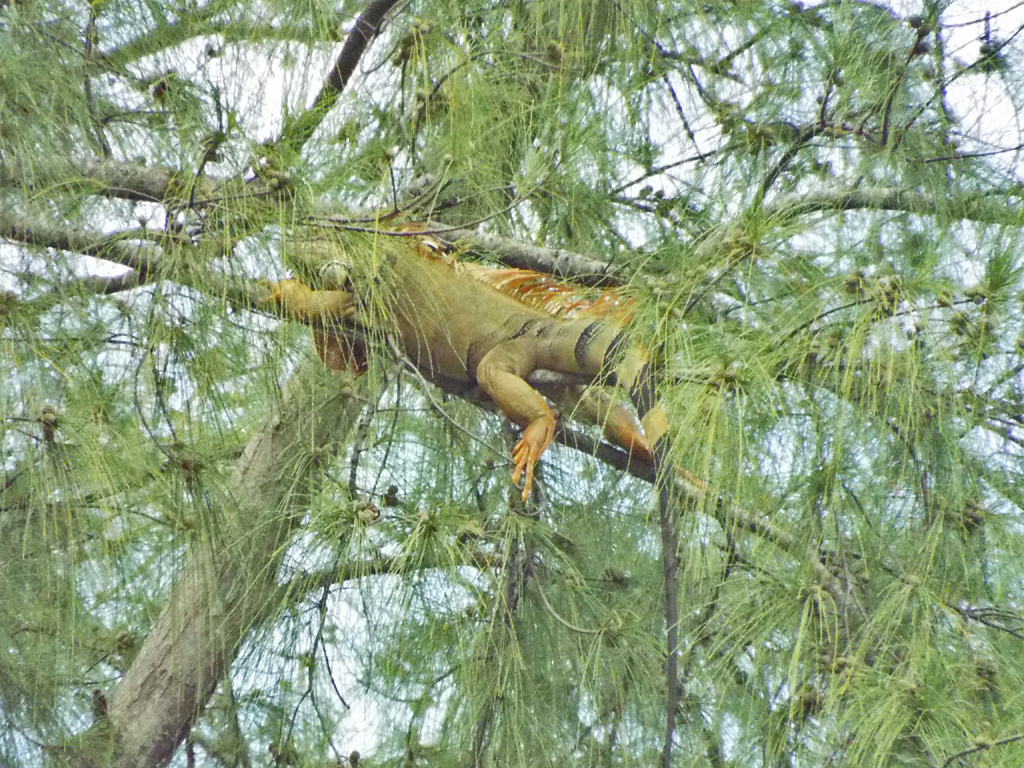
At the other end of the park, I looked in one of the trees over a pond and thought someone had lofted a pool-toy raft into the branches, but it turns out it was an iguana! This invasive species (introduced via escaped or released pets) can grow several feet long. They often lounge in the trees, I’ve been told.

iguana
A real lounge lizard?

There was also a Merlin being harassed by a flock of Blue Jays. Eventually the jays gave up and the little raptor staked out some lookout perches high above the park, but it was very wary of us and kept flying off a bit as we approached. This photo was the closest it let us get before flying off and out of sight.

merlin
Merlins arrive in October and generally stay the winter.

Our last birds in the park were some Northern Parulas, Chestnut-sided Warblers, and a pair of male Cape May Warblers, still sporting some bright yellows.

cape-may-warbler
One of two Cape May Warblers, enjoying berries from ornamental plant in the park.

eBird list for A.D. Barnes Park:
http://ebird.org/ebird/view/checklist/S32064632

After leaving the park, we headed for some neighborhoods in the Dadeland/Kendall area of Miami [map], hoping to find the exotic species I mentioned at the start of the post. These birds were somewhat hard to get good looks at, since they tend to hang out in peoples yards or behind houses.

I did get a quick look at a Spot-breasted Oriole in someone’s tree, and there were the typical mockingbirds and cardinals. We did see a White-winged Dove as well as a Loggerhead Shrike, too. At the King’s Creek Village subdivision we were surprised by a Red-whiskered Bulbul that was flycatching from a fruit tree of some sort. We had initially walked into the area behind some apartments to scout it out, and the bulbul surprised us. It stayed in plain sight until I ran back to the vehicle to get my camera. On my return to the immediate area, it of course flew off never to be seen again!

eBird lists for Kendallwood and Kings Creek Village:
http://ebird.org/ebird/view/checklist/S32068268
http://ebird.org/ebird/view/checklist/S32069300

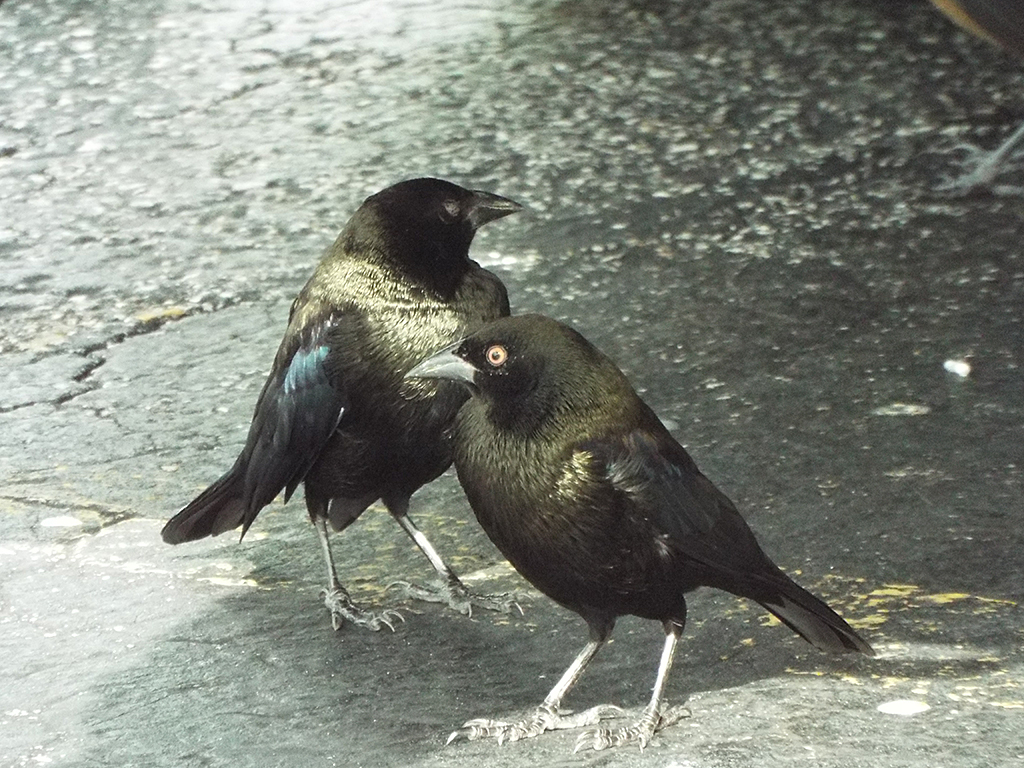
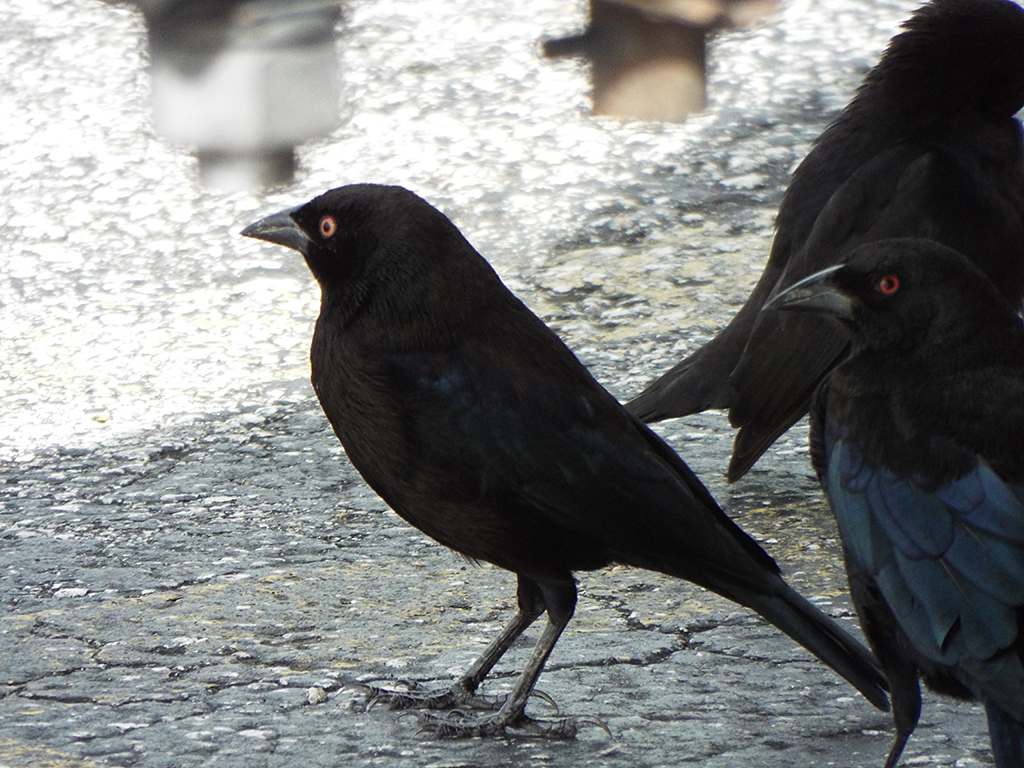
After that, we cruised around a bit looking in on places where Common Mynas had been seen recently (they are scattered all around the city). At one commercial area we pulled in and noticed a large amount of blackbirds in a parking lot, many of the birds standing under vehicles. Many of the birds were Boat-tailed Grackles, but the smaller blackbirds gave me a double-take. What I at first thought were Common Grackles were in fact Bronzed Cowbirds. It turns out that this particular location is a known hangout for them. These birds are rare at the Space Coast, though, so it was pretty exciting. I love this pair of photos, because they show how different most blackbirds look in direct sunlight vs. indirect light.

bronzed-cowbirds-sun.jpg
You can see why Bronzed Cowbirds are so-named when they are in direct sunlight.
bronzed-cowbirds-shade
Bronzed Cowbirds looking “none more black” in the shade. I love the grumpy expression on the bird on the right!

We stopped for gas on NW 42nd avenue, near where some recent Common Myna sightings were listed in eBird. While filling up, sure enough, there was a myna on a used car lot sign! In fact, here’s a Google Street View of the exact sign (I know, sorry replacement for an actual photo of the bird). Zoom out of Street View to see the location on the map.

If you’re counting (and I was), that’s three lifers – the Spot-breasted Oriole, the Red-whiskered Bulbul, and a Common Myna.

We then made our way to the area around Matheson Hammock Park [map], including “the round beach”. There was still evidence of Hurricane Matthew’s presence here, which made some exploration a bit interesting, due to expanses of mud, plant debris, and coconuts.

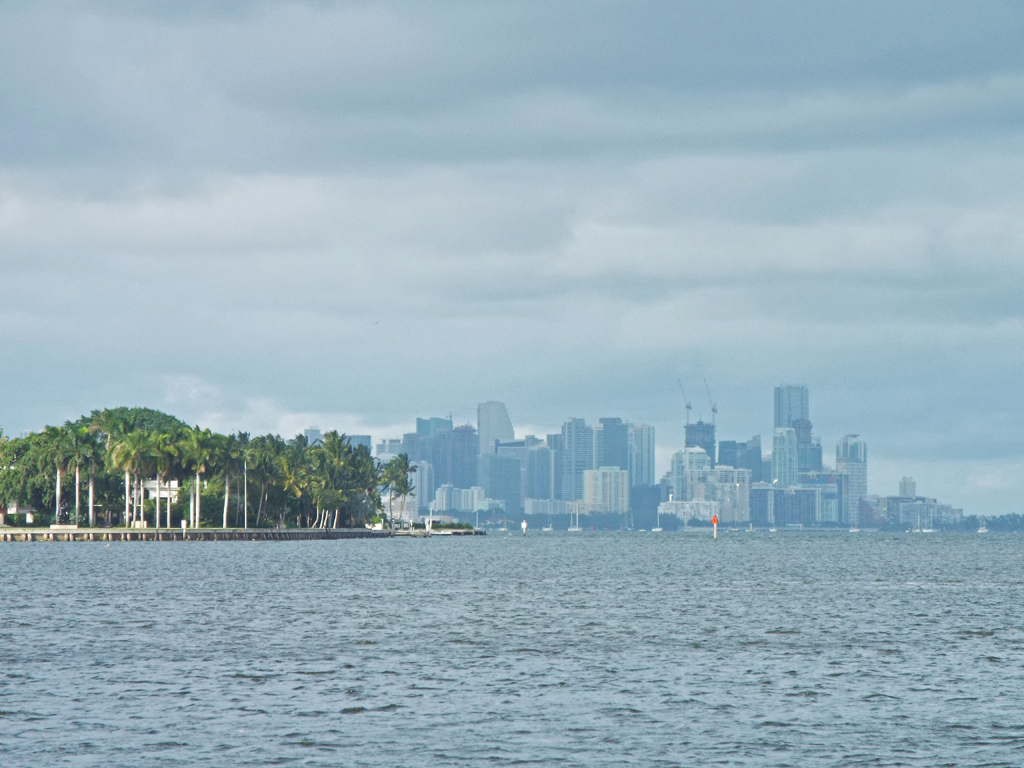
miami
Part of downtown Miami from the beach near Matheson Hammock.

The wind was really picking up, keeping many of the small birds down, but the more powerful aerialists were about, either kiting high up above the shore, making high-speed runs with a tail-wind, or roosting, bodies bent into the wind.

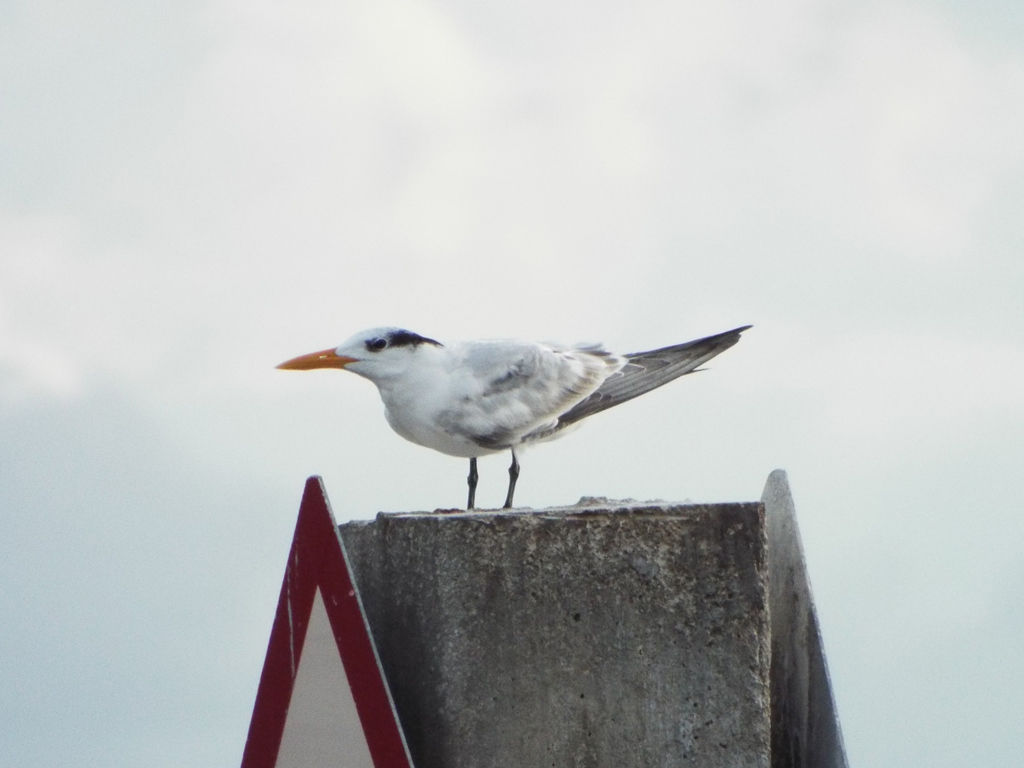
royal-tern
This Royal Tern is in “winter” plumage, with a white forehead and black nape feathers (I think it looks like Patrick Stewart). The buffeting wind didn’t seem to bother it much.

The sea-spray was really starting to fly, and more heavy showers were in the area, as we decided to head out. A few shorebirds were sheltering behind some sea walls or low vegetation.

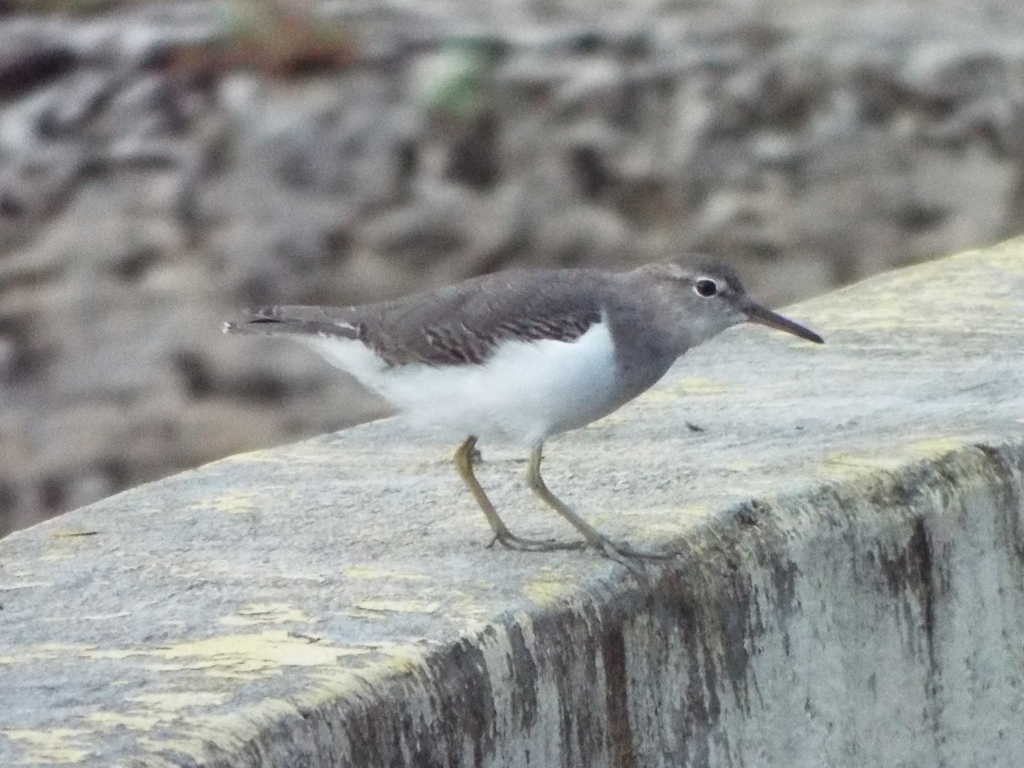
spotted-sandpiper
An “Unspotted” Sandpiper on top of a short sea wall. Spotted Sandpipers lose their spots over the winter, but their overall shape and constant tail-bobbing makes them easy to identify.

Matheson Hammock eBird list:
http://ebird.org/ebird/view/checklist/S32073100

Our day wasn’t quite over yet. Earlier in the day, at A.D. Barnes Park, we noticed two young, abandoned cats. I realize cats and birding are a real hot-button issue these days, and I’m not going to get into any of the politics of it here. Suffice it to say that we had it in our minds to return and get these cats out of the park and fostered or adopted. We did go back and managed to get one of the cats, but the other was much more evasive. The cat we did catch is now spayed and living inside a safe and loving home.
It was a long day, but rewarding all the same. I managed 3 life birds and got a cat off the “streets” and out of the park. I also learned my lesson to be better prepared for unexpected sighting opportunities. I’ll have to go back to Miami and get my Red-whiskered Bulbul photo, plus there are more south Florida specialties to find.