SCBWF 2017 Day 2: Central Florida Specialties

My second (and longest) field trip this year was the Central Florida Specialties trip, led by my friend Dave Goodwin. I’ve done this trip several times, though I skipped it last year. The trip includes stops in many different habitats in Osceola County.

It was one of the coldest mornings of the season as we began, before dawn, to find Red-cockaded Woodpeckers at Three Lakes WMA [map].
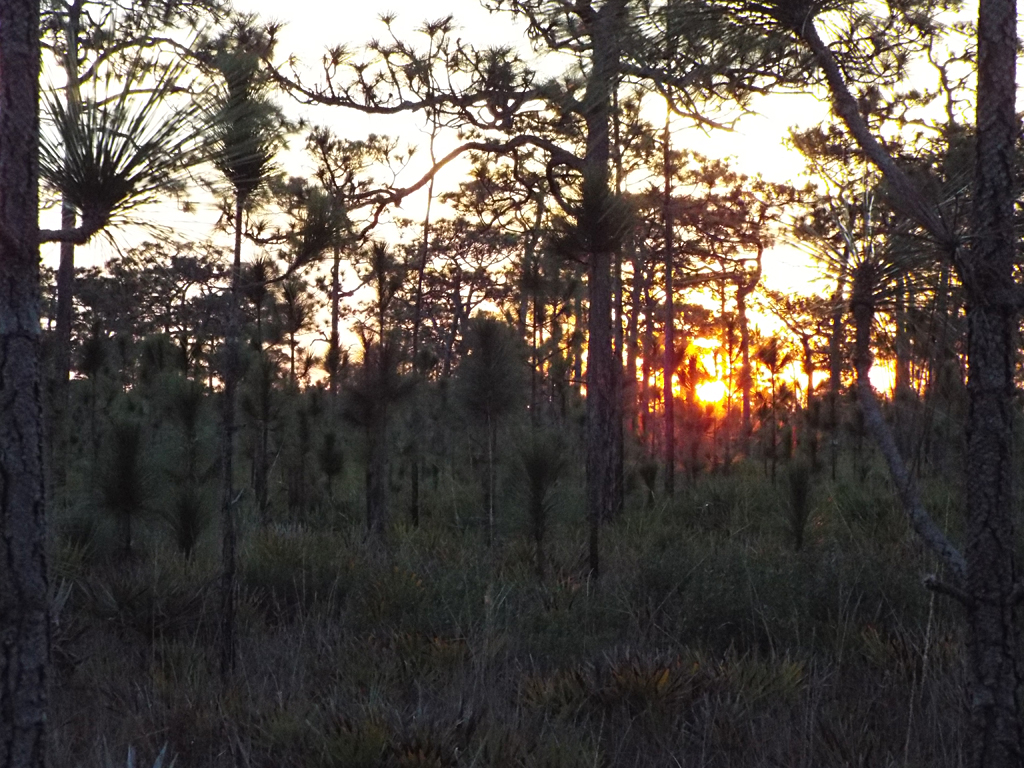
three-lakes-sunrise
Sunrise over the pine flatwoods.

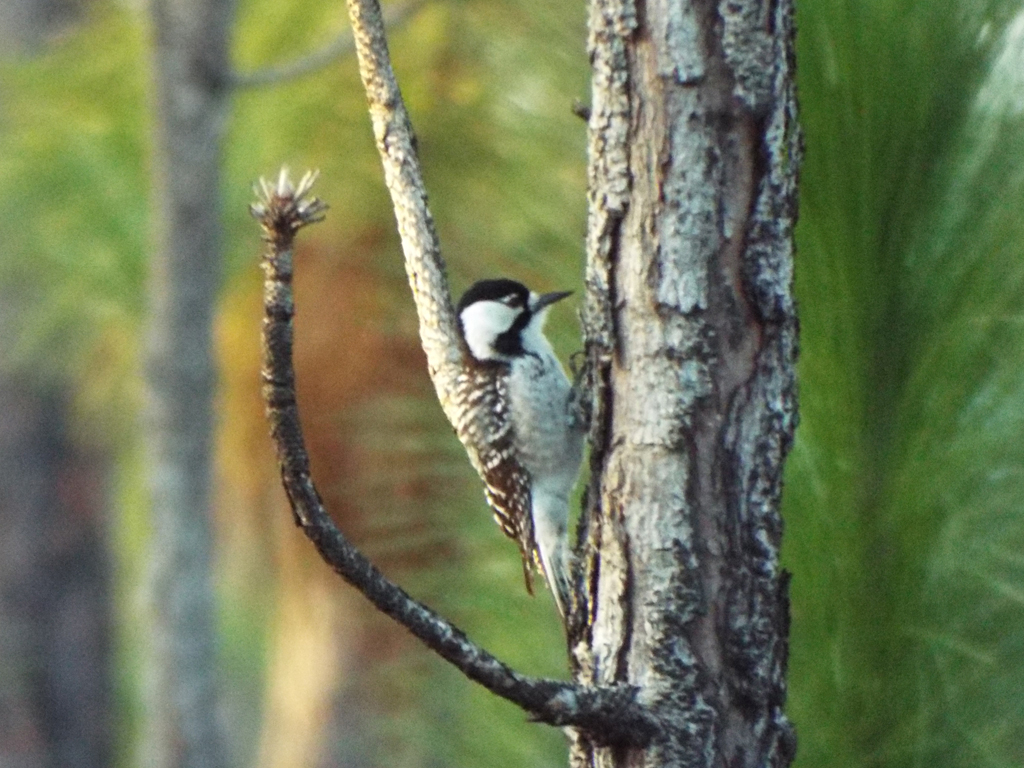
Although we arrived at our target area before sunrise, the woodpeckers were already active, flying low among the trees making their squeak-toy calls to one another. Red-cockaded Woodpeckers are cooperative, family nesters. Previous years’ offspring help parents raise the current brood in a territory, helping with things like feeding and defense.
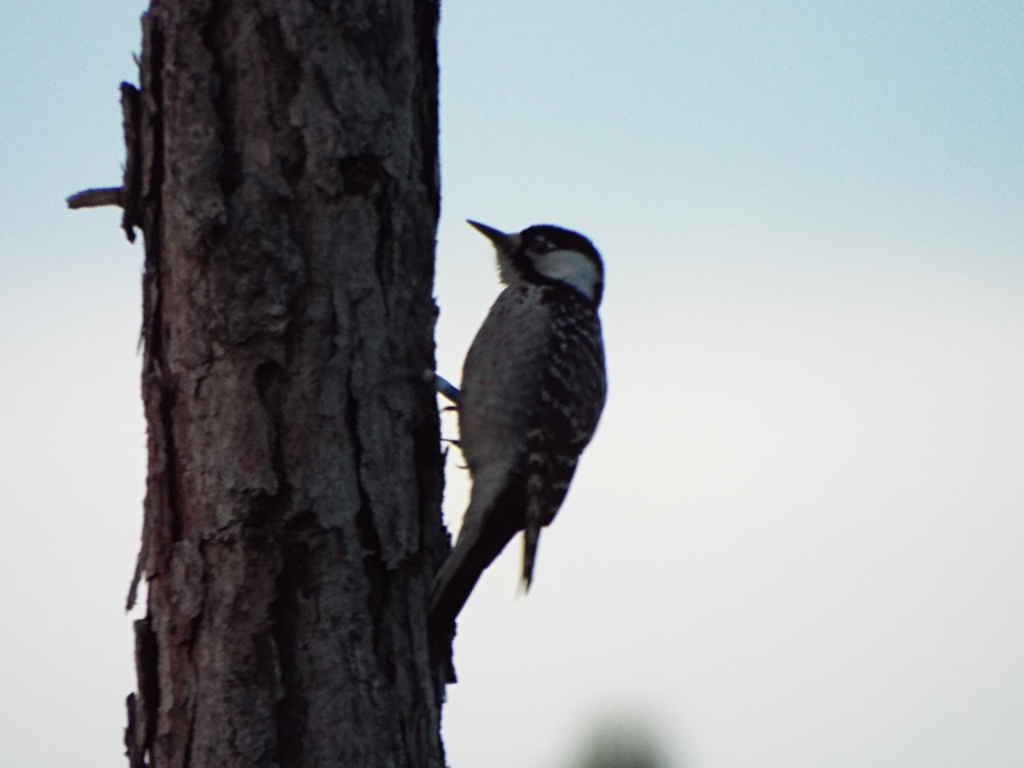
three-lakes-rcw3
The white cheek-patch on this species is a “diagnostic” field-mark. No other small woodpecker in North America has this feature. The tiny red “cockade” feathers on the side of the head are nearly impossible to see in the field.
three-lakes-rcw2
As the sun came up, it got easier to see the birds, and they were fairly unconcerned with our proximity.

As the sun climbed higher and the temperature (slowly) with it, other birds of the pine flatwoods began to stir. We got a few Brown-headed Nuthatches, Eastern Bluebirds, and perhaps an Eastern Towhee call or two.

Our other target species for the day in the flatwoods was the Bachman’s Sparrow. Late January is still a little early for this species to begin singing for mates and territory, but we tried calling them out a few times, with no success. I did hear one very distant song as we were beginning to move out and back to our group’s bus, but that was all.

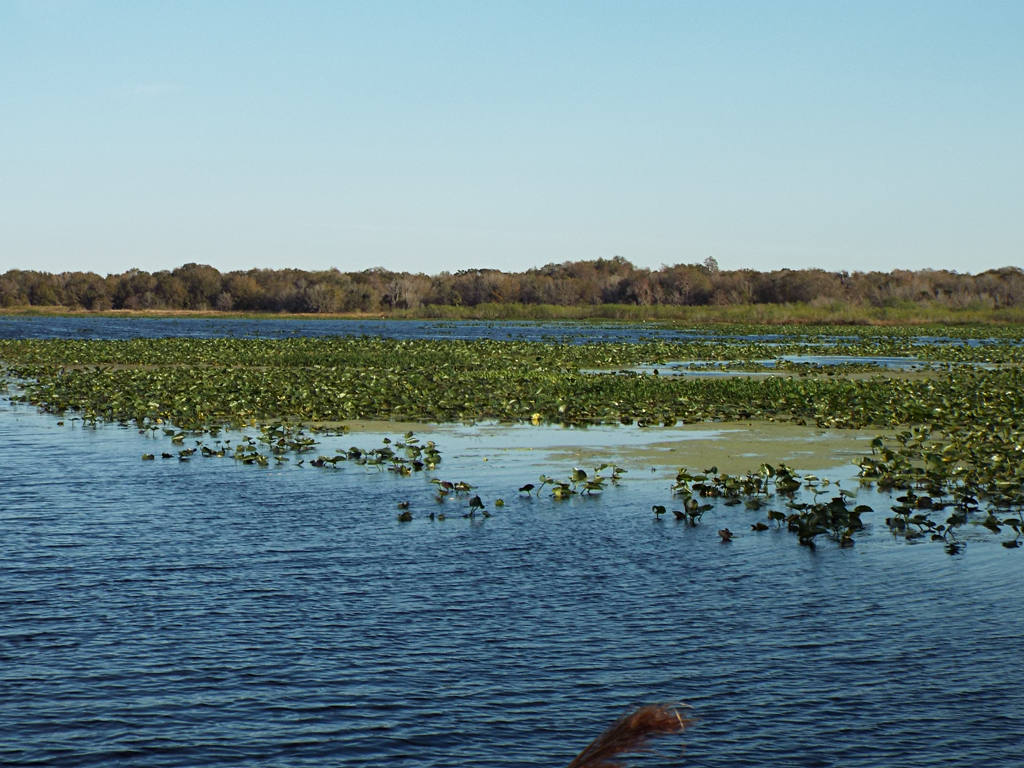
Our next stop was at Lake Jackson [map]. We did not stay long. The wind was blowing from the north across the lake, creating a natural air conditioner. It was cold enough to start with, and that just made it almost impossible to stand and scope out the lake for birds. After just a few minutes, Dave got us back in the bus for the next stop, out of the wind!
lake-jackson
Lake Jackson.

After a brief stop on Prairie Lake Road to call for Bachman’s Sparrows again (to no avail), we headed to a couple of stops on Lake Marian

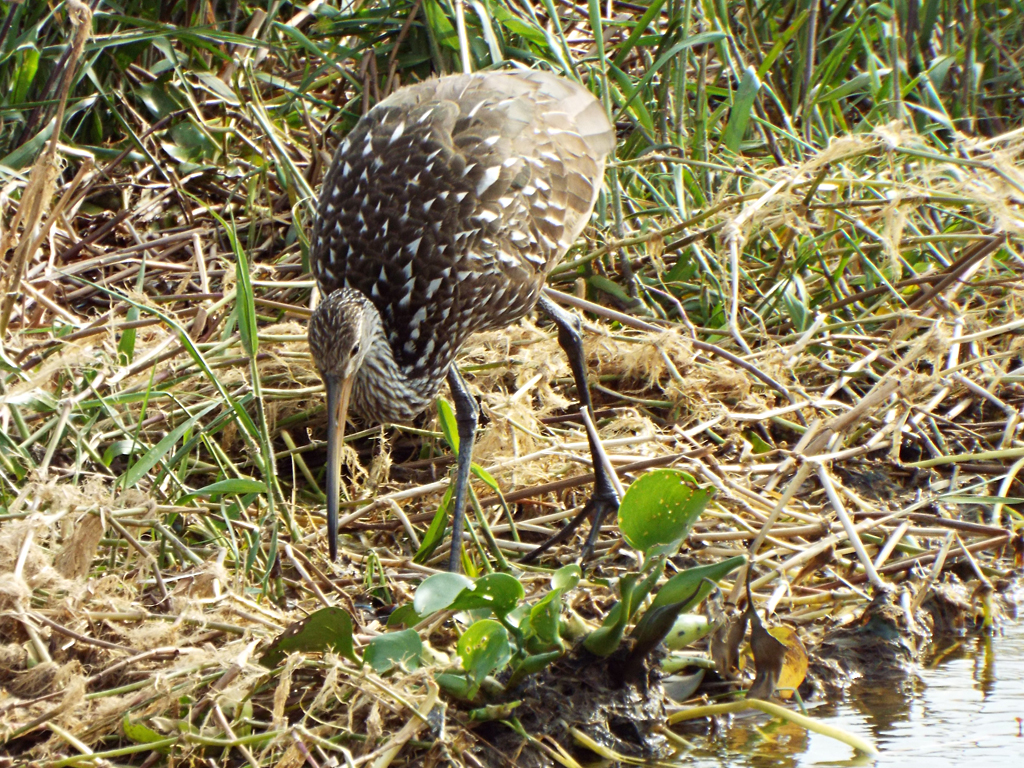
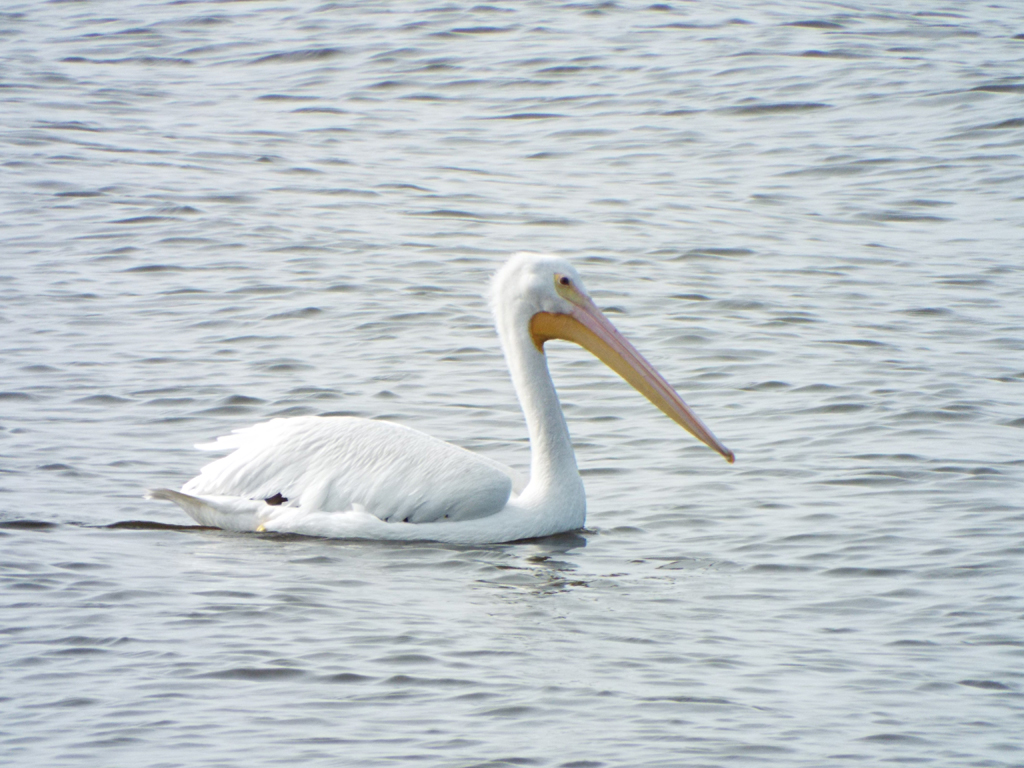
At the marina [map] there were hundreds of Tree Swallows swarming around, providing a backdrop for some of the more dramatic species, like Limpkins, American White Pelicans, Bald Eagles, and even a pair of Bonaparte’s Gulls.
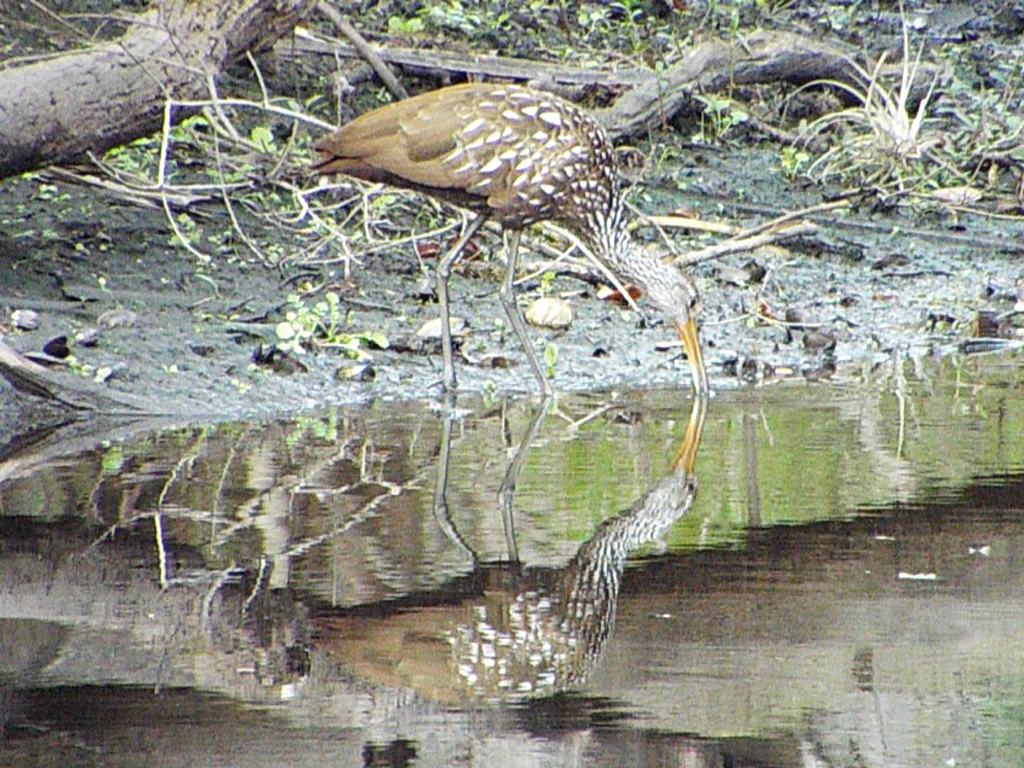
jackson-limpkin
Limpkins were relatively abundant, not just at this stop, but throughout the festival.


marian-pelican
The proportions of the American White Pelican, when swimming or on the ground, can seen quite awkward.
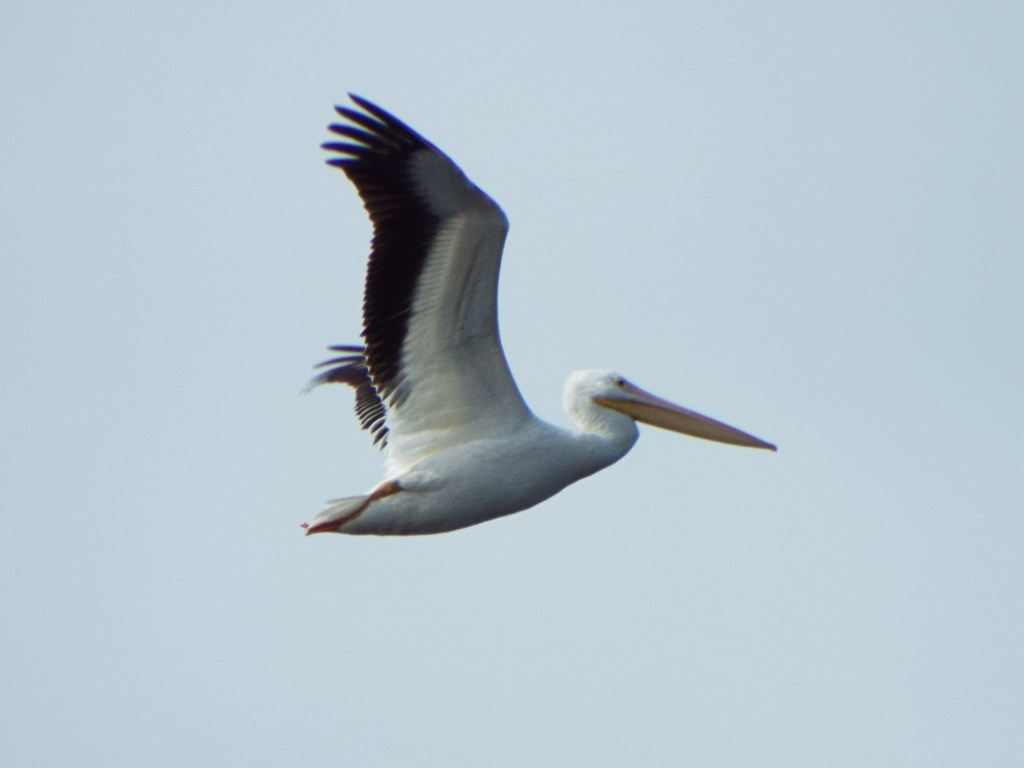
marian-pelican-flight
Once airborne, pelicans are surprisingly graceful birds.

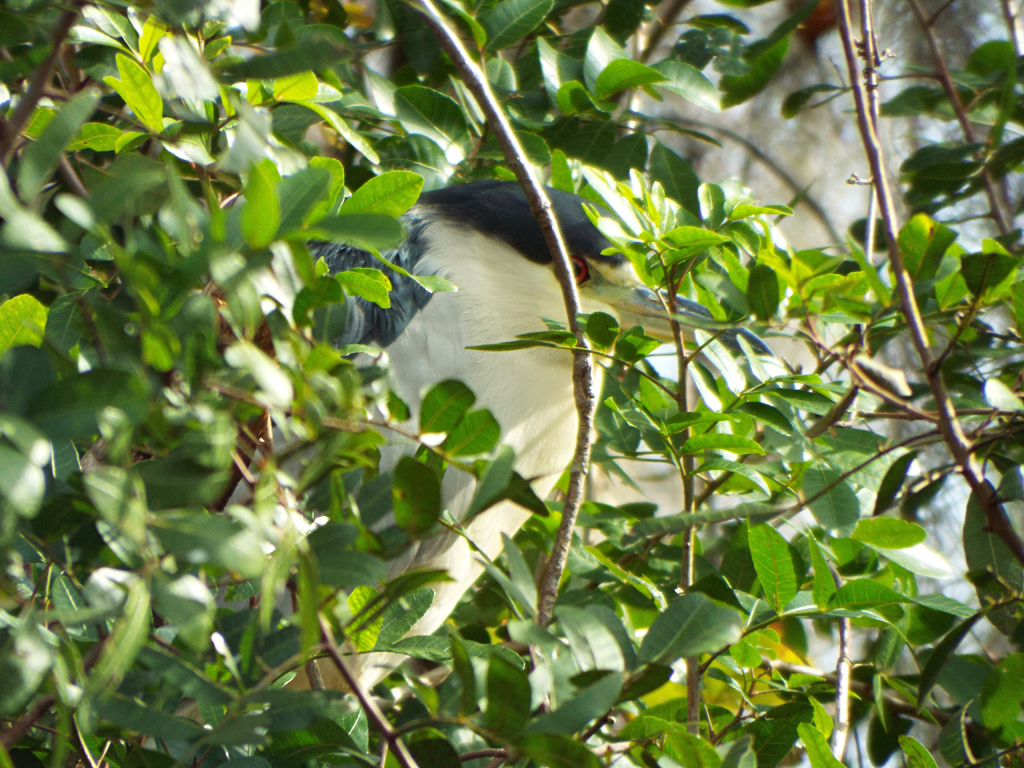
At the boat ramp [map] on the lake, we had a pair of Baltimore Orioles feeding among Yellow-rumped Warblers and American Robins. The vegetation that provided both food and concealment for these smaller birds was also the day roost for at least one Black-crowned Night Heron.
marian-black-crowned-night-heron
A Black-crowned Night Heron hiding out.

After wrapping up at Lake Marian, we headed down Joe Overstreet Road to the Landing, on the shore of Lake Kissimmee [map]. As you head along the road, toward the lake, the habitat changes from upland and ranch agriculture to wetlands and lacustrine (that means “lake related”) landscapes.
joe-overstreet-redheaded
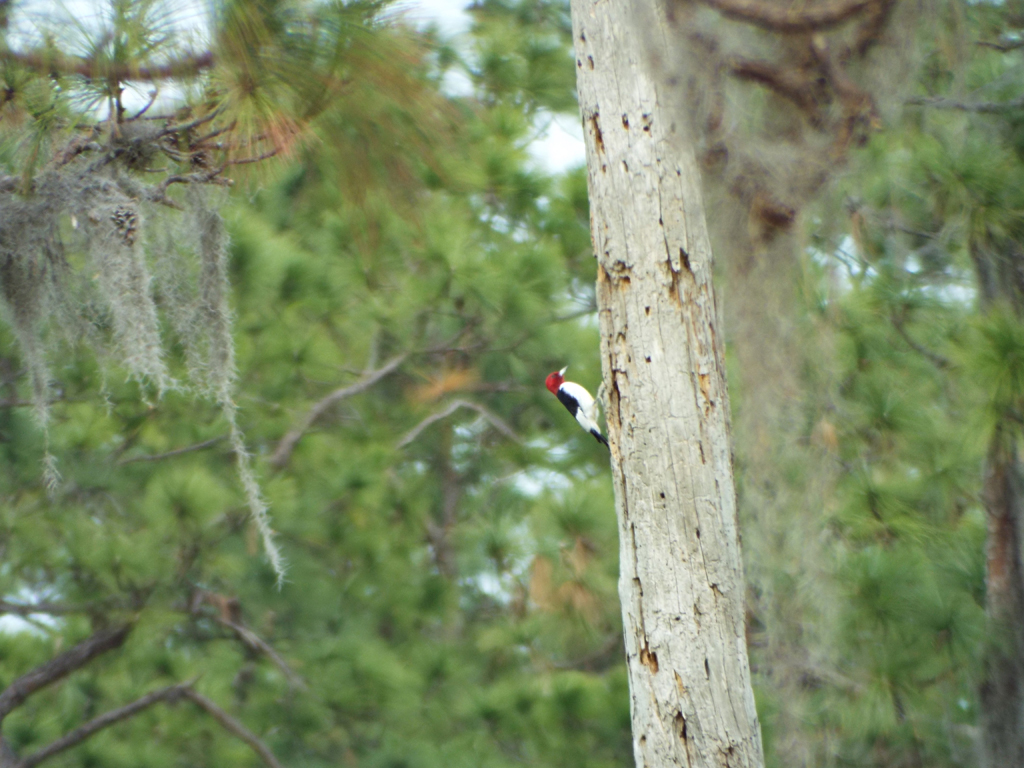
Adult Red-headed Woodpeckers really stand out, even from a distance!

There is usually a family of Red-headed Woodpeckers near the start of the road, associated with some dead trees and farm buildings. We did not see them at first, but at least one adult came out to investigate some woodpecker calls we played.

Further along, we had a few raptors, including a Bald Eagle harassing an American Kestrel on some irrigation equipment. The lands on either side of the road are still owned by the Overstreet family and include cattle and sod farms.

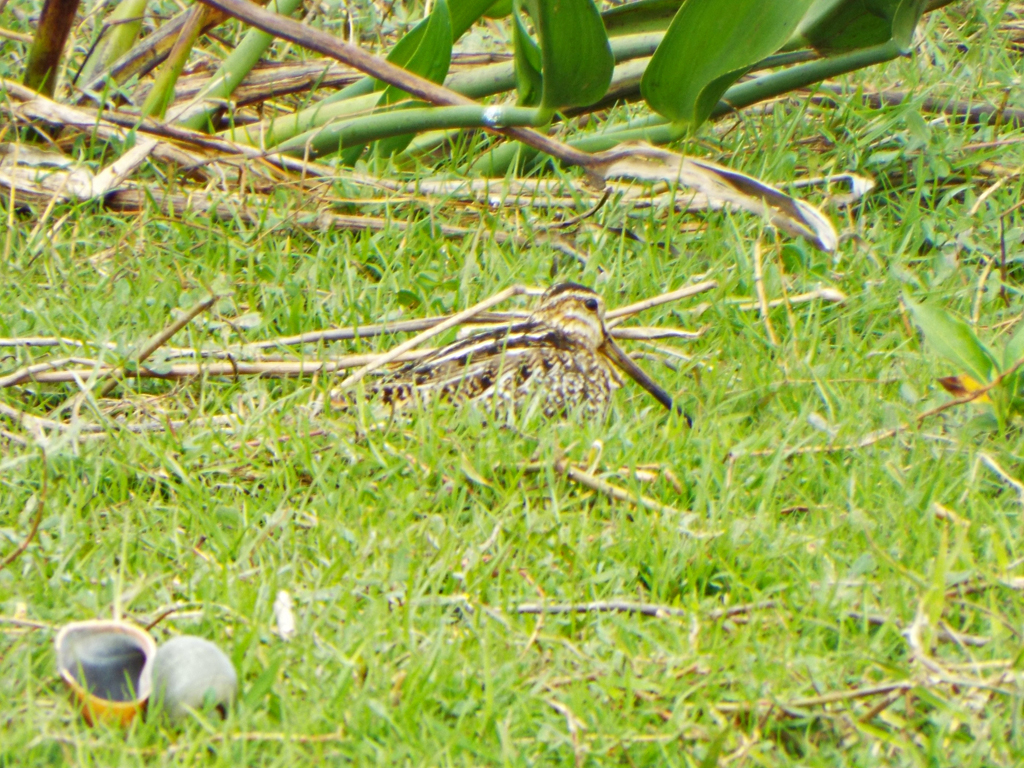
Down by the water, the wind wasn’t as bad as earlier at Lake Jackson, but it was still a bit breezy. Some Wilson’s Snipes were slinking along nearby in the grass while Boat-tailed Grackles made a racket at the boat dock.
snipe
One of the nearby Wilson’s Snipes, probing the wet ground for insects. Note the large, invasive Apple Snail in the foreground. These are much larger than our native snails, but the Limpkins and Snail Kites seem to enjoy them.

A single distant Snail Kite was seen in one of the spotting scopes, and one Bald Eagle, too. There were a few wading and diving birds out on the water, but nothing in very large numbers except for a flock of Cattle Egrets that made its way through.
joe-overstreet-anhinga
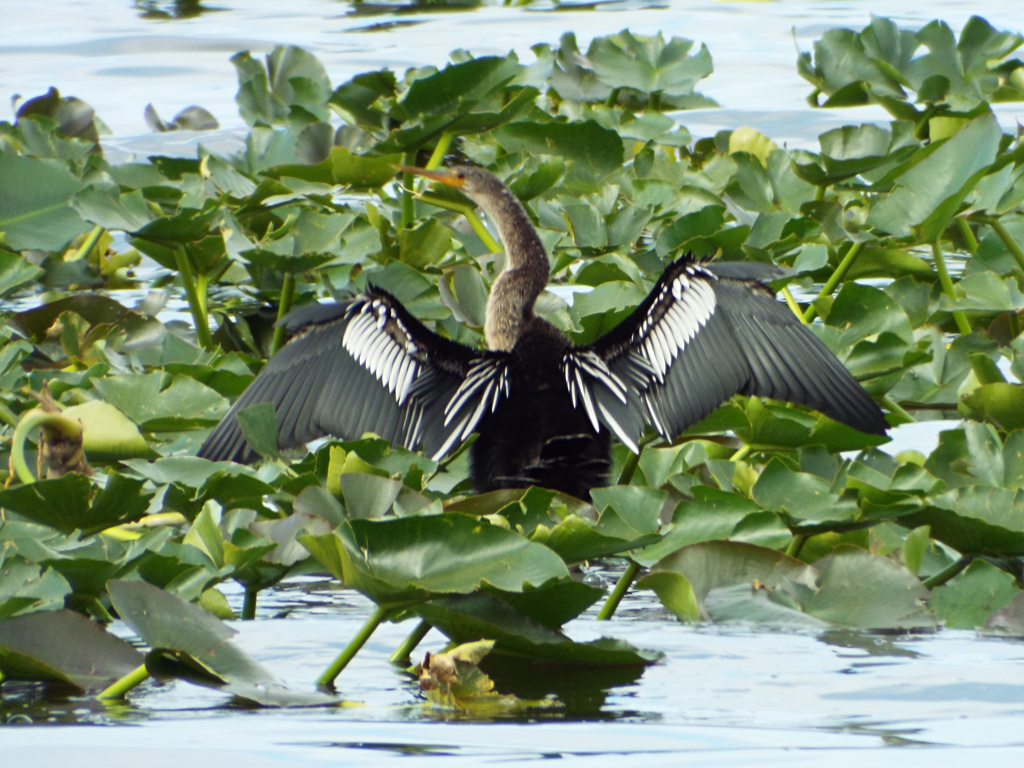
An Anhinga drying its wings among the lily pads.

From Joe Overstreet we briefly stopped by the Double C Bar ranch [map], where the last known non-migratory Florida Whooping Crane sometimes hangs out. It was not seen, and Dave Goodwin talked a bit about how the non-migratory flock was a failed experiment, with most of the birds succumbing to bobcats and other predators. The focus now is on the migratory flock that winters in the panhandle and flies to Wisconsin in the spring.

Our last stop of the day, at Lakefront Park on East Lake Tohopekaliga [map]. This place is known to have Snail Kites that pass close to the park and restaurant, and we hoped to get some good views. Unfortunately the weather got windier and colder, and a few of us got only one extremely distant view of a Snail Kite in one scope.
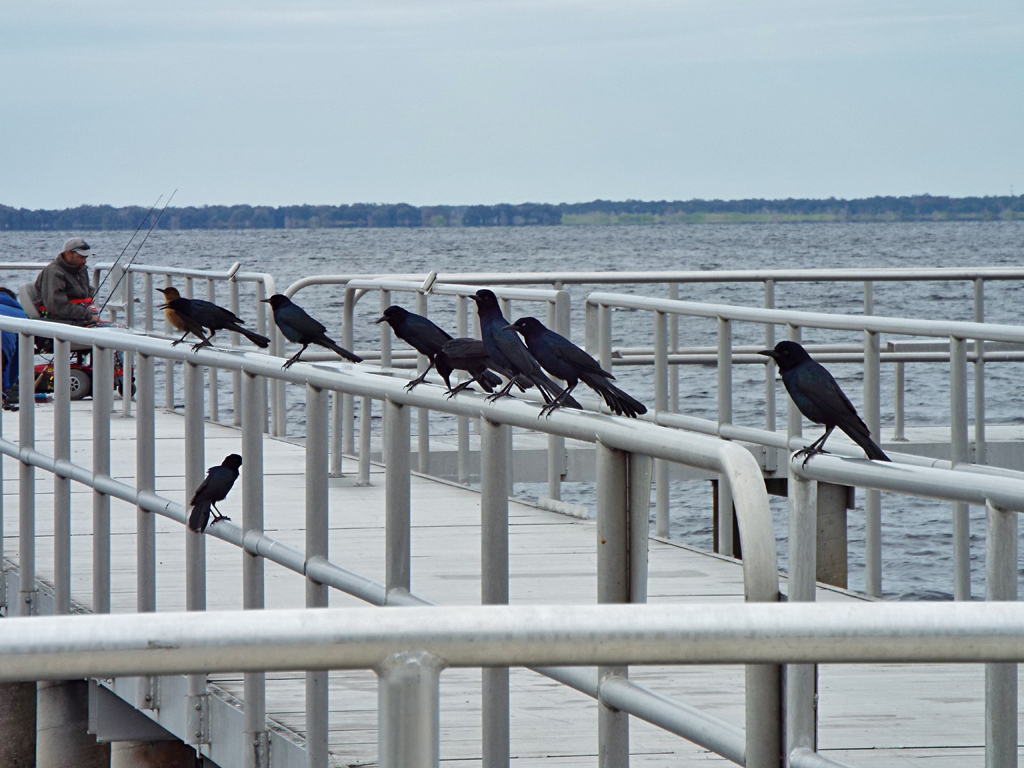
 

boat-tailed-grackles
Boat-tailed Grackles defying the wind.
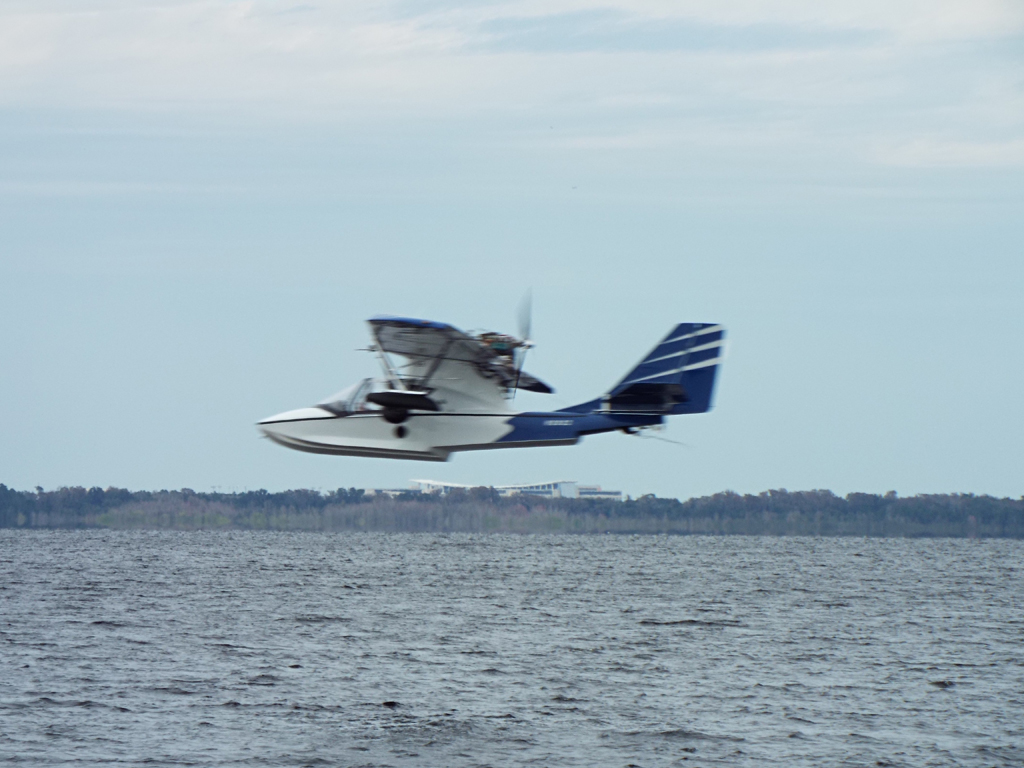
plane
Not a Snail Kite.

That was about it for the trip. We headed back to Festival HQ after a long but fun day around central Florida. We didn’t get all our “hoped for” birds, but honestly, that’s only a small disappointment for me. We have to remember the birds are not there for us; we have the privilege to go and seek them out, but it has to be on their terms as much as possible. Conservation and education should take precedence over consumption and exploitation.
SCBWF 2017 Day 1: Little Big Econ plus Bonus Birds

I can’t believe it’s been 2 weeks since the 2017 Space Coast Birding and Wildlife Festival. I apologize for the delay, but here are some photos and experiences I’d like to share with you.

First of all, I scaled back a lot this year, primarily for budgetary reasons. Last year I had a packed schedule, with many night hikes and early mornings. I was completely exhausted and mentally spent. Since I had done a pelagic trip at the end of September of last year, I decided (after much hand-wringing) to forgo the offshore trip this year. This turned out to be a bit of a blessing, as I understand the Monday trip had to come inshore and essentially do a lagoon tour amid rough seas, wind, and frigid (for Florida) temperatures.

In any case, I did three day-time trips, one night-hike, and a few side-trips for rarities in the area.

That first trip was the Little Big Econ State Forest hike [map]. Now, you might be wondering what a “Little Big Econ” is. It’s a combination of the two rivers that flow near and through the state forest and the inclusive wildlife management area (the Little Econ actually joins the “Big” Econ southwest of the state forest). You can read about the Econlockhatchee River at this St. Johns River Water Management District page. We hiked in at the Barr Street trailhead.

Along with other familiar faces at the festival, it was nice to see Bert Alm there. I met Bert at a Florida Master Naturalist Program class almost two years ago. Bert and his wife have gotten quite involved in conservation and wildlife rehabilitation since moving to the area, and it’s always a pleasure to see him.

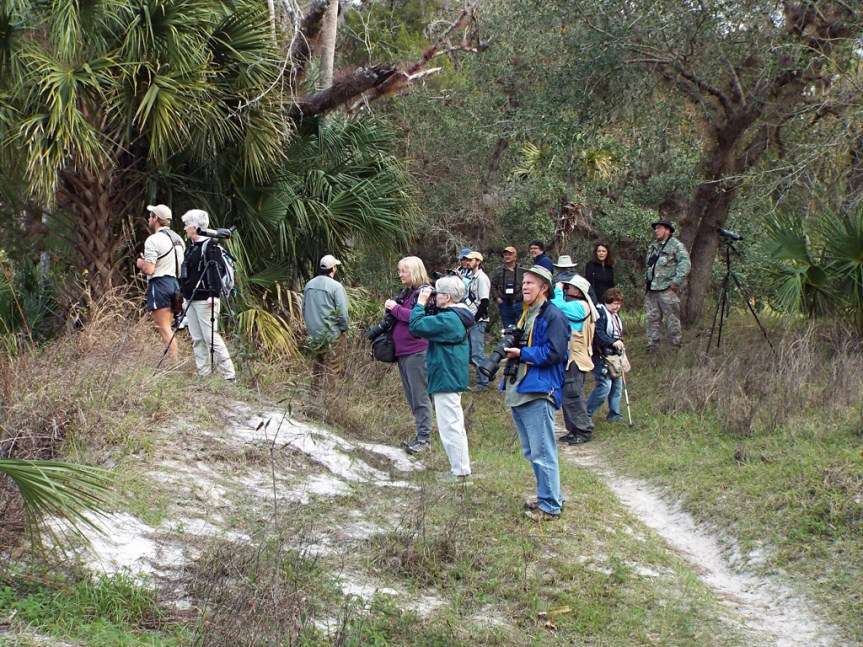
econ-group
This is most of our trip group. Trip leader L0rne Malo is in the camo to the right, Camille is in the purple fleece at the center, and there’s Bert, in the aqua shirt and pale ochre vest, partly obscured.
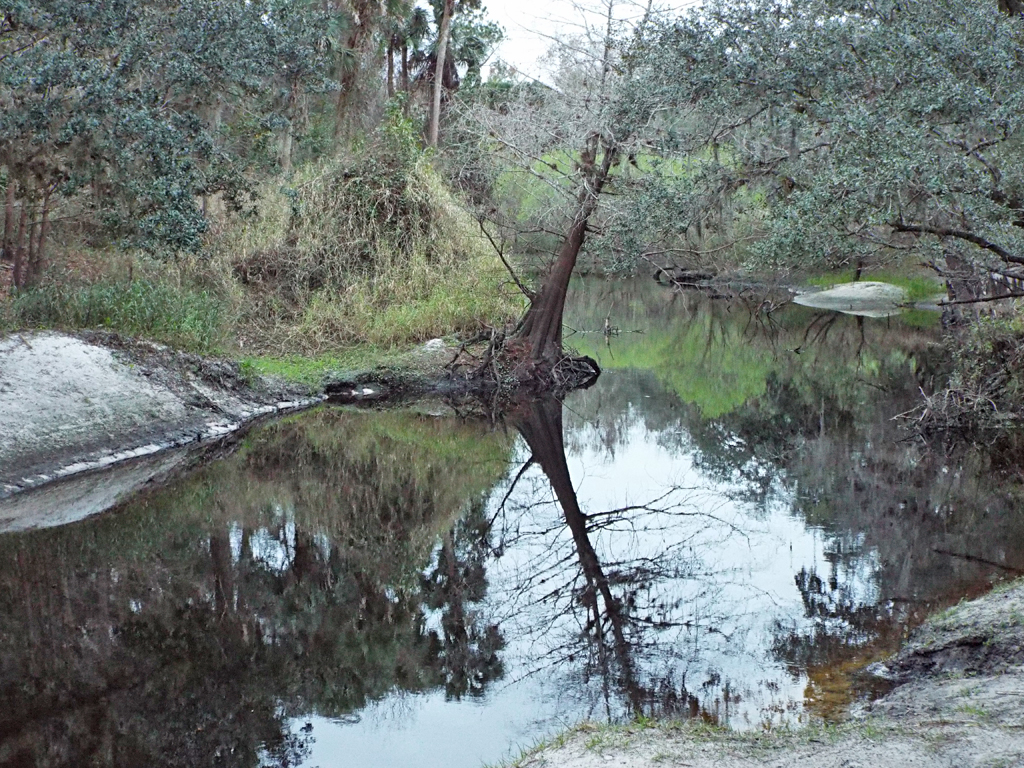
little-big-econ-river
The Econlockhatchee River is a “black water” river, so named because of the tea-colored water, stained by tannins from organic sediments and particles.

Like most typical black water rivers, the Econ (and Little Econ) are stained a dark brown from organics and have steep, sandy sides. In many ways the ecosystem here is similar to Turkey Creek (in Brevard County), which is a smaller black water river in a more built-up area.

eagles
A pair of adult Bald Eagles near their nest. They raised a couple of chick this year, and one fledged youngster was still nearby.
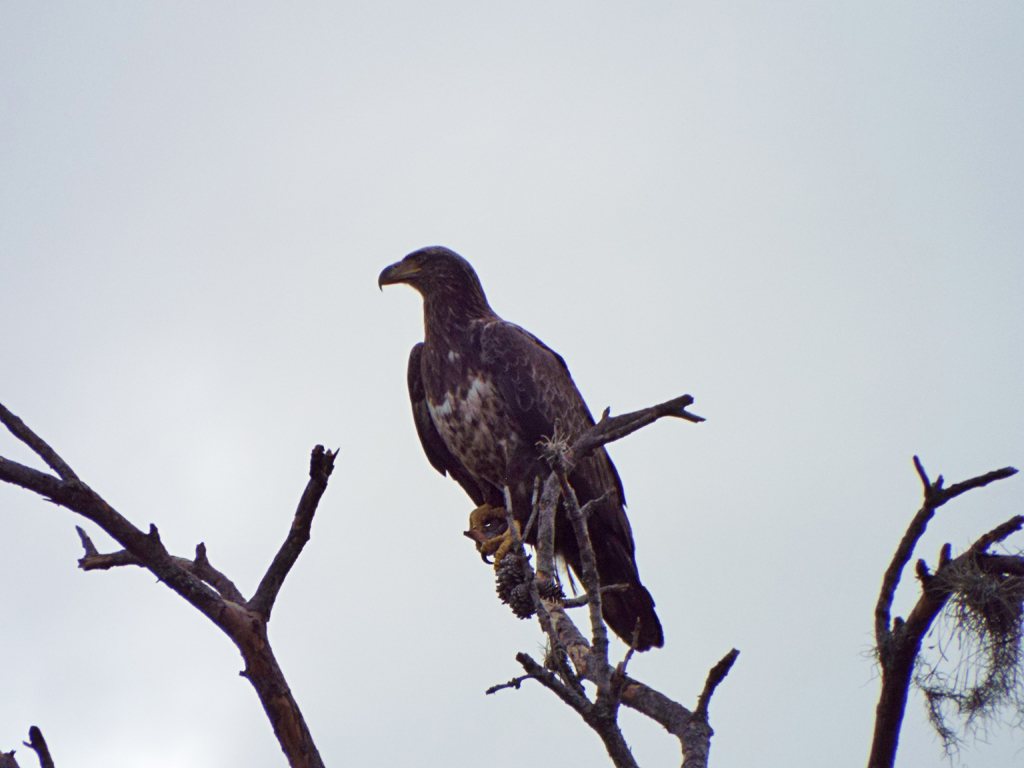
imm-eagle
This Bald Eagle youngster had recently fledged and stayed in view of its parents.

We had the expected winter residents, like Red-bellied and Downy woodpeckers, Blue-grey Gnatcatchers, Yellow-rumped Warblers, and more. There is one nesting Bald Eagle pair (see above). At one bend in the river I was surprised to see a Limpkin along the bank. Limpkins eat Apple Snails (both the native and introduced varieties), which I did not think lived in rivers and creeks.

econ-limpkin
This Limpkin found a stash of Apple Snails near the river bank.

There was one surprise that cropped up when some of the trip co-leaders started “pishing” to call in some of the warblers and other small songbirds. Along with titmouses, gnatcatchers and kinglets, a Blackburnian Warbler came into view high up in a mostly bare tree. It only stayed in view for a couple of seconds, but was long enough to get a look at the yellow-orange and black facial markings, as well as the sides and wings. This is extremely early for this species to be in Florida. Blackburnians winter over mainly in northern South America and Central America. Without photographic proof, this sighting won’t be “official”, but that doesn’t take away from the exhilaration and puzzlement of seeing it, for me.

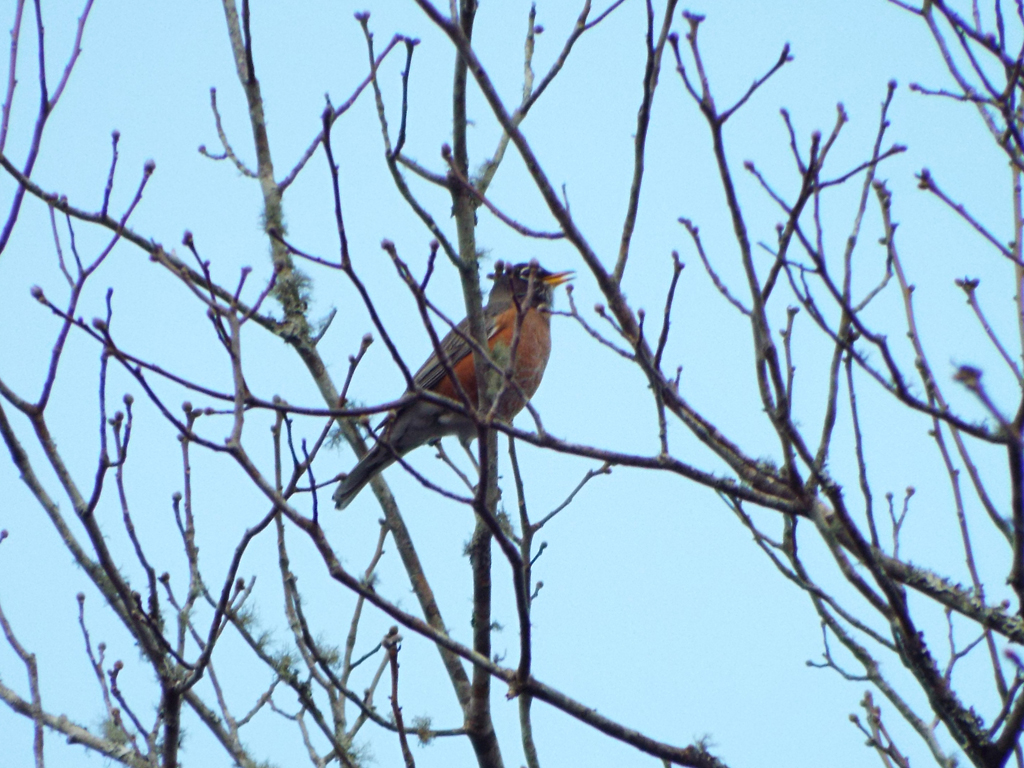
robin
A more typical (but handsome) bird species for Florida winters, the American Robins will start leaving in a couple of weeks as spring returns.

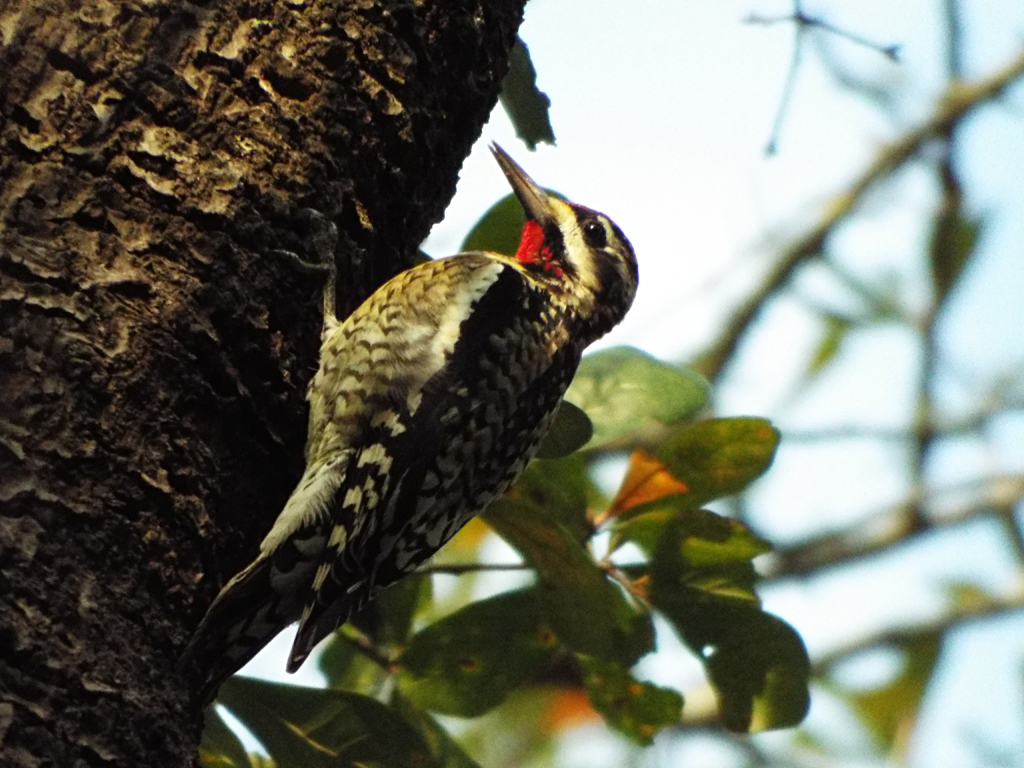
Throughout the morning, we kept hearing the cat-like calls of Yellow-bellied Sapsuckers (in fact, I think their call sounds more like a cat than Grey Catbird calls). It took a while, but one finally came in close and stayed for a photo-op.

yellow-bellied-sapsucker
The red throat of this bird indicates it’s a male. Yellow-bellied Sapsuckers drill rows of holes to tap tree sap, which it licks up (along with any protein-rich insects that get in the sap).

We hiked a total of about 5 kilometers (3 miles) on part of the Florida Trail and back before leaving the park. Most of the group then stopped at C.S. Lee Park (a small park and boat ramp off SR-46) [map] on the way back to Titusville where we saw some wading birds, among others, in the adjacent wetlands and flood plain of the St. Johns River.

Since the day was only half over, it was decided to take a trip to the Space Coast Regional Airport [map] and find the Scissor-tailed Flycatcher. Mrs. Lonely Birder and I tried finding this bird before New Years, with  no success.

This time the bird was out, catching large grasshoppers on the airports barbed-wired fence!

scissor-tailed-1
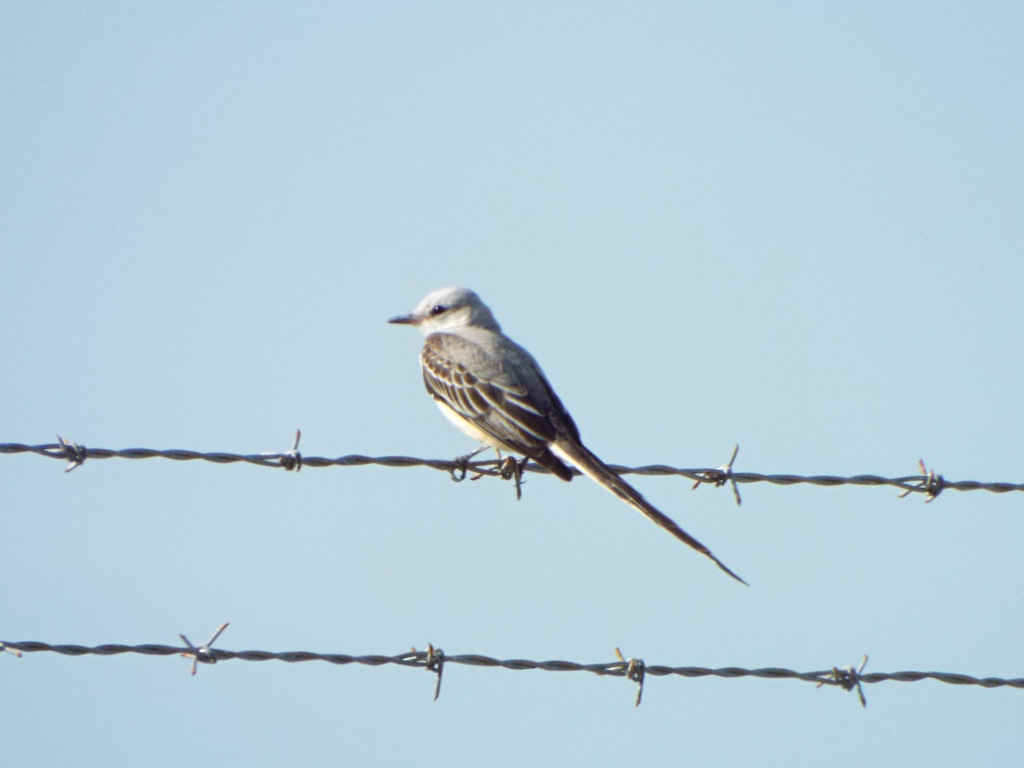
The relatively short tail of this bird indicates it’s an immature bird. Yes, believe it or not, adult Scissor-tailed Flycatchers have even longer tails than this.

Bonus bird number one, and a life bird! Scissor-tailed Flycatchers are rare but regular visitors to central Florida; there’s at least one every winter. As I’ve mentioned in this blog before, many flycatcher species have site affinity – that is, they often return to the same places year after year. If this bird decides this makes a fine winter home, we may have several years to look forward to seeing this bird as an adult!

scissor-tailed-2
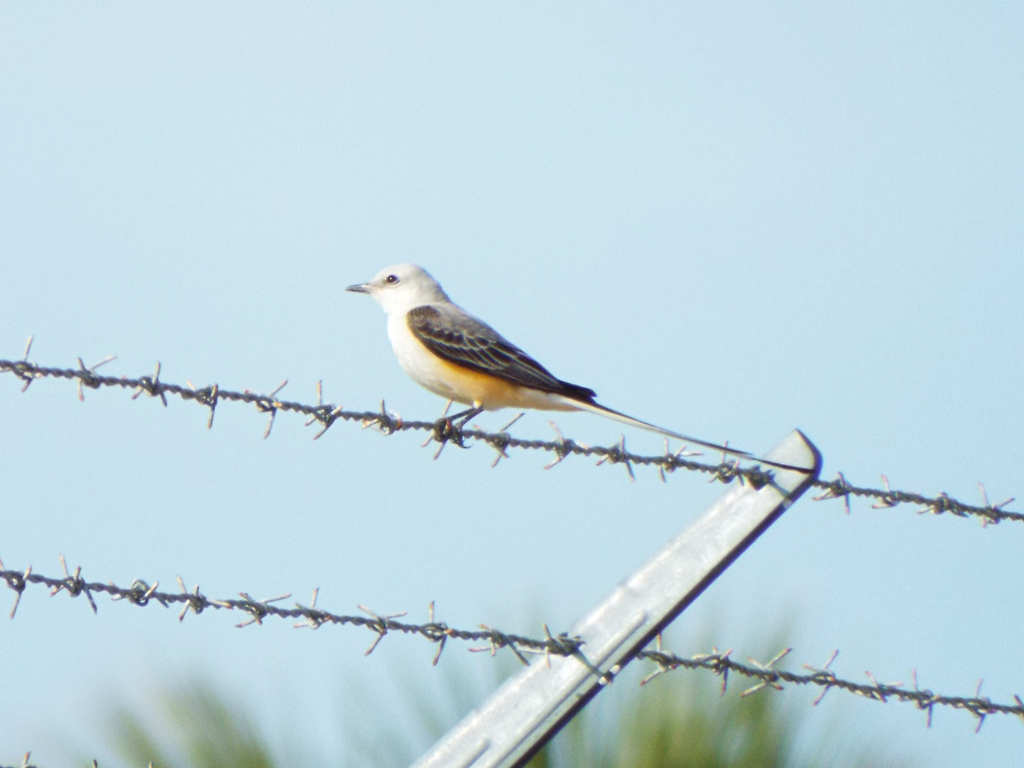
I was trying to capture the salmon colored flanks in this shot, but here it almost looks yellow.

After hawking grasshoppers and other insects for a few minutes along the fence line, the bird flew off a distance onto some power lines, so we left and decided to try and see another reported rarity: a Long-tailed Duck seen near the Canaveral Locks, at the Rodney S. Ketcham Boat Ramp [map].

It took some patience, but the duck finally did emerge from behind some cement pilings and out toward the adjacent marina.

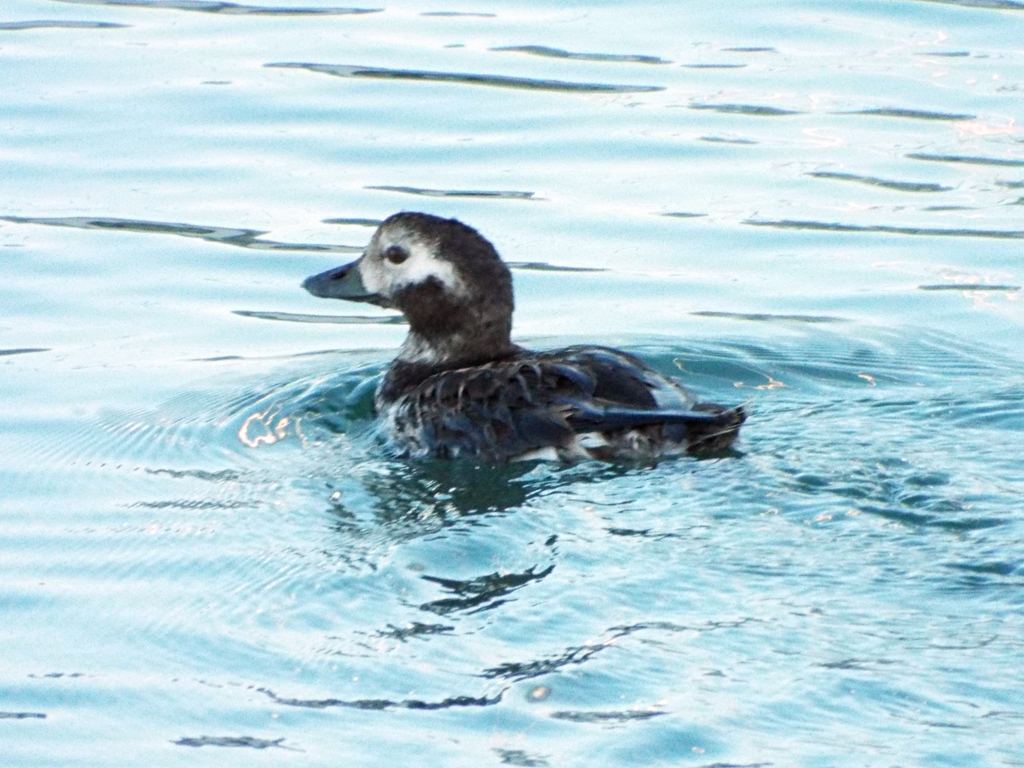
long-tailed-duck_1
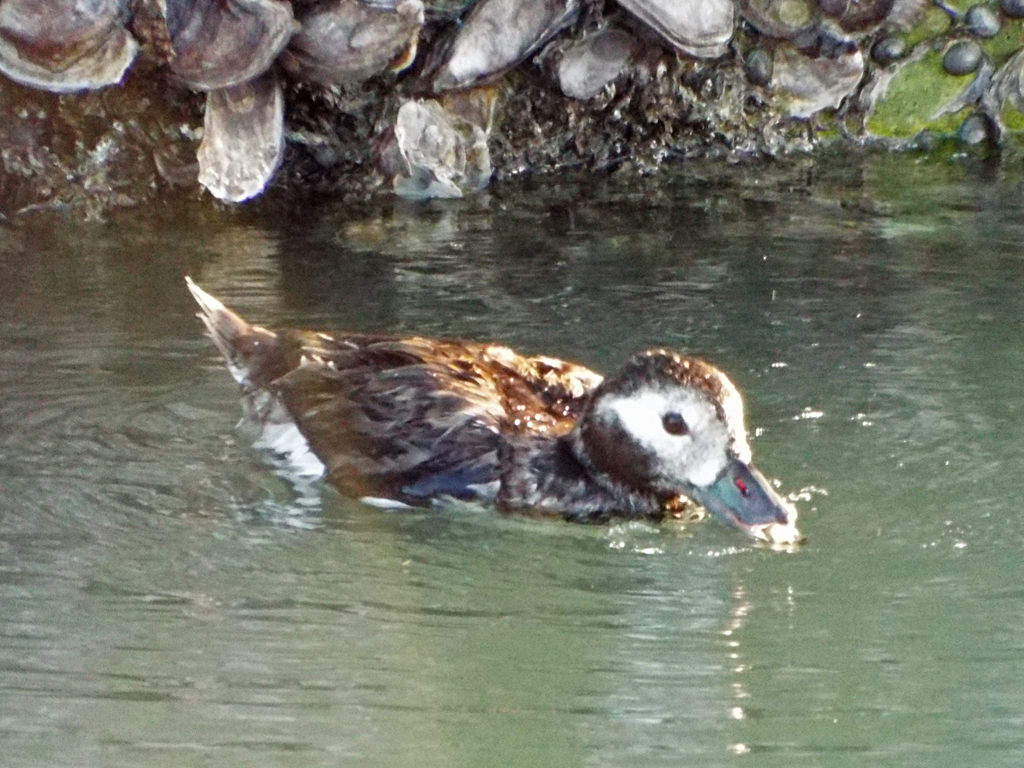
The plumage details and lack of long central tail feathers indicate that this is a female.

Bonus bird number two! I’ve seen this species once before, when a male was seen near Parrish Park, under the causeway bridge between Titusville and the Merritt Island National Wildlife Refuge, a couple of years ago.

long-tailed-duck_2
So long, little duck! She started getting annoyed at our ogling and headed for the marina.

That ended the daytime activities for the festival. The Florida Ornithological Society didn’t have a booth this year, but I did run into a few members, including Gina and Adam Kent, at the exhibitor area. Most of the usual vendors, organizations, and tour operators were there, including the Florida Wildlife Hospital with their animal ambassadors (Bella, the American Kestrel and Copper, a Red Rat Snake).

That just left a night hike with the Enchanted Forest Sanctuary. This was the only night hike I did, and it has always been fun and educational. There were two main changes this year, though. One is that the sanctuary no longer calls owls in. I was mildly disappointed, but there is growing uncertainty as to the ethics of calling for birds in general, with some parks and organizations eliminating the practice. Whatever the specific reasons for not calling owls, the hike was still great fun. The second change was a result of the main Southern Flying Squirrel nest getting blown down during Hurricane Matthew in October. The squirrels relocated to other nests, so they were not easily enticed to the feeder for viewing through a night vision camera.

It was a busy and fulfilling day (and evening), with one life bird and exploring a new place (Little Big Econ).

Christmas Passed

Here we are, right between Christmas and New Year’s Day. Since the middle of December many regions are once again in the throes of the “CBC” – the Christmas Bird Count. This Audubon sponsored endeavor is one way that bird population trends are tracked, long term, across the continent. Count season starts before Christmas and ends just after the New Year.

Last count season, I took part in the CBC in my home county. This time around, I helped my friend David Goodwin and his team with the east Pasco County count, the day after Christmas.

In order to get started on time, I had to leave my house before 3am for the 2+ hour drive to our meeting place at a Denny’s by the interstate, just outside St. Leo. From there we hit several spots in our designated part of the count circle (for an explanation of the CBC and count circles, visit the Audubon CBC webpage).

We started before dawn at the Tyndall Road Marsh [map] to catch birds most active at or before dawn. Much of the day required that we drive on McKendree Road – an unpaved stretch with washboard ridges and potholes – and other rural streets to get to our various hot spots.

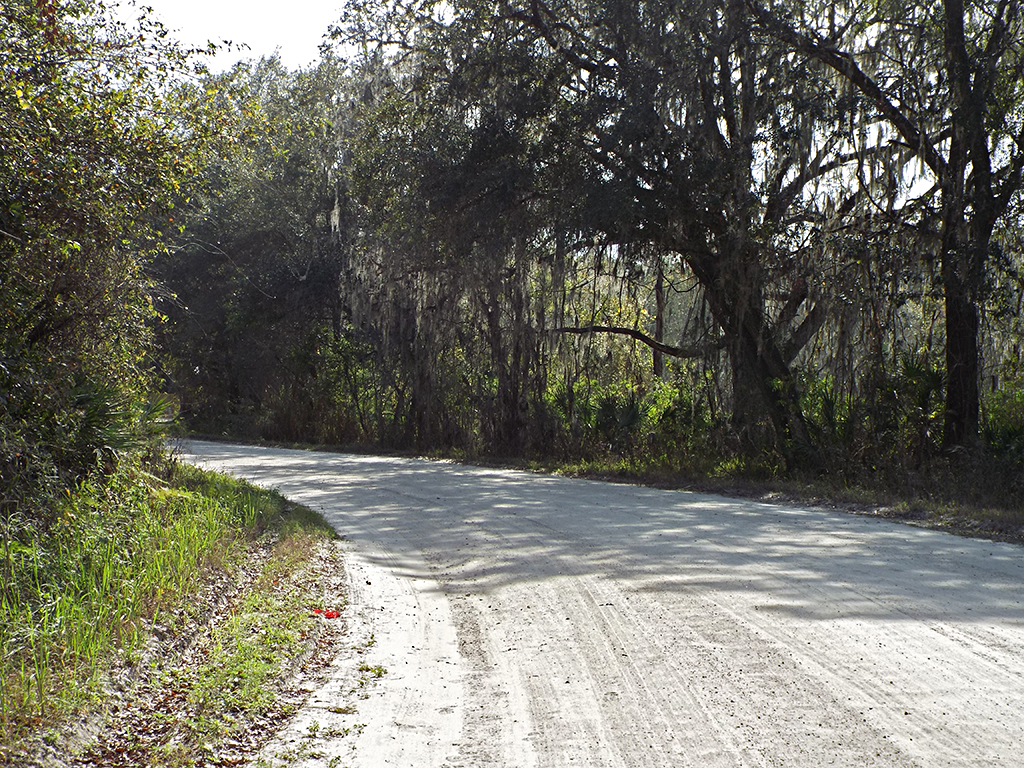
road
This is a typical road in east Pasco County.

As a group, we found 107 species for the day (I personally identified 99). Some of the good “gets” for the count were American Woodcock (seen by Dave Goodwin before dawn), American Pipits, a couple of Red-headed Woodpeckers, and a Merlin.


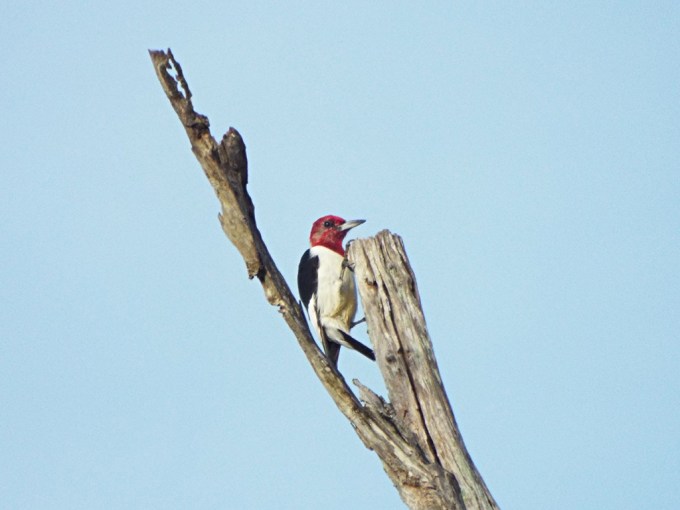
red-headed-woodpecker
The closest and longest look I’ve had of a Red-headed Woodpecker!


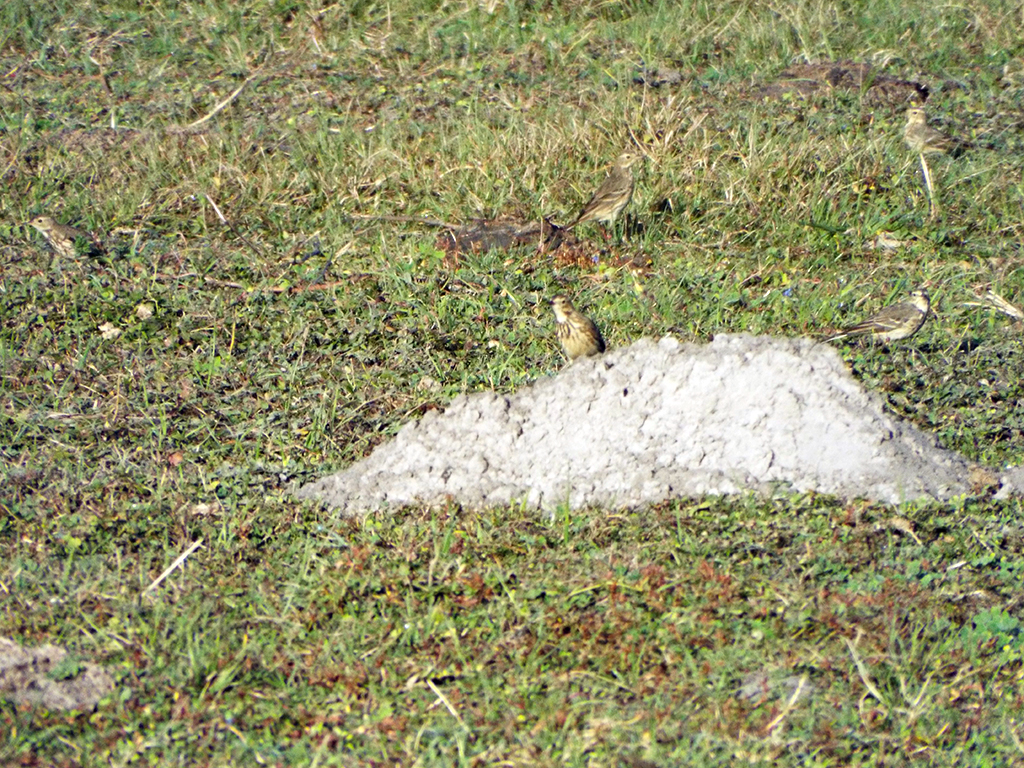
american-pipits
If you look closely, you’ll see 5 American Pipits in this shot. They blend in very well on the ground where they forage for insects.

The parts of Pasco County we birded are all quite rural, making for some lovely scenes, and we were only downwind of some of the more fragrant aspects a couple of times.

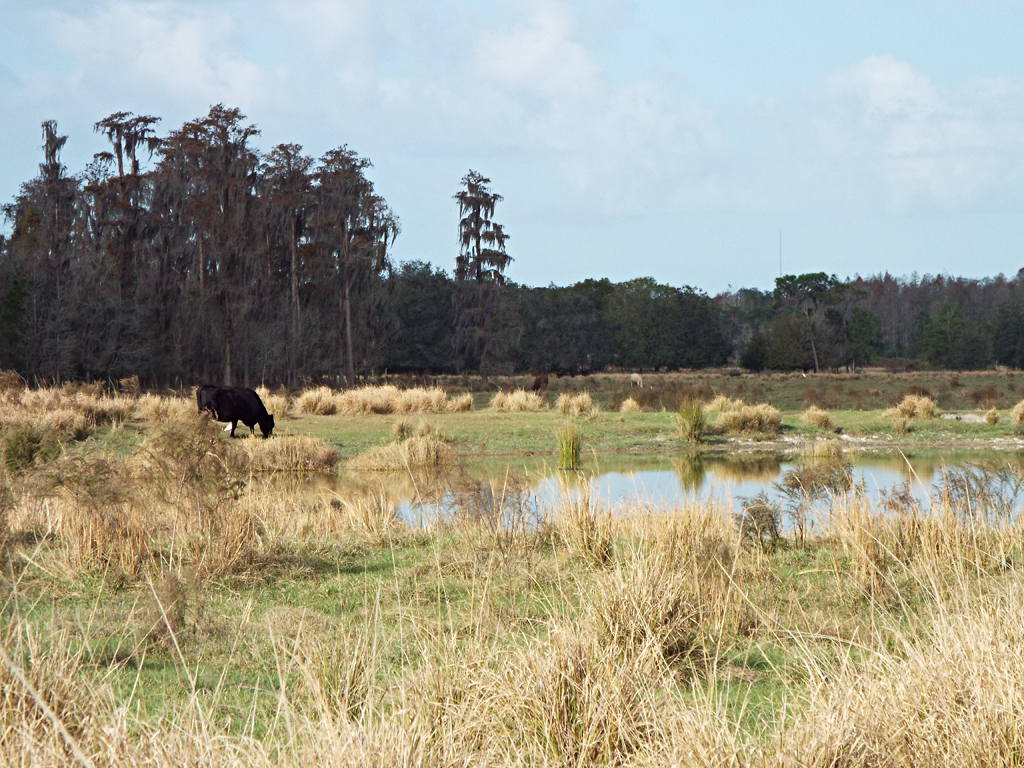
cow-and-pond
This cow pasture has an obligatory watering hole and an attendant cattle egret, behind the cow. Note the remnant of a cypress dome on the left.
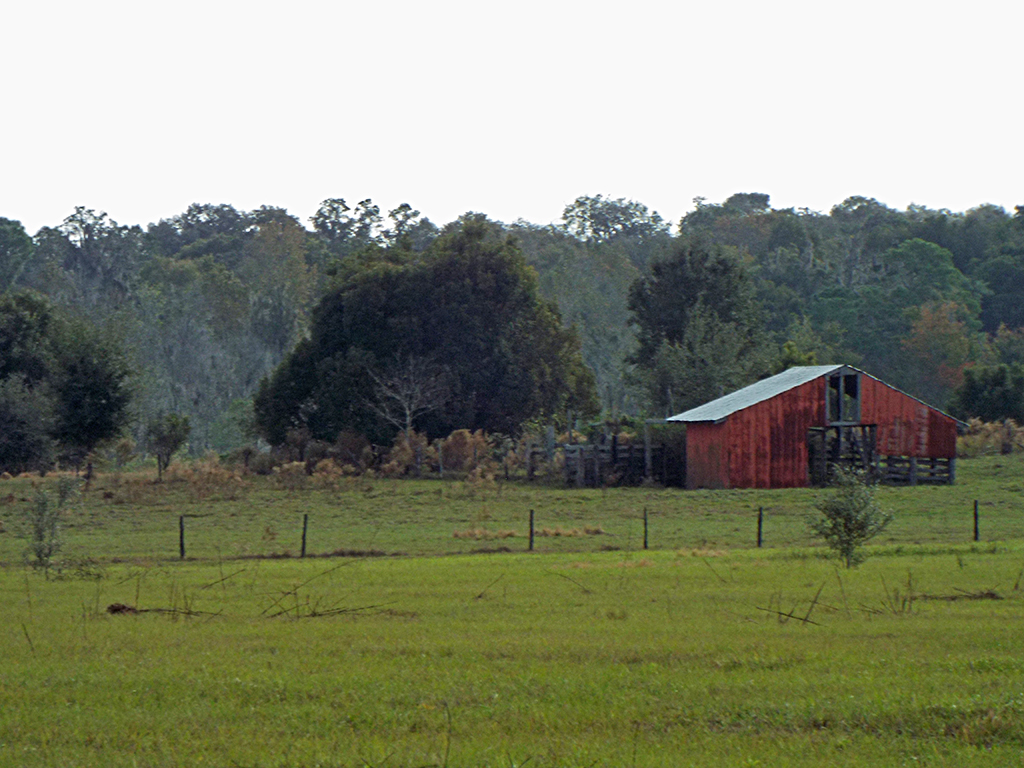
pasco-barn
Florida isn’t all palm trees and thrill rides. I leave it up to you if that’s a good or bad thing.

At Wesley Chapel District Park [map], Erik Haney got a pair of Ovenbirds to respond to a recorded call of that species, but they remained very well hidden. We managed to scare up a Carolina Wren or two, and on the way out, a singing Blue-headed Vireo briefly got us back, scanning the woods to see it.

carolina-wren
Carolina Wrens share the same habitat as Ovenbirds, but are often a little less secretive.

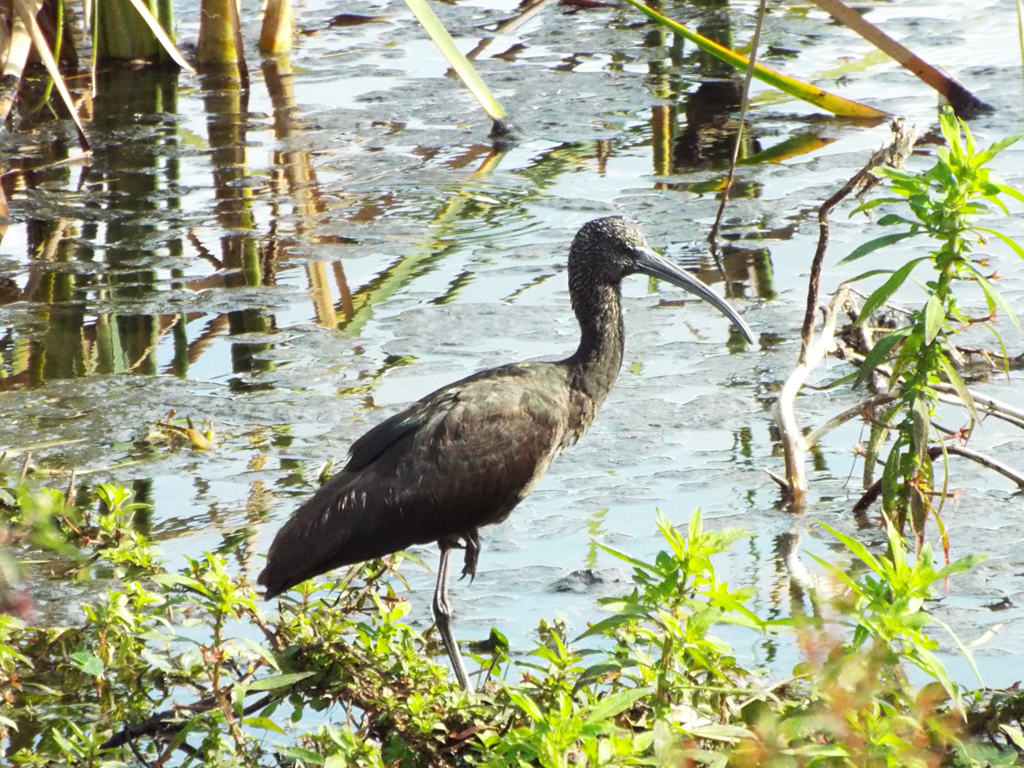
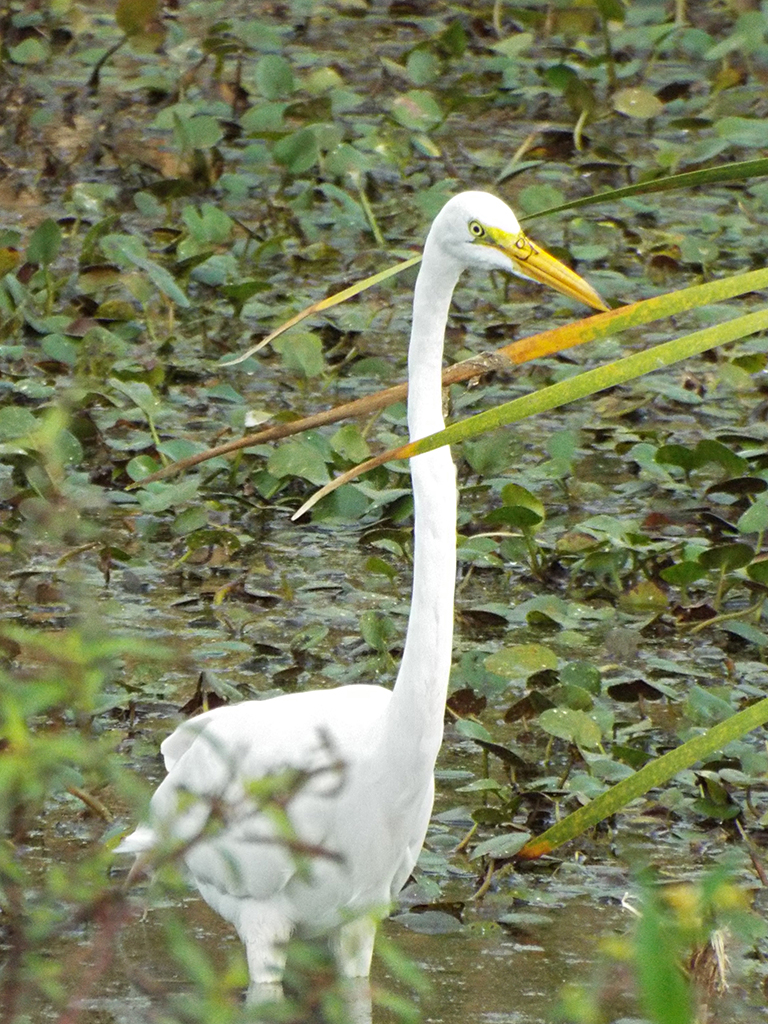
In general, the concentration of wading birds was low throughout the day. The only large numbers were from a distant rookery before dawn, as they dispersed. There were just two wading birds at Wesley Chapel District Park. A Great Egret and a Glossy Ibis were quietly feeding in a small wetland area.

glossy-ibis
A Glossy Ibis, looking a bit less than glossy, over the winter.
great-egret2
A really great Great Egret!

The goal of any count is to see as many birds of as many species as possible. To achieve this birders, of course, use skill, patience, and optics. But there is an even greater urge than usual to “pish” at birds to get them to come out into the open or to use recordings. It is much easier in these days of smartphones to get high quality recordings of almost any bird to draw it out. And it’s not just the recording of the target bird. Some birders use the distress calls of other birds (the Tufted Titmouse is a favorite among eastern birders) or even predator calls, such as screech owls. There’s an always ongoing debate as to how much of this is necessary or causing stress/harm to the birds. It’s generally accepted that the least one uses these measures the better, but it can be hard when doing something like a CBC or a paid field-trip.

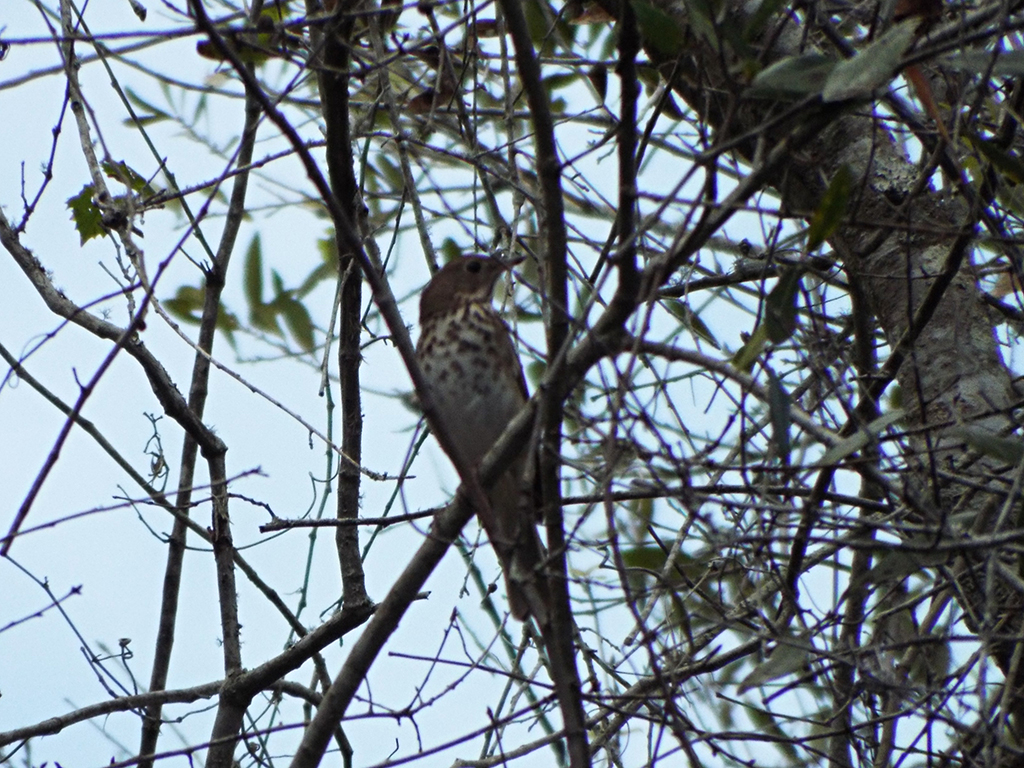
hermit-thrush
Hermit Thrushes were among the birds pulled into clear view due to the persistent playing of an Eastern Screech Owl recording.

Our group made a lot of use of titmouse and screech owl recordings to lure birds out. We relied on it much more than I am comfortable with, but probably did no permanent harm to the birds in the areas in which we used them.

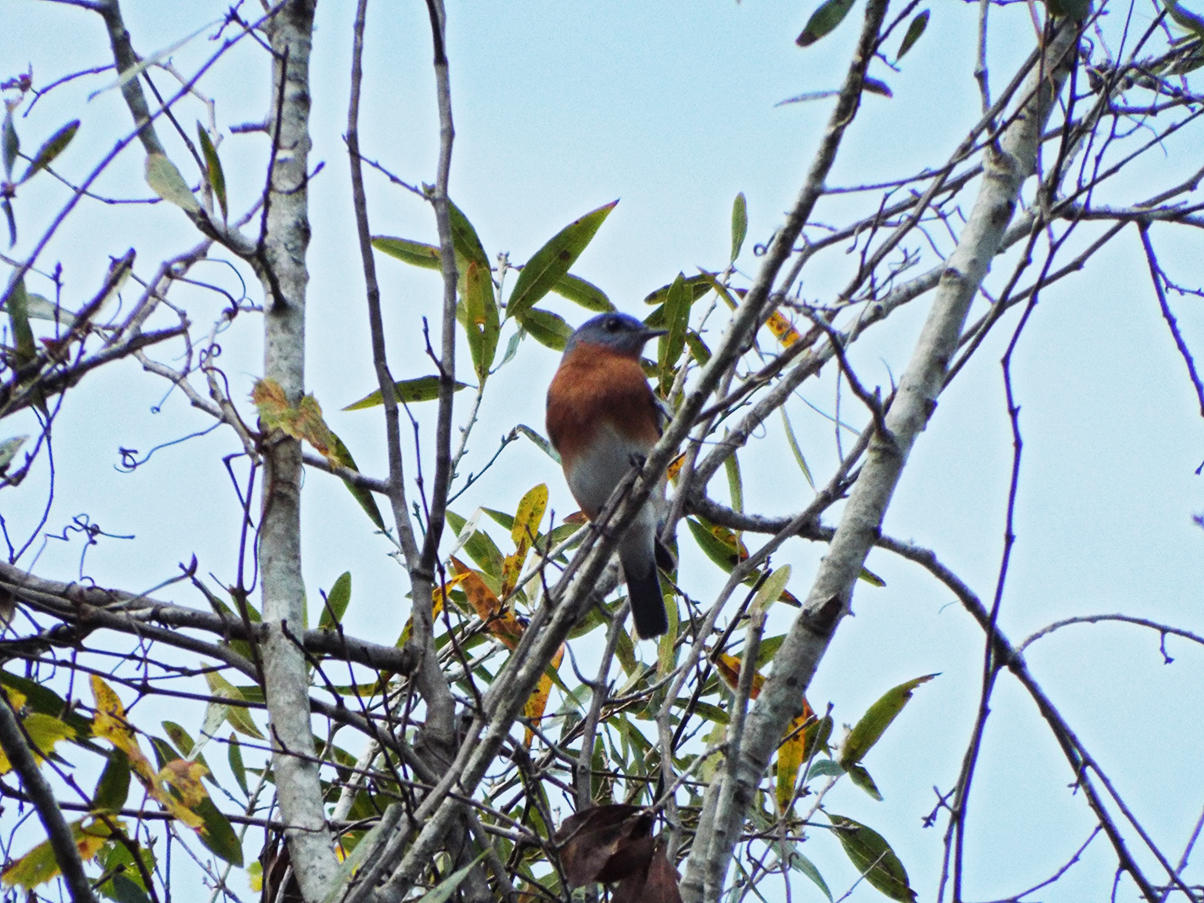
eastern-bluebird
Eastern Bluebirds are normally birds of open or semi-open country, but our recordings lured more than a few into more wooded areas to see what the hubbub was about.

We ended the day with a walk through an old field, looking for sparrows in the brush and weeds and then circling back to McKendree road for a final look for ducks and shorebirds at pond we had scoped out earlier in the day. Throughout most of the day, Dave Goodwin had been commenting on us not having seen a Northern Harrier. By sundown, we still hadn’t seen one. But as I made one last scan in the fading light, I caught one in my binoculars skimming low over the fields. I found it fitting that I found the bird that way. On my first field trip with Dave at the Space Coast festival, our group was heading home in the tour bus, going over our day’s list. The only hoped for or expected bird we didn’t have was a Northern Harrier. Just after Dave commented on how nice it would be to have that bird before we arrived back at the festival HQ, I looked out the window and there was a Northern Harrier, about to fly over the road. “You mean, like that one?” I said to him. It was a cool moment.

For the so-inclined, here are all the eBird lists for our stops. If you poke around eBird, you’ll see Erik’s lists too, which differ slightly from mine. This isn’t for lack of trust or disagreement, it’s that sometimes we were looking in slightly different areas and saw different birds.

Tyndall Road Marsh: http://ebird.org/ebird/view/checklist/S33203139
McKendree Road: http://ebird.org/ebird/view/checklist/S33205152
Wesley Chapel District Park: http://ebird.org/ebird/view/checklist/S33206770
Mariners Harbour Drive: http://ebird.org/ebird/view/checklist/S33210038
Wesley Chapel-Overpass Road: http://ebird.org/ebird/view/checklist/S33207398
Tyndall Road: http://ebird.org/ebird/view/checklist/S33209070
Tyndall Road Curved Woods: http://ebird.org/ebird/view/checklist/S33210011
Kenton Road: http://ebird.org/ebird/view/checklist/S33210738
Old Pasco Road Sparrow Field: http://ebird.org/ebird/view/checklist/S33212110
Hadlock Drive: http://ebird.org/ebird/view/checklist/S33212564
Gray Catbird Loop: http://ebird.org/ebird/view/checklist/S33242919
Wesley Chapel School complex: http://ebird.org/ebird/view/checklist/S33242790
Bridgewater Development: http://ebird.org/ebird/view/checklist/S33242525
McKendree Road, across from pond: http://ebird.org/ebird/view/checklist/S33242994

I would have liked to stay for the end of the day count up from all the teams in the CBC circle, but I had a 2+ hour drive ahead of me. So I said my good-byes and headed home. Birding with Dave is always fun and informative. CBC days are long. You have to drive, walk, talk and share with people for hours, and sometimes the birds are less than cooperative. Birders, as a general rule, get along pretty well. After all, we’re united by this passion for birds. But having Dave head up a team is special, and all four of us did pretty well, and had fun doing it.

Unlimited Ducks!

As much of the nation went into a deep freeze last week, the cold air brought with it those promised ducks to Florida. As I mentioned in my last blog post, ducks and other waterfowl only tend to migrate south when the weather or food supply dictate. When ponds and lakes freeze over, these birds cannot forage and have to move to warmer places.

The ducks came in to the Merritt Island National Wildlife Refuge in massive amounts last weekend. Thousands of birds settled into their usual digs along Black Point Wildlife Drive [map], along with a growing contingent of shorebirds and gulls and terns.

The first most noticeable difference along Black Point was the relative abundance of Wilson’s Snipes, feeding in the open. Snipes are usually fairly cryptic and will suddenly take to the air in an erratic zig-zag flight pattern only when approached very closely, often startling whomever is walking by. They rely on their camouflaged plumage to stay hidden. This was the largest single grouping of Wilson’s Snipes I’ve seen – almost 40 birds.

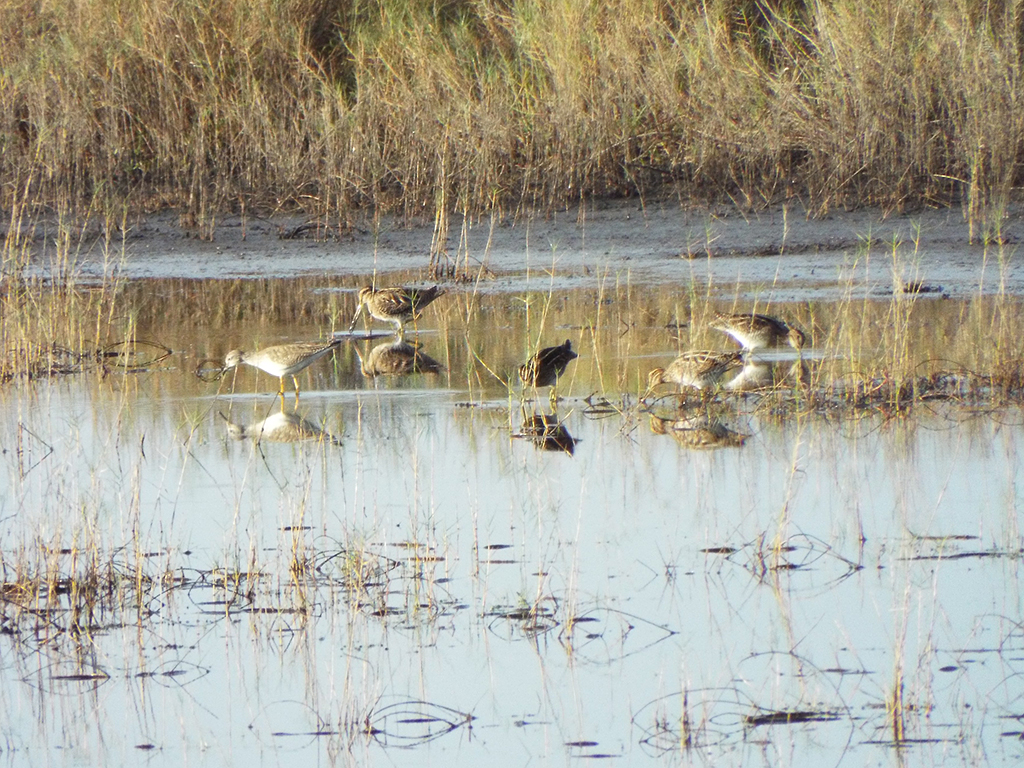
snipes-yellowlegs
Normally secretive Wilson’s Snipes feeding in the open with Greater and Lesser Yellowlegs.
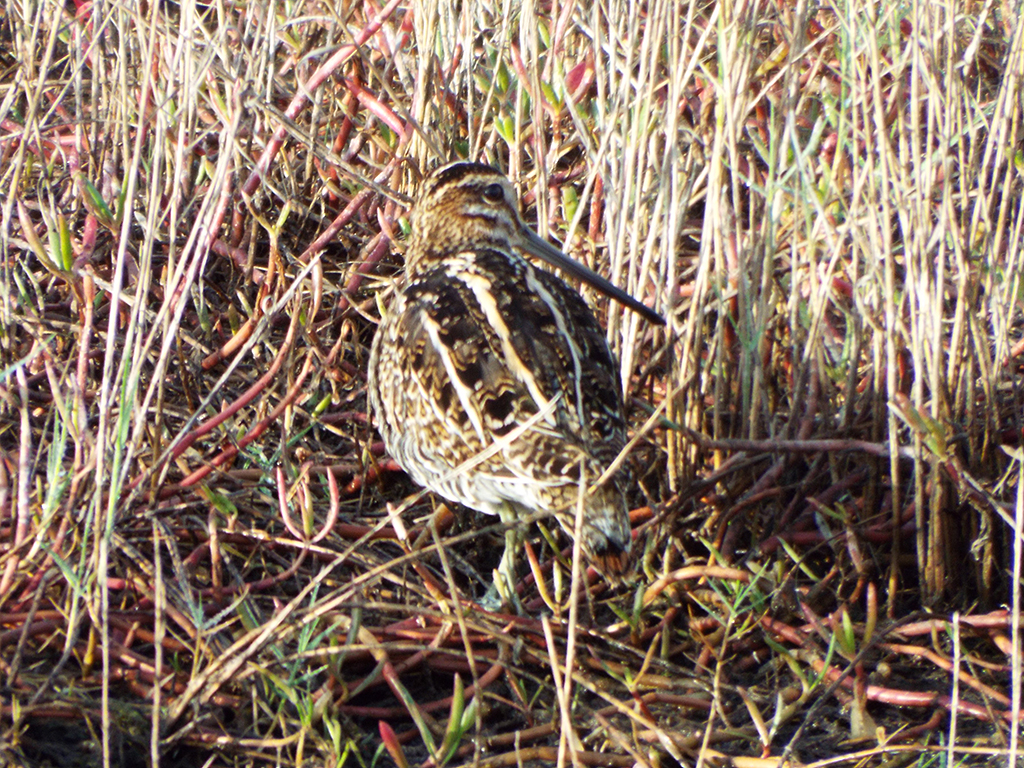
wilsons-snipe1
Snipe’s bills are similar in size and shape to those of dowitchers, and their feeding methods and posture seemed much alike. This bird was resting in the margin of some tall marsh grass.

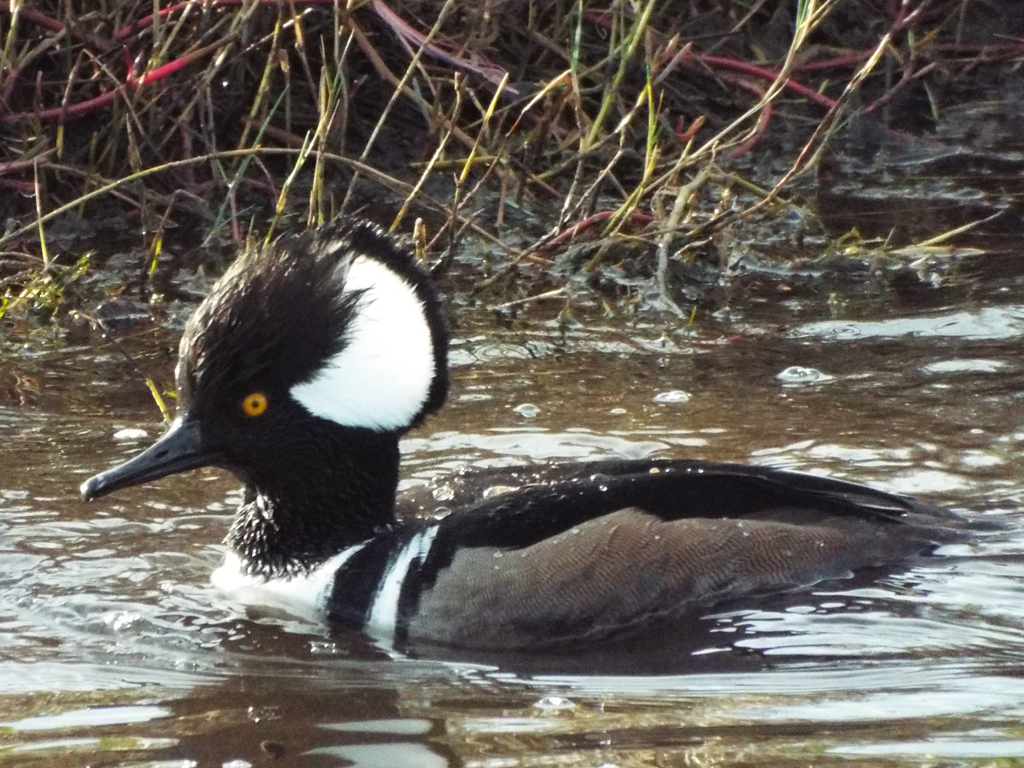
Ducks started appearing farther along the drive. First, Hooded Mergansers in small groups, quickly diving and scouting for prey. When food is abundant, these birds are in almost constant motion and only fully on the surface for a few seconds at a time.


hooded-merganser
A Male Hooded Merganser in an alert posture (crest up).

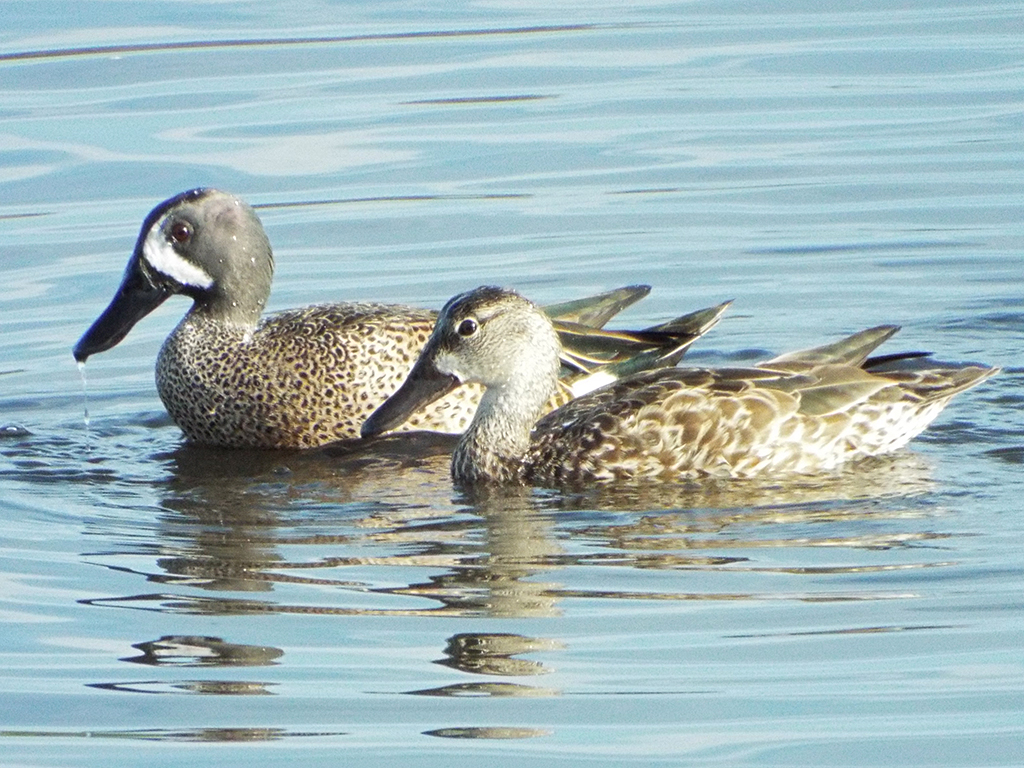
Blue-winged Teals had already arrived in numbers earlier in the Fall, but they have been joined by Northern Shovelers and Northern Pintails.

blue-winged-teal-couple
This male (left) and female (right) Blue-winged Teal pair have likely been at MINWR for weeks.
pintail-tail
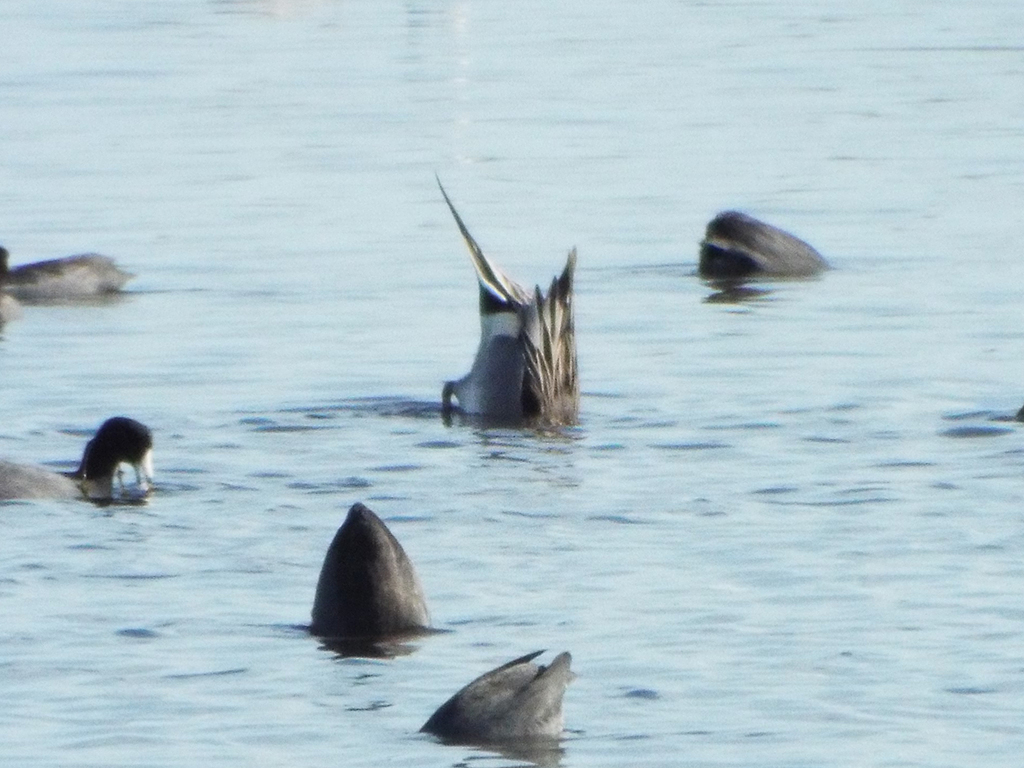
Bottoms up! Even without breeding plumage, you can see how pintail ducks got their name.
shovelers-pintails-coots
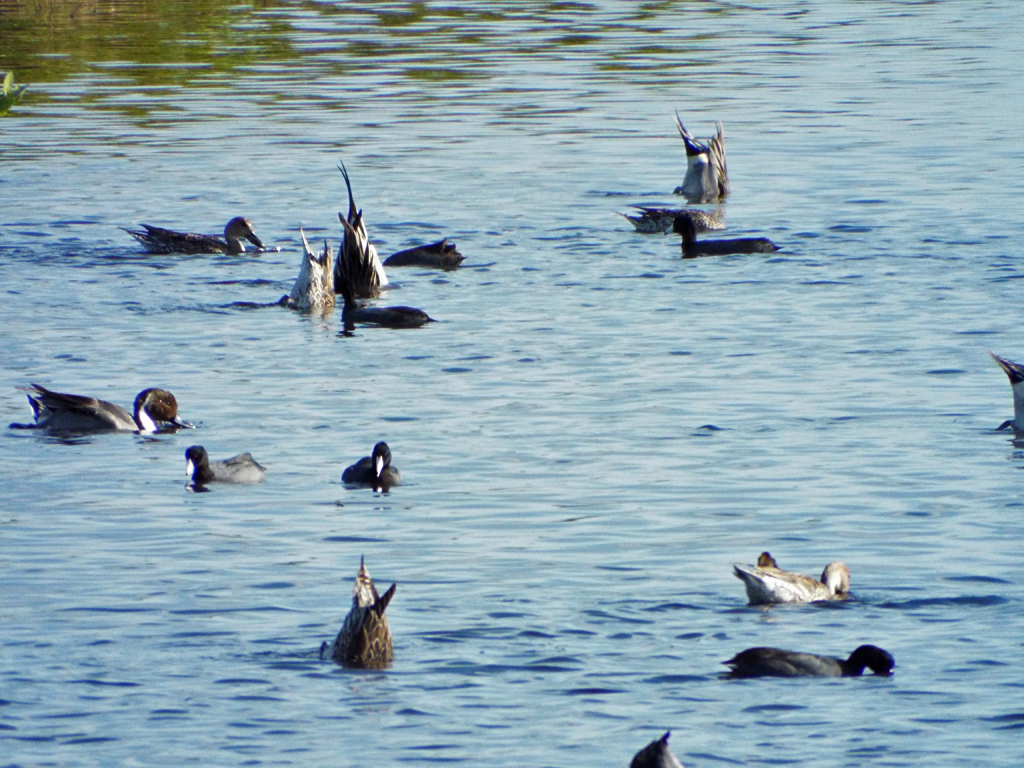
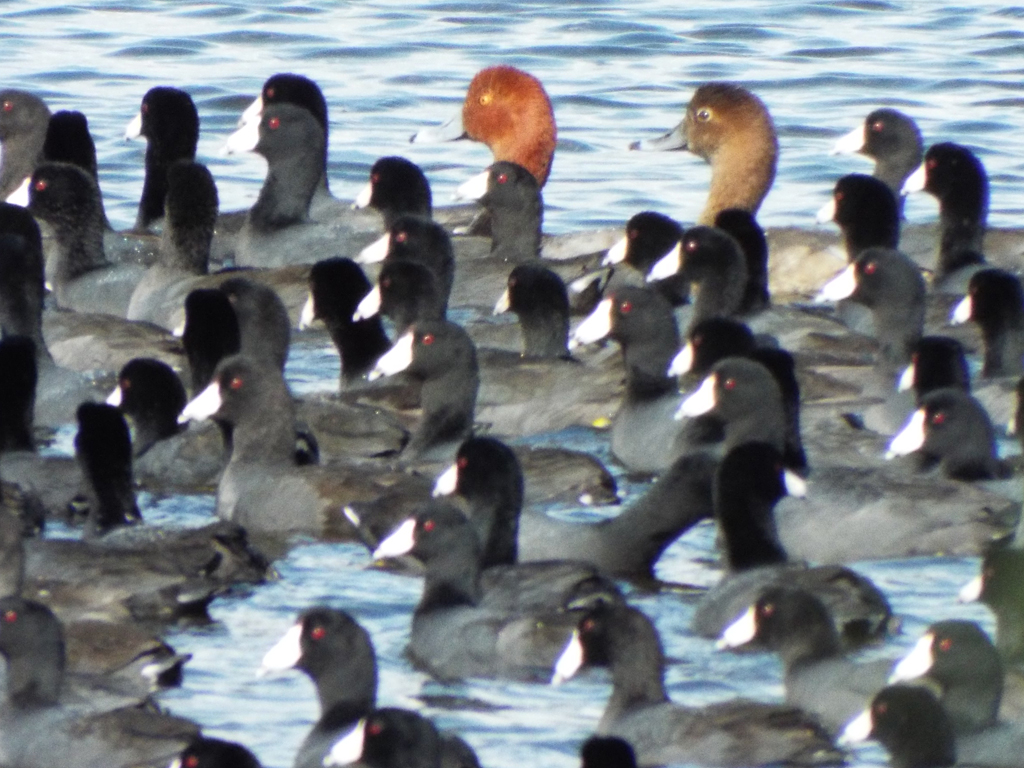
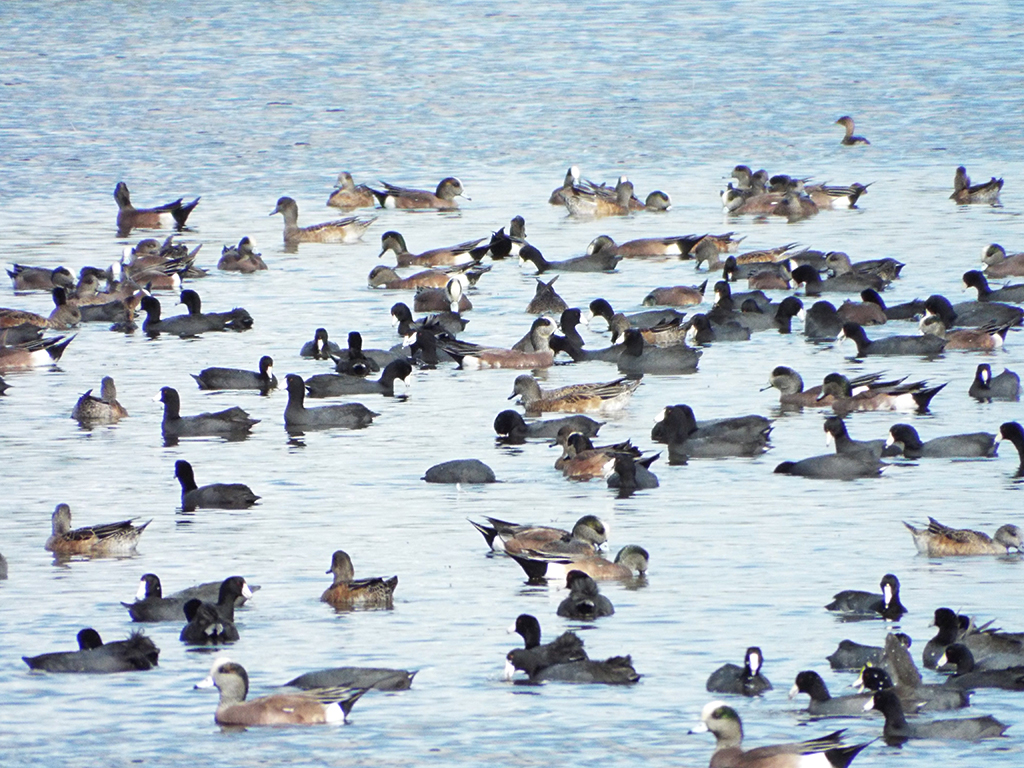
A wider shot showing Northern Shovelers, Northern Pintails, and American Coots together. Large areas of the ponds on the west side of the road (north of Cruickshank) were like this.

A large flock of Redheads were just within binocular range, as well as smaller pockets of Gadwalls, Ring-necked Ducks, and even an overflight of Black Scoters. Overhead and in spotting scope range (for those that had them) were many hundreds of more ducks, too distant or backlit to identify.

Of course, winter means American Coot time. Coots gather in huge rafts over the winter, using a “safety in numbers” survival strategy from predators, such as Bald Eagles. Sometimes other birds use the coots as cover, some blending in better than others. The largest rafts of coots were actually along Playalinda Beach Road (402) in some mangrove-screened ponds [map]. Google Maps erroneously calls this Max Brewster Memorial Parkway.

redheads-coots
A pair of Redheads trying to fit in.

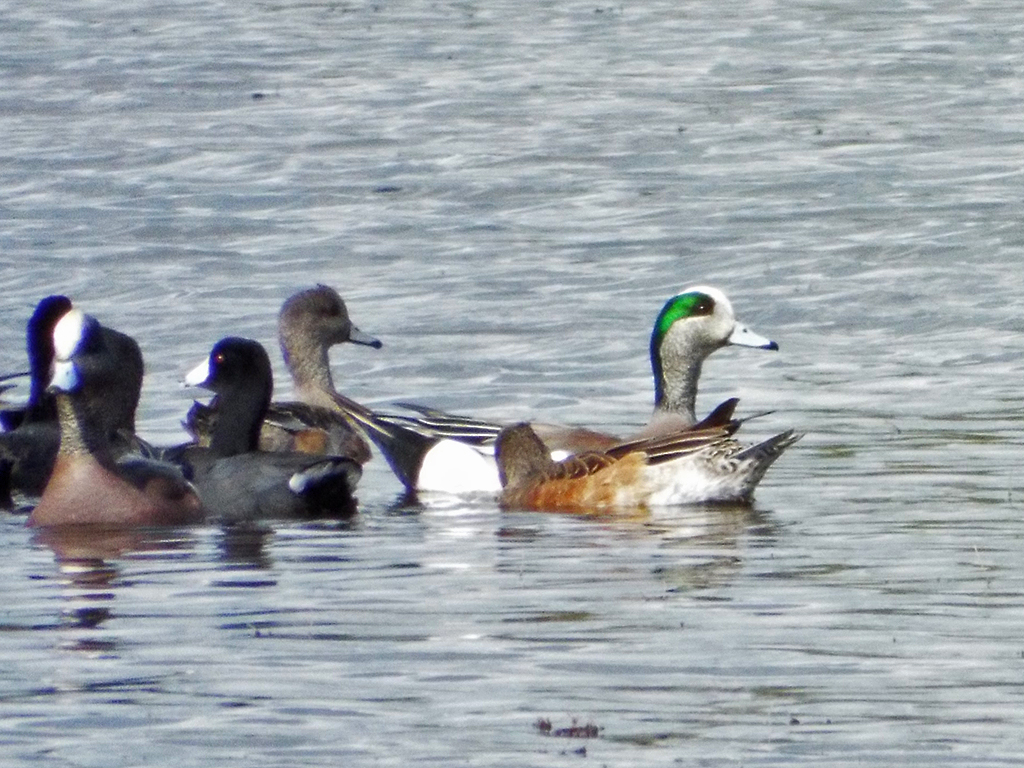
The main event the past few years along this stretch has been the large and vocal numbers of American Wigeons. Whether it’s the added privacy of the mangrove hedge or something about the ecology of the area, the wigeons have staked it out.


american-wigeon
The few gaps in the mangroves allowed for some photos. The green feathers on the male American Wigeons are spectacular when they catch the sunlight.
many-wigeons
Many American Wigeons (and coots, of course). There might be a grebe or two in there, as well.
wigeons-flight
The wigeons were a bit skittish. It seemed like they took to the sky at the slightest approach through the mangroves. The large flocks would break up and circle in smaller groups like this before settling down again.

Hopefully the ducks will stay over longer this winter than they have. The Space Coast Birding and Wildlife Festival begins in just over a month, and the impressive array of ducks at MINWR would be a great treat for field-trip attendees!


Look Who’s Ducked in for a Visit

The major bird “events” that many people look forward to in Florida are the Spring and Fall songbird migrations. In the Fall, hundreds of northern species funnel south through the state either to stay for the winter or on their way to Central and South America. The process is reversed in Spring when these species pass north on the way toward their breeding grounds.

There’s another migration that happens, though. In November, ducks by the thousands begin to arrive on the coasts, lakes, ponds, lagoons, and estuaries. Unlike most songbirds, whose drive to migrate is dictated primarily by length of day, many ducks and other waterfowl migrate when the food supply or weather dictates. If a winter is comparatively mild and food is abundant, these birds may not arrive in Florida until later in the winter, if at all.

One thing to count on, no matter when the ducks arrive, is that there’s almost always a vagrant, rare or unusual species that pops up here and there in central Florida.

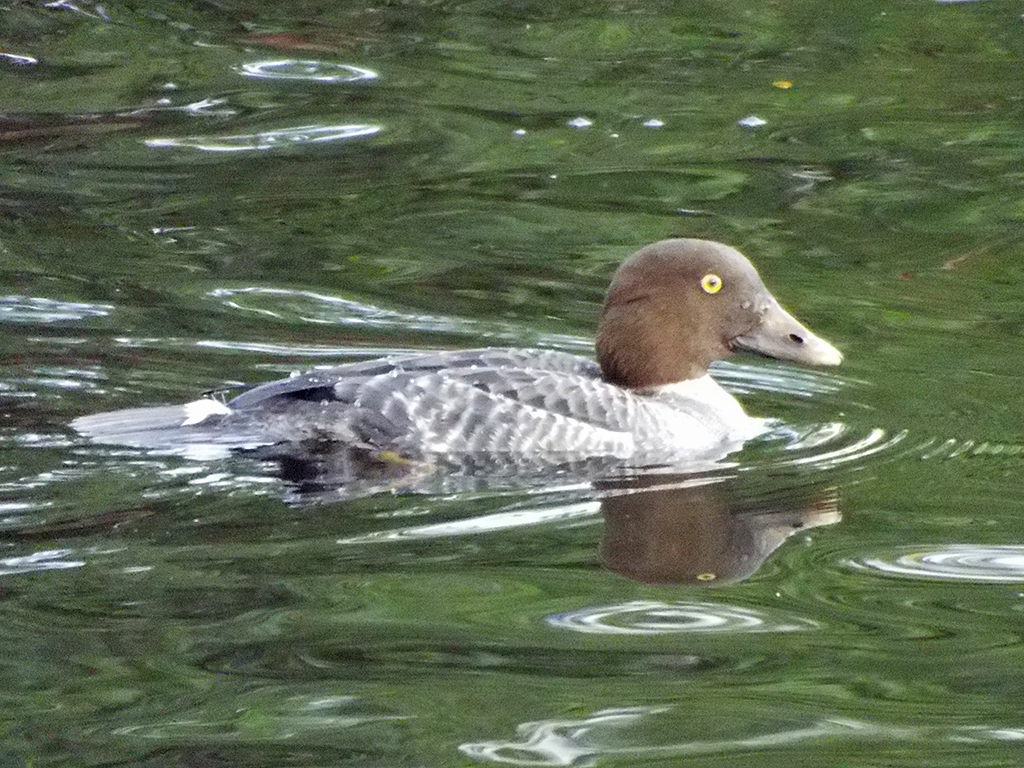
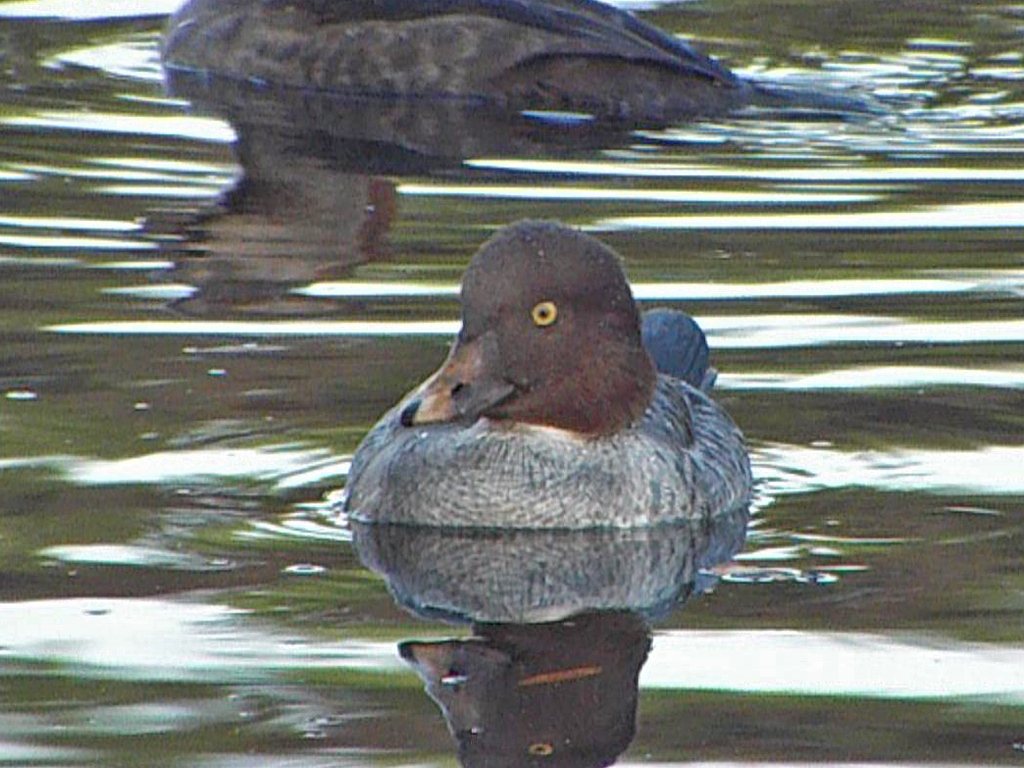
For example, there has been a Common Goldeneye at a small retention pond in Melbourne for the past couple of weeks. This particular bird has been hanging out with a flock of Hooded Mergansers. Common Goldeneyes normally winter as far south as the Gulf Coast and the Carolina Coast (though they are increasingly found in northern Florida).

common-goldeneye1
The brown head indicates that this is a female. Note the gold-colored eye that gives this bird its name.
common-goldeneye3
In breeding season, the tip of the bill would be brighter yellow, contrasting with the almost black base. The black area at the tip of a duck’s bill is called the nail and is sometimes useful for species identification.
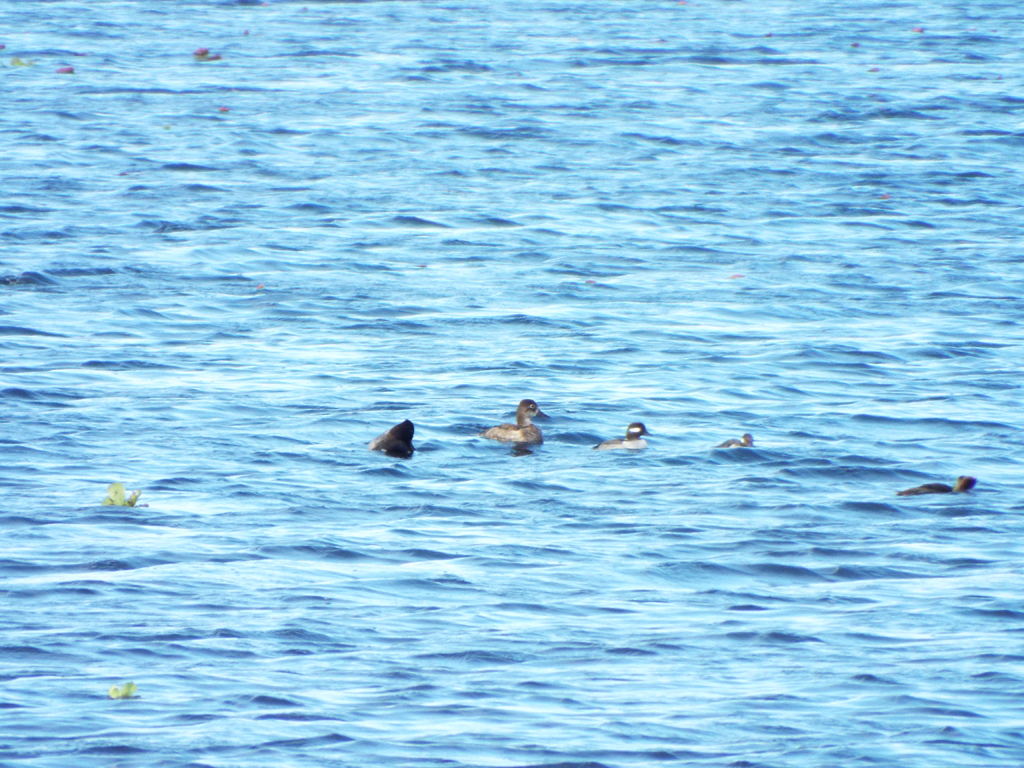
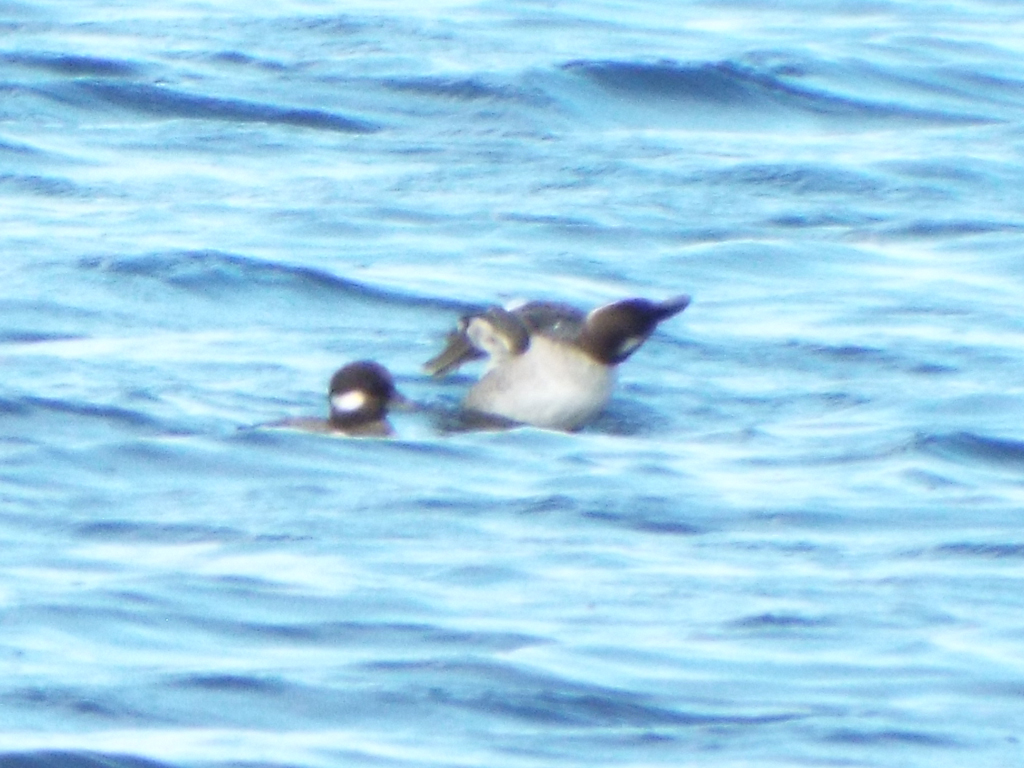
A few days earlier,  another rare but regular visiting duck species was seen at Orlando Wetlands Park. Buffleheads are small diving ducks, usually seen in saltwater bays or along the coast in winter (though they do breed near northern lakes). These Buffleheads (either females or immature males) were swimming and diving with Hooded Mergansers, Lesser Scaups and a Ring-necked Duck. The typical winter range for Buffleheads just extends into extreme northern Florida.

bufflehead-in-there
The Buffleheads are the 3rd and 4th ducks from the left, in this distant shot. The first duck is tipped tail-up, feeding. The white head-stripe was noticeable, even without binoculars.
bufflehead-in-there2
Here’s a close crop of the birds on the wind-ruffled surface of one of the artificial ponds that make up the park.

The two duck species above are among the more often seen, since their historical winter ranges are not that far away.

Other rarer, but regular waterfowl visitors to Florida include Snow Geese, Ross’ Geese, Mute Swans, and Long-tailed Ducks (the latter usually along the coast or in coastal lagoons). Over-wintering ducks and other waterfowl aren’t always that picky on where they stay, either. It often pays off to drive by suburban and urban retention ponds. Keep your eyes open!

Memory and Mystery

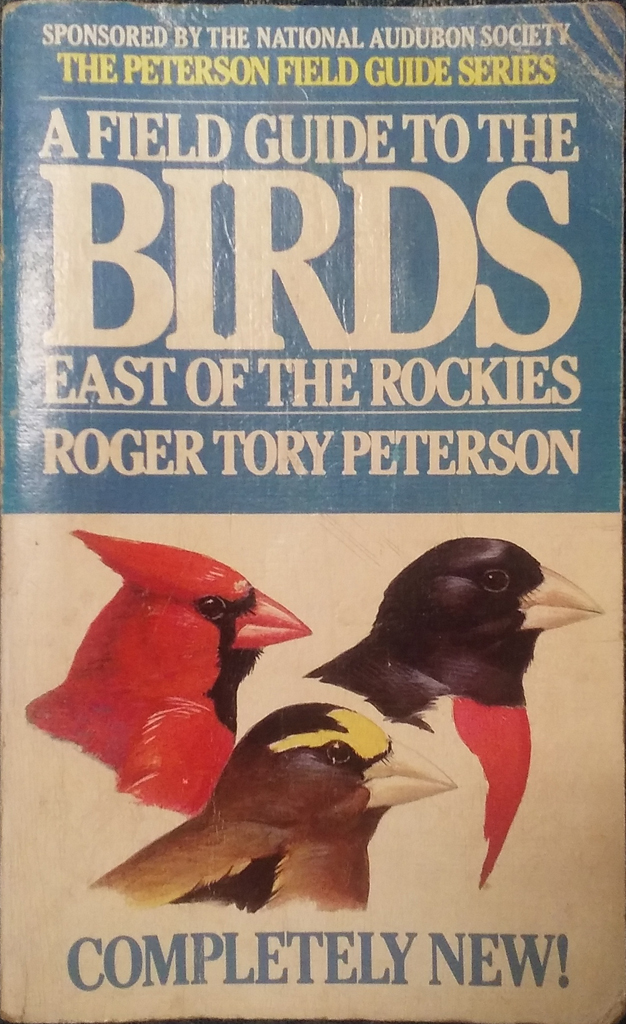
After over a decade, I was finally able to recover my 4th edition of A Field Guide to the Birds East of the Rockies, by Roger Tory Peterson. It was given to me by an aunt soon after I had my spark as a high-school senior to be a birdwatcher. Years ago, I lent the guide to a friend with whom I almost immediately lost regular contact with. I purchased a 5th edition, after making do with my Stokes guide for a time (which is fine, if you like photo-based vs. illustration based guides – a discussion for another time).

peterson-4th
The cover of my Peterson’s 4th Edition with the 3 (sort of now formerly) finch heads. Since this edition, cardinals and grosbeaks are still “together”  (family Cardinalidae) but separate from finches and sparrows (family Emberizidae). Back in 1980, they were all in family Fringilidae. Taxonomists live and die by their Latin, of course.
Its recovery also includes attendant checklists and notes, some made in the margins of this  well-worn volume. But with it came a mystery! I have “Scrub Jay” noted, seen in Montana.
Why is this significant? At the time I “lost” the guide, I had not yet seen a Florida Scrub-Jay. It is also important to note that the 4th edition was published in 1980. As many of my birding readers know, bird taxonomy (the practice and science of classification) is in a constant state of flux. Back in the early 1980s, birds such as the Baltimore and Bullock’s Oriole were lumped (or re-lumped) into “Northern Oriole” and there was only one “officially” recognized species of Scrub Jay on the continent. Since then, the Scrub Jay has been split and/or redefined at least twice.
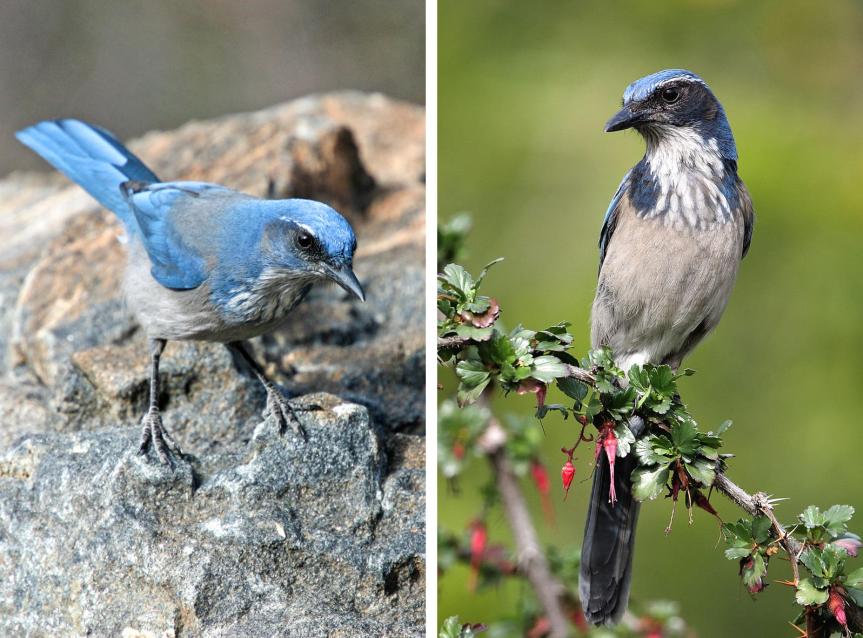
What to make of this simple note of a Scrub Jay in Montana in 2001? The two most likely candidates are the California Scrub-Jay and Woodhouse’s Scrub-Jay; both were formerly part of the “Western Scrub-Jay” prior to a taxonomic split this year. In 2001 the Western Scrub-Jay was already a distinct species from the Florida and Island species, but my 1980s era guide didn’t tell me that.
sfw_gbbc_2014_5238_western_scrubjay_lou_orr_arcadia_ca_habitat_kk
From left: Woodhouse’s Scrub-Jay. Photo: FLPA/Alamy; California Scrub-Jay. Photo: Lou Orr/Great Backyard Bird Count (Not my photos).
The problem is larger than this, though. For either “probable” species of scrub jay, neither is terribly likely in the places I visited back then. Our track took us from Fort Benton, along the Missouri River to Great Falls, south to Helena and eventually to Three Forks. According to eBird (which risks becoming the “Wikipedia” of the bird-sighting world, I realize) there are no reports of a scrub jay within hundreds of kilometers of my locations. The closest mapped species is the California Scrub-Jay, seen near the Thompson Falls Reservoir. But it’s the least likely given the habitat. The closest Woodhouse’s Scrub-Jay is mapped near the Cress Creek Nature Trail in Idaho, well to the south.
Unfortunately I did not make any further notes on this sighting (or if I did, they are lost to both my memory and physically). Was the bird or birds I saw pale or strongly colored? I want to say pale, but memory is notoriously faulty and I can’t rely on a decade-and-half-old recollection.
Realistically, this doesn’t mean a whole lot in practical terms. It’s one “count” on my life-list I can’t really add. The best I can do is note, in today’s taxonomy, “Woodhouse’s/California Scrub-Jay” and leave it at that. It’s an almost imperceptible blip in the vast store of bird sightings both within and outside of eBird.
This illustrates the importance of notes and photographs. It hasn’t really been until my adoption of eBird to track my sightings and my use of a camera that I’ve had any semblance of good record-keeping with my birdwatching activities (and even still, I could do much better). I am not by nature an organized person. For these and other past records, they’ve passed on into memory and thus into obscurity and I’m left with a handful of sightings that will be best served as personal myth.
Fun with Anis

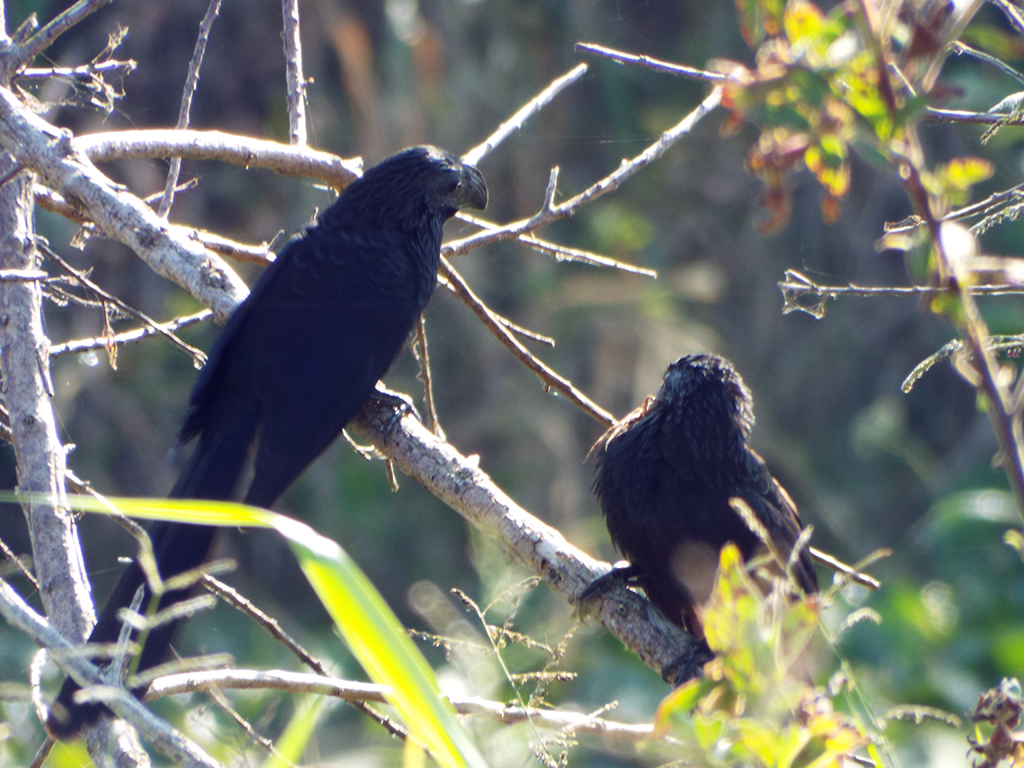
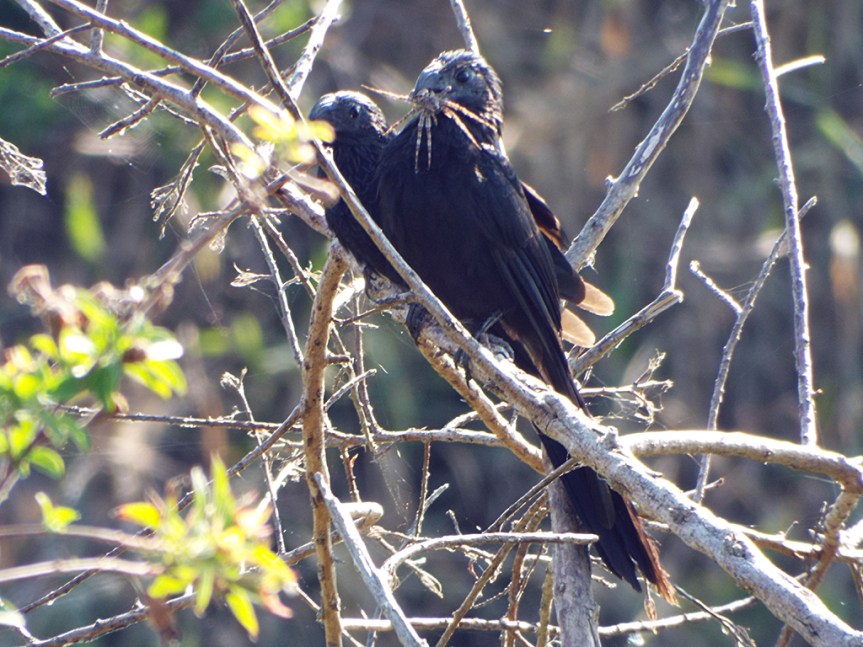
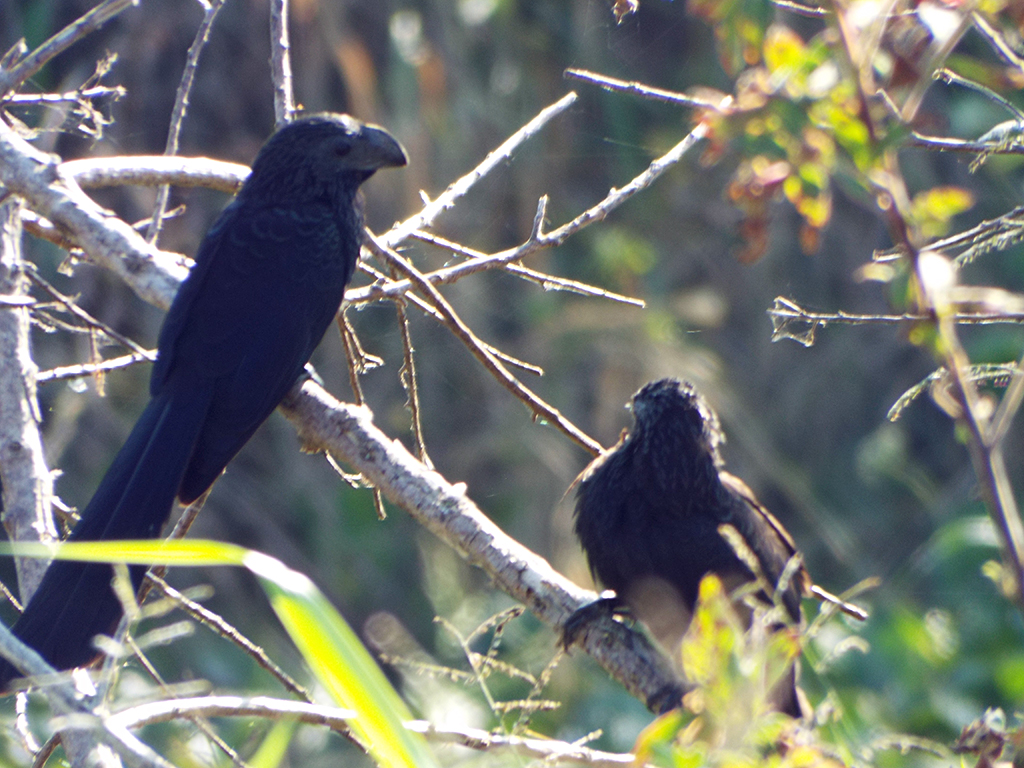
At Lake Apopka this morning, we had this fun little interaction between the two Groove-billed Anis that have been seen there all week.

what-is-that1
“Oh yeah, what you got there?”


what-is-that2
“Uh…wait. I don’t think I like this…”
 
what-is-that3
“What? This thing is GREAT!”           “…keep that thing away from me…”
The bird with the spider tried to give it to the other one several times, even chasing it a bit up the branch!
Oh, and Groove-billed Ani? Lifer!

Fellsmere Friends

Here are just a few of the friends I met down near Fellsmere this past week.

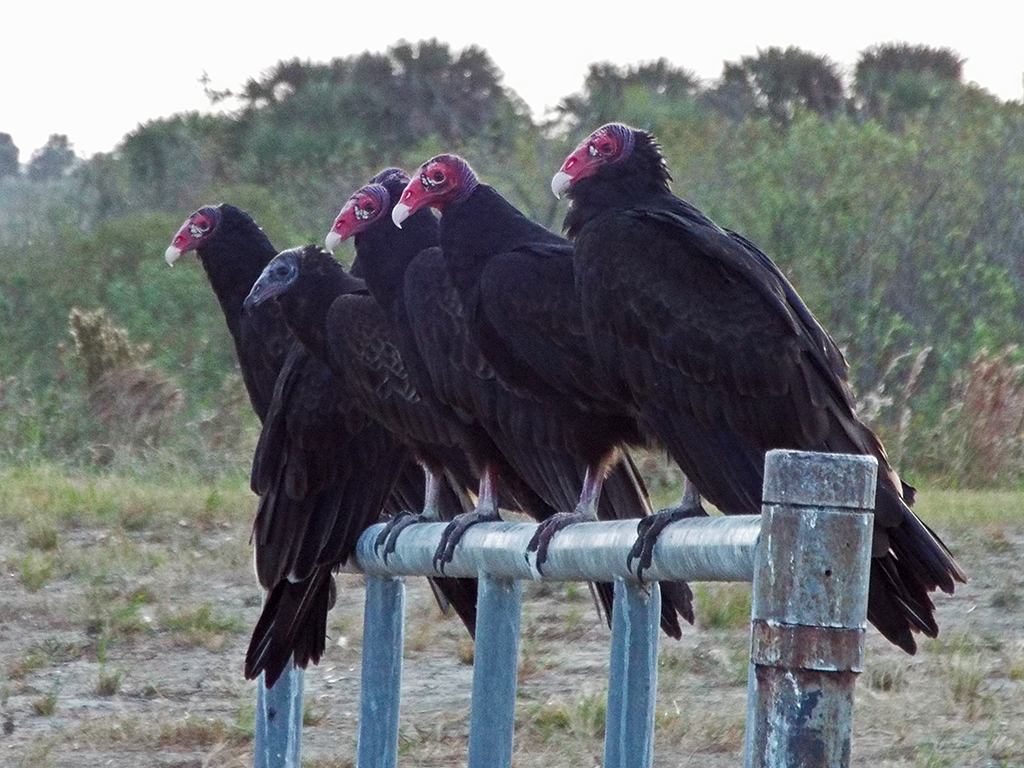
t-vultures
Can you spot the youngster in this line of Turkey Vultures?
red-shouldered-hawk
This “Florida form” of Red-shouldered Hawk has lost (perhaps molted) its tail. It is just growing back.
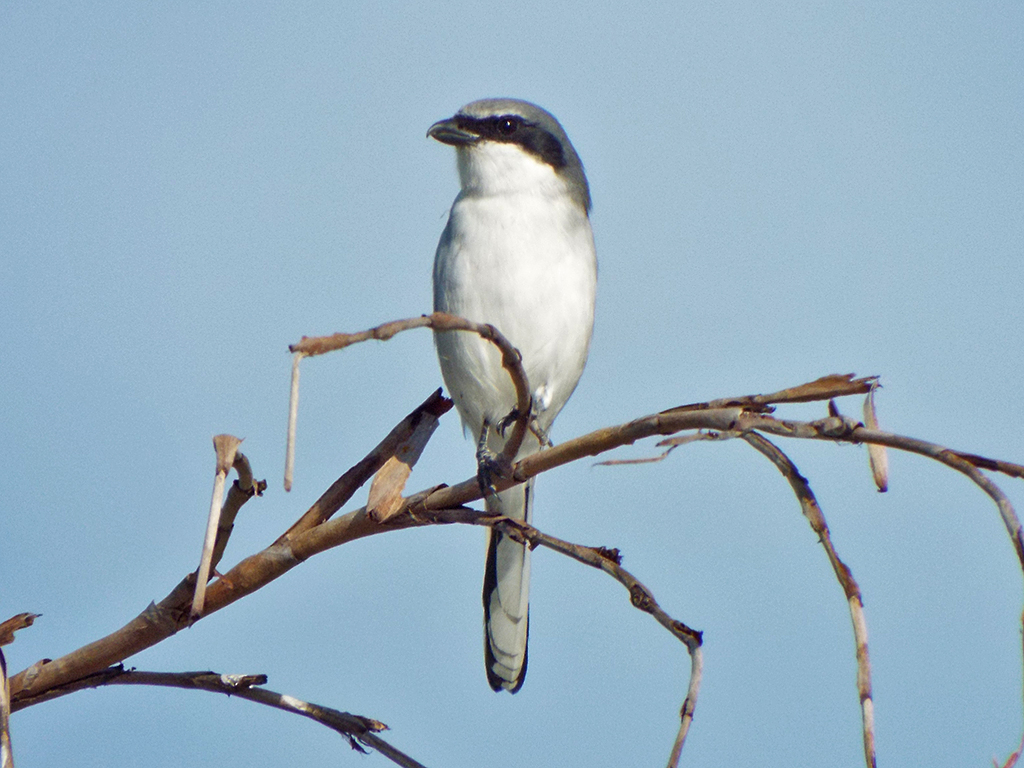
shrike
Loggerhead Shrikes are so named because of the relative large size of their heads to their bodies. Loggerhead Sea Turtles are named for the same reason.