Scrubbing it Up in Malabar

I spent the morning in the central part of the Malabar Scrub Sanctuary. My post from April 14th discusses how much of the sanctuary was overgrown too much for the Florida Scrub Jay. The central part, however, is being managed to keep the habitat more amenable to the jays and other scrub-adapted wildlife.

The Malabar Scrub Santuary was set up in the early to mid 1990s, using a failed housing development from the 1980s.

photo sign.jpg
Malabar Woods Blvd. You can’t have a more exclusive address

Here are a few photographs of what post-burn scrub habitat looks like from ground level. I am not sure exactly when this was burned, but probably some time this year. Vegetation grows back very quickly; these plants are adapted to fire. photo scrub2.jpg
Burn-managed scrub.

You’ll notice the lower part of the tree trunks are charred, but there’s no evidence of buring in the upper part. Management fires, like the natural fire they mimic, are fast moving and low to the ground. The taller trees here are relics of pre-management days. Left to its own devices, a scrub habitat would tend to be devoid of any taller trees. You can see that the burns have caused many of these taller tress to die, though. photo scrub1.jpg

Lack of shade is par for the course in scrub country.

There were some Blue-grey Gnatcatchers calling in their wheezy-complaining way along the paths off the paved boulevard, but as I walked down the defunct street, I noticed something ahead that excited me a bit. I couldn’t be sure until I got closer, but yes! Florida Scrub Jays! One was acting as a look-out on top of a dead sapling while another foraged on the ground. The foraging jay actually came within 2 feet of me and was very curious. I know that many people tend to feed them (which is illegal), so I don’t know if this jay is habituated to hand-outs or if this was just a normal level of curiousity seen in the species.

photo jay-lookout1.jpg
Sentinel.

photo jay-good-color.jpg
The blue coloration was very varible, depending on the sun angle. This shot shows it to best effect.

photo jay-close.jpg Hello neighbor!

I walked along some of the paths that led into the more forested parts of the sanctuary. I saw a White-eyed Vireo, but wasn’t able to get a photo (again!!), but was hearing what sounded like an Eastern Towhee. I know that the White-eyed Vireos in this area love to mimic towhees, so I was skeptical. It took some careful and lonely stalking, but sure enough, there was male Eastern Towhee singing in the shade of a tree. The race of Eastern Towhee here in Florida has white eyes (rather than the red eyes of northern bretheren) and a slightly less musical and slurring voice.

photo towhee-singing.jpg
Eastern Towhee singing his heart out.

photo towhee-sitting.jpg
Pause for breath.

At this point the sun was really beating down and I started to head back out. I saw a few more jays and another towhee. I noticed on my way back out to the scrub habitat a six-lined racerunner and creepy flies (like I’ve seen at Turkey Creek Sanctuary).

The only other resident I saw before exiting the sanctuary was this small Gopher Tortoise. It was about the size of a small bagel, but I don’t know how old that would make it, but I expect pretty young in turtle-years.

photo young-gopher-tortoise.jpg
Looks like the kids play outside in this neighborhood.

Both the Florida Scrub Jays and the Eastern Towhees are firsts for this year, bringing my 2013 total to 132 species.

Migration?

A note to my followers: I’m going to try and make a primary blog for Lonely Birder, which will entail:

  1. Temporarily renaming this blog (you’ll automatically still follow me)
  2. Moving to a new primary blog with the lonelybirder.tumblr.com URL (you’ll have to find and follow me “manually”

Is this something you’d all not mind doing? I’ll try to keep in good communication through the switch, if I do it. There’s no way to convert this to my primary blog, so I’ll have to migrate (mainly by “hand”) all my posts to this point. That’s not an insignificant undertaking, but I want to keep continuity if possible.

Thanks.

2013 Species Count Audit – 130

With the first sighting this year of a Common Nighthawk, my 2013 species count is now up to 130. I expect it will remain close to this until fall with the migration and perhaps a trip or two to the Gulf Coast. Other notable species in the past few weeks for the 2013 count are the Canada Geese I saw in Massachusetts last month, a Northern Flicker just down the road.

Summer at Turkey Creek

I was feeling well enough yesterday to head out to Turkey Creek Sanctuary, despite the oppressive humidity and only 3 hours of sleep! Now that summer is in full force, my expectations tend to be low in terms of my birding, but just having a hike in the woods is a good treat. Of course, things never quite turn out how one expects and I ended up having a pretty good outing.

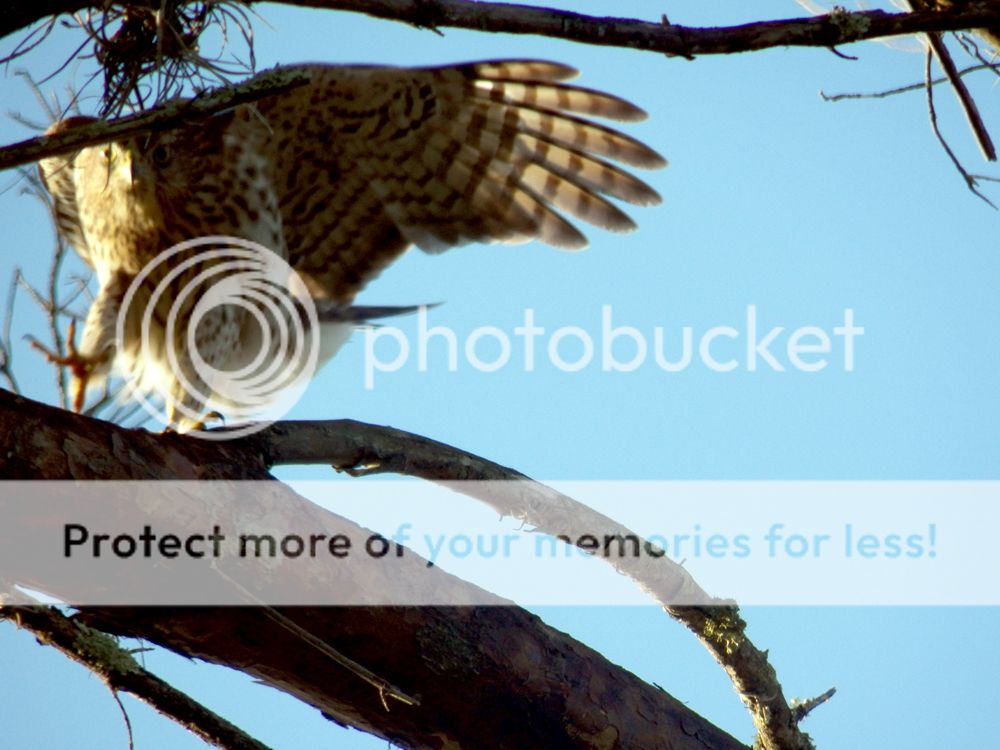
I started out heading toward the Scrub Trail area first, which immediately paid off. I could hear raptors calling in the area. From the sounds of the calls (which sounded like overworked squeak toys), I believed them to be immature Red-shouldered Hawks. There were two of them and at first glance as they quickly flew off toward the Scrub Trail and Harris radio tower area, I thought I could confirm my suspicions of their species; however, first one, and then the other obliged me by perching in the trees right overhead. Closer inspection showed them to be juvenile Cooper’s Hawks.


The first of 2 juvenile Cooper’s Hawks (possibly a female).


The second juvenile Cooper’s Hawk (smaller, likely male). I barely captured its awkward landing onto the branch.

These two characters provided a constant backdrop of sound and comical aerial displays for the whole morning wherever I was in the sanctuary. As they called out and flew circles around the immediate area, I happened to notice this Northern Parula sitting very very still, occasionally glancing nervously up at them. After the hawks passed by and were out of sight, it became more active and several more voiced their tiny displeasure at my presence. I suspect a nest was nearby, and the whole clan chipped and chirped at me along the path as I went.


Northern Parula nervously scanning the skies.

I walked from there to the dam overlook (technically a weir) and spillway, where the Melbourne-Tillman Canal empties into Turkey Creek. Although the weir and the “tuff boom” flotation barriers end up catching quite a bit of trash, the area upstream does provide habitat for wading birds and other species that appreciate the slow moving water. There were a few Green Herons and a Tri-colored Heron working the area, as well as a solitary American Coot. I also spied a tiny baby alligator. [Edit 10-28-2013: Not a tiny alligator, but a Florida Softshell Turtle. They have very flexible necks, and can hold their heads up in a way that doesn’t expose their shells.]


Tricolored Heron.


American Coot. Love the red eye.


Not a tiny alligator, but a Florida Softshell Turtle.

I watched the birds there for a few minutes, but that part of the sanctuary area is not shaded, and it was already getting oppressive. I headed back down the trail and toward the boardwalk to head up to the Sand Pine Ridge Trail while the lighting was still good and the sun not so high. Aside from a couple of Carolina Wrens and two Fox Squirrels (no pics), it was already fairly quiet. I did hear one or two White-eyed Vireos, too. As I started to head west along the trail, I noticed a new trail sign, “Turkey Oak Trail” and decided to check it out. As the sign on the other end of the trail suggests, this trail is fairly primitive. In part, it crosses through the upland part of the sanctuary that saw the most damage and tree-fall from the hurricanes in 2004. If I remember correctly, hurricane Jeanne did the most damage here. In some parts of this area over 70% of the canopy was removed from fallen trees or stripped branches. The remaining trees are still leaning.


Leaning trees from 2004 hurricane damage.

Some parts of this new trail are in some denser vegetation, though, with some evidence of fire. Quite a few logs that had laid on the path have sections cut out, which provided this nice looking mushroom a place to live.


This mushroom is a fun guy (fungi).

There were quite a few Blue-grey Gnatcatchers in this part of the sanctuary too. Two things about gnatcatchers that I really came to appreciate yesterday: they are tiny and they never stop moving. One managed to sit still just long enough for me to snap this photograph.


Mighty mite!

This Turkey Oak Trail basically runs north of and parallels the Sand Pine Ridge Trail, so I came out very close to the start of that trail and the boardwalk. I decided to retrace my steps and head back toward the Scrub Trail, but instead of go back toward the dam, I headed back in towards McKinnon’s Way. On the way, I stopped at the emergency boat ramp and had a sit-down for a few minutes. While there, a very pretty butterfly landed close by. To me, it looks like a Monarch, except it was much more red than any Monarch I’ve seen, which are typically orange. [Edited to add: this is, in fact, a Viceroy. It is considered a Müllerian mimic of the Monarch.]


Viceroy butterfly

The morning ended with the most exciting part of my outing, which I unfortunately was unable to capture on camera. As I was sitting, I saw a large elongated shape coming out of the water near the edge of the creek (there’s no bank to speak of, really). My instinct was it was a gator, so I started to jump up to run back up the ramp away from the water, but I realized it was a manatee! It raised its head up onto the side of the creek and mouthed at some vegetation. By the time I regained my composure, it had turned and submerged back into the creek. I was disappointed I didn’t get to take a photograph, but thrilled to see a manatee up close. With that, it was getting really oppressive (despite the breeze that had picked up), so I walked back out to head home.

Cold in the Sunshine State

It’s been a frustrating 10 days or so here, as I recover from a summer cold. I rarely get sick, but when I do, it’s usually epic or at least long-lived. I first got a rapid sore throat last Sunday, and it went from there to my head (sinus, headache), then down into my lungs (cough, congestion), and now back out to my head again. It’s on its last legs, thankfully.

Having had a good run of regular outings through the spring, not having the outlet that birding provides me has been challenging. I’ve always been one to cherish a walk in the woods – even if short – to clear my head and reset my mind. If we have a comparatively quiet evening this week I may dash of to  Erna Nixon Park or something, we’ll see.

New England intermission

I was away to New England this past weekend for a quick trip for a family function. Now, some might take me to task, but due to the quick schedule and uncertainties on where I was to stay, I did not take my bins or my camera with me.

I ended up at my brother’s apartment in an established neighborhood outside of the city with a good number of mature trees and such. For the first time in years I heard the clear whistling song of the Song Sparrow each morning, though I never did positivity identify one by sight. There were also some American Robin parents feeding their nearly full-grown fledgling. It still had some of the breast markings of an immature, but the wash of orange-red was unmistakable.

The day before, while a friend and his wife drove me toward their home, we passed a small field with a flock of Canada Geese. Now I realize, being FROM that neck of the woods, that Canada Geese are far too common. They are very often an nuisance. But I was thrilled, because it’s been so many years since I’ve seen one.

Other than that, there were some brief sightings or sounds from American Crows, Blue Jays, Northern Cardinals and I think perhaps Common (a.k.a. European) Starlings.

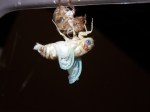
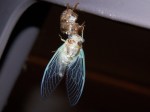
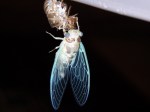
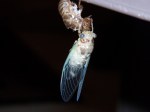
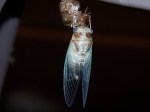
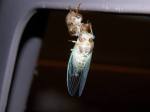
My wife noticed a cicada emerging from its shell tonight just before 10pm. Here are some pictures I took over about 1/2 an hour! So cool! (Note this cicada is unrelated to the 17-year brood currently active in the Northeast)

by row:

  • 9:50pm 
  • 10:00pm
  • 10:10pm
  • 10:20pm
  • 10:30pm
  • 12:00am

Click to enlarge and browse!

[Edited to add: I took one more photo at midnight, and by 1:00am it was gone, presumably climbed or flew to a safer location]

Law of the Concrete Jungle

My wife and I were distressed to discover one of the crane babies seems to be missing and presumed dead. Now that the chicks are getting so big, the family unit has been foraging farther away and crossing the very busy main road to find food. For some reason, they have never tried to walk further onto the property here at work behind the buildings (away from the road). We’ve been worried one might get hit by less than attentive or (unfortunately) evil drivers. For the past several days now, only one chick has been seen with the parents. It’s possible the other chick met a more “natural” end: disease, gator, choking.  Whatever the case, I hope the remaining chick stays safe and the parents stay healthy enough for another brood next year.