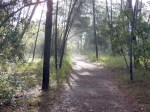
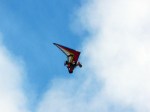
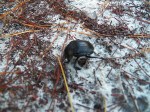
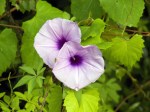
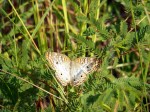
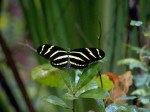
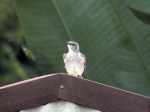
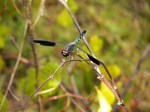
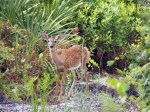
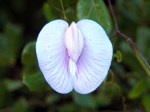
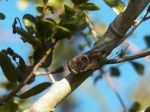
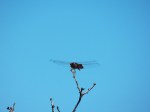
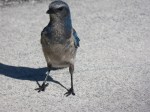
Pictures from Sunday (August 25, 2013).

  • Sand Pine Trail, Turkey Creek Sanctuary in the early morning.
  • Ultralight over Turkey Creek! NEATO!
  • Beauty Berry (notice how it’s more purple than pink now).
  • Large black beetle of some kind (over 1” long!).
  • I think these are sweet potato flowers.
  • While Peacock butterfly.
  • Zebra Longwing (Florida’s State Butterfly!).
  • Juvenile/Fledgling Northern Mockingbird resting on my shed.

Click images to enlarge and browse.

Youth Day!

Sunday was another quiet morning at both Turkey Creek Sanctuary and Erna Nixon Park. What activity there was revolved around juvenile Northern Cardinals (making the usual racket) and some Northern Parulas and Blue-grey Gnatcatchers high in the canopy (at least at Turkey Creek; almost nothing was to be had at Erna Nixon). Still, it was a pleasant enough morning and not too hot since it was mostly overcast. Toward the end of my Turkey Creek hike it started to rain rather steadily, but the rain hadn’t affected Erna Nixon Park when I drove there later in the morning.

After returning home, at some point during the early afternoon, my wife excitedly drew my attention to the antics of a bird on the wire between our house and the utility pole. It was a fledgling Northern Mockingbird leaping off the wires and making short almost flycatcher like sorties before landing back on the wire. We watched it for a few minutes and then noticed another fledgling along the power lines running along the right-of-way behind our house. And then ANOTHER. Then I noticed a fly-catcher along the same wire. It was a bit tougher to identify, but I finally figured out it was a juvenile Great-crested Flycatcher. It seemed a bit more adept at flying, so likely was past fledgling stage.

Looks like the day belonged to the youngsters.

[Edited to add: I’ll have a few photos from the parks later this week (more flowers, bugs and trees), and I’ll see how my only shot of one of the youngsters turned out.]

Life List Audit – Breaking 200!

I found some notes from our San Diego trip (2011) and was able to finally verify several more species for my life-list:

  • Cassin’s Kingbird
  • Black-chinned Hummingbird
  • Pelagic Cormorant

The new total is 201. I realize that for someone birding as long as I have (since 1990) 201 seems pretty small for a life-list. That doesn’t really bother me too much. There have been chunks of time (including grad school) where birding took a back seat to other pressing matters. My goal when birding is to observe behavior over tick-marks on a list. I also don’t have much of a travel budget (even for regional trips) so I don’t forge far and wide to get my list up. Don’t get me wrong, when an opportunity does come for me to get to new places and new habitats, I am all for it. But life list growing isn’t my main priority.

In any case, I’ve passed the 200 mark for my life list, and that is at least some milestone worth being happy about.

It was a very quiet morning at Turkey Creek Sanctuary. Here are a few of the things I saw today.

  • Centrosema virginiarum (wild pea)
  • Cicada
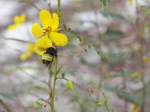
  • Bumblebee
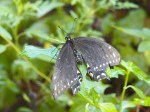
  • A very worn Black Swallowtail butterfly
  • Mini-lubber!
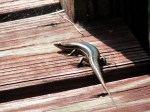
  • A very shiny skink of some kind
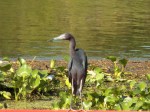
  • Little Blue Heron

Also saw some Blue-grey Gnatcatchers, Northern Cardinals, a Brown Thrasher, Green Herons (adult and immature), and an American Coot. Heard, but did not see a couple of White-eyed Vireos.

[Edited to add: also there was a (un)Spotted Sandpiper near the weir and canal where the herons were, Common Ground Doves near the Harris broadcast tower, and Blue Jays here and there.]

Florida’s Official Bird of Awesomeness

I didn’t go birding this weekend (at least not as an “official” activity with birding specifically in mind), but seeing some Swallow-tailed Kites on several occasions, it got me to thinking about these most graceful of flyers.

image
Eating on the wing. Copyright David Oakley.

When we moved to Florida over a decade ago, I noticed these birds during our first spring and summer. By our second spring, they were a common sight almost daily on the stretch from our apartment out to the interstate (which was much less developed than now). In 2004, we got a “double whammy” from hurricanes Frances and Jeannie and along with other formerly common species (most notably the Brown Pelicans), the local population of Swallow-tailed Kites all but vanished from our skies.

image
The Great Florida Birding & Wildlife Trail uses the Swallow-tailed Kite as it’s “official” bird. Why not the State of Florida?

Slowly, since then, there are more and more of them overhead, and this year they are about as numerous as they were in 2003. I have seen family groups soaring together a few times and they are a comforting and familiar sight almost every day. [Note: other birds, like the Brown Pelican have also recovered nicely since 2004]

Florida and closely adjoining areas of the US are the northern limits of this species’ normal breeding range, and due to their aerial skill and prey choice (lizards, insects, frogs) have managed to adapt to human incursions on their territory. I have seen them soaring over The Villages, Kissimmee, Venice Beach, Lake Wales, Melbourne and Key West.

image
Florida is the USA’s Swallow-tailed Kite Central.

These kites are migratory and leave for warmer climates in Central and South America each autumn. They return around March and begin breeding through the spring and summer.

Some US states list them as endangered or threatened, but I believe this is in part due to these states lying at the extreme of this species’ range. The International Union for Conservation of Nature (IUCN) notes that Swallow-tailed Kites have a very large global range and its population trend is increasing. This does not mean that these kites are unaffected by environmental degradation or habitat loss, but compared to some other animals and birds of prey in particular, they seem to be holding their own, at least globally.

Given their striking appearance, grace and population concentration in Florida, it’s strange to think that this bird is not the official State Bird. That honor belongs to the Northern Mockingbird. Although it’s insignificant to many other social, legislative and ethical problems today, I would be glad to see an initiative to see Swallow-tailed Kites as the State Bird of Florida.

Fay Lake Wilderness Park

My birding adventure this Sunday was a damp one at Fay Lake Wilderness Park. It has been fairly rainy in this area through the week, and the park was still wet from the previous day’s showers. It was mostly overcast, too, which helped keep the temperature down and I didn’t need to squint much.

The park is pretty, with mostly wide paths (looks like they use a 4-wheeler to keep things clear) and a series of wooden overlooks around the lake perimeter.

photo fay-lake.jpg
Fay Lake.

What struck me first upon entering the park trails was the almost unbelievable cacophany of tree frogs. When walking by a grove of palms when the frogs were calling, this has to be the loudest natural sound I’ve heard since the 17-year cicadas in Wheeling in 1999.

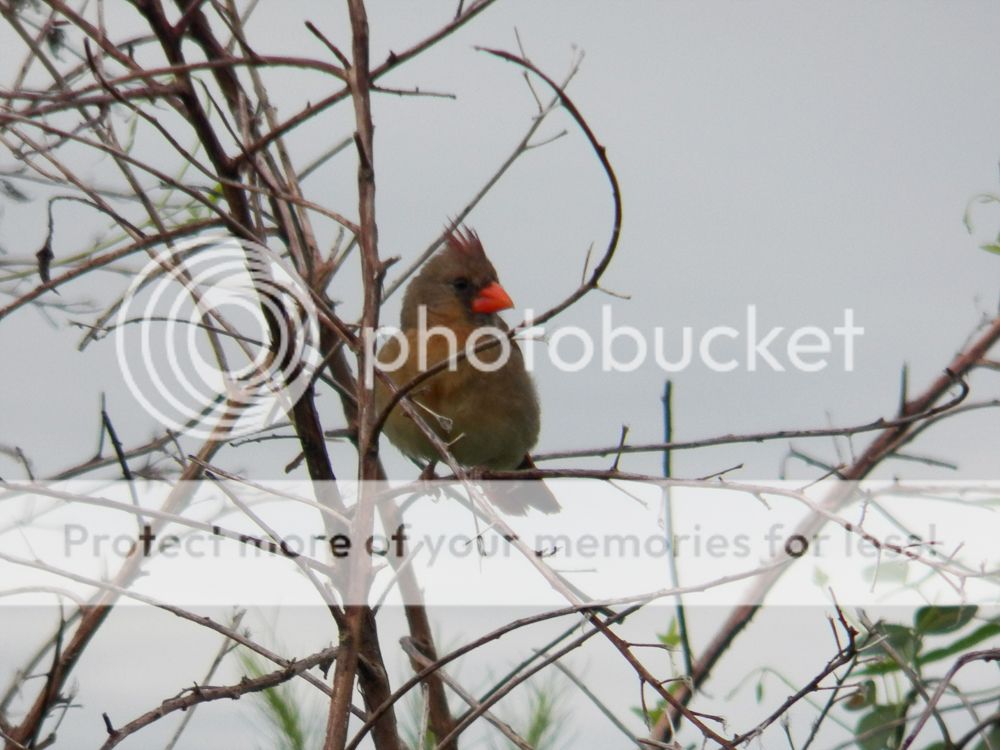
Like most of Brevard County’s parks, Northern Cardinals were just about everywhere. I like this shot of a singing female. In the bird world it’s rare for the females to sing, but for cardinals, both males and females sing regularly.

photo female-card.jpg
Female Northern Cardinal singing. This shot looks way too much like a winter scene up north!

Another constant companion throughout the morning were these grasshoppers. Some friends over on the Gulf Coast call the large grasshoppers there “lubbers” and the ones out there I have seen can be over 4 inches long. A few of these approached that size, but most were about 2-3 inches in length. I’ve been calling them “mini-lubbers.” photo mini-lubber1.jpg
Mini-lubbers were everywhere.

There were plenty of butterflies and skippers, too. I counted at least 6 different species. This one obliged me by sitting still for a while so I could get a decent shot.

photo butterfly.jpg
Gulf Fritillary.

This about a close to a Turkey Vulture as I’ve ever been. Vultures get a bad rap for eating carrion and lurking about dead things, but they provide a crucial service in “recycling” dead animals.

photo turkey-vulture.jpg
Turkey Vulture.

I got some good binocular views of an Eastern Towhee and a Red-shouldered Hawk, a brief glimpse of a White-eyed Vireo, and at least one Common Ground Dove. At one point a Little Blue Heron in mid-molt from white to blue flew overhead. It looked like it was marble.

I noticed that just about every square foot of the park showed some evidence of burning. The park sits just to the west of the interstate and adjoins the St. John’s National Wildlife Refuge, so regular burning is easier here than in many other parks.

photo fay-burned.jpg
Scorch marks and new growth.

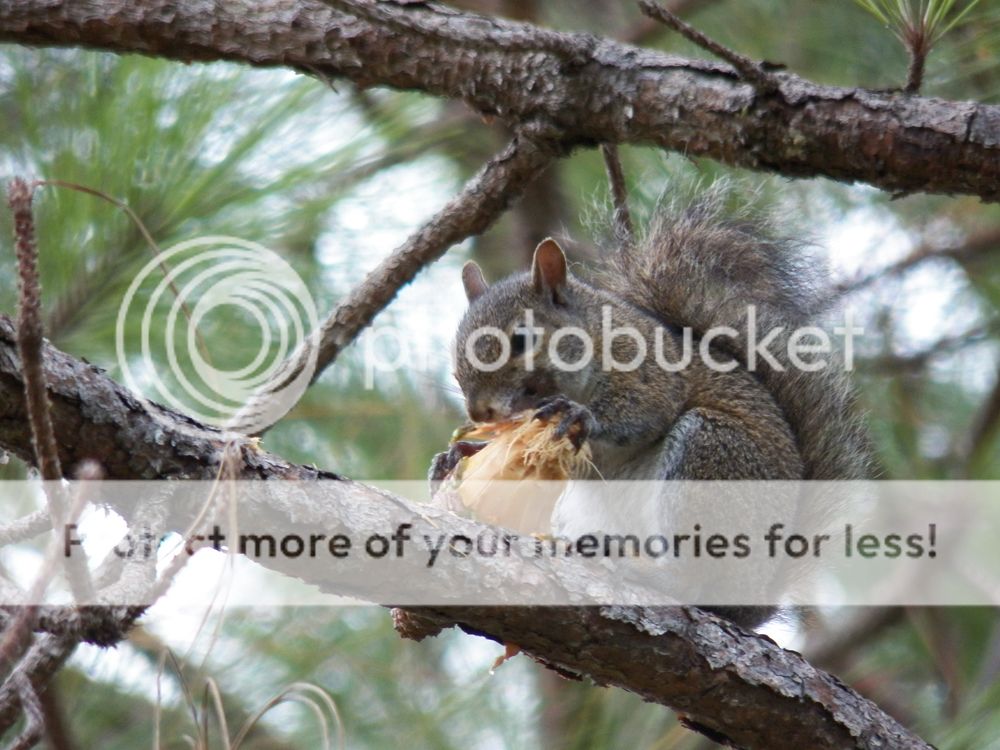
The area shown above was the sight of a little bit of action, too. Some grackles were trying to harrass an adult Cooper’s Hawk and managed to drive it away. As I was watching that (sorry, no pics!) I was lightly pelted from something above me. A squirrel was having a pine cone breakfast. photo squirrel.jpg
Squirrel!

As I said, the park borders the St. John National Wildlife Refuge, and the border was marked by some barbed wire and signage. The barbed wire was not continuous, and the path systems of the two parks intersect and merge here and there. I found myself on the “wrong” side of the fencing a few times and had to back-track out. I could hear Bobwhite calls deep in the Refuge area, but was unable to see anything in my binoculars. The Refuge looked pretty, if a bit empty of visible animal life.

photo wildlife-refuge.jpg
St. John’s National Wildlife Refuge.

That was about it for the morning. The paths back toward my starting point were very wet at this point and the tree frogs were nearly deafening. I’d like to stop back to this park in the fall and definitely next spring before the hot weather sets in. Here’s a parting shot of one of the mini-lubbers.

photo mini-lubber2.jpg
Mini-lubber says bye!
Crane Family Sadness

I’ve been avoiding this for a few weeks now, but you can probably tell from the lack of Sandhill Crane updates that all is not well with the crane family. The surviving chick seems to have perished as well, a few weeks ago. The parents have been near the front retention pond intermittently since then, but I have not seen them on the premises since early last week. It’s a sad fact of life for birds like these cranes. Like a lot of other wildlife (and feral animals as well), they face tremendous natural and man-made obstacles for survival. I remain hopeful that next year they will be able raise at least one chick to adulthood.