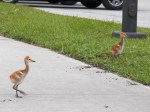
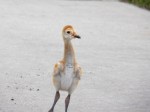
The cranes that live and nest where I work hatched 2 babies again this year, about a week or so ago. It’s been hard to get emotionally invested in the family after last year’s heartbreaking loss of both chicks (presumably to traffic accidents, though nothing definitive is known). But they are so darn cute, I had to take these photos as the kids were feeding and walking around with their parents. Here’s to hoping they stay safe and grow strong.

Top O’ The Morning…

I returned to Turkey Creek Sanctuary today hoping to catch some early migrants and to cover more of the paths than last week.

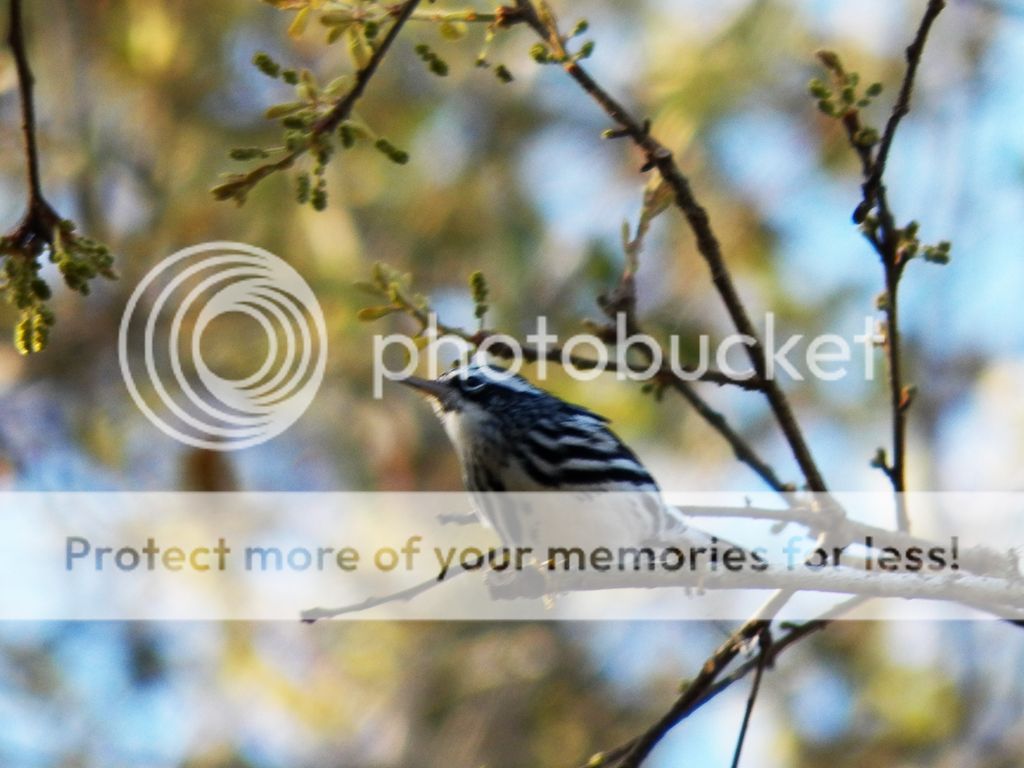
For the most part the “winter residents” are still holding the fort, with a plethora of Blue-gray Gnatcatchers, Pine Warblers, Black-and-white Warblers, Northern Parulas, Yellow-rumped Warblers, Northern Cardinals (who are getting even more vocal) and Gray Catbirds. I do beleive that the Palm Warblers have pretty much vacated the sanctuary.

photo bww.jpg
We meet again, my monochromatic friend.

The trees are really starting to leaf-out (even more than last week), casting a greenish light on the boadwalk, which might suit those celebrating St. Patrick’s Day tomorrow!

photo greenish.jpg
May the road (or in this case, boardwalk) rise with you.

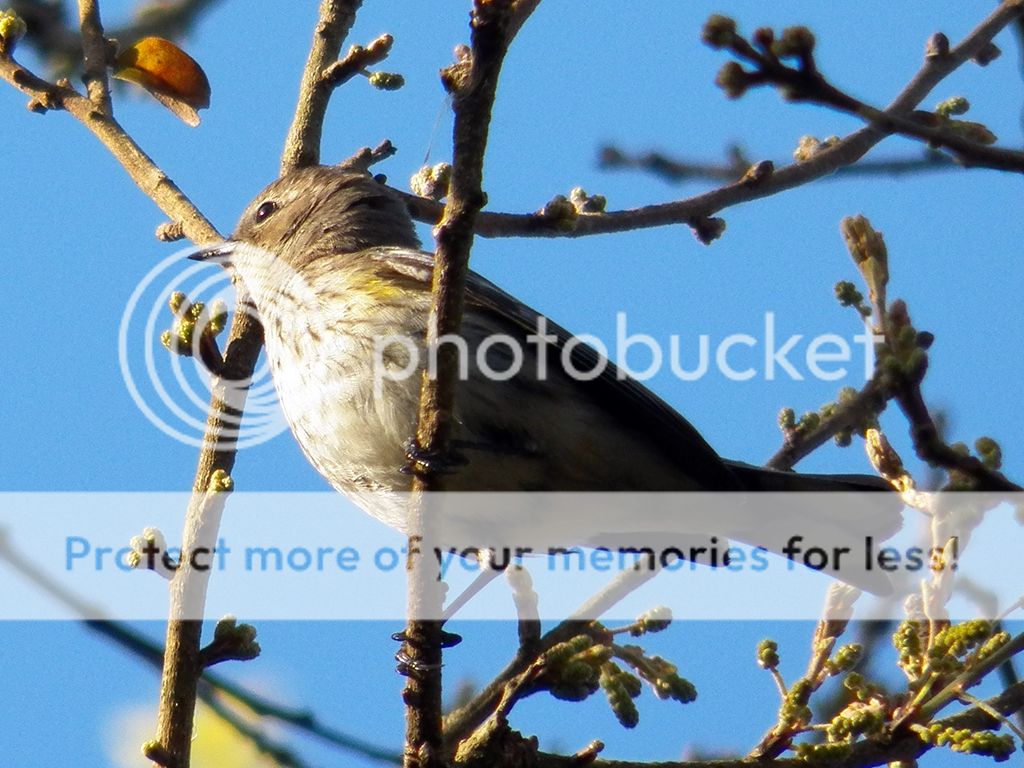
I’ve noticed that the Yellow-rumped Warblers in the area have shifted their foraging strategies a bit. They seem to be skulking more in the underbrush than they had been earlier in the winter. I am fairly sure this is related to what food items are availble for them as springtime approaches.

photo yrw.jpg
Yellow-rumped Warbler.

An exception to the status quo (that is, more signs of Spring) was the unmistakable call of Yellow Warblers in the canopy. Among my first “regular” birds during the summers in New England, Yellow Warblers were always a great sighting on any birding day for me. They were cheerfully loud, beautifully conspicuous, and easy to identify. I tried my best to get an actual visual on one, but they remained stubbornly up in the foliage. (NOTE: The following photo is not mine, but from Wikipedia).

image
Yellow warbler, via Wikipedia user “Mdf”

I also noticed that the boardwalk at the end of the Floodplain Trail is almost finished. I did not see or hear the Boy Scouts working on it today, but I think they just have some finishing work and clean-up left.

photo flood-plain-boardwalk1.jpg
Looking back from the end of the new Flood Plain Trail Boardwalk.

The big surprise of the morning happened when I was looking up into some foliage through a hole in the understory along the Hammock Loop. Just as I Iooked directly above me, a Peregrine Falcon flew right through the clear patch of sky. One second or one foot difference and I might have missed it!

I was also excited to see a flock of Cedar Waxwings near the weir. I somehow missed seeing this species during the Blue Heron Wetlands field trip during the Space Coast Birding and Wildlife Festival, so being buzzed by a 20-strong flock today was a real treat. 

Species list for today (♫ = voice only; FOY=first of the year):

  • Northern Cardinal
  • Gray Catbird
  • Blue-gray Gnatcatcher
  • Northern Parula
  • Black-and-white Warbler
  • Yellow-rumped Warbler
  • Pine Warbler
  • Yellow warbler (FOY) ♫
  • Red-bellied Woodpecker
  • Blue-headed Vireo
  • Fish Crow
  • Black Vulture
  • Turkey Vulture
  • Peregrine Falcon! (FOY)
  • Tri-colored Heron
  • American Coot
  • Great Blue Heron
  • Carolina Wren ♫
  • American Goldfinch ♫
  • Mottled Duck
  • Downy Woodpecker ♫
  • Cedar Waxwing (FOY)

That brings us near to the first of “Official” Spring later this week and the hope of some great birding during migration coming up.

What was that, Bill?

My birding day was an abbreviated walk through Turkey Creek Sanctuary this morning, as I wanted to sleep in due to the start of Daylight Saving Time and wanting to make it to Indiafest before the afternoon wore on.

I bumped into Bill Haddad, a birder who splits his time between North Carolina and Florida. He’s here until late April before departing for the Blue Ridge, where he’ll stay until later in the fall, when he returns to Florida.

We walked most of the boardwalk together, swapping tips and stories, which was pleasant, though it meant not covering as much grounds as I usually do. It was a bit of a “birdy” morning, but most of the action stayed out of sight in the canopy (which is beginning to leaf out as spring arrives).

Bill is an accomplished birder and I learned a few good tips for some areas to concentrate on in April as the migration moves through our area, and his warbler identification is better than mine – something I hope to improve upon this spring.

We had one mystery bird: a light or whitish bird with heavily streaked flanks popped into view on top of a sapling, close by. Bill’s first thought was that it was reminiscent of a Pine Siskin (the quality of the stripes, not the color or shape of the bird). Just the very middle of its throat and belly clear whitish (much narrower than one would expect from a Black-and-white or Blackpoll Warbler) and it had no distinctive facial features. My Peterson’s guide was not helpful, and it moved to quickly for us to get either of our cameras on it. The best explanation we came up with was a Black-and-white Warbler with a slightly aberrant plumage. Such is the way with birding!

We had a nice but quick view of a male Pileated Woodpecker as it worked near its mate in excavating a nest hole (or so we assume – they were on the opposite side of the trunk that we could see).

photo pileated-2014mar09.jpg
Best view of the male Pileated Woodpecker.

Here’s the species list for the morning – many of these were voice only (♪):

  • White-eyed Vireo ♪
  • Northern Parula
  • Pine Warbler (these were excessively numerous today!)
  • Carolina Wren
  • Northern Cardinal
  • Gray Catbird
  • Blue-gray Gnatcatcher
  • Black-and-white Warbler ♪
  • Red-bellied Woodpecker
  • Yellow-bellied Sapsucker ♪
  • Turkey Vulture
  • Black Vulture
  • Blue-headed Vireo
  • Yellow-rumped Warbler
  • Palm Warbler
  • Pileated Woodpecker
  • Downy Woodpecker ♪
  • Fish Crow ♪
  • Red-shouldered Hawk ♪

Bill also told me that he’s recently started wearing hearing aids, specifically to regain his lost high frequency hearing. He’s still learning how to gauge distances, which made for interesting stalking of the Northern Parulas and number of Blue-gray Gnatcatchers. It was interesting to me to hear about his experience with hearing loss as it relates to birds, as it is something I thought I had to deal with recently.

Malabar Scrub Sanctuary: March 2, 2014

I apologize for the delay in getting this post up, but here’s a summary of my last birding excursion, this past Sunday.

My last visit to the Malabar Scrub Sanctuary was memorable, in part, because of how close I got to some Florida Scrub Jays. To be honest, my main goal was to see some of these birds again.

The sanctuary itself is divided into two main parts, an eastern and western section, with the Cameron Preserve in the middle. This forms a more or less contiguous open space ranging from low scrub to mature second-growth forest.

I started the morning in the western section, nearby the Turkey Creek Sanctuary. This part of the park is mainly forested with a semi-closed canopy. Northern Parulas were numerous and vocal. Almost everywhere I saw or heard Northern Parulas, Yellow-rumped Warblers were nearby. The males are molting into their breeding plumage and are looking quite sharp! The warblers tended to move through the trees just ahead of Blue-gray Gnatcatchers.

The Northern Cardinals are ramping up their activity as well. Most years, the cardinals in this area only show a slight decrease in activity through the winter. Some years I have even seen fledgling birds in late January, meaning at least some of these birds are nesting and breeding through the winter. This year, however, the cardinals have been more laid back and quiet through most of the winter. Things are changing now, though, and soon I expect these handsome birds will be singing and chirping their way to distraction, as always.

At one point, I heard a distinctive bird-like chatter up in the trees and looked up at some tall pines, trying to find what was making the sound. I heard a similar response about 100 feet away in another treetop, but could not see anything. The first noise came from a tree with a nest in it, though I could not tell if the nest was occupied. The nest was 2-3 feet wide and make of sticks. I’ve embedded this video below, mostly for the sound recording. If anyone knows what this is, please let me know.

Mysterious chattering call. Does anyone know what this is?

I heard several small groups of American Goldfinches at various places, and the constant calls of the Carolina Wren at times challenged the cardinals for predominance. In both sections of the sanctuary I heard White-eyed Vireos singing their odd, semi-mimicked songs, but the one I did see was too quick to grab a photograph (if you follow this blog, you’d know it took almost a year for me to actually photograph one of these birds, despite hearing them almost the entire spring and summer).

After completing one of the loop trails through that part of the sanctuary, I drove to the eastern portion, where I saw the scrub jays last year. They did not disappoint. After one “false alarm” by this Northern Mockingbird, I was visited by a couple of jays, who let me get quite close and seem to be people watching as much as I was birdwatching.

photo n-mockingbird.jpg
Perhaps I was being silently mocked?

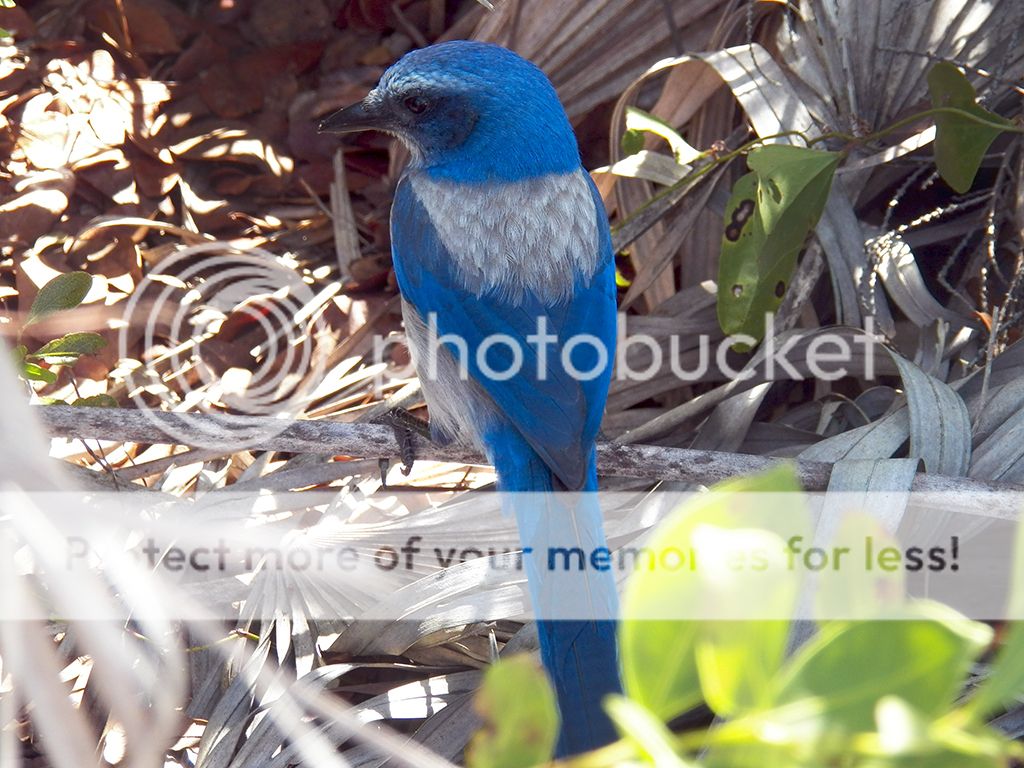
Florida Scrub Jays are intensely curious birds, and also quite social (like most corvids). One pair hung around the tree I was near, trying to catch a glimpse of a bird that was noisily rustling in the brush along the trail. One of the two let me get within a few feet of it (the rustling turns out to have been Eastern Towhees foraging in the leaf-litter).

photo s-jay.jpg
When I said, “I don’t have any snacks for you,” this bird actually did turn up its nose.

Further along the trail this bird followed me and let me get closer and even take a short video. The video starts when the jay notices a large wasp flying around. The loud sound at the end is the camera’s zoom mechanism.

Florida Scrub Jay goes after a wasp (not in frame).

When it flew off and ran around, it was chasing the wasp, which it then summarily caught, dismembered and ate after scurrying into the brush. I managed some photographs after the meal was complete, but I love the picture shown here because it shows off the beautiful blue plumage on this handsome bird.

photo s-jay-back.jpg
Florida Scrub Jay after just eating a large wasp.

After a few more minutes, the jays got bored with me and flew off (I heard several other individuals in the vicinity).

During the wildlife festival in January, a group of us were talking about various state birds, and it was mentioned that Florida’s state bird is the Northern Mockingbird. I offhandedly said I voted for the Swallow-tailed Kite, but Laura Erickson immediately piped up and said, “I think it should be the Florida Scrub Jay.” And she’s right.

The Florida Scrub Jay is completely endemic to the state. No other Florida bird is as emblematic of the struggle in Florida of wildlife and open space vs. development or of natural Florida vs. the tropical paradise we’re trying to force it to be. While it might lack appeal for citizens for whom the Scrub Jay is not found nearby, any benefit the species might get by elevating it to official status would be welcome, in my eyes.

I finished up the morning by walking to the end of the paved road before turning around and walking back out. One pleasant surprise there was a trio of Brown-headed Cowbirds on the powerline.

Once again, here is the species list from Sunday (including the drive to and from the sanctuary):

  • Northern Mockingbird
  • Fish Crow
  • Brown Pelican
  • Great Blue Heron
  • Yellow-rumped Warbler
  • White-eyed Vireo
  • Blue-gray Gnatcatcher
  • Northern Cardinal
  • Eastern Towhee
  • Florida Scrub Jay (FOY)
  • Boat-tailed Grackle
  • Osprey
  • Turkey Vulture
  • Black Vulture
  • Brown-headed Cowbird (FOY)
  • Palm Warbler
  • Carolina Wren
  • Northern Parula
  • Blue Jay
  • Pileated Woodpecker (voice)
  • Tree Swallow
  • Red-shouldered Hawk
  • American Goldfinch (voice)

Coming up Next: Malabar Scrub Sanctuary, March 2, 2014

I had a pleasant outing at the Malabar Scrub Sanctuary yesterday, with some decent photos. I’ll be getting a post together some time later today or this evening. In the meantime, here’s the species list, including the drive there and back:

  • Northern Mockingbird
  • Fish Crow
  • Brown Pelican
  • Great Blue Heron
  • Yellow-rumped Warbler
  • White-eyed Vireo
  • Blue-gray Gnatcatcher
  • Northern Cardinal
  • Eastern Towhee
  • Florida Scrub Jay (FOY)
  • Boat-tailed Grackle
  • Osprey
  • Turkey Vulture
  • Black Vulture
  • Brown-headed Cowbird (FOY)
  • Palm Warbler
  • Carolina Wren
  • Northern Parula
  • Blue Jay
  • Pileated Woodpecker
  • Tree Swallow
  • Red-shouldered Hawk
  • American Goldfinch

More to come.

Coming up Next: Malabar Scrub Sanctuary, March 2, 2014

I had a pleasant outing at the Malabar Scrub Sanctuary yesterday, with some decent photos. I’ll be getting a post together some time later today or this evening. In the meantime, here’s the species list, including the drive there and back:

  • Northern Mockingbird
  • Fish Crow
  • Brown Pelican
  • Great Blue Heron
  • Yellow-rumped Warbler
  • White-eyed Vireo
  • Blue-gray Gnatcatcher
  • Northern Cardinal
  • Eastern Towhee
  • Florida Scrub Jay (FOY)
  • Boat-tailed Grackle
  • Osprey
  • Turkey Vulture
  • Black Vulture
  • Brown-headed Cowbird (FOY)
  • Palm Warbler
  • Carolina Wren
  • Northern Parula
  • Blue Jay
  • Pileated Woodpecker
  • Tree Swallow
  • Red-shouldered Hawk
  • American Goldfinch

More to come.

Turkey Creek, February 23, 2014

First, my apologies; I forgot to check my camera batteries before arriving at the park, and they were dead, so no photos from today.

I decided to drop in on Turkey Creek to see how things are going on now that winter is waning. It was a pretty good morning, all things considered.

The most noticible change over my last visit was the sound. Although the area nearest the start of the trails and boardwalk was pretty quiet, once you got closer to the creek, things picked up. There was a pleasing jumble of Blue Jays, Blue-gray Gnatcatchers, Northern Cardinals, Gray Catbirds and Northern Parulas. Northern Parulas are a year-round species in this part of Florida, but they make themselves fairly scarce through the winter. The males are now in their breeding plumage and are singing from the canopy. It was nice to see them (and hear them). Yet another sign spring has arrived in the Sunshine State. Don’t worry, my northern friends, it’s coming I promise!

Other notable wintering species were a Blue-headed Vireo and a couple of Black-and-white Warblers.

I didn’t venture to the canal or weir today, but I did see a small flock of Black-bellied Whistling Ducks fly over.

At one point I heard a very distinctive sounding whining roar overhead, and looked up to see an Osprey, high in the sky! No, not THAT Osprey, THIS kind of Osprey:

image
CV-22 Osprey, via Wikipedia.

It was pretty high up, but the unique engine sound and one of the rotors (on the left wing), catching the sunlight making it almost shimmer, made it hard to miss.

Complete species list for this morning:

  • Northern Cardinal
  • Blue-gray Gnatcatcher
  • Yellow-rumped Warbler
  • Downy Woodpecker
  • Yellow-bellied Sapsucker
  • Tree Swallow
  • Black-and-white Warbler
  • Northern Parula
  • Carolina Wren
  • Northern Mockingbird
  • Gray Catbird
  • Turkey Vulture
  • Black Vulture
  • Red-shouldered Hawk
  • Black-bellied Whistling Duck
  • Great Blue Heron
  • Wood Stork
  • Blue-headed Vireo
  • Boat-tailed Grackle
  • Fish Crow
  • Osprey
  • American Goldfinch
  • Eurasian Collared Dove
  • Mourning Dove
  • Rock Pigeon

Notably absent were the Palm Warblers I expected to see, which have been everywhere else in eastern Florida in droves. The large flocks of American Robins also seem to have dispersed, indicating the nearness of spring not just for Florida, but for points north.

It was nice to see the old place perking up a bit after such a silent fall and winter.