With some better reports coming in from along some parts of the Space Coast, I thought it might be a good time to return to Turkey Creek Sanctuary. The better forecast for migrants is for later in the week, but the winds have been out of the south for the past few days, making for at least some marginally good conditions. I met up with Camille again and we set out along the Sand Pine Trail on our way to the boardwalk where there are generally reliable sightings.
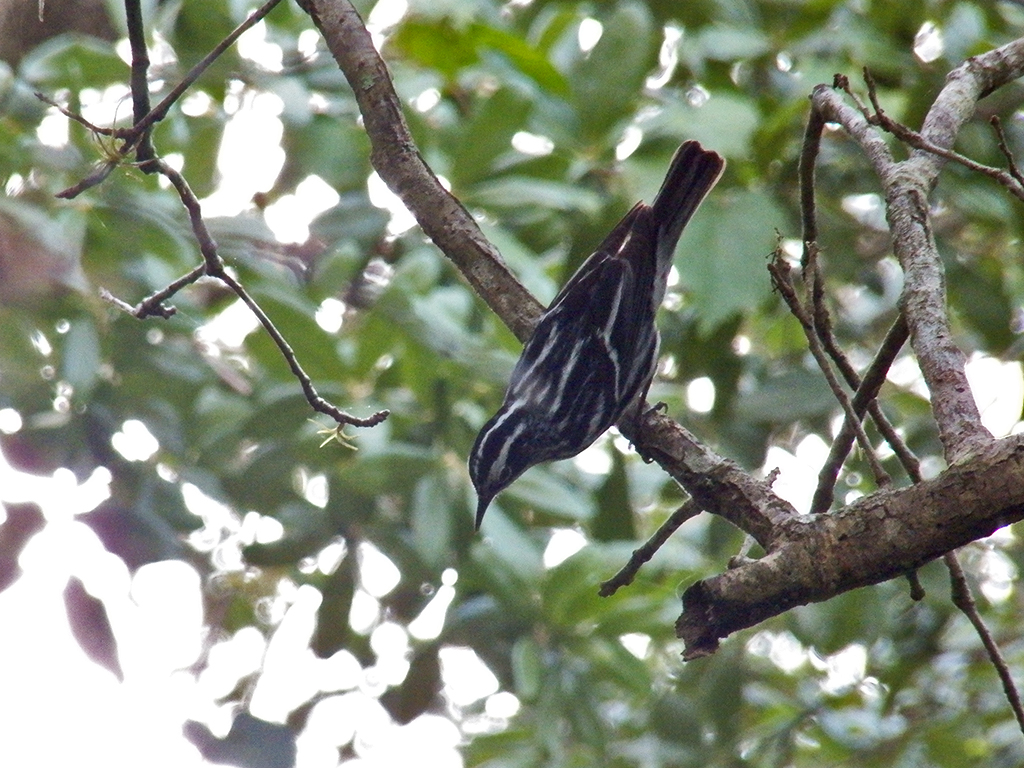
Aside from the usual Northern Cardinals and Carolina Wrens singing up a storm, we did encounter a decent sized, mixed flock of Black-and-white Warblers and Blackpoll Warblers, mostly high in the pine trees. Since different warbler species often associate with each other, we gave this group a really good look to make sure we weren’t missing any other species before moving on down the trail. The flock more-or-less followed us along the trail, but we didn’t see much else. I could hear Chimney Swifts above us, but never got a good look, and there were Blue-gray Gnatcatchers nearby as well.
We got to the boardwalk to an area where Camille (who had run into Bill Haddad last week) had seen some warblers, and is known to be a pretty good hot-spot. At first we didn’t see to much, but then we heard some gnatcatchers (often a preamble to warbler or vireo activity). Sure enough, we wound up with a nice group of Blackpolls, Black-and-Whites, American Redstarts, and even a Black-throated Blue Warbler!
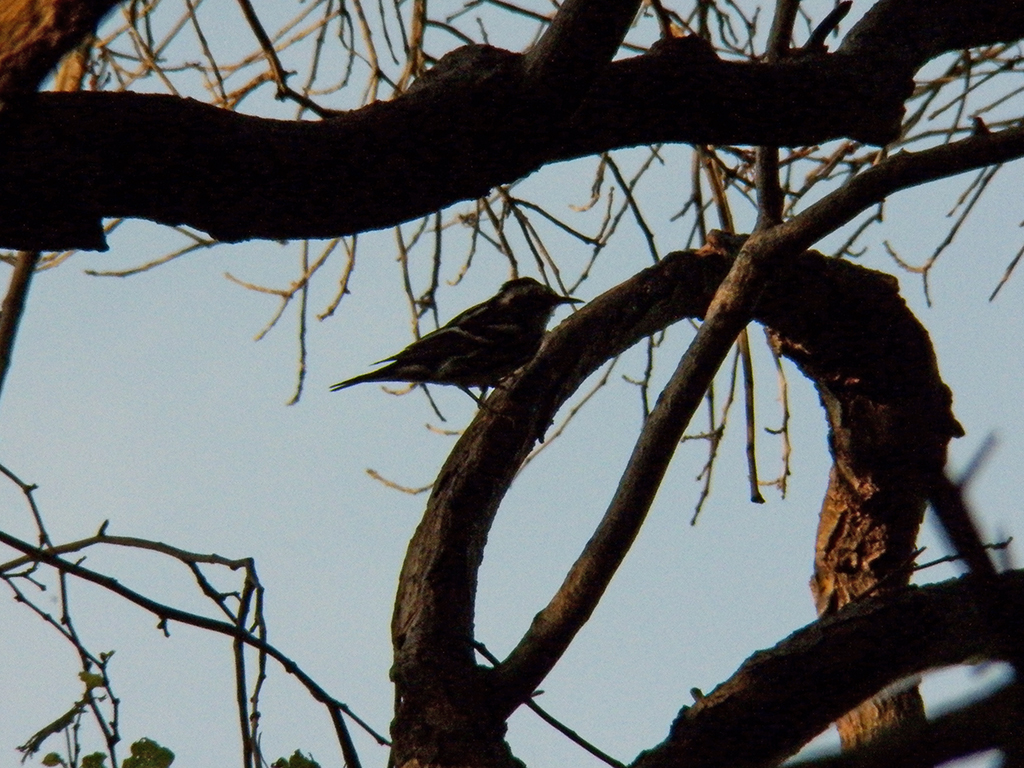
This Black-and-white Warbler was hanging around with some Blackpoll Warblers.
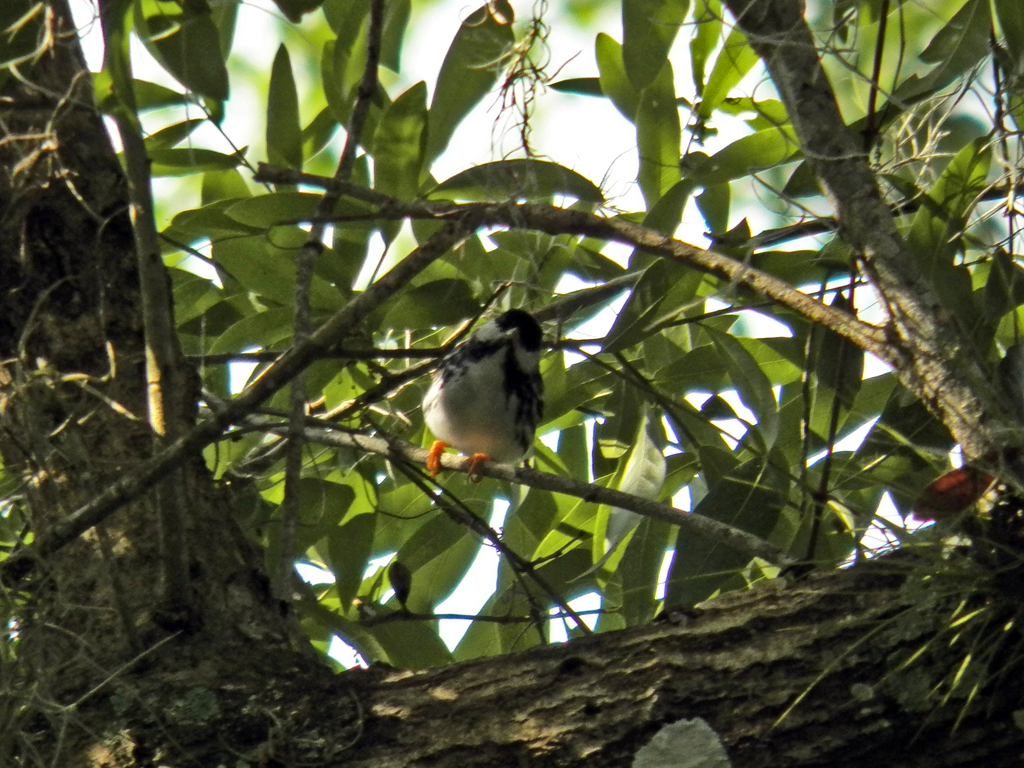
Sometimes it can be hard to distinguish the Blackpolls (especially the females) from some other species when the birds are in the canopy or in poor light (most of the birds we saw were very backlit). A key identifier for Blackpoll Warblers is their orange feet.
“He did tell you about the feet.”
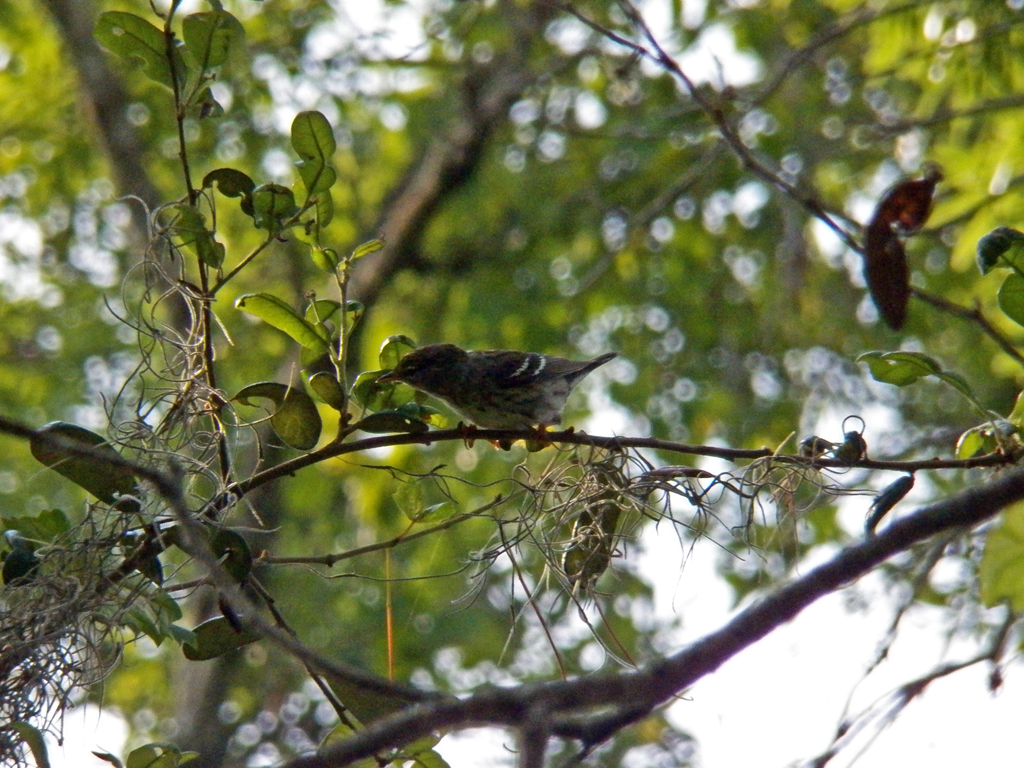
Female Blackpoll Warblers lack the dashing black cap (or “blackpoll”) of the male, but they have a pretty olive-yellow tint and subtle streaking. Again, those orange feet are a good field mark to differentiate the females from other, similarly colored birds.
Prominent wing-bars are also a great field-mark for Blackpolls.
Most of these birds were engaged in three types of foraging: creeping, gleaning, and flycatching. Creeping is when birds walk along the bark of a tree trunk or limb, grabbing small invertebrates as they move along. When birds hop or walk from branch to branch or on twing, reaching up or across to grab food, that is gleaning. Flycatching, of course, is what just what it says: the bird will dash out from a perch to grab a flying insect from mid-air, often performing stunning aerial acrobatics to do so.
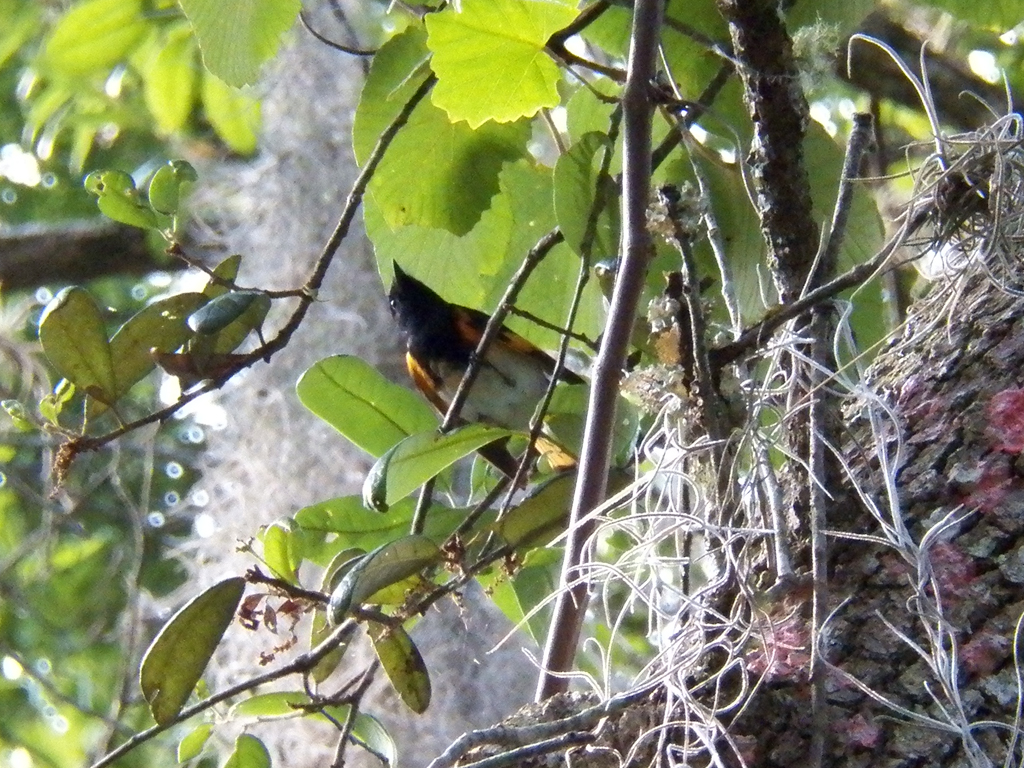
Along with our “monochromatic” friends (being mostly black and white), this flock of birds had a fair amount of American Redstarts among them. Redstarts are fun birds. The males are strikingly black and orange colored and they constantly flutter about, drooping their wings and fanning their tails. They will often drop off a branch and flit down, like a falling leaf, only to swoop back up and start again. The females are just as active as the males, though their colors are a little more muted (olive-brown and yellow).
Fast and furious, it’s hard to get a good shot of an American Redstart.
The overall effect of these three species moving through the canopy was one of almost dizzying chaos. It was hard to know where to center the eyes, binoculars, or camera. There was at least one Black-throated Blue Warbler among them, but it was hard to know if any more were in the melee of feathers.
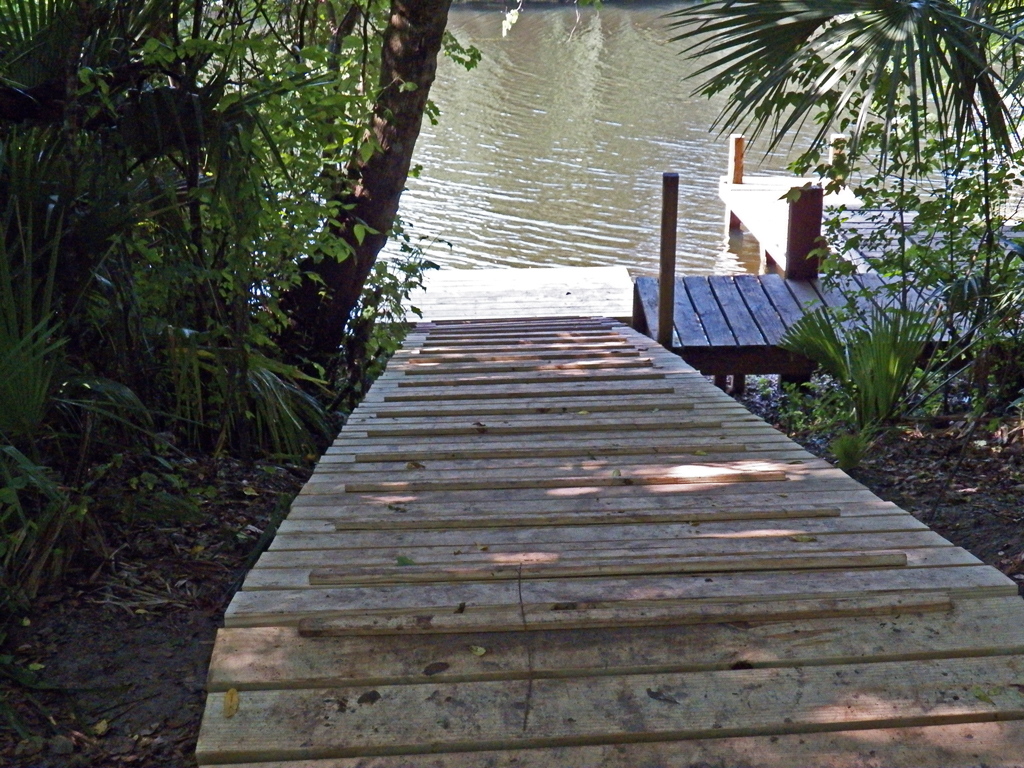
It was fairly quiet further along the boardwalk and onto McKinnon’s Way. We would hear some high-pitched calls here and there, but it was difficult to see much in the canopy. I got a glimpse of a Blue-gray Gnatcatcher, and we picked out a few more Blackpolls, but that was mostly it, until we got to the weir. First, I had a look at the “emergency” boat ramp. If you remember from last time at Turkey Creek, the high waters had likely removed the ramp’s deck (which was a bit rotted anyway). Repairs have been made, and there’s even a new platform at the base of the ramp.
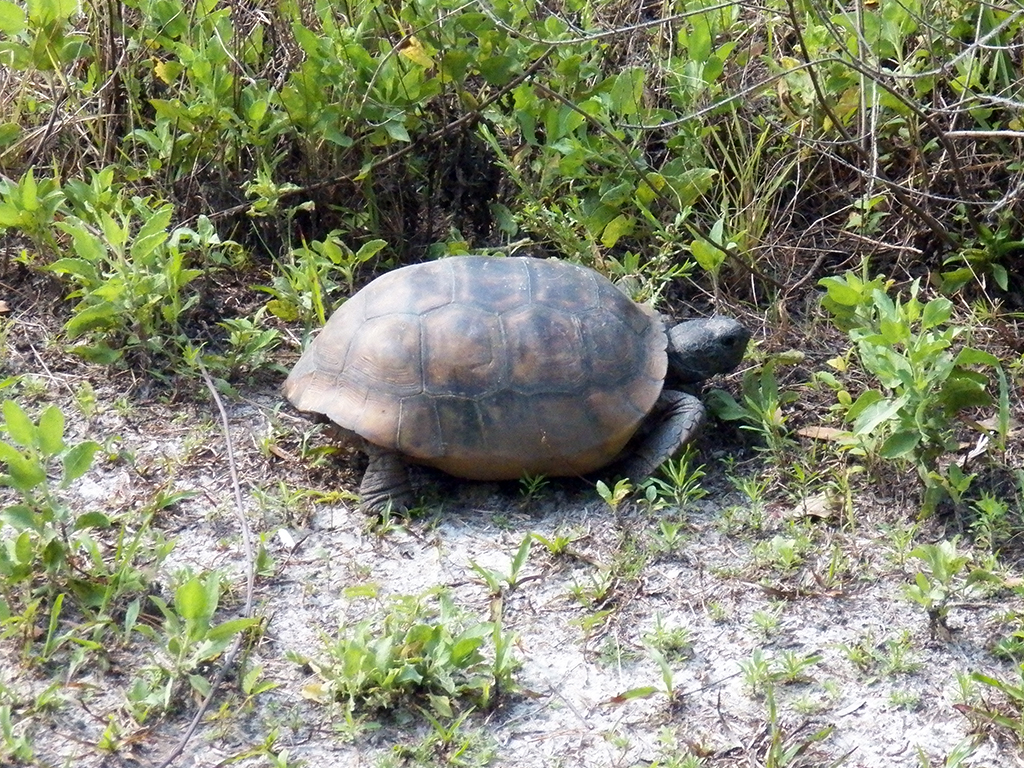
As we came out of the woods, we saw some movement along the trail up ahead. There was an overturned Gopher Tortoise! I quickly walked up and turned it upright. It didn’t hiss all that much and walked on its way.
It was a real topsy-turvey day for this tortoise!
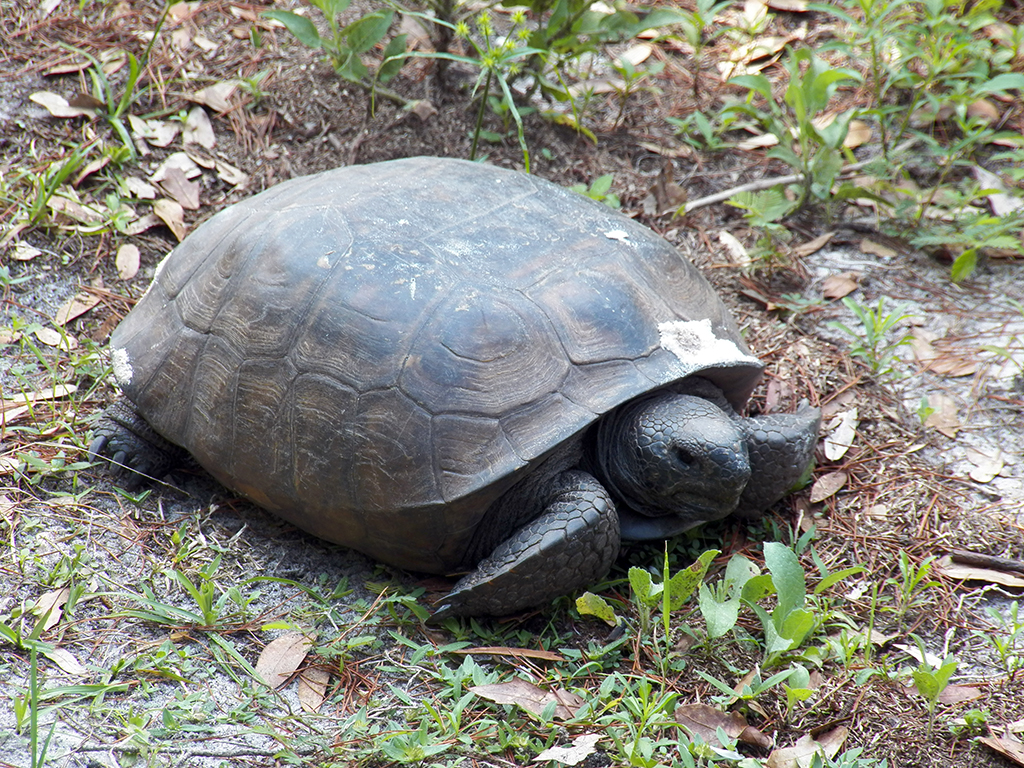
There was a larger tortoise further down the path, and Camille wondered if maybe they had a tussle or mating encounter that went awry (at least for the first turtle). I actually recognized the second tortoise from it’s shell markings and size, which was kind of cool.
This tortoise was much more grumpy and hissed a lot before lumbering on its way.
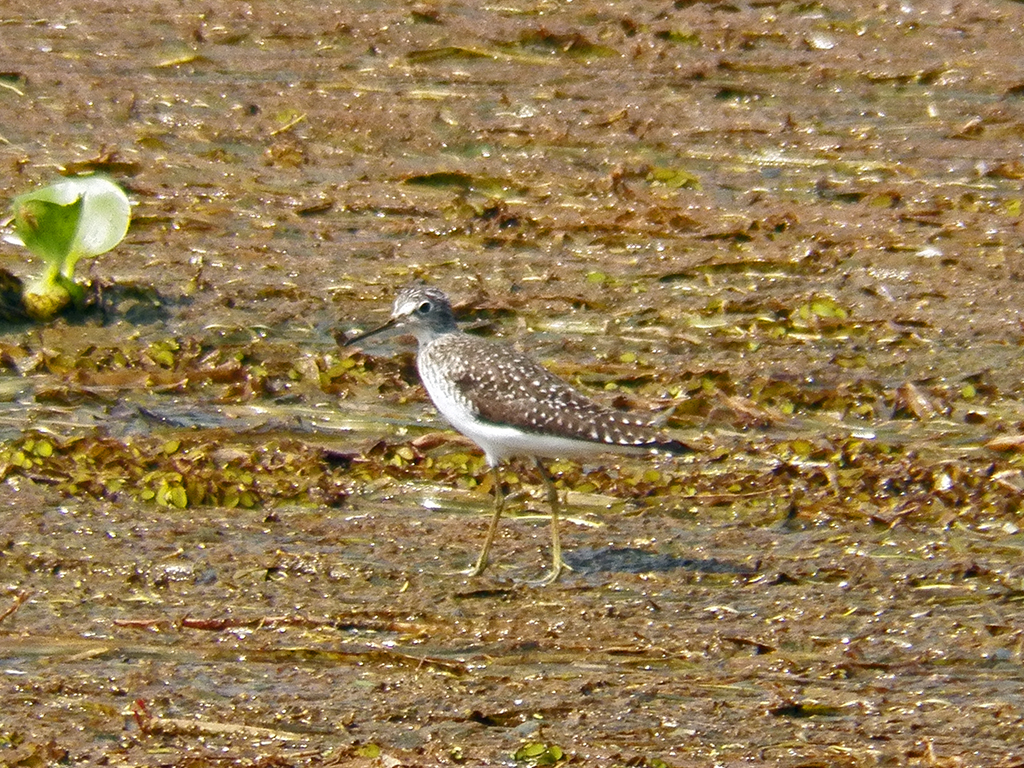
At the weir there were 2 spillways open, since the water was still somewhat low on the canal side. At first the area behind the orange float barrier seemed completely bird-free, but upon closer inspection there was a single Killdeer, one Green Heron, and then a lovely surprise. A pair of Solitary Sandpipers! This was another life bird for Camille, and a first of the year for me. I’ve actually encountered this species before, along the trail leading to McKinnon’s Way from the boardwalk. It was odd that they were so far into the wooded trail area, and i don’t know if this is the same pair or not.
One of two Solitary Sandpipers walking in the muck.
With the day wearing on and the heat climbing, it was about time to wrap things up. We walked back up the western side of the Sanctuary, past the Scrub Trail, to where there are sometimes Indigo Buntings or vireos, but it was really quiet. We had one more look at some Blackpoll Warblers before heading on toward the Picnic Pavilion and then out.
Overall, it wasn’t a bad day for birding, especially given there wasn’t any special fall-out event or anything. Clearly Blackpolls and redstarts dominated the Sanctuary this weekend. What we didn’t see in species variety was more than made up for in the numbers of warblers. Here’s the species list in no particular order:
Carolina Wren
Northern Cardinal
Black-and-white Warbler
Blackpoll Warbler
Northern Parula (♫)
Chimney Swift
Downy Woodpecker (♫)
Blue Jay (♫)
Black-throated Blue Warbler
American Redstart
Blue-gray Gnatcatcher
Fish Crow
Green Heron
Killdeer
Solitary Sandpiper
Red-bellied Woodpecker (♫)
Gray Catbird
The weather forecast calls for potential fall-out inducing conditions early this week, but not so much for the coming weekend, so we’ll see how that pans out.
[My apologies – this post is late and delayed due to a really bad head cold I am just now getting over]
In contrast to the morning at Meade Botanical Gardens, the second part of our day was a lot quieter. After some lunch at Einstein Bros. Bagels, we drove over to the Lake Berry Overlook. The boardwalk out to the overlook is in a very posh neighborhood, and just gawking at some of the homes could be a daily hobby. Our hope was to see a Red-headed Woodpecker that has been reported on eBird. The boardwalk traverses some nice transitional vegetation, and we could hear Northern Parulas and cardinals along its length. Toward the end there were several pairs of Red-bellied Woodpeckers, and we manged to glimpse three male Wood Ducks through the swampy trees and brush. At least one Red-shouldered Hawk flew nearby, as well as a raptor we didn’t quite get a good enough look at. It seemed to lack most of the obvious field marks for a Red-shouldered Hawk, but nothing definitive. Unfortunately, the Red-headed Woodpecker did not appear, though we heard some encouraging call notes. On the way back out near the boardwalk entrance some Chimney Swifts flew overhead, the first I’ve seen this year.
We continued on to the Harry P. Leu Gardens to try our luck there. Leu Gardens, as I’ve said, is more formal and organized that Meade. It has a membership structure and entrance fees to help pay for its upkeep and events. People often hold weddings and other formal affairs there. There are more exotic plants, with many paved paths. This was all very beautiful, but either a combination of the non-native vegetation and the heat, or just luck of the draw, we didn’t see much in the way of birds (and certainly warblers).
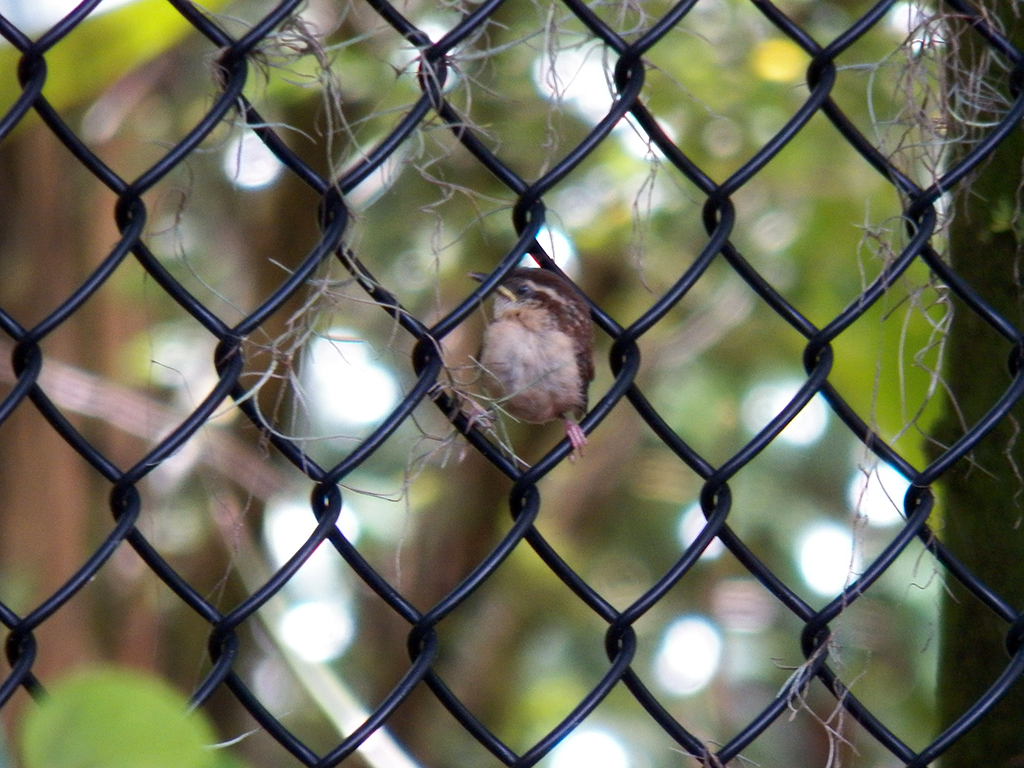
We did see some activity along the chain-link fence by the parking lot. At first I thought they were Worm-eating Warblers, but a closer look was cuter!
Baby Carolina Wren! The fence spacing here is much smaller than a standard chain-link fence, so this bird was small.
Apart from that, we did see a few larger birds, like crows, Anhingas and even an Osprey. We tracked a Northern Parula through the canopy for a while before getting any sort of decent look. Otherwise, despite the beautiful surroundings, we were getting tired.
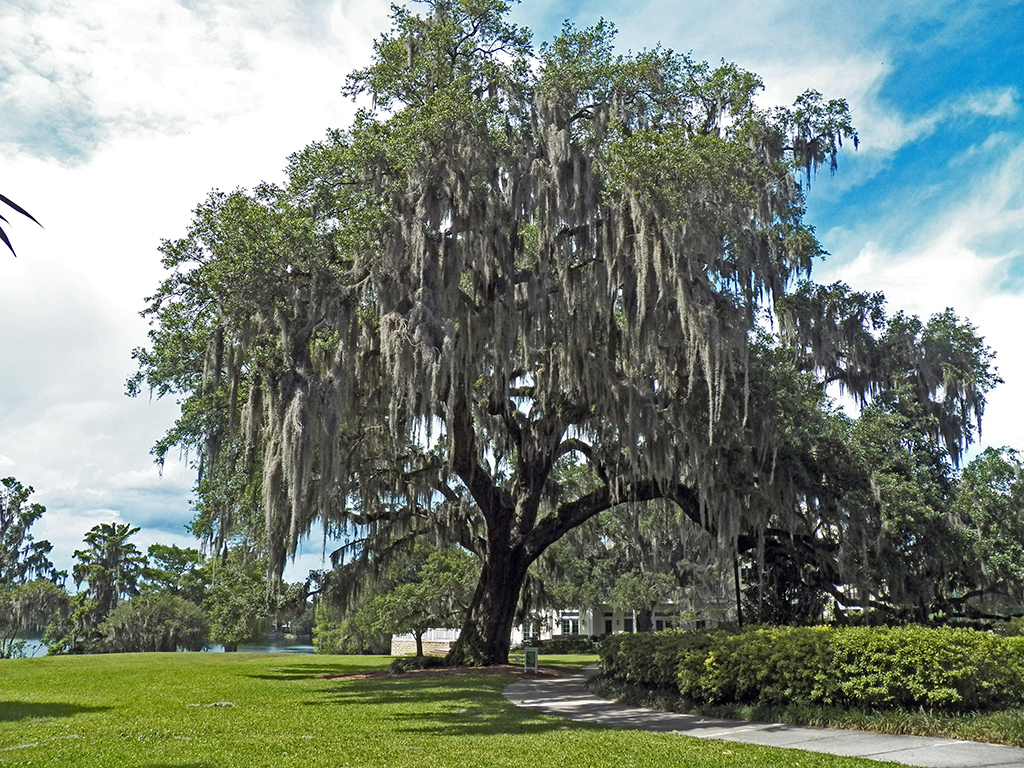
Marvelous oak tree with Spanish Moss.
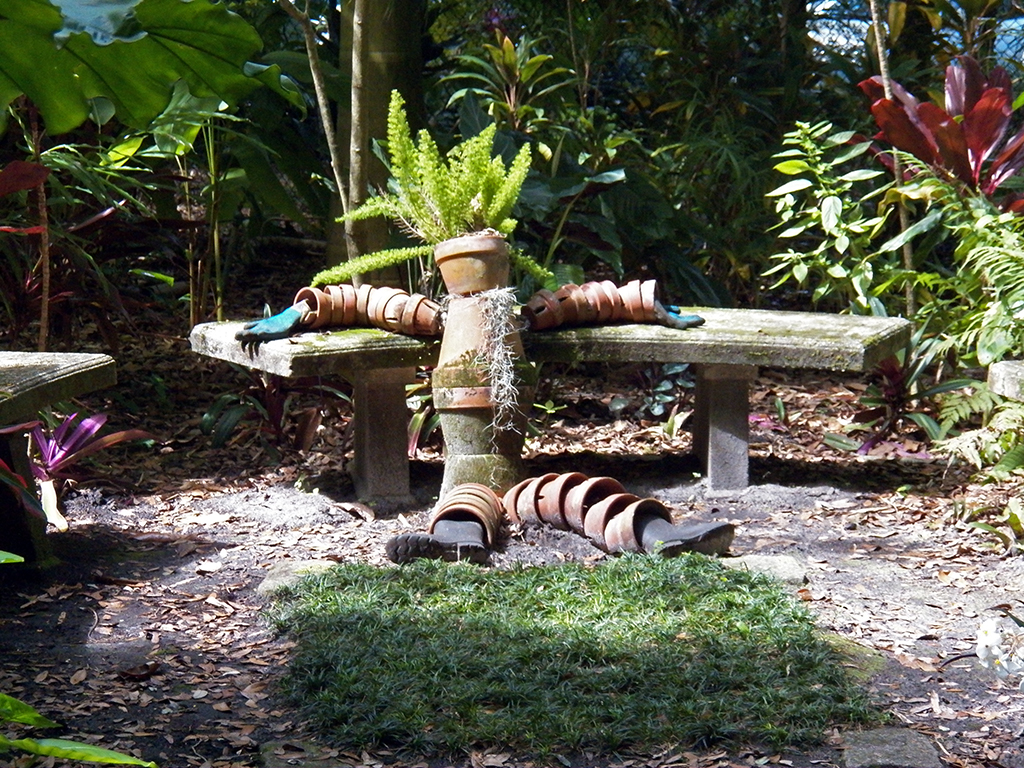
There were a few more whimsical garden areas, too. This “pot head” was definitely a work of art, with some butterflies nearby and Blue-gray Gnatcatchers singing in the trees above.
“What’re you doin’, man?” “Just chillin’, dude.” “Yah..”
And that was our day out at Winter Park. For any “score keepers” out there, we can round out our afternoon species list:
Red-bellied Woodpecker (Lake Berry Overlook)
Northern Parula (♫ LBO)
Red-shouldered Hawk (LBO)
Wood Duck (LBO)
Chimney Swift (LBO)
Carolina Wren
Blue-gray Gnatcatcher
Blue Jay
Fish Crow
Northern Parula
Osprey
Anhinga
Northern Mockingbird
Black Vulture
Turkey Vulture
My apologies for the delay in getting this out. Spring head colds are the worst!
Hello, Lonely Birder Blog Fans! My apologies for the lack of updates (especially after Part 1 of my Winter Park adventures with Camille), but I’ve been sick since Thursday. I hope to get caught up this week.
Let’s face it, it’s been a very slow early migration season in east central Florida. If the past two years give any indication, it’s to expect another hit-or-miss month of April. During Easter week my friend and newly minted birder, Camille discussed alternatives to get some of her first migrating warblers and other birds this spring, since some of my usual haunts and both of our other endeavors have not really gotten us a very good sampling of birds that should be passing through the state on their way northward. We hit upon doing some urban birding around Orlando.
Winter Park has a number of different parks and gardens, so we chose two: Meade Botanical Gardens and the Harry P. Leu Gardens. Meade is a little more native and informal, while Leu is a little more formal. We had read via eBird and the mailing lists that some migrants had been seen in and around both parks, and that Meade Gardens had a resident Barred Owl as well as Wood Ducks. Camille loves owls, so getting a nice daytime owl was high on our list. On our way toward the reported owl location, we had luck with some good views of the typical winter residents: Carolina Wrens, Northern Cardinals, Northern Parulas, and others. The Carolina Wrens were not shy at all at the southern end of the gardens.
While April is normally the month for lots of migratory birds to pass through the area on their way to their breeding grounds, the year-round residents are busy making house right here.
Mixed in with the Carolina Wrens were several House Wrens, singing their perky and bubbly songs.
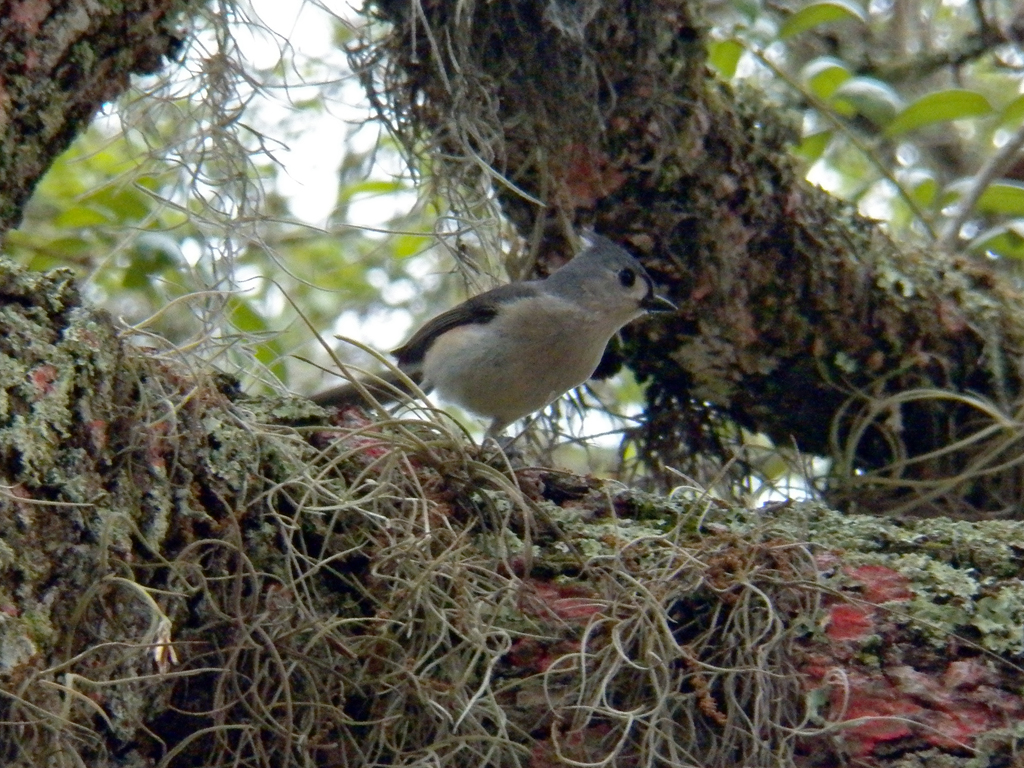
We also heard and saw a fair number of Tufted Titmouses. There are a few mated pairs using birdhouses with chicks present (at least based on the peeping we could hear within).
Titmouses share their chickadee cousins’ acrobatic antics. This one barely stopped long enough for a photo-op.
We were not having much luck finding any owls, but we heard at least one calling to our north, perhaps out of the park. We followed the sound to a creek, but we saw that across the creek was someone’s house and there was no apparent way to cross it. Then I heard a faint, low, “coo” and asked out loud, “What the heck is that?” and looked at an oak limb just above Camille’s head.
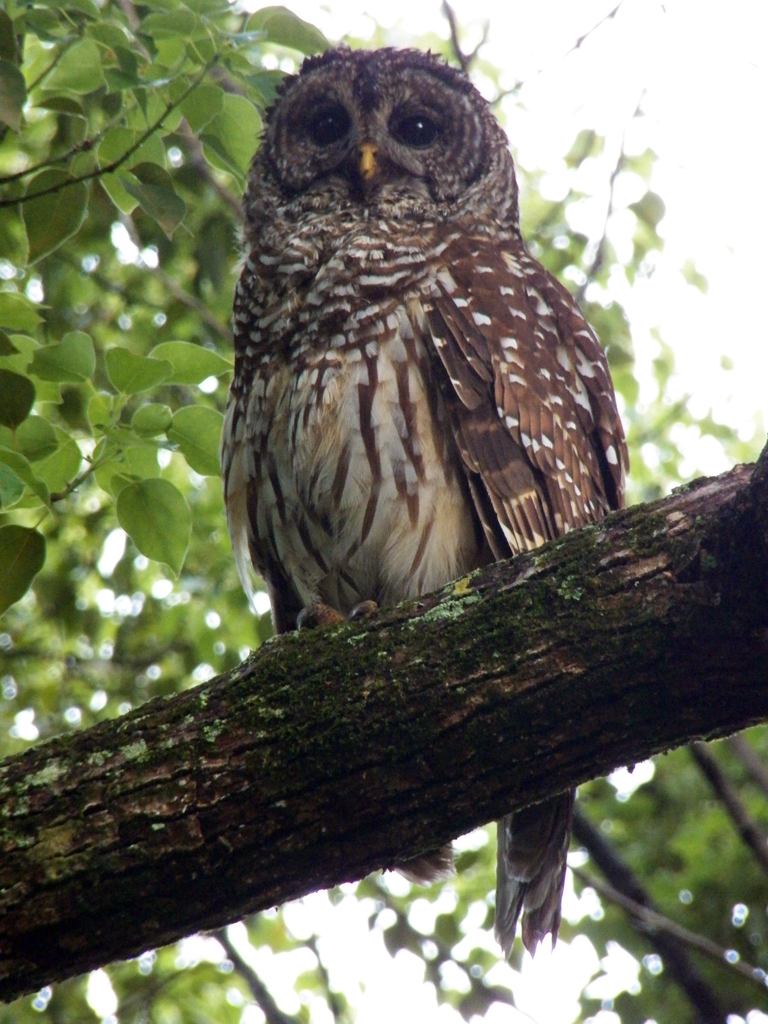
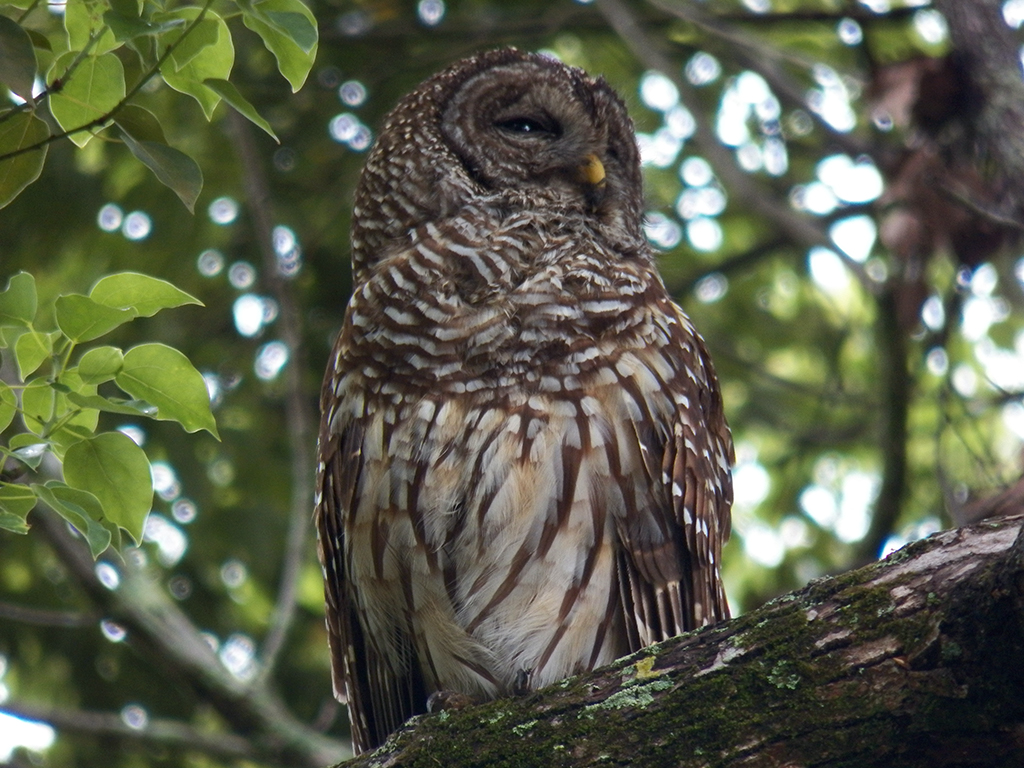
Who’s that cooking up a beautiful pose?
A VERY patient Barred Owl was perched about ten feet up, looking around and not at all ruffled by our presence. We found out later that this was the female of a mated pair that has two youngsters nearby. We did heard what was presumably the male further out, We both took a large number of photographs before reluctantly moving on through the gardens.
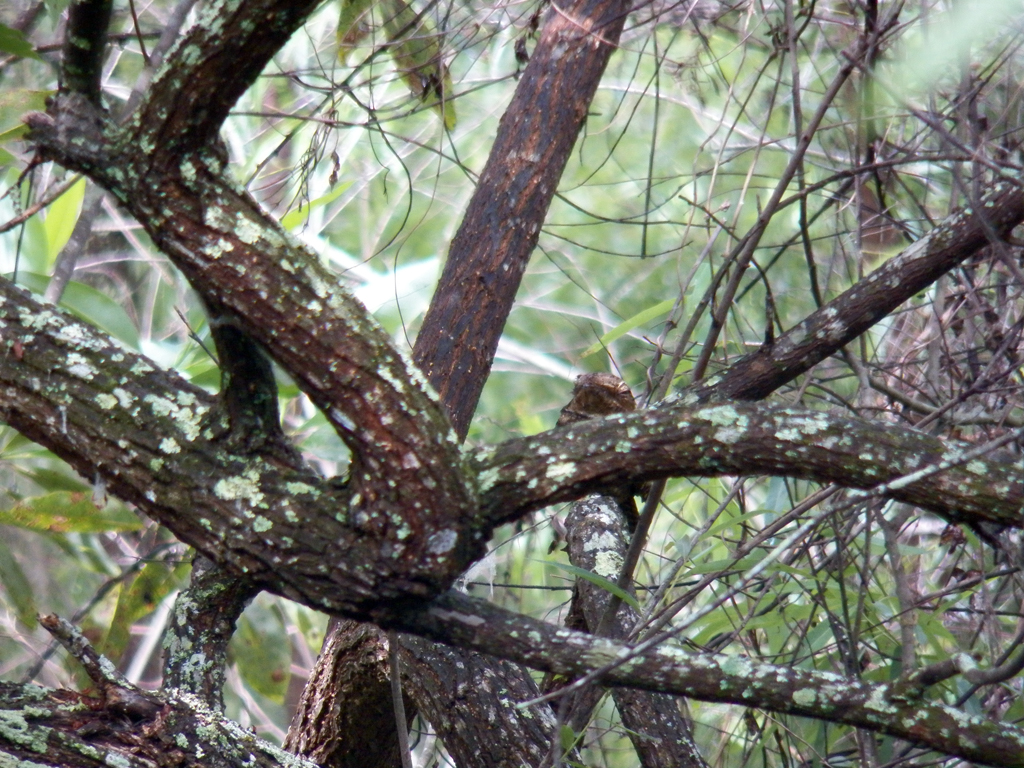
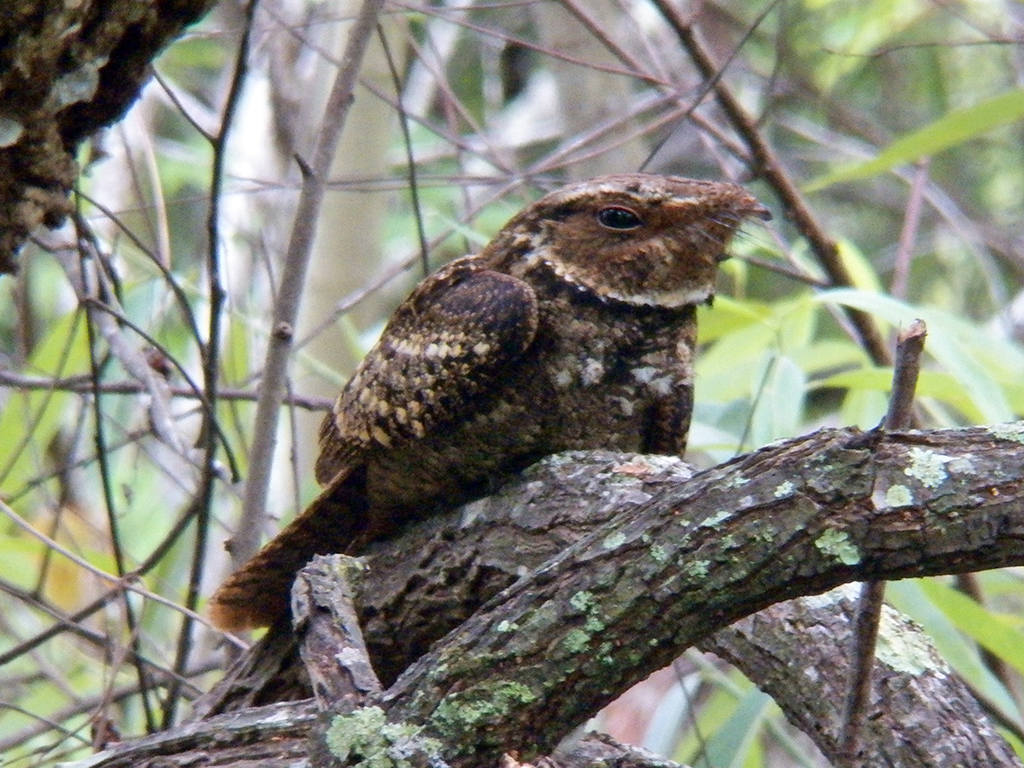
We started passing some other birders along the trails, and one man asked if we had seen the “Chuck” yet. I wasn’t sure what he was asking, but it turns out a larger group of birders had flushed a bird and were very carefully stalking it and trying to avoid spooking it again. Here’s a shot from the first set of photographs I took. Can you see what the fuss was all about?
Where’s Chuck?
Do you see it? No? Just right of center, that slightly warmer brown “knob” is, in fact, a Chuck-will’s-widow. Chucks are members of the nightjar family, which includes Whip-poor-wills and Common Nighthawks (among others). Locally common, Chucks are normally a bit hard to find. They blend in with branches and leaves (as you can see), and prefer to stay motionless to fleeing. But if you get too close, it will quickly fly through the woods to another spot and take another cryptic pose. This was a life bird for me!
We managed to get some side looks at the bird along the boardwalk as we continued, staying with the birding group for a while. Camille saw and identified a Swamp Sparrow (despite my best attempts at derailing her – she had a better view than I did!), and before the other birders IDed it. toward the end of the boardwalk, we heard some Gray Catbirds singing along with what sounded like a Painted Bunting. The catbirds did eventually show themselves a bit, but the buntings did not.
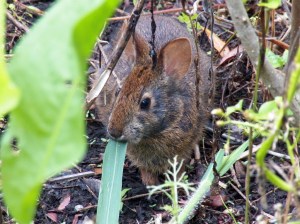
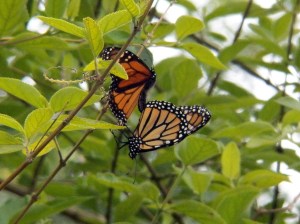
Along the same section of boardwalk, we saw some non-avian friends, including a Florida Box Turtle and a Marsh Rabbit. Near some flower gardens, we got to see a mated pair of Monarch butterflies flying together, along with other butterflies.
Florida Box Turtle high-tailing it out of sight.
Marsh Rabbit crunching on a leaf.
Spring is in the air for Monarchs
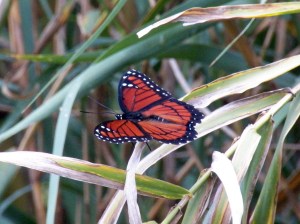
Viceroy (a Monarch mimic) having a rest.
Camille and I decided to track back through the boardwalk to get another look at the Chuck-will’s-widow and eventually get back to the Barred Owl. On the way past the second viewing spot for the Chuck, we bumped into none other than Reinhard Geisler. We last saw Reinhard at the Orlando Wetlands, where he helpfully gave us a park map before shooing us out the door from his photography workshop. He was with a small group taking some photographs of the bird from the boardwalk. I asked if he had taken any “good shots” and he laughed and said, “depends on your definition of good.” The bird was in a tough spot to photograph from that vantage point. Camille and I decided to go down a path past the limb the Chuck was sitting on to both get a better photo, and to see more of the gardens. I went back and asked if everyone in the group with Reinhard had gotten a good look, because we intended to pass close to the bird, and we didn’t want anyone to miss out if it should flush and fly away. It seemed as if everyone agreed, so Camille and I proceeded. I managed to get a couple of decent close shots before the bird did indeed fly off to a new spot.
Hey, Chuck! Here, you can more clearly see the dead leaf and bark pattern typical of nightjars. They’ll often rest with their eyes almost completely closed. This bird was actually fairly alert and observant. It fled before we got much closer. Sorry Reinhard, I hope you got your best photos.
We eventually caught up to the larger group of birders, and then we all made our way back to the Barred Owl, which was sitting in the same place, though looking somewhat sleepy.
It was well past this owl’s bedtime.
Further out on the creek, there was a pair of Wood Ducks, one male and one female. A Great Blue Heron was resting one one foot nearby. Shortly they were joined by a Great Egret that landed even closer to us and nervously stalked the creek among the cypress knees.
Male Wood Duck.
Typical heron resting pose.
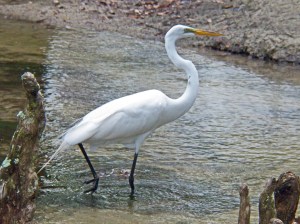
What a great egret.
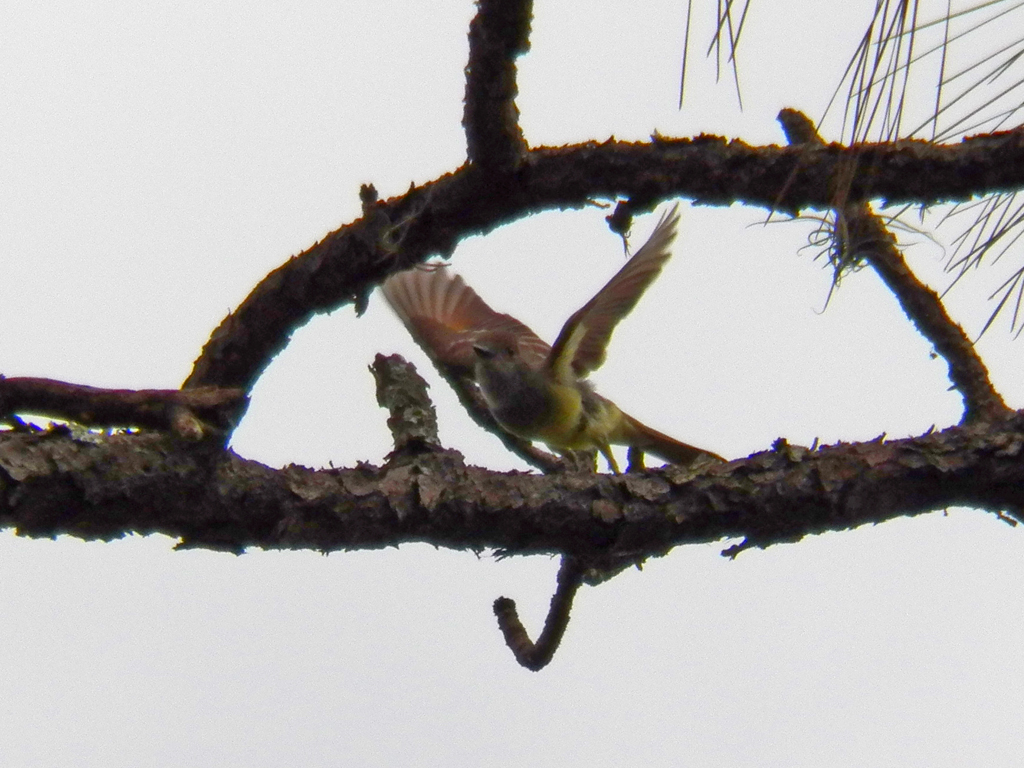
To this point we still hadn’t seen any migrating warblers, though other birds were active and present. Back at the parking area we saw more Tufted Titmouses, a Palm Warbler, at least one Prairie Warbler and a Black-and-white Warbler. There were more Carolina and House wrens singing, as well as the ever present Northern Cardinals. I kept hearing Great Crested Flycatchers all morning, but it wasn’t until we were back at the parking lot getting ready to head out that I finally saw one. Despite all the vocal presence at work, in my backyard and in various area parks, I finally got my first visual confirmation of a Great Crested Flycatcher at Meade Gardens.
Great Crested Flycatcher taking flight.
Not far from the parking lot is an area called “the clay pits” that led down to more water and some marshy ground. I could hear Painted Buntings down in the nearby brush, so I descended into one of the pits trying to get a closer look. I finally managed to flush a pair of buntings, just catching a blur of the red, blue and green colors of a male Painted Bunting before they flew out over the gardens and out of sight.
We had one last surprise before we left. Suddenly, right in front of us, an outburst of angry tweets and chittering came from one of the larger trees. Two Great Crested Flycatchers whirled into view, feet locked, spiralling down to the ground in a mini tornado of wings. They actually hit the ground before disengaging and flying off, calling out to each other.
Here’s the list for Meade Gardens, mostly in order:
Mourning Dove
Northern Cardinal
Northern Parula
Red-bellied Woodpecker
Carolina Wren
House Wren
Common Grackle
Tufted Titmouse
Red-shouldered Hawk
Barred Owl
American Crow
Downy Woodpecker (♫)
Mallard
Fish Crow
Red-winged Blackbird
Chuck-will’s-widow (life)
Swamp Sparrow
Gray Catbird
Blue Jay
Northern Mockingbird
Wood Duck
Great Blue Heron
Great Egret
Blue-gray Gnatcatcher
Palm Warbler
Prairie Warbler
Pileated Woodpecker (♫)
Black-and-white Warbler
Great Crested Flycatcher
Painted Bunting
Our next and ultimate destination was the Harry P. Leu Gardens, but we first got a bit of lunch and decided to detour to nearby Lake Berry Overlook. A Red-headed Woodpecker has been reported there, and we thought it worth our while to check it out. One of the birders we bumped into earlier was also getting lunch and casually mentioned they saw a single Cape May Warbler in the parking area, but we had yet to see any migrating warblers. We hoped our luck would be better at Leu Gardens. We’ll pick up the story in Part 2.
I decided to go to Turkey Creek Sanctuary this weekend, as it had been a while since I last checked in. The area had some weather move through that made me hopeful some early migrants had made a pit stop overnight.
Hope springs eternal, as the saying goes. It turned out to be another eerily quiet morning for the majority of the sanctuary. There were pockets of Northern Cardinals and the winter residents are still hanging on, though their numbers are much lower. Any activity was in widely spaced pockets, with only a few individual birds.
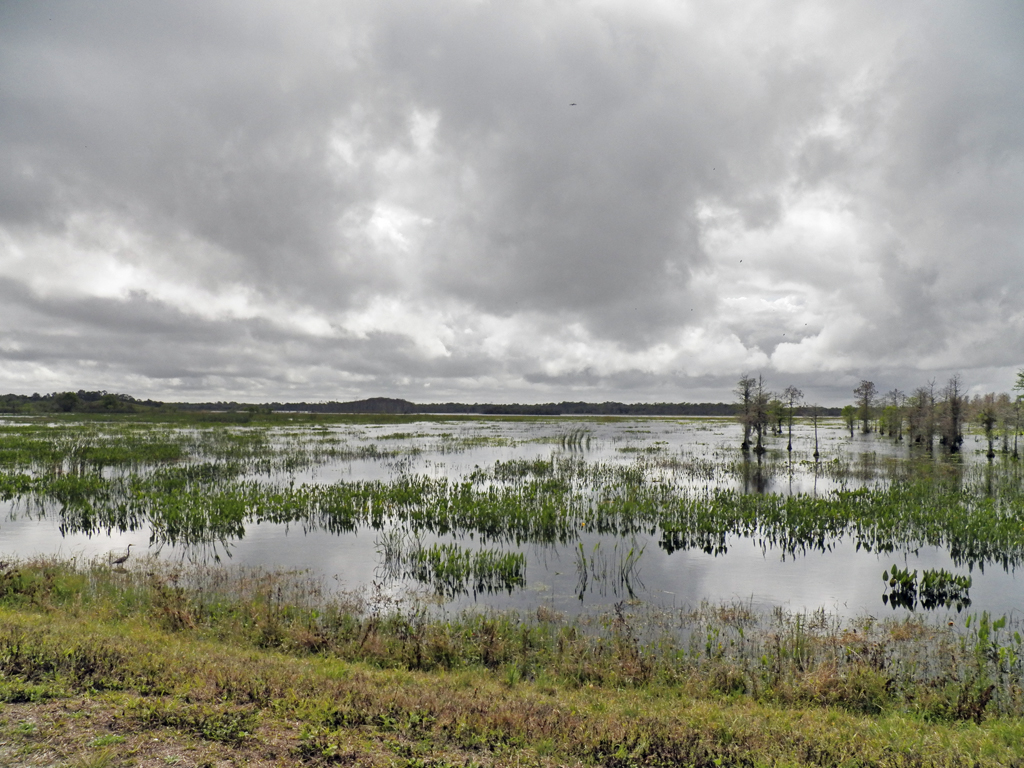
Some typical Turkey Creek Sanctuary habitat.
Besides the cardinals, I encountered a couple of Gray Catbirds in the Saw Palmetto along the boardwalk loop and I could hear Northern Parulas up in the canopy. I also came upon small bands of Prairie Warblers both on the boardwalk loop and later, along the Sand Pine Trail.
I heard Yellow Warblers and Blue-headed Vireos together as I approached the canoe deck. It’s been a mild source of frustration for me that for a few years in a row, in the same general location, I can hear Yellow Warblers high in the canopy but have been unable to get any decent binocular views, to say nothing of photographs. Some patient watching did get me some good looks at the vireos singing and hopping below the canopy, though.
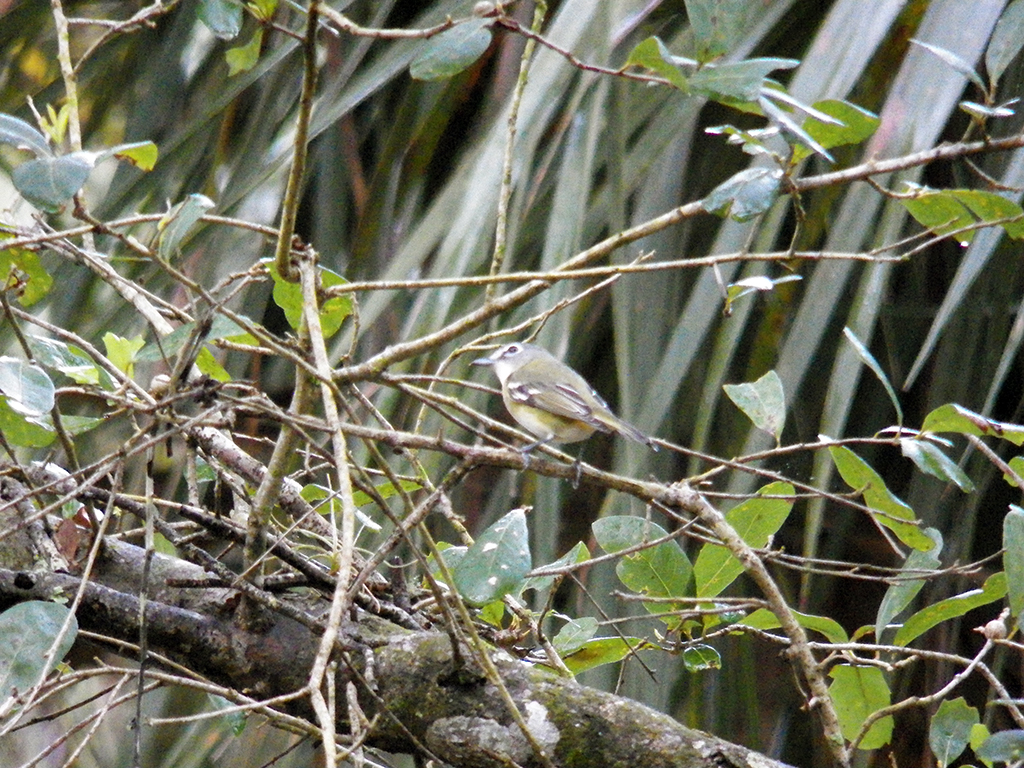
The Blue-headed Vireo’s song is a bright, “Cheerio! See you later!” (at least that’s how I hear it). True enough, this is the last view I had of it before it moved out of view.
I saw almost no birds at all along the creek overlook boardwalk (though there were quite a few Northern Parulas singing). I spooked an Osprey down by the boardwalk on the Flood Plain Trail, but otherwise there were no birds present there either. I met up with an out-of-state couple who were visiting the sanctuary for the day. They asked me if I had seen “anything good,” and I had to admit it was seriously quiet. They had heard that the sanctuary was a decent place for spring migrants. I explained that it was probably still a bit early for most of the migrants, but that also the sanctuary has been very quiet for a couple of years now, even during migration seasons. But, as I told them, you never know what you might see on any given day.
I had two surprises on the Sand Pine Trail which would later come to cause me some small embarrassment. First, somewhere near the mid-point of the trail I heard some distinct whistling notes close by. I knew the birds had to be very near, but I was not detecting any movement. I noted, in the back of my mind, that further up the trail I could hear something that sounded somewhat vireo-like as well, but I was trying to focus on the birds at hand (or at ear, I guess). Finally, after trouncing back and forth on the trail trying to get a good vantage point I saw movement and got a look at a brown warbler skulking in the mid-story, and then another nearby. Based on the facial pattern and overall shape (and later confirmed when I played the bird’s song) I identified the bird as my first of year (FOY) Swainson’s Warbler. How exciting! A spring migrant after all! I took a few photographs that I thought would be pretty decent and clear enough to convince the (at times) über-skeptical e-mail lists that I had indeed seen Swainson’s Warblers. This would come back to haunt me.
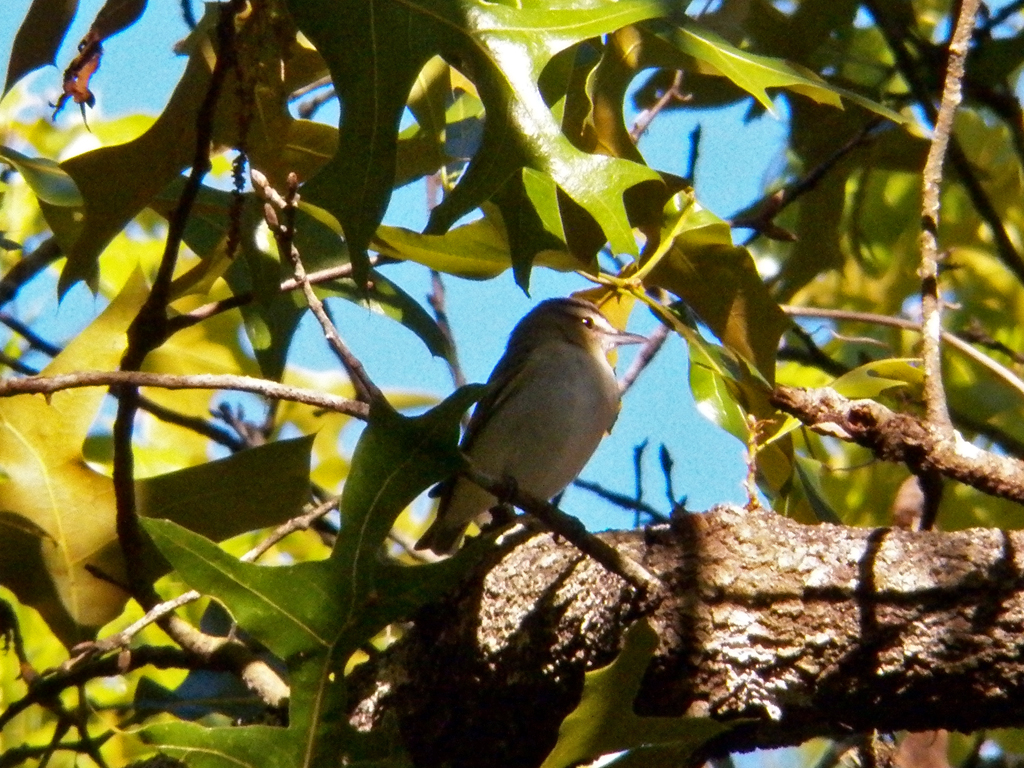
I walked further up the trail, and again heard the vireo song, but much closer. About 10 or 12 feet up in some of the smaller trees I saw two Red-eyed Vireos. One of them let me get some great binocular views before moving off a bit. The light and shadow through the trees made the photographs a bit tough, but I got some good shots, including this one.
Red-eyed Vireo
At this point I did not realize that my Swainson’s Warbler photographs did not properly write to my camera’s memory card. Later that afternoon I went to post to BRDBRAIN and FLORIDABIRDS-L that I had seen FOY/FOS Swainson’s Warblers, and only quickly looked at what photographs I had pulled form the card, I attached this vireo photograph! As you can imagine, I received some properly amused replies that I had actually seen a Red-eyed Vireo, not a Swainson’s Warbler. You can imagine my dismay as I checked and sure enough, in my excitement I had posted the wrong photo. I had not realized I had no Swainson’s Warbler pictures! I quickly posted another message to the e-mail lists explaining my error, but I am sure it’s already added to the body of lore I’ve managed to accumulate there (to examples: I once jumped the gun that a winter American Goldfinch was a Snow Bunting, and my hearing two Carolina Chickadees at Erna Nixon Park was roundly scoffed at by a couple of list members).
This isn’t the first time my camera (or the memory card) has failed me like this. Since my trip to Minnesota the camera hasn’t been right. Whether or not it was due to the cold, or just a coincidence, I seem to lose some pictures and the controls react more sluggishly than they used to.
I heard more Prairie Warblers on the Sand Pine Trail, but had my best photo opportunity interrupted by a loud, if well meaning family. I couldn’t stay too angry about it, since the kids were genuinely interested in nature and the wildlife they might see. They weren’t being obnoxious, and the parents were encouraging this in them. I also reminded myself that the bird photographs are icing on the cake. It’s great just to be out and see these magnificent creatures.
As a last minute decision, I went down to McKinnon’s Way and then over to the weir and canal, but there wasn’t much happening there either.
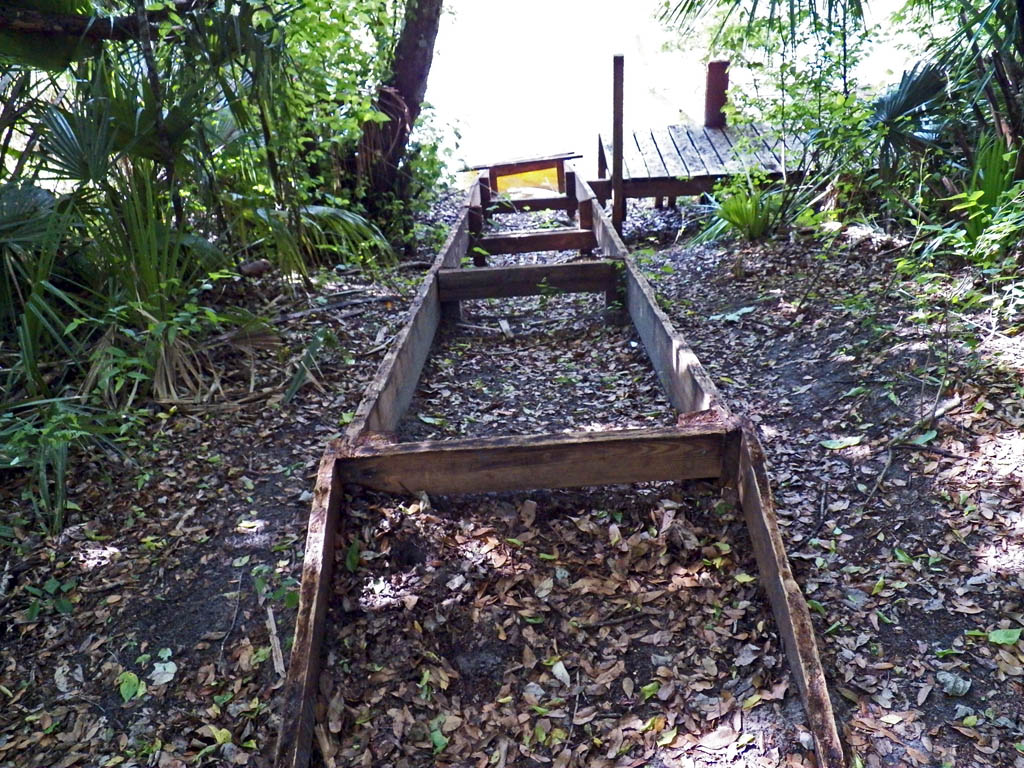
The boat ramp has yellow caution tape at the entrance to the path leading to it. I peered around it and saw that the decking had been removed. I don’t know if this was from the minor flooding a few months back or from the planks being removed for repair (the wood seemed to be a bit rotted from what I could tell). The creek level is down to normal now, and the lower and newer parts of the ramp’s deck seem fine, if a little more crooked.
Remnants of the “emergency” boat ramp.
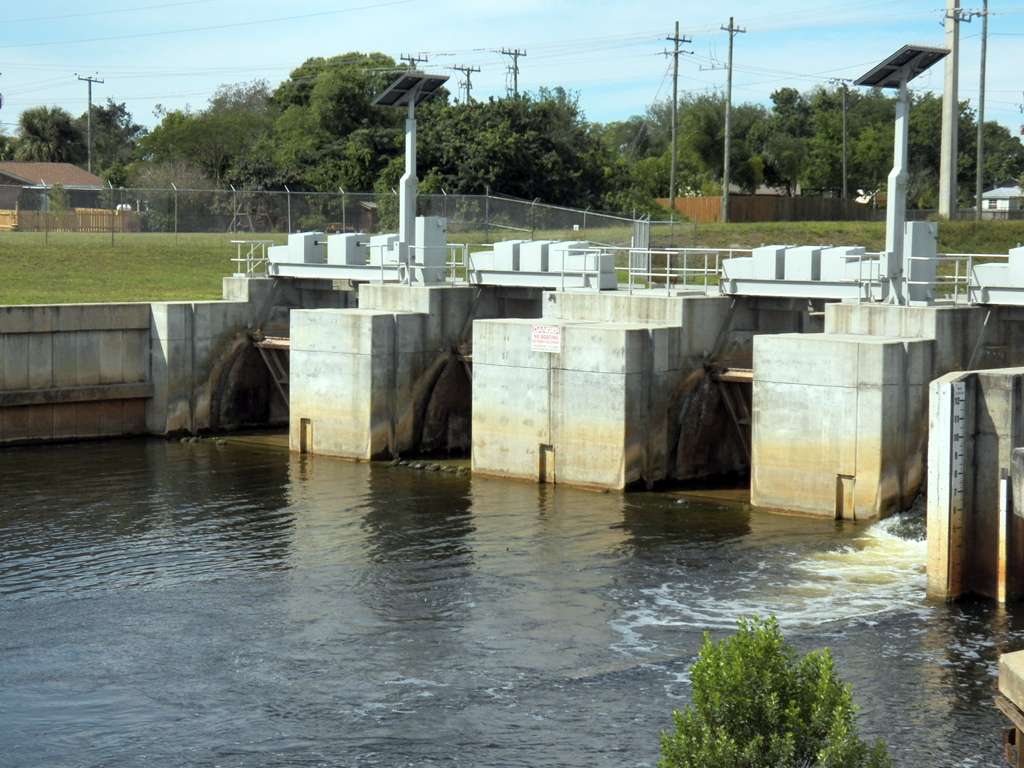
At the canal and weir there was one Little Blue Heron and one Cattle Egret. The canal level was surprisingly low. We’ve had a relatively wet winter and early spring, but the past few weeks have seen some above normal temperatures with little rain. This must have been enough to drop the water level down quite a bit. Even the heavy showers from previous days must not have made much of an impression. Only one discharge was open on the weir, and there were turtles stacked up at the edge of the others, taking advantage of some prime basking real estate.
Turtles bask along the discharge openings of the weir at the Melboune-Tillman Canal and Turkey Creek.
The low discharge can be explained better by looking at the next two photographs, showing how low the canal level is.
The canal bottom is starting to get exposed.
The floating barrier is resting on the bottom now.
I stirred up some more cardinals on my way back toward the sanctuary entrance, but saw little else in the way of bird life. I saw one Black Racer (a snake species), which quickly slid away from me before I could even get my camera up to take its picture, and of course the lizards are ever prevalent.
Here’s the total species list. Except for the Prairie Warblers, most of these were single or pairs of birds, widely spaced apart throughout the sanctuary.
Common Grackle
Mourning Dove
Eurasian Collared Dove
Osprey
Northern Mockingbird
European Starling
Carolina Wren
Northern Parula (♫)
Northern Cardinal
Gray Catbird
Red-bellied Woodpecker
Fish Crow
Prairie Warbler
Great Blue Heron
Blue-gray Gnatcatcher (♫)
Purple Martin
White-eyed Vireo
Red-eyed Vireo
Swainson’s Warbler
Blue Jay
Yellow Warbler (♫)
Blue-headed Vireo
Little Blue Heron
Cattle Egret
The lack of bird life here and in many other parks is perplexing. Certainly the amount of insect and reptile life seems to be about the same, and the plants (apart from some more invasive species than a few years ago) seem healthy. There are still very large gar in the creek, and the manatees come upstream as they always have. But something is affecting the birds’ ability or willingness to stop and stay at many of the areas they used to frequent. Last year Shirley Hills told me that it was the quietest year to her recollection, and she had been birding Turkey Creek for decades. I really hope things pick up in April, as the main body of spring migrants make their way through. The birds have either found better places to stop or are vastly reduced in numbers. How much of that would be part of normal population fluctuations and how much from something we ought to be alarmed about isn’t something I am able to know as yet.
Spring migrant season is nearly upon us, though the eBird and mailing-list reports are still dominated by winter residents here along the Space Coast. I hadn’t been to Lori Wilson Park in a while, so I put a quick plan together with Camille to have a look there and then Jetty Park (where I have not been until now).
I wish we’d see some cool birds!
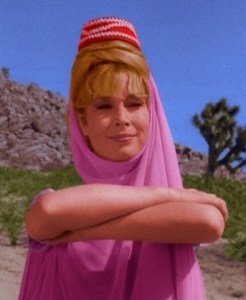
Lori Wilson Park is a small hammock near the beach along A1A in Cocoa Beach. The access road to the park and the adjacent beach is called “I Dream of Jeannie Lane,” since that’s where astronaut Captain (later Major) Nelson finds Jeannie’s bottle and rescues her, becoming her master in the 1960s TV series.
The park provides a nice little break from the tourist trap restaurants and entertainment and the well-used beaches. We came across a group of birders watching a Black-and-white Warbler at the start of the boardwalk. Phyllis Mansfield leads a birding walk there a couple of times a month, so I think that was her group. Phyllis is also fairly prolific on eBird and the FLORIDABIRD-L and BRDBRAIN listservs.
The group was about to move on, so Camille and I (in true Lonely Birder style) stayed and watched the bird forage in the dense foliage while a couple of Fish Crows hung around the small drip-pool that’s set up to attract birds. The sun angle was still fairly low and the bird was in some dense vegetation, but sometimes odd lighting makes for some interesting photographs.
“Listen to the wind blow, watch the sun rise. Run in the shadows…”
We then slowly made our way around the boardwalk, but it was very quiet. I did catch a very quick glimpse of an Ovenbird and there were Gray Catbirds in greater numbers. We also saw some Northern Cardinals, but for the most part the park had little bird activity and was eerily quiet at times. Once or twice I caught what sounded like a snippet of a Blue-gray Gnatcatcher song and some American Goldfinch call notes.
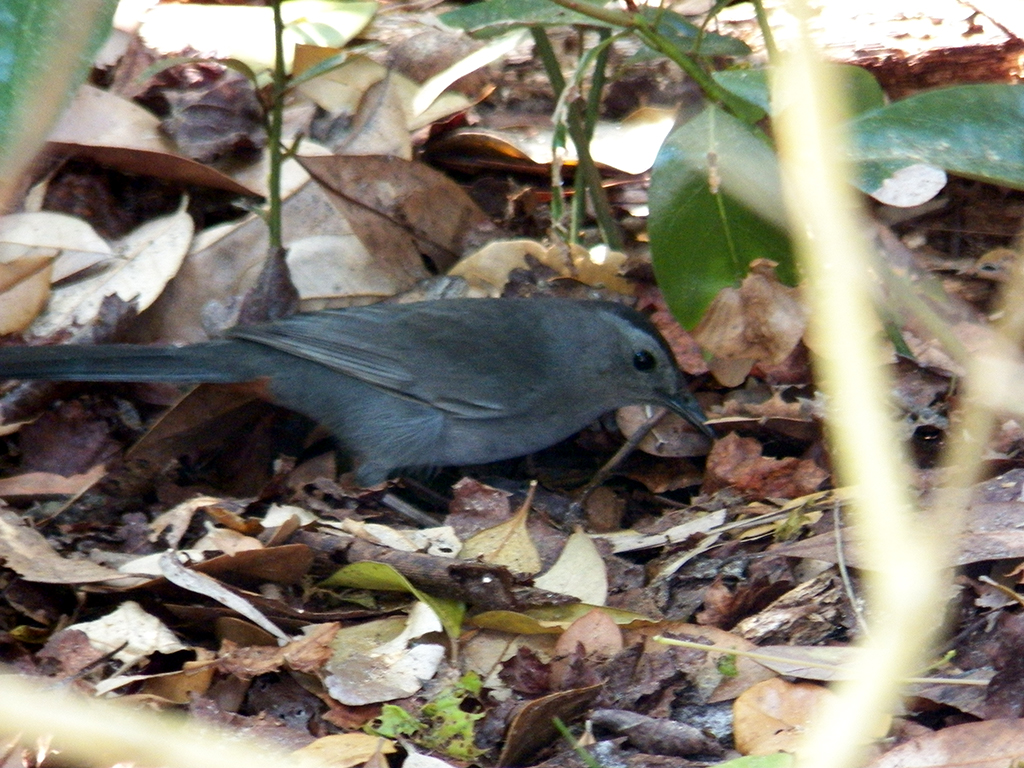
This Gray Catbird was slinging dead leaves around, looking for food. It’ll need to fuel up, as this species is usually heading north around this time.
We went from the park to the nearby beach, but it was already well populated by people sunbathing, swimming, fishing, and surfing. We saw a small flock or two of Laughing Gulls and Ring-billed Gulls, but little else. We heard later on that one group reported large numbers of Black Skimmers at the beach, but I presume that was well before we got there.
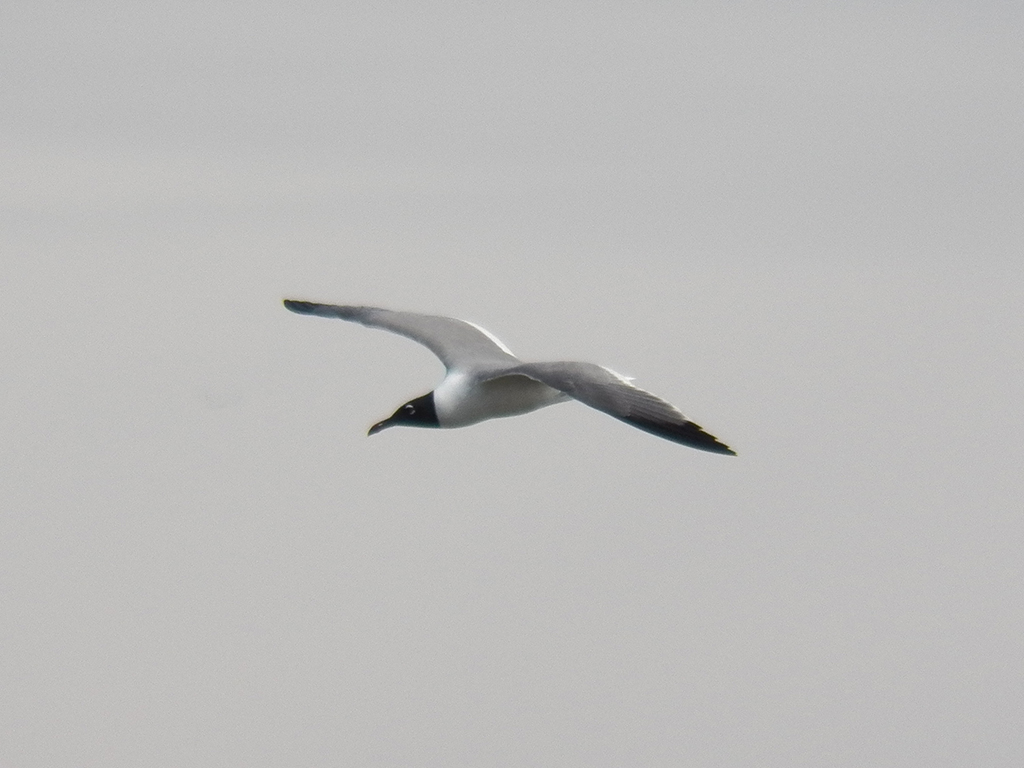
This Laughing Gull has it’s summer clothes on!
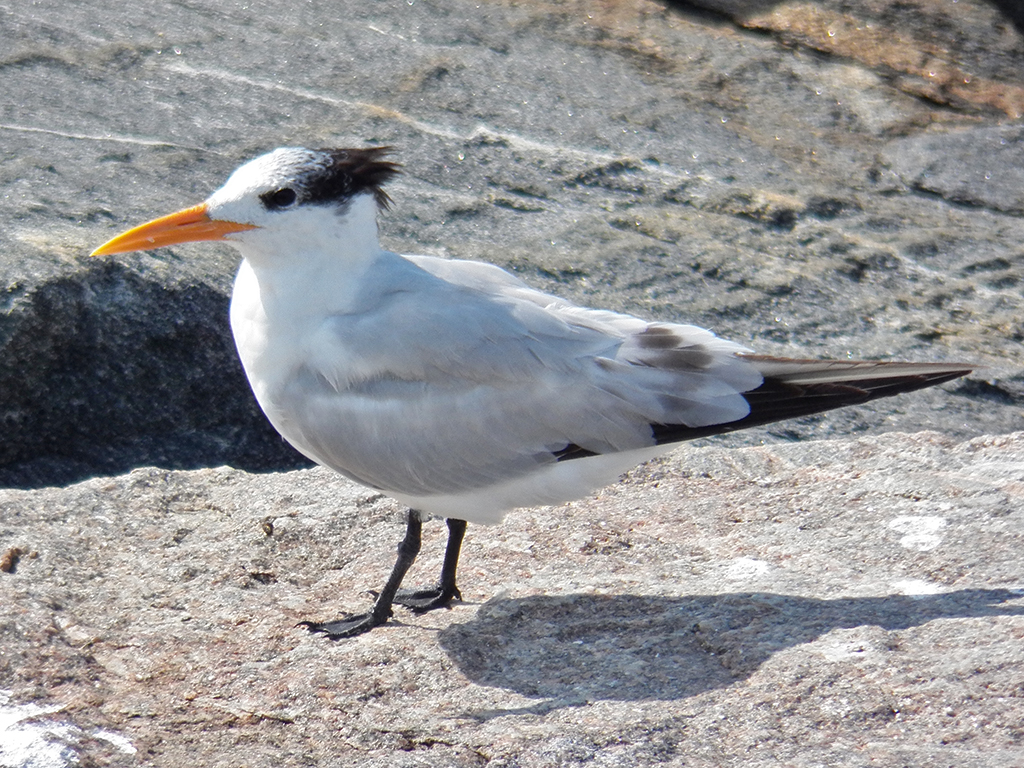
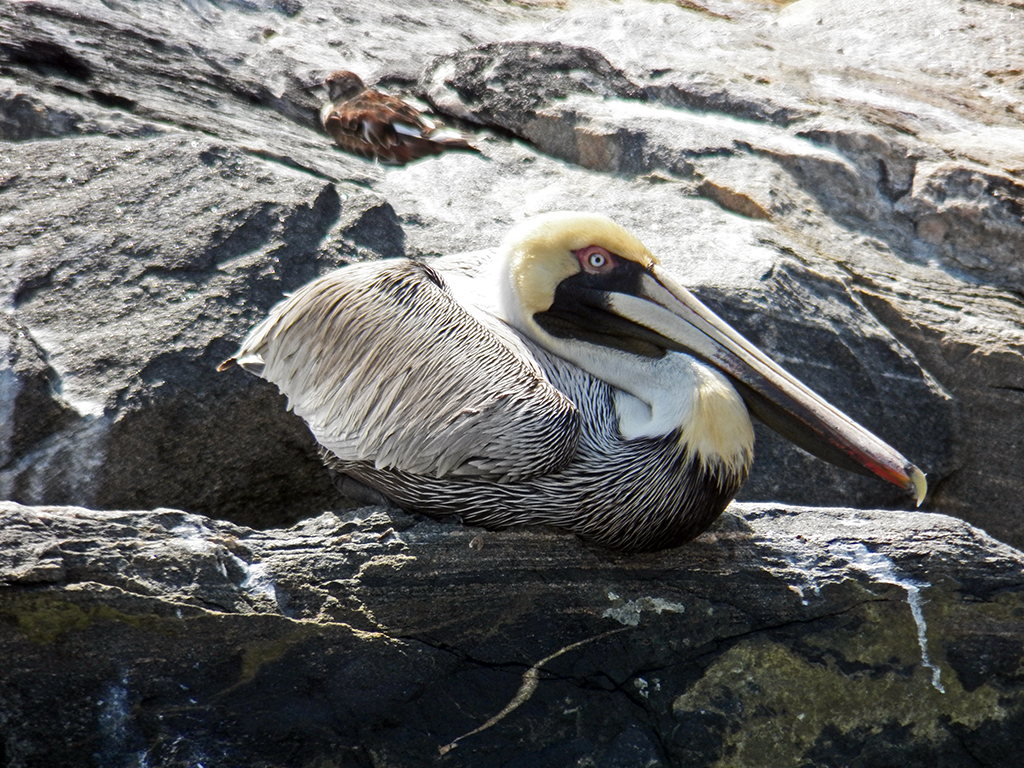
We drove from Lori Wilson Park to Jetty Park, in Cape Canaveral. Jetty Park is one of the best public viewing areas for rocket launches from the Cape. It was usually overwhelmed during Space Shuttle launches, and even today, with no rocket launches it was crowded, primarily with people fishing. The rocks along the jetty were full of Brown Pelicans, Royal Terns, Ruddy Turnstones, and Sanderlings. Across the inlet we saw some Double-crested Cormorants, a Great Blue Heron and some unidentified flocks of gulls.
Royal Tern doing a rather nifty Sir Patrick Stewart impression.An adult Brown Pelican resting on the jetty.
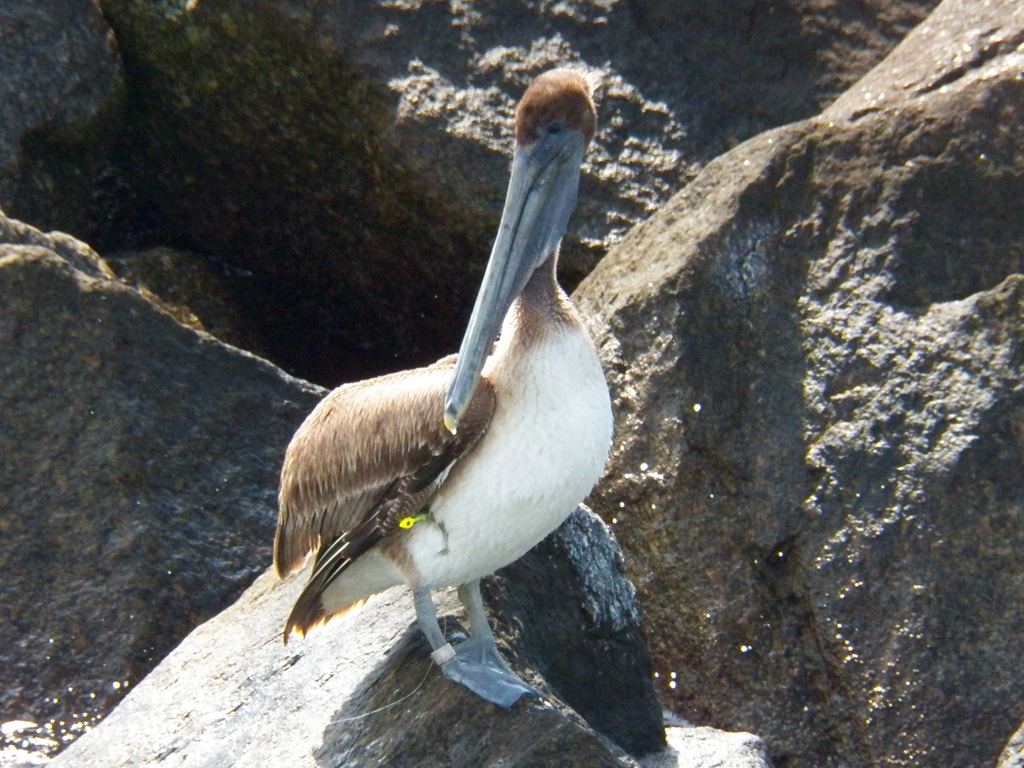
With so many people fishing along the jetty, it’s perhaps no surprise that the birds don’t always have a positive experience with the people. One immature pelican had a fishing lure stuck on its side. It did not appear to be causing the bird any major issues. It could still fly and swim without any obvious hindrance, but without a way to remove the hook, what may happen in the coming days is worrisome. I hope the poor bird can safely dislodge the lure. I’m hopeful the incident that caused this was not intentional, but either way it can be sad to see the price exacted by our species on others.
“What the heck is this thing?”
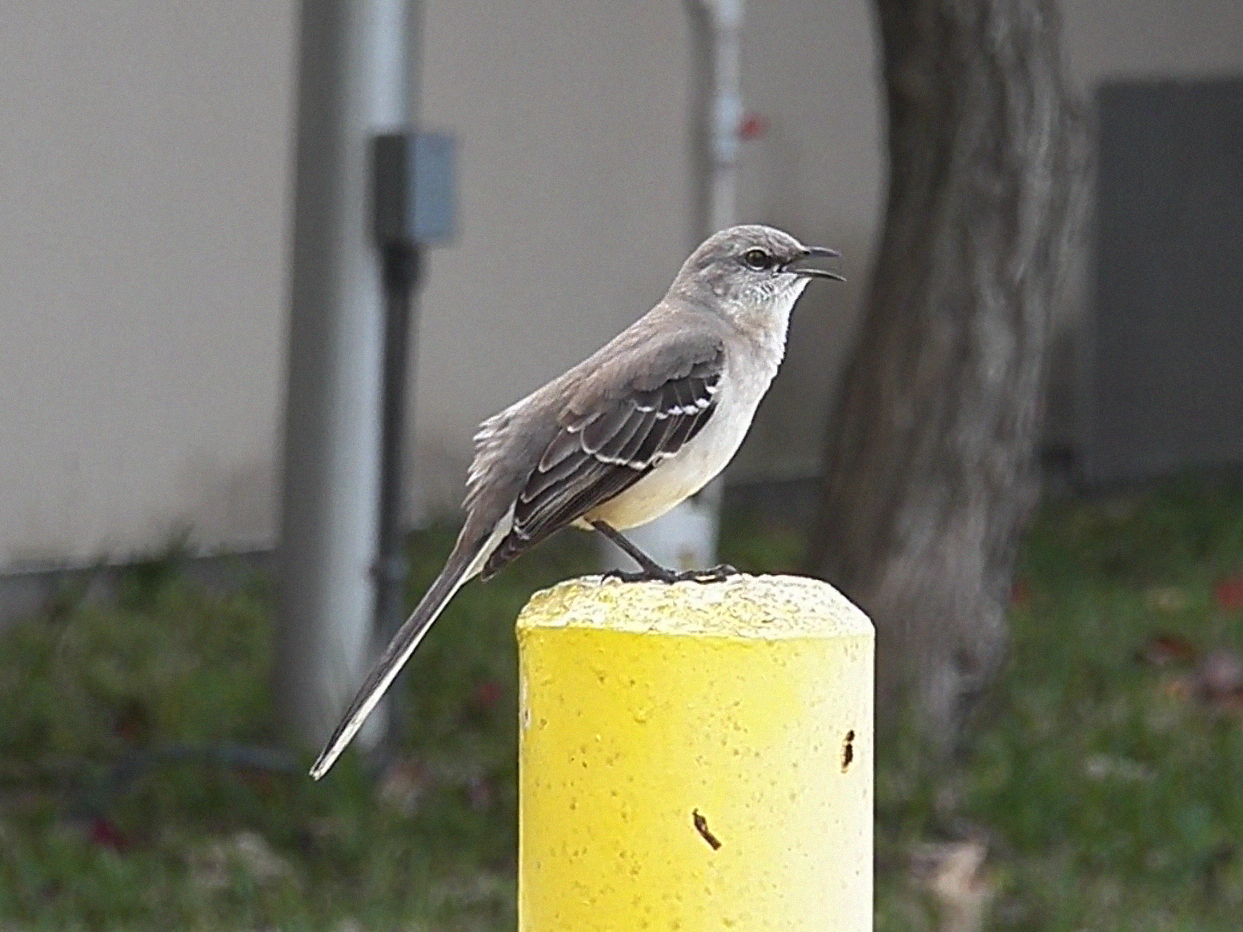
Coming back from the jetty, there as a Northern Mockingbird loudly singing from a concrete post in the parking lot. Mockingbirds are ubiquitous in Florida (as they are in many places), a testament to their adaptability and tolerance for disturbance. While many, if not most, bird species have been negatively impacted by human activity, some birds are well adapted to take advantage of human landscapes.
“But I don’t want any of that — I’d rather — I’d rather…just…sing!”
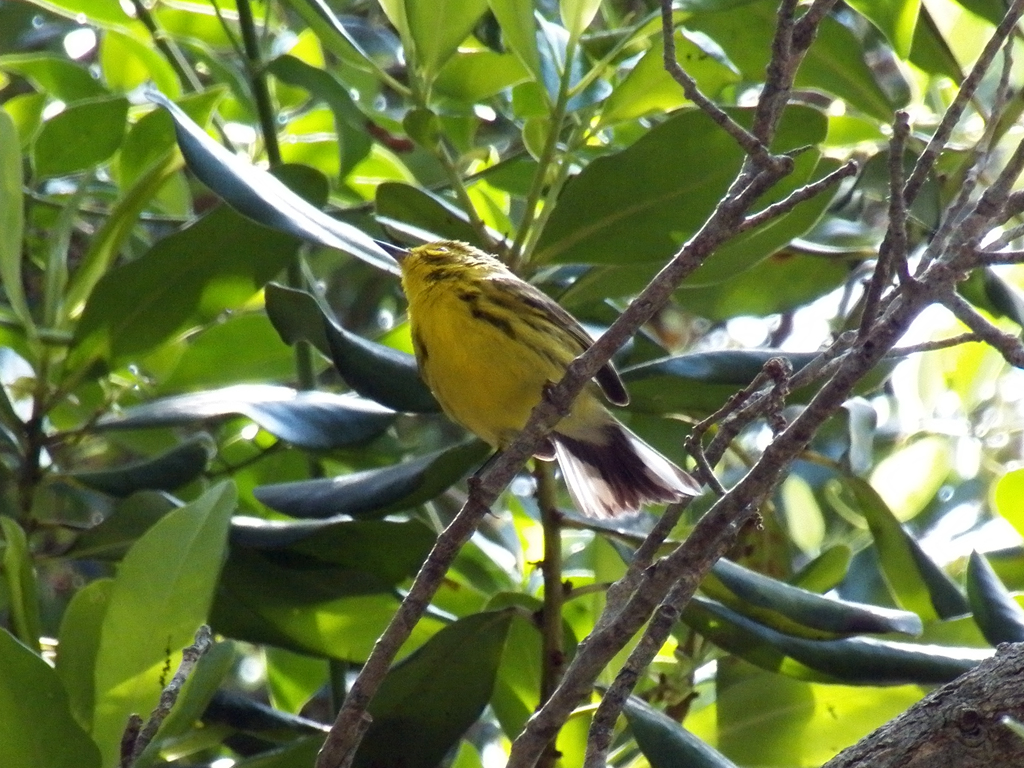
There’s a small section of hammock vegetation near the park with a walkway through it. There, we heard and saw more Gray Catbirds and a Palm Warbler or two. We were surprised by a flash of yellow and a bobbing tail, which at first I thought was a yellow “Eastern” Palm Warbler. On closer inspection, it turned out to be a Prairie Warbler (a FOY for me, and a lifer for Camille). It didn’t stick around long, soon getting lost in the thick tangles of branches.
Prairie Warbler taking a quick pause to look for bugs before moving on.
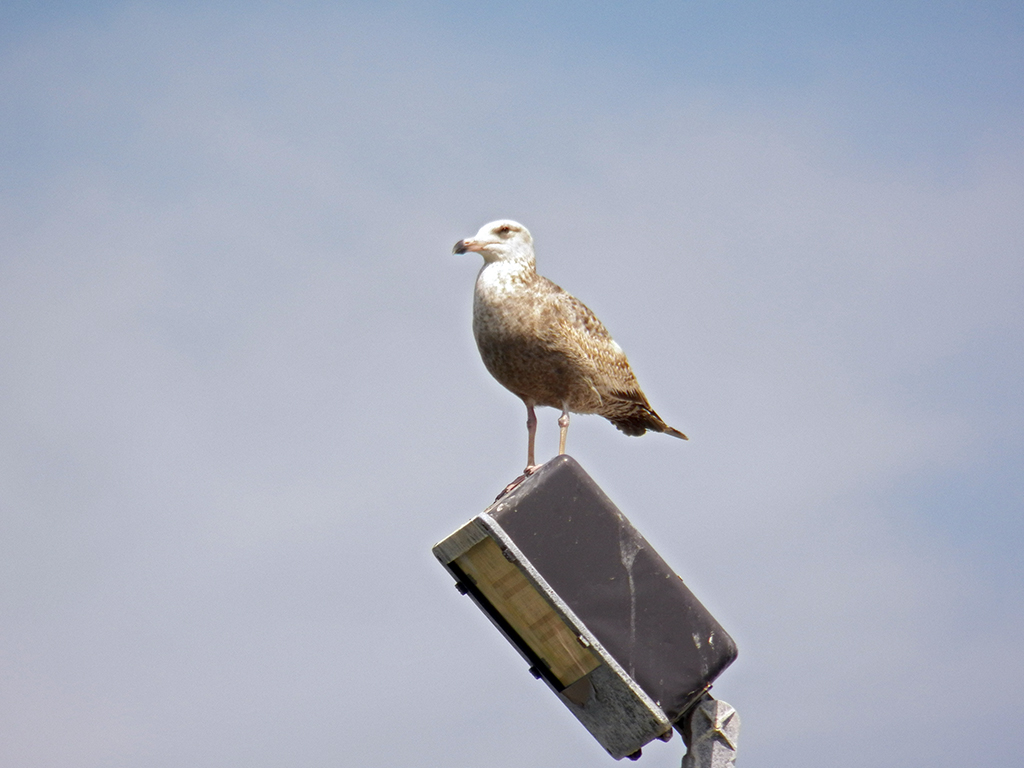
We drove from Jetty Park to the Canaveral Locks to see what was happening there. Aside from a young Herring Gull and several dozen Double-crested Cormorants on the opposite side of the locks, not much was going on bird-wise. We watched the locks open to let some small boats through. That caused a sea turtle and a manatee to come to the surface briefly and then we decided to call it a day.
Lonely Herring Gull is lonely.
The species list for the day for all three locations:
Fish Crow
Black-and-white Warbler
Mourning Dove
Boat-tailed Grackle
Gray Catbird
Ovenbird
Northern Cardinal
Palm Warbler
Northern Mockingbird
Laughing Gull
Ring-billed Gull
American Goldfinch (♫)
Brown Pelican
Ruddy Turnstone
Sanderling
Royal Tern
Great Blue Heron
Double-crested Cormorant
Prairie Warbler
Herring Gull
Snowy Egret
Turkey Vulture
Osprey
Despite the warm weather (it was well into the 80s) it seems that the winter birds are still hanging on and we’ve not quite seen any large numbers of migrants. I’ve seen some NEXRAD (weather radar) images showing that mass movements of birds are starting, so it’s only a matter of time.
I am working on a new post and should have it up by tomorrow. I just ran out of steam yesterday and last night. In the meantime, enjoy these different sort of birds I saw in my neighborhood this weekend!
This weekend’s adventure was to Joe Overstreet Road and Landing. I haven’t been to the area since three winters ago during the Central Florida Specialties field trip. Some Whooping Cranes are somewhat regularly seen from the road on the Double C Bar Ranch on Canoe Creek Road, just before Joe Overstreet Road. I did not see any Whoopers on this trip, though.
From Canoe Creek Road and for most of Joe Overstreet Road the landscape is dominated by upland fields and scattered trees. As one gets closer to Joe Overstreet Landing at Lake Kissimmee of course the landscape changes to marshes and open water, with some wet meadows (much of the land along the road is a cattle ranch). The transition from upland to wetland/lake was best illustrated by the change of crows, with American Crows along most of the road and Fish Crows closer to the lake. Not only were the voices a clear indication of species change, but the American Crows I saw seemed perceptually larger and more robust than the Fish Crows. Usually I have a much harder time telling the difference by sight, as the two species have a significant overlap in their sizes. For whatever reason the American Crows in this part of the state are quite large.
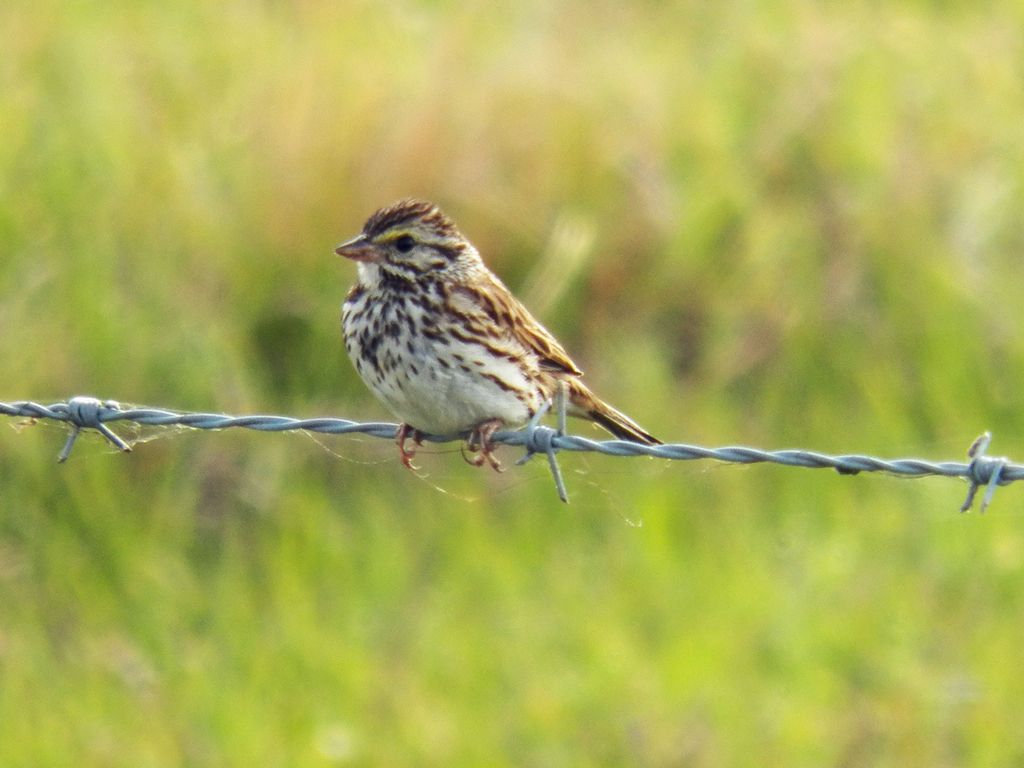
There were small bands of Savannah Sparrows along the barbed-wire fences. For the most part they seemed content to watch me, only fleeing if I stepped a little too close, but never really flying too far.
The Savannah Sparrow equivalent of sitting on the front porch. Someone fetch this bird some lemonade!
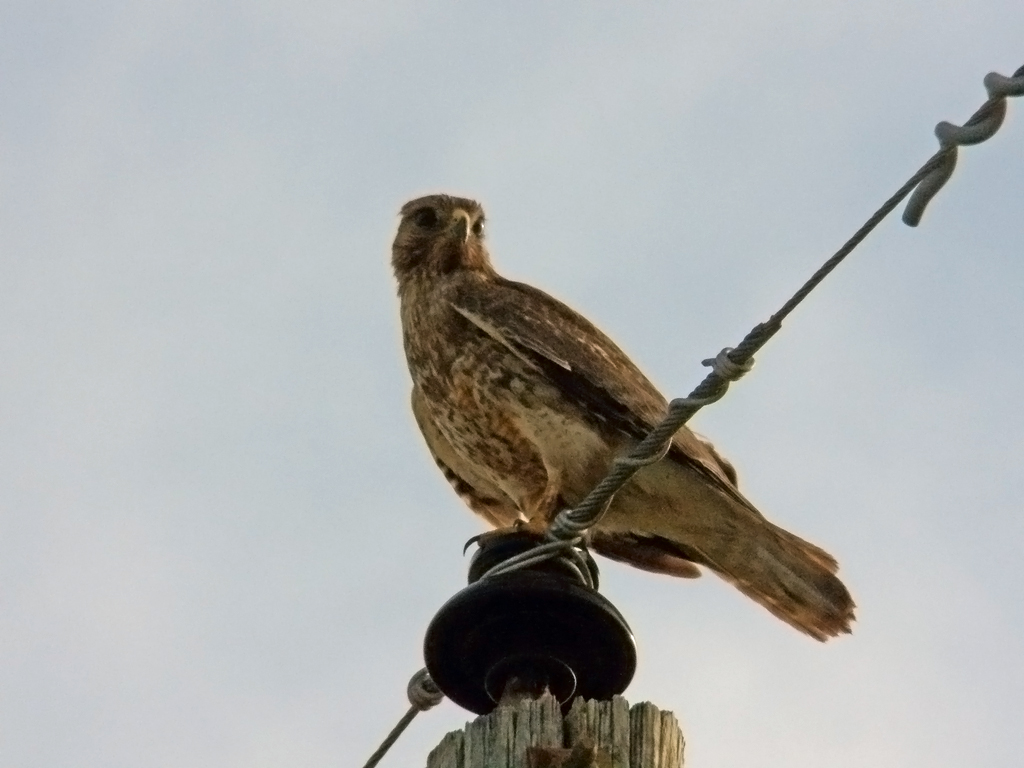
Even the birds of prey were relatively approachable. A juvenile Red-shouldered Hawk sat just outside my car’s window, paying me little mind. It didn’t fly off the post it was on until I got out of the car, and even then it just swooped up to the top of the nearest utility pole.
The nearby power lines and widely spaced trees make good perches for the raptors to hunt from. I saw both “regular” and “Florida form” Red-shouldered Hawks, including some that flew into a copse of pine trees and harassed a Great Horned Owl (from the sounds of it). The American Kestrels hung around nearby too, making the sparrows a little nervous, but the heavy hitters in the intimidation department were the Bald Eagles. Any time their shadows fell nearby, the sparrows and meadowlarks would dive for cover.
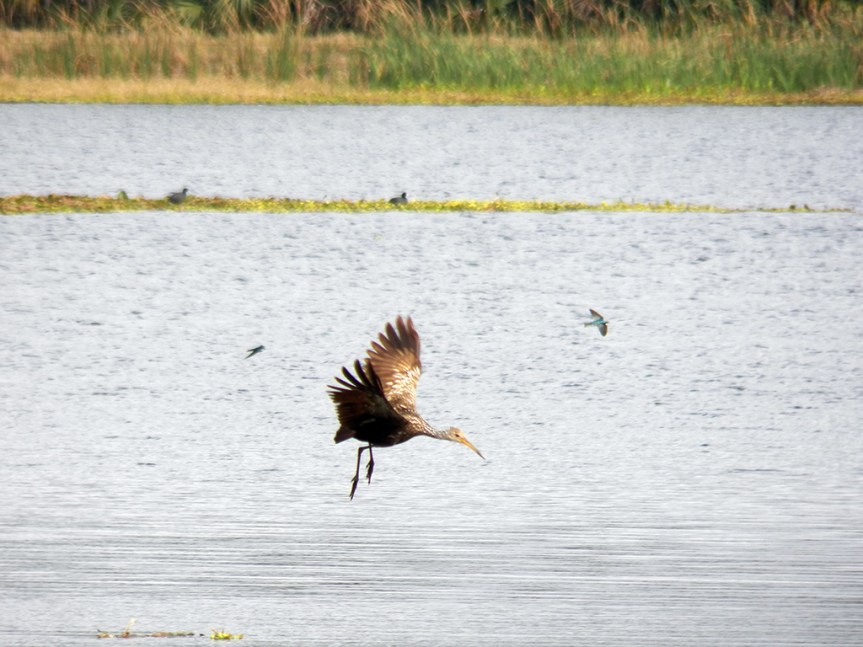
Down at the boat ramp by the lake there were American Coots, Common Gallinules, a Pied-billed Grebe and some Cattle Egrets. I scanned the lake and its more distant far shore for Snail Kites, but I did not see any. There were some gulls, terns, and a couple of Bald Eagles. I saw one Osprey and very few herons (I think I saw one Great Egret and a small group of Little Blue Herons). I could hear at least one Limpkin calling, but aside from some Boat-tailed Grackles and Red-winged Blackbirds, it was fairly quiet at the lake.
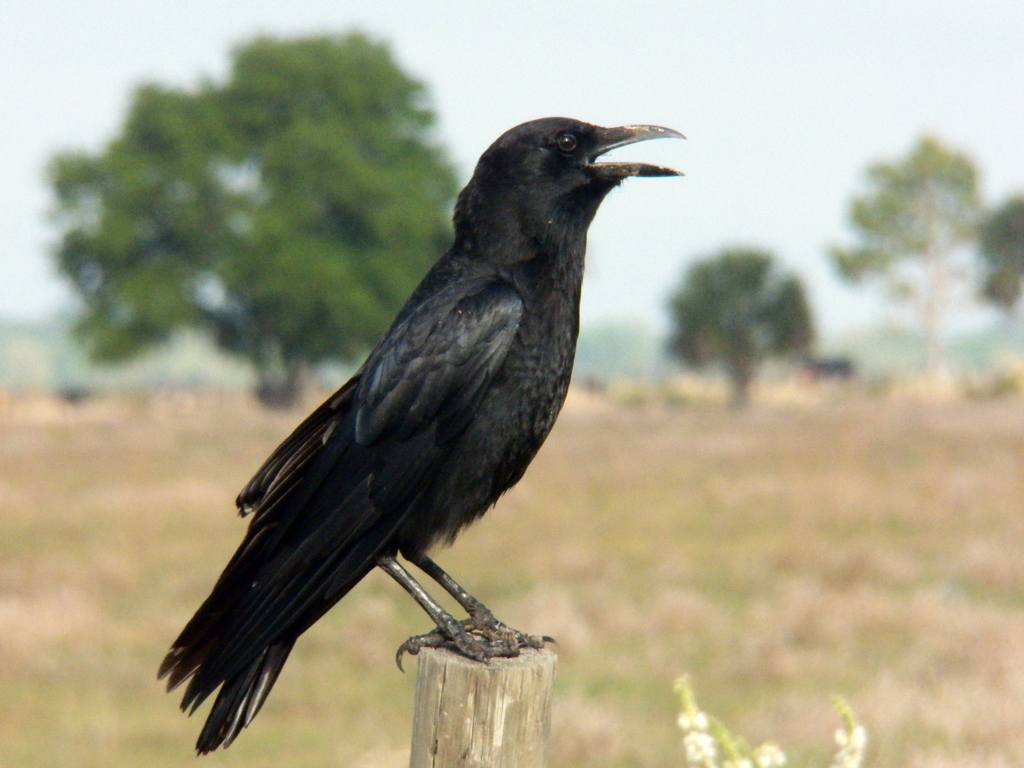
Crows are opportunistic scavengers and omnivorous, and are not above raiding the nests of songbirds (for eggs or young), and will eat lizards and small mammals if given the chance. They also will eat carrion. During nesting and fledging season, this does not endear them to smaller birds, and they will sometimes be chased or mobbed like hawks, eagles, or owls.
This is what an American Crow looks like after being repeatedly dive-bombed and defecated on by 2 very angry Northern Mockingbirds. The small white specks are remnants of the altercation.
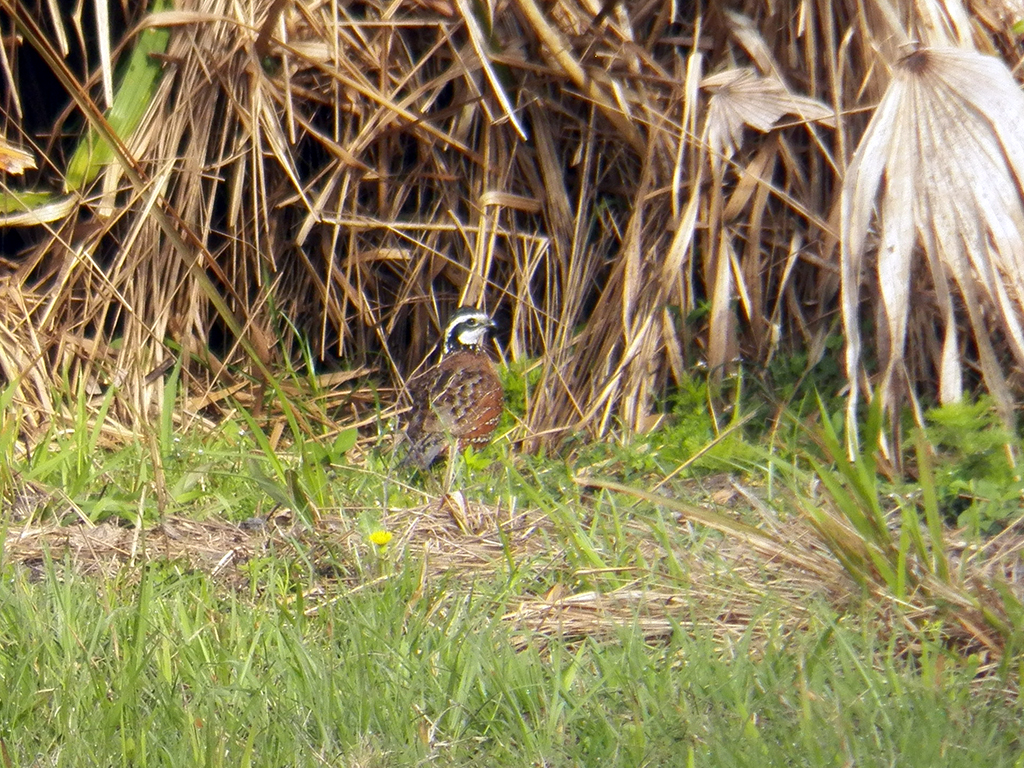
It was a final treat of the morning to see several Northern Bobwhites. I’ve heard them in various places in my adventures, but I haven’t had a solid visual identification. I saw one step out of some dead palm fronds for a moment, before a Red-shouldered Hawk caused it to take cover. I also managed to flush some females out, where they had been hiding in plain sight. They blended into the brown grasses and small shrubs so well that I didn’t know they were there until they quickly spang up in a burry flight to another concealed spot.
A Northern Bobwhite quail moments before dashing back under cover.
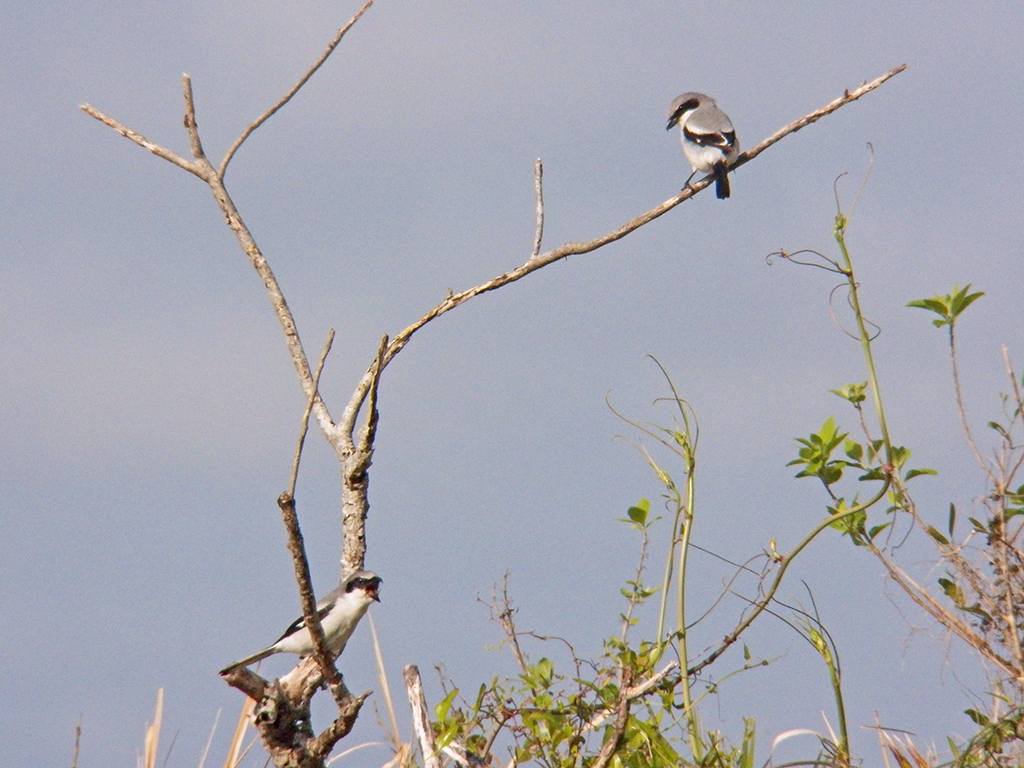
Besides birds attacking the American Crows, the Eastern Meadowlarks were courting and having territorial disputes. A pair of Loggerhead Shrikes were chasing each other around, too. I almost got one of my hope-for photographs, but the moment was so brief, I didn’t even have time to lift my camera. There was a Northern Mockingbird on a dead limb of a small tree, and the shrikes flew up in to the same tree. For an instant both a Northern Mockingbird and a Loggerhead Shrike were in the same tree, in the same field of view! I would really like to get such a photograph, showing the similarities and differences between these two birds.
Moments after a Northern Mockingbird was chased off the limb on the right side of this dead tree-top. The bird at the bottom seems to be eating something as its companion watches.
Before turning onto Canoe Creek Road again, I stopped to watch a few Eastern Bluebirds fly and catch insects. I actually thought they were flycatchers at first, but the orange breast threw me off. When I finally got a good binocular view in full sunlight I saw they were actually bluebirds. Nearby, a Tufted Titmouse was calling and hopping through some branches while Northern Cardinals sang nearby.
I drove up to the Double C Bar Ranch for one final search for Whooping Cranes but coming up empty, I headed for home. I took a quick detour to the Wild Florida wildlife park and passed some Sandhill Cranes on the road leading to the parking lot. I didn’t really have time to look around, so I just circled the lot and headed back to the main road.
Here’s the trip’s species list in approximate order of positive identification:
White Ibis
Cattle Egret
Savannah Sparrow
Mourning Dove
Eastern Meadowlark
American Crow
Red-shouldered Hawk
American Kestrel
Blue Jay
Black Vulture
Bald Eagle
Northern Mockingbird
Boat-tailed Grackle
European Starling
Osprey
Fish Crow
American Coot
Cattle Egret
Glossy Ibis
Limpkin (♫)
Palm Warbler
Red-winged Blackbird
Common Gallinule
Ring-billed Gull
Pied-billed Grebe
Turkey Vulture
Killdeer
Eurasian Collared Dove
Loggerhead Shrike
Blue-gray Gnatcatcher (♫)
Red-bellied Woodpecker
Great Horned Owl (♫)
Northern Bobwhite
Eastern Bluebird
Tufted Titmouse
Northern Cardinal
Sandhill Crane
I’m hoping to check eBird and the e-mail lists to see if the Whooping Cranes are still being seen there, and to get some better tips for getting a good look. I’ll likely head back to Joe Overstreet Road soon, before the weather gets too hot.
I bucked the Lonely Birder trend again this past weekend by heading out to the Orlando Wetlands Park with my friend Camille. She is such an enthusiastic new birder, it’s great to head out with her and see whatever we can. This trip was focused on two things:
Thing 1: Neither of us had been to Orlando Wetlands Park before. It is closed seasonally from November through all of January which includes the usual dates for the Space Coast Birding and Wildlife Festival.
Thing 2: A male Vermilion Flycatcher was reported there this winter (and apparently the past several winters), a rare and desirable bird for this area. It’s getting late in the “wintering” season in central Florida, so it’s likely he’ll head north soon. This weekend was a good opportunity to see him.
This is actually a really big park. We walked at least 5 or 6 miles in the course of the day.
We arrived during a light rain shower, and (along with several other birders, including a group of photographers) used some small shelters near the parking area to wait out the rain and watch what birds were in the nearby trees and brush. We could hear a lot of “chipping” notes which turned out to be a large number of Yellow-rumped Warblers. Interspersed with them were some American Goldfinches, and I could hear at least two White-eyed Vireos. There was one Yellow-throated Warbler (one of several life birds for Camille).
There’s an education center nearby, and we went there to find a park map, and apparently interrupted a photography workshop lead by Reinhard Geisler, who tried to whisk us out, until we told him we just wanted a map. He grabbed one for us and quickly shut the door!
As we passed some large blue plastic tubs, ostensibly for a plant experiment, we saw some more Yellow-rumped Warblers, as well as Blue-headed Vireos, and some Carolina, House and Marsh Wrens in the brush nearby. I thought I caught a glimpse of an Ovenbird, but not enough to really be sure. I also caught a quick look at a Ruby Crowned Kinglet.
A Blue-headed Vireo shows off its white spectacles and yellow-green flanks.
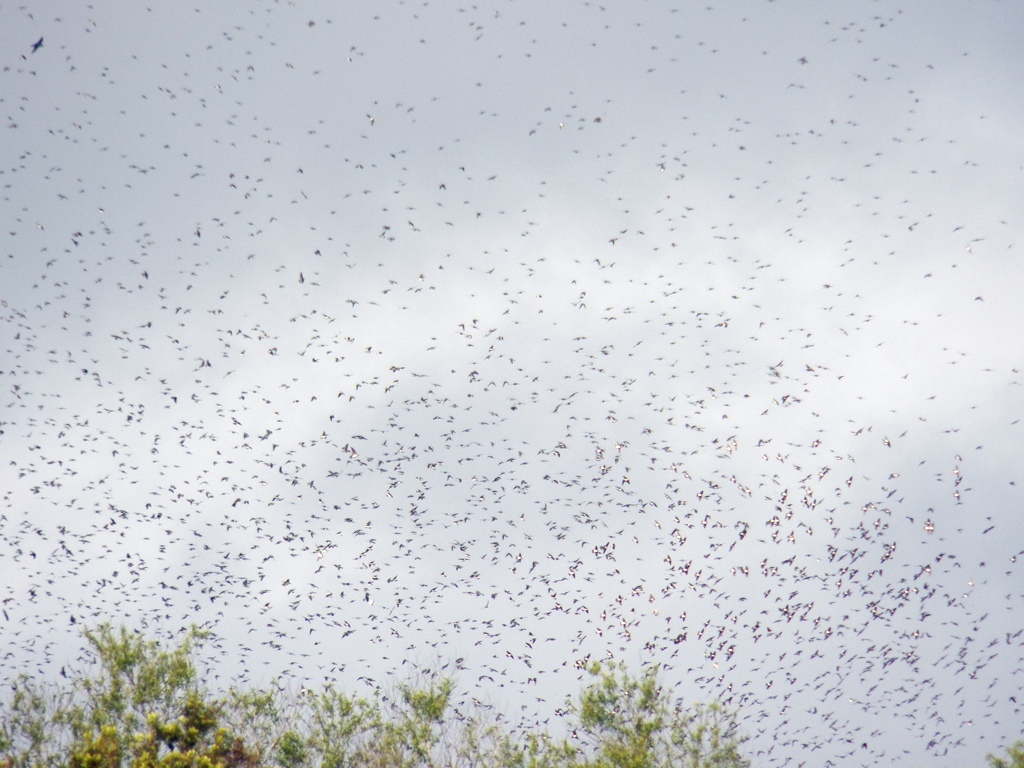
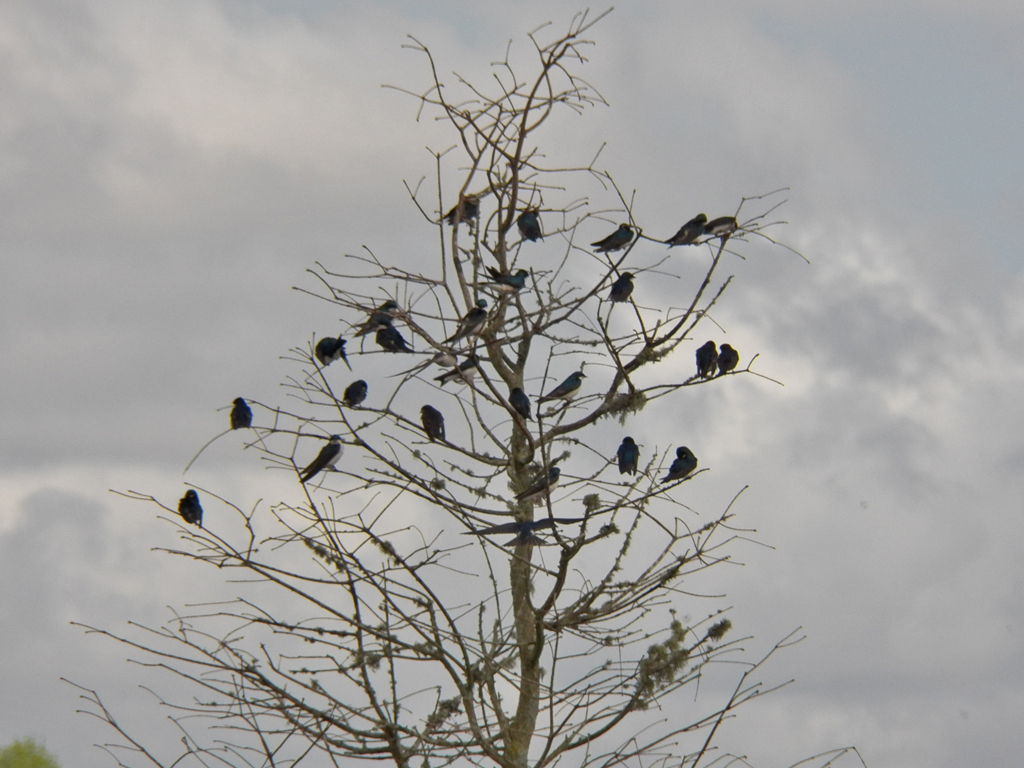
As we got out past that area near some open marshland, there were dozens of Tree Swallows all around us, and then looking farther out, a huge flock of many hundreds (perhaps even a thousand!) were swirling. Everywhere we went, all day, there were Tree Swallows.
One of several swirling masses of Tree Swallows we saw throughout the day.
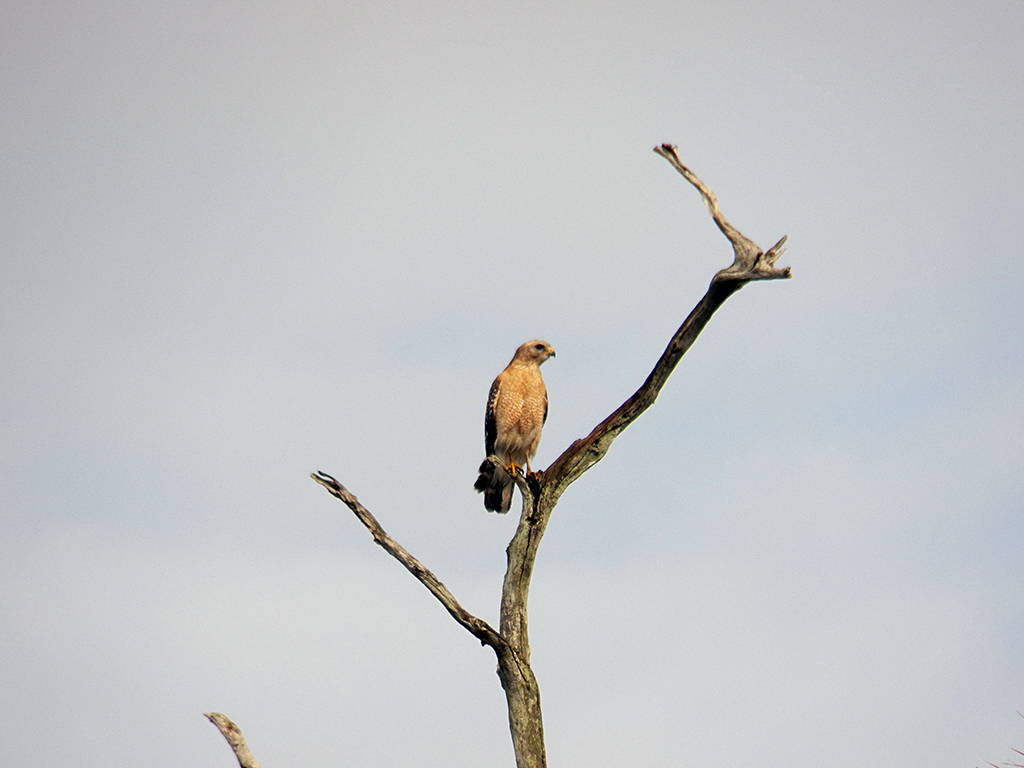
We saw our first herons and egrets, as well as some American Coots, and further along, Common Gallinules. In a dead tree there was a pale adult Red-shouldered Hawk that we spotted quite a distance away. We saw several of that species through the day (of course, some may have been repeat individuals), all the pale “Florida form.”
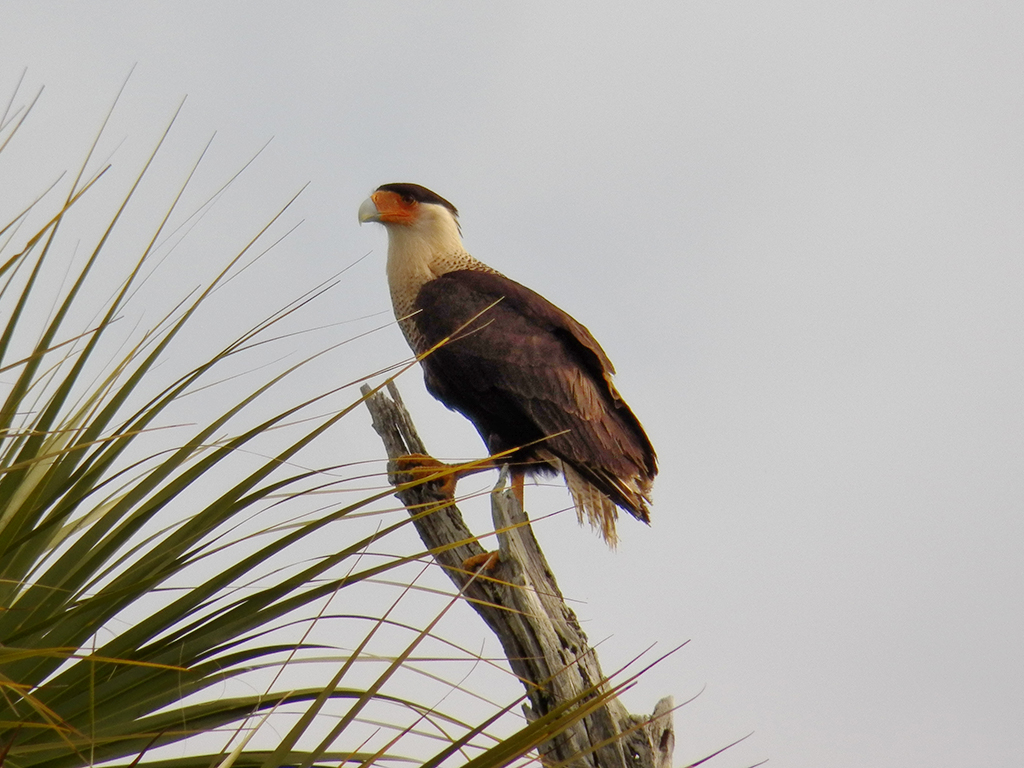
More impressively, Camille was wondering if we’d see any Crested Caracaras, and shortly thereafter in a tree not far from that hawk, was an impressive caracara, alternating between grooming and watching us approach. Just about all of the Crested Caracaras I have seen in Florida have been banded at least once, but this one was not banded and quite majestic.
Crested Caracaras are majestic looking birds.
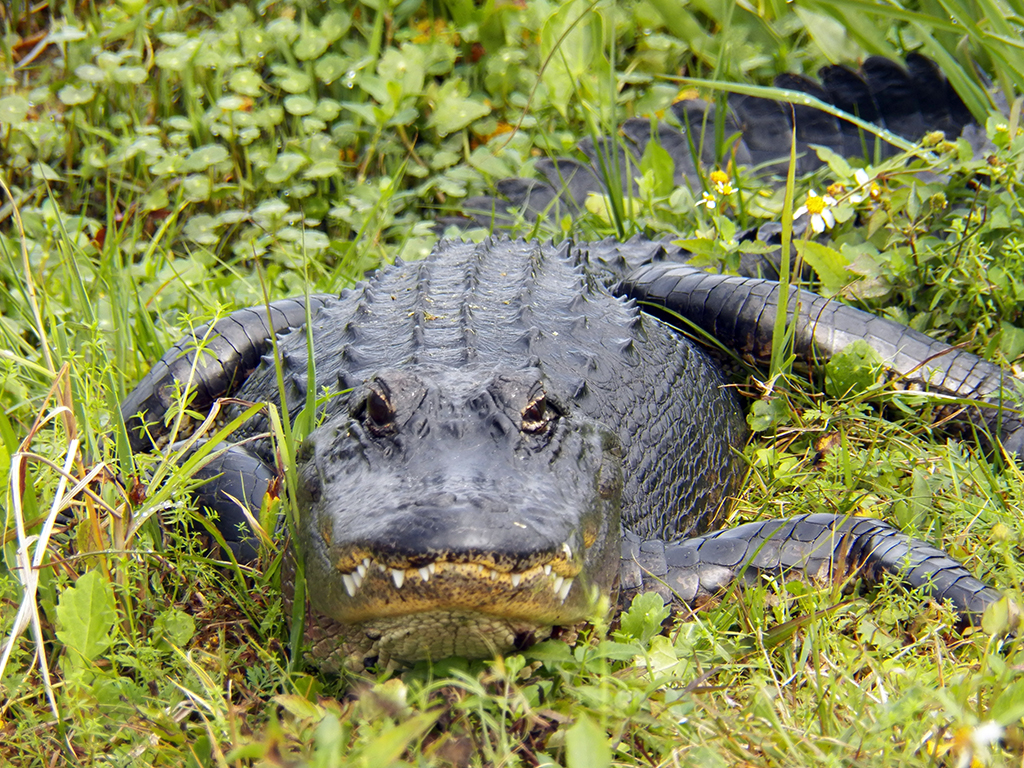
The park also has an impressive number of alligators. Every embankment we walked along had at least several, sometimes in close proximity. The largest I saw was over eight feet long, and there were some small 2-3 foot long ones as well. Many seemed to be snoozing or at least disinterested, but some were alert and intently watching us as we went by. At one point, near the end of the day, a woman we spoke with was saying how, even as a native Floridian, she sometimes gets a little nervous with so many alligators out and about.
“One medium and one large ‘gator to go, please.”
Her comment made me realize that while I used to be a little intimidated and anxious at some of the larger alligators I would see, now I just harbor a great deal of respect and admiration. I’ve never felt threatened by an alligator. In fact, more often than not, even the larger ones will panic and head straight for the water in a startling splash if I accidentally seem to be getting too close.
“This IS my happy face.”
Alligators weren’t the only non-avian species present. There were turtles sunning in most of the ponds and open wetlands and various butterflies. I did not notice any dragonflies, but it may be too early in the year to expect the adults to have emerged from the water yet.
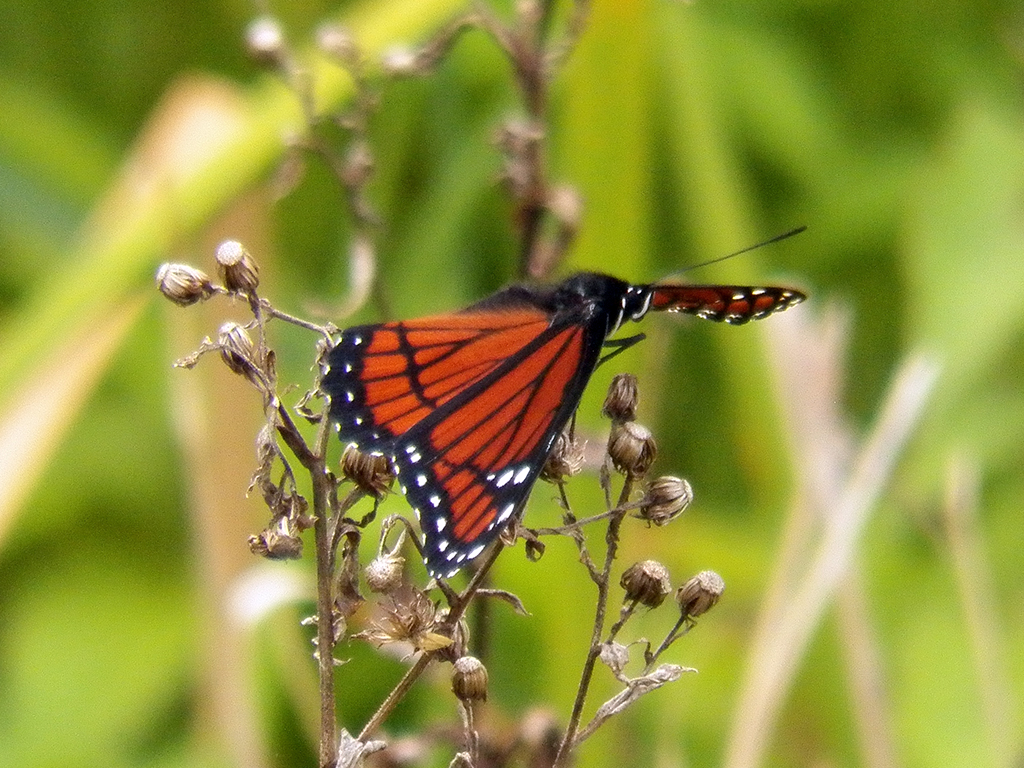
This is a Viceroy, a mimic of the better known Monarch butterfly. The extra, thicker black line running across the thinner lines is the defining field mark.
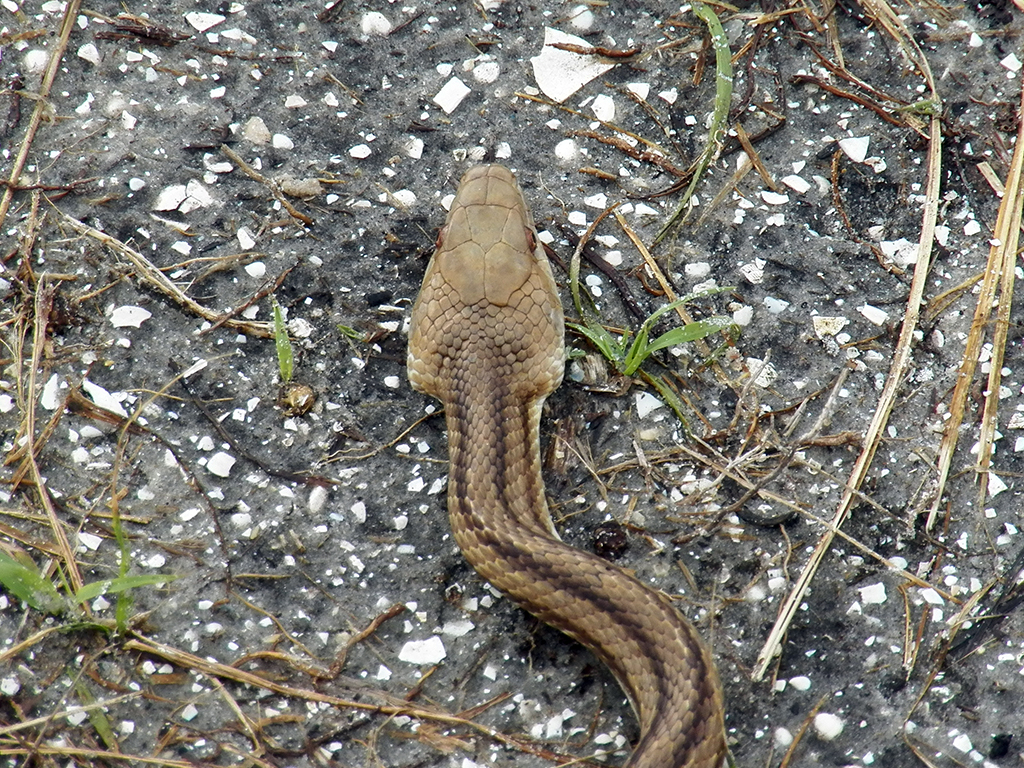
We came across a three-foot long snake on one path that Camille almost stepped on. I looked up what species it was after getting home, and it was a yellow striped Rat Snake. Normally this species is nocturnal, and I thought maybe this individual had expended some energy before dawn and was waiting for the sun to warm it up so it could get about its business.
A major difference between this park and something smaller, like the Wetlands in Viera, is the density of bird activity. With so much room to spread out, there didn’t seem to be as much bickering and posturing among the wading birds. There were Limpkins around, but they only flew out in the open a few times. The herons were mainly standing alone, with only the usually grumpy Tricolored Herons making any regular fuss. It’s possible we caught the park on a quiet day, with things transitioning from Winter to Spring, but I’ll have to revisit a few times to know for sure.
A Limpkin with a Tree Swallow escort comes in for a landing.
As I mentioned above, one reason for coming to this particular park was to see the Vermillion Flycatcher. We had some vague idea of where it might be based on eBird reports and some e-mail list messages, but as the scale of the park became evident to us, we realized we needed specific help on where to find it. As we were walking down the aptly named “Alligator Alley” a couple of men approached our location and asked if we were trying to find the Vermillion Flycatcher. They then gave us very specific instructions on where to walk and what to look for.
So off we went, via their directions, across the park. We walked quite a long distance, well over a mile, until we came and area to that most closely matched their description. There were a few things wrong, however, with what we had read about where it would likely be and this location. There were no “small” cypress trees, for example, and the only cypress stand that might have been close to the two men’s description was apparently accessible from other trails, making it unlikely that we’d have to be out where we were to see it. As we searched for the flycatcher, we did see some Caspian Terns, a perched Osprey, and several Great Blue Herons in the cypress dome across the water. We decided to head out and either ask someone else, or just take our chances in another area of the park.
After we walked a way down the trail just a short way, we saw a photographer setting up a tripod and asked him if he knew how close we were to the flycatcher’s location. He told us we were no way near it, and in fact we had to cross almost the entire park to find it! We were a bit frustrated and amazed because of how specific the first set of directions had been, but this man had photographed the bird the previous day and was very confident in where we needed to go.
There were Red-winged Blackbirds in moderate numbers. Most were busy finding food and looking around. The majority of the males had their red shoulder patches (called epaulets) in eclipse, showing mainly the yellow border. The epaulets are exposed when the bird is looking for a mate or staking out his territory.
Most of the male Red-winged Blackbirds seemed content to walk the edge of the water with very little fuss. There were some singing here and there, but nowhere near the frenetic activity the species often exhibit at Viera.
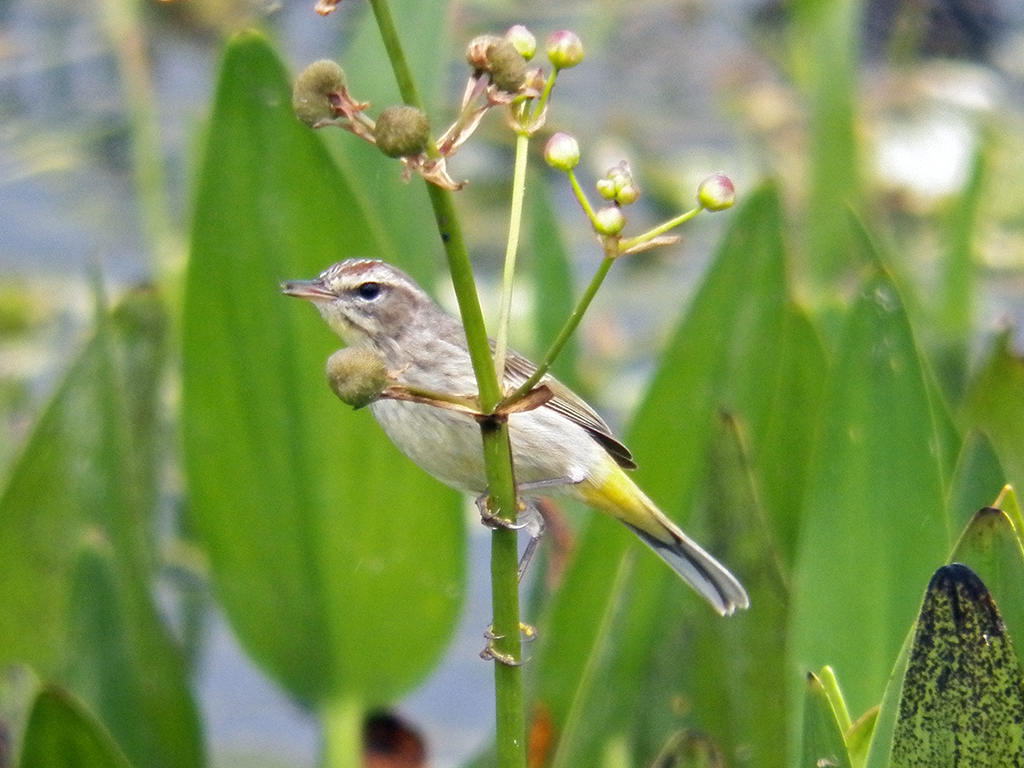
Some smaller birds were flying along the trail, including Savannah Sparrows and Palm Warblers. Most of the Palm Warblers in central Florida during the winter time are of the gray “Western” variety, with limited yellow to their tail coverts and sides. One Palm Warbler was foraging along the reeds and other water plants near us, and it stood out because of how pale it was compared to other Palm Warblers I’ve seen this winter.
Pale Palm Warbler eating tiny bugs.
Just across the road along the shoreline of the pond I was slightly startled to see several very small birds wading within a few feet of me. At first I thought they were sparrows, but once my brain adjusted to what it was seeing, I realized they were very small sandpipers. Other than Sanderlings and Ruddy Turnstones, I’d never been that close to small shorebirds, and it turns out these were Least Sandpipers (I had to double check at home because Western Sandpipers are also small, but they have dark legs whereas Least Sandpipers have yellowish legs).
Hangin’ with my peeps at Orlando Wetlands Park.
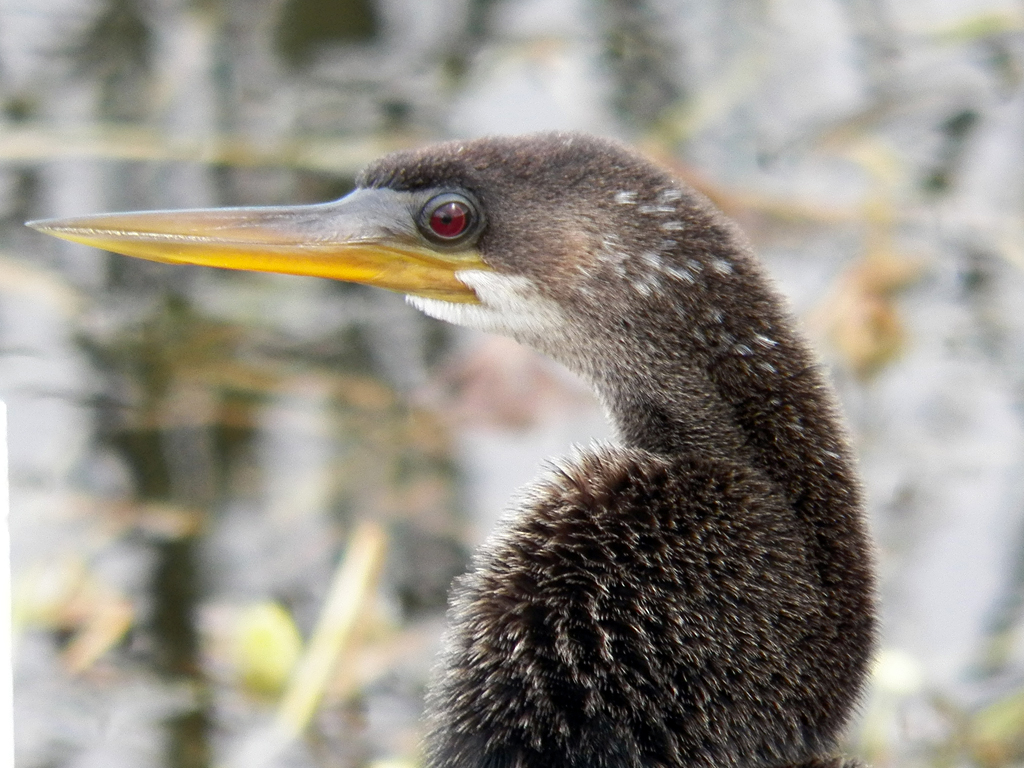
Anhingas were distributed fairly evenly around the park. I don’t know when the normal breeding season is for them, though I know they can breed any time of year in places. We encountered one Anhinga that seems to be a juvenile or an immature bird. Other Anhingas in the area (Viera, for example) have blue skin around the eyes and lores (area in front of the eyes) which indicates breeding adults, but this one does not have those markings.
A young Anhinga nervously watched us as we passed by.
A flock of American Wigeons took to the sky at one point, marking the largest group of ducks we’d seen all day. Aside from a few isolated Blue-winged Teals, and later a few Mottled Ducks at the end of the day, these were the only ducks we’d see.
As we continuted to follow the photographer’s directions, we eventually came upon some birders who had just seen the Vermillion Flycatcher and were happy to point out where to stand and what to look for. It turns out we were just around the corner from the spot when the first two men had us go in the complete opposite direction! I don’t know if they were being malicious or were confused themselves over where they had been that morning, but it was frustrating at first. But the walk, though hard on the feet, was not a waste, as we did get to experience areas of the beautiful park we’d likely have walked through anyway. We were warned that without a high powered scope or telephoto lens, we weren’t likely to see much more than a reddish dot or smudge, but we knew that going in. Any glimpse of the bird was worth it.
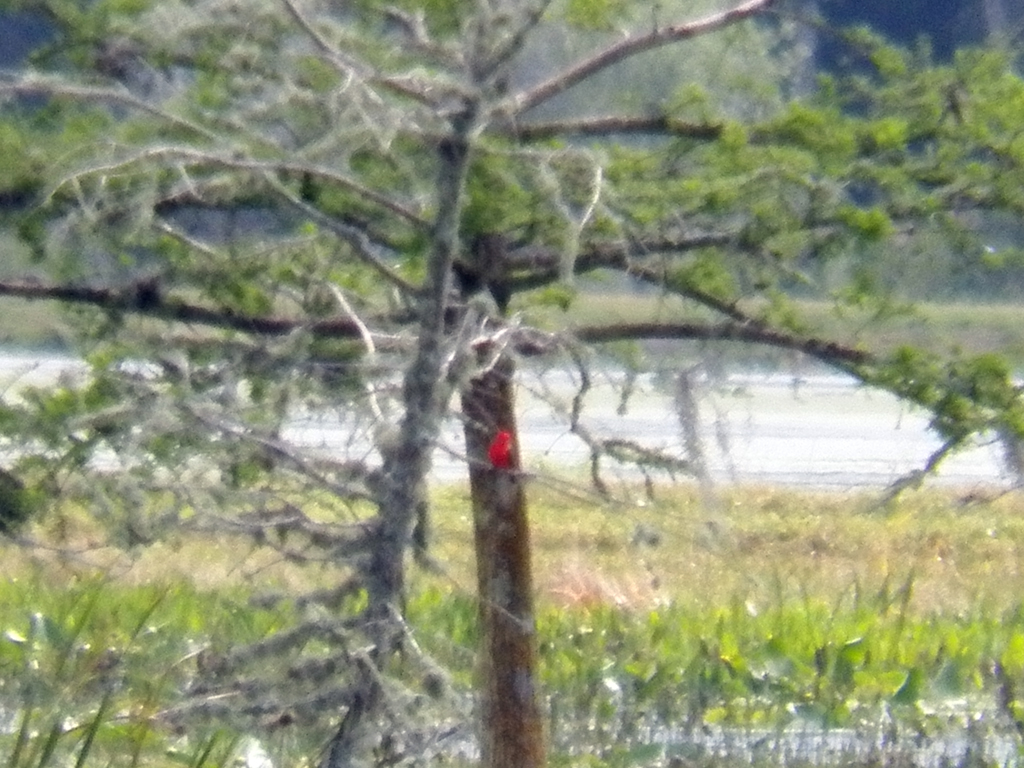
We stood at the spot and scanned the small cypress trees for several minutes and were just about second guessing ourselves when I finally caught a flash of red in my binoculars and saw my very first Vermillion Flycatcher! Soon, Camille had it in her sights as well, and we watched that little red smudge sally over the water and back to the same perch several times. I decided to take whatever image my camera could capture, even if just a red blob.
It’s not much, but that red blob is a male Vermillion Flycatcher! Worth every minute, mile and foot ache!
We watched him for a while longer before finally heading back down the trail, where we came across a woman setting up a spotting scope, looking toward the trees the flycatcher was in, from the opposite direction. We talked to her for a few minutes, and found out that she birds with the man running the photography workshop (Reinhard Geisler) and had seen the flycatcher from that vantage point some days earlier. She very quickly got it in her scope and let us have a look. In her scope one could see his face clearly, including the black eye-line.
We continued to walk back toward the education center and the parking area, stopping to look at a few more birds. As we did, the woman with the spotting scope walked by us and pointed out Tree Swallows perched in some small trees out in the water, relatively close to us. After seeing so many hundreds, if not thousands, of these birds flying all day, it was nice to see some sitting quietly.
A small group of Tree Swallows taking a bit of a break.
We walked a little further on and saw another bird we had hoped to see there, but had eluded us all day: a Purple Gallinule. We’d both seen this species this year, but they’ve been comparatively rare lately and are such a neat bird, we really were wanting to get it on this trip.
Just as we were arriving back toward the parking lot, one of the large swirling masses of Tree Swallows was descending along the trees along the trail. There were two main components to the flock, and as the two flocks interacted, they started noisily calling out and descended further. Eventually hundreds landed in just a few trees at the edge of the road, causing the entire tree to sag and bend. This caused the birds to loudly launch off the trees en masse and take to sky in a frantic surge. They did this a few times before heading off a short distance.
Thus ended our day at Orlando Wetlands Park. It lived up to its hype, and we got lots of good birds, including a good handful of lifers for Camille. We didn’t leave the park until after 3:00, which was much much later than I anticipated, and even realized it was. Our feet and backs were sore, but it was an amazing adventure.
Here’s my complete species list in general order of first positive identification.
Yellow-rumped Warbler
American Goldfinch
Northern Parula (♫)
White-eyed Vireo (♫)
Carolina Wren
Common Ground Dove
Gray Catbird
Northern Cardinal
Pine Warbler
Boat-tailed Grackle
Ruby-crowned Kinglet
Blue-headed Vireo
House Wren
Red-bellied Woodpecker
Yellow-throated Warbler
Marsh Wren
Tree Swallow
Palm Warbler
Turkey Vulture
Black Vulture
White Ibis
Sandhill Crane
Great Blue Heron
Tricolored Heron
Red-shouldered Hawk
Crested Caracara
American Coot
Great Egret
Pied-billed Grebe
Blue-winged Teal
Belted Kingfisher
Little Blue Heron
Limpkin
Red-winged Blackbird
Common Gallinule
Anhinga
Green Heron
Common Yellowthroat
Swamp Sparrow
American Bittern
Savannah Sparrow
Snowy Egret
Cattle Egret
Glossy Ibis
American Wigeon
Fish Crow
Sora (♫)
Least Sandpiper
Greater Yellowlegs
Killdeer
Caspian Tern
American White Pelican
Bald Eagle
Osprey
Black-crowned Night Heron
Vermillion Flycatcher
Mottled Duck
Purple Gallinule
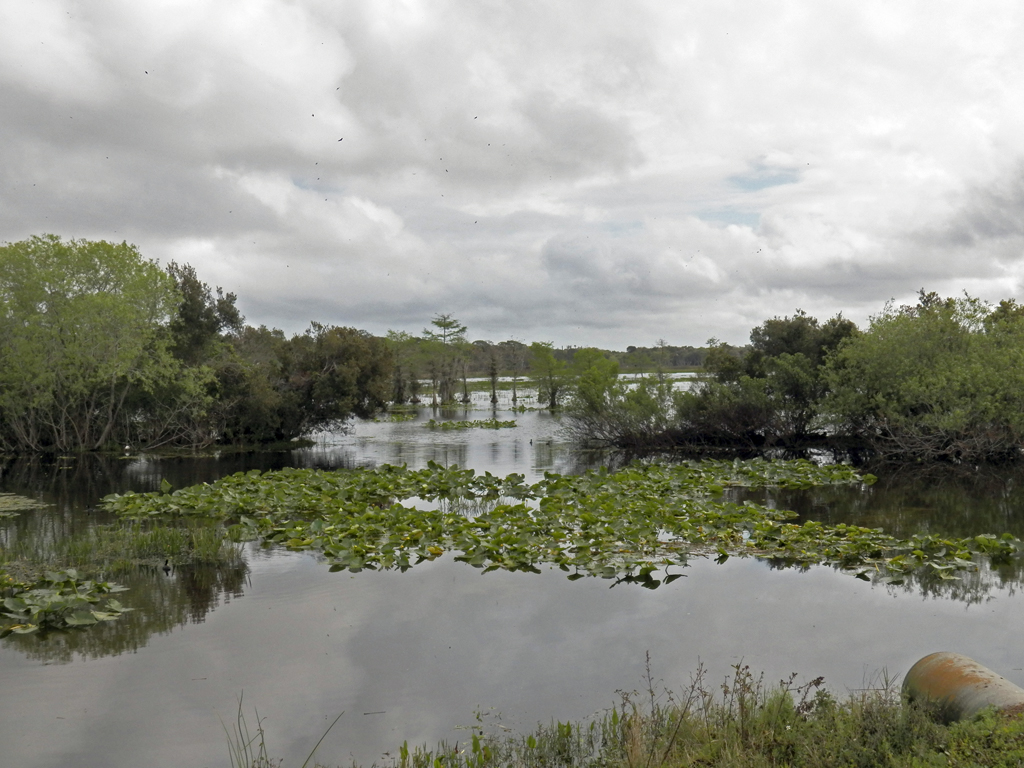
A parting look at the beautiful Orlando Wetlands Park (those black specks in the sky are more Tree Swallows).
After Mrs. Lonely Birder finished a 2 mile race in the Eau Gallie district of Melbourne, FL this morning, we came across this pair of Blue-crowned Parakeets (sometimes called Blue-crowned Conures)!









 Lonely Birder