My recounting of the 2015 SCBWF will be on ice for a few days as I tromp across the Duluth, Minnesota area with Laura Erickson for Superb Owl Weekend. Blogging will resume next week.
P.S. we already saw a Common Eider and Snowy Owl, so we’re off to a great start.
Day three of my Space Coast Birding and Wildlife Festival adventure was squally, rainy and cold (at least by Florida standards). We had a good string of seasonably warm and sunny days leading up to the festival, and the weather basically held until the 23rd, when the wind began to pick up. But the next morning was a bit problematic for our trip to Lake Apopka. We had a few stops along the lake’s restoration areas, but remained huddled near the bus, as a windbreak. These areas were once farmland that the St. Johns River Water Management District purchased to undo years of harm agricultural runoff and other environmental hazards had done to the lake.
As we were leaving the area of the pump house not far from Lust Road, the bus got stuck in some mud. We had been looking for a previously identified White-faced Ibis (unusual for central Florida), and had not been able to find it. As we waited for a person to come and use a nearby bulldozer to pull the bus out, we all scanned the grasses and willows again, and finally someone spotted it in their digiscope! It can be very hard to pick out a White-faced Ibis from a Glossy Ibis, especially in the winter, unless you can get a good look at its eye and lores. So it was fortunate we got stuck, otherwise we would have missed out on a rare bird.
I wasn’t able to take much in the way of photographs due to the weather and bad timing, which is unfortunate. Despite the howling winds, we still managed to see (as a group) over 80 species of birds. We were hoping to see the Groove-billed Anis and Vermillion Flycatchers that have been wintering over at the lake, but the wind likely kept them grounded and out of sight.
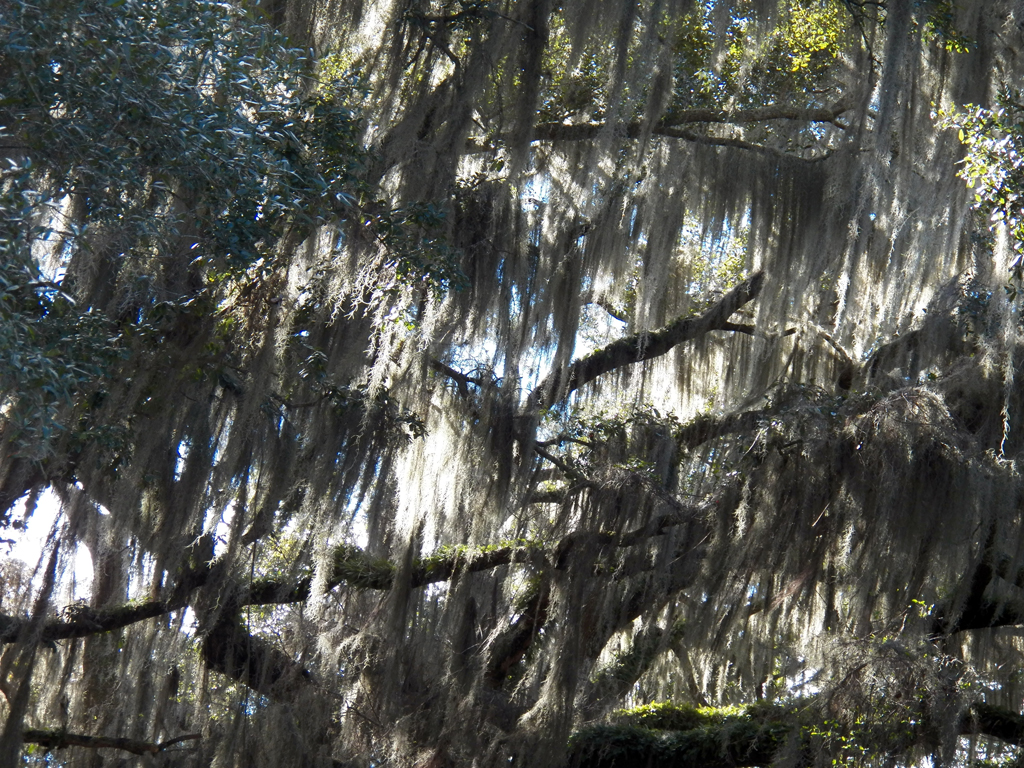
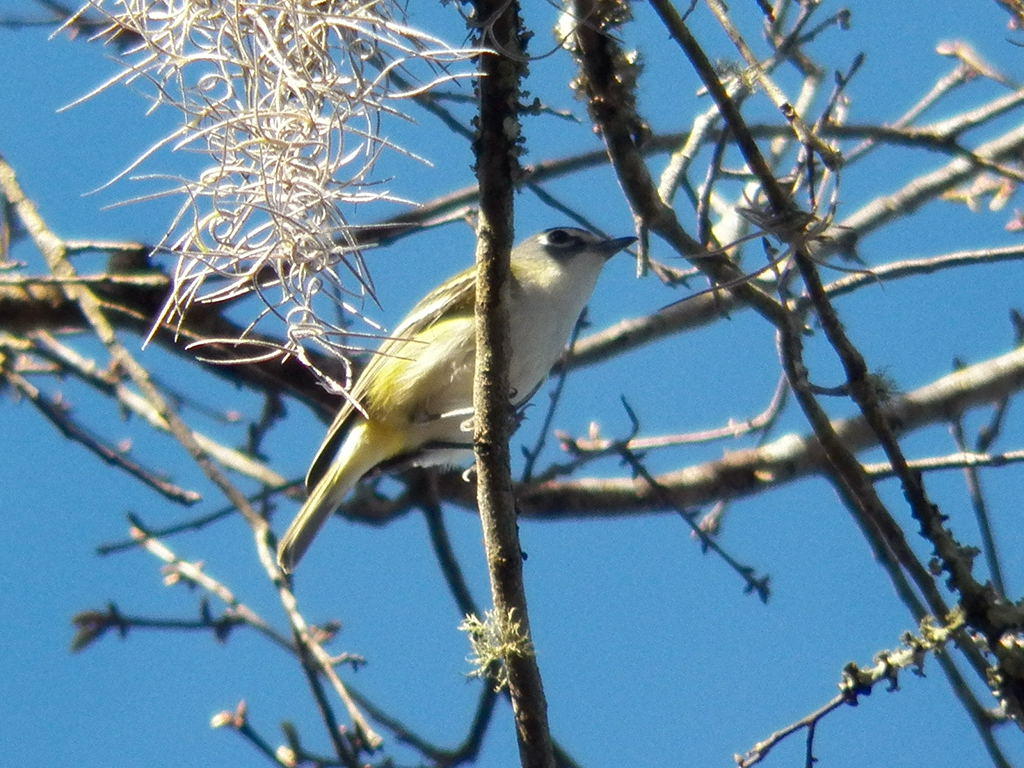
One of the few decent photographs I managed to take. I sometimes forget how exotic all this Spanish Moss must look like to people wholly unfamiliar with it. It’s really quite dramatic and ubiquitous here in Florida.
For me, personally, it was very gratifying to get my first verified Orange-crowned Warbler later in the day in a flooded area of young trees and brush near the North Shore Restoration Area.
Again, not so good for photographs, but we netted a great bunch of birds anyway.
Here’s my personal list of birds, in the order of the checklist provided on the field trip:
Black-bellied Whistling Duck
Gadwall (FOY)
American Wigeon
Mallard
Blue-winged Teal
Green-winged Teal (FOY)
Ring-necked Duck
Lesser Scaup
Common Goldeneye *
Hooded Merganser
Wild Turkey
Pied-billed Grebe
Wood Stork
Double-crested Cormorant
Anhinga
Great Blue Heron
Great Egret
Little Blue Heron
Cattle Egret
Green Heron
Black-crowned Night Heron
White Ibis
Glossy Ibis
White-faced Ibis *
Black Vulture
Turkey Vulture
Osprey
Bald Eagle
Northern Harrier
Sharp-shinned Hawk (FOY)
Cooper’s Hawk
Red-shouldered Hawk
Red-tailed Hawk
American Kestrel
Sora
Common Gallinule
American Coot
Sandhill Crane
Killdeer
Wilson’s Snipe
Laughing Gull
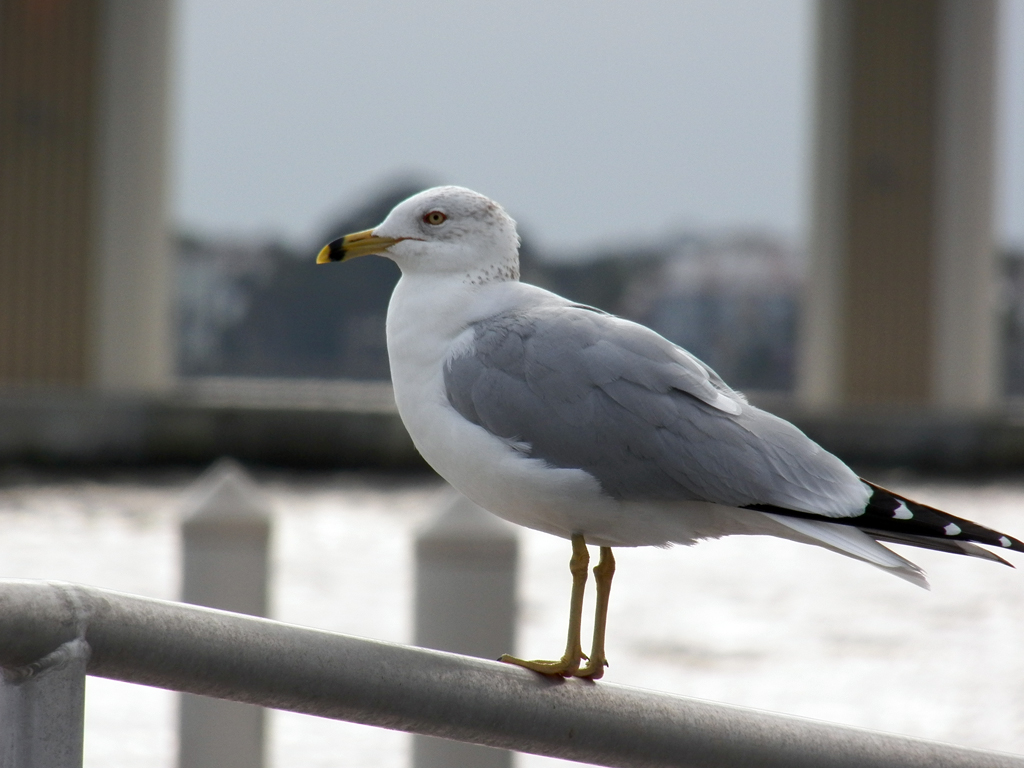
Ring-billed Gull
Mourning Dove
Common Ground Dove
Belted Kingfisher
Red-bellied Woodpecker
Eastern Phoebe
Loggerhead Shrike
White-eyed Vireo
Florida Scrub-Jay
American Crow
Fish Crow
Tree Swallow
Blue-gray Gnatcatcher
Ruby-crowned Kinglet
Eastern Bluebird
American Robin
Northern Mockingbird
European Starling
Black-and-white Warbler
Orange-crowned Warbler
Common Yellowthroat
Palm Warbler
Yellow-rumped Warbler
Savannah Sparrow
Northern Cardinal
Red-winged Blackbird
Common Grackle
Boat-tailed Grackle
After getting back to EFSC but before heading home, I once again tried to find the Long-tailed Duck near Parrish Park, but the winds were still really screaming (over 30mph) and there were very few birds out on the water.
My second day at the Space Coast Birding & Wildlife Festival started at the Salt Lake Wildlife Management Area. The weather forecast called for increasing winds in the afternoon, but the morning started off calm enough. The weather was seasonable, which was a good change from the record cold for last year’s festival.
On the lake shore at the start of the day we had some good views of American Coots, Common Gallinules and a couple of Purple Gallinules. The Purple Gallinues were very active, running across the lilly pads and other vegetation like mad chickens with huge floppy feet. I’d managed to miss this bird species all of last year, so it felt nice to see them and watch their antics.
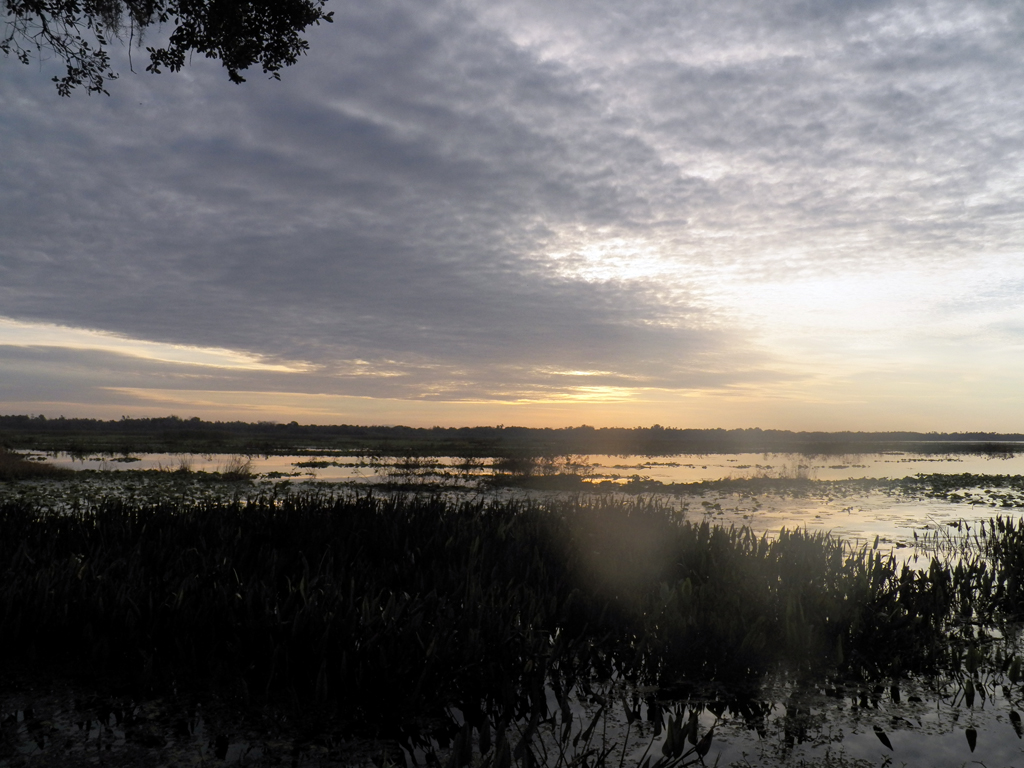
Sunrise at Salt Lake WMA .
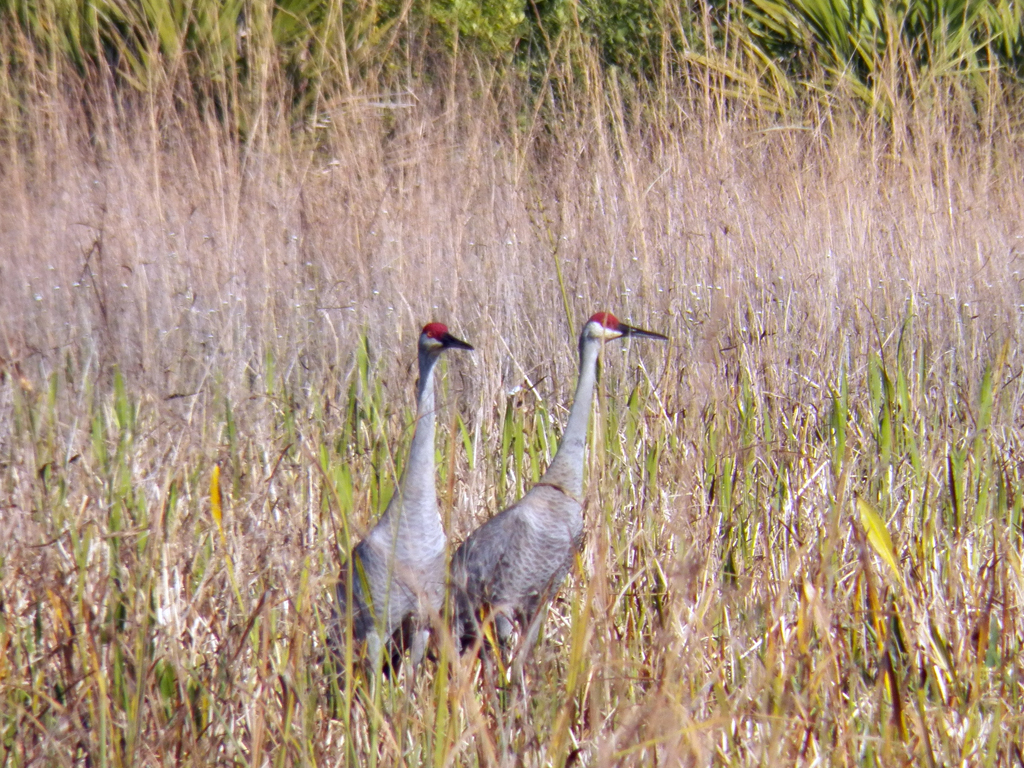
The winds did start to pick up, which likely affected our attempts to see any sparrows. We crossed into the Seminole Ranch Conservation area, where we did see a pair of Sandhill Cranes getting their nest started. As I’ve mentioned before, spring in Florida starts in February. Many resident birds are picking nest sites and gathering material. Some are already mating and will have eggs before too long. Some of the scrub vegetation have already begun to bud and leaf out, and more of that will happen in earnest before the end of February. There was also a female Bald Eagle sitting on a large nest, her head showing up bright white against the dark branches.
These cranes were getting their nest area started. One of our trip leaders said this is the first pair to do so in a long time in this part of the management area.
List of species seen at Salt Lake WMA (in order of the checklist):
Double-crested Cormorant
Great Blue Heron
Great Egret
Little Blue Heron
Tricolored Heron
White Ibis
Glossy Ibis
Black Vulture
Turkey Vulture
Blue-winged Teal
Bald Eagle
Cooper’s Hawk
Red-shouldered Hawk
American Kestrel
Purple Gallinule
Common Gallinule
American Coot
Sandhill Crane
Killdeer
Caspian Tern
Mourning Dove
Barred Owl (♫)
Red-bellied Woodpecker
Downy Woodpecker
Northern Flicker
Pileated Woodpecker
Eastern Phoebe
White-eyed Vireo (♫)
Tree Swallow
Carolina Wren (♫)
Blue-gray Gnatcatcher
Eastern Bluebird
American Robin
Gray Catbird (♫)
Yellow-rumped Warbler
Pine Warbler
Palm Warbler
Common Yellowthroat (♫)
Eastern Towhee (♫)
Northern Cardinal
Red-winged Blackbird
Boat-tailed Grackle
I’d like to take some space here to thank Kim and Billy Bump from Mississippi for sharing some conversation and birding knowledge with me. They were so friendly and sharing, which made the trip even more worthwhile. As a closet introvert, group outings use up a lot of my energy, but people like the Bumps help me recharge and stay positive.
Blackpoint Drive
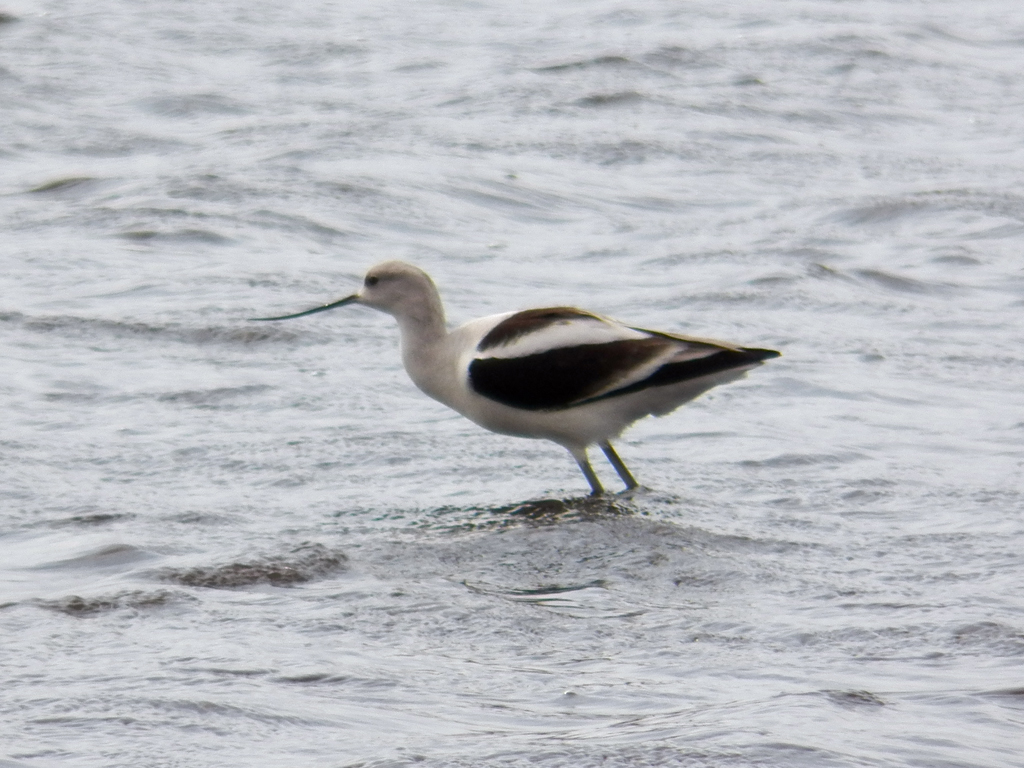
I used the break between the Salt Lake WMA trip to go to Blackpoint Drive on the Merritt Island National Wildlife Refuge (MINWR). I last visited there at the end of December when the ducks and shorebirds were still arriving for their winter quarters. The wind was starting to pick up and the first several viewing areas had almost no wildlife visible from the road. A bit further down on the left, a scattering of American Avocets were wading, belly deep, while sweeping their upturned bills through the water.
An American Avocet leaning into the wind.
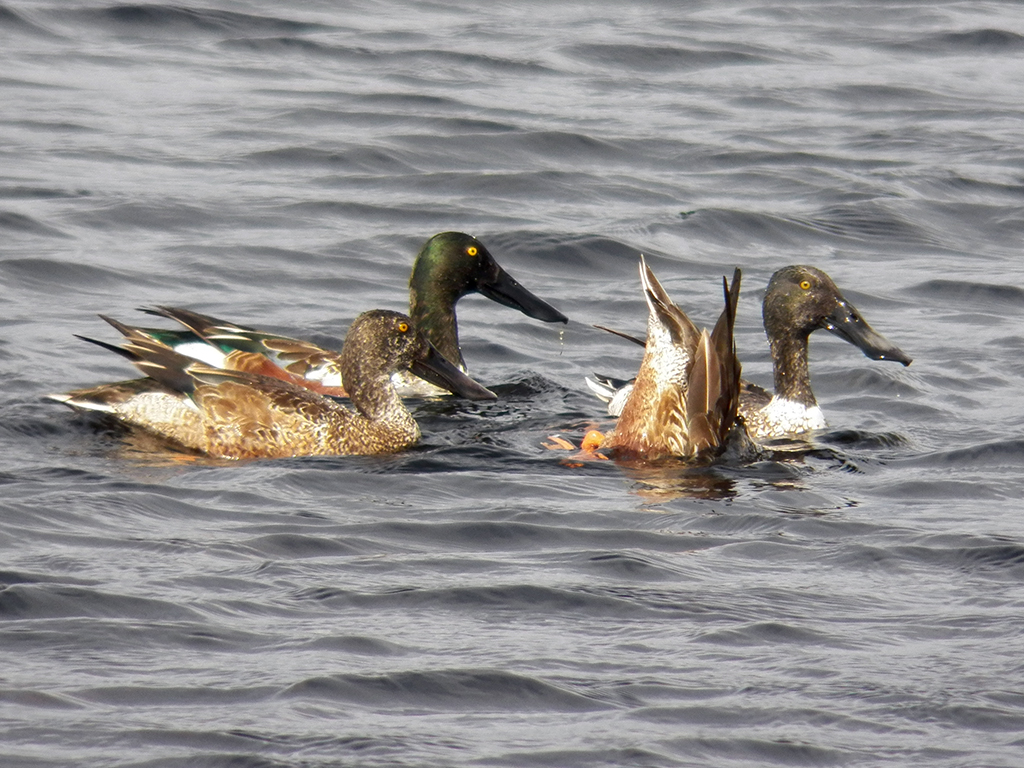
Beyond the areas the avocets were feeding in, on the right side of the road, larger groups of American Coots, various duck species and some other shorebirds were in higher numbers. The first group consisted of mostly coots and Northern Shovelers. The shovelers are usually in a wide array of plumage variations, depending on the age and gender of the duck.
Quite a positive group of ducks (3 up and 1 down).
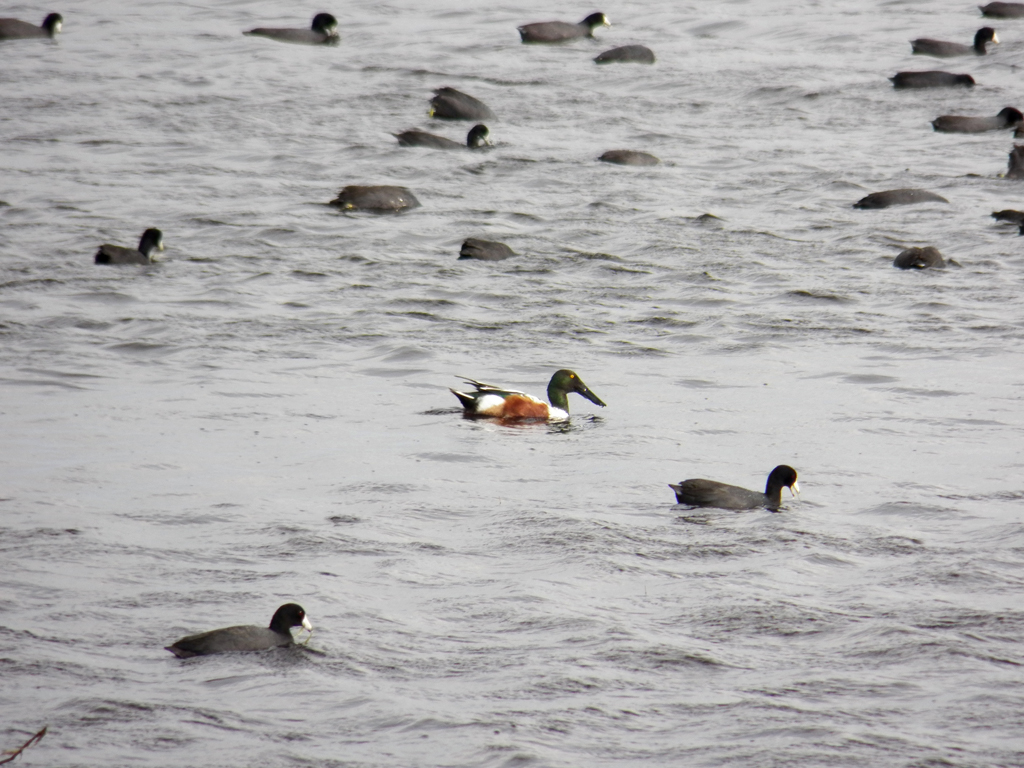
The next group of ducks were quite a distance across the water, but seemed to consist of some Ring-necked Ducks and Northern Pintails, trying to blend into the massive numbers of American Coots. In this loosely congregated raft of birds there was a solitary male Northern Shoveler trying to blend in.
Duck Witness Protection Program FAIL.
I exited Blackpoint Drive after passing a few more view points with distant ducks and shorebirds. Toward the exit is one area that usually has American Wigeons, and they were toward the far end. There had been reports of at least one American-Eurasian Wigeon hybrid, but even when a Northern Harrier flushed the birds out and closer to me, I could not see if any of those particular birds were hybrids. For viewing like this a spotting scope is probably the best tool of the trade, but any decent scope is well beyond my budget right now, but I was keenly aware of my 8×42’s limitations.
Intermission
After a quick stop by the MINWR’s visitors’ center to see if any Painted Buntings were at the feeders (no, too windy), I stopped at Parrish Park to try to find the Long-tailed Duck that has been all the talk on the birding e-mail lists. The wind at this point was really gusting, and the only birds at the park were some grounded Ring-billed Gulls and Ruddy Turnstones, staying out of the wind behind concrete walls at the boat ramp.
“Oh, the millionth birder looking for a Long-tailed Duck… how…*yawn* .. exciting….”
I spent some time after that hanging around at the Festival HQ and met up with Dave Goodwin at the Florida Ornithological Union booth. Dave’s a great guy and leads the Central Florida Specialities trip each year, and he was telling me about how great of a trip it was this year. I’m going to join the FOU this year and try to make it to their meetings and get some different perspectives on birding and ornithology. It’ll be quite a step for a Lonely Birder like me, but I’m going to give it a go.
Nocturnal Nature Hike at Enchanted Forest Sanctuary
When I saw there were two nighttime hikes at this year’s festival, I was very excited. The previoius night’s adventure had me anticipating more good things, especially since the second night hike was at the Enchanted Forest Sanctuary (EFS). The trip leaders were quite knowledgeable on the parks ecology and nighttime activities. We spotted and identified several animal tracks, including mice, rabbits, armadillos, tortoises and perhaps even an coyote! I learned that if you hold your flashlight in the right place, nearest your center of vision, you get eyeshine back from anything that has a tapetum lucidum, including spiders! You can see spider eyes glinting from over 50 feet away. I had heard of spider eye-shine before, but never how to see it properly.
We only had a brief audio encounter with an Eastern Screech Owl, but the highlight was the brief glimpse, through a night-vision camera, of a Southern Flying Squirrel! They are small and very quick, and the trip leaders said that in many places there is a higher density and population of flying squirrels than Gray Squirrels.
I saw a few other instances of eyeshine in the trees and brush, but nothing we could identify. Still, it was a beautiful night and seeing EFS at night was a real treat and a fitting end to a long but pleasant day of birding and nature.
The Space Coast Birding and Wildlife Festival kicked off on Wednesday, January 21st, but I didn’t have my first event until Thursday morning. There was a morning excursion to the Diceandra Scrub Sanctuary in Titusville. The main goal of this particular trip was to see the endangered Diceandra Mint (sometimes called the Titusville Mint) which is endemic to the sanctuary. Much of the focus of the trip was on scrub ecology and how it related to the plant’s presence there.
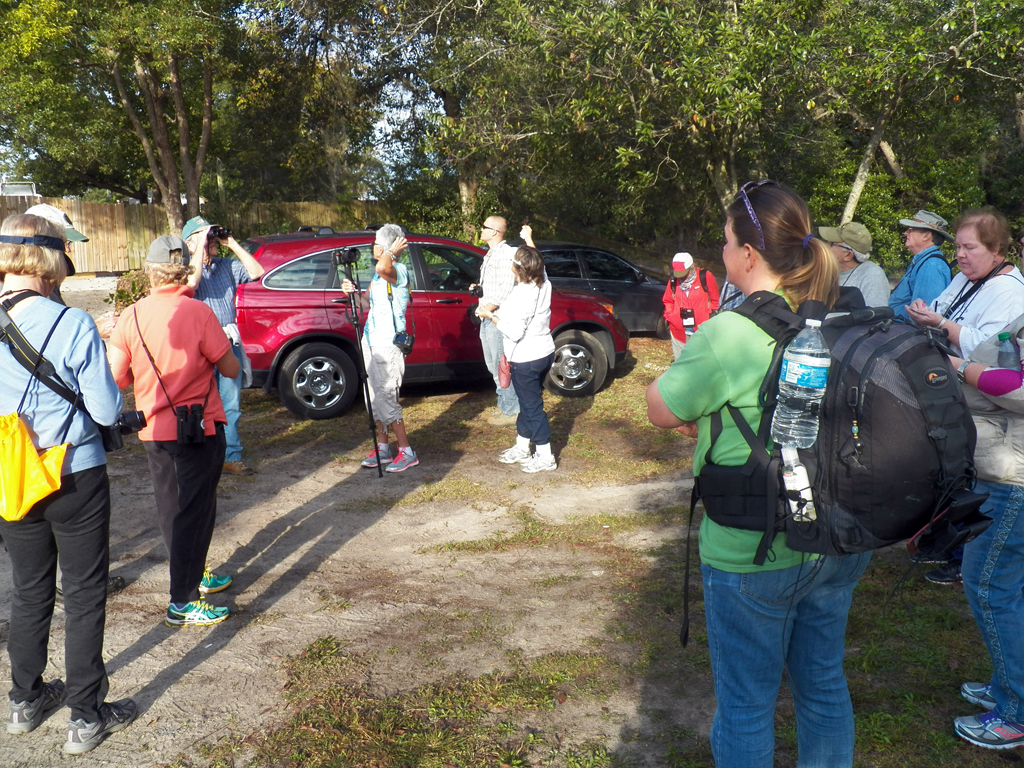
A flock of birders descend on Titusville.
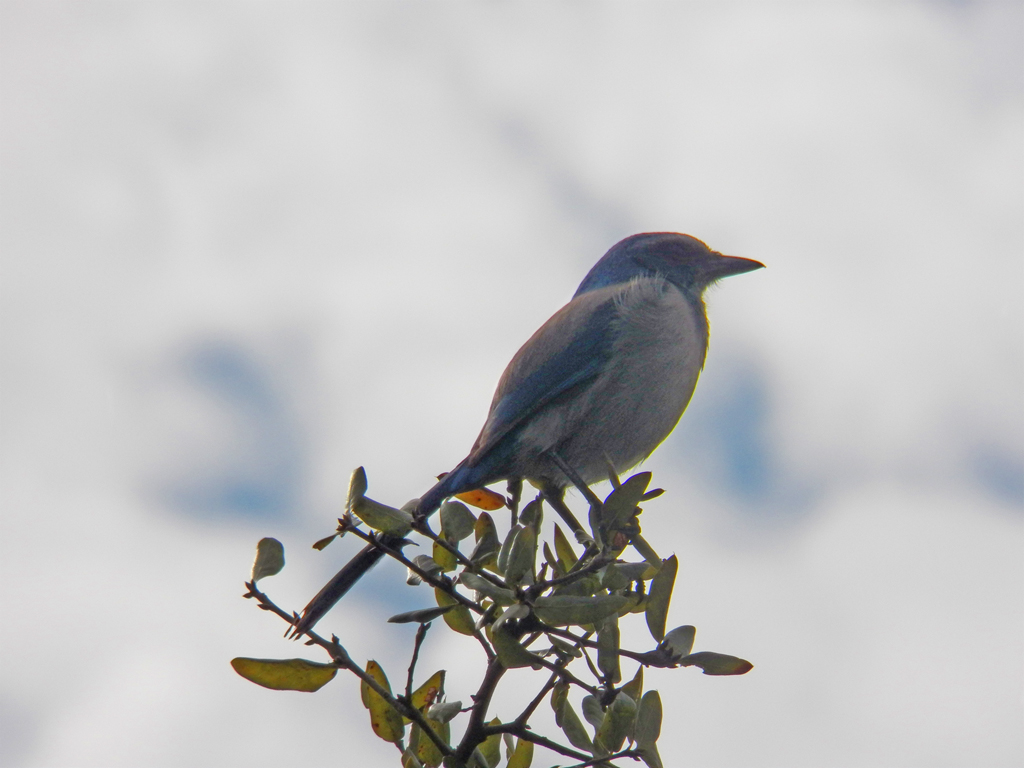
Now, don’t get me wrong. I appreciate ecology and biology in general. I’m an environmental geographer and conservationist, but I was there for the birds. Many were singing, and we got some decent views of the Florida Scrub Jays that live on the property. Unlike the jays at either Malabar Scrub Sanctuary or at the Cruickshank Sanctuary, these jays were wary and kept their distance.
This jay was acting as a sentinel as it’s family members foraged below. The jays insisted on being between us and the sun, making photography a challenge for me.
Our trip leader was very interested in the mushrooms and other fungi we saw, and stopped to explain the various types. I was surprised by how many wild mushrooms are edible, We didn’t come across any overtly poisonous ones, though.
Here’s the list of species identified on the property.
Eastern Towhee
Blue Jay
Red-shouldered Hawk
Carolina Wren {♫)
Northern Cardinal
Turkey Vulture
Eastern Phoebe
Fish Crow
Florida Scrub Jay
Gray Catbird
Palm Warbler
Red-bellied Woodpecker
Black Vulture
Common Grackle
White-eyed Vireo
American Robin
Common Ground Dove
Downy Woodpecker
Tufted Titmouse
After heading back to Festival HQ (at Eastern Florida State College – Titusville) for a quick lunch, I decided to take a walk to the park area behind campus. Chain of Lake Park consists of some artificial lakes (or large ponds, more accurately) with paths, boardwalks and footbridges around and through the park. On the adjacent fields between it and the EFSC campus were several dozen Killdeer and one medium flock of Ring-billed Gulls.
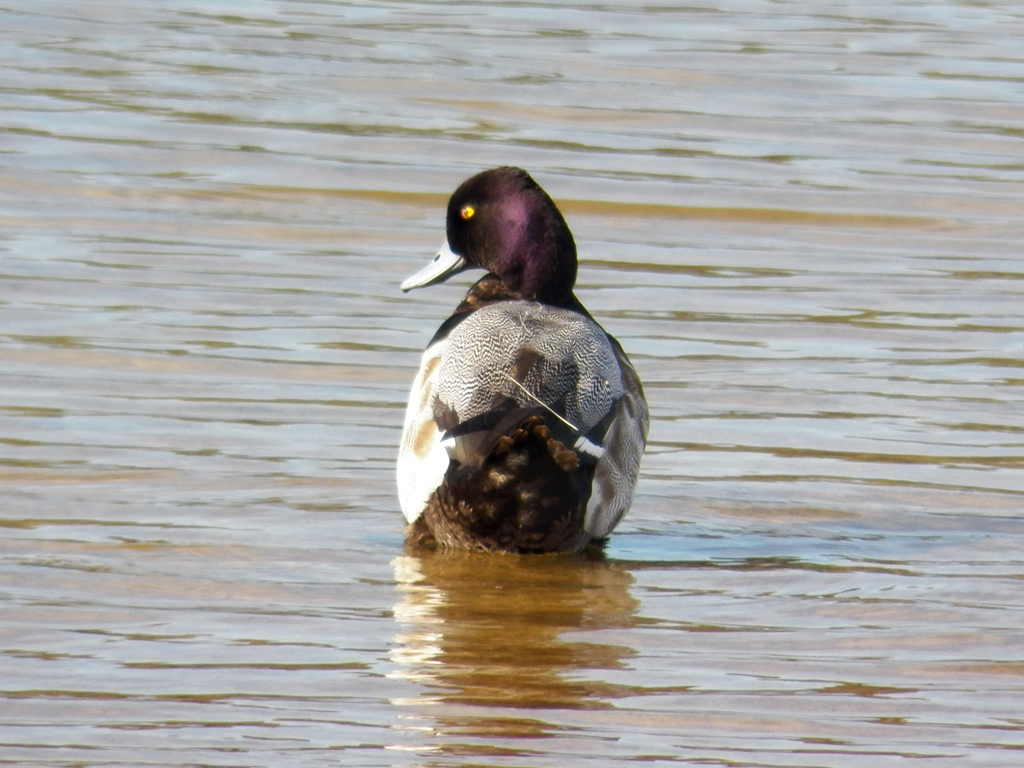
The variety of bird life was an unexpected pleasure for a suburban-type park. The ponds I walked around had Blue-winged Teals, Mottled Ducks, and even a Lesser Scaup. I flushed at least 3 Wilson’s Snipes from one side of the first pond I walked along.
This Lesser Scaup kept looking over his shoulder at me. It’s not paranoia if a birder really is taking photos of you, is it?
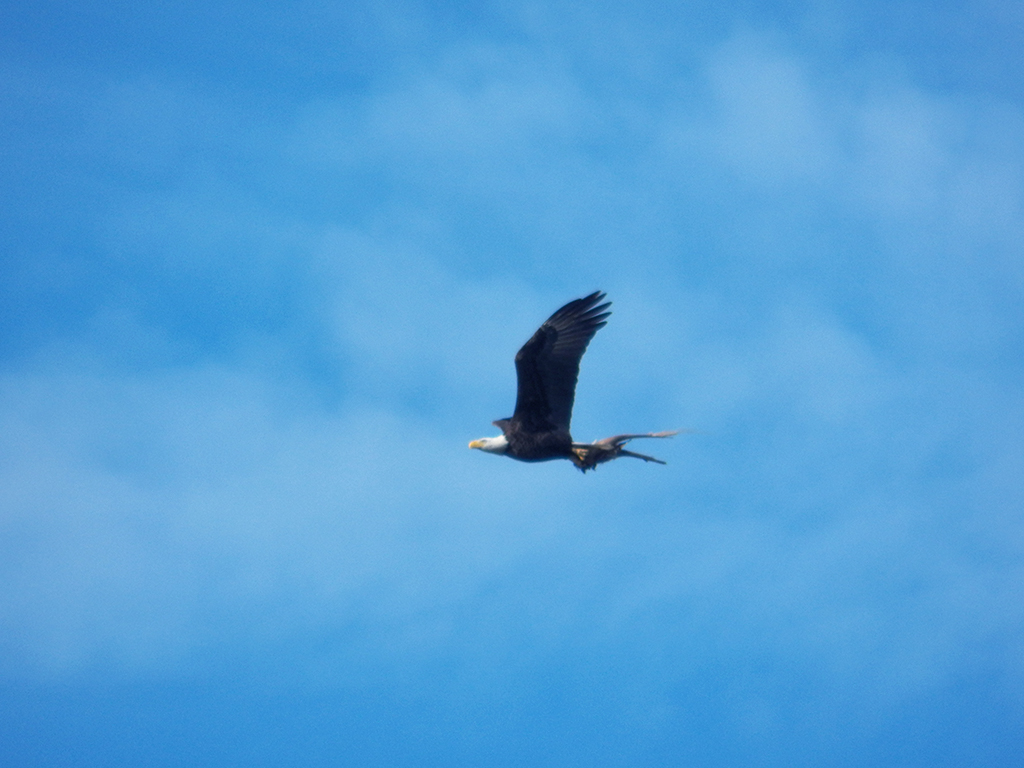
There is even a pair of nesting Bald Eagles nearby. I could hear them making their squeaky and giggly calls from the EFSC campus. They appear to be building up their nest in anticipation of some eggs and chicks later in the spring.
At first I thought this Eagle was bringing food for its mate, but upon closer look, it appears to be a clump or roots or driftwood for nesting material.
The list of bird species at Chain of Lakes Park:
Killdeer
Cattle Egret
Ring-billed Gull
Loggerhead Shrike
Wilson’s Snipe
Savannah Sparrow
Lesser Scaup
Bald Eagle
Red-shouldered Hawk
Red-winged Blackbird
Mottled Duck
Anhinga
American White Pelican
Fish Crow
Palm Warbler
Great Egret
American Robin
Eurasian Collared Dove
Black-and-white Warbler
Finally, on Thursday, I participated in a nocturnal nature hike at Fox Lake Park. I had such a good time last year at the Owl Prowl at Sams House at Pine Island Sanctuary that I immediately signed up for this field trip when I registered for the festival in November.
For this trip we were seated in a flat bed trailer (like what you might ride on in a hay-ride, minus the hay) and driven to a few places to try and call some owls.
First, the trip leader used a recorded Barred Owl call to attract an owl to our vicinity. It worked! A Barred Owl flew in only a few meters over out heads. They don’t seem very bothered by spotlights, so the trip leaders spotlit the bird while many of the people took photographs with their smart phones. I wasn’t expecting that any photos would come out, so I left my camera in the car. I really regret that, but I got some amazing unaided eye and binocular views of the owl. After a few minutes, it called out and got a response from another owl (probably its mate) and got to hear some pretty wild barking and whooping calls.
After they moved off into the distance, we went to the next location to try and call some Eastern Screech Owls. We did not get any responses; however, one of the Barred Owls (perhaps the same one as earlier) followed and watched us for a while. We tried another location, but the Barred Owl continued to join us. Owls are known to be pretty vicious with other owl species, so it’s likely the presence of the Barred Owl kept any Screech Owls from calling out or getting close to us.
It was a beautiful night in any case, and we did some star gazing along the way. Part of the park had been burned as part of a management effort to control the scrub vegetation, so a few places were a bit smoky, but that small annoyance was well worth putting up with for a great night hike.
After that, my first day at the festival wrapped up and I headed home to rest for the next morning.
The 2015 Space Coast Birding and Wildlife Festival is now over, and I had a wonderful, if exhausting, several days. The festival capped the event with the pelagic birding tour yesterday.
I’ll be updating the blog with each day’s adventures this week – it was just too hectic and busy to get anything posted during the festival. Stay tuned!
As you may have noticed, things are slow here at the Lonely Birder blog. With a couple of weeks of intense birding coming up, I’ve taken the past few weekends to spend time at home and rest up. At one point I mentioned how some of my birding mentors and friends seem to bird every day, versus my once per week adventures. Mrs. Lonely Birder quickly pointed out, “You do go birding every day.” This caused me some pause, and I realized, she is right.
Although Sunday mornings are usually my “official” birding hike for the week, any time I am out and about, I am watching birds and identifying what I see. On the ride to work I might see a dozen or so species, for example, along the main street between home and work. I drove to my parents’ today, which is mostly highway, and saw 15 while driving (there could have been more, but safety first!).
Fish Crow
Ring-billed Gull
Boat-tailed Grackle
Palm Warbler
Fish Crow
Red-tailed Hawk
Mourning Dove
Cattle Egret
Snowy Egret
Anhinga
Turkey Vulture
European Starling
Black Vulture
Osprey
Sandhill Crane
My point is that birding is not always a suburban safari or hours long hike. I know people who are content to watch birds in their yard from the kitchen window. Any time outside affords one the opportunity to see birds (or dragonflies, butterflies, and even lizards). You don’t need fancy equipment (although that can make it more fun!) or field guides (although that can make it easier). You just need eyes, ears and curiosity.
This past Sunday was my first birding-specific outing of the year, and I decided to check in on my old favorite haunt, Turkey Creek Sanctuary. The weather has been pretty mild, so I was hopeful for some good bird activity.
The past couple of years have really been a let-down for the Sanctuary. Birds seem to be utilizing the park less and less, and good activity is much more sporadic. I’ve seen a couple of reports via the BRDBRAIN and FLORIDABIRDS-L e-mail lists of some decent sightings there, but my morning was more typical of my other outings there.
One major change in the Sanctuary from two or three years ago is the relative dearth of Northern Cardinals. Regular and long-time readers will note my somewhat antagonistic love-hate relationship with these birds. They are beautiful to see and hear, but they had nearly overrun the Sanctuary. It had gotten to the point that their calls and songs were drowning out those of other birds I was trying to find and observe. Oh, how I wish for the good ol’ days! I saw a total of 2 and heard perhaps half a dozen cardinals for the entire morning.
What were plentiful were the American Robins and Blue-gray Gnatcatchers. Right upon entering the park and nearing the boardwalk, the first of what would be at least half a dozen overflights of a 10 or 15 American Robins flew overhead. American Robins are migratory; birds from the southern USA make their way to Florida and Mexico for the winter, while birds from further north move into the southern USA. The end result is a north-south shift of the the robins’ range, out of Canada, with a large section of the country having robins all year, though probably not the same robins. I never saw any robins in the park, just flying high over my head, en route to whatever winter roost they will use until they leave in the Spring.
I caught up to a small flock of gnatcatchers on the boardwalk and enjoyed watching them hop and flit about the tree-tops, singing out their wheezy little calls. I was also watching the group closely because often other small birds will associate with the gnatcatchers. Sure enough, a small group of Blue-headed Vireos was there in the same tree. Both the gnatcatchers and the vireos are quite active, but I managed to snap some photographs, clearly showing the Blue-headed Vireos’ diagnostic fieldmarks: white spectacles on a gray head, with yellow flanks and an olive-greenish tail.
This Blue-headed Vireo was palling around with some Blue-gray Gnatcatchers.
A breeze picked up by mid-morning, sending leaves and other debris swirling around the more open areas. By this time of year at the Turkey Creek Sanctuary the deciduous trees have dropped most of their leaves and the canopy is much more open, which makes observing any overflying birds (like the American Robins) easier. On this day I noted White Ibises, Black and Turkey vultures, a Double-crested Cormorant, and even a high-soaring Anhinga. A pair of Ospreys also went by, calling to each other as the wind swiftly carried them out of sight.
Some typical winter residents were also present, though in very low densities. I saw a single Yellow-throated Warbler, one Downy Woodpecker and two Ruby Crowned Kinglets. My very first visit to this park in 2002 coincided with a mass visitation of kinglets. There were literally hundreds of them throughout the park, hopping on the boardwalk railings and filling the adjacent trees with chittering notes.
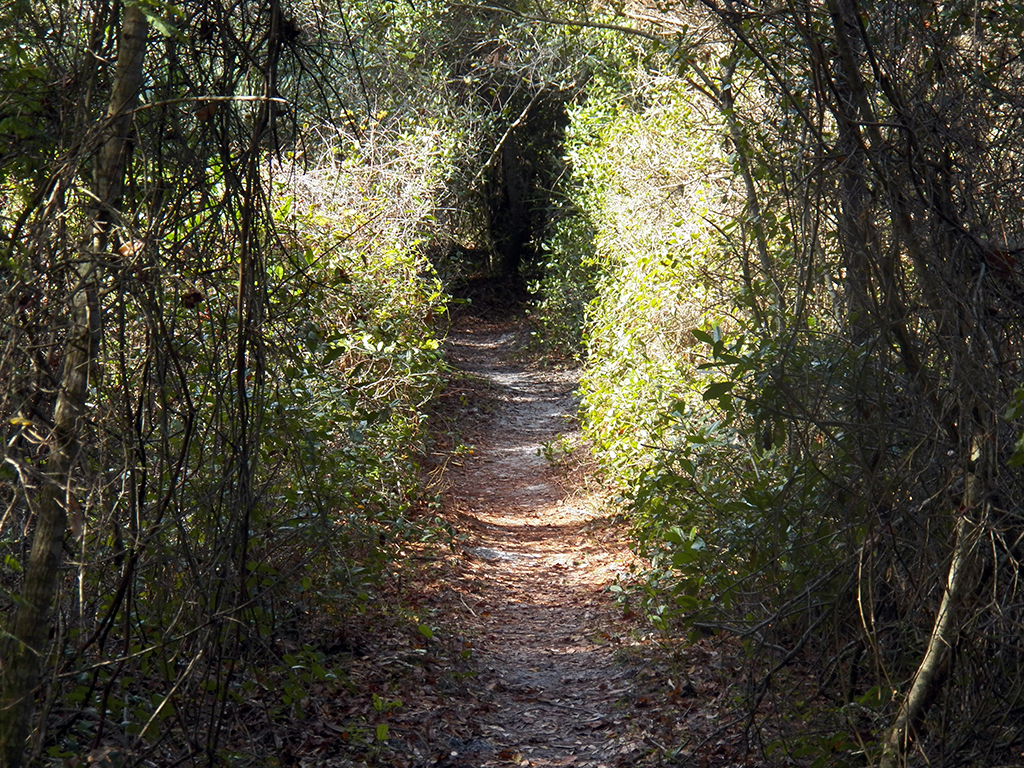
I took the opportunity this trip to walk the Scrub Trail. I tend to neglect this trail, mainly due to low bird activity, but it’s a nice loop off the trail leading to the jogging and exercise paths.
“A path! A path!”
As I returned back along the western and northern edge of the park toward to exit, I caught the song of a Yellow-throated Vireo over the fence-line. It sound like it came closer a few times, but I never did catch sight of it. I hung around for a while (getting a fire-ant bite on my finger for my troubles) before moving along and out.
Species seen by approximate order of identification:
Black Vulture
Ring-billed Gull
Rock Pigeon
White Ibis
American Robin
Northern Cardinal
Blue-gray Gnatcatcher
Blue-headed Vireo
Carolina Wren (♫)
Fish Crow
Turkey Vulture
Yellow-throated Warbler
Downy Woodpecker
Gray Catbird
Anhinga
Ruby-crowned Kinglet
Ovenbird
Palm Warbler
Blue Jay (♫)
Double-crested Cormorant
Yellow-throated Vireo
Osprey
Red-bellied Woodpecker (♫)
Happy New Year everyone, and here’s to another great year of birding!
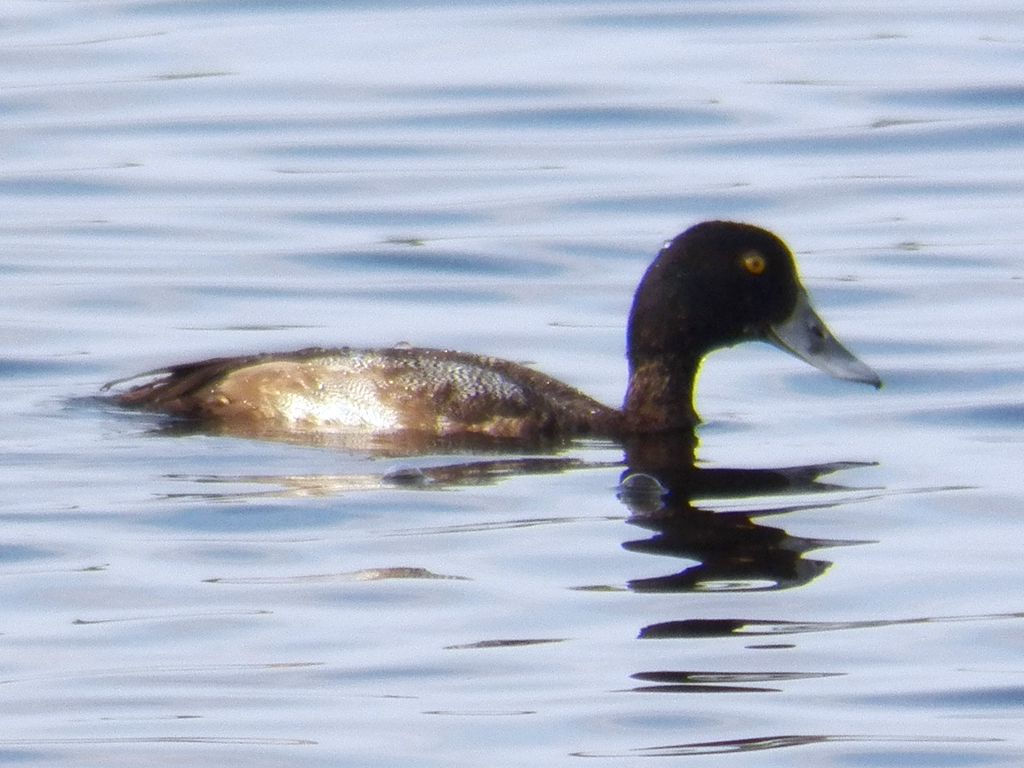
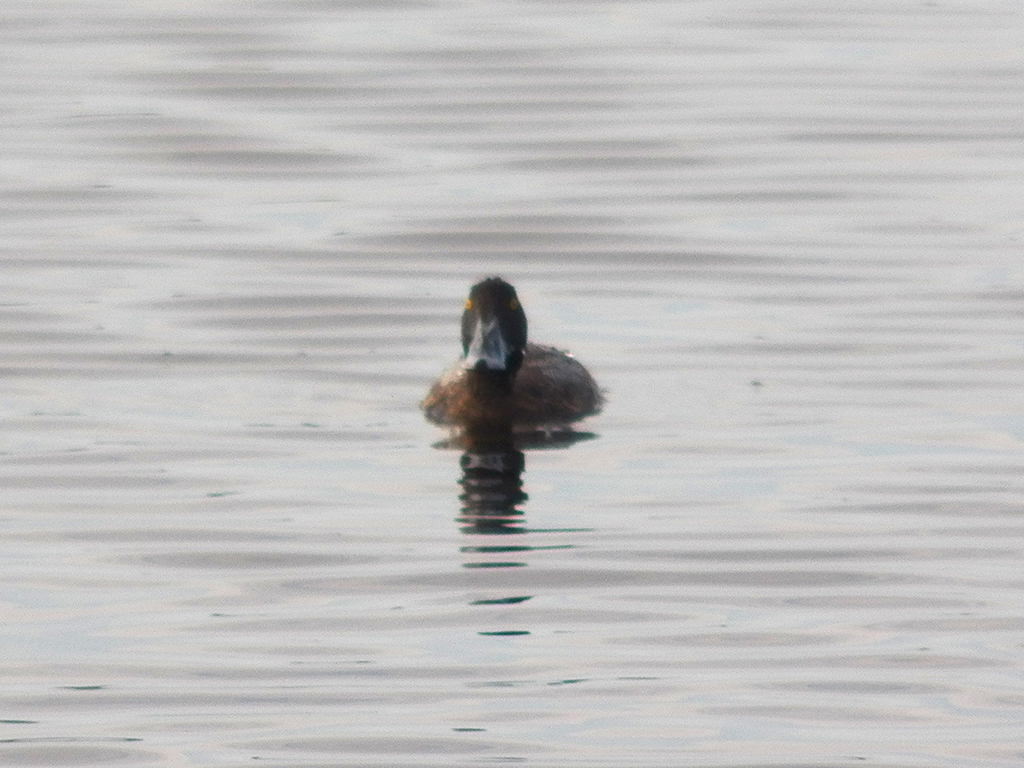
Two varieties of scaups frequent east-central Florida. Telling them apart can be a little challenging, especially if they are not seen together, but there are a couple of tips that might help.
Greater Scaups generally have flatter or rounder heads, compared to Lesser Scaups. Lesser Scaups often have a slight crest or point at the top of the head, behind the eye. Head color is sometimes mentioned as a way to tell them apart, and in the photos below you can certainly see how the Lesser Scaup has a redder head. My experience in the field, however, shows that sometimes the head colors are almost indistinguishable.
When seen from the front, Greater Scaups have a wider head bill and nail (the spot at the tip of the bill). The Lesser Scaups’ bills and nails tend to look “squished” sideways. The photo below and to the right isn’t exactly head-on, but you can see how the nail is almost completely round, while the nail on the Greater Scaup (on the left) is a bit wider than it is tall. There is certainly overlap, and viewing angle can complicate things, but at least it is another ID tool that might help with a positive identification.
Remember, not all birds can be positively identified every time. I have ambiguous bird sightings almost every time I’m out (birding or just doing errands). For example, more subtle point between these two species is the amount of white showing on the sides when these ducks are on the water. Normally, more white shows on the Greater Scaup, while less is evident on the Lesser Scaup. In the photos above, you can see more white on the Lesser Scaup. Trying to figure out what’s what is sometimes its own reward. The joy of birding is in the journey.




 Lonely Birder